How to Choose a Bed for a Small Bedroom
Quick answer: To choose a bed for a small bedroom, measure the room first, then pick the largest mattress that still leaves roughly 24 to 30 inches of clear floor on the sides you use and about 30 inches at the foot or the door swing. Favor a slim frame, a low-profile or wall-hung headboard, legs that show floor, and storage that earns its place. Skip anything that needs more clearance than the room can give.
How to choose a bed for a small bedroom comes down to one honest question: how much floor are you willing to give to sleeping? The bed is the biggest object in the room, and it decides how every other piece of furniture will fit, where the door opens, and whether you can walk to the closet without turning sideways. A bed that is one size too big can make a pleasant room feel like a cargo hold, while a well-chosen one can leave space for a desk, a reading chair or a dresser. This guide is a buying guide, not a product list. It covers how to measure, how to match mattress size to the room, frame types and their trade-offs, headboards, materials, storage, safety, three example rooms, a comparison table, a checklist and an FAQ. For the wider picture, start with our pillar on the best furniture for small apartments, and keep the small bedroom ideas hub open for styling. The companion post on furniture that makes small rooms feel bigger covers the rest of the room.
Start with the room, not the mattress
Most people begin with a mattress size they want and then try to make the room agree. Reverse that order. Measure the room at floor level and at the height of your headboard, because baseboards, radiators and sloped ceilings can change the real usable width by several inches. Write down the length and width, then mark every item that cannot move: the door and its swing, the window and its sill height, the closet doors, the radiator, vents and outlets.
Next, draw a rectangle on the floor with painter’s tape at the size of the mattress you are considering. Mattress dimensions vary a little between makers, so treat the numbers in this guide as typical ranges and confirm against the exact product before you buy. Leave the tape down for a day or two. Walk around it, open the door, open the closet, and sit on the edge as if you were putting on shoes. The tape test reveals pinch points that a tape measure does not.
Finally, decide who uses which side. A bed pushed into a corner needs only one access side, which saves a lot of floor, but it means the person against the wall climbs over the other. A bed with both sides open feels easier and calmer for two adults, though it costs about 24 inches of floor for each side. Be realistic about habits. If one person always gets up first, put that person on the open side.
Clearance rules that keep a small room usable
Clearance is the gap between the bed and the next object. Rules of thumb differ between designers, and a rental or a very small room often forces compromises, so use these as hedged targets, not laws.
- Main walkway beside the bed: around 24 to 30 inches on each side you use. Below 20 inches, making the bed and changing sheets becomes awkward.
- Foot of the bed to a wall or dresser: around 24 to 36 inches, depending on whether you walk through that gap every day.
- Door swing: keep the door’s full arc clear, or swap it for an outward swing or a sliding option only if the lease allows changes. Do not let the bed block the door from opening fully.
- Dresser drawer pull: a drawer needs roughly its own depth plus 20 to 24 inches to stand and reach. If the gap is smaller, choose a taller, narrower chest or put clothes under the bed.
- Closet access: leave at least 24 inches in front of a swing door, or 12 to 18 inches in front of a sliding or bifold door if you only reach in and do not stand inside.
- Window: avoid placing the head of the bed under a window that opens inward, and keep radiators and heating vents uncovered by bedding or the frame.
If the room cannot give these numbers, the answer is almost always a smaller mattress, a platform frame without a footboard, or a bed that stores vertically, not a tighter squeeze.
Mattress sizes and what they mean for a small room
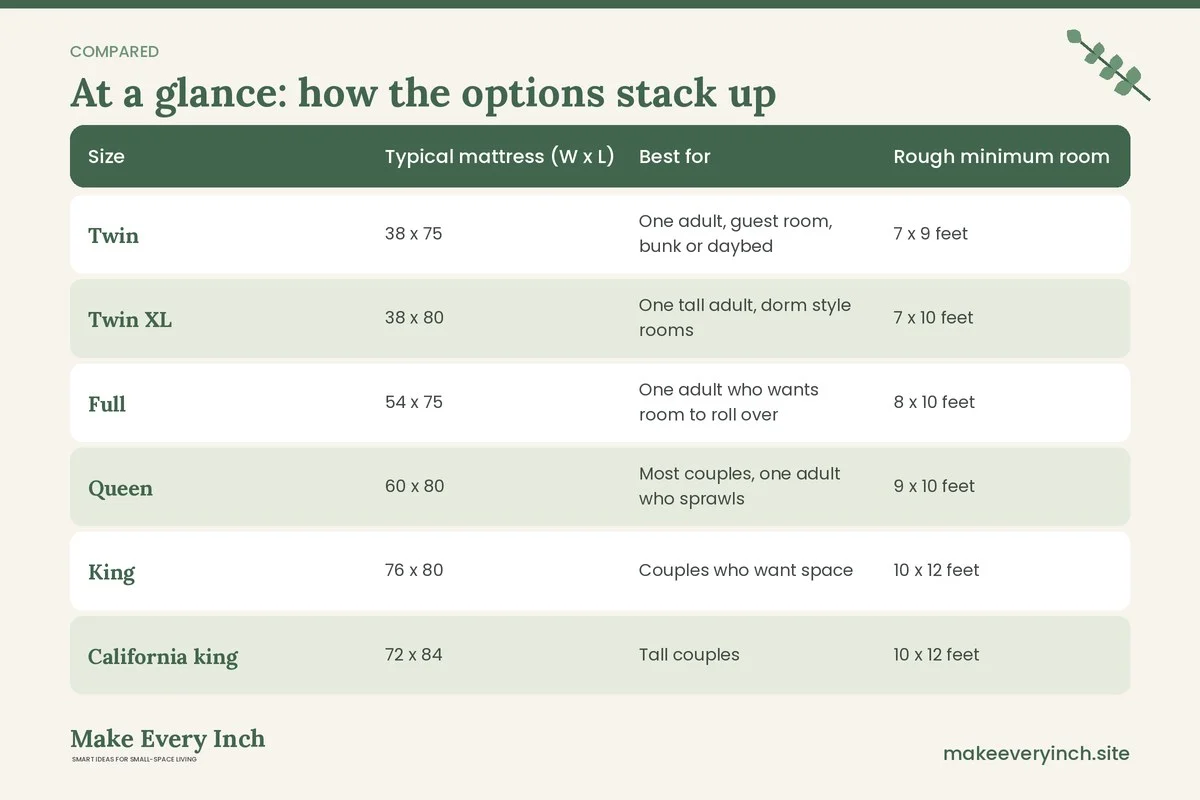
The table below lists typical mattress footprints in inches. These are approximate, and frames add several inches on every side. Use the last column as a rough guide to the smallest room that is likely to work, assuming a door and a closet in the usual places. Real rooms differ.
| Size | Typical mattress (W x L) | Best for | Rough minimum room | Trade-off |
|---|---|---|---|---|
| Twin | 38 x 75 | One adult, guest room, bunk or daybed | 7 x 9 feet | Short and narrow for tall sleepers |
| Twin XL | 38 x 80 | One tall adult, dorm style rooms | 7 x 10 feet | Specialty sheets can be harder to find |
| Full | 54 x 75 | One adult who wants room to roll over | 8 x 10 feet | Tight for two adults |
| Queen | 60 x 80 | Most couples, one adult who sprawls | 9 x 10 feet | Leaves little floor in a room under 10 x 10 |
| King | 76 x 80 | Couples who want space | 10 x 12 feet | Often dominates a small room |
| California king | 72 x 84 | Tall couples | 10 x 12 feet | Longer, so it eats walkway at the foot |
A queen is the most common choice for couples, and it can work in a room of about 9 by 10 feet if you accept a narrow path, a wall-hung or very slim headboard and a small night table. Our post on small bedroom ideas with a queen bed shows layouts. A full is a sensible middle size for one adult who wants more than a twin but cannot spare a queen’s width. A twin or twin XL works well for a single sleeper and frees a surprising amount of floor, and it can double as a sofa when pushed against a wall with bolsters.
Choose the frame type to match your habits
The frame decides height, storage, how the bed looks and how much floor it actually uses. These are the main types and what to weigh for each.
Platform bed
A platform bed has a solid or slatted surface that supports the mattress without a box spring. It is usually low and has a clean edge, which makes a small room feel calmer. Check that the slats are close enough together for your mattress type, since some mattresses need a firm, closely spaced base. A platform with a hidden drawer or two can hold bedding, but drawers need pull-out clearance at the side or foot, so check that gap in your plan.
Frame with legs
A bed on legs shows floor underneath, which creates an airy feel and lets you slide flat bins under the frame. It also lets light and air pass, so dust is easier to reach and clean. Leg height matters. Roughly 8 to 12 inches of clearance fits many shallow storage bins, while 6 inches or less suits a low, modern look but wastes the space for storage. Our guide to under-bed storage ideas covers bin sizes and dividers.
Storage bed with drawers or a lift
A storage bed turns the space under the mattress into a wardrobe. Drawer beds need pull-out clearance, and lift-up beds raise the whole mattress on a gas lift, so check the weight of the mattress and the headroom above the bed. If you have low ceilings or a shelf above the bed, a lift mechanism may not open fully. Read our best beds with storage guide for features to compare.
Daybed or sofa bed
A daybed acts as a sofa by day and a bed at night, which suits a guest room, a home office or a studio. It usually needs a firm back or bolsters to feel like seating. A sofa bed folds out, so it must have a floor clearance for the full length when open. Folding mechanisms can pinch fingers and hands, so keep children away from the hinge area and operate them slowly.
Murphy or wall bed
A wall bed folds up and hides, freeing most of the floor during the day. It is a serious piece of furniture. It must be anchored to wall studs or structural framing according to the maker’s instructions, and a wrong installation can fail under the weight of the mattress and frame. In a rental, do not drill or install one without written permission from the landlord, and consider having a professional do the mounting. Read our studio apartment ideas with a Murphy bed before you decide.
Loft or bunk
A loft bed lifts the sleeping platform and leaves the floor below for a desk, a sofa or a wardrobe. It suits rooms with ceilings of about 8 feet or higher, but remember that sitting up in bed needs head clearance. Many people find roughly 30 to 36 inches of space above the mattress comfortable, and less can feel cramped. Choose a model with proper guard rails and a sturdy ladder, and follow the load limit. Loft and bunk beds are generally not recommended for young children, so check the maker’s age guidance.
Headboards, footboards and depth
Headboards add depth, and depth is what a small room lacks. A thick upholstered headboard can add 4 to 8 inches to the length of the bed, which can be the difference between a clear path and a pinched one. A few options save floor.
- A wall-hung or slim panel headboard: a thin board mounted to the wall adds almost no depth. Check the load limit and stud locations for any wall mounting, and ask your landlord before you drill. In a rental, a freestanding panel that leans against the wall avoids holes.
- A headboard that doubles as storage: a shelf headboard holds a book, a glass and a phone. Make sure it is stable, and avoid putting heavy or breakable items high above a sleeping head.
- No headboard, with paint or fabric on the wall: a painted arch or a hung textile behind the bed gives the look of one without taking depth. Use low-VOC paint, ventilate the room while it dries and ask permission before painting a rental.
- No footboard: a footboard adds up to 4 inches and blocks the sight line along the floor. A low platform with a bare foot looks longer and feels lighter.
Materials and finishes that help a small room
Material changes how heavy a bed looks. A dark, bulky solid frame can dominate a small room, while a light wood, a painted metal or a slim upholstered frame looks smaller. Visible legs and open slats make a bed feel lighter than a closed base. Some points to weigh follow.
- Solid wood: sturdy and long-lived, often heavy to move. Good if you plan to stay put.
- Metal: slim profiles and open shapes, which suit tight rooms. Check the welds and bolts, and tighten them occasionally.
- Upholstered: soft and quiet, with a comfortable headboard, but fabric collects dust and can be harder to clean. Look for removable covers.
- Engineered wood: lighter and usually less expensive, with variable quality. Look for a solid center support and a stated weight limit.
- Finish: a light or mid-tone finish reflects more light than a very dark one. Low-VOC finishes are a good idea in a closed room. Let a new frame air out in a ventilated space before you sleep in the room.
Compare the main frame types
| Frame type | Floor used | Storage | Best room | Watch out for |
|---|---|---|---|---|
| Slim platform with legs | Footprint of the mattress plus a few inches | Bins underneath | Rooms where walkway matters | Slat spacing and mattress match |
| Drawer platform | Footprint plus drawer pull-out | Drawers in the base | Rooms without a closet | Clearance to open drawers |
| Lift storage bed | Footprint only | Large hidden compartment | Rooms with high ceilings | Headroom and mattress weight |
| Daybed | Smaller than a full bed | Sometimes a trundle | Guest rooms and offices | Comfort as a sofa |
| Wall bed | Almost none by day | Built-in cabinetry | Studios and multi-use rooms | Wall anchoring and lease rules |
| Loft bed | Footprint above the floor | Space below | Rooms with 8 foot ceilings | Head clearance and ladder safety |
Choose storage that earns its place
Storage in a bed frame is useful only if you will use it. Think about what you actually need to store. Out-of-season clothing, spare bedding and shoes suit under-bed bins, while daily clothes belong in a dresser or closet. If you add drawers under the bed, you give up the open floor effect, so decide which matters more. Flat containers on wheels slide out without a drawer track, which saves cost and weight, though the dust is easier to reach than the dust inside a closed drawer.
Look at the wider storage plan too. Our posts on small bedroom storage ideas and small bedroom storage ideas that save floor space show how to pair a bed with a tall, narrow chest and wall-mounted shelves. When shelves hang above a bed, check the load limit, anchor into studs where the instructions require, and avoid placing heavy objects directly over the sleeping area. Never drill into a wall in a rental without permission.
Three example rooms
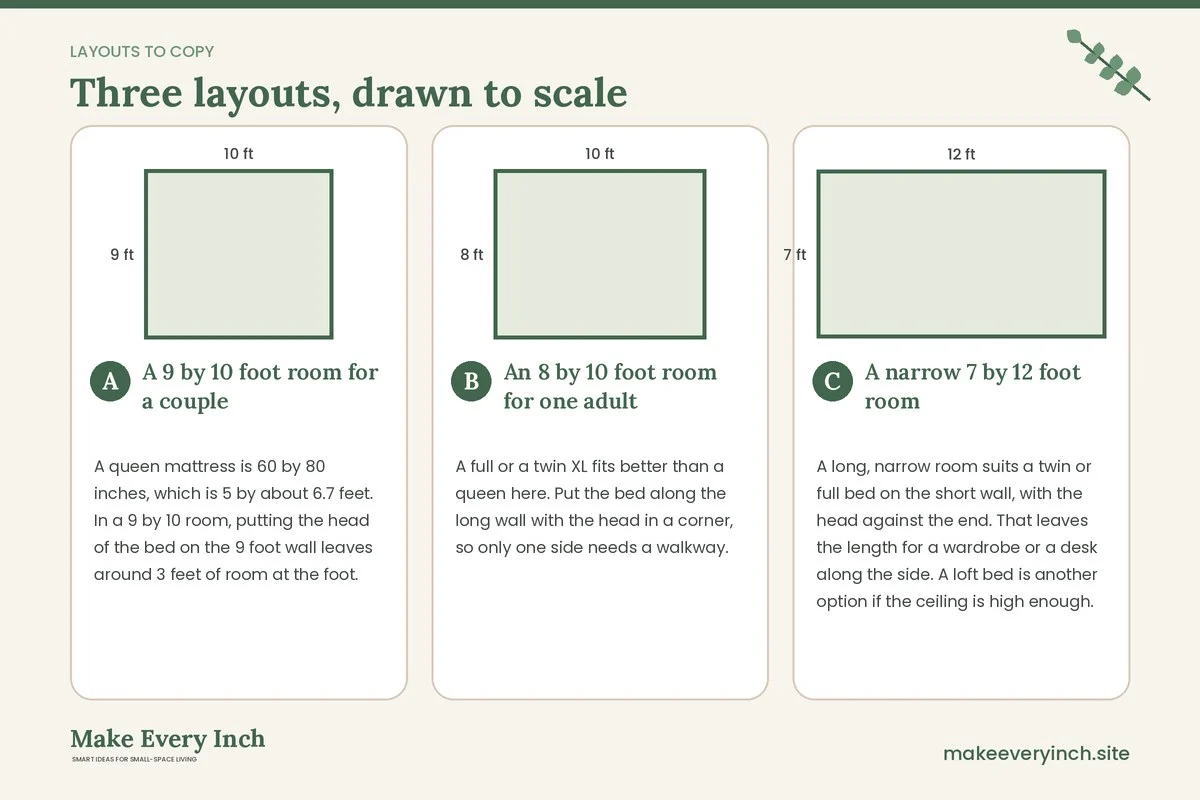
A 9 by 10 foot room for a couple
A queen mattress is 60 by 80 inches, which is 5 by about 6.7 feet. In a 9 by 10 room, putting the head of the bed on the 9 foot wall leaves around 3 feet of room at the foot. Choose a slim platform frame with legs, skip the footboard and use a wall-hung or panel headboard to save depth. Add a narrow wall-mounted shelf or a 12 inch deep night table on each side. The side gap is roughly 1.5 feet each, which is tight but workable if the door is on the foot wall. This room does not have space for a dresser, so choose a bed with drawers or use tall hanging storage on the closet wall.
An 8 by 10 foot room for one adult
A full or a twin XL fits better than a queen here. Put the bed along the long wall with the head in a corner, so only one side needs a walkway. That leaves a path of about 30 inches on the open side and room for a 20 inch deep desk or dresser at the foot. A daybed style frame with a back and bolsters lets the bed read as a sofa in a small home office. If you choose a bed with a trundle, check that there is room to pull it out.
A narrow 7 by 12 foot room
A long, narrow room suits a twin or full bed on the short wall, with the head against the end. That leaves the length for a wardrobe or a desk along the side. A loft bed is another option if the ceiling is high enough. Place the lofted bed over a built-in desk or a wardrobe, and anchor it as described in the instructions. Keep a light-colored wall at the foot so the room feels longer.
Lighting, bedding and the small details
A bed also shapes how the room feels at night. A wall sconce or a clip-on reading light frees the night table. Plug-in sconces avoid hardwiring, which is useful in a rental. Keep cords tidy and away from the bed frame and mattress edge. Choose a bedspread that does not hang to the floor if you want to show under-bed storage, and a bedskirt only if it does not hide the view of the legs. A neutral bedding palette keeps the visual weight of a large mattress low. Our small bedroom lighting ideas post covers options.
Safety notes
- Anchor tall pieces. A tall chest or bookcase near the bed should be anchored to a stud or according to the maker’s instructions, since tipping furniture is a recognized hazard, especially for children.
- Respect weight limits. Wall beds, loft beds and wall shelves list load limits. Do not exceed them, and remember that two adults plus a mattress can be a lot of weight.
- Mind the pinch points. Folding beds, sofa beds and lift mechanisms can trap fingers. Keep children and pets clear when moving them.
- Check the lease. Many leases forbid drilling or installing a wall bed. Get permission in writing before you make holes, and use freestanding options if you cannot.
- Keep heat sources clear. Do not block radiators, heaters or vents with the frame or bedding.
- Allow fresh finishes to air. New frames, mattresses and paint can have a smell. Ventilate until it fades.
Buying checklist
- Measure the room, the door swing and the closet.
- Tape the mattress size on the floor and live with it for a day.
- Plan 24 to 30 inches on each access side where you can.
- Pick the largest mattress that keeps the main walkway clear.
- Choose a frame with a slim profile, and visible legs if you want an airy look.
- Skip the footboard, and keep the headboard shallow.
- Decide whether you want drawers, bins or open floor.
- Check the frame’s weight limit, slat spacing and mattress compatibility.
- Confirm that the bed passes through the stairwell, the elevator and the bedroom door.
- Check delivery size and assembly space.
- Ask the landlord before you anchor or mount anything.
- Leave a plan for the old bed and mattress.
FAQ
What is the best bed size for a small bedroom?
It depends on who sleeps in it and how big the room is. A full or a queen is common for rooms near 9 by 10 feet, while a twin or twin XL works in smaller rooms. Measure first, since your door and closet often decide the answer more than the floor area.
Can I fit a queen bed in a 10 by 10 room?
Usually yes, with around 3 feet of walkway at the foot and 2 feet at one or both sides. You will have little floor left for a dresser, so plan wall storage or a bed with drawers.
Is a platform bed better than a box spring in a small room?
A platform often has a lower, cleaner profile and needs no separate base, which helps in a room with low ceilings. A traditional frame with a box spring can be taller. Check what your mattress maker recommends.
Should I choose a bed with drawers?
Drawers help when you lack a closet, but they need pull-out room. If the floor around the bed is too tight, bins under a frame with legs are often easier to use.
How high should the bed be?
A top-of-mattress height of roughly 20 to 25 inches is comfortable for many adults to sit down on and stand up from. Taller frames give more storage room, and lower ones make a ceiling look higher.
Is a Murphy bed worth it?
It can be a great choice in a studio or a multi-use room, because it frees the floor during the day. It needs careful installation, and a rental needs written permission first.
Does a headboard matter for space?
Yes, because a thick one adds depth. A thin panel, a wall-hung board or a painted wall shape saves several inches.
Keep going: Keep planning with our guide to the best furniture for small apartments, our small bedroom layout ideas and the roundup of small bedroom furniture ideas.
Save this guide for later
Pin the ideas you like to Pinterest so you can come back to them when you plan your space.