21 Playful Maximalist Apartment Ideas That Don’t Feel Cluttered
Quick answer: The best playful maximalist apartment ideas layer a limited color family, mix patterns by scale, group collections in tight clusters and give every object a home. Maximalism is edited abundance, not clutter. Keep clear floor space and one calm surface per area, dust regularly and rotate what you display.
Playful maximalist apartment ideas start from a simple truth: more is only a problem when it has no order. A room full of color, art and objects can feel joyful and personal when it follows a few rules, and it can feel exhausting when it does not. Small apartments are actually a good place to try the style, since a compact room is easy to wrap in a single bold idea. This guide covers what separates maximalism from clutter, 21 ideas, a comparison table, three example apartments, a step-by-step editing method, cleaning realities, budget tiers, mistakes, a checklist and an FAQ. If you want the opposite approach, see our minimalist apartment ideas, and if you like a looser, plant-filled mix, read our boho apartment ideas.
Maximalism is not clutter
Clutter is stuff with no job and no place. Maximalism is a deliberate choice to surround yourself with things you love, arranged so the eye knows where to rest. The difference shows up in a few habits. Maximalist rooms repeat colors so objects feel related. They group items into collections instead of scattering them. They keep walkways clear, and they have a few calm moments, such as one plain sofa or one empty shelf, that let the busy parts stand out.
A useful test is to ask three questions about each object. Do I love it, does it use or display well, and does it have a spot where it looks intended? If the answer to any is no, it is probably clutter. The playful part comes from humor and surprise: a striped ceiling, a pink door, a cabinet of toy robots or a rug in a clashing pattern that somehow works.
Check the lease and set limits first
Before painting a wall or hanging a gallery, read the lease and photograph every wall, floor and fixture. Many landlords ban paint and nails, so plan for removable and leaning solutions. Then set limits that protect the room: keep at least 30 inches of clear walkway, leave the area in front of the door and window open and decide on a maximum of three or four colors plus neutrals. Limits sound unplayful, but they are what make the abundance readable.
21 playful maximalist apartment ideas
Color layering
1. Choose a color family, not a single color
Pick three or four related colors, such as pink, red, orange and tan, or blue, green, teal and mustard. Spread them across walls, rugs, art and textiles so each color shows up at least three times. That repetition is the thread that holds a busy room together.
2. Paint or cover one bold wall
A deep green, terracotta or cobalt wall creates a backdrop for art and furniture. If painting is not allowed, use peel-and-stick wallpaper on one wall, or hang a large piece of fabric on a tension rod. Test a small patch first, and see our removable wallpaper ideas.
3. Use a color-blocked or painted ceiling effect
A colorful ceiling is playful, but in a rental you can mimic it with a canopy of fabric or a line of paper lanterns. In an owned or permitted space, a lighter shade than the walls keeps the ceiling from feeling heavy. Avoid very dark colors in rooms under 8 feet high.
4. Add a neutral anchor
Every maximalist room needs a quiet piece, such as a white or oatmeal sofa, a plain wood table or a cream rug. The neutral anchor gives your eye a place to rest, and it makes the color around it look brighter.
5. Echo accent colors in small items
Put a color from the rug in a lampshade, a bowl and a book spine. Small echoes cost very little and connect objects across the room.
Pattern mixing
6. Mix patterns by scale
Use one large pattern, one medium and one small, such as a big floral curtain, a medium stripe on a cushion and a small check on a throw. Different scales read as layered rather than chaotic, and they allow many patterns to sit together.
7. Share a color across every pattern
If each pattern contains at least one shared color, they almost always look related. Pull the shared color from the largest item, such as the rug, and look for it in everything else. Hold a swatch or a photograph beside the item before you buy.
8. Pair organic and geometric patterns
Combine something curved, such as florals or paisley, with something straight, such as stripes, plaid or checks. The contrast gives the room energy, and it avoids the sugary look of too many florals.
9. Use solid fabrics as breathers
Between patterned items, place a solid cushion, a solid throw or a plain lamp. Breathers are the maximalist equivalent of punctuation, and they let the patterned items stand out.
Walls and collections
10. Build a salon-style gallery wall
Mix frames, sizes and subjects, but keep a consistent gap of about 2 inches and align the group around a center point. Start with the largest piece, and build outward. Adhesive strips rated for each frame work in many rentals, and leaning frames on a ledge avoids marks. See our renter-friendly wall decor ideas.
11. Group collections in tight clusters
Ten small vases look like clutter when scattered and like a collection when grouped on one shelf. Cluster similar objects by color, material or theme, and give the group a tray, a shelf or a cabinet. Odd numbers, such as three, five or seven, are easier to arrange.
12. Display collections in a glass cabinet or a shelf
A glass-front cabinet keeps dust off and makes a collection look curated. A secondhand display case or a bookcase with a door works well. Edit the collection once a year, and keep only the pieces you still enjoy.
13. Stack books by color or size
Books arranged by spine color create a rainbow that looks planned. Lay a few horizontally, and put a small object on top. Keep some shelves half empty so each item has air around it.
14. Hang plates, mirrors or textiles as art
A cluster of plates, a group of small mirrors or a woven textile fills a wall with texture. Use plate hangers that rest on adhesive hooks rated for the weight, or lean a few plates on a shelf with a lip.
Furniture and lighting
15. Choose one bold furniture piece per room
A velvet sofa in tangerine, a pink armchair or a patterned bookcase becomes the star. Put it in the room’s focal spot and let other furniture play a supporting role. For a small room, choose a piece on legs to keep the floor visible.
16. Mix furniture eras and finishes
Thrifted wood, painted metal, rattan and lacquer can sit together if they share a color or a shape. Repeat a finish at least twice in the room, such as black legs on a table and a lamp.
17. Layer rugs
A small bright rug on top of a larger neutral one adds pattern and defines a seating zone. Use a non-slip pad, and keep the edges flat to avoid tripping. A runner or a round rug works well in a narrow living room.
18. Layer light at three heights
Use a floor lamp, a table lamp and a plug-in sconce or a string of fairy lights. Warm bulbs around 2700 K make color look rich, and several small sources are more flattering than one overhead light. See our renter-friendly lighting ideas.
19. Choose playful lamp shades and fixtures
A fringed shade, a mushroom lamp, a neon sign or a paper lantern adds humor. Use LED bulbs for items that stay on for a long time, since they run cooler and use less power. Keep cords tidy with clips.
Small-space strategy
20. Use the walls and the vertical
In a small apartment, go up. Shelves, hanging plants, tall bookcases and a gallery wall use space without taking floor area. Keep the lower third of the room more open, and put the busiest displays at eye level or above.
21. Edit by rotating
Keep a box or a closet for objects not on display, and swap a few items every season. Rotation keeps the room fresh, prevents dust build-up on static displays and lets you own more than you show.
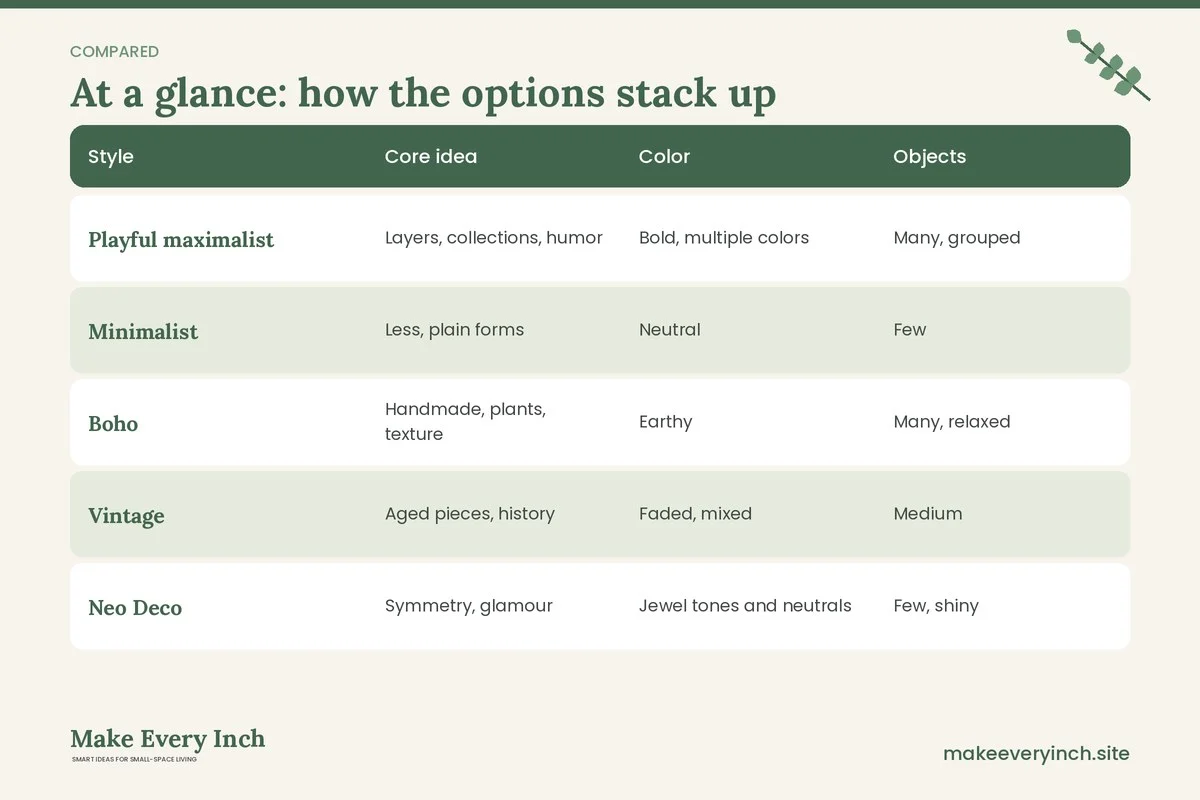
Maximalist versus other styles
| Style | Core idea | Color | Objects | Upkeep |
|---|---|---|---|---|
| Playful maximalist | Layers, collections, humor | Bold, multiple colors | Many, grouped | Higher, regular dusting |
| Minimalist | Less, plain forms | Neutral | Few | Low |
| Boho | Handmade, plants, texture | Earthy | Many, relaxed | Medium |
| Vintage | Aged pieces, history | Faded, mixed | Medium | Medium |
| Neo Deco | Symmetry, glamour | Jewel tones and neutrals | Few, shiny | Medium |
If you like glamour with edits, compare our neo deco apartment ideas. For a broader, warmer take on thrifted rooms, see our vintage apartment ideas.
Three example maximalist apartments
A 350 square foot studio
Paint or cover one wall deep green. Put a pink velvet loveseat against it, and hang a salon gallery above in black, gold and wood frames. Add a pair of patterned cushions in large and small scale, a striped rug on a cream base and a bookcase with books sorted by color. Keep the bed area simple with plain linen and one patterned throw.
A one-bedroom with a collector
Give the collection a cabinet. Use a secondhand glass-front display case for ceramics, and group toy figures on a freestanding bookcase. Add a tray on the coffee table, and keep one wall plain. Rotate pieces every few months and store the rest in labeled boxes.
A small rental with strict rules
Lean large art on a console, hang textiles on tension rods and use peel-and-stick wallpaper in a closet or on a removable panel. Layer rugs and lamps, and keep paint off the walls. See our small bedroom ideas for renters for bedroom options that leave no mark.
A step-by-step method to edit and curate
Step 1: Empty one surface
Take everything off a shelf or a table. Clean it, then put back only items you love and use. Seeing the empty surface resets your eye.
Step 2: Sort by category
Group objects by type, such as ceramics, books, frames and candles. If a category has more than you can display, choose the best.
Step 3: Choose a palette
Pick three or four colors, plus neutrals. Anything outside the palette goes into storage or gets painted, wrapped or covered.
Step 4: Build clusters
Arrange objects in groups of three or five, with a tall, a medium and a low piece. Leave a gap between clusters.
Step 5: Add one calm area per wall or surface
Keep at least one plain area, such as a bare section of wall, an empty shelf or a clear tabletop.
Step 6: Photograph and cut
Take a photo of the room. The photo shows what the eye sees. Remove anything that looks like a distraction, and do not add anything for a week.
Cleaning and dust realities
More objects mean more dust, so plan for it. Dust shelves and displays every week with a microfiber cloth or a soft brush, and wipe flat surfaces after you move objects. Glass cabinets keep fragile items clean, and baskets with lids hide small items. Vacuum rugs weekly, and rotate them to prevent wear. Keep pathways wide enough for a vacuum or a mop, and put heavy items on higher shelves, never on the floor. In kitchens, avoid collections near the stove, where grease settles, and wash items on open shelves several times a year.
Safety matters too. Secure tall bookcases to the wall, or use rental-friendly anti-tip straps with the landlord’s permission. Keep cords away from walkways, and do not cover lamps or heaters with fabric. Fairy lights and paper lanterns need LED bulbs. Keep fragile items out of reach if you have pets or children.
Making maximalism renter-friendly
Photograph the walls and floors, and keep the lease in mind. Use leaning art, tension rods, removable wallpaper, rugs, furniture and plug-in lights in place of paint and nails. Use adhesive strips within their weight limits, test on a hidden spot and remove them slowly. Choose large textiles to cover a wall, and keep original curtains, light fixtures and hardware in a labeled box so you can restore them. Before move-out, photograph the walls again.
Thrifting and building the look on a budget
Maximalism suits a thrifter, because variety is the point. Look for frames, ceramics, lamps, trays, textiles and small furniture at thrift stores, estate sales and online marketplaces. Buy pieces in your palette, and ignore the rest, however cheap. Paint frames to unify them. Wash secondhand textiles, and check lamp cords. Use a color wheel app or a paint chip to match items, and carry a swatch of your rug when you shop. Prices vary widely, so treat any single figure as a rough guide. For the wider approach, see our guide to small apartment makeover on a budget.
Budget guide
Under $75
Secondhand frames, spray paint, a few patterned cushion covers, fabric for a tension rod hanging and a lamp shade swap.
About $250
A flatweave rug, a floor lamp, a gallery of prints with frames, peel-and-stick wallpaper for one wall and a thrifted display cabinet.
$700 and up
A statement sofa or chair, a large rug, custom curtains, a bookcase and a few original art pieces.
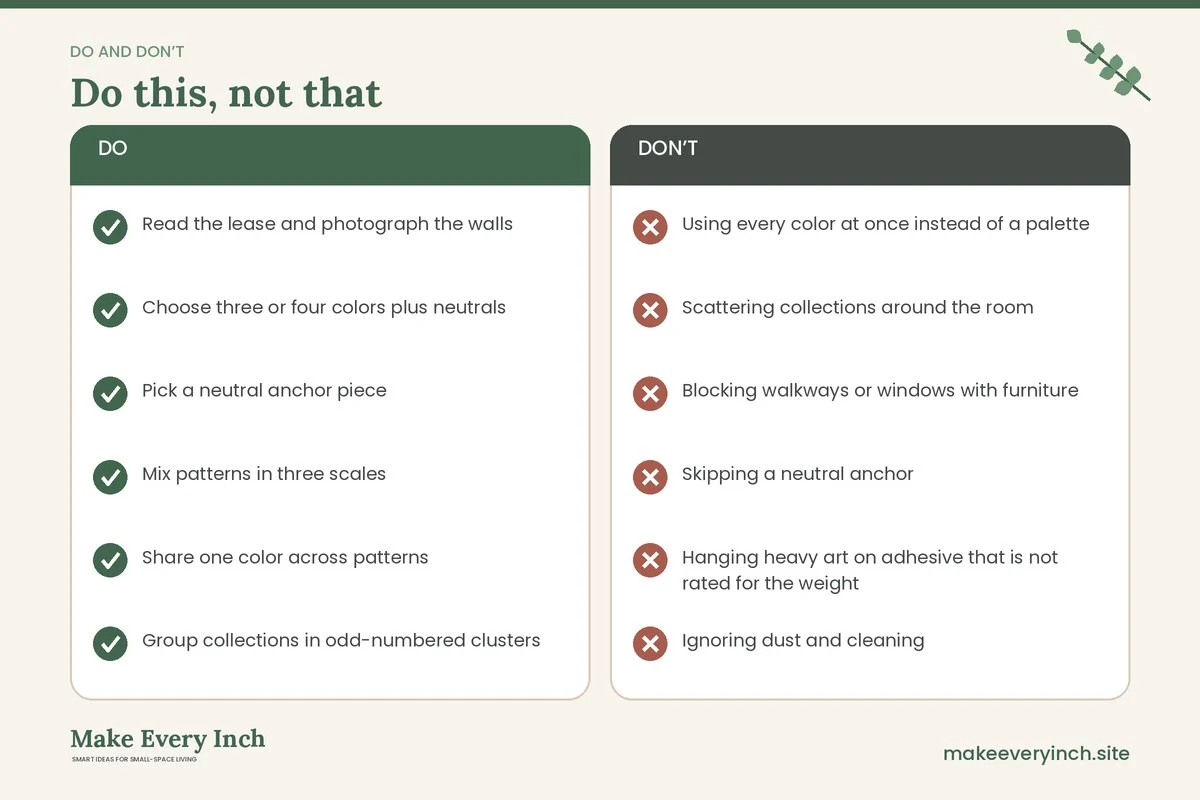
Mistakes to avoid
- Using every color at once instead of a palette
- Scattering collections around the room
- Blocking walkways or windows with furniture
- Skipping a neutral anchor
- Hanging heavy art on adhesive that is not rated for the weight
- Ignoring dust and cleaning
- Buying cheap items only because they are cheap
- Never rotating or editing
- Painting walls without reading the lease
Playful maximalist checklist
- Read the lease and photograph the walls
- Choose three or four colors plus neutrals
- Pick a neutral anchor piece
- Mix patterns in three scales
- Share one color across patterns
- Group collections in odd-numbered clusters
- Keep 30 inches of clear walkway
- Layer lamps at three heights
- Secure tall furniture
- Dust weekly
- Rotate objects each season
FAQ
What is playful maximalism?
It is a style of abundant color, pattern and objects, arranged with a plan and a sense of humor. It follows a palette and groups collections so the room feels lively but ordered.
How do I avoid clutter in a maximalist apartment?
Give every object a spot, group collections, keep walkways clear and include one calm area. Edit and rotate regularly.
Can maximalism work in a small apartment?
Yes. Compact rooms can handle bold color and layered displays, as long as the floor stays open and you use walls and vertical space.
How do I mix patterns without a mess?
Use different scales, share one color across all patterns and add solid breathers. Mix curved and straight patterns.
What colors work for maximalism?
Choose three or four related colors, plus a neutral. Jewel tones, warm pinks and oranges or blues and greens are popular choices.
How can I do it in a rental?
Use leaning art, tension rods, removable wallpaper, rugs and lamps. Test adhesive in a hidden spot and photograph the walls.
How do I keep a maximalist home clean?
Dust displays weekly, use glass cabinets and lidded baskets, and vacuum rugs. Rotate objects so you can clean behind and under them.
Is maximalism expensive?
Not necessarily. Thrifted frames, textiles and ceramics in a shared palette create a rich look at a low cost. Add a few higher quality items over time.
Keep going: Explore more styles in our boho apartment ideas, neo deco apartment ideas and modern small apartment ideas.
Save this guide for later
Pin the ideas you like to Pinterest so you can come back to them when you plan your space.