14 Small Living Room Storage Ideas Minimalist Homes Can Copy
Quick answer: The best small living room storage ideas minimalist homes use are closed, low and quiet: one wall-length cabinet with flat doors, a bench with a lid, a media console with drawers, and one open shelf kept at 60 percent full. Cut the contents first, assign every category a single home, and match door and wall color so the storage disappears.
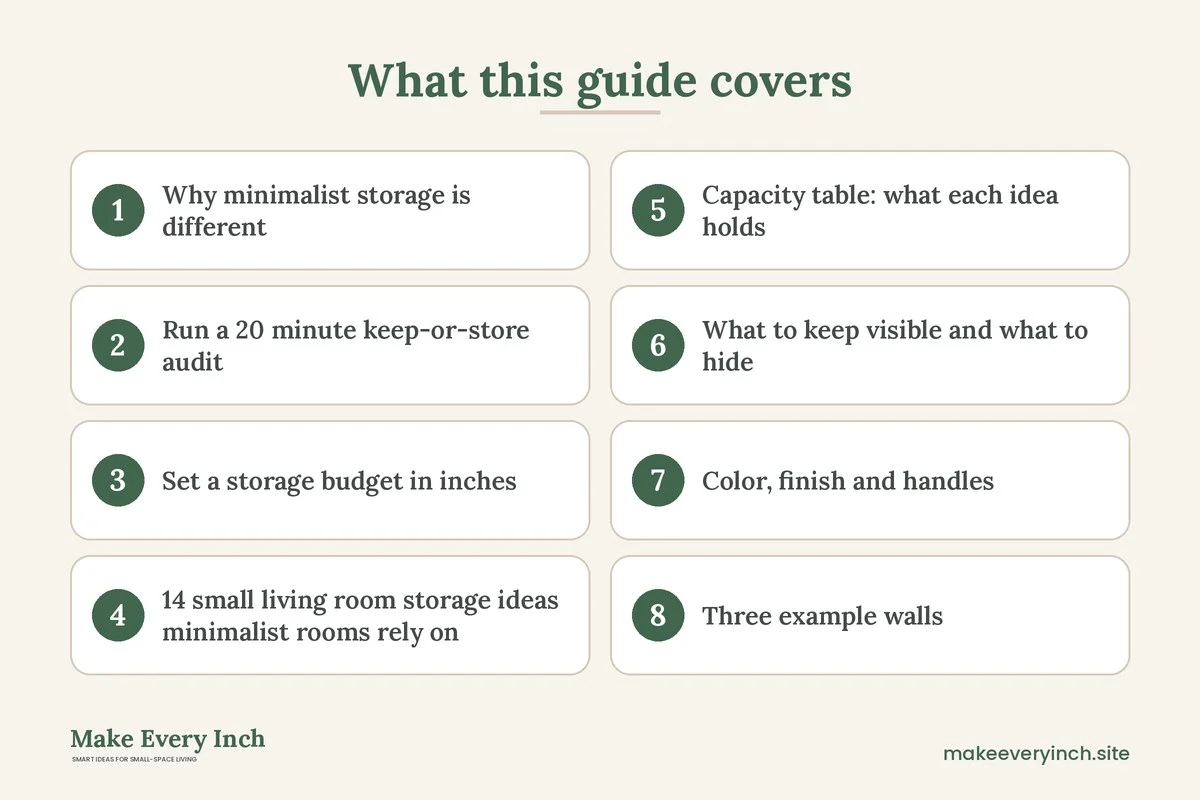
Small living room storage ideas minimalist style can actually use begin with a surprising rule: storage is the last step, not the first. A minimalist room looks calm because few things live in it, and the things that do have an obvious place. If you buy cabinets before you cut the contents, you simply hide clutter in a nicer box. This guide reverses that order. You will run a quick audit, set a storage budget in inches, and then choose from 14 specific plans that keep surfaces clear. It includes measurements, a capacity table, a weekly reset routine, three example walls, a mistakes list and a checklist. For the full overview of the topic, read our pillar guide on small living room storage ideas and the wider small living room ideas hub.
Why minimalist storage is different
Most storage advice says to add more places to put things. Minimalist storage says to reduce what needs a place. The goal is not an empty room but a room where the eye finds long, clean lines: a floor that is mostly visible, a wall that is mostly one color, and surfaces that hold two or three chosen objects at most.
That changes what you buy. Instead of many small baskets and boxes, you want a few larger, closed pieces with flat fronts. Instead of shelves packed edge to edge, you want shelves with open space on them. Instead of a different finish for each piece, you want one or two finishes that repeat. Visual quiet matters as much as capacity, because even a very tidy room looks busy when ten different materials and colors show.
There is also a practical benefit. Fewer pieces means fewer corners to dust, fewer gaps for things to pile up in, and an easier time vacuuming. Many people find that a small living room feels about a third larger once the floor is visible along the walls.
Run a 20 minute keep-or-store audit
Before you measure anything, take everything out of the living room that is not furniture. Put it in a pile on the floor or on a bed, and sort it into four groups.
- Daily: remote, throw, current book, charger, glasses
- Weekly: board games, hobby supplies, guest blankets, spare cables
- Seasonal: holiday items, extra bedding, winter accessories
- Not living room items: mail, shoes, tools, paperwork, kitchen things
Only the first two groups deserve space in the living room. The seasonal group goes to a closet shelf, a bed-bottom box or a shared storage area, and our guide to under bed storage ideas covers where. The last group moves to its true home, and if it has no home, that is a separate problem to solve outside this room. For deeper help with the purge itself, see small apartment decluttering ideas.
Now measure the pile. Stack the daily and weekly items and estimate their volume. As a rule of thumb, a typical small living room needs about 8 to 12 cubic feet of hidden storage for its daily and weekly items. A 36 inch wide, 16 inch deep, 18 inch tall cabinet holds roughly 6 cubic feet, so most rooms need one or two closed pieces, not a wall of them. If your pile is larger, cut again before you shop.
Set a storage budget in inches
Pick a total length of wall that storage may occupy, and do not exceed it. A simple formula for a small living room is 25 to 35 percent of one long wall. In a 12 foot wall, that is 36 to 50 inches of cabinet front, plus the sofa and any seat storage. Anything beyond that tips the room from calm to crowded.
Also set a depth limit. In a room under 150 square feet, choose pieces 12 to 16 inches deep for walls, and treat anything over 18 inches as a major commitment that eats floor space. Shallow depth is the secret of minimalist storage: a 12 inch deep cabinet along a whole wall costs only a foot of floor but holds far more than you expect.
14 small living room storage ideas minimalist rooms rely on
Closed storage on the walls
1. One flat-front wall cabinet
Choose a single long cabinet with handleless doors, or push-to-open fronts, painted or finished to match the wall. At 12 to 16 inches deep and 30 to 36 inches tall, it holds games, cables and blankets behind a clean face. Keep the top clear, or hold one object there.
2. A floating console on the media wall
A wall-mounted unit at 12 inches deep, set 8 to 10 inches off the floor, keeps the floor visible below. Drawers hide remotes, consoles and chargers. The visible floor under it makes the wall look lighter. Check that the wall can take the weight, and see the small living room TV wall ideas guide for mounting heights.
3. Tall and narrow beside the window
A 12 to 14 inch wide, 70 to 80 inch tall cabinet beside a window uses height that normally goes unused. Paint it the wall color so it reads as part of the wall. For the shelf version, see the best narrow bookshelves.
4. Doors that hide the shelves
If you own open shelves already, add simple doors or fabric panels in a neutral tone. A slim curtain on a tension rod over a shelf bay is a low-effort option. Doors turn visual noise into one plain surface.
Storage that is also furniture
5. A lidded bench under the window
A bench 14 to 18 inches deep and 36 to 48 inches long gives seating and a hidden box for throws or board games. Choose a plain upholstered or wood top. Leave the surface bare apart from one cushion.
6. A storage ottoman instead of a coffee table
A single large ottoman with a tray holds blankets inside and doubles as a table. Pick one in a solid color that matches the sofa. Our best storage ottomans guide covers sizes and what to check before buying.
7. A coffee table with a closed drawer
If you prefer a table, choose one with a drawer or a lower shelf with a lid. Keep the top clear apart from a tray. If the room is tight, our guide to small living room ideas without a coffee table shows alternatives.
8. A sofa with storage in the base or arms
Some sofas have lift-up seats or a side compartment for throws. Verify the opening mechanism and the clearances, because a lid that needs 20 inches to open can hit a table. It adds capacity without adding any extra footprint.
Smart open storage
9. One open shelf, 60 percent full
Keep one shelf as the only open display. Fill no more than 60 percent of the length, group items in odd numbers, and leave a gap of at least 4 inches between groups. The empty space is part of the design. Two or three books, one plant and one object per shelf is plenty.
10. A picture ledge instead of a bookcase
A 4 inch deep ledge holds a few frames or a small stack of books, but it cannot be filled with clutter. This is a good choice for a renter who wants less to store, and it works with no-drill adhesive options in some cases. Always follow weight limits.
11. A single wall rail
A slim rail or a pair of pegs holds a bag, a tote or a throw. Keep it to one item per hook. Minimalist storage should have a clear rule about how many things hang.
Hidden and vertical options
12. Behind-the-sofa console
A 10 to 12 inch deep console behind a floating sofa holds a lamp, a tray and a closed basket on a lower shelf. It also marks an edge between zones. Keep a 30 inch path behind it.
13. Use the vertical dead space
The 12 to 18 inches above a door, or the space above a cabinet, can hold a row of matching boxes. Keep the boxes uniform in color, and label the insides rather than the fronts. Read more in vertical storage ideas.
14. A hidden compartment or secret zone
Hollow bases, lift-top tables, and cabinets behind a sofa can hold cables, spare chargers and rarely used items. See hidden storage ideas for more places that most rooms overlook.
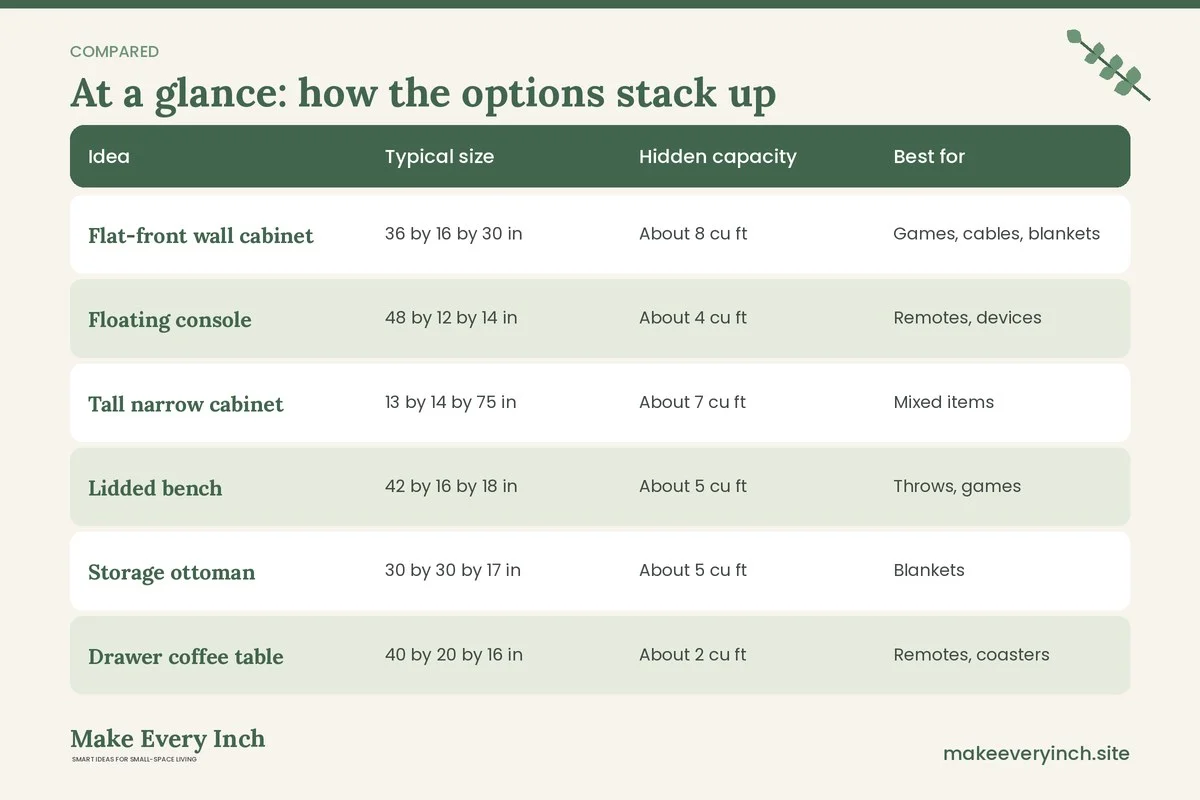
Capacity table: what each idea holds
These are rough estimates for a typical product, and your piece will differ, so measure before you buy.
| Idea | Typical size | Hidden capacity | Best for | Floor cost |
|---|---|---|---|---|
| Flat-front wall cabinet | 36 by 16 by 30 in | About 8 cu ft | Games, cables, blankets | 16 in depth |
| Floating console | 48 by 12 by 14 in | About 4 cu ft | Remotes, devices | None below |
| Tall narrow cabinet | 13 by 14 by 75 in | About 7 cu ft | Mixed items | 14 in depth |
| Lidded bench | 42 by 16 by 18 in | About 5 cu ft | Throws, games | 16 in depth |
| Storage ottoman | 30 by 30 by 17 in | About 5 cu ft | Blankets | 30 in square |
| Drawer coffee table | 40 by 20 by 16 in | About 2 cu ft | Remotes, coasters | 20 in depth |
| Sofa storage | Varies | About 3 to 6 cu ft | Throws | None |
| Behind-sofa console | 48 by 12 by 30 in | About 3 cu ft | Lamps, baskets | 12 in depth |
| Picture ledge | 36 by 4 in | Display only | Frames | 4 in depth |
What to keep visible and what to hide
A minimalist room still needs some personality, so decide in advance what earns a visible place. The rule of three works well: on any flat surface, show at most three things, and make sure at least one of them is useful, such as a lamp or a tray. Everything else goes inside.
Visible: a plant, a lamp, one or two books, a ceramic object, a clock or a framed print. Hidden: remotes, chargers, cables, tissues, mail, magazines, game controllers and toys. Use cord clips and a cable box behind the media unit, so wires do not draw the eye.
If something is used daily and you cannot bear to put it away, give it a tray. A tray turns a few loose objects into one deliberate group, and it makes tidying a one-second job.
Color, finish and handles
Match the cabinet to the wall color when you can. A white cabinet on a white wall, or a pale oak piece on a warm neutral wall, recedes and makes the room look bigger. Choose matte finishes, because gloss reflects every clutter shape and every fingerprint.
Handles break lines. Pick push-to-open doors, integrated finger pulls or very slim bar handles in the same color as the front. If you must use knobs, choose one style and one size across the entire room. Limit the palette to three tones, such as warm white, light wood and one dark accent in black or charcoal. For more on the look as a whole, see minimalist apartment ideas.
Three example walls
Example 1: The 11 foot media wall
A renter has a flat wall with a 50 inch TV. The plan uses a 60 inch floating console at 12 inches deep, mounted 9 inches off the floor, with two drawers for devices and a door for games. A 14 inch wide tall cabinet stands to one side in the wall color. The result is about 10 cubic feet of hidden storage, a visible floor, and a top surface with a lamp and one plant.
Example 2: The 10 foot window wall
A short wall holds a window. The plan uses a 42 inch bench below the sill, with a lid and 5 cubic feet of space, plus a rail with two hooks beside the window. A floor lamp stands at one end. The bench holds the throws and the games, and the walls stay free.
Example 3: The studio-style living area
An open room has no extra walls. The plan places a 48 inch deep console behind the sofa as a divider, with one closed lower shelf, plus a storage ottoman in front of the sofa. The console holds a lamp and two trays, and the ottoman holds the throws and the controllers. Seasonal items go under the bed. For zoning, see small apartment living room ideas for studios.
The weekly reset routine
Storage only works if the system is easy to maintain. Use a five-minute reset once a day and a fifteen-minute pass once a week.
- Return remotes, chargers and cups to their homes
- Fold the throw and place it in the bench or on one chair arm
- Clear the coffee table or tray to its three objects
- Sort the mail and move it out of the room
- Wipe the surfaces
- On the weekly pass, check each closed cabinet and remove anything that does not belong
- Once a month, ask whether any item has gone unused, and donate it
Adopt a one-in, one-out rule. When a new book or object enters the room, one leaves. This stops the hidden storage from becoming a second clutter zone.
Budget guide
These ranges are rough and vary by region and retailer.
Under $100
Trays, cord clips, a cable box, a few uniform boxes and a curtain for an open shelf. The audit costs nothing and does most of the work.
About $200 to $500
A lidded bench or a storage ottoman, a narrow cabinet, a floor lamp and a rail. This covers most of plans 5, 6, 3 and 11.
$600 and up
A floating console, a custom-sized cabinet or a sofa with storage. At this level, measure twice, and check the weight rating and delivery route first.
Mistakes to avoid
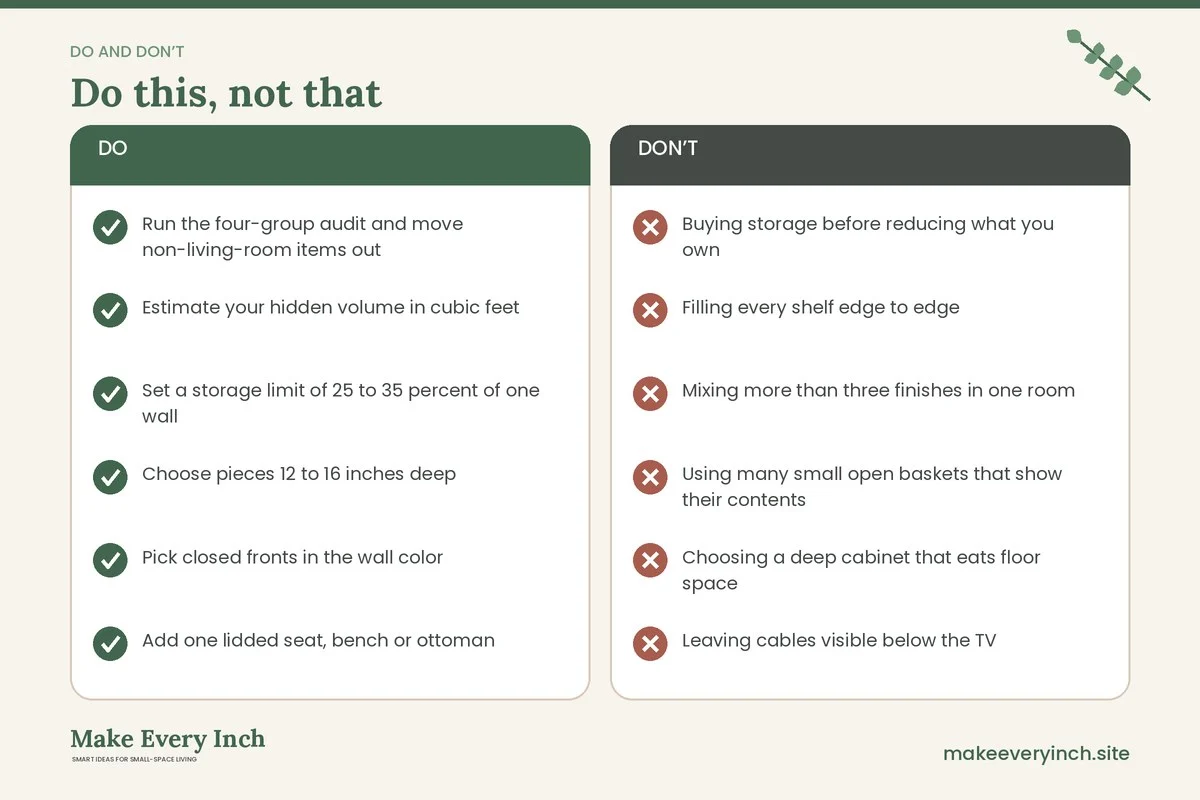
- Buying storage before reducing what you own
- Filling every shelf edge to edge
- Mixing more than three finishes in one room
- Using many small open baskets that show their contents
- Choosing a deep cabinet that eats floor space
- Leaving cables visible below the TV
- Using high-gloss fronts that show fingerprints
- Forgetting door swing and drawer clearances
- Keeping the audit pile under the sofa
Minimalist storage checklist
- Run the four-group audit and move non-living-room items out
- Estimate your hidden volume in cubic feet
- Set a storage limit of 25 to 35 percent of one wall
- Choose pieces 12 to 16 inches deep
- Pick closed fronts in the wall color
- Add one lidded seat, bench or ottoman
- Keep one open shelf at 60 percent full
- Limit surfaces to three objects
- Hide cables with clips and a box
- Set a daily and weekly reset
- Use the one-in, one-out rule
FAQ
What is the best storage for a small minimalist living room?
Closed, shallow and low pieces with flat fronts, such as a wall cabinet, a lidded bench and a media console with drawers. They hide items and keep lines clean.
How much storage does a small living room need?
Most small rooms need around 8 to 12 cubic feet of hidden space for daily and weekly items. Measure your own pile after an audit to get a better figure.
Can I have open shelves in a minimalist room?
Yes, in moderation. Keep one shelf and fill it to about 60 percent, with grouped items and clear gaps.
How do I hide the TV cables?
Use cord clips, a cable cover on the wall and a box or a drawer behind the media unit. A floating console with a rear opening is helpful.
What color should minimalist storage be?
The same color as the wall or a close neutral. Matte finishes look calmer than gloss.
How do I stop clutter coming back?
Use a one-in, one-out rule and a five-minute daily reset. Give each category one home, and avoid spare catch-all baskets.
What if I rent and cannot drill?
Choose freestanding cabinets, benches and ottomans. Our guides on no-drill storage ideas for renters and the renter-friendly storage ideas for small living rooms cover options.
Is minimalist storage expensive?
Not necessarily. Most of the work is reducing what you own, and a few well-chosen pieces cost less than many small ones. See the budget small living room storage ideas for cheaper routes.
Keep going: Keep planning with our small living room storage ideas, the Japandi small living room storage ideas and our guide to small space storage furniture.
Save this guide for later
Pin the ideas you like to Pinterest so you can come back to them when you plan your space.