15 Small Living Room Furniture Ideas for Families With Kids
Quick answer: The best small living room furniture ideas for families favor durable, wipeable surfaces, rounded corners, low and stable pieces, and hidden storage for toys. Choose a sofa with removable washable covers, an ottoman or table without sharp edges, a low media unit, and anchor every tall bookcase or cabinet to the wall. Keep a 30 to 36 inch walkway plus a clear play patch of roughly 4 by 6 feet.
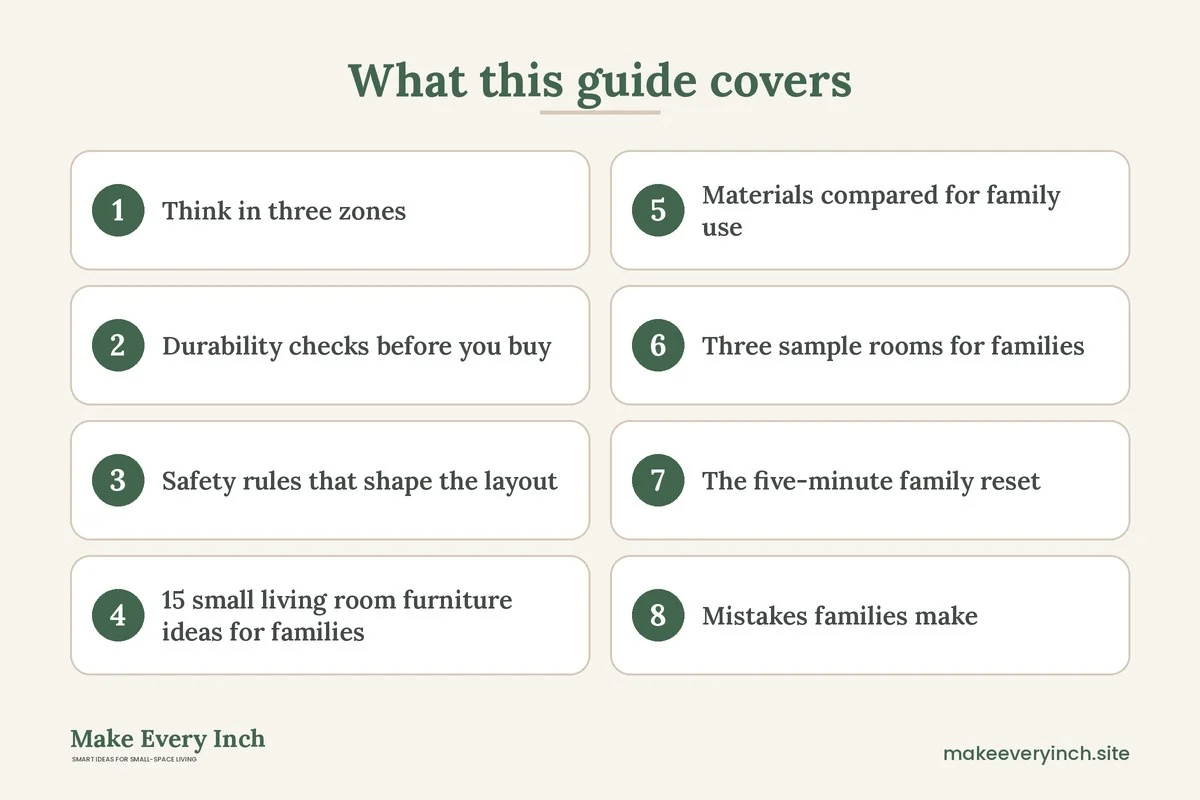
Small living room furniture ideas for families have to meet a different test from a showroom. The sofa becomes a trampoline, the coffee table becomes a racetrack, the rug becomes a snack bar and the bookcase becomes a climbing frame. In a small room, all of this happens in the same few square meters where adults also try to relax. A good family plan therefore chooses furniture for three things at once: how well it survives, how safely it behaves around children, and how neatly it hides the toys. This guide covers the durability checks, the safety measures, 15 furniture ideas, a materials table, three sample rooms, a daily reset routine, a checklist and a FAQ. For the wider topic, read our main guide to small living room furniture ideas, the broader small living room ideas pillar and the companion post on small living room storage ideas for families.
Think in three zones: adult, play and travel
Before buying anything, divide the room into three zones. The adult zone is where the sofa and the main lamp sit. The play zone is an open patch of floor where children can build, crawl or draw. The travel zone is the path from the door to the other rooms, which must stay clear so that no one trips over toys at night.
In a small room these zones overlap, so give each one a measurement. A play patch of about 4 by 6 feet is usually enough for one or two young children, and an open rug in the middle of the room often serves best because it is visible from the sofa. The travel zone should stay at 30 to 36 inches wide, and a few inches more if anyone uses a stroller, a walker or a wheelchair. The adult zone is whatever remains, which is why every large piece has to earn its place.
Most families find that the play zone shrinks and grows through the day. In the morning it might be the full rug. In the evening it shrinks to a basket and a corner. Furniture that can move or fold makes this possible, so a rolling cart, light stools and an ottoman that pushes against the wall are more useful than heavy, fixed items.
Durability checks before you buy
Durability is a matter of materials and construction. Without testing claims or brand promises, a few observable checks tell you most of what you need.
- Frame: a solid hardwood or a sturdy engineered frame with joints that are glued and screwed or dowelled holds up better than thin staples. Lift one corner and check that the frame does not twist.
- Fabric: tightly woven fabrics hide marks and resist snagging. Performance weaves, microfiber and some treated cottons are often easier to clean. Check the label for cleaning codes, and see whether the covers come off.
- Cushions: firm, resilient cushions recover better from jumping than very soft ones. Reversible cushions let you rotate wear.
- Finishes: wipeable surfaces such as sealed wood, laminate and powder-coated metal resist spills. Raw wood and glass show marks quickly.
- Legs: four sturdy legs or a solid base are more stable than thin splayed ones. Check that the feet will not scratch the floor, and add felt pads.
- Hardware: drawer runners that stop at the end, doors that close softly and handles without sharp edges make a difference around small hands.
The cheapest durability upgrade is protection. Washable throws, cushion covers and a dense rug underlay add years to any piece, and they can be replaced without changing the furniture.
Safety rules that shape the layout
Safety is the other half of a family plan, and furniture decisions affect it directly. These guidelines apply to most households with children, but check any product instructions and local rules.
- Rounded corners: where a toddler runs at head height, choose round or softly curved tables and ottomans. If you already own sharp ones, fit corner guards until the child is older.
- Anchoring: secure tall or top-heavy pieces, such as bookcases, cabinets and TV units, to a wall stud or masonry with the hardware suited to the wall. Place heavy items low, and do not leave drawers open as steps.
- Stable bases: wide, low furniture is harder to tip than tall, narrow furniture. Avoid lightweight side tables that a child can pull over.
- Cords and blinds: keep cords out of reach, and fix cable covers along the wall.
- Windows: keep climbable furniture away from windows and balcony doors.
- Glass: choose tempered or laminated glass if you use it at all, or skip glass tops when children are small.
- Heat and electrics: keep lamps stable, with cords tucked away, and place radiators and heaters behind a guard.
If you rent and cannot drill, ask your landlord about permitted fixings, or use lower furniture. Our guide to no-drill storage ideas for renters shows lower-risk options.
15 small living room furniture ideas for families
The sofa and seating
1. A sofa with removable, washable covers
Covers that unzip and go in the washing machine are the best insurance against spills. Choose a sofa between 72 and 84 inches that seats the household without crowding the play patch. Our best sofas for small apartments post explains size and depth.
2. A sectional with a storage chaise
A compact sectional gives the family a place to pile up for a film, and the chaise can hide blankets and toys. It works best in rooms about 11 feet wide or more. If the room is smaller, read best sectionals for small living rooms for compact shapes.
3. A sofa with a firm, deep seat and low back
A back around 30 to 33 inches high keeps sight lines open and makes the sofa harder to topple over than a tall, narrow one. Firm cushions suit jumping, and a seat height around 17 to 19 inches helps children climb on and off safely.
4. Poufs and floor cushions as flexible seats
Light, soft seats move with the play patch. Poufs double as footrests and extra seating, and they have no corners. They are a good choice where space is tight and the number of people changes through the day.
Tables and surfaces
5. A round or oval coffee table
Curves are kinder to heads and easier to walk around than a rectangle. A 30 to 36 inch round table leaves a path of 30 inches or more on each side in most small rooms. Choose a wipeable top and a lower shelf for books.
6. An upholstered storage ottoman
A padded ottoman has no hard corners, seats extra people and stores toys. Pick one with a lid that cannot slam down, such as a hinge with a soft-close, or a lift-off lid. See our best storage ottomans guide for features to check.
7. A nesting pair that tucks away
Two small tables that slide together give you a surface for homework or a snack and disappear into a corner when the floor is needed for play. Light versions are easy for adults to move, but choose heavy enough bases that children cannot pull them over.
8. A small table and stools for kids
A child-height table of around 18 to 20 inches, with two stools, gives children their own place to draw, build or snack. It keeps the coffee table clear and teaches them to use their own surface. Stack the stools under the table when not in use.
Storage that hides toys
9. A low media console with doors
Doors keep cables and clutter out of sight and out of reach. A console about 16 to 18 inches high with doors that close softly stores games, books and a few toys. Fix the TV to the wall or to the unit using the manufacturer’s method. For wall plans, see small living room TV wall ideas for families.
10. Baskets and bins on low open shelves
Open cubbies about 12 to 14 inches deep let children see and reach their toys. Choose fabric or sturdy plastic bins with handles. A low unit under a window or along the shortest wall keeps the room tidy without adding height.
11. A tall narrow bookcase for adult items
Use the vertical space for things children should not reach, such as breakable items and adult books. A bookcase 10 to 12 inches deep fits a small room. Anchor it to the wall with a bracket or strap, put heavy items on the lowest shelves and check the fixing from time to time. Our best narrow bookshelves post lists slim options.
12. A bench with storage by the door
A bench around 36 to 48 inches long gives space to sit and put on shoes, and the compartments below hold bags and boots. It keeps the entry from spilling into the living room. See small entryway storage for more.
Multi-use pieces
13. A fold-away or drop-leaf table
For families who eat in the living room or need a homework spot, a drop-leaf table folds to a slim width and opens to seat four. Round the corners and choose a stable base. Our best small dining tables post compares sizes.
14. A rolling cart for crafts and snacks
A narrow cart with a lip around each shelf holds markers, paper or snacks. Park it beside the sofa during the activity and roll it to the wall afterward. Choose one with locking wheels.
15. A daybed or sleeper sofa for guests
If grandparents or friends stay over, a sleeper sofa lets the living room double as a guest room. Measure the opened footprint so that it does not block the play patch or the door. Keep the mechanism away from small fingers.
Materials compared for family use
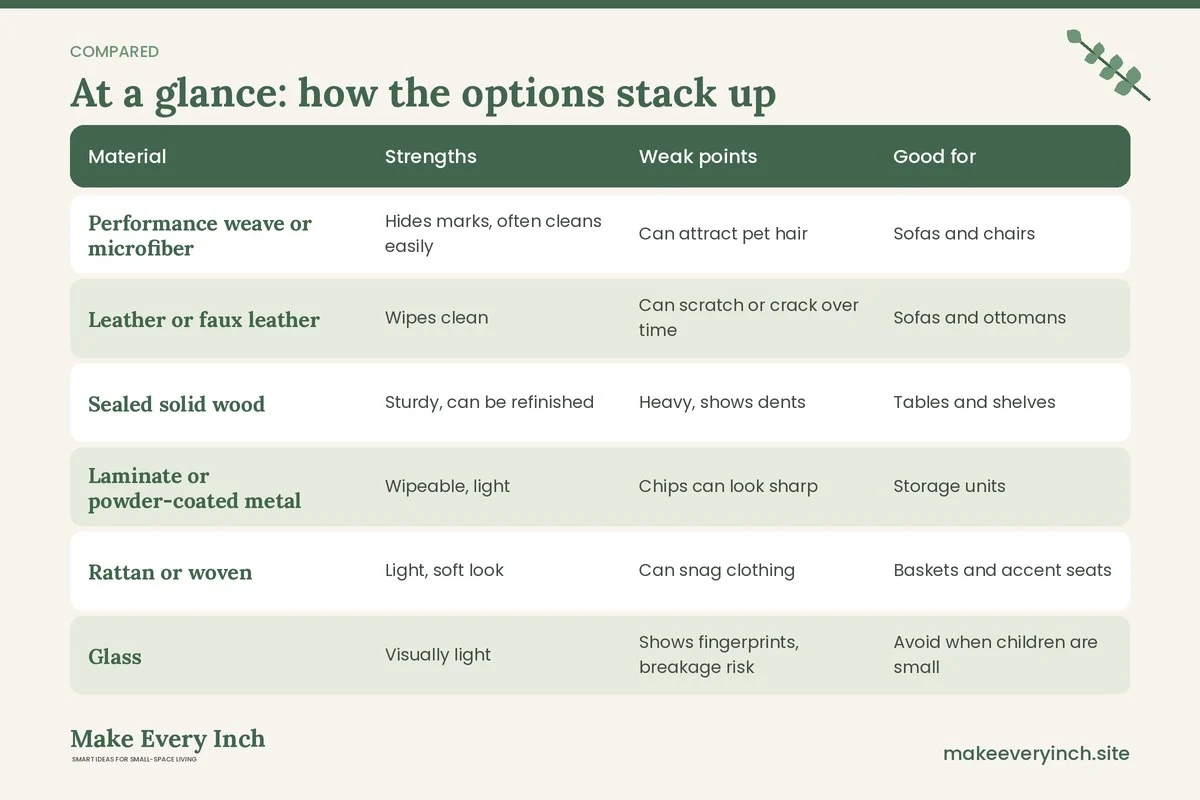
The table below summarizes how common furniture materials behave in a busy household. It is a general guide and not a product claim.
| Material | Strengths | Weak points | Good for |
|---|---|---|---|
| Performance weave or microfiber | Hides marks, often cleans easily | Can attract pet hair | Sofas and chairs |
| Leather or faux leather | Wipes clean | Can scratch or crack over time | Sofas and ottomans |
| Sealed solid wood | Sturdy, can be refinished | Heavy, shows dents | Tables and shelves |
| Laminate or powder-coated metal | Wipeable, light | Chips can look sharp | Storage units |
| Rattan or woven | Light, soft look | Can snag clothing | Baskets and accent seats |
| Glass | Visually light | Shows fingerprints, breakage risk | Avoid when children are small |
Three sample rooms for families
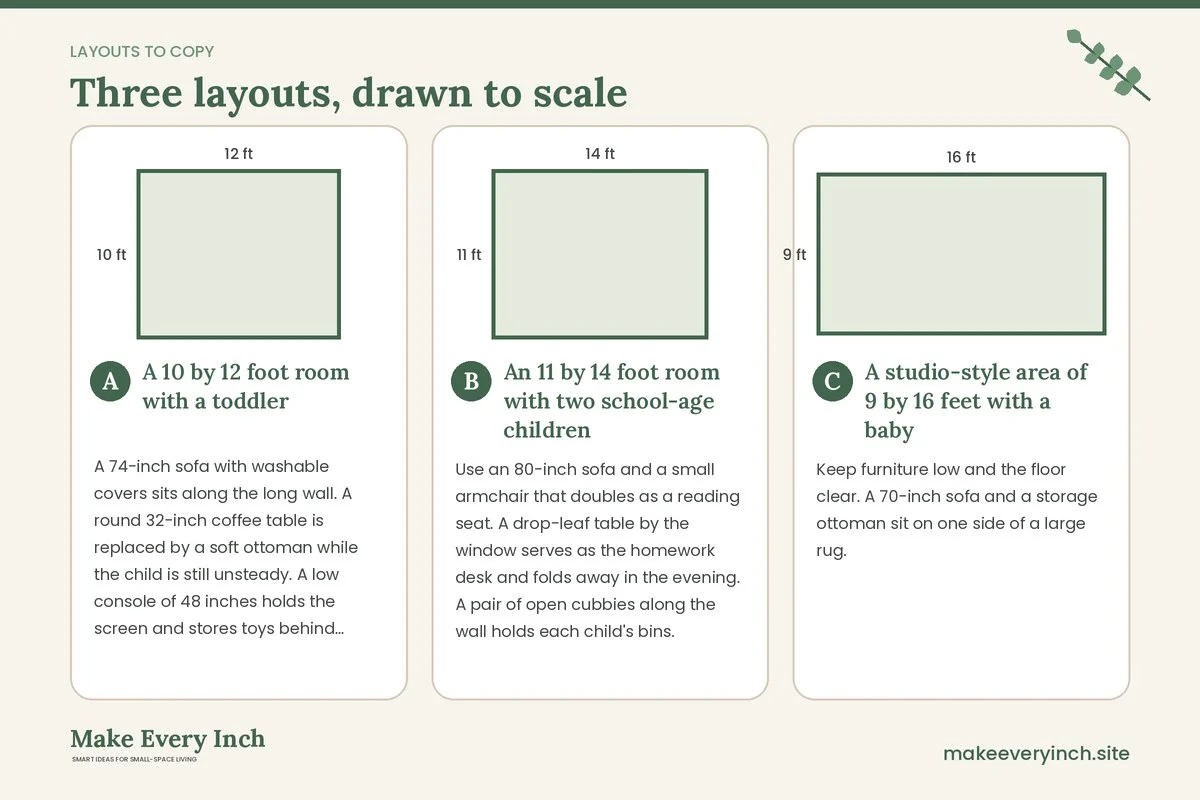
A 10 by 12 foot room with a toddler
A 74-inch sofa with washable covers sits along the long wall. A round 32-inch coffee table is replaced by a soft ottoman while the child is still unsteady. A low console of 48 inches holds the screen and stores toys behind doors. A tall bookcase stands on the short wall, anchored with a bracket, and holds adult books on the upper shelves and baskets below. A 5 by 8 foot rug is the play patch, and the walkway along the door stays at 32 inches.
An 11 by 14 foot room with two school-age children
Use an 80-inch sofa and a small armchair that doubles as a reading seat. A drop-leaf table by the window serves as the homework desk and folds away in the evening. A pair of open cubbies along the wall holds each child’s bins. A nesting pair of tables comes out for snacks. The center of the room stays open for board games, and a basket on the cart holds controllers and chargers.
A studio-style area of 9 by 16 feet with a baby
Keep furniture low and the floor clear. A 70-inch sofa and a storage ottoman sit on one side of a large rug. A narrow console behind the sofa holds a lamp and baby essentials out of reach, and a tall unit stands against the wall near the entrance, securely anchored. Use a play mat during the day and roll it away at night. For a studio, see small apartment living room ideas for families for more layouts.
The five-minute family reset
Furniture keeps a family room workable only if it is put back to its default each evening. A short routine does more than any single purchase.
- Toys to bins: everything with a home goes into its bin. Toys without a home go in a basket for sorting at the weekend.
- Surfaces cleared: tables, the cart and the sofa arms are emptied so that tomorrow starts with a blank slate.
- Covers and throws straightened: a quick shake keeps cushions from sagging.
- Walkway checked: pick up anything from the travel zone so that no one trips at night.
- Tall furniture checked: look at the anchored pieces once a week to make sure the fixings are secure and that no drawers are left open.
- Spills handled early: wipe marks while they are fresh, and keep a cloth in a basket close to the sofa.
Children can take part from about age three. Giving them a basket with a picture on it turns tidying into a game, and a clear home for each item makes it easier to keep the system going.
Mistakes families make
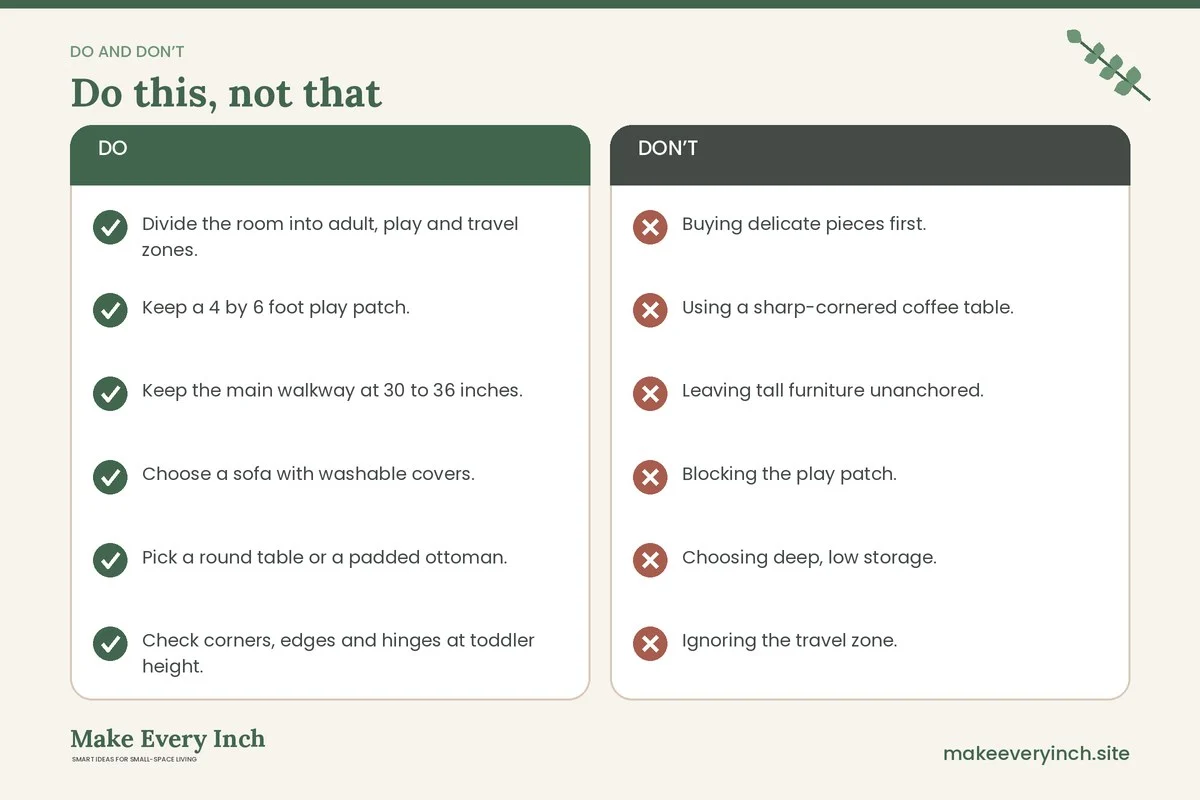
- Buying delicate pieces first. Choose durable, wipeable furniture now and save delicate items for later.
- Using a sharp-cornered coffee table. At toddler height, rounded corners or an ottoman are safer.
- Leaving tall furniture unanchored. Secure every bookcase, cabinet and TV unit.
- Blocking the play patch. If the floor is full of furniture, toys end up on the sofa.
- Choosing deep, low storage. Bins that are too deep become black holes. Use shallow bins for everyday toys.
- Ignoring the travel zone. A 30-inch path matters at night more than a perfect layout in the day.
- Forgetting the long term. Furniture that adapts, such as a bench that becomes a shoe seat, will outlast a toy-only piece.
Budget and phasing for a growing family
Children grow quickly, and needs change every year or two. Spend the most on the sofa and the rug, since those take the most wear. Buy storage that adapts, such as cubbies that can hold books later, and choose tables that can be used by adults. Secondhand furniture is often well built, and sturdy hardwood pieces can be cleaned or refinished. Skip items that only suit one stage, or borrow them from friends. Wait on decor until the toddler stage passes, and add it once the room has settled.
Family furniture checklist
- Divide the room into adult, play and travel zones.
- Keep a 4 by 6 foot play patch.
- Keep the main walkway at 30 to 36 inches.
- Choose a sofa with washable covers.
- Pick a round table or a padded ottoman.
- Check corners, edges and hinges at toddler height.
- Anchor every tall bookcase, cabinet and TV unit.
- Keep furniture away from windows and cords.
- Add low cubbies or bins that children can reach.
- Reserve high shelves for breakables.
- Put felt pads under legs.
- Set a five-minute evening reset.
FAQ
What is the best sofa for a small family living room?
A sofa between 72 and 84 inches with removable washable covers, firm cushions and a low back is a good fit. Check that it leaves a 30 to 36 inch walkway and a play patch.
Is a coffee table safe with toddlers?
A round or oval table with soft edges is safer than a sharp rectangle, and an upholstered ottoman is safer still. Corner guards can help temporarily.
How do I anchor furniture if I rent?
Ask the landlord what fixings are allowed, since many leases permit small anchor screws. If drilling is not allowed, choose lower furniture or use non-damaging strap options and keep the heaviest items low.
How do I store toys in a small living room?
Use a storage ottoman, low cubbies with bins and a console with doors. Keep only the current favorites in the room and rotate the rest.
What flooring and rug suit a family room?
A dense, low-pile rug with a non-slip underlay is easy to clean and safe for play. Use one large rug instead of several small ones, so that the edges do not catch feet.
How much space should I leave for play?
Aim for a patch of about 4 by 6 feet for one or two young children, and keep a separate 30 to 36 inch path for walking.
Keep going: Keep planning with our small living room layout ideas, small living room ideas for renters and small living room ideas with a sectional for families.
Save this guide for later
Pin the ideas you like to Pinterest so you can come back to them when you plan your space.