21 Small Apartment Living Room Ideas for Families With Kids
Quick answer: The best small apartment living room ideas for families give each age one clear zone, keep the floor mostly open, and hide toys in minutes. Choose washable fabrics, rounded edges and a sofa that can take a beating, anchor every tall piece to the wall, keep cords out of reach, and place seating so a parent can see the room from the kitchen.
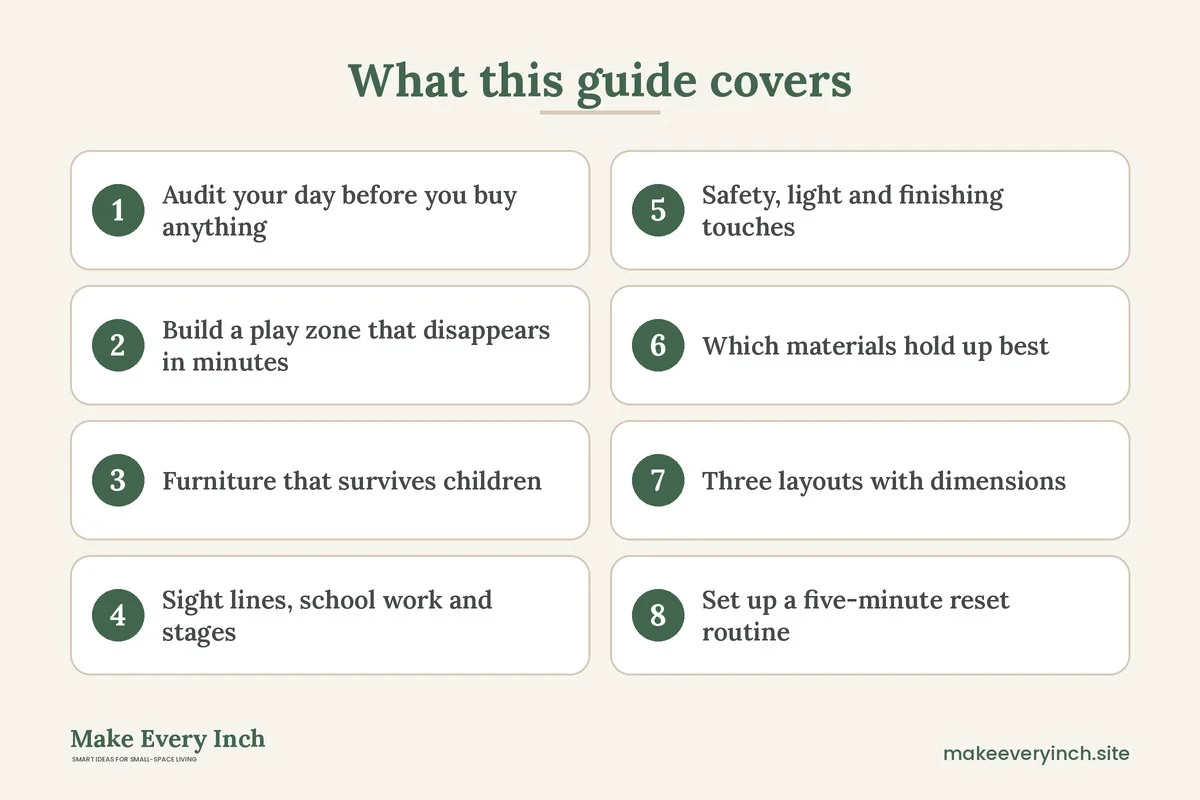
Small apartment living room ideas for families have to do more than look good in a photo. The same 150 square feet is a play area at 7 a.m., a homework table at 4 p.m., a movie theater on Friday and a place for adults to sit down at 9 p.m. This guide is built around that daily cycle. It covers a quick audit of how your family really uses the room, 21 ideas grouped by job, three layouts with dimensions, a table of kid-proof materials, a toy rotation method, safety basics for each age and a budget guide. If you want the general rules for any small living room first, read our pillar guides on small living room ideas and small apartment living room ideas. This post stays with the family angle.
Audit your day before you buy anything
Spend one ordinary weekday noticing where everyone ends up. Write down where the baby naps or plays, where the school-age child spreads out, where the adults sit and which spots collect clutter. Most families find that the floor in front of the sofa does the heaviest work, and that the real trouble is not a lack of space but a lack of a daily reset.
Then measure. Note the room length and width, the door swings, the window wall and the distance from the sofa to the TV. Mark a clear path of at least 30 inches from the door to the kitchen, because a family walks that path carrying laundry baskets, backpacks and hot food. Everything else is negotiable. The goal is a room where the floor is open for play and the adult seating still works when the toys are put away.
Build a play zone that disappears in minutes
1. Use a rug as the play boundary
A 5 by 8 or 6 by 9 foot rug marks where play happens and where it stops. Kids learn that toys live on the rug, and a reset means sweeping everything back onto it and into bins. Pick a low pile in a mid-tone or a pattern, because a pale solid shows every juice spill.
2. Put bins on a low, sturdy bench
A bench about 15 to 18 inches tall with cubbies holds six to eight fabric or plastic bins and doubles as seating at a play table or at the window. Label bins with pictures for toddlers and with words for readers. A bin that the child can open alone is a bin that actually gets used.
3. Choose a storage ottoman over a coffee table
A large storage ottoman gives you a padded, rounded surface for feet and snacks, plus a hidden box for blankets and the toys that make a mess. A tray on top turns it into a table for adults. See also best storage ottomans for what to check before buying.
4. Roll a toy cart into the closet
A narrow rolling cart, about 12 inches wide, can hold the daily toys and slide into a closet or behind a door at bedtime. This is the fastest hide-away option because one push clears the room. Look for a cart with locking casters so it cannot roll when a toddler pulls on it.
5. Rotate toys instead of storing all of them
Keep only about a quarter of the toys in the living room at a time, and store the rest in labeled boxes under a bed or on a closet shelf. Swap one box every week or two. Kids play longer with fewer toys that feel new again, and the room needs fewer bins. See under bed storage ideas for where the spare boxes can go.
6. Add a wall-mounted or leaning book display
Front-facing book ledges, 3 to 4 inches deep, let small children see covers and pick books themselves. Where you cannot drill, use a freestanding rack that is anchored to the wall with the strap it ships with. A book corner with one floor cushion pulls kids away from the TV without any nagging.
Furniture that survives children
7. A sofa with washable covers
Choose a sofa with removable, machine-washable covers or a performance fabric that is rated for heavy wear and wipes clean. Skip delicate velvet, loose weaves that catch fingernails and white linen. Depth matters for small rooms, so aim for a seat depth of 20 to 22 inches, which suits adults and is easier for kids to climb off.
8. Rounded edges everywhere kids walk
Round and oval tables, ottomans and soft-edge benches reduce the sting of a fall at toddler height. If you own a square coffee table, add clear corner guards or move it to the wall until the child is steadier. This is a common-sense measure, not a guarantee, and supervision still matters most.
9. A nesting table set for flexible surfaces
Two or three nesting tables slide apart for snacks and puzzles, then stack to take up one footprint. They are lighter than a single large table, so a parent can move them quickly when a toddler starts crawling toward the edge.
10. Anchor every tall piece
Bookcases, dressers, media units and tall shelves can tip when a child climbs on them. Use the wall anchors or tip-over straps that come with the furniture, fasten into a stud or use the right wall anchor for your wall type, and put heavy items low. In a rental, ask the landlord about anchor holes, which are small and easy to patch, because safety matters more than a perfect wall.
11. Choose a low, wide TV console
A console 16 to 20 inches deep with closed doors keeps remotes, game controllers and cables out of reach. Mount the TV to the wall if the lease allows it, or use a base that the manufacturer says is stable at your TV size. See small living room TV wall ideas for layouts that save floor space.
Sight lines, school work and stages
12. Seat the sofa to face the kitchen
In an open-plan apartment, the person cooking should be able to see the play rug. Place the sofa with its back to the entry or the bed side, and keep the line between kitchen and rug free of tall furniture. A low console works better than a bookcase as a room divider because it blocks feet, not eyes.
13. A homework spot that folds away
A wall-mounted drop-leaf desk, 18 to 24 inches deep, gives a school-age child a real surface without a permanent desk. Alternatively, a console table behind the sofa works for two stools. Keep a caddy with pencils, paper and a lamp so setup takes ten seconds, and clear it before dinner.
14. Floor seating for movie night
Stack three large floor cushions or a folding foam mattress in a closet, then pull them out in front of the TV. Kids get a nest, adults keep the sofa and nothing sits in the room all week. A washable duvet cover on the foam makes cleanup easy.
15. Plan for the baby stage
For crawlers, the key is a clean, open floor, a play mat that wipes down, covered outlets and a gate if the kitchen or the front door is close. Keep a low shelf for three or four toys and a basket for the rest. Avoid hanging cords from blinds in reach.
16. Plan for the toddler stage
Toddlers climb, so anchor furniture, choose a heavy bench rather than a light stool, and keep breakables above their reach. A small table and two chairs about 12 inches high gives them a place to color, and it can live under the window.
17. Plan for the school-age stage
Older kids need a surface for projects and a place for a backpack and shoes. Hooks at child height by the door, a shallow shelf for library books and a pinboard for the week’s schedule keep the main room calm. They also like a corner that is theirs, even if it is only a cushion and a lamp.
Safety, light and finishing touches
18. Manage cords and blinds
Use cord winders or wall-mounted cordless blinds, tie up charger cables behind furniture and tuck lamp cords into a channel along the baseboard. Corded window coverings are a known strangulation hazard for young children, so choose cordless styles or keep cords short and out of reach, as product safety guidance advises.
19. Layer the lighting
A bright overhead light is useful for cleanup, but evenings work better with a lamp on a dimmer or a warm bulb. Place lamps on stable surfaces away from the edge, use heavy bases and put cords behind furniture. See small living room lighting ideas for fixtures that fit tight rooms.
20. Use vertical space for adult stuff
Move the things children should not touch up high: candles, electronics, art supplies and medicine. A high shelf at 60 inches or above works well, as long as it is secure. This leaves the lower shelves for kid-friendly items and keeps the floor clear.
21. Give adults a spot that stays adult
Reserve one chair, one corner of the sofa or one small side table for yourself. Keep a lamp, a book and a throw there. A visible adult corner makes it easier to tidy the room back to a place you want to be after bedtime.
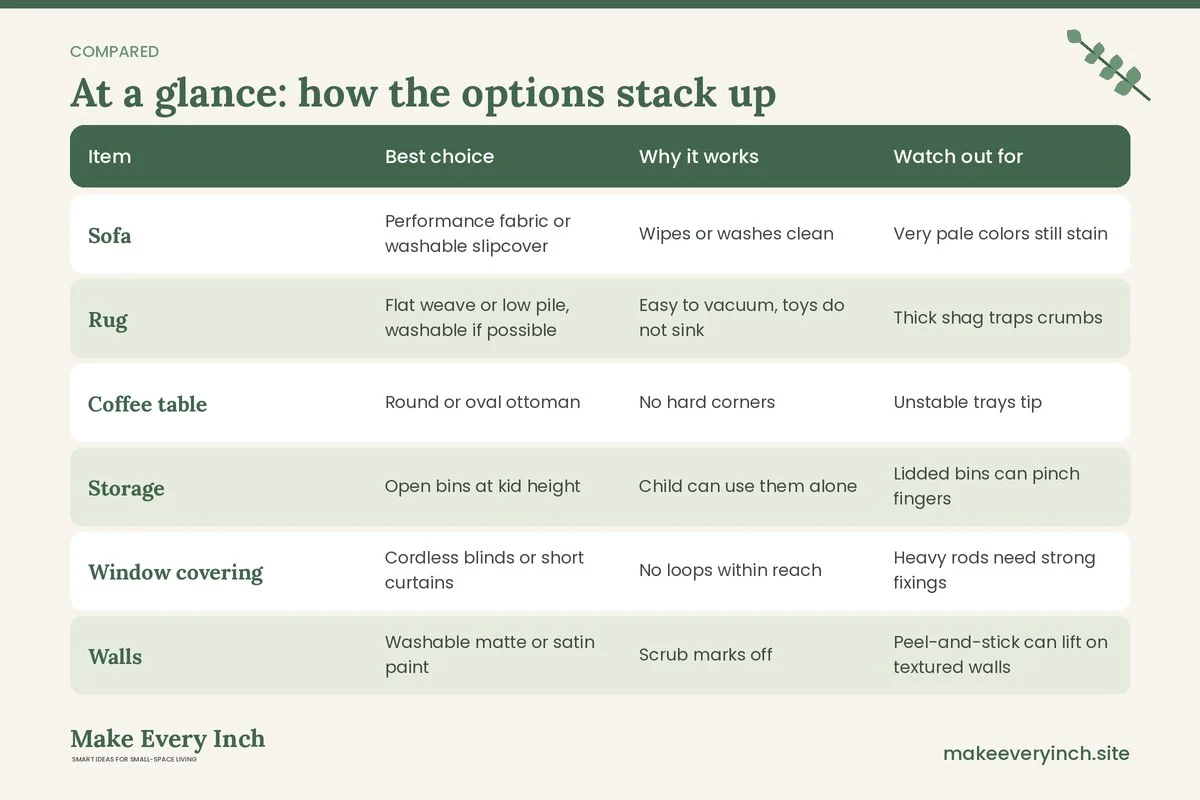
Which materials hold up best
| Item | Best choice | Why it works | Watch out for |
|---|---|---|---|
| Sofa | Performance fabric or washable slipcover | Wipes or washes clean | Very pale colors still stain |
| Rug | Flat weave or low pile, washable if possible | Easy to vacuum, toys do not sink | Thick shag traps crumbs |
| Coffee table | Round or oval ottoman | No hard corners | Unstable trays tip |
| Storage | Open bins at kid height | Child can use them alone | Lidded bins can pinch fingers |
| Window covering | Cordless blinds or short curtains | No loops within reach | Heavy rods need strong fixings |
| Walls | Washable matte or satin paint | Scrub marks off | Peel-and-stick can lift on textured walls |
| Floors | Vinyl plank, sealed wood, or a rug over carpet | Spills wipe up | Slippery rugs need a pad |
Three layouts with dimensions
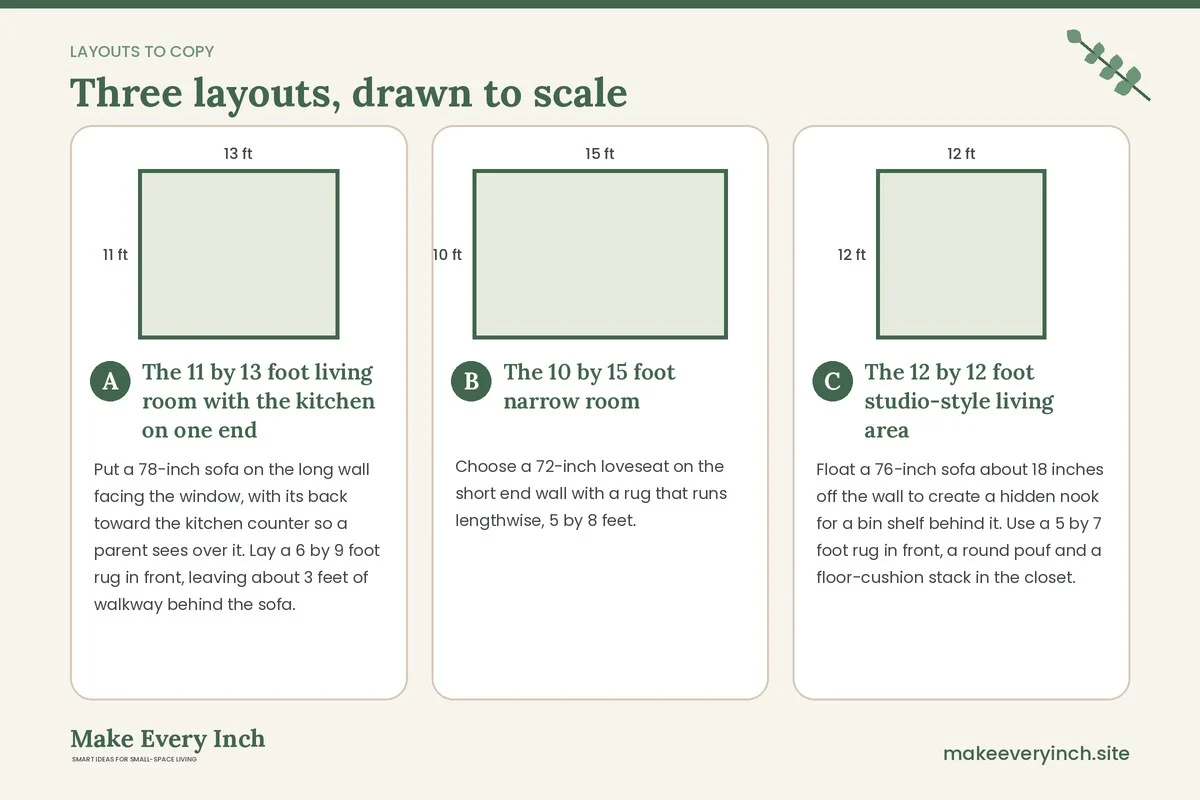
The 11 by 13 foot living room with the kitchen on one end
Put a 78-inch sofa on the long wall facing the window, with its back toward the kitchen counter so a parent sees over it. Lay a 6 by 9 foot rug in front, leaving about 3 feet of walkway behind the sofa. Place a storage bench under the window, a round ottoman in the middle and a 40-inch console on the short wall for the TV. The rug becomes the play zone, and you keep a clear 36-inch path to the kitchen.
The 10 by 15 foot narrow room
Choose a 72-inch loveseat on the short end wall with a rug that runs lengthwise, 5 by 8 feet. Use the long wall for a shallow 12-inch deep bookcase, anchored to the wall, and a drop-leaf desk at the window end that is 20 inches deep. The TV sits on a low console on the opposite short wall. This leaves roughly 40 inches of floor on the window side for a toy cart and the walkway.
The 12 by 12 foot studio-style living area
Float a 76-inch sofa about 18 inches off the wall to create a hidden nook for a bin shelf behind it. Use a 5 by 7 foot rug in front, a round pouf and a floor-cushion stack in the closet. Mount the TV on the long wall, and use a folding table on one side that opens for homework and meals. Keep a 30-inch minimum path to every door.
Set up a five-minute reset routine
A system matters more than a perfect storage plan. Try this routine each evening with kids who are old enough to help. First, toys go back to the rug, then into the bins. Second, blankets and cushions return to the ottoman or the closet. Third, a basket collects items that belong in other rooms, so the rest of the room clears quickly. Fourth, a quick wipe of the table and a sweep of the floor under the sofa. Use a timer and a song, because five minutes feels like a game.
A weekly step is the toy rotation. Pick a day, put away the toys that have not been touched, and bring out the box that has been resting. A family that does this stops adding bins and starts keeping the room open.
Teach kids the system
Small children copy what they see. Show them where each thing lives, and use pictures on bins until they read. Praise the putting away rather than the result. Keep the number of bins low, because ten categories fall apart quickly while three or four hold. Let children choose which toys are in this week’s box, which gives them a sense of ownership and makes the rotation less of a fight.
Budget guide
Prices vary by city and brand, so treat these as rough ranges in US dollars.
Under $150
A washable rug, fabric bins, cord winders, anchoring kits and floor cushions. Second-hand benches and nesting tables are easy to find and sand smooth.
$150 to $600
A storage bench, a storage ottoman, a rolling cart, a drop-leaf desk and a cordless blind. This is where most families get the biggest change in daily function.
$600 to $1,500
A washable or performance sofa, a good rug, a low console and proper lighting. Buy the sofa last, and measure the door and the stairs first.
Mistakes to avoid
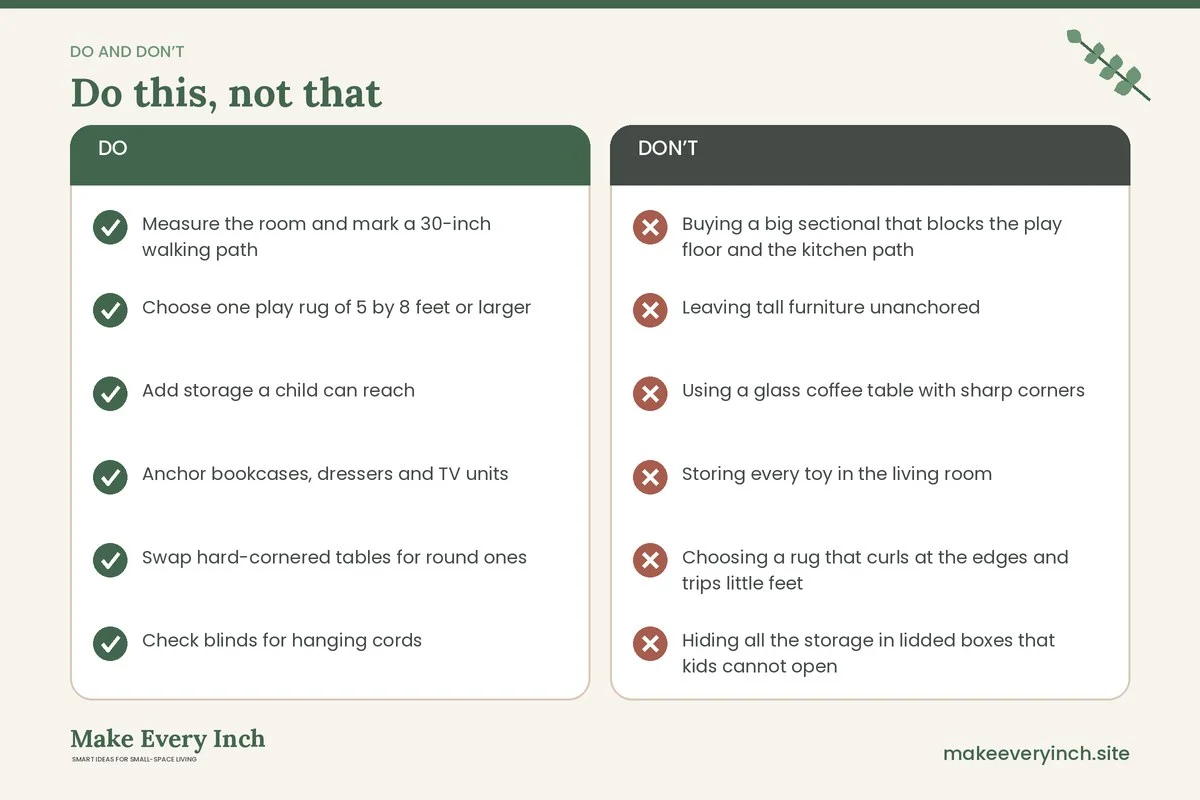
- Buying a big sectional that blocks the play floor and the kitchen path
- Leaving tall furniture unanchored
- Using a glass coffee table with sharp corners
- Storing every toy in the living room
- Choosing a rug that curls at the edges and trips little feet
- Hiding all the storage in lidded boxes that kids cannot open
- Forgetting an adult seat that is not covered in toys
- Leaving cords from blinds, chargers or lamps within reach
Family living room checklist
- Measure the room and mark a 30-inch walking path
- Choose one play rug of 5 by 8 feet or larger
- Add storage a child can reach
- Anchor bookcases, dressers and TV units
- Swap hard-cornered tables for round ones
- Check blinds for hanging cords
- Cover unused outlets and tidy cables
- Set up a quick homework caddy
- Store floor cushions for movie night
- Pick a weekly day for toy rotation
- Keep one adult-only seat
- Photograph the room, then review the setup every six months as kids grow
FAQ
How do I fit a play area into a small living room?
Use a rug as the boundary, store most toys in bins on a low bench and keep only a quarter of the toys out. A rolling cart lets you clear the floor in one push.
What sofa is best for a family in a small apartment?
Pick a compact sofa, 72 to 80 inches wide, with a washable cover or performance fabric and a seat depth near 20 to 22 inches. Test the cushions for firmness so adults can stand up easily.
How can I stop toys from taking over?
Limit what is out, rotate the rest and give each type of toy a labeled bin. Three or four bins hold better than ten, and a short nightly reset keeps the system going.
Is a coffee table safe with a toddler?
A soft-edged or round ottoman is a safer choice than a glass or square table. Whatever you choose, supervise and add corner guards where needed.
How do I anchor furniture in a rental?
Use the straps or brackets that come with the furniture, and ask your landlord about small anchor holes. They are easy to patch, and tip-over prevention is a standard recommendation for homes with children.
Where can kids do homework in a tiny living room?
Try a drop-leaf desk, a console behind the sofa or a folding table. Keep supplies in a caddy so the surface clears quickly.
How do I set up a movie night with little space?
Store floor cushions and a foam mat in the closet, pull them out in front of the TV and move the ottoman aside. Everyone gets a spot without a bigger sofa.
How do I keep the room looking good with kids?
Choose a calm palette, use closed storage for adult items and keep a short list of things that must be put away every evening. A few well-chosen pieces look better than many small ones. For more ideas on budget, see small apartment living room ideas on a budget.
Keep going: Explore our small living room storage ideas, small living room layout ideas and small apartment living room ideas for couples.
Save this guide for later
Pin the ideas you like to Pinterest so you can come back to them when you plan your space.