Convertible Furniture Ideas for Studio Apartments
Quick answer: The best convertible furniture ideas for studio apartments are pieces that change role without a tool: a sofa that becomes a bed, a wall bed, a drop-leaf or extending table, a lift-top coffee table, a desk that folds shut and nesting stools. Measure the open footprint, not just the closed one, leave roughly 24 to 36 inches of clearance where a piece unfolds, anchor anything tall, and check the lease before you fix anything to a wall.
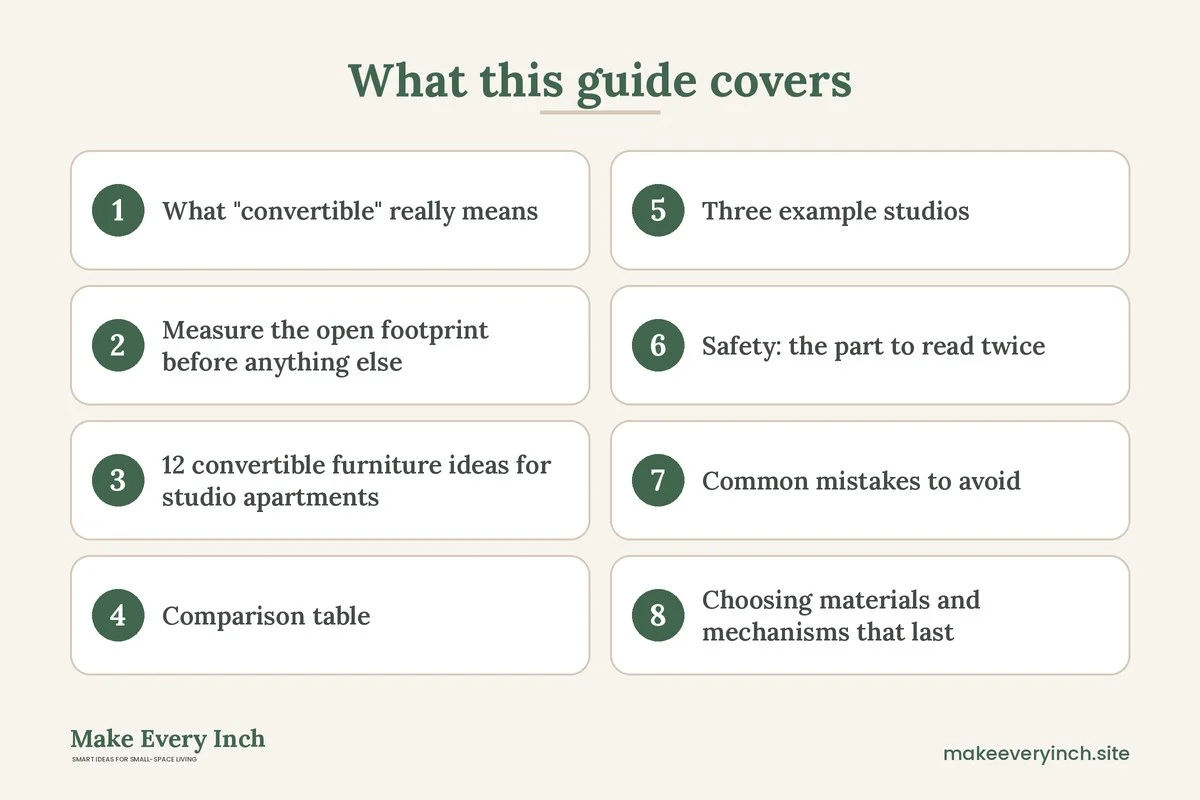
Convertible furniture ideas for studio apartments start from one fact: in a single room, every square foot has to work at least two jobs, and often three. The bed has to disappear by day, the dining table has to become a desk, and the sofa has to host an overnight guest. Furniture that converts lets one footprint do all of that in sequence instead of asking you to buy a separate piece for each job. This guide explains how conversion works, what to measure before you commit, 12 types of convertible pieces, a comparison table, three example studios, the safety points that people skip and a checklist. For the wider buying picture, read our pillar on the best furniture for small apartments, and for layouts that suit these pieces, see studio apartment furniture ideas.
What “convertible” really means
Convertible is a loose word, so it helps to split it into three kinds. Knowing which kind you are buying tells you what can go wrong.
- Transforming pieces change shape: a sofa bed unfolds, a table extends, a desk flips open. They have moving parts such as hinges, slides, springs and locks.
- Hidden pieces tuck away: a wall bed lifts into a cabinet, a fold-down desk closes into a shelf. They are fixed to a wall or a frame.
- Role-swapping pieces do not move at all but serve two purposes: a bench that is also a trunk, an ottoman that is also a table. They are the lowest risk because nothing can pinch a finger.
A studio usually benefits from one big transformer, usually the sleeping piece, and a handful of simple role-swappers. Too many moving parts become a daily chore, and a piece you dread opening is a piece that stays half open and blocks the floor.
Measure the open footprint before anything else
The mistake that ruins most convertible purchases is measuring only the closed size. A convertible piece lives in two states, and the open state is the one that decides whether the room works.
The numbers to write down
- Closed footprint: width and depth when the piece is at rest.
- Open footprint: width and depth when fully deployed. A sofa that opens into a bed can nearly double its depth. A wall bed projects roughly the length of the mattress from the wall.
- Swing or fold path: the arc a door, leaf or lid sweeps while it moves. Mark it on the floor with tape.
- Clearance beside the open piece: about 24 to 36 inches on at least one long side, so a person can get in and out or walk past. In a very tight room 18 to 20 inches may be tolerable for a short pass, but it feels cramped for daily use.
- Door and path check: the opened piece should not block the entry door, the bathroom door, the oven or a closet.
- Ceiling and wall height: a wall bed or a fold-up unit needs clear height on the wall, and light fixtures, sprinklers, sloped ceilings and vents can interfere.
Cut paper or cardboard to the open footprint and lay it on the floor. Live with it for a weekend, stepping around it as you would in real life. If the cardboard makes the room unusable, the piece will too.
The weight and reach check
Many convertible pieces need a person to lift, pull or push a part. A hidden bed may be counterbalanced, a sofa mechanism may need a firm pull, and a table leaf may be heavy. Try to handle the mechanism in a showroom or read the manufacturer’s stated operating instructions and weight. If the daily action feels like effort at the store, it will feel worse on a tired evening.
12 convertible furniture ideas for studio apartments
Pieces that handle the bed
1. A sofa bed or sleeper
The classic answer. The seat and back unfold into a sleeping surface. Look at the mattress thickness, the support under it and whether the frame is metal or wood. A thin mattress over a bar can be uncomfortable for more than a night or two, so these suit guests better than a daily sleeper. Check that the open depth fits your room with 24 inches or more on one side.
2. A futon style frame
A futon frame has a seat position and a flat position. It tends to be lighter and simpler than a sofa bed, with fewer parts that can fail. It suits a studio where the sleeper is the main bed only if you pick a mattress made for daily use.
3. A daybed with a trundle
A daybed reads as a sofa by day. A trundle slides out from beneath for a second sleeper. This is a strong choice for a studio where the bed is the sofa, because there is no mechanism to fold. Sizes vary, so check whether the trundle needs 30 or more inches of clear floor in front.
4. A wall bed (also called a Murphy bed)
A wall bed pivots up into a cabinet, freeing the floor in the daytime. It is the most space-efficient answer for a single sleeper or a couple, and some units include a desk or a sofa. It is also the piece with the strictest safety rules, covered below. For layout ideas, see studio apartment ideas with a Murphy bed.
5. A storage platform bed
This is a role-swapper rather than a transformer. Drawers or a lifting platform hide bedding, off-season clothes and extra linen. It does not clear floor space like a wall bed, but it removes the need for a separate dresser. For buying advice, read our guide to the best beds with storage.
Pieces that handle the table
6. A drop-leaf table
Two hinged leaves fold down so the table can sit against a wall at 8 to 12 inches deep. With leaves up it seats two to four. Look for sturdy support brackets and leaves that lock in place. Rounded corners are kinder in a tight room.
7. An extending table
A table that slides apart to add a leaf suits a studio that hosts occasionally. A common pattern is a table of about 30 inches in its closed length that grows to 50 or more with a leaf. Store the spare leaf flat behind a wardrobe or under the bed. For related options see the best small dining tables.
8. A lift-top coffee table
The top lifts and slides forward to make a desk or an eating surface at a more comfortable height, with storage inside. It is a good pick if the studio has no room for a separate desk. Check that the lifting arms feel stable, since a weak mechanism wobbles under a laptop.
9. A wall-mounted fold-down table or desk
A leaf attached to the wall that folds flat when you are done. It takes almost no floor space. It does need a secure fixing, so read the safety section before you drill anything. A good alternative for a rental is a freestanding drop-leaf, see how to fit a desk into a studio apartment.
Pieces that handle the rest
10. Nesting tables and stools
Nested pieces take the footprint of one and can spread to serve three or four people. Stools that double as side tables, extra seats and plant stands are the cheapest conversion in the room and carry no moving parts.
11. A storage ottoman or bench
An ottoman can be a seat, a footrest, a side table with a tray, a hidden storage box and, in a pinch, a bed for a child. A bench at the end of the bed can hold blankets and double as an entry seat. See the best storage ottomans.
12. A room divider that is also storage
A tall open shelf placed between the sleeping area and the living area splits the studio visually and stores books and baskets. It is a convertible in the sense that it has two jobs. Back it with a panel if you want privacy, and anchor it. For ideas see studio apartment ideas with a room divider.
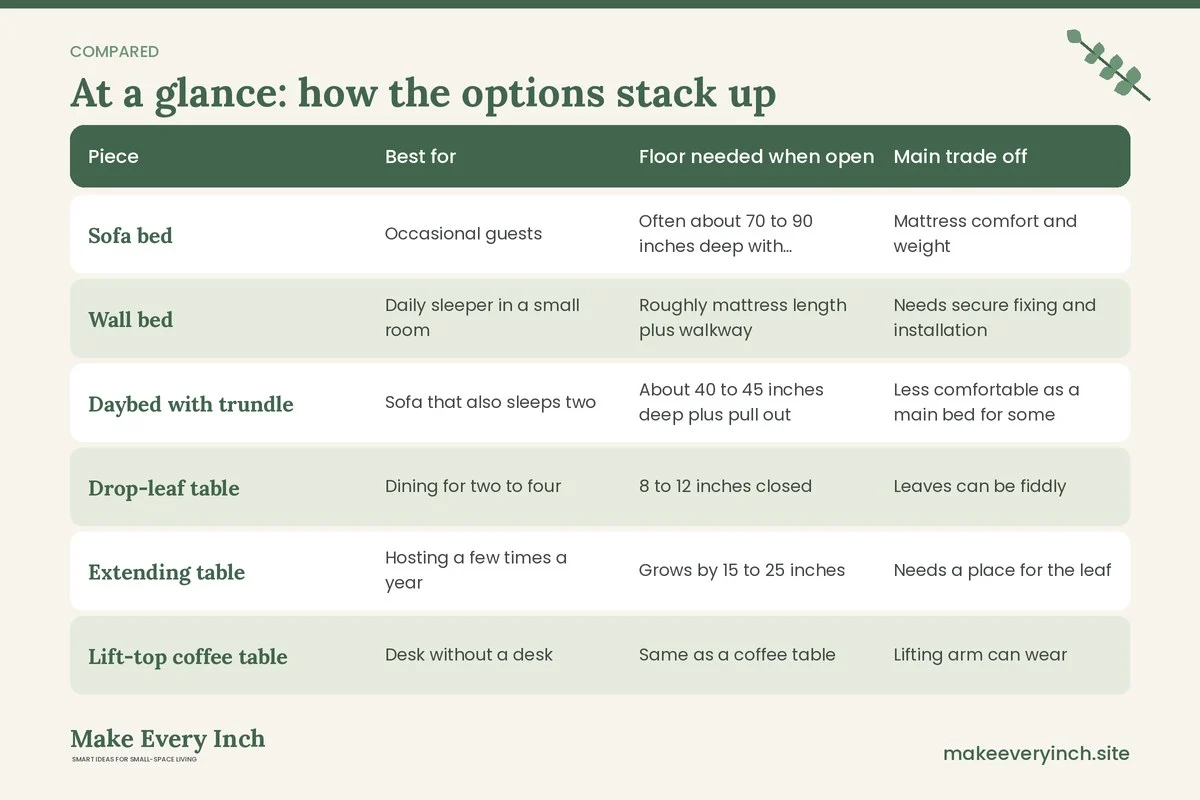
Comparison table: which convertible fits which problem?
| Piece | Best for | Floor needed when open | Main trade off | Effort per day | |
|---|---|---|---|---|---|
| Sofa bed | Occasional guests | Often about 70 to 90 inches deep with clearance | Mattress comfort and weight | Medium | |
| Wall bed | Daily sleeper in a small room | Roughly mattress length plus walkway | Needs secure fixing and installation | Low to medium | |
| Daybed with trundle | Sofa that also sleeps two | About 40 to 45 inches deep plus pull out | Less comfortable as a main bed for some | Low | |
| Drop-leaf table | Dining for two to four | 8 to 12 inches closed | Leaves can be fiddly | Low | |
| Extending table | Hosting a few times a year | Grows by 15 to 25 inches | Needs a place for the leaf | Medium | |
| Lift-top coffee table | Desk without a desk | Same as a coffee table | Lifting arm can wear | Low | |
| Fold-down wall desk | Laptop work in a nook | Almost none when closed | Fixing to wall, lower load limit | Low | |
| Nesting set | Flexible extra surfaces | Smaller than any single table | Surfaces are small | Very low |
Figures are rough ranges to guide planning. Always use the manufacturer’s real dimensions, since pieces vary widely.
Three example studios
Example 1: A 350 square foot studio for one person who works from home
The sleeping piece is a wall bed with side shelves, placed on the short wall so it opens along the room’s length. By day the wall reads as a bookcase, and the floor is open for a rug and a small sofa. The workstation is a lift-top coffee table, so the sofa becomes the office. A drop-leaf table folded against the opposite wall serves lunch. With the bed down the walkway from the door to the kitchen stays about 30 inches, a figure to confirm with tape before buying. A second look at the plan shows the bed would block the closet door, so the closet clothing moves to an open rail beside the entry.
Example 2: A 450 square foot studio for a couple
A daybed with a trundle serves as both the sofa and the bed, so there is no single big conversion. The couple chooses an extending table that sits against the wall as a console at 14 inches deep and grows to a four seat table for hosting. Nesting tables beside the daybed replace the nightstands. A tall shelf divides the sleeping end from the kitchen end and is secured to the wall studs with the landlord’s consent. The unconverted state is a calm, hotel-like room, which makes the pieces feel permanent rather than temporary.
Example 3: A 300 square foot studio for a renter who cannot drill
The renter’s lease bans fixing anything to walls, so the plan avoids wall beds and wall-mounted desks. A sofa bed handles guests, a freestanding drop-leaf table is both the desk and the dining table, and a storage ottoman holds linen. A tall bookcase stays freestanding with an anti-tip strap that attaches to a stud only if the landlord approves it, and otherwise the shelving stays low, under about 36 inches, so it cannot tip onto a person. This is the simplest, least risky plan and it works well in a rental.
Safety: the part to read twice
Wall beds and anything that tilts
A wall bed is a heavy piece that stores a lot of energy in springs or pistons. It must be fixed to wall studs or the structure the manufacturer specifies, using the hardware that comes with it, and installed exactly to the instructions. If you do not have the skills, hire a qualified installer. Never install a wall bed on a wall you have not identified as sound, and never in a rental without written permission. Keep children and pets clear while it moves, and do not let anyone sleep on a partly lowered unit. If a mechanism feels stiff, loose or uneven, stop using it and contact the maker.
Anchor tall pieces
Any tall shelf, wardrobe or divider can tip, and a studio is often where small children visit. Use the anti-tip hardware that comes with the piece, fixed into a stud or with the correct anchor for your wall type. If you cannot drill, choose lower pieces, put heavy items on the bottom shelves and keep the unit against a wall with its weight at the base.
Pinch points and fingers
Hinges, scissor mechanisms, folding legs and sliding leaves all create pinch points. Fold and unfold slowly, keep hands on the outer edges and not in the gaps, and check that locks click before you put weight on a surface. Teach every adult in the home the correct way to operate a piece. Do not let small children play with folding mechanisms.
Wall-mounted load limits
A fold-down desk or table is only as strong as its fixing. Check the stated load limit, the wall construction and the stud spacing. Standard studs are often around 16 inches apart, though old buildings vary, so confirm with a stud finder. Do not mount to plasterboard alone unless the manufacturer’s hardware is designed for it, and keep the load within the limit including a laptop, a monitor and a person leaning on it.
Lease permission and no drilling without it
Read your lease. Anything that needs drilling, anchoring or removing a section of baseboard needs written permission. If you do not have it, buy freestanding pieces. Holes, even small ones, can cost a deposit, and unauthorized modifications can breach the lease.
Electrical and lighting
Convertible pieces with built-in lights or outlets should have cords that are not pinched in the mechanism. Do not run extension cords under rugs or through a closing hinge. Use a surge protector with a cord that has slack for the movement.
Common mistakes to avoid
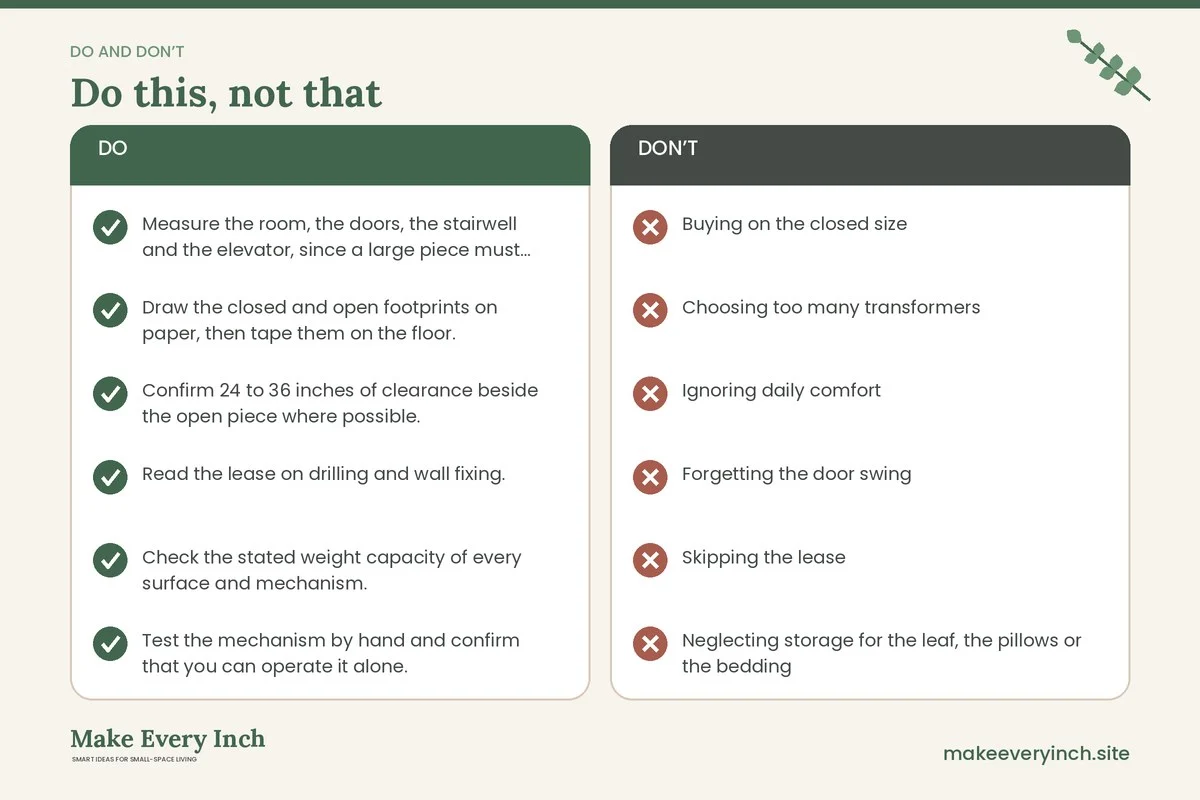
- Buying on the closed size: measure the open footprint and the swing path.
- Choosing too many transformers: one or two moving pieces are enough.
- Ignoring daily comfort: a sofa bed that is fine for guests may be poor for nightly use.
- Forgetting the door swing: if the entry door hits the opened bed, the plan fails.
- Skipping the lease: wall mounted pieces need permission.
- Neglecting storage for the leaf, the pillows or the bedding: the conversion needs a place to put the parts.
- Letting the room stay half converted: pick pieces that take under a minute to reset, or you will leave them open.
Choosing materials and mechanisms that last
Frames in solid wood or sturdy metal usually handle repeated opening better than thin particle board. Look at how the hinges are attached, since screws into thin board can loosen with use. Gas lifts and springs should feel smooth and hold the position at any angle. Check whether replacement parts are available. For upholstered pieces, a tight weave and removable covers help with cleaning. For a table, a laminate or sealed finish resists drinks, and a matte surface hides scratches. Because a convertible piece does more than one job, it also suffers more wear, so favor simple mechanisms over clever ones.
A short purchase checklist
- Measure the room, the doors, the stairwell and the elevator, since a large piece must arrive.
- Draw the closed and open footprints on paper, then tape them on the floor.
- Confirm 24 to 36 inches of clearance beside the open piece where possible.
- Read the lease on drilling and wall fixing.
- Check the stated weight capacity of every surface and mechanism.
- Test the mechanism by hand and confirm that you can operate it alone.
- Pick one transformer and a few role swappers rather than many.
- Plan where bedding, leaves and cushions are stored.
- Anchor any tall piece, or choose a low piece instead.
- Set a daily reset routine of under two minutes.
FAQ
What is the best convertible piece for a small studio?
There is no single best, but a wall bed gives the most floor space back if you can fix it safely, and a daybed with a trundle is the simplest if you cannot drill.
Can a sofa bed be my everyday bed?
Some can, if the mattress is designed for nightly use. Many are made for occasional guests, so check the mattress thickness and the support before relying on one every night.
How much space do I need around a convertible piece?
As a guide, about 24 to 36 inches on at least one side of the open piece, and enough to keep doors and appliances clear. In very tight rooms, test with tape and adjust.
Are convertible pieces safe for renters?
Freestanding ones, such as sofa beds, drop-leaf tables and nesting sets, are the lowest risk. Wall mounted ones need written permission from the landlord.
Do convertible pieces break easily?
Moving parts wear out faster than fixed parts, so choose simple mechanisms, solid frames and parts that can be replaced, and operate them gently.
How do I decide between a wall bed and a sofa bed?
Pick a wall bed if you sleep in the room every night and own or have permission to fix the wall. Pick a sofa bed if the studio mostly needs a seat and the bed is for guests.
Keep going: Keep going with the best furniture for small apartments, the studio apartment ideas guide and our small space organization ideas for more ways to make one room do more.
Save this guide for later
Pin the ideas you like to Pinterest so you can come back to them when you plan your space.