15 Small Balcony Furniture Ideas for Safe, Comfortable Seating
Quick answer: The best small balcony furniture is light enough to move, low enough to stay clear of the railing, and sized to leave a 24 to 30 inch path. Choose foldable or stackable pieces, keep seats away from the railing, check the building’s weight and lease rules before you buy, and anchor or weigh down anything the wind could lift.
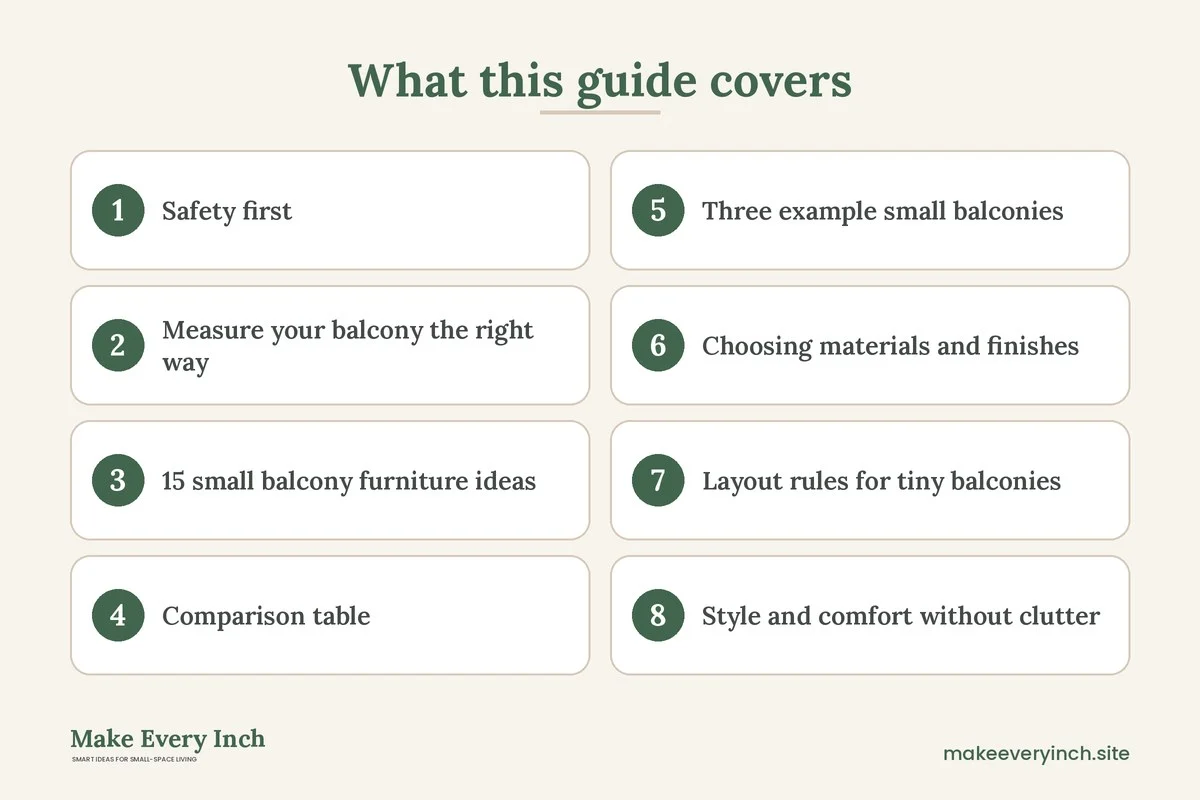
Small balcony furniture has a harder job than furniture indoors. It has to fit in a footprint that is often only 4 to 6 feet deep, survive sun, rain and wind, and stay safe at height. A good setup turns a narrow slab of concrete into a real second room, and a careless one turns it into a hazard. This guide walks through the safety checks first, then measuring, 15 furniture ideas, a comparison table, three example balconies, materials, layout rules and a checklist. For the full overview of outdoor spaces this size, start with our pillar guide to small balcony ideas, and when you are ready to deal with the clutter that builds up out there, see the companion post on small balcony storage ideas.
Safety first: read this before you buy anything
A balcony is not a floor like any other. It is a structure hanging off or standing beside a building, and it has limits. Treat the points below as the first step of your plan, not an afterthought.
- Check the weight limit. Balconies and decks are designed for a certain load, and the number is not the same everywhere. Ask your landlord, building manager, HOA or a local building office what the balcony is rated for. Do not guess. People, planters full of wet soil, water-filled bases and heavy stone tables add up faster than most people expect, so keep the total modest and spread the weight out instead of piling it in one spot.
- Respect the railing. Railings protect adults, but they can be a climbing risk for children and pets. Low furniture, planters, storage boxes and chairs placed against the railing work like steps. Keep seats, benches and anything a child could climb at least 3 feet from the railing, and never put a table or chair where a small person can use it as a ladder. If you have young children or a pet that climbs, ask your building about rules and options for gaps in the railing before you let anyone out there alone.
- Think about wind and tip-over. The higher the floor, the stronger the gusts. Lightweight chairs, umbrellas and tall narrow tables can slide, tip or blow off the balcony and hurt someone below. Choose stable, low-slung pieces, fold and stow items when you are away, and skip large umbrellas on upper floors unless the building permits them and you can secure them properly.
- Secure anything that could fall. Cushions are harmless, but pots, trays, lanterns and side tables can become projectiles. Nothing should sit on the railing top, on a ledge or on an unsecured shelf.
- No grills or open flame unless allowed. Many leases, fire codes and HOAs prohibit charcoal grills, gas grills, fire pits, patio heaters and sometimes even candles on balconies. Read the lease and your local rules. When in doubt, do not use them. Electric or flameless options are only suitable if the building allows them.
- Electrical safety. Use only outdoor-rated string lights and extension cords, plug into a GFCI-protected outlet where possible, and never overload a socket or run a cord through a door so that it gets pinched. Skip real candles near cushions and curtains, and choose battery-powered flameless candles with the building’s permission in mind.
- Water and drainage. Do not hose down the balcony or let watering overflow to the floor below. Check where the drain is, keep it clear, and put saucers or trays under planters. Water damage to the neighbours below is a common reason for complaints.
- Toxic plants. If you grow plants beside your furniture, check that they are safe for the children and pets who will use the space. Several common ornamental plants are harmful if chewed or swallowed. Ask a vet or a reliable poison-control resource if you are unsure.
- Sun and heat. Dark metal frames and dark cushions can get hot enough to burn skin or damage a pet’s paws in direct sun. Choose lighter finishes where you can, add shade, and test a surface with the back of your hand before anyone sits down.
- Permission. Read the lease and any HOA rules for what is allowed on a balcony. Do not drill into railings, walls, floors or the building’s structure without written permission. Everything in this guide can be done without drilling.
Measure your balcony the right way
Before you look at a single chair, draw your balcony on paper. You need the real dimensions and the real obstacles, not a rough guess.
1. Measure the usable floor. Measure the depth and width in inches, and then subtract the space taken by the door swing, the drain, any support posts and the railing base. Many balconies have a clear depth of 3.5 to 6 feet.
2. Mark the door swing and the walkway. Keep a clear path of at least 24 inches from the door to the seat and to wherever you need to go, such as a drain or a water tap. A path of 30 inches feels comfortable.
3. Check the height of the railing. Note whether it is solid, bars or glass, because that changes how much you can see from a seated position and what is safe to place near it.
4. Note sun and wind. Find out where the sun falls in the morning and afternoon, and whether the wind funnels along the wall. This decides what you can leave out and what must be stored.
5. Tape it out. Use painter’s tape on the floor to outline each piece of furniture. Stand in it for a few minutes. If the door cannot open fully or you must shuffle sideways, the furniture is too big.
A useful rule is to subtract 24 to 30 inches of walkway from the depth of the balcony. What remains is the depth available to furniture. On a balcony with a clear depth of 4 feet, that leaves around 18 to 24 inches, which suits a bench, a slim bistro table or two folding chairs, and not much more.
15 small balcony furniture ideas
Seating that saves space
1. Folding chairs that hang on the wall or lie flat
Folding chairs are the easiest way to keep a small balcony open. Open them when you want to sit, and fold them against a wall when you do not. Choose a style that locks securely open, and store them folded when you leave the balcony so wind cannot toss them around. Do not hang anything from the railing without permission.
2. A stackable pair
Two stackable chairs take up the footprint of one when you are not using them. Look for chairs with a wide, stable base and a seat height of around 16 to 18 inches. Stack them against the wall when the weather turns, and weigh the stack with nothing heavy that could slide.
3. A narrow bench
A bench 14 to 18 inches deep is one of the most efficient pieces of small balcony furniture. Seat two people along the wall, and use the space under it for storage. Place it against the wall, not against the railing, and make sure the back is not low enough to act as a step for climbing children.
4. A low lounge chair or floor cushions
If the balcony is wide but shallow, low seating keeps the view open and lowers the centre of gravity, which helps in wind. Floor cushions weather poorly and are easy to move, so choose a quick-drying outdoor fabric and bring them in during rain.
5. A corner seat
A small corner bench or a two-seat corner arrangement uses the dead space where two walls meet. It leaves the middle open, which makes the balcony feel larger. Keep it away from the railing and out of the door’s swing.
Tables that fit
6. A bistro table with a folding top
A table with a 20 to 24 inch top fits two coffees and a plate. Choose one that folds flat, and pick a version with a stable base that does not rock. Check the surface heat before leaving drinks in the sun.
7. A wall-mounted drop-leaf table
This is only an option if your lease and the building allow fixing something to the wall. If not, skip it and choose a freestanding fold-away table. Never drill into balcony walls or railings without written permission, and make sure the fixing method is suitable for outdoor weather.
8. Nesting tables
Two or three nesting tables slide together into a stack the size of one stool. Pull them apart for drinks or a book, and tuck them away when you want the floor free. They also let you place a table beside each seat without a large central table.
9. A stool that doubles as a table
A sturdy stool with a flat top can be a seat, a side table and a plant stand. Choose a heavy enough base that the wind cannot move it, and one with a rim or tray top so items do not slide off.
10. A railing table with permission
Some buildings allow clip-on or hook-on tables that sit on the railing. Many forbid them because anything on a railing can fall onto the people below. Check the rules before you consider one, and treat this as a last option, not a first.
Furniture that works twice
11. A storage bench
A bench with a lid hides cushions, a small watering can or spare chair pads from rain and prying eyes. Check that the lid does not slam on small fingers and that the bench is not heavier than the floor can sensibly hold when loaded. For more ways to organise the clutter, see our guide to small balcony storage ideas.
12. An ottoman or pouf
A weatherproof pouf is a footrest, an extra seat and a side table when you add a tray. Choose one with a washable cover and a base that drains.
13. A planter bench
A bench with built-in planters adds greenery without a separate stand. Keep it modest in weight, check that the drainage does not flow onto the neighbour below, and avoid plants that are toxic to pets and children if they may chew leaves.
14. A folding drying rack that doubles as a screen
If you hang laundry, a folding rack placed against a wall can also provide a visual screen. Check that the building allows laundry on balconies, because some do not.
15. A small outdoor rug
A rug is not furniture, but it defines the zone and makes bare feet comfortable. Choose a flat-weave outdoor rug that dries quickly, lay it so that it does not trip anyone at the door, and lift it regularly so water does not trap under it and stain the floor or drain onto the balcony below. For ideas on rug sizing indoors that translate outside, see how to choose rug size for a small living room.
Comparison table: which furniture suits which balcony
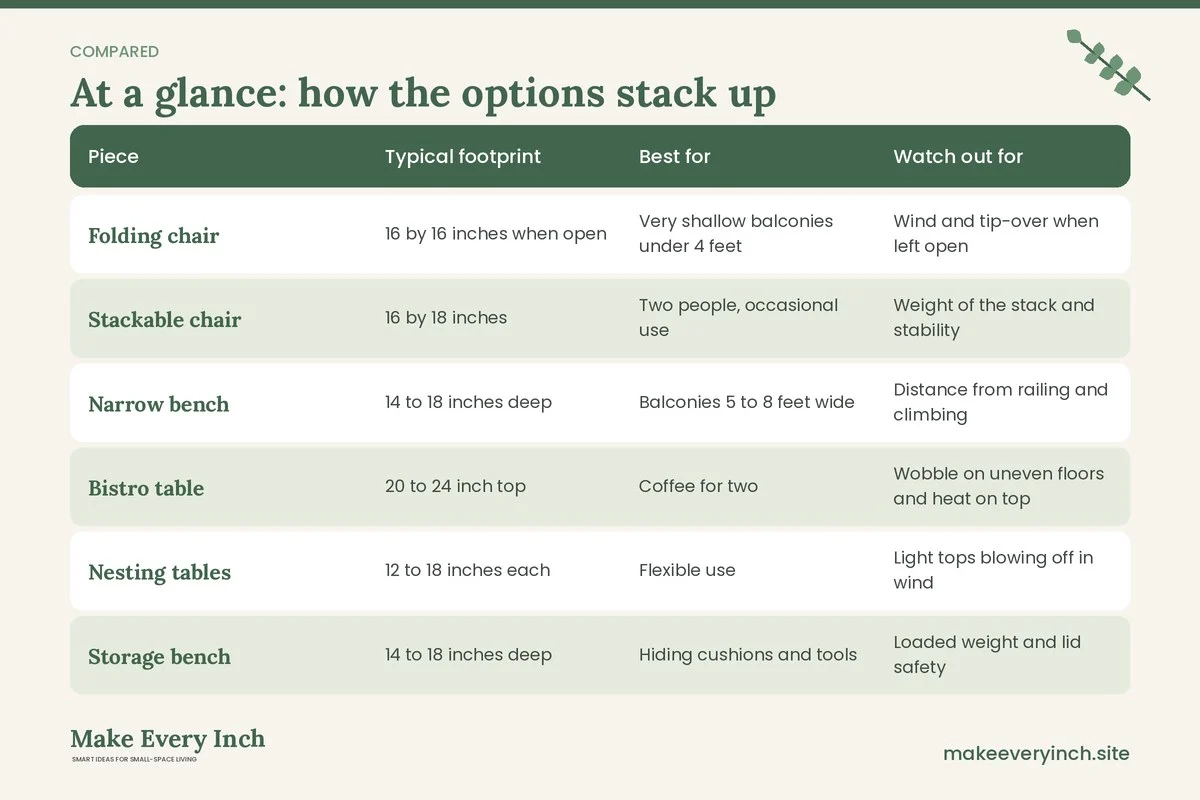
| Piece | Typical footprint | Best for | Watch out for |
|---|---|---|---|
| Folding chair | 16 by 16 inches when open | Very shallow balconies under 4 feet | Wind and tip-over when left open |
| Stackable chair | 16 by 18 inches | Two people, occasional use | Weight of the stack and stability |
| Narrow bench | 14 to 18 inches deep | Balconies 5 to 8 feet wide | Distance from railing and climbing |
| Bistro table | 20 to 24 inch top | Coffee for two | Wobble on uneven floors and heat on top |
| Nesting tables | 12 to 18 inches each | Flexible use | Light tops blowing off in wind |
| Storage bench | 14 to 18 inches deep | Hiding cushions and tools | Loaded weight and lid safety |
| Pouf | 14 to 18 inches across | Extra seat and footrest | Moisture and drainage |
| Low lounge chair | 24 to 30 inches wide | Wider balconies | Blocking the door swing |
| Outdoor rug | 3 by 5 or 4 by 6 feet | Defining a zone | Trapped water and trip hazards |
Three example small balconies
A shallow balcony, 3.5 by 8 feet
This is the narrow strip you find on many apartment buildings. With 24 inches reserved for walking, only about 18 inches remain. Mount nothing without permission. Choose a bench against the wall, 14 inches deep, with a stackable chair or two folding chairs that tuck behind it when not in use. Use a stool as a drinks table. Keep every seat at least 3 feet from the railing wherever you can, and if that is not possible on such a shallow space, choose seating that is too low and too small to climb, and supervise children closely or keep them off the balcony.
A medium balcony, 5 by 9 feet
There is room for a bistro table with a 22 inch top and two folding chairs, along with a slim planter at the wall end. Place the table off-centre toward the wall so the walkway runs along the railing side without any furniture touching it. Add a small outdoor rug to anchor the zone and a basket under the table for cushions. Keep the weight low, and check with the building before adding more than a few planters.
A wide corner balcony, 6 by 10 feet
A corner seat with a low table, a pouf or two, and a weatherproof rug makes a lounge. Keep a 30 inch route from the door to the far end. Put the tallest items, such as a narrow shelf with a lamp, against the wall and secure them to prevent tipping. Leave the railing zone clear, and do not stack planters on the ledge.

Choosing materials and finishes
Materials decide how long your furniture lasts and how safe it is.
- Powder-coated or aluminium frames are light and resist rust, but very light chairs can slide in the wind, so choose a wider base or add weight sensibly.
- Resin or synthetic wicker copes with rain and sun. Check that the frame underneath is rust-resistant.
- Hardwood or treated wood looks natural, though it needs regular care and may stain the floor beneath if it holds water. Use pads under the feet.
- Steel is strong but can rust and can get very hot in the sun.
- Plastic and resin are cheap, light and easy to clean, but may fade and may be too light for windy buildings.
- Fabric should be labelled as outdoor, quick-drying and UV-resistant. Foam inside should drain or dry fully, because trapped moisture grows mould.
Think about weight twice. A light chair is easier to move and to store, but a heavy one resists wind. On a high floor, the safest compromise is a medium-weight piece that you fold or stow when you are not outside.
Layout rules for tiny balconies
- Keep the door clear. The door must swing without hitting furniture, and in an emergency you should be able to get out quickly.
- Place seating against the wall. Back-to-wall seating keeps everyone away from the railing and frees the middle.
- Leave a straight path. A 24 to 30 inch walkway is easier to use than a winding one.
- Use vertical space carefully. Tall shelves help, but only if they are stable and secured. See vertical storage ideas for the logic, and apply it outdoors only with permission and secure anchoring.
- Create a single focal point. One plant, one lantern or one small rug is enough. A crowded balcony feels smaller and is less safe.
- Plan for emergencies. Do not block access to the door, any emergency exit route or the drain.
Style and comfort without clutter
Furniture only gets used if it is comfortable. Add a slim cushion to a bench seat, and choose outdoor fabrics in light colours that hide dust and reflect heat. Repeat one or two colours, such as green and cream, so the balcony looks calm. A few plants in lightweight pots add life. Choose lights that are rated for outdoor use and keep cords tidy. Shade matters more than most people expect: a simple shade cloth or a clip-on screen, used only if the building allows it, makes the space usable at midday.
If you also want your indoor rooms to flow into the balcony, repeat a colour or a material from your living room. Our guide to small living room ideas shows how to build a consistent look, and the same principles help a balcony feel connected.
Renting? Keep it removable
If you rent, the golden rule is that everything must come with you when you leave. Use freestanding furniture, weighted bases instead of fixings, and removable adhesive options only where the landlord approves. For more on this mindset, read our renter friendly apartment decorating ideas and the companion piece on renter friendly small balcony ideas. Photograph the balcony before you move anything in, so you can show its original condition when you leave.
Stretching a budget
You do not need to buy everything at once. Start with a seat and a small surface, live with the balcony for a few weeks, and add pieces only when you find a real need. Secondhand outdoor furniture can be a good source, as long as you check the frame for rust, wobble and sharp edges. For more strategies, see budget small space ideas and our look at thrifted furniture ideas for small homes.
Seasonal care and storage
Furniture lasts longer when you protect it. In winter or heavy storms, bring cushions indoors, fold chairs, and cover or stack what must stay out. Do not store flammable items, such as fuel or paint cans, on a balcony. If indoor space is short, a lidded bench or a small deck box holds cushions out of the rain. Clean frames with mild soap and water, rinse into a bucket instead of letting runoff drip onto the floor below, and let everything dry before storing it.
Common mistakes with small balcony furniture
- Buying a set that is too big. Sets are designed for patios. Measure first, and consider buying pieces separately.
- Ignoring wind. A pretty chair that blows over is a hazard.
- Pushing seating against the railing. It looks tidy but creates a climbing risk and increases the chance of a fall.
- Overloading with planters. Wet soil is heavy, and too many pots can exceed what the structure is meant to carry.
- Blocking the door. Always check the swing, even when the door is open.
- Using indoor furniture outside. Indoor fabrics and finishes break down in sun and rain.
- Forgetting the neighbours. Dripping water, noise and falling items affect the people below and beside you.
- Skipping the lease. A rule you did not read can cost you a deposit or a fine.
Balcony furniture checklist
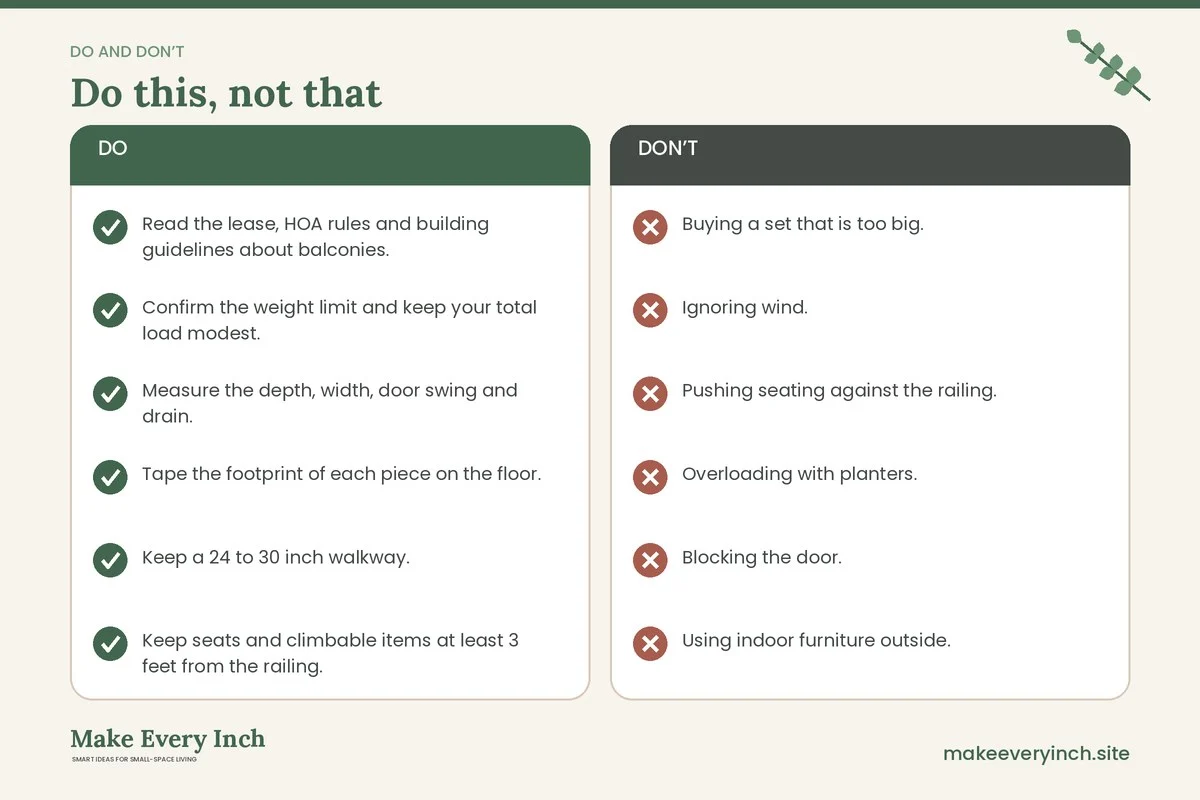
- Read the lease, HOA rules and building guidelines about balconies.
- Confirm the weight limit and keep your total load modest.
- Measure the depth, width, door swing and drain.
- Tape the footprint of each piece on the floor.
- Keep a 24 to 30 inch walkway.
- Keep seats and climbable items at least 3 feet from the railing.
- Choose stable, wind-resistant pieces and stow light ones when you are away.
- Secure anything tall and keep nothing on railings or ledges.
- Check that all electrical items are outdoor-rated and plugged into a protected outlet.
- Skip grills, fire pits and open flame unless the rules clearly allow them.
- Check that every plant is safe for pets and children.
- Test surface heat before sitting down.
- Protect the floor and the neighbours below from water.
- Photograph the balcony before and after.
FAQ
What is the best small balcony furniture for a very narrow balcony?
For a balcony under 4 feet deep, choose a folding chair or two and a small stool or fold-flat table. Keep the walkway clear and keep seats away from the railing. A narrow bench along the wall is another option if you have the width.
How much weight can my balcony hold?
It depends on the building, its age, its materials and local codes, so there is no universal answer. Ask your landlord, building manager or a local building authority for the rated load. If no one can tell you, keep furniture light, avoid heavy stone and water-filled items, and spread the load out.
Can I put furniture against the railing?
It is safer not to. Furniture beside the railing can help children and pets climb over it. Keep seating and storage at least 3 feet from the railing where you can, and ask the building for advice if your balcony is too small to allow that.
Do I need permission to add furniture to my balcony?
Freestanding furniture is usually fine, but many leases and HOAs have rules about what can be on a balcony, including laundry, grills, umbrellas and the visibility of items from the street. Read the lease, and ask in writing if you are unsure. Never drill into railings or walls without permission.
How do I stop furniture blowing away?
Choose stable, medium-weight pieces, fold and store light items when you are away, and avoid large umbrellas or tall narrow tables on upper floors. Do not tie furniture to the railing unless the building allows it and the railing is designed for it.
Can I use string lights and candles on a balcony?
Use only lights and cords that are rated for outdoor use, plug them into a protected outlet and avoid overloading sockets. Real candles are a fire risk and are banned in some buildings, so check the rules first. Battery-powered flameless candles are a gentler option.
What furniture is best for a balcony with pets?
Choose stable furniture, keep it away from the railing, avoid plants that are toxic to pets, and check that surfaces are not too hot in the sun. Make sure there is no gap in the railing a pet can slip through, and do not leave pets unsupervised if there is any climbing or jumping risk.
Keep going: Keep planning with our pillar guide to small balcony ideas, the companion post on small balcony storage ideas and our tips for small space plants and planters.
Save this guide for later
Pin the ideas you like to Pinterest so you can come back to them when you plan your space.