Small Balcony Ideas: The Complete Guide to Safe, Beautiful Outdoor Space
Quick answer: The best small balcony ideas start with safety and measurements, then add comfort. Check the weight limit, the railing and the lease first. Pick one job for the space (sitting, dining, growing or relaxing), choose slim or foldable furniture that suits that job, use vertical storage and plants, add privacy and warm outdoor-rated light, and keep the floor clear and the drainage open. A balcony can feel like an extra room when every inch has a purpose.
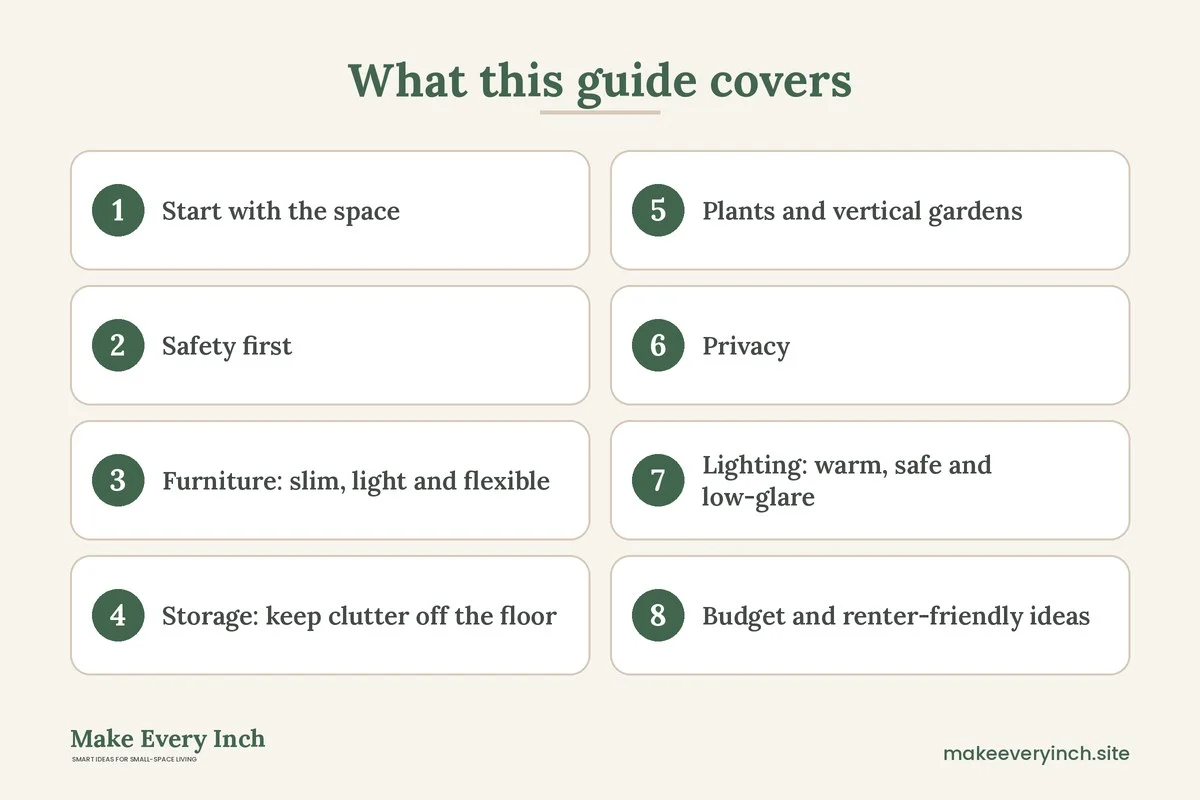
Small balcony ideas can turn a narrow strip of concrete into the best spot in your home, but only if you plan it like a real room. A balcony is smaller than most indoor rooms, it is exposed to sun, wind and neighbors, and it usually sits several feet above the ground. That mix means a good plan has to cover comfort and safety together. This pillar guide pulls our whole cluster of small outdoor space posts into one place. It covers how to measure and choose a purpose, the safety rules that matter most, furniture, storage, plants, privacy, lighting, renter rules, budget, pets, hot sun, cozy evenings and the neighboring spaces such as patios, porches and small decks. Each section links to a detailed guide, and the final section lists every post in one place. If you rent, keep your lease in mind from the first step.
Start with the space: measure, observe and choose one job
Before you buy a single chair, spend a few days noticing how the balcony behaves. Check which hours get direct sun, which side catches the wind, where rain blows in and where the neighbors can see you. Many balconies are only 3 to 5 feet deep and 6 to 12 feet wide, so even a few inches change what fits. Measure the width, the depth, the height of the railing, the swing of the door and the position of any drain, outlet or tap.
Then draw the balcony on graph paper or in a free floor planner and tape the footprint of each piece you are considering onto the floor. Leave a clear walking path of roughly 24 to 30 inches from the door to the main seat, and leave the door able to open fully. Painter’s tape costs nothing and prevents most expensive mistakes. If the balcony is very small, a path might be the only free floor you have, and that is fine.
Next, choose one main job for the space. A balcony that tries to be a dining room, a garden, a storage shed and a lounge at once usually ends up as a cluttered corner. Pick the job that you will actually use most:
- Sitting and relaxing: one or two comfortable seats, a small side table and soft light.
- Dining: a narrow bar-height or drop-leaf table with two chairs.
- Growing: a vertical garden, railing planters and a small herb corner.
- Working or reading: a chair, a lap table and shade.
- Sharing: a flexible layout for two people, with folding pieces that tuck away.
Once you know the job, every purchase has a test. If it does not serve the job, it does not go on the balcony. Our post on small balcony ideas for two people shows how to split a tiny space between two uses without it feeling crowded, and our guide to small balcony mistakes to avoid lists the planning errors we see most often.
Safety first: weight, railings, wind and the lease
A balcony is part of the building structure, and it has limits. Read this section before you buy anything heavy, and come back to it whenever you add something new. This is general guidance, not engineering or legal advice. If you have any doubt about the strength of a balcony, ask your landlord, building manager or a qualified professional.
Weight limits and loads
Every balcony is built to carry a certain load, and the number depends on the building, the age and the local rules. Do not guess. Ask your landlord, management company or homeowners association whether a limit exists and what it is. Remember that the load includes people, furniture, planters, wet soil, standing water and snow. Soil is much heavier than it looks, and a watered pot can weigh several times what the empty pot does. A crowd of friends standing on the balcony at once is also a load.
Spread weight out rather than stacking it in one place, keep heavy planters close to the wall where the structure is strongest, and avoid heavy items such as stone tables, large water features or hot tubs unless the building has confirmed the balcony can take them. Choose lightweight pots such as resin, fiberglass or fabric grow bags, and lighter soil mixes. If you see cracks, rust, crumbling concrete, sagging, soft spots or flaking around the fixings, stop adding weight and report it to the person who manages the building.
Railings and edges
The railing is a safety barrier, not a shelf. Keep it clear of anything a child or a pet could climb. That means no chairs, tables, storage boxes or planters pushed against the railing where someone could step on them. Do not lean on, sit on or climb the railing. Check that it feels solid, that fixings are tight and that gaps between bars are not wide enough for a small child or a pet to slip through. If the gaps are wide, ask your landlord about approved options, because adding screens or covers can change wind load and may need permission.
Railing planters are popular, but they carry a risk. A pot that falls from a balcony can seriously injure someone below. Use planters that lock onto the railing with proper brackets, fasten them securely and check the fixings often. Where a pot could fall outward, choose an inside-mounted option or put the pot on the floor instead.
Wind and falling objects
Wind gets stronger as you go up a building, and a light chair, an umbrella or a potted plant can become a hazard in a gust. Anything that could blow or fall should be secured, weighted or brought inside. That includes cushions, lanterns, umbrellas, tall plants, hanging baskets, small tables and decorative objects. Use heavy bases, tie-downs, clips and low centers of gravity. Do not store anything loose on the railing or a ledge, and do not hang items outside the railing line.
In storms or high wind, move lightweight items indoors or lay them flat. Sunshades and large screens catch wind like a sail, so use ones designed for the load, fasten them securely and take them down in bad weather. A good habit is a quick scan before bed or before leaving the house: if it could fly, bring it in or fix it down.
Grills, candles and open flame
Many buildings, leases, insurers and local fire rules ban charcoal and gas grills on balconies, and some ban open flame of any kind. Never assume it is allowed. Check your lease, building rules and local fire regulations before you use any grill, fire pit, chiminea, patio heater or candle. If the rules allow a certain type of cooking device, keep it well away from walls, railings, furniture, plants and overhanging structures, never leave it unattended and never use it indoors or in an enclosed space. Fuel containers have strict storage rules, and many buildings do not allow them at all.
For atmosphere without the risk, use flameless candles and battery-powered lanterns. They give the glow of a flame with none of the danger, and they suit windy evenings. Keep ashtrays out of pots, because soil and some planter materials can burn. If you smoke, use a deep, non-flammable container and dispose of butts safely.
Outdoor-rated electrical
Anything that plugs in outside must be made for outdoor use. Use lights, cords and extension leads that are rated for outdoor conditions, keep connections off the floor and away from puddles, and do not run an indoor cord through a doorway or under a closed door. Use a weather-protected outlet where one exists, and a residual-current device or a similar protection if your wiring supports it. Do not daisy-chain extension cords, and do not overload an outlet. When in doubt, use solar or battery lights, which avoid the issue entirely. See small balcony lighting ideas for safe options that still look good.
Drainage and water
Balconies are designed to shed water. Keep the drain, gutter or run-off point clear of leaves, soil and debris, and never block it with a planter or a rug. Raise pots on feet so that water can run away, use saucers sparingly and empty them after rain. Standing water can damage the surface, leak into the home below, freeze and crack in winter, and attract mosquitoes. Watering plants can also drip on neighbors below, so water gently and avoid overflow. Avoid sealing the floor with something that traps moisture unless your landlord agrees.
Toxic plants, pets and children
Some popular plants are toxic to pets and children, including a number of common flowering and bulb plants. Before you buy, check each plant against a reliable pet-safety list, such as one from a veterinary or poison-control source, and keep anything doubtful out of reach. Mulch, fertilizer, slug bait and pest sprays can also be dangerous if eaten. Our guide to small balcony ideas for pet owners goes into pet-safe plants, escape-proofing and heat.
Lease and HOA permission
Many leases and homeowners association rules limit what you can attach to a balcony, what you can hang from it, what you can put on the floor and even what colors you can use. Common restrictions include no drilling, no railing planters, no grills, no screens, no flooring changes and no storage visible from the street. Ask in writing before you make any fixed change, take photos of the balcony before you start and keep a copy of the reply. Our guides to small balcony ideas for renters and renter-friendly small balcony ideas show how to get a lot of style from freestanding, removable choices.
Furniture: slim, light and flexible
Furniture is the biggest decision on a small balcony, because it takes the most floor. The aim is to seat people comfortably without blocking the door or the path. Look for pieces that are weatherproof, light enough to move and secure enough not to blow away. A bistro set of two chairs and a small table is the classic choice, but there are many others.
Foldable chairs and tables store flat against a wall or inside the home. Bar-height tables use vertical space and keep the floor open under them. Corner benches use wasted corners, and benches with hidden storage double as a seat and a box. A drop-leaf or wall-mounted table gives you a surface only when you need it. A small outdoor rug can define the zone, though it should drain freely and be secured against wind. See small balcony furniture ideas for a deeper look at chairs, tables, benches and multi-purpose pieces, and our indoor pillar on the best furniture for small apartments for general rules about scale and folding.
Check weight before you buy. Cast metal, stone and heavy hardwood are weather-tough, but they add load, so choose lighter frames where you can. Rounded corners are kinder in a tight space. Choose cushions that dry quickly, and bring them in before rain or storms.
For wider outdoor spaces with more room to play with, our post on small patio furniture layout ideas walks through arrangements that you can adapt for a bigger balcony.
Storage: keep clutter off the floor
A balcony fills up quickly with tools, pots, cushions and the things that do not fit indoors. A cluttered balcony feels smaller and can block the exit in an emergency, so storage needs a plan. The simplest ideas are vertical: wall hooks, rails, narrow shelves and hanging baskets, all fixed with permission and rated for the load. Under-bench storage, a slim cabinet against the wall and a lidded box that doubles as a seat all hold a lot without taking up much floor.
Choose storage that is weatherproof, ventilated and not too heavy, and avoid storing flammable liquids, gas bottles or chemicals on a balcony. Keep a clear path to the door and do not stack things higher than the railing. Our guide to small balcony storage ideas covers benches, cabinets, hooks and covers, and the companion post on small outdoor storage ideas for apartments shows how to store gear when you have no shed or garage. For the system behind it, borrow ideas from our pillar on small space organization ideas.
Plants and vertical gardens
Plants are the quickest way to make a balcony feel alive. They soften hard edges, add privacy and can feed you. The trick in a small space is to grow up, not out. Wall-mounted planters, trellises, tiered stands, railing boxes and hanging pots all use vertical space and leave the floor free. Choose plants to match your light: sun-lovers such as herbs and tomatoes need around six hours of direct sun, while shade lovers such as ferns and many foliage plants tolerate much less.
Beginner gardens
If you are new to growing, start with a few forgiving plants rather than a crowded jungle. Herbs, salad leaves, a pot of strawberries or a few hardy flowers are easy first choices. Use good potting mix, pots with drainage holes and a regular watering routine. Check wind and sun, because a small balcony can swing from scorching to shaded. Our guide to small balcony garden ideas for beginners walks you through what to plant and how to avoid common failures.
Vertical gardens
Vertical gardens stack plants in a pocket, a shelf or a trellis, so a wall becomes the garden. They are ideal for small balconies, but they add weight and moisture to the wall, so check the lease and the load. Use lightweight planters, secure them firmly and think about run-off onto neighbors. See small balcony ideas with vertical gardens for plans and plant lists.
No lawn, no problem
Many small outdoor spaces have no grass at all, just paving, decking or concrete. That is not a problem, because pots, planters and a few soft materials can create a garden feeling. Our post on tiny outdoor space ideas without grass shows how to build texture and green with containers, outdoor rugs and tiles that clip together.
Privacy: feel hidden without feeling boxed in
A balcony is often the most exposed part of a home. Neighbors can look in from the side and above, and passers-by can see up from below. Privacy makes the space more usable, because you relax more when you are not watched. The aim is to block sightlines, not to wall yourself in.
Plants are the softest screens. Tall planters, climbing plants on a trellis and a row of slim shrubs all add green privacy. Bamboo or reed screens, fabric panels and outdoor curtains give instant cover, and a pergola-style frame with a sheer panel gives a dappled screen. Slatted screens let some air through, which reduces wind pressure. Be careful: solid screens catch wind and can add load to a railing, so use options made for the job, fasten them as the manufacturer directs and always ask the landlord first. Our guide to small balcony privacy ideas compares each approach, including removable options that suit renters.
Lighting: warm, safe and low-glare
Good lighting turns a balcony into a place you can use after dark. Think in layers. A soft string of lights gives ambient glow, a lantern or a small lamp on a table gives pools of light and a clip-on or recessed light helps with tasks such as reading or cooking. Warm light is generally more flattering and relaxing than cold white, and dimmable fixtures let you set the mood.
Solar and battery lights are the easiest and safest option, because they need no outlet and no cords. If you use mains lights, they must be outdoor-rated and plugged into a protected outlet, with cords kept off the floor. Flameless candles give a glow without fire. Avoid very bright floodlights that spill into neighbors’ windows, and think about the light pollution you are creating. See small balcony lighting ideas for plans and safe setups, and small balcony decor ideas for cozy evenings for blankets, textures and scents that complete the mood.
Budget and renter-friendly ideas
You do not need a large budget or a landlord’s blessing to improve a balcony. Many of the best changes are cheap, removable and quick. An outdoor rug, a few pots, a string of solar lights, a folding chair and a throw pillow can change the feel in an afternoon. Second-hand furniture, DIY planters made from crates, and cuttings shared by friends keep the cost down. The key is to buy for the job you have chosen and to avoid impulse buys that will not fit.
For renters, freestanding solutions are the safest route. Interlocking deck tiles, a rug, a freestanding screen, clip-on lights, S-hooks and tension-style supports can all be removed without damage, as long as the lease allows them. Take photos before you start, keep all receipts and instructions, and ask for permission when in doubt. See small balcony ideas on a budget for thrifty plans, small balcony ideas for renters for lease-safe changes and renter-friendly small balcony ideas for more ways to personalize without losing your deposit. When you want the same thinking for the whole home, our hub on budget small space ideas pulls together money-saving ideas for every room.
Heat, sun and weather
A balcony faces the weather directly. A south or west-facing balcony can become very hot in summer, and surfaces such as metal furniture and dark flooring can get uncomfortably warm. Shade is the first fix: a sail, an umbrella with a heavy base, a retractable awning or tall plants can cool the space. Check that any shade structure is allowed and that it is secured against wind. Light-colored cushions and rugs reflect heat, and misting or damp cloths can cool a hot afternoon. Water plants early or late in the day.
In cold or wet weather, protect furniture with covers, bring cushions in and clear snow and ice away from the drain. Do not let heavy snow or standing water build up on the floor. Our guide to small balcony ideas for hot sunny spaces covers shade, cool materials and plants that cope with heat.
Pets and children
A balcony is a hazard if pets or small children can get out or fall. Check gaps in the railing, keep furniture away from the edges, secure doors and never leave pets or children alone on a balcony. Cats are especially prone to falls, and many owners choose approved netting or screens, subject to landlord permission. Make sure pets have shade and water, and check that the floor is not too hot. Keep toxic plants, fertilizers and cleaning products out of reach. Read small balcony ideas for pet owners for pet-safe plants, flooring and escape-proofing.
Dining and entertaining outside
A tiny balcony can still host a meal. A bar-height table on the railing side, a folding bistro table or a wall-mounted drop-leaf can all work for two. Keep the table light and stable, secure the tablecloth with clips and avoid glass that could shatter in wind. If the rules allow cooking, keep it simple and away from flammable items. Otherwise, bring the cooking indoors and serve outside. See how to create a tiny outdoor dining area for layouts and table styles, and our indoor pillar on small dining room ideas for ideas about scale, seating and lighting that translate outside.
Beyond the balcony: patios, porches and decks
Many of the same principles apply to other small outdoor spaces. A compact patio has more floor but the same need for zoning, storage and privacy. A porch brings a roof and a front-facing view. A small deck often has height and railings, so the safety rules in this guide apply there as well.
- For a ground-level space, see small patio ideas for compact homes and small patio furniture layout ideas.
- For an entrance space, read small porch decorating ideas.
- For raised timber areas, read small deck ideas for limited space.
- For spaces with no lawn, read tiny outdoor space ideas without grass.
Treat each as a room: pick a job, measure, choose slim furniture, add plants and light and check the rules.
Connect indoors and outdoors
A balcony feels larger when it looks like a continuation of the room beside it. Repeat a color or a material from inside, keep a clear sightline through the door and avoid heavy curtains that block the view. If your balcony opens from a living area, our pillar on small living room ideas shows how to arrange seating so the doorway stays open. For a studio, the hub on studio apartment ideas shows how an outdoor corner can act as an extra zone. When you want wider inspiration for style and color, our guide to small room decor ideas is a good starting point.
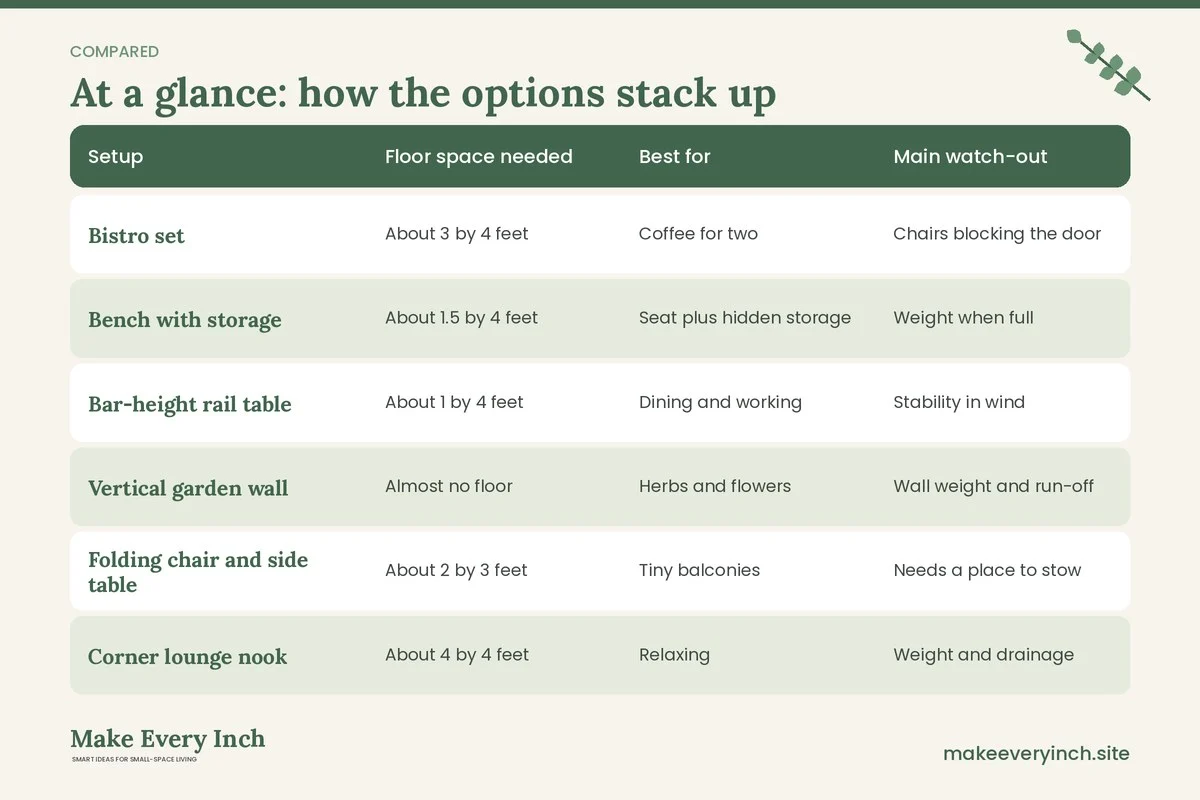
Choosing a setup: a comparison table
The table below compares common balcony setups. Use it as a quick filter before you shop, and read the linked guide for each option.
| Setup | Floor space needed | Best for | Main watch-out |
|---|---|---|---|
| Bistro set | About 3 by 4 feet | Coffee for two | Chairs blocking the door |
| Bench with storage | About 1.5 by 4 feet | Seat plus hidden storage | Weight when full |
| Bar-height rail table | About 1 by 4 feet | Dining and working | Stability in wind |
| Vertical garden wall | Almost no floor | Herbs and flowers | Wall weight and run-off |
| Folding chair and side table | About 2 by 3 feet | Tiny balconies | Needs a place to stow |
| Corner lounge nook | About 4 by 4 feet | Relaxing | Weight and drainage |
| Shade sail or umbrella | Varies | Hot sunny balconies | Wind and permission |
Common mistakes to avoid
Most balcony problems come from a few repeat errors. People buy furniture before measuring, overload the floor with soil and pots, push seats against the railing, ignore drainage, forget about wind and skip the lease check. Another common mistake is trying to do everything at once, which leaves no room to move. Our post on small balcony mistakes to avoid goes through them, with fixes for each.
A simple small balcony ideas checklist
Use this list to plan, build and maintain your space.
- Ask your landlord or HOA about weight limits, rules and permission.
- Inspect the floor, railing and fixings for damage before adding anything.
- Measure the balcony and tape the footprint of each item.
- Choose one main job for the space.
- Keep a clear path to the door and keep the door able to open fully.
- Keep furniture and planters away from the railing.
- Secure or bring in anything that could blow away or fall.
- Use lightweight pots and spread the load.
- Keep the drain clear and raise pots so water can run away.
- Use outdoor-rated lights and cords, or choose solar and battery lights.
- Check every plant for toxicity to pets and children.
- Follow the rules on grills, fire and candles, and use flameless options.
- Add shade, privacy and warm light.
- Review the space each season and adjust.
Frequently asked questions
How do I make a small balcony look bigger?
Keep the floor as clear as possible, use slim or foldable furniture and go vertical with plants and storage. Light colors, a simple palette and a rug that runs across the floor help the space feel wider. Keeping a clear sightline from the door also makes it feel more open.
How much weight can a balcony hold?
It depends on the building, its age and local rules, so there is no single answer. Ask your landlord, building manager or HOA for the limit, and remember that people, furniture, wet soil, water and snow all count. If you see cracks, rust or sagging, stop adding weight and report it.
Can I put planters on my balcony railing?
Often you can, but only with permission and with brackets that lock onto the railing. A falling pot can seriously hurt someone below, so check the fixings regularly or place pots on the floor instead. Some leases ban railing planters entirely, so ask first.
Can I use a grill or fire pit on a balcony?
Many buildings, leases and local fire rules ban charcoal and gas grills, fire pits and open flame on balconies. Check your lease and local regulations before you use anything. Flameless candles and battery lanterns give a similar glow without the risk.
How can I get privacy on a small balcony?
Use tall planters, a trellis with climbing plants, bamboo or reed screens, outdoor curtains or slatted panels. Choose options designed for balconies and fasten them securely, because solid screens catch wind. Ask permission first if the screen attaches to the railing.
What can renters do on a balcony?
Renters can use freestanding furniture, outdoor rugs, interlocking tiles, pots, clip-on or solar lights and removable screens. Avoid drilling or fixed changes unless the lease allows them. Take photos before you begin and keep any written permission.
Are balcony plants safe for pets?
Not all of them are. Several common flowering and bulb plants are toxic to cats and dogs, so check every plant against a trusted pet-safety list. Keep fertilizers, mulch and pest products out of reach too.
How do I keep my balcony from getting too hot?
Add shade with an umbrella, a sail or an awning, and choose light-colored cushions and rugs. Tall plants and a damp cloth can cool the air. Make sure any shade structure is allowed and secured against wind.
What lights are safe for a balcony?
Solar and battery lights are the safest and simplest. If you use mains lights, they must be outdoor-rated, plugged into a protected outlet and kept off wet floors. Do not daisy-chain extension cords.
All our small outdoor space guides
Every guide in this cluster is listed below. Pick the one that matches your space or your question.
- Small balcony furniture ideas: slim, folding and multi-purpose pieces that fit tight floors.
- Small balcony storage ideas: benches, hooks and cabinets that clear the floor.
- Small balcony ideas for renters: lease-safe changes that leave no marks.
- Renter-friendly small balcony ideas: more removable ways to personalize a rented balcony.
- Small balcony ideas on a budget: thrifty plans that look good.
- Small balcony garden ideas for beginners: easy plants and simple routines.
- Small balcony privacy ideas: screens, plants and curtains that block sightlines.
- Small balcony lighting ideas: safe, warm layers for evenings.
- Small balcony ideas for two people: shared layouts for couples and friends.
- Small patio ideas for compact homes: zoning and planting for ground-level spaces.
- Small patio furniture layout ideas: arrangements that keep paths clear.
- Tiny outdoor space ideas without grass: containers, tiles and rugs for hard surfaces.
- Small porch decorating ideas: welcoming entrances in tight spaces.
- Small deck ideas for limited space: compact layouts for raised timber areas.
- Small balcony ideas for pet owners: pet-safe plants, flooring and escape-proofing.
- Small balcony ideas with vertical gardens: grow up the wall instead of across the floor.
- Small balcony decor ideas for cozy evenings: textiles, light and scent for after dark.
- Small outdoor storage ideas for apartments: store gear without a shed or garage.
- Small balcony mistakes to avoid: common errors and how to fix them.
- How to create a tiny outdoor dining area: tables and seating for meals outside.
- Small balcony ideas for hot sunny spaces: shade, cool materials and heat-tolerant plants.
Keep going: Keep going with small balcony furniture ideas, small balcony storage ideas and small balcony ideas for renters.
Save this guide for later
Pin the ideas you like to Pinterest so you can come back to them when you plan your space.