15 Small Balcony Ideas for Renters That Follow the Lease
Quick answer: Small balcony renters should start with the lease, then choose freestanding, removable and light pieces: a foldable chair set, an outdoor-rated rug, a rail-free shelf, clip-free lighting on a plug-in strand and a few secured planters. Keep furniture away from the railing, never drill without written permission, avoid grills and open flame, and make sure water and soil cannot drain onto neighbors below.
Small balcony renters have a different problem from homeowners. You want a place to sit with a coffee, but you also have a lease, a landlord, a neighbor below and a railing you did not choose and cannot change. This guide is written for that situation. It explains how to find out what you are allowed to do, how to measure a tiny space, which 15 ideas are easiest to remove at move-out, what can go wrong, and how to build a balcony that looks good and stays safe. If you want the broader overview of balcony styling, start with the main guide to small balcony ideas and then come back here for the rental rules. A companion post on making a small balcony work on a tight budget covers the money side, and our earlier guide to renter friendly small balcony ideas gives a shorter list of quick wins.
Step one: find out what your lease and building actually allow
Before you buy anything, read three documents: your lease, any building rules or house rules, and the HOA or condo rules if the building has them. Balconies are often treated as common or limited common areas, which means the landlord or association may have the final say even though only you use the space. Look for these topics.
- Storage and obstruction: Some buildings ban storing items on balconies, or limit what can be seen from the street. Others only restrict items that stick out past the railing.
- Grills, fire pits and open flame: Many leases and local fire codes prohibit them on balconies. Treat this as a firm no unless the lease clearly says otherwise.
- Railing attachments: Planter boxes, clip-on shelves, privacy screens and banners are commonly restricted, because they can fall and because they change how the building looks.
- Flooring and coverings: Some rules ban anything that traps water against the slab. Others only ban items that stain or scratch the surface.
- Drilling and fixing: Assume the answer is no unless you have written permission. This includes the railing, the walls, the ceiling and the door frame.
- Plants and watering: Rules may limit hanging plants, require saucers and ban watering that drips onto the unit below.
- Noise and quiet hours: Wind chimes, speakers and late evening gatherings may be limited.
If any rule is unclear, send a short email and keep the reply. A good message names the item, says where it will sit and says how you will remove it. For example: “I would like to place two freestanding planters and a folding table on the balcony. Nothing will be attached to the railing or walls. Please confirm this is acceptable.” A written yes protects your deposit and makes a dispute at move-out much easier to settle. If you rent in a building with an association, ask whether there is a separate list of balcony rules, because those are not always in the lease.
Photograph the balcony before you start. Capture the floor, the railing, the walls, the ceiling and the drain, from several angles, with the date visible. These photos are your proof of the original condition.
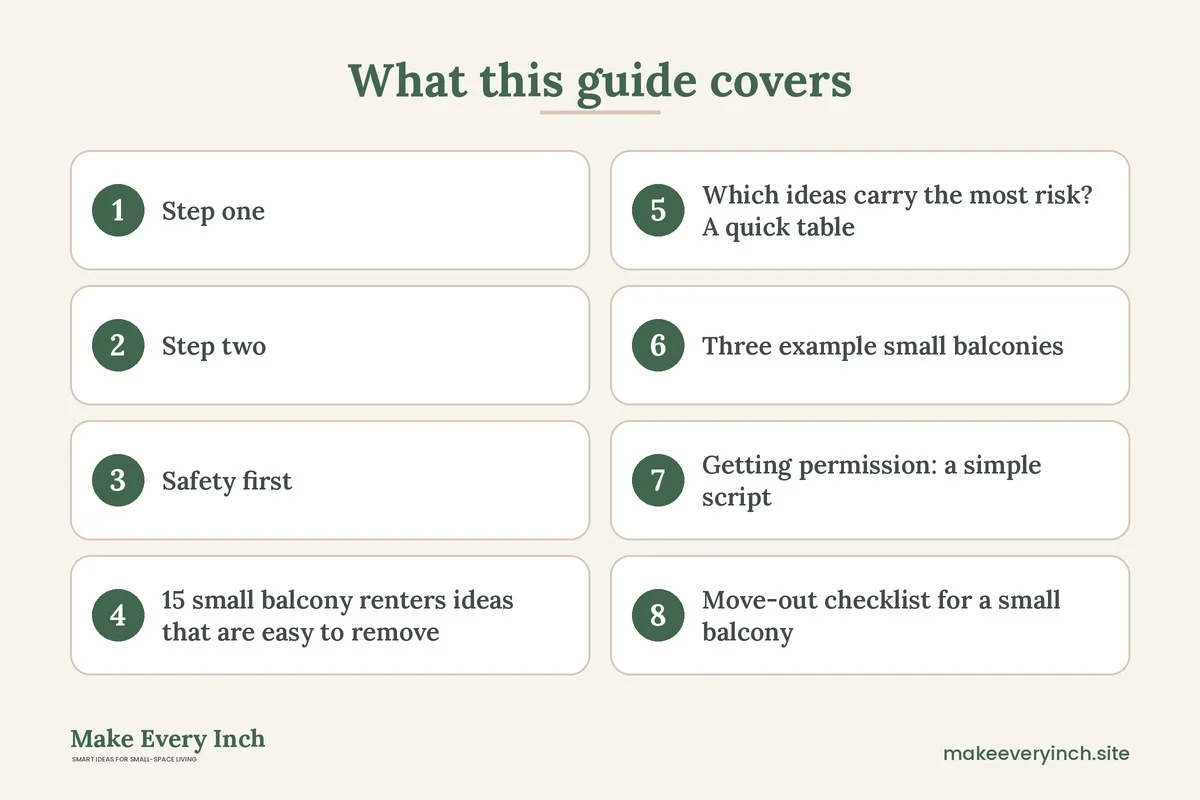
Step two: measure the space and plan the footprint
A balcony that looks tiny is usually workable once you give each person and each piece a clear zone. Measure the floor depth and width, the height of the railing, the width of the door swing and the distance from the door to the nearest obstruction. Many small balconies are about 3 to 5 feet deep and 6 to 10 feet wide. Your own numbers matter more than these ranges.
These planning numbers keep the space usable and safe.
- Clear walkway: keep at least 20 to 24 inches clear from the door to the seat, so you can step out without climbing over a chair.
- Door swing: the door must open fully. Mark the swing arc on the floor with tape and keep it clear.
- Seat depth: a small chair needs about 24 inches of floor depth, plus 12 to 18 inches in front for legs.
- Table gap: a bistro or drink table needs about 12 to 16 inches of floor space, and should sit within arm’s reach of the seat.
- Railing buffer: leave a gap of at least 12 inches between the railing and any seat, table or planter, so nothing becomes a step up.
- Drain access: keep the drain clear. Do not park a heavy item over it.
Tape the layout on the floor with painter’s tape and stand in it. If you cannot walk through without turning sideways, remove one item. A small balcony works best when it does one job well, such as a morning coffee spot, a reading chair or a plant corner, instead of trying to be a living room.
Safety first: the rules that matter more than the styling
This is the part to read twice. Balconies are elevated, exposed and shared with neighbors, so mistakes cost more than on a floor-level patio. None of the following replaces advice from your landlord, building manager or a qualified professional, but each one is a common-sense starting point.
Weight limits
Balconies are designed for a limited load. People, furniture, planters full of wet soil, water-filled containers and snow or rain all add weight. Ask the landlord or building manager whether there is a stated load limit, and do not overload the space. Wet soil is much heavier than it looks. A few large ceramic planters can weigh more than people expect, and a crowded gathering can add more weight again. Spread weight out, keep heavy items near the wall where the structure is usually strongest, and choose lighter pots and furniture. If the balcony shows cracks, rust, spongy flooring, loose railings or pooling water, stop using it and report it to the landlord in writing.
Railing height, climbing risk and children or pets
Railing heights and gap sizes are set by local codes, and older buildings may not meet current rules. If you have young children or pets, treat the railing as a climbing hazard. Do not place furniture, planters, storage boxes or anything else that a child or a pet could use as a step near the railing. Horizontal rails are easier to climb than vertical ones. Gaps can let a small child or pet slip through. Ask the landlord before adding any mesh, screening or barrier, because it may be restricted, and never rely on a decorative screen as a safety barrier. Supervise children and pets whenever they are on the balcony, and do not leave the door open for unsupervised access.
Furniture away from the railing
Keep seats, tables and anything people can stand on at least 12 inches from the railing. A chair placed against a railing makes it easy to climb up and lean out. Place seating along the wall instead, facing the view, and keep the area next to the railing open.
Wind and tip-over
Balconies, especially on higher floors, can have strong gusts. Lightweight chairs, umbrellas, tall planters and flat-panel screens can tip or blow away. Choose low, stable furniture, use a heavy base for anything tall and bring light items inside when strong wind is forecast. A falling chair is a danger to people on the ground. Avoid large umbrellas unless the lease allows them and the base is rated for balcony use.
Falling objects
Anything placed on a shelf, a railing or a ledge can fall. Do not put pots, bottles, glasses or tools on the railing top. Secure planters in low stands or boxes with a lip, put a saucer under each pot and keep storage inside closed containers. Any object that falls from a balcony can seriously hurt someone below.
Fire, grills and open flame
Many leases and local codes prohibit grills, fire pits, patio heaters and open flame on balconies, and some also limit storing fuel canisters. Do not assume a small electric or tabletop grill is allowed. Ask first. Do not smoke over dry plants or foam cushions, and dispose of cigarette butts in a proper container, never in a pot. Candles are also a risk. Many people use battery-powered flameless candles instead, and they are usually a safer choice around fabric and wind.
Electrical safety
If you use lights, choose products labeled for outdoor use and follow the instructions. Plug into a protected outlet, ideally one with ground-fault circuit interrupter (GFCI) protection, and do not overload sockets or daisy-chain extension cords. Keep cords and plugs off wet floors, avoid running cords through a door that cannot close properly and unplug lights during storms. Battery or solar string lights remove many of these risks. Never drill into a wall or run a cable through a window frame without permission.
Drainage and water damage
Water that spills over the edge lands on the neighbor below. Water that pools on the floor can damage the slab, the door threshold and the unit under you. Use saucers, water plants carefully, never hose or pour water over the edge and keep the drain clear. If you place a rug or mat, choose one that dries quickly and lift it regularly to check the floor underneath for trapped moisture.
Toxic plants
Some common plants are harmful to pets and children if chewed or swallowed. Check each plant against a reliable source such as a veterinary or poison control list before buying, and keep potentially harmful plants out of reach. Pick pet-safe herbs or foliage if you share the space with animals. Fertilizers and soil additives can also be harmful, so store them out of reach.
Heat from sun on surfaces
Metal furniture, dark flooring and railings can get hot in direct sun. Test chairs and surfaces before sitting, especially with children, and avoid placing bare skin on hot metal. A light-colored outdoor rug or a shade cloth, if allowed, helps.
15 small balcony renters ideas that are easy to remove
Every idea below can be removed at move-out without a trace, as long as you use it in a way that matches your lease. Where an idea involves a lease-sensitive item, the note says so.
Seating that fits the footprint
1. A folding chair pair
Two foldable chairs that hang on the wall or lean against it free up the floor when you are not using them. Pick chairs with stable legs and feet that do not scratch the surface. A folded pair stored behind the door takes very little room.
2. A small bench with storage
A narrow bench sits against the wall and holds cushions, a watering can or a blanket. Keep the lid light, so it does not trap fingers, and check the weight rating before sitting. Do not store fuel, chemicals or anything flammable inside.
3. A floor cushion set
A pair of weather-resistant floor cushions fit on very shallow balconies, where a chair would take up the whole depth. Store them indoors when it rains. For more seating ideas indoors and out, see our guide to small space seating ideas for guests.
Tables and surfaces
4. A folding bistro table
A small table folds flat against the wall and comes out for coffee or lunch. Keep it clear of the railing and make sure it is stable before putting a hot drink on it.
5. A nesting stool or table
A nesting set gives you a drink surface and a second seat. The same principle indoors is explained in our guide to the best nesting tables for small apartments.
6. A tray on a crate
A sturdy crate with a tray on top works as a low table. Check that it is stable and that the tray has a lip.
Flooring and softness
7. An outdoor-rated rug
A rug makes concrete feel like a room. Choose an outdoor-rated one that dries quickly, and lift it from time to time to check for trapped moisture. Avoid anything that slides, and check that it does not block the drain or the door.
8. Interlocking floor tiles
Click-together tiles cover a worn slab without adhesive. Check whether the lease allows covering the floor, and make sure water can still run to the drain.
9. A thin mat at the door
A small mat catches dirt from your shoes before it comes indoors. Choose one without a thick lip so the door still closes.
Light and atmosphere
10. Solar or battery string lights
Strings that do not need a socket remove most electrical risks. Where you do need a plug, use outdoor-rated lights on a protected, GFCI outlet, and avoid overloading. Our guide to renter friendly lighting ideas covers more options for indoors.
11. Flameless candles in lanterns
Battery lanterns give a warm glow without a flame. They are a safer choice near fabric, plants and wind. Check that the battery cover is closed and keep batteries away from children.
Privacy and shade
12. A freestanding screen
A freestanding folding screen or a trellis on a stable base gives some privacy. Make sure it cannot tip in the wind, keep it from the railing and ask your landlord before blocking sight lines or adding anything to the railing.
13. A shade sail or umbrella (only if allowed)
Shade helps in hot climates, but it adds wind load. Ask permission first. Never tie anything to the railing or the building unless the landlord has agreed in writing.
Greenery
14. A cluster of low planters
Group three or four low pots in one corner instead of spreading them. Use lightweight containers, saucers and a mix of pet-safe plants. See our guide to small space plants and planters ideas for plant choices that stay compact.
15. A tiered plant stand
A freestanding stand lifts plants off the floor and uses vertical space. Make sure it is stable, that every pot is secured and that heavy pots go on the bottom shelf. Do not attach it to the railing.
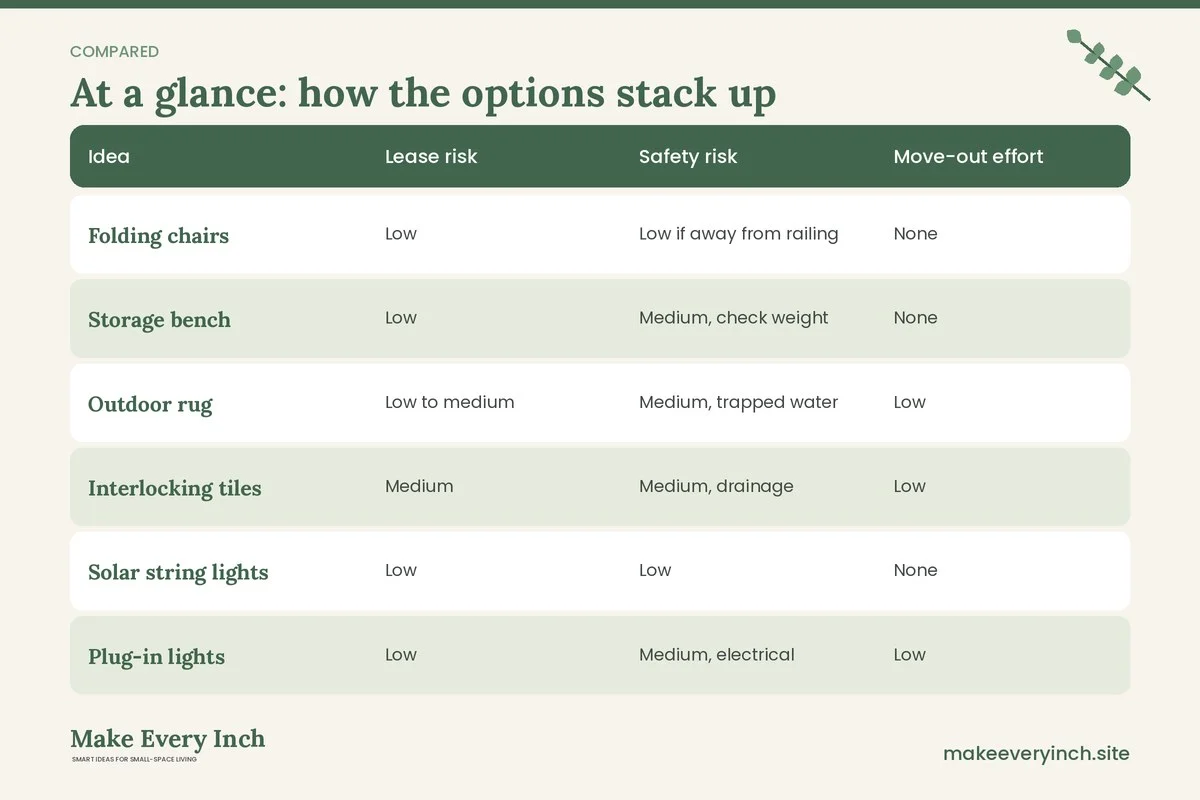
Which ideas carry the most risk? A quick table
Use this table to decide what to do first. The risk column is a general guide and does not replace the lease or advice from the building manager.
| Idea | Lease risk | Safety risk | Move-out effort | |
|---|---|---|---|---|
| Folding chairs | Low | Low if away from railing | None | |
| Storage bench | Low | Medium, check weight | None | |
| Outdoor rug | Low to medium | Medium, trapped water | Low | |
| Interlocking tiles | Medium | Medium, drainage | Low | |
| Solar string lights | Low | Low | None | |
| Plug-in lights | Low | Medium, electrical | Low | |
| Freestanding screen | Medium | Medium, wind | Low | |
| Shade sail or umbrella | High | High, wind | Medium | |
| Low planters | Low | Medium, weight and water | Low | |
| Tiered plant stand | Low | Medium, tip-over | Low | |
| Anything on the railing | High | High, falling objects | Medium | |
| Grill or fire pit | Very high | Very high | Not advised |
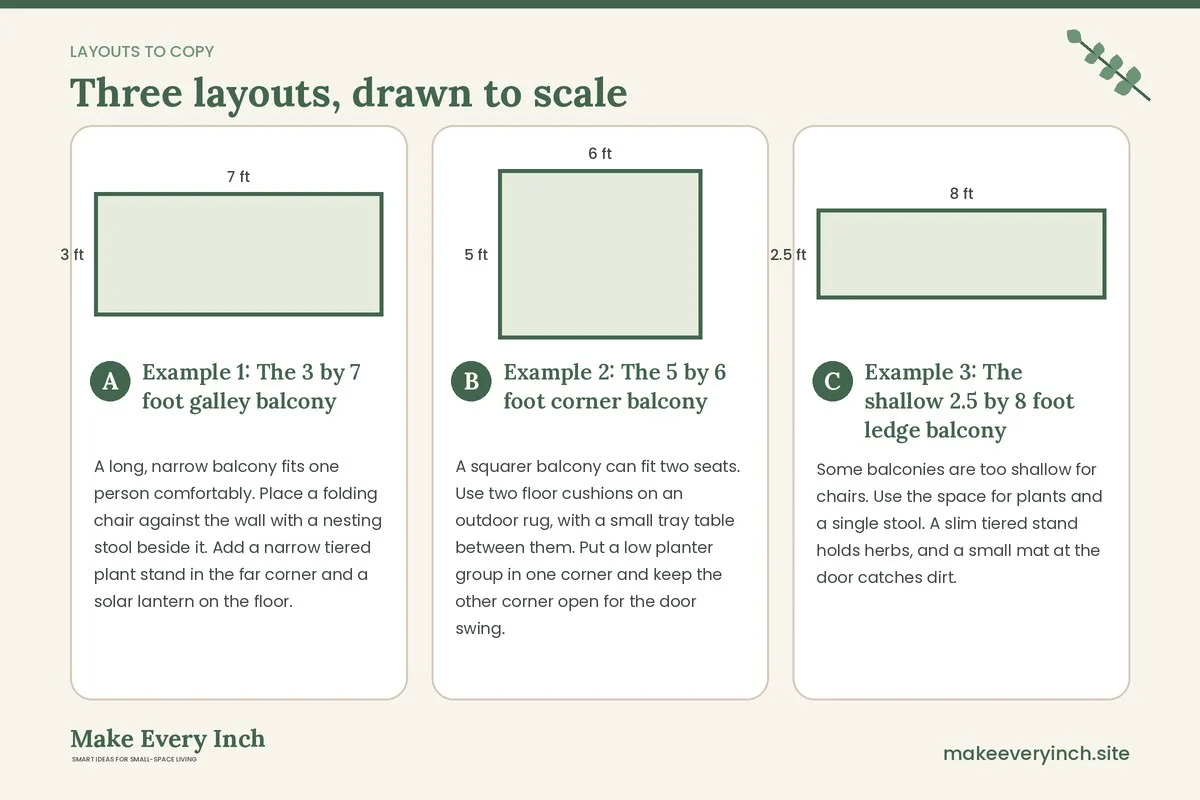
Three example small balconies
Example 1: The 3 by 7 foot galley balcony
A long, narrow balcony fits one person comfortably. Place a folding chair against the wall with a nesting stool beside it. Add a narrow tiered plant stand in the far corner and a solar lantern on the floor. Keep a clear path of at least 20 inches to the door. The chair stays at least 12 inches from the railing, and the plant pots have saucers so they do not drip below. Nothing is attached to the railing or the wall.
Example 2: The 5 by 6 foot corner balcony
A squarer balcony can fit two seats. Use two floor cushions on an outdoor rug, with a small tray table between them. Put a low planter group in one corner and keep the other corner open for the door swing. A battery string of lights is draped over a freestanding trellis, not the railing. If the building allows a small screen, place it at the side for privacy, on a stable base.
Example 3: The shallow 2.5 by 8 foot ledge balcony
Some balconies are too shallow for chairs. Use the space for plants and a single stool. A slim tiered stand holds herbs, and a small mat at the door catches dirt. The railing stays clear, and the stool tucks beside the door. If this balcony is mostly for looks, treat it as a green view from indoors and keep the door area clear so you can still step out for a minute of fresh air.
Getting permission: a simple script
Many renters worry that asking will lead to a no. In practice, landlords often agree to freestanding items that leave no mark, particularly if you describe them clearly. Use this short checklist when you write.
- List the items and their rough size, such as “two folding chairs and a small table”.
- State that nothing will be attached to the railing, wall or ceiling.
- Confirm that you will keep the drain clear and will not let water run onto neighbors.
- Say that you will not use a grill, a fire pit or open flame.
- Offer to remove everything at move-out and to repair any damage.
- Ask for a written reply and keep it with your lease.
Move-out checklist for a small balcony
When the lease ends, a clean balcony helps you get the full deposit back.
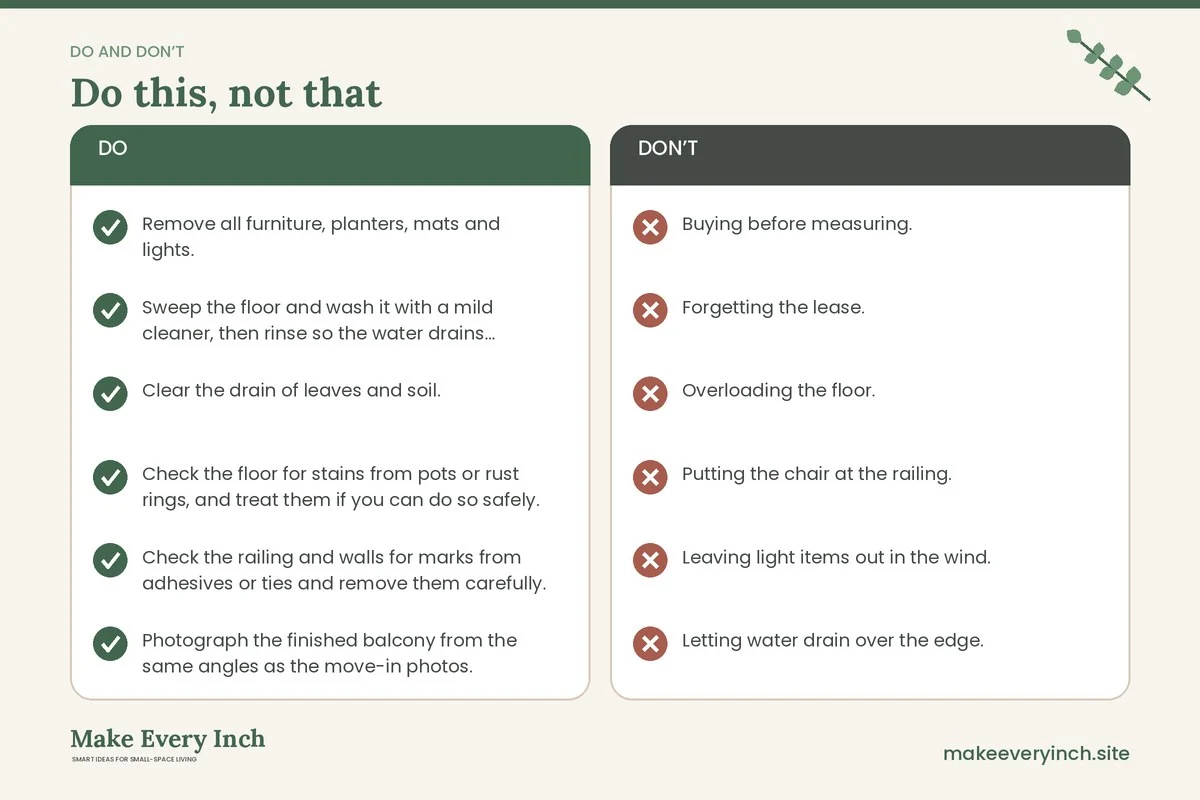
- Remove all furniture, planters, mats and lights.
- Sweep the floor and wash it with a mild cleaner, then rinse so the water drains properly.
- Clear the drain of leaves and soil.
- Check the floor for stains from pots or rust rings, and treat them if you can do so safely.
- Check the railing and walls for marks from adhesives or ties and remove them carefully.
- Photograph the finished balcony from the same angles as the move-in photos.
Common mistakes small balcony renters make
- Buying before measuring. A chair that fits in a shop may block the door once it arrives.
- Forgetting the lease. A banner or a railing planter can lead to a fee.
- Overloading the floor. Too many wet planters or too many people can add more weight than the structure was designed for.
- Putting the chair at the railing. It looks nice and creates a climbing hazard.
- Leaving light items out in the wind. A tipped chair can hurt someone below.
- Letting water drain over the edge. It annoys neighbors and can lead to a complaint.
- Using indoor extension cords outside. Indoor cords are not made for damp conditions.
- Ignoring pet and child safety. Toxic plants and railing gaps are easy to miss.
Frequently asked questions
Can my landlord stop me from using the balcony?
Your lease and local rules decide this. Many landlords allow normal use but restrict storage, grills and attachments. Ask in writing if you are unsure.
Can I put a grill or fire pit on a rental balcony?
Many leases and fire codes prohibit them on balconies. Treat them as not allowed unless the lease clearly says otherwise, and ask the landlord or building manager before bringing any open flame or fuel onto the space.
How much weight can my balcony hold?
There is no single answer, because it depends on the building. Ask the landlord or building manager for the load limit, and do not overload the space. When in doubt, choose lighter furniture and fewer, smaller planters.
Can I hang things from the railing?
Often not. Railings may be restricted, and anything hung from them can fall. Ask the landlord first, and prefer freestanding options.
How do I add privacy without damaging anything?
Use a freestanding screen or a trellis on a stable base, set away from the railing. Check the lease first, and never rely on a screen as a safety barrier.
What should I do if the balcony looks unsafe?
Stop using it, keep people away and report the problem to the landlord in writing. Look for cracks, rust, loose railings, spongy floors or standing water.
Is it safe to leave plants out in winter?
It depends on the plant and the climate. Move delicate plants indoors, empty saucers so they do not freeze and crack, and check that the drain is clear of ice.
Keep going: Ready to keep going? Read our main guide to small balcony ideas, plan your spending with small balcony ideas on a budget and borrow rental rules from security deposit safe apartment upgrades. For the rest of your home, see renter friendly apartment decorating ideas.
Save this guide for later
Pin the ideas you like to Pinterest so you can come back to them when you plan your space.