16 Small Balcony Ideas on a Budget You Can Build in Stages
Quick answer: A small balcony on budget works best when you build in stages: safety and lease check first, then a seat, then a surface, then light, then green. Use secondhand and multipurpose pieces, choose lightweight items that sit away from the railing, skip grills and open flame, and secure everything that could fall, tip or drain onto a neighbor.
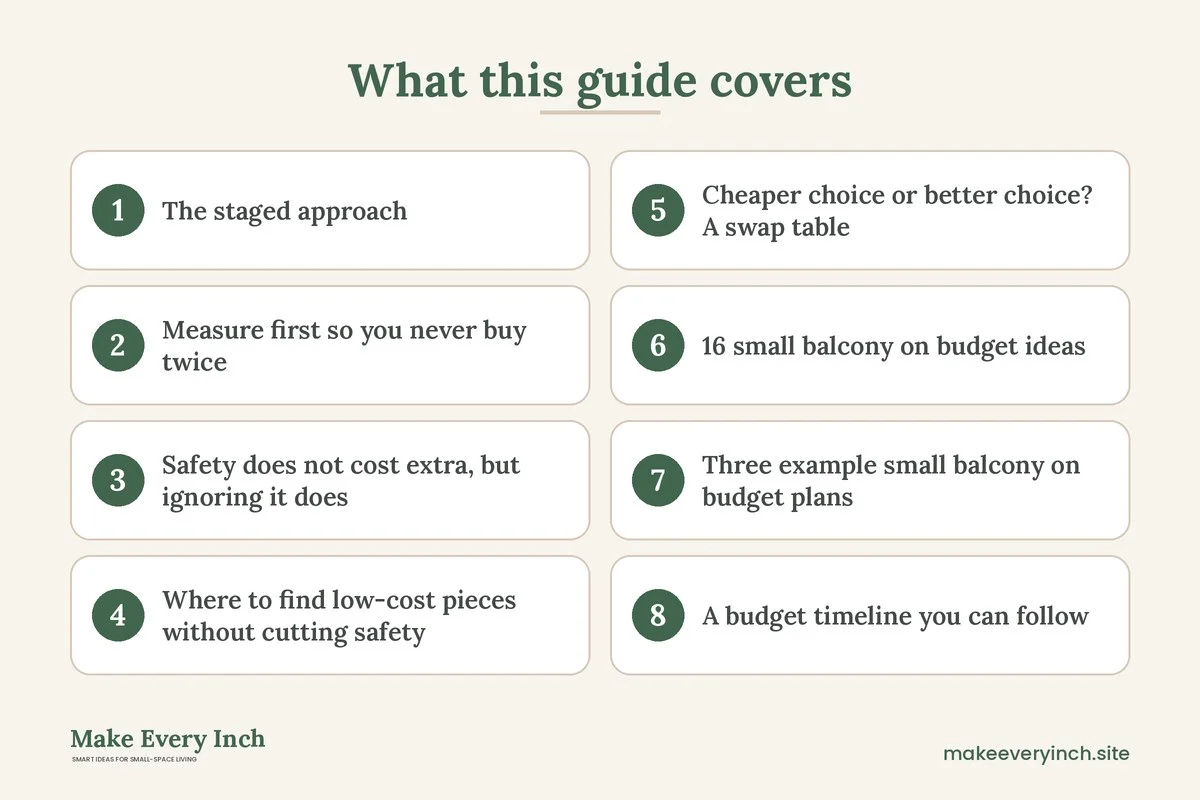
A small balcony on budget is a puzzle with three parts: very little floor, very little money and a long list of things that can go wrong at height. The answer is not to buy a full set of outdoor furniture and hope it fits. The answer is to spend in a smart order, borrow ideas from indoor rooms and choose pieces that earn their space. This guide gives you a staged plan, a swap table that compares cheaper and better choices without quoting any prices, a secondhand inspection list, 16 ideas, three example plans and a real safety section. For the main overview of balcony styling, see our pillar guide to small balcony ideas. If you rent, the lease rules in our post on small balcony ideas for renters apply to every idea here.
The staged approach: spend in this order
Most people start with the fun part, such as lights and cushions. On a balcony, the order matters, because the first stage protects you and the last stage decorates. Work through the stages and stop when the space feels finished. Each stage can be done over a weekend or spread over a season.
Stage 1: check, measure and make it safe
This stage costs almost nothing, and it prevents expensive mistakes. Read your lease and any building or association rules. Photograph the floor, railing and drain. Measure the depth, width, railing height and door swing. Check the floor for cracks, rust, loose railing posts, spongy spots and pooling water. If you see a structural problem, report it to the landlord and do not use the space until it is checked. Then clean the floor and clear the drain so water runs off instead of sitting.
Stage 2: one place to sit
A single comfortable seat does more than five decorations. Choose something small, stable and light that you can move. This is the stage where secondhand pieces shine, because a balcony seat does not need to be new.
Stage 3: one surface
Add a drink-height surface within arm’s reach of the seat. A stool, a crate with a tray or a small folding table is enough.
Stage 4: light
Add soft light so the balcony is usable at night. Solar or battery lights avoid electrical risk.
Stage 5: green and texture
Finish with a few plants, a mat or a cushion. Add one item at a time, so the space does not fill up with clutter.
Notice what is not on the list. There is no stage for a grill, a heater or a hanging railing planter. These are the items most likely to break lease rules or create safety problems, and they are the most expensive to get wrong.
Measure first so you never buy twice
The cheapest piece of furniture is the one you only buy once. Before you shop, mark the balcony on the floor of another room with painter’s tape, using the real measurements. Walk through it. Many small balconies are about 3 to 5 feet deep and 6 to 10 feet wide, but your numbers rule.
- Walkway: keep 20 to 24 inches clear from the door to the seat.
- Door swing: keep the full arc clear.
- Seat: about 24 inches of depth, plus space for legs.
- Surface: within arm’s reach, usually 12 to 16 inches from the seat.
- Railing buffer: at least 12 inches between the railing and any seat, table, planter or box.
- Total weight: keep heavy items small in number, and ask about the load limit.
If a piece does not fit your tape layout, it will not fit your balcony. This habit saves more money than any coupon.
Safety does not cost extra, but ignoring it does
A low budget is not an excuse to cut corners on safety. A fall from a balcony, a fire or a leak onto a neighbor can be far more costly than any furniture. Use this section as a checklist. It is general guidance and does not replace your landlord’s rules, local codes or advice from a qualified professional.
Check the lease, the landlord and the HOA
If you rent, ask in writing before you add anything. If you live in a building with an association, ask whether it has rules about balcony items, visible storage and plants. A free email can prevent a fine.
Weight limits
Balconies are built for a limited load. Ask the building manager about it, and do not overload the space. Wet soil, water-filled containers, heavy ceramic pots and crowds all add weight. Budget-friendly choices help here, because plastic or lightweight planters are lighter than ceramic or stone. Keep heavy items against the wall and spread them out.
Railings, children and pets
Treat the railing as a climbing and falling hazard. Keep furniture, planters and boxes at least 12 inches from it, so nothing becomes a step. Horizontal bars are easier to climb, and wide gaps can let a small child or pet through. Do not add mesh or screens without permission, and do not count on them as a barrier. Supervise children and pets at all times on the balcony.
Wind, tip-over and falling objects
Secure everything. Pots, bottles, glasses and tools should never sit on the railing top. Use stable bases, low planters with saucers and heavy items at the bottom of any stand. On windy days bring light chairs, cushions and decorations indoors. Anything that falls can hurt a person below.
Fire, grills and open flame
Many leases and local codes prohibit grills, fire pits, patio heaters and open flame on balconies. Check before bringing any, and treat the answer as no unless it is clearly yes. Choose battery-powered flameless candles instead of real ones, and keep fabric, dried plants and cushions away from any heat source.
Electrical safety
Use outdoor-rated lights and cords, and plug into a protected outlet, ideally one with ground-fault circuit interrupter (GFCI) protection. Do not overload sockets or chain extension cords together. Keep plugs and cords off wet surfaces, and do not run a cord through a door that cannot close. Solar or battery lights avoid most of these concerns and often cost less to set up.
Water, drainage and neighbors
Keep the drain clear, use saucers under pots and water slowly. Do not pour or spray water over the edge, since it lands on the unit below. Check under mats and rugs for trapped moisture.
Toxic plants
Some plants are harmful to pets and children if chewed or swallowed. Check each plant against a trusted list before buying. Free cuttings from friends are fine, but identify them first.
Hot surfaces
Metal furniture and dark floors get hot in the sun. Test a seat before sitting, and use a light cover or a cushion.
No drilling
Never drill into the railing, walls or ceiling without permission. Budget ideas are almost all freestanding, and that is a feature, not a limit.
Where to find low-cost pieces without cutting safety
Secondhand shops, community swaps, neighbors who are moving and online listings are good sources for balcony furniture. The cheapest option is not always the best, so inspect each piece before you bring it home.
- Check the frame: look for rust, cracks, bent legs and loose joints. A rusty frame can fail under weight.
- Sit on it and rock it: a seat should not wobble or creak.
- Check the feet: rough or sharp feet can scratch the floor and trap water.
- Check the weight: a heavy piece can overload a small balcony, and a very light piece can blow away.
- Check the finish: peeling paint and splintered wood are not a good choice for bare hands and pets. Avoid refinishing a piece indoors without good ventilation and a low-VOC product.
- Clean before you use: wash with mild soap and let it dry completely before putting it outside.
- Skip anything that may trap pests or mold: old cushions are often better replaced with a washable cover.
A tip for planning: wait a few days after you see a piece you like. Impulse buys are the biggest budget leak, and balconies are small enough that one wrong piece fills the space.
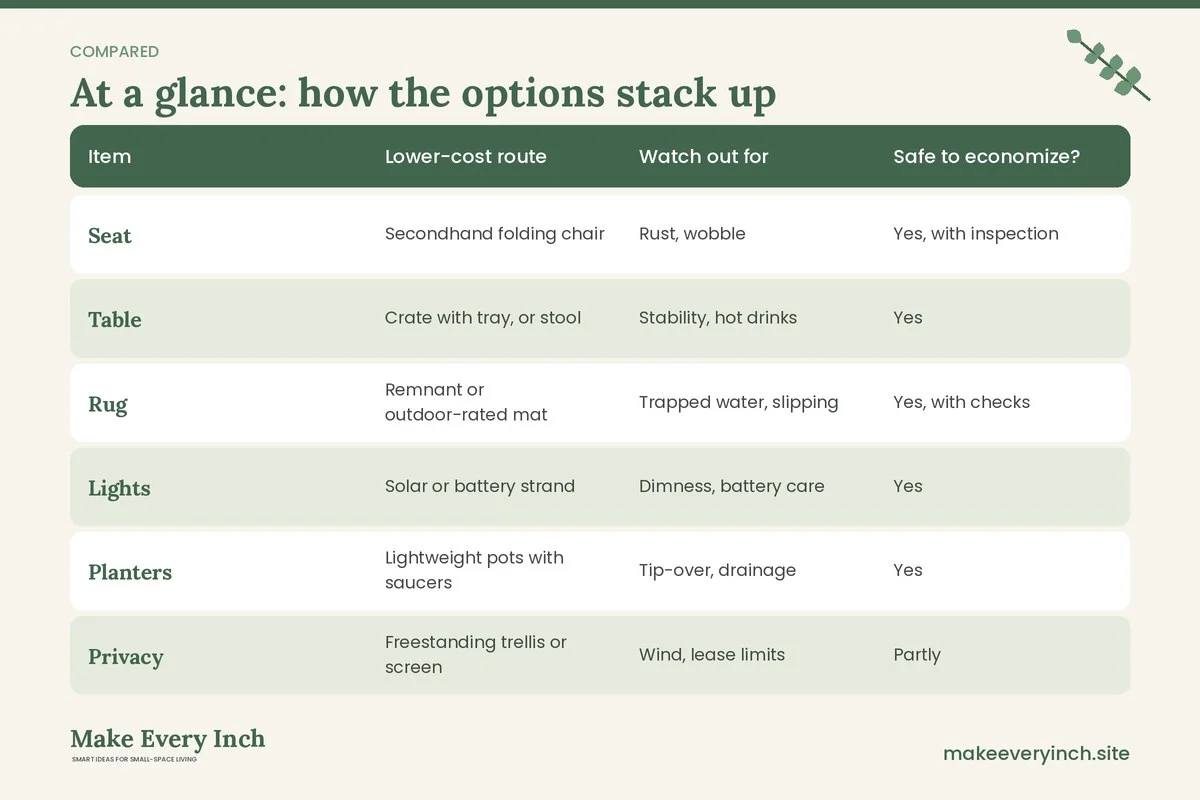
Cheaper choice or better choice? A swap table
This table compares common balcony items by what you give up and what you gain when you go the lower-cost route. It does not quote prices, because costs vary. Use it to decide where saving is smart and where it is risky.
| Item | Lower-cost route | Watch out for | Safe to economize? | |
|---|---|---|---|---|
| Seat | Secondhand folding chair | Rust, wobble | Yes, with inspection | |
| Table | Crate with tray, or stool | Stability, hot drinks | Yes | |
| Rug | Remnant or outdoor-rated mat | Trapped water, slipping | Yes, with checks | |
| Lights | Solar or battery strand | Dimness, battery care | Yes | |
| Planters | Lightweight pots with saucers | Tip-over, drainage | Yes | |
| Privacy | Freestanding trellis or screen | Wind, lease limits | Partly | |
| Shade | Wait, or ask before adding | Wind load, permission | No, ask first | |
| Electrical | Outdoor-rated and protected | Overload, damp | No | |
| Railing items | Skip them | Falling objects | No | |
| Grill or fire | Skip them | Lease, fire code | No |
16 small balcony on budget ideas
Seating that costs little
1. One secondhand folding chair
A single chair covers most needs. Inspect it, clean it and add a washable cushion. Fold it flat when you are not using it.
2. A crate or stool that is both seat and table
A sturdy stool serves as a perch or a drink surface. It tucks beside the door, and it works as extra seating for a guest. See our post on small space seating ideas for guests for more ways to stretch limited seating.
3. Floor cushions
Cushions on a mat suit very shallow balconies. Choose weather-resistant covers, and bring them in when it rains.
Surfaces and storage
4. A tray on a crate
A tray on a stable crate makes a drink table for very little. Make sure the tray has a lip.
5. A folding table
A secondhand folding table doubles as a plant stand on days when you are not eating. Keep it away from the railing.
6. A lidded storage box that doubles as a bench
A sturdy box stores cushions and watering tools. Never store fuel, chemicals or anything flammable in it. Our guide to small space organization ideas shows how to decide what really needs to live outside.
7. A narrow shoe rack as a plant shelf
A rack stands against the wall and holds a row of small pots. Check that it is stable, and that the shelves can take the weight of wet soil.
Floor, light and atmosphere
8. A remnant mat or outdoor rug
A small mat defines the seating zone and softens hard concrete. Choose one that dries quickly, and lift it from time to time.
9. Solar string lights
These need no outlet and have no cords to trip over. Drape them over a freestanding trellis or a tall plant stand, not the railing.
10. Flameless candles in jars or lanterns
These give a warm glow without a flame. Keep the battery cover closed and store spare batteries away from children and pets.
11. Reused jars as lanterns
Jars with battery tea lights make soft light at no cost. Place them on the floor or a table, never on the railing.
Green on a small budget
12. Herbs from cuttings
Many herbs grow from cuttings in water. Pot them in lightweight containers with saucers. Check each herb against a pet-safe list. Our guide to small space plants and planters ideas has more compact options.
13. A tiered stand from scrap
A simple stand made of stable crates or a secondhand shelf lifts plants off the floor. Put heavy pots on the bottom, and make sure nothing leans or wobbles.
14. A single statement plant
One large plant in a low pot can replace a crowd of small ones. Keep it away from the railing and out of the walkway.
Privacy, color and wall-free decor
15. A freestanding trellis for privacy
A freestanding trellis with a climbing plant gives soft screening. Place it on a stable base, away from the railing, and ask permission if you rent.
16. Color from fabric and paint on movable pieces
Paint a secondhand stool or crate, working with good ventilation and a low-VOC outdoor product. Add one throw or cushion in a bold color. Color on movable pieces moves with you when you leave.
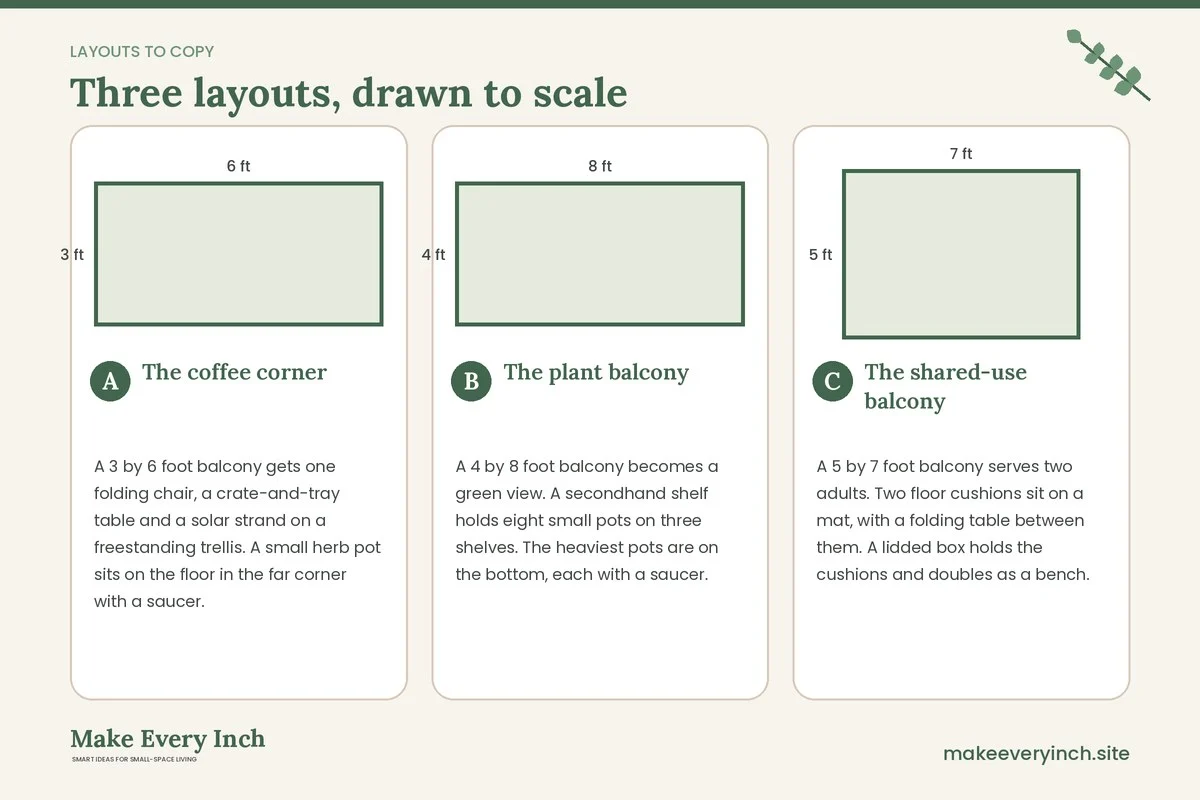
Three example small balcony on budget plans
Plan A: The coffee corner
A 3 by 6 foot balcony gets one folding chair, a crate-and-tray table and a solar strand on a freestanding trellis. A small herb pot sits on the floor in the far corner with a saucer. The chair is 12 inches from the railing, and the path to the door is 22 inches wide. The total effort is a weekend, and most of the work is cleaning and measuring.
Plan B: The plant balcony
A 4 by 8 foot balcony becomes a green view. A secondhand shelf holds eight small pots on three shelves. The heaviest pots are on the bottom, each with a saucer. A stool sits next to the door for watering. A mat catches soil. Nothing hangs from the railing, and the shelf is set against the wall, away from the edge. Before buying plants, check each one against a pet-safe list.
Plan C: The shared-use balcony
A 5 by 7 foot balcony serves two adults. Two floor cushions sit on a mat, with a folding table between them. A lidded box holds the cushions and doubles as a bench. Lights come from a battery strand. The table folds against the wall when the balcony is a drying spot or a place to air out bedding. Because the balcony is shared, the plan avoids anything tall that could tip in a crowd.
A budget timeline you can follow
Spreading the work over weeks keeps the cost manageable and helps you spot what you really use.
- Week 1: read the lease, ask for permission if needed, photograph, measure, clean and clear the drain.
- Week 2: find a seat and test it. Sit on it for several evenings before adding anything else.
- Week 3: add a surface and a mat. Check that the door still opens fully.
- Week 4: add light, using solar or battery strands.
- Week 5 and later: add plants one by one, and watch how the balcony changes with the season.
Budget mistakes to avoid
- Buying a full set. Sets are often too big for a small balcony.
- Skipping the measuring. A returned item is an extra trip and sometimes a fee.
- Choosing the cheapest light cord. Indoor cords do not belong outside.
- Buying heavy pots. Weight adds up quickly and may exceed the limit.
- Putting things on the railing. It is the most common reason for a fall.
- Ignoring the lease. A fine can cost more than the whole project.
- Forgetting storage. Cushions and light items need a dry home in bad weather.
- Buying toxic plants. A bargain plant is not a bargain if a pet chews it.
For more ways to stretch a small amount of money across a whole home, see our wider guide to budget small space ideas and the room-by-room advice in small room decor ideas.
Frequently asked questions
What should I buy first for a small balcony on budget?
Do the free work first: check the lease, measure and clean. Then buy or find one stable seat. Add other items only after you use the first one for a while.
Is secondhand outdoor furniture safe?
It can be, if you inspect it. Check for rust, cracks, loose joints and wobble, and clean it well. Do not use a piece that feels unstable.
Are solar lights better than plug-in lights?
They avoid cords and socket overload, which makes them a simple choice on a balcony. Plug-in lights are fine if they are outdoor-rated and used on a protected, GFCI outlet without overloading.
Can I use a grill on a small balcony?
Many leases and local codes prohibit grills on balconies. Check first, and treat it as not allowed unless it is clearly permitted.
How do I stop water draining onto my neighbor?
Use saucers, water slowly, keep the drain clear and never pour or spray water over the edge. Check under mats for trapped moisture.
How much weight can my balcony hold?
Ask the landlord or building manager for the limit. Keep heavy items few, light and close to the wall, and avoid crowding.
Can I make a balcony pet-safe?
Keep furniture away from the railing, avoid toxic plants and supervise your pet. Ask the landlord before adding any barrier, and do not leave a pet alone on the balcony.
Keep going: Keep building in stages. Read the main guide to small balcony ideas, check the lease rules in small balcony ideas for renters and carry the same stretch-your-money habits indoors with budget small space ideas. Our guide to renter friendly apartment decorating ideas helps with the rest of the home.
Save this guide for later
Pin the ideas you like to Pinterest so you can come back to them when you plan your space.