The Best Nesting Tables for Small Apartments That Actually Work
Quick answer: The best nesting tables for a small apartment are a set of two or three with tops between 12 and 22 inches, graduated heights from about 16 to 24 inches, and a footprint that nests fully under the largest table. Look for stable legs, rounded edges, a wipeable top and a size that fits beside the sofa with 30 to 36 inches of walkway left over.
Nesting tables small apartments can use all day are different from the decorative sets sold for large living rooms. In a compact home, a table has to earn its floor space, and a nest does that better than almost any other piece: it is a single footprint when you do not need it and two or three surfaces when you do. This guide is a buying guide, not a product list. It explains what to look for, the sizes that suit different rooms, how materials and shapes compare, the trade-offs of each style, safety points, three example rooms, a comparison table, a checklist and an FAQ. If you are still choosing the wider furniture mix, start with our pillar guide on the best furniture for small apartments, then come back here to decide on tables. If you are also weighing seating that stores things, read our sibling guide on the best ottomans with storage for small homes.
Why nesting tables suit small spaces
A fixed coffee table claims the same patch of floor every hour of the day. A nest does not. Stacked, a set takes the footprint of its largest table, which is often 18 to 22 inches square or round. Pulled apart, the same set gives you two or three separate surfaces that can sit beside a sofa, in front of an armchair or next to a bed. That flexibility matters in a room that is also a dining spot, an office and a guest room.
Nesting tables also solve a layout problem that single tables cannot. When you host, you need more surfaces, and when you are alone you need almost none. A nest follows that rhythm. It also helps in rooms where the furniture has to be rearranged often, such as a studio where the sofa area becomes a sleeping area at night. Because each table is light, one person can move the whole set without help.
There are trade-offs. Each individual top is small, so nothing in a nest holds a large tray, a full laptop setup and a mug at the same time. The legs of the larger tables are often wider apart to let the smaller ones slide beneath, which can make them less stable than a single table of the same size. And the more tables you own, the more surfaces there are to clutter. The sections below help you choose a set that avoids those problems.
Measure before you shop
Most disappointing nesting tables fail on measurement, not on style. Spend ten minutes with a tape and painter’s tape before you browse.
Measure the footprint you can spare
Mark the footprint of the largest table on the floor with painter’s tape, usually a square or circle of 18 to 24 inches across. Live with the tape for a day. If you keep stepping over it, try a smaller footprint or a different spot. The nest should sit in a place where you can reach it without moving other furniture, such as the end of a sofa, the corner beside a chair or the wall beside a bed.
Measure the reach
A table next to a seat is only useful if a hand can reach it without leaning. As a rule of thumb, keep the near edge of a surface about 16 to 24 inches from the front edge of the seat or the arm. Closer than about 14 inches and you will bump a knee, and farther than about 26 inches and you will have to lean. Sit in your usual spot and hold an imaginary mug to find your own comfortable distance.
Measure the height
Compare the table height with the arm of the sofa or the top of the mattress. A surface within about 2 inches of the sofa arm is comfortable, so with a typical arm height of 22 to 26 inches, a taller table suits the sofa end and a shorter one suits a low lounge chair. For a bedside use, a top that is level with or a little below the top of the mattress is easy to reach. Because heights in a nest vary, measure the one you will use most.
Measure the walkway
Leave 30 to 36 inches for the main path through a living room and around 24 inches for a path used only occasionally. These are hedged ranges, not rules; a narrow apartment may need to settle on the lower number. A nest that sticks out into the main path will become the object you trip over, so be honest about where the path runs.
What to look for in a set
Number of tables
A set of two is the best choice for most small apartments. It nests tightly, has a small footprint and gives you two surfaces for sofa-side use. A set of three adds a third height and works well in a living room that often hosts, but the smallest table becomes quite tiny and the stack takes up more floor. A set of four or more usually only makes sense in a larger room, where it can double as a plant stand or display. If you have a studio and are unsure, begin with two.
Top size
A top of 12 to 14 inches holds a mug, a phone and a small lamp base. A top of 16 to 18 inches holds a plate or a tablet. A top of 20 to 22 inches can hold a laptop with a little room around it. If you plan to use a table for dinner on the sofa, choose a set whose larger table is at least 18 inches across and a depth that fits over your knees. A very tiny top is attractive, but it also tips drinks more easily, so a lip or a small rim is a useful feature.
Height range
The smaller tables in a nest are usually shorter, since they must slide under the bigger ones. A typical set might range from about 16 inches at the lowest to 24 inches at the highest, but ranges vary. Look at the lowest table’s clearance: it must be low enough to fit under the next table’s apron or crossbars. If the tables are stacked in a staggered line, the shapes need to match so that the legs do not collide.
Leg design
Legs affect stability, cleaning and the look of the room. Straight legs that splay slightly are more stable than very thin pins. Hairpin and metal legs look light and let the eye pass under the table, which helps in a small room. Solid panel sides feel heavier but hide the clutter underneath. Check that the legs of the smaller tables clear the legs of the larger one with a gap of at least half an inch, so nothing scrapes when you slide them.
Materials and finishes compared
The material changes how the table looks, how much it weighs, how it handles spills and how it wears. There is no single winner, so match the material to the way you live.
Solid wood and veneer
Wood feels warm and looks good in most rooms. A solid top is durable and can be refinished, while a veneer over engineered wood is lighter and often cheaper to make. Both can mark with rings and heat, so use a coaster or a tray. Look for a finish that is sealed, and wipe spills quickly.
Metal
Metal frames and tops are slim, strong and easy to wipe. They can feel cold or clatter if you set something down hard. A powder-coated finish resists scratches better than a thin paint. Metal tops can show fingerprints and may get warm in direct sun, so think about the spot.
Glass
Glass tops make a small room feel lighter because you can see through them. They are also more fragile and show fingerprints and dust. If you choose glass, look for tempered glass and edges that are smooth and polished, and avoid placing a heavy item on a very small top. Think carefully if you have small children or a pet that jumps.
Stone and composite
Marble, stone and stone-look composites add weight and a premium feel. They also add weight in the physical sense, which can make a nest harder to move and risky for a toe or a floor. Natural stone can stain, so check the care guidance. These are best in a spot where the nest stays put.
Rattan, cane and woven
Woven materials add texture and softness. They are light, but the surface may be uneven, so a tray or a flat insert helps. A woven side can snag clothing, so check that the edges are finished.
Plastic and molded resin
Molded tables are light and easy to clean, and some are made for outdoor use. They can feel less substantial, and a very light table may slide when you lean on it. If you choose this kind, look for a stable base and a matte finish that hides scuffs.
Shapes: round, square, rectangular or mixed
Shape changes how a nest behaves in a small room.
- Round: No corners to bump, so it is friendlier in tight paths and around children. Circular tops nest compactly and look soft against a boxy sofa. The trade-off is that a round table wastes some corner space, so it sits better away from a wall.
- Square: Fits tightly against a wall or the end of a sofa, which saves floor. The corners are sharper, so look for rounded edges.
- Rectangular: Gives more length for a laptop or a tray and can slide across a sofa. It needs a bit more room to rotate and sits best parallel to the seat.
- Mixed or staggered: A set where the tables are different shapes, or where the smaller tables nest at an angle, adds interest and is useful in a corner. It can look fussy in a very small room, so keep the colors and materials related.
Nesting tables compared with other small-space surfaces
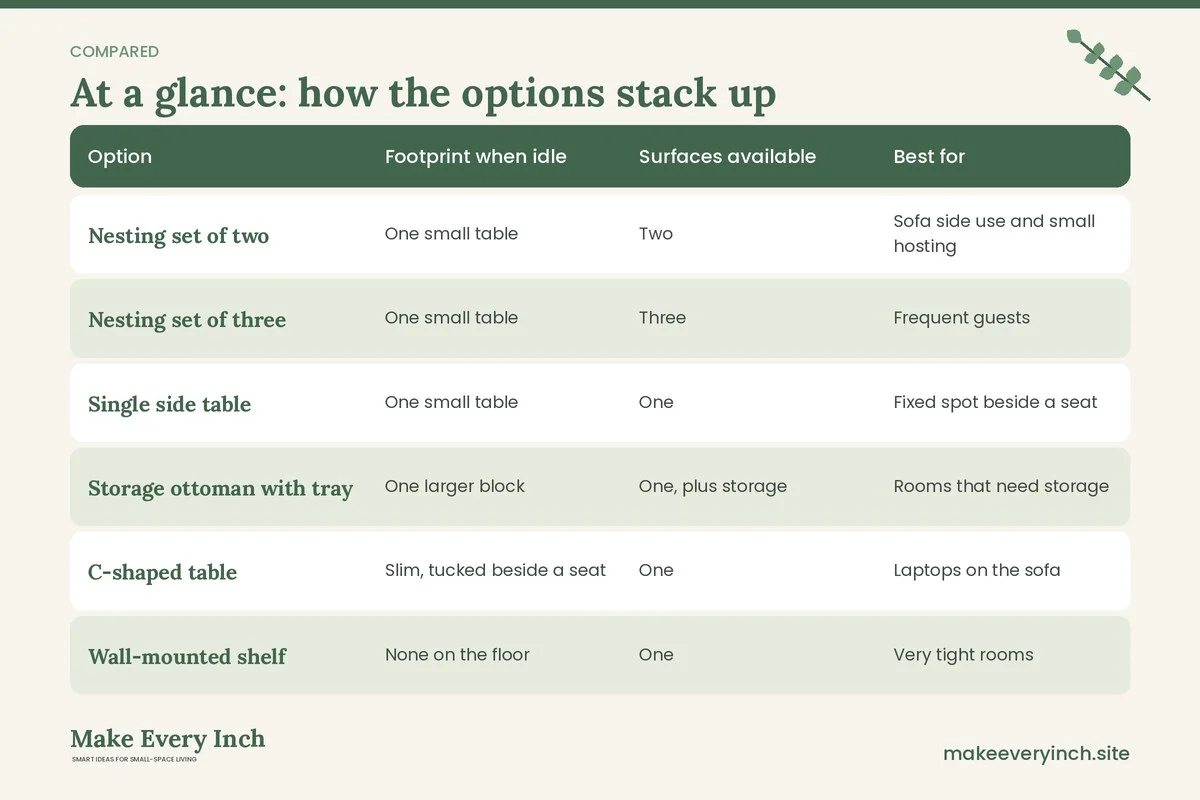
The table below compares a nest with other options, to help decide whether it is the right choice for your room.
| Option | Footprint when idle | Surfaces available | Best for | Main trade-off |
|---|---|---|---|---|
| Nesting set of two | One small table | Two | Sofa side use and small hosting | Small tops |
| Nesting set of three | One small table | Three | Frequent guests | Tiny smallest table |
| Single side table | One small table | One | Fixed spot beside a seat | Not flexible |
| Storage ottoman with tray | One larger block | One, plus storage | Rooms that need storage | Heavier to move |
| C-shaped table | Slim, tucked beside a seat | One | Laptops on the sofa | Only suits some seats |
| Wall-mounted shelf | None on the floor | One | Very tight rooms | Needs fixings and a lease check |
The most useful insight from the table is that a nest and a storage ottoman do different jobs. The nest gives you reachable surfaces and the ottoman gives you hidden storage. In many small living rooms, a pair of the two is better than either alone. If you want to explore the storage side, see our guide to the best storage ottomans.
Three example rooms
A 10 by 12 foot living room with a loveseat
A 70 to 72 inch loveseat sits on the long wall. Place a nest of two at one end of the loveseat, with the larger table close to the arm and the smaller one tucked beneath it. When two people watch a film, pull the smaller table out to the other end. This leaves the floor in front of the loveseat clear and keeps a path of about 36 inches to the door. A slim floor lamp stands behind the loveseat so the tables are free of a lamp base. For other layout ideas in a room this size, read our guide to small living room layout ideas.
A studio of about 400 square feet
In a studio the sofa often faces the bed or the kitchen. A nest of three can live between the sofa and the wall, and the largest table works as a laptop surface during the day. At night, carry the largest table to the side of the bed for a drink and a book, and tuck the other two back by the sofa. Because the tables move, you do not need a separate bedside table. Choose a set with light legs, since you will carry it often. Our guide to studio apartment ideas has more on zoning a single room.
A small bedroom with a double bed
A narrow bedroom may fit only a few inches between the bed and the wall. Instead of two bedside tables, one nest of two on the side with more room covers both needs. Use the taller table beside the bed and slide the shorter one beside a reading chair or under the window. Keep at least 24 inches on the side you step out of. For more in this space, see our collection of small bedroom ideas.
Ways to use a nest beyond the sofa
Nesting tables are among the most adaptable small pieces you can buy, and they do more than hold a mug.
- As a dining overflow: When friends come over, pull the tables to the sofa so each person has a spot for a plate. See our guide to best small dining tables for a more permanent option.
- As a plant display: Stagger heights to make a small plant stand, but keep the base waterproof with a saucer.
- As an entryway landing zone: The larger table by the door holds keys and mail, and the nest slides out of the way when you carry groceries.
- As a work surface: The highest table can serve as a laptop perch for a short session, though it is not a substitute for a proper desk.
- As a bar or tea cart: Set a tray across two tables, or use one for the kettle and one for the cups.
- As a bedside pair: Move one table next to the bed at night and return it in the morning.
Safety and practical notes
Nesting tables are low-risk furniture, but a few checks keep a small space safe.
- Pinch points: Fingers can get caught when two tables slide together. Slide the smaller table out by its top edge, not by the legs, and keep children away while you nest or unnest the set.
- Stability: Do not stand on a nesting table or use it as a step. Place a lamp or a candle only on a table with a wide, stable base, and keep hot items on a heat-safe tray.
- Glass and edges: If you choose glass or stone, check that the edges are smooth, and avoid placing a nest where a child might fall against it.
- Floors: Add felt pads under the legs so the tables do not scratch wood or laminate, and check the pads every few months. Under a rug, make sure the legs sit evenly so the top does not rock.
- Cords and lamps: Run any lamp cord so that it is not a trip hazard, and do not run a cord under a rug. Keep chargers and power strips off the floor and away from drinks.
- Tall furniture nearby: If your nest sits beside a tall bookcase or shelving unit, anchor the tall piece to the wall using the hardware that suits your wall type, and only after you have confirmed your lease allows it. Use a stud finder to locate studs, and never drill without permission. If you rent, a freestanding low unit is a safer choice.
Mistakes to avoid when buying
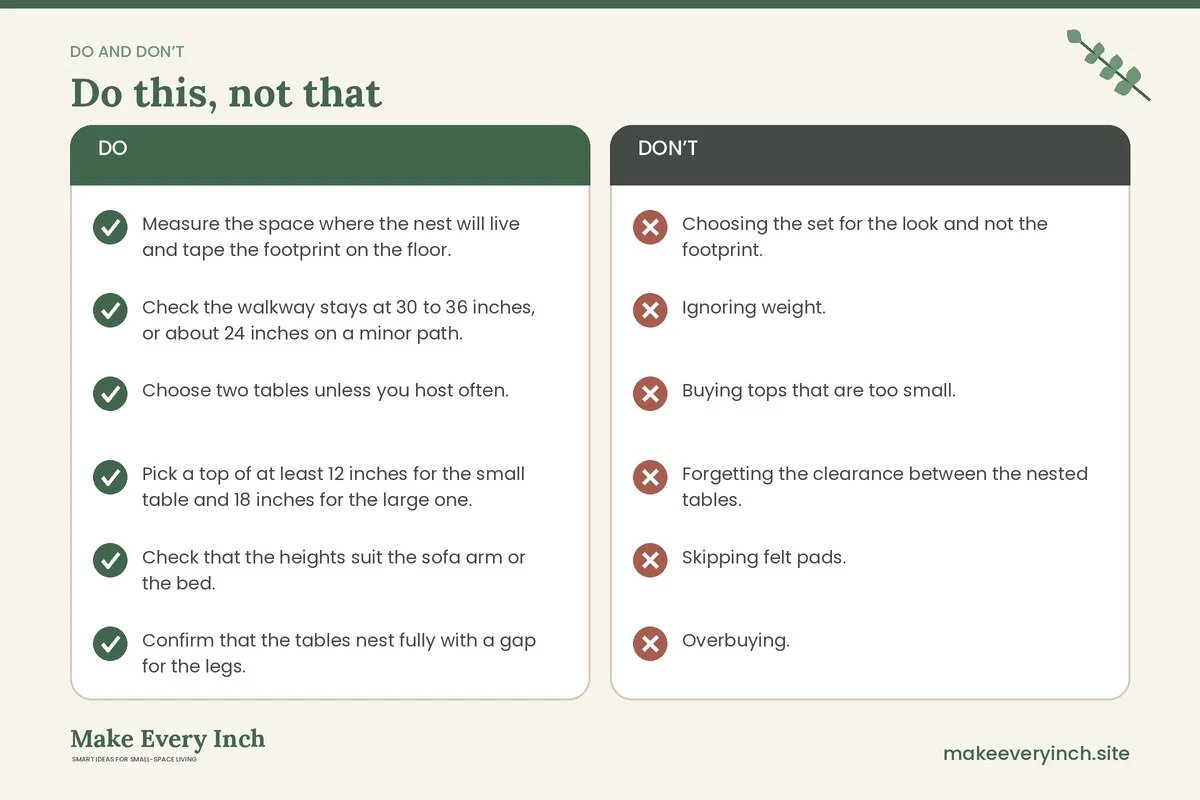
- Choosing the set for the look and not the footprint. A beautiful set that blocks the path will be moved to the garage within a month.
- Ignoring weight. A heavy stone set looks luxurious but it will not slide easily across a rug, and you will stop moving it.
- Buying tops that are too small. If a mug and a phone cover the entire top, you will end up resting things on the floor.
- Forgetting the clearance between the nested tables. Some sets must be stored in a certain order. Check that all tables really slide fully under the largest one.
- Skipping felt pads. The first drag across a floor can leave a mark that stays for good.
- Overbuying. A set of four in a small room produces four surfaces to clutter. Start with two.
- Matching everything. A room full of identical tables looks flat. Mixing a round nest with a square side table can add depth if the finishes relate.
How to style a nest so it does not look cluttered
A nest on show should look calm. Keep only what you use on the top table: a small lamp, a coaster, a plant or a stack of two books. Leave the lower tables clear until you need them. Group objects by height, with a tall item at the back and a low one at the front. Use a tray on the largest table to keep small things together and to give the top a bit of edge. When the nest is stacked, treat the top as a mini shelf and refresh it each season, but avoid piling items that would have to move every time you pull a table out.
Color works the same way. If the sofa is a strong color, choose tables in a neutral wood, black or white, so the room does not feel busy. If the room is neutral, a set in a muted green, a warm wood or a metallic finish gives some contrast. Light colors reflect more light and make a small room feel larger. For more on making a small room feel open, see our guide to small living room ideas.
Care and cleaning
A little care makes a set last through several moves. Wipe wood with a soft damp cloth and dry it at once. Clean metal with a mild cleaner and a soft cloth. Glass needs a glass cleaner and a lint-free cloth. Use coasters on every surface, and avoid leaving wet pots on wood. Tighten loose screws once or twice a year, since tables that are moved often can loosen at the joints. If a leg wobbles, check the floor first, since the problem might be a slope rather than the table.
A simple buying checklist
- Measure the space where the nest will live and tape the footprint on the floor.
- Check the walkway stays at 30 to 36 inches, or about 24 inches on a minor path.
- Choose two tables unless you host often.
- Pick a top of at least 12 inches for the small table and 18 inches for the large one.
- Check that the heights suit the sofa arm or the bed.
- Confirm that the tables nest fully with a gap for the legs.
- Check for rounded edges and a stable base.
- Pick a material that suits how you live, such as wood or metal for everyday use.
- Add felt pads before you use the tables.
- Make sure you can lift each table with one hand.
- Check the return policy in case the size is wrong.
- Plan where each table goes when it is not in use.
FAQ
How many nesting tables do I need for a small apartment?
Two is enough for most small apartments. It gives you two surfaces for the sofa and a compact footprint when you stack them. Choose three if you often host or want a third height for a bed or a plant.
What size should nesting tables be?
Tops between 12 and 22 inches suit most small rooms. The larger table is usually 18 to 22 inches, and the smaller is usually 12 to 16 inches. Heights run from about 16 to 24 inches across a set, though sets differ.
Are nesting tables a good replacement for a coffee table?
They can be. A nest is more flexible than a single coffee table because you can pull the tables apart and put them where you need them. If you need a large single surface for games or books, a coffee table or a storage ottoman with a tray may suit you better.
Which material is best for a small space?
There is no single best one. Metal and glass look light, wood feels warm and is easy to refinish, and woven materials add texture. Pick the one that suits your cleaning habits, your floors and your family.
Can I use nesting tables as bedside tables?
Yes, if the height is close to the top of the mattress and the top is large enough for a lamp or a glass. Keep any lamp on a stable base, and move the tables back to their nest in the morning if you need the floor space.
Do nesting tables work on rugs?
They do, but the legs need to sit evenly on the rug. A thick, soft rug can make the top rock, so try a flat-woven rug or place the table at the edge. Use pads under the legs to protect the rug from marks.
Do I need permission from a landlord to use nesting tables?
No, since they are freestanding. You only need permission if you choose to fix anything to the wall, such as anchoring a nearby tall piece or hanging a shelf. Always ask first and never drill without permission.
Keep going: Keep planning with our best furniture for small apartments guide, our small space storage furniture ideas and our small space organization ideas.
Save this guide for later
Pin the ideas you like to Pinterest so you can come back to them when you plan your space.