12 Small Living Room TV Wall Ideas Modern Homes Love
Quick answer: The best small living room tv wall ideas modern rooms use are a flush wall mount with hidden cables, a floating low media shelf, a slim slatted or panelled backdrop, a recessed niche and a single strip of indirect light. Keep the screen center at 40 to 44 inches from the floor, sit about 1.2 to 1.6 times the screen diagonal away, limit the wall to two or three materials and follow the TV and mount instructions for every fixing.
Small living room tv wall ideas modern style relies on are really about subtraction. A modern wall does not need more objects around the screen. It needs fewer lines, fewer cables and one clear material that frames the picture. In a small room the television is often the largest object on the wall, so the way you treat it decides whether the room feels calm or cramped. This guide focuses on the modern look specifically: how to pick a mounting style, how to plan the sightline from the sofa, how to hide the cables that spoil clean lines, how to use a backdrop, a floating shelf and light to make the screen feel built in, and how to keep everything safe. It includes 12 ideas, a comparison table, three example walls, a colour and material guide, mistakes to avoid, a checklist and an FAQ. For the full overview, start with our main guide to small living room TV wall ideas, and for the room as a whole see small living room ideas.
What makes a TV wall look modern
Modern design is easy to recognise and hard to fake. It uses straight lines, flat planes, restrained colour and visible order. On a television wall that translates into a few repeatable traits.
- Alignment. The screen, the shelf below it and any art or panel beside it share edges. If the shelf is 48 inches wide and the screen is 43 inches wide, the shelf should extend evenly past each side, not lean to one.
- Few materials. Choose two or three, such as painted plaster, a wood veneer and a matte metal. Each extra material adds visual noise in a small room.
- No visible cables. A modern wall looks like it was built around the screen. Loose wires break that illusion more than any other detail.
- Negative space. Leave empty wall around the television. A bare area of 6 to 12 inches on each side reads as intentional, while crowding the screen with frames reads as clutter.
- Hidden or flat hardware. Low-profile mounts, concealed shelf brackets and push-open doors keep the surface smooth.
Think of the wall as one composition with three layers: the backdrop, the screen and the surface below it. You can change one layer without rebuilding the others, which is why the ideas below are written as swaps.
Plan the sightline before you choose a style
Modern walls fail most often because the screen is the wrong size or at the wrong height, not because the style is wrong. Take these measurements first.
Viewing distance
A common guide is to sit between 1.2 and 1.6 times the screen’s diagonal measurement away from it. For a 43 inch screen that is roughly 4.3 to 5.7 feet. For a 55 inch screen it is about 5.5 to 7.3 feet. For a 65 inch screen it is about 6.5 to 8.7 feet. Many small living rooms have only 6 to 8 feet between the sofa and the wall, so a screen in the 43 to 55 inch range is usually comfortable. Measure from the front edge of the sofa cushion to the wall, and subtract the depth of any media shelf.
Screen height
Sit on your sofa in your usual position and note where your eyes are. Most people’s eye level is 38 to 44 inches from the floor on a standard sofa. Aim to place the center of the screen at or just above that, usually 40 to 44 inches. Hanging the television too high, like above a mantel, strains the neck, so it suits a screen you glance at rather than one you watch for hours. If the only possible spot is high, ask whether the mount can tilt, and follow the instructions that came with it.
Width of the wall
Measure the wall from corner to corner and from floor to ceiling. Mark the centre of the screen with tape. In a modern layout the centre of the screen usually aligns with the centre of the sofa or the centre of the wall, so the composition looks balanced from the doorway.
Light and glare
Stand where you will sit and look at the wall in the evening and in daytime. A window directly opposite or beside the wall can cause reflections. A matte finish on the surrounding wall and a screen with a good anti-glare coating help, and so does placing the screen where windows are to the side, not behind you. Heavy curtains or sheer blinds can solve the rest.
12 small living room tv wall ideas modern rooms can use
Mounting and framing
1. A flush mount with a slim bracket
A low-profile bracket keeps the screen close to the wall, so it looks like a picture. Choose a bracket rated for your television’s weight and size, and check the pattern of holes on the back of the screen. Find the wall studs with a stud finder, or use anchors rated for your wall type, and follow the instructions supplied with both the TV and the mount. If you are unsure, a qualified installer is a sensible choice. A flush mount works best when the cables run into the wall, as the next idea explains.
2. Concealed cables through the wall
The single biggest improvement to a modern wall is hiding the power and signal leads. A cable cover in the same colour as the wall is the simplest version. A pass-through kit with a wall plate lets the leads travel inside the wall to a low outlet. Use products designed for in-wall power, never run an ordinary extension lead inside a wall, and if you are not sure about the wiring ask a qualified electrician. In a rental, a paintable cable channel is the practical option.
3. A recessed niche
If you are renovating, a niche that is a few inches deep lets the screen sit almost level with the surrounding wall. It also gives you a built-in space for a power point and a streaming box. This is a project for a qualified professional, because walls may hold wiring or structural elements.
4. A tilting or swivelling arm in a corner
Corners are common in small rooms. A swivel arm lets one screen serve both the sofa and a nearby dining chair, and it folds back flat when not in use. Leave the clearance the instructions recommend so the screen does not strike a wall or a door.
Backdrops and surfaces
5. A slatted wood panel
Vertical wood slats behind the screen add texture and hide wires behind them. Slats of 1 to 2 inches wide with small gaps look contemporary and absorb a little sound. Fix the panel according to its instructions, and keep the screen mount attached to the wall structure and not just to the thin panel unless the panel manufacturer says it can carry the load.
6. A single bold paint colour
Paint the wall behind the television a deep, matte shade, such as charcoal, navy or forest green. A dark backdrop reduces the contrast between the screen and the wall, so the black rectangle seems to melt into the room. It is the least expensive way to change the look, and it works in rentals if the lease allows painting.
7. A large-format panel or microcement look
A smooth, uniform finish in a large format looks sleek behind a screen. Peel-and-stick or panel options exist for renters, but check the lease and the product instructions before you begin. A single plane of colour makes a small wall feel larger because there are fewer joints.
8. A framed-screen effect
Add a thin frame or a painted border around the television, with 2 to 3 inches of margin. The result looks like a piece of art when the screen is off. Keep the border the same colour as the wall, or one shade darker, to keep the look quiet.
Shelves and storage
9. A floating media shelf
A wall-hung shelf or low cabinet frees the floor and makes a small room feel bigger. Keep it 6 to 12 inches from the floor, or install it low enough to be under the screen with a 4 to 8 inch gap between the shelf top and the bottom edge of the screen. Choose a depth of 12 to 16 inches so it holds a streaming box and a router with ventilation space. Mount it using fixings suited to your wall and the weight, and follow the shelf instructions. For rentals, see our no-drill storage ideas for renters.
10. A closed cabinet with a push-open door
Doors keep the surface calm, and a push-open mechanism avoids visible handles. Modern rooms often prefer one long cabinet to several small ones. Cut a slot or leave a gap at the back for cables, and make sure there is enough airflow around any device that gets warm.
11. A narrow ledge for one piece of art
Instead of a shelf full of objects, use a ledge about 4 inches deep and 36 to 48 inches long next to the screen. Lean a single print or sculpture on it. The restraint is what makes it modern, so resist the urge to add more.
Light
12. Indirect light behind the screen
A strip of warm white LED light at the back of the screen or along the shelf softens the contrast between the picture and the wall. Choose a strip made for indoor use with a plug-in driver, follow the instructions, and place it so the light does not shine into your eyes. A dimmer is useful, since a gentle glow of about 5 to 10 percent of full brightness is often enough for a film. For more on light see our small living room lighting ideas.
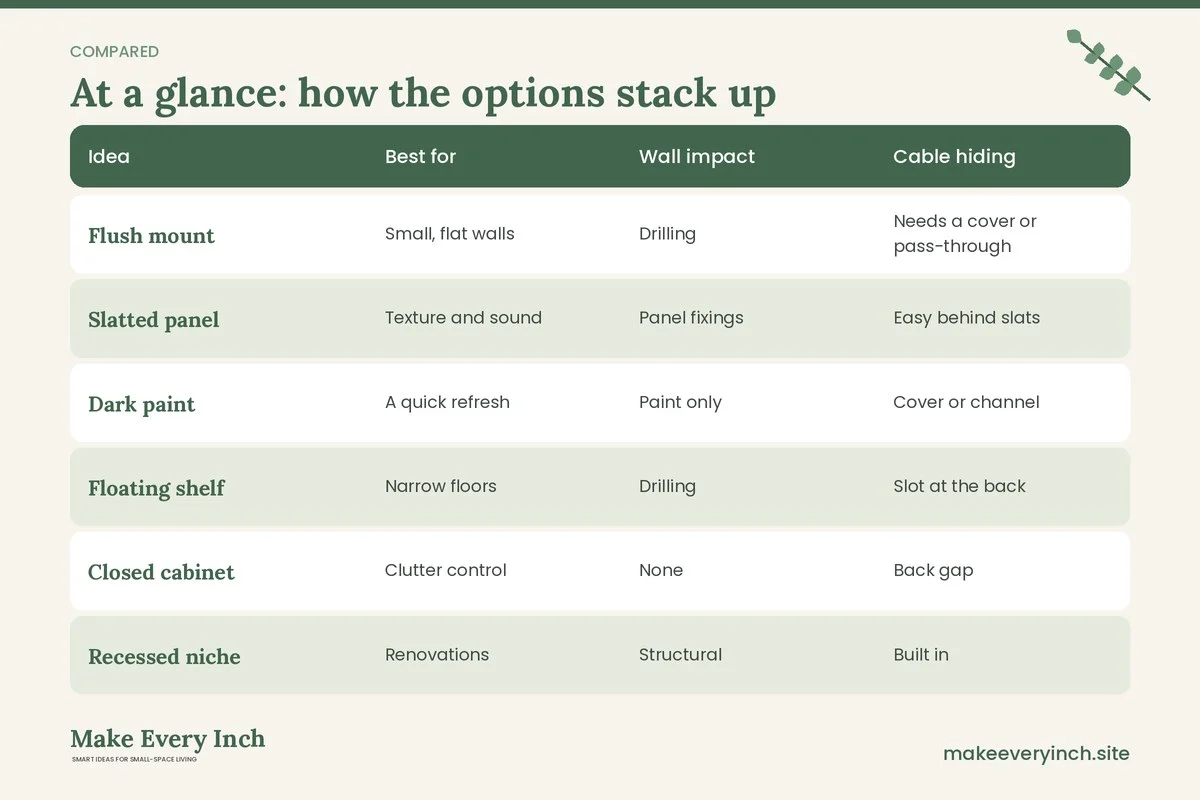
Comparison table: which modern treatment fits you
| Idea | Best for | Wall impact | Cable hiding | Renter friendly |
|---|---|---|---|---|
| Flush mount | Small, flat walls | Drilling | Needs a cover or pass-through | Check lease |
| Slatted panel | Texture and sound | Panel fixings | Easy behind slats | Sometimes |
| Dark paint | A quick refresh | Paint only | Cover or channel | Check lease |
| Floating shelf | Narrow floors | Drilling | Slot at the back | Check lease |
| Closed cabinet | Clutter control | None | Back gap | Yes |
| Recessed niche | Renovations | Structural | Built in | No |
| Light strip | Evening comfort | Adhesive | Plug-in driver | Usually |
| Freestanding stand | Rentals | None | Cable clips | Yes |
Three example modern walls
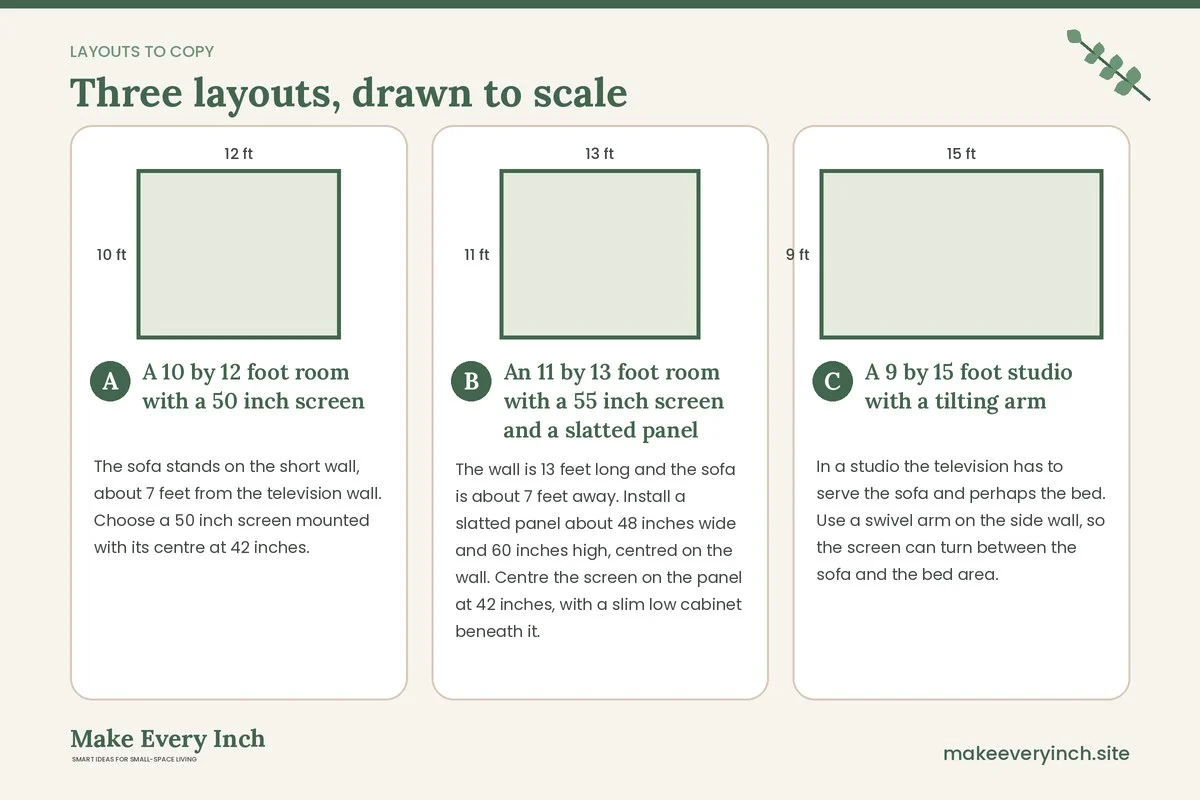
A 10 by 12 foot room with a 50 inch screen
The sofa stands on the short wall, about 7 feet from the television wall. Choose a 50 inch screen mounted with its centre at 42 inches. Underneath, hang a floating shelf 44 inches wide and 14 inches deep, mounted about 12 inches above the floor. Paint the wall behind in a deep grey, and run the power leads in a paintable channel down to a low outlet. Add a floor lamp in the corner and a single print on a ledge to the right, so the composition has a vertical accent. The result is a clean, quiet wall that uses about 14 inches of depth.
An 11 by 13 foot room with a 55 inch screen and a slatted panel
The wall is 13 feet long and the sofa is about 7 feet away. Install a slatted panel about 48 inches wide and 60 inches high, centred on the wall. Centre the screen on the panel at 42 inches, with a slim low cabinet beneath it. The slats hide the cables, and the cabinet holds the box and games. A small plant on the cabinet’s right side balances the weight. Keep the tones consistent: oak slats, a white cabinet and a matt black screen.
A 9 by 15 foot studio with a tilting arm
In a studio the television has to serve the sofa and perhaps the bed. Use a swivel arm on the side wall, so the screen can turn between the sofa and the bed area. Keep the wall behind it in a single colour, run the cable in a channel and use a narrow cabinet as a divider behind the sofa. The sofa is about 6.5 feet from the screen, which suits a 43 to 50 inch television. When the screen is not in use, fold it flat against the wall.
Colours and materials for a modern TV wall
A modern palette can be neutral or bold, but it should be limited. A few combinations are worth trying.
- Warm white and pale oak. Soft, light and calm. Good for a small, bright room that you want to feel larger.
- Charcoal and walnut. Moody and cinematic. The dark wall hides the screen when it is off.
- Greige and matte black. A grown-up neutral that works with almost any sofa.
- Deep green and brass-toned accents. A richer look, which needs a simple layout to avoid feeling busy.
- Soft grey and white. A cool, tidy scheme that suits compact urban flats.
Material finish matters as much as colour. Matte surfaces reduce reflections, while glossy finishes can bounce light back at you. Choose a matte or satin paint for the wall behind the screen. For shelves, a thin edge of 0.75 to 1 inch looks more refined than a thick one. For handles, push-open or integrated pulls keep the lines clean.
Keeping the wall safe
Safety is part of design. A television is heavy, and a wall-mounted shelf is under load every day.
- Read the instructions that came with the TV and the mount before you buy fixings. Check the weight rating, the hole pattern and the wall types the mount is made for.
- Locate studs with a stud finder, or choose anchors suited to the wall type, such as plaster, brick or concrete, and follow the manufacturer’s guidance. Do not trust a plain screw in a thin plaster wall.
- Never mount above a heat source, such as a fire, without checking the manufacturer’s guidance.
- If you have children or pets, consider anti-tip straps for freestanding furniture and keep leads out of reach.
- Do not drill near switches or where cables might run behind the wall without checking first. If in doubt, ask a qualified professional.
- Leave ventilation around the screen and any media devices.
- Ask a second person to help lift and hold the screen while you fit it.
Common mistakes on modern TV walls
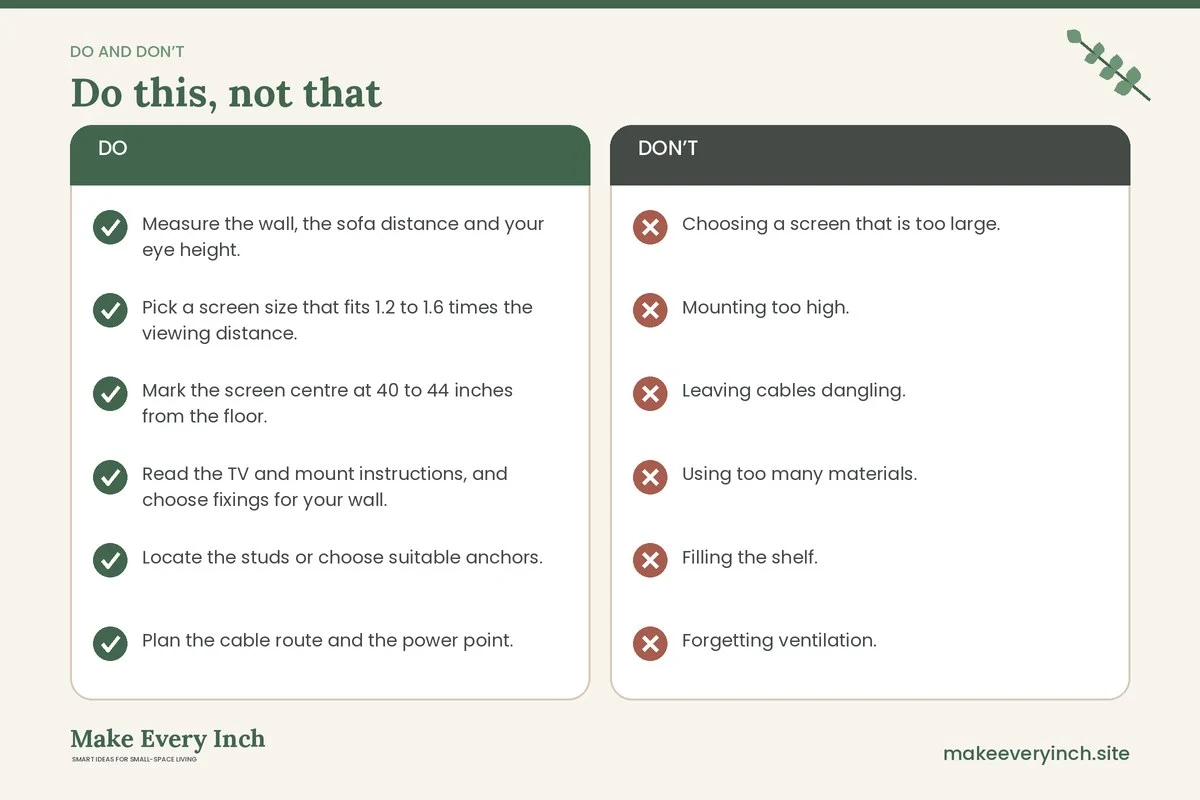
- Choosing a screen that is too large. A 65 inch screen in a 6 foot viewing distance overwhelms the room.
- Mounting too high. A screen set at 55 inches or more causes neck strain.
- Leaving cables dangling. One visible lead can undo the whole look.
- Using too many materials. Wood, stone, metal and paint all at once feel busy.
- Filling the shelf. A modern shelf holds three or four items, not twenty.
- Forgetting ventilation. Closed cabinets with no gap can trap heat around devices.
- Ignoring sound. Slim screens have slim speakers, so consider a compact soundbar on the shelf.
Modern touches that cost little
You do not need a renovation. A few smaller changes can lift a wall quickly.
- Paint the wall behind the television one shade darker than the other walls.
- Replace a mismatched stand with a plain low unit in a single finish.
- Use a paintable cable cover to hide leads.
- Hang a single large print or mirror to one side, so the screen is not the only focal point.
- Swap a busy rug for a plain one in a neutral tone.
- Put a lamp with a slim base at the end of the sofa and switch off the overhead light in the evening.
Modern TV wall checklist
- Measure the wall, the sofa distance and your eye height.
- Pick a screen size that fits 1.2 to 1.6 times the viewing distance.
- Mark the screen centre at 40 to 44 inches from the floor.
- Read the TV and mount instructions, and choose fixings for your wall.
- Locate the studs or choose suitable anchors.
- Plan the cable route and the power point.
- Choose one backdrop: paint, panel or slats.
- Pick a low shelf or cabinet that matches the width of the screen.
- Limit the palette to two or three materials.
- Add a soft indirect light.
- Keep the shelf to three or four objects.
- Leave ventilation space around devices.
FAQ
How high should a TV be in a modern small living room?
Most people are comfortable with the centre of the screen at about 40 to 44 inches from the floor. Sit in your usual spot and check that your eyes are level with the upper half of the picture.
What size TV suits a small living room?
Many small rooms suit a screen between 43 and 55 inches. Use the distance from the sofa to the wall and the 1.2 to 1.6 times diagonal guide to decide.
How do I hide TV cables on a modern wall?
Use an in-wall pass-through kit designed for the purpose, or a paintable cable channel in the wall colour. A cable box under a floating shelf also helps. If the work involves mains wiring, ask a qualified electrician.
Is it better to mount the TV or use a stand?
A mount saves floor space and looks cleaner, but a stand is fine in a rental or if the wall is not suitable. Choose a low stand with slim legs and a matching finish.
What colour wall is best behind a TV?
A matte, mid-to-dark shade reduces contrast with the screen. Greys, deep greens and navy are popular, but a warm white also works if the room has soft light.
Can I do a modern TV wall in a rental?
Yes. Use a freestanding stand or cabinet, a paintable cable cover, a leaning ledge for art and a plug-in light strip. Check the lease before drilling or painting, and see our renter friendly apartment decorating ideas.
Keep going: Keep planning with our small living room layout ideas, small living room storage ideas and small living room ideas for renters.
Save this guide for later
Pin the ideas you like to Pinterest so you can come back to them when you plan your space.