12 Small Living Room TV Wall Ideas Japandi Style with Warm Wood
Quick answer: The best small living room tv wall ideas japandi style pair a low, light-wood console with a slatted or sliding panel, natural textures and soft paper or linen light. Mount the screen so its center sits roughly 38 to 44 inches from the floor, keep the console low at 12 to 18 inches, leave open wall for calm, and choose two woods and one muted accent. Follow the TV and mount instructions for stud and anchor needs.
Small living room tv wall ideas japandi style start from an honest problem: a black screen is the least Japandi object in the room. Japandi blends Japanese restraint with Scandinavian warmth, and it values natural materials, handmade shapes, low furniture and quiet light. A television is none of those things. The good news is that a small wall can soften the screen with wood, texture, a low horizon line and thoughtful lighting, so the television belongs to the room instead of dominating it. This guide explains the design logic, the measurements for a low-slung layout, 12 ideas, a materials table, three example rooms, a styling formula, a mounting safety section, a checklist and an FAQ. For the overview, read our main guide to small living room tv wall ideas and the broader small living room ideas pillar. If you prefer a stricter, more stripped-back approach, see the sibling post on small living room tv wall ideas minimalist.
The Japandi logic for a TV wall
Three ideas shape a Japandi TV wall, and they are worth knowing before you shop.
- Low and horizontal: Japanese interiors favor low furniture and a calm horizon line. A console 12 to 18 inches high, with a screen mounted a little lower than you would in a conventional room, keeps the eye near the floor and makes a small room feel taller.
- Warm natural materials: light oak, ash, birch, bamboo, rattan, linen, paper and unglazed ceramic bring the warmth that a screen lacks. Aim for two wood tones at most, plus one textile texture.
- Ma, or meaningful space: the Japanese idea of ma values the empty space between objects as much as the objects. On a TV wall, that means a single considered grouping and a deliberate area of empty wall, not a wall filled to the corners.
Japandi differs from pure minimalism in one practical way. It accepts a little handmade imperfection and a few well-chosen objects. A slightly uneven ceramic bowl or a woven basket is welcome, while a stark white shelf with a single perfect object might feel cold. The aim is calm with character.
Measurements for a low, warm layout
Japandi rooms sit lower, so the usual numbers shift slightly. Treat these as hedged ranges and adjust to your seating.
- Screen center height: about 38 to 44 inches from the floor for a standard sofa, and lower if you sit on a low sofa or floor cushions. A low-slung screen suits the calm horizon line.
- Viewing distance: roughly 1.2 to 1.6 times the screen diagonal. For a 43 to 55 inch screen, that is about 5 to 7 feet.
- Console height: 12 to 18 inches. A low unit keeps the screen from feeling like it floats too high.
- Console depth: 12 to 16 inches in a small room.
- Gap between console and screen: 8 to 14 inches, which leaves a breathing band of wall. For a slat panel behind the screen, extend the panel at least 4 to 6 inches beyond each screen edge.
- Slat spacing: many people choose slats about 1 to 2 inches wide with gaps of 0.5 to 1 inch, which reads as a fine, calm rhythm.
- Walkway: keep 30 to 36 inches clear in front of the wall.
- Sofa seat height: 14 to 17 inches suits the low profile. Check the sight line from a seated position.
Tape the screen, the console and the panel outline on the wall and floor before you buy anything. Sit in your seat and judge how low and wide the grouping feels. A common mistake is a console that is too tall, which breaks the horizontal rhythm.
12 small living room tv wall ideas japandi style
Ideas built around wood
1. A slatted wood panel behind the screen
A vertical slat panel behind the TV adds texture and warmth, and the fine lines make the wall look taller. The panel can be a flat set of solid slats or a lightweight version mounted on a backing board. Choose a light, natural finish rather than a dark stain. If you rent, a freestanding or leaning panel avoids permanent fixing. Follow the panel instructions for fixing, and confirm that the combined weight of the panel and screen is supported by the wall.
2. A low floating wood console
A narrow floating unit mounted just above the floor, at 10 to 14 inches high, keeps the floor visible and gives the wall a floating horizontal line. The visible floor beneath it makes a small room feel larger. Use anchors or studs rated for the load, and read the unit’s instructions carefully.
3. A solid wood media bench with tapered legs
A freestanding bench in light oak or ash, at 14 to 18 inches high, is the easiest route in a rental. Its open legs let light pass underneath. Add a woven basket on one side to hide remotes and cords, and keep the top clear apart from a single object. See our Japandi apartment ideas for more on this style.
4. A wood frame around the screen
A simple surround in thin wood, mounted as a shallow frame, makes the television look like a deliberate picture on the wall. Leave ventilation gaps around the set and follow the TV manufacturer’s clearance guidance. This is a project to plan carefully, since a frame that blocks airflow is a risk.
Ideas built around screens and covers
5. A sliding paper or wood panel
Inspired by shoji screens, a sliding panel in frosted paper-style material or light wood slats can slide across the TV when it is off. The wall then looks like a calm paneled surface. Use a track that is rated for the panel weight, make sure the panel never rests on the screen, and leave airflow. A sliding screen suits people who watch a few hours a week.
6. A curtain or linen panel
A simple linen curtain on a ceiling or wall track can cover the TV and a portion of the wall. When open it frames the screen, and when closed it softens the wall. Choose a heavy, natural weave in an oatmeal or soft gray tone. It also helps with sound and glare. Keep fabric away from the vents and hot surfaces.
7. A tokonoma-style niche
In traditional Japanese rooms, the tokonoma is an alcove for a single piece of art or an arrangement. You can borrow the idea by dedicating a section of the wall, beside the screen, to one object: a branch in a vase, a small scroll-style print or a ceramic piece. Place it so its center sits near the screen center height, and leave 10 to 14 inches of space between the object and the screen.
8. A leaning mirror or art pair at one side
If your TV wall faces a window, a tall leaning mirror at one side of the console bounces daylight into the room. Lean it securely and anchor it with a safety strap if it is tall. Keep the opposite side calm so the wall does not feel busy.
Ideas built around light and texture
9. A paper or linen lamp at the console end
A single paper lantern or linen-shaded lamp at one end of the console gives soft diffused light and a gentle, handmade look. Choose a warm bulb, around 2200 to 2700 kelvin, and keep the lamp at least a few inches from any wood panel or fabric. Our small living room lighting ideas covers lamp placement in more depth.
10. Warm light behind the panel
A low-output warm strip behind a slat panel or under a floating console creates a glow that reduces the contrast between a bright screen and a dark wall. Use products that are suitable for the location and keep wiring tidy. The effect should read as a soft halo, not a spotlight.
11. A woven textile on the nearby wall
A flat woven wall hanging, a rattan tray or a jute piece adds texture without competing with the screen. Place it on the wall opposite or to one side, and keep it to one piece. Natural fibers absorb a little sound, which is useful in a small room with hard surfaces.
12. A rug and floor cushions to ground the low seating
A wool or jute rug in a natural tone, 5 by 8 feet or 6 by 9 feet, anchors the TV zone. Add one or two floor cushions for casual seating. Keep the edge of the rug about 6 inches from the console, and avoid thick pile that traps a cushion edge or a console leg.
Materials table: choose a calm combination
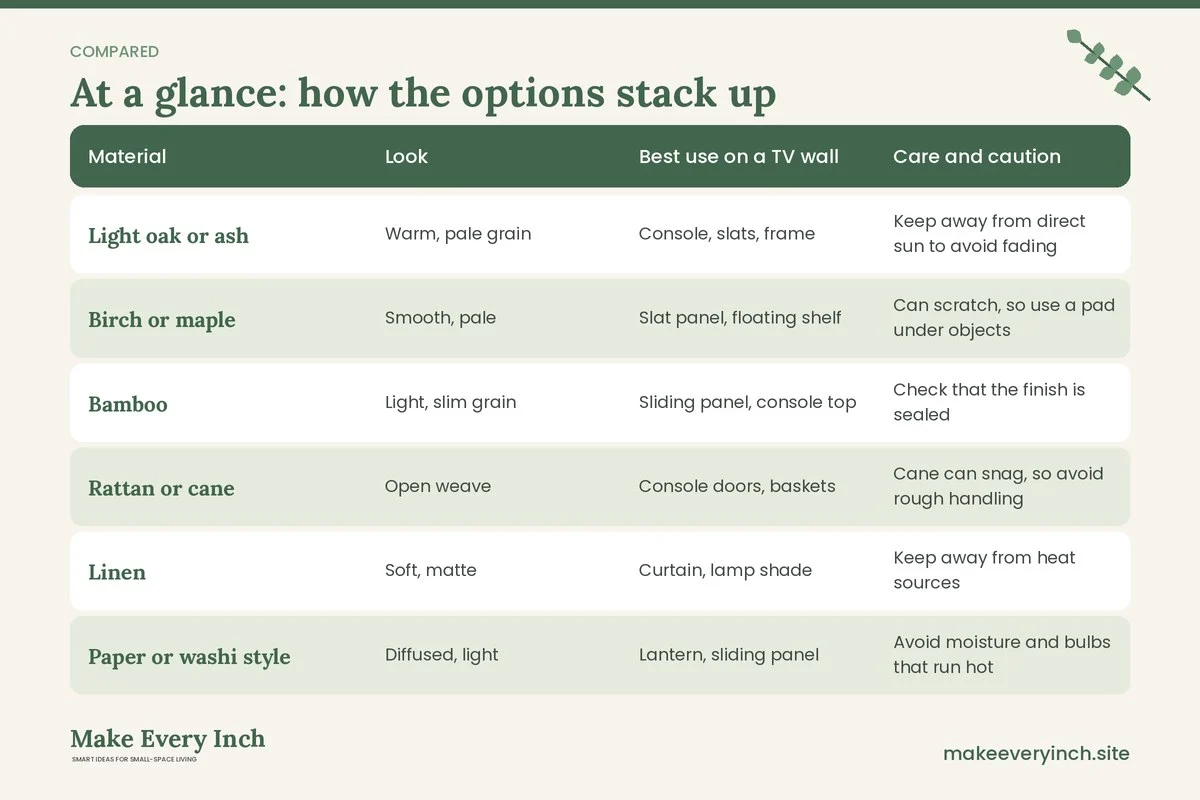
The table compares common Japandi materials for a TV wall. Choose two woods at most, one textile and one accent.
| Material | Look | Best use on a TV wall | Care and caution |
|---|---|---|---|
| Light oak or ash | Warm, pale grain | Console, slats, frame | Keep away from direct sun to avoid fading |
| Birch or maple | Smooth, pale | Slat panel, floating shelf | Can scratch, so use a pad under objects |
| Bamboo | Light, slim grain | Sliding panel, console top | Check that the finish is sealed |
| Rattan or cane | Open weave | Console doors, baskets | Cane can snag, so avoid rough handling |
| Linen | Soft, matte | Curtain, lamp shade | Keep away from heat sources |
| Paper or washi style | Diffused, light | Lantern, sliding panel | Avoid moisture and bulbs that run hot |
| Unglazed ceramic | Matte, earthy | Vases and bowls | Place away from the console edge |
| Wool or jute | Textured, natural | Rug | Choose a low pile |
Colors that keep the wall calm
Japandi palettes are warm and muted rather than white and cool. Start with a soft off-white, clay or greige wall and add one deeper tone from nature, such as a muted olive, a charcoal or a dusty terracotta. Keep the wood tones close to each other, and let the screen’s black be the darkest point in the room. A small amount of black in a lamp base, a frame or a ceramic piece ties the screen into the palette.
If the wall is painted a mid-tone, a dark screen reads as softer. A very pale wall makes the screen stand out more. Test a patch beside your wood samples and look at it in morning and evening light, since warm tones shift significantly across the day.
Three example rooms
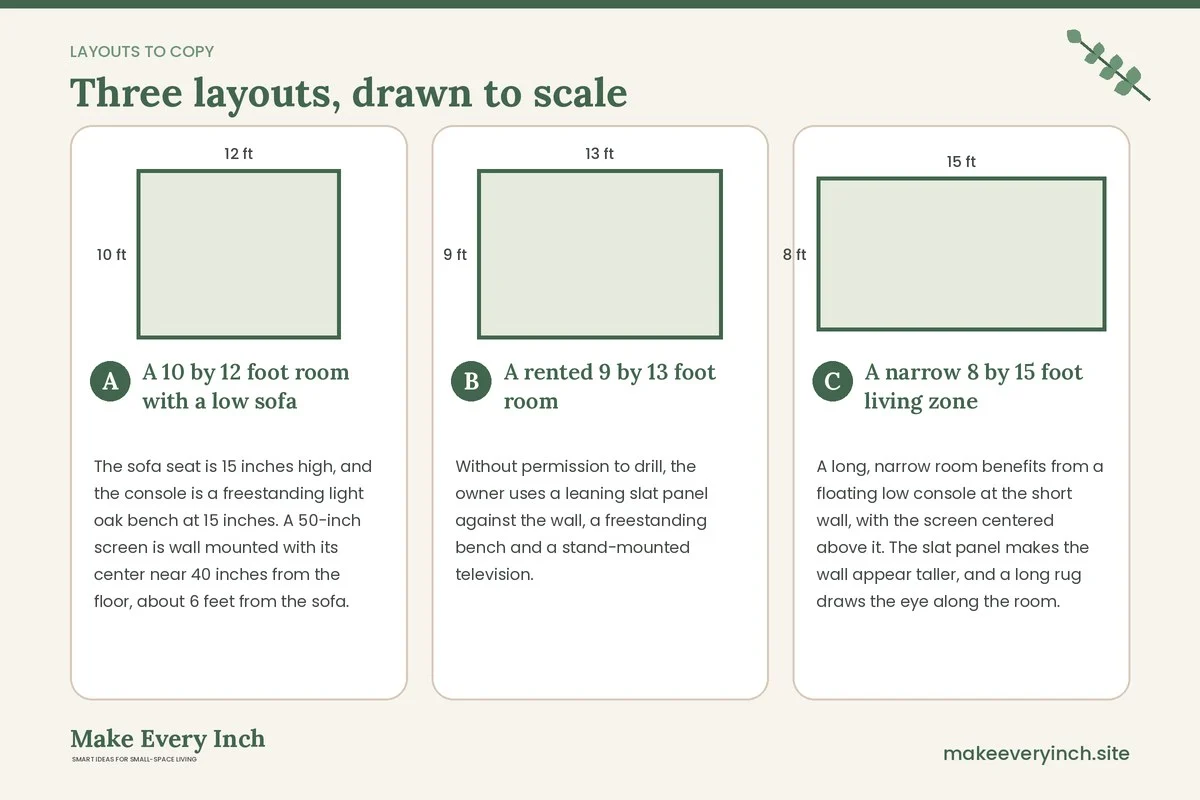
A 10 by 12 foot room with a low sofa
The sofa seat is 15 inches high, and the console is a freestanding light oak bench at 15 inches. A 50-inch screen is wall mounted with its center near 40 inches from the floor, about 6 feet from the sofa. Behind it is a panel of fine slats, extending about 5 inches beyond each side. A paper lamp sits at one end of the bench, a woven basket at the other, and a flat-weave rug in oat tones lies under the front legs of the sofa. The room reads low, warm and calm.
A rented 9 by 13 foot room
Without permission to drill, the owner uses a leaning slat panel against the wall, a freestanding bench and a stand-mounted television. A linen curtain on a tension track covers the side wall, and a single ceramic vase sits on the bench. Everything can be removed without leaving a mark. See our small living room ideas for renters for more ways to adapt the idea.
A narrow 8 by 15 foot living zone
A long, narrow room benefits from a floating low console at the short wall, with the screen centered above it. The slat panel makes the wall appear taller, and a long rug draws the eye along the room. The sofa sits 7 to 8 feet from the wall, so the screen can be up to 55 inches. For more narrow room ideas, read our guide to narrow living room ideas.
A styling formula for the console
A Japandi console works best with a simple, repeatable formula that keeps the surface calm.
1. One tall element: a slim vase with a single branch, or a lamp.
2. One low object: a ceramic bowl or a small stack of books.
3. One natural texture: a woven tray or a basket on the floor beside the console.
4. Empty space: leave at least a third of the top bare.
Rotate the objects with the seasons, such as a flowering branch in spring and dried grasses in autumn, instead of adding new things. This keeps the surface alive without making it crowded.
Cables and equipment in a warm room
Visible black cords are the fastest way to break the Japandi mood. Use a wood-toned cable cover painted or finished to match the wall or panel, route cords behind the slat panel where the instructions allow, and keep devices inside a closed cabinet or a basket with a gap for airflow. Keep a power strip off the floor and away from fabric. If you plan any in-wall routing, follow local rules and use a qualified person. Streaming devices that tuck behind the screen reduce the equipment you must hide.
Mounting and safety notes
- Read the TV and mount instructions first. They give the weight limit, screw size and suitable wall types.
- Fix to studs, or use anchors rated for the load. A screen on a slat panel still needs its weight carried by the wall behind, not just the panel. Follow the panel and mount instructions together.
- Check behind the wall. Use a detector for pipes and wires before drilling.
- Support the panel properly. A heavy wood panel can fall if its fixings are weak, so use the hardware recommended for its weight.
- Anchor tall items. Tall mirrors, shelves and cabinets should be fixed with the anti-tip fittings supplied, especially in homes with children or pets.
- Keep fabric and paper away from heat. Leave space between a lamp, a vent or a hot device and any paper or linen.
- Leave airflow. Do not box the screen in without ventilation.
Mistakes to avoid
- A console that is too tall. A tall unit loses the low horizon line that defines the style.
- Too many woods. Three or four tones make the wall look busy, so stick to two.
- Cold white everywhere. Japandi wants warmth, so pick off-whites and add texture.
- Overfilling the wall. Ma depends on empty space, so resist adding frames.
- Forgetting the screen’s glare. A glossy screen opposite a window needs a curtain or a different position.
- Heavy dark stains. Very dark wood moves the look toward a different style and shrinks a small room.
- Mounting the screen too high. A low-slung look needs a low center, so test with tape.
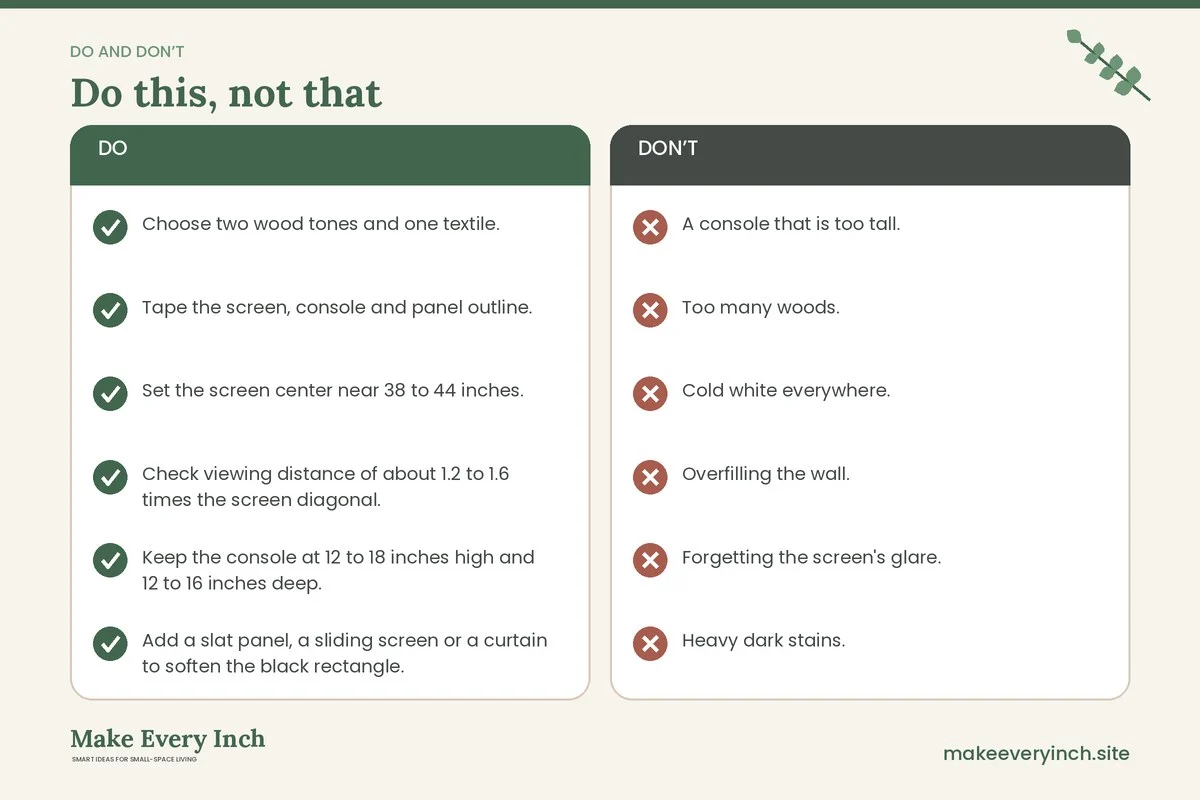
Japandi TV wall checklist
- Choose two wood tones and one textile.
- Tape the screen, console and panel outline.
- Set the screen center near 38 to 44 inches.
- Check viewing distance of about 1.2 to 1.6 times the screen diagonal.
- Keep the console at 12 to 18 inches high and 12 to 16 inches deep.
- Add a slat panel, a sliding screen or a curtain to soften the black rectangle.
- Read the TV and mount instructions, then use studs or rated anchors.
- Hide cables in a cover or behind the panel.
- Add one warm lamp and optional indirect light.
- Style with a tall, a low and a natural texture, and leave a third of the top bare.
- Keep a 30 to 36 inch walkway.
- Anchor any tall furniture.
FAQ
How do I make a TV look Japandi?
Surround it with warm natural materials, keep the console low, hide cables and add soft light. A slat panel, a linen curtain or a sliding screen reduces the visual weight of the black rectangle.
What height should a Japandi TV console be?
About 12 to 18 inches suits a low horizon line. A floating unit can be mounted at 10 to 14 inches off the floor. Make sure the screen sits comfortably above it.
Can I use a wood slat wall in a rental?
A freestanding or leaning panel avoids drilling. If you want to fix it to the wall, check your lease first and use fixings suitable for the wall.
Is Japandi the same as minimalist?
They overlap, but Japandi is warmer and accepts handmade texture and a few chosen objects. Our post on small living room tv wall ideas minimalist covers the stricter version.
What color should the wall be?
Soft off-white, greige, clay or a muted green work well. Test samples next to your wood in morning and evening light.
Where can I find more Japandi living room ideas?
Try our small apartment living room ideas Japandi and small living room storage ideas Japandi guides.
Keep going: Keep planning with our cozy small living room ideas Japandi, small living room layout ideas Japandi and small living room tv wall ideas cozy.
Save this guide for later
Pin the ideas you like to Pinterest so you can come back to them when you plan your space.