Small Closet Drawer Alternatives
Quick answer: The best small closet drawer alternatives are hanging cube organizers, fabric bins on shelves, shelf baskets, narrow rolling carts and organizers that hang under a short rod. Measure the closet depth first, keep every container light enough to lift with one hand, and match the container to the item: soft bins for knits, open baskets for socks, carts for floor space.
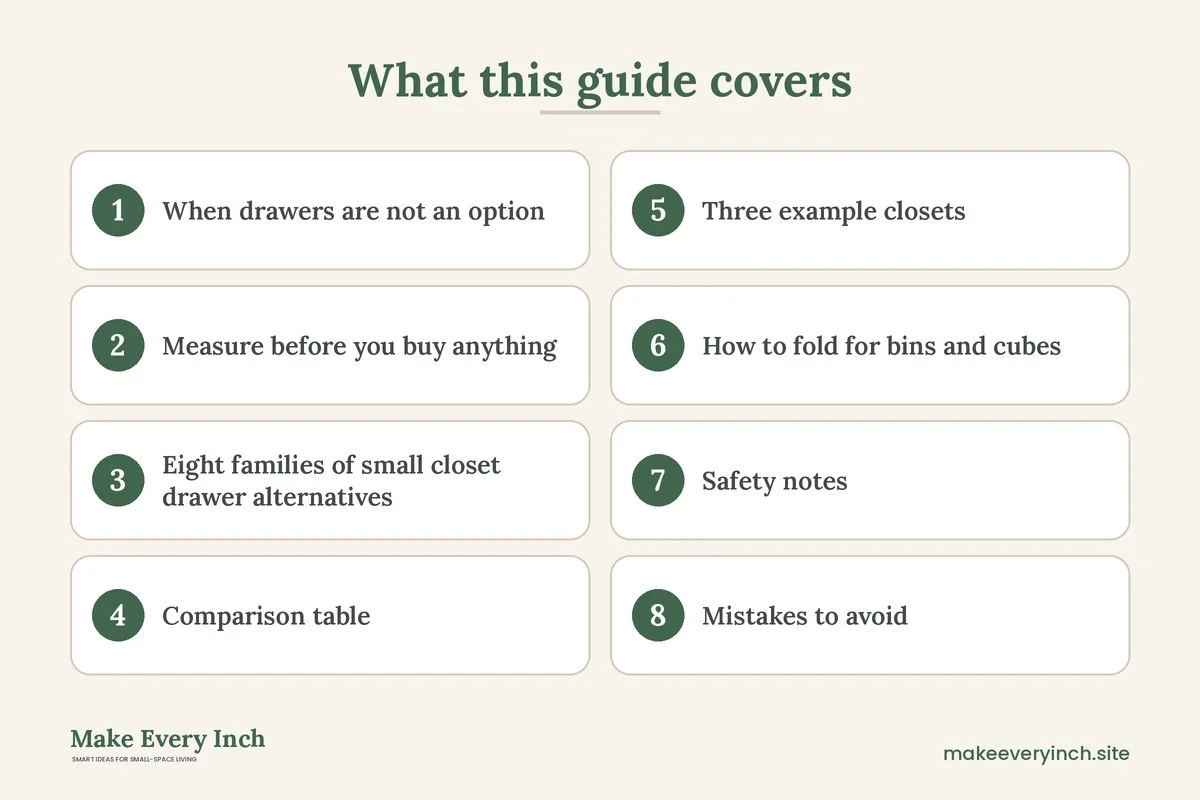
Small closet drawer alternatives matter because many closets simply have no room for a dresser, and a lot of rentals have no built-in drawers at all. A standard reach-in closet is often only 24 inches deep, which is not enough to open a drawer and still stand in front of it. Even where a drawer unit fits, it can eat the floor that a hamper, shoes or a vacuum need. The good news is that you can get the same result, a spot for folded clothes that you can see and reach, with softer, lighter and more flexible containers. This guide explains when drawers are not an option, how to measure, eight families of alternatives, a comparison table, three example closets, folding rules, safety notes, mistakes and a checklist. For the big picture, start with our pillar guide to small closet ideas, and when you are ready to use the inside of the door as well, read the companion post on small closet door storage ideas.
When drawers are not an option
Drawers are convenient, but they ask for something a small closet rarely has: clearance in front. A drawer that is 16 inches wide needs about 16 to 20 inches of free space in front of it to pull out fully. A closet with a door that swings inward, or a closet only 22 to 26 inches deep, cannot spare it. Here are the common situations where an alternative is the better choice.
- A shallow reach-in closet. If the opening is narrow, a drawer unit blocks the rod above it and the doors beside it.
- A rental with rules. You may not be allowed to build in shelves or drawers, and a freestanding chest might not fit your lease’s idea of tidy.
- A sloped or attic closet. Under a roof slope, a rigid drawer cannot go where a soft bin can.
- A closet that doubles as a room. In a studio, the closet might be a nook, and you cannot afford floor space for furniture.
- A heavy load worry. Drawers full of clothes are heavy, and a tall unit that tips is a real risk, especially in a home with children.
- A move coming soon. Soft bins and baskets fold, stack and travel, and drawers do not.
If any of these sound like your closet, the options below let you keep folded clothes organized without a single drawer slide. For more general ideas on getting the most from tiny closets, our guide to small closet organization ideas covers the rod and shelf basics, and our post on DIY closet organization for small spaces shows low-cost ways to build the system.
Measure before you buy anything
Every alternative in this guide depends on three measurements. Take them once, write them down and carry the list when you shop.
- Depth: measure from the back wall to the inside of the door frame. Many closets are 24 inches deep, and some older ones are as little as 20. Subtract 1 to 2 inches so the door can close.
- Width of each section: measure between side walls, between shelf brackets or between a divider and a wall. A hanging organizer that is 12 inches wide needs 12 inches of rod, plus a little room on each side.
- Height under the shelf and above the floor: measure the clear gap from the floor to the bottom of the shelf, and from the shelf to the rod. The gap tells you if a stack of baskets fits or if a rolling cart clears the hanging clothes.
Also measure your clothes. Fold a sweater, a pair of jeans and a stack of t-shirts the way you plan to store them and measure the thickness. A folded sweater is often 10 to 12 inches wide and 3 to 4 inches thick, and a pile of five is 12 to 20 inches high. Choose containers that fit the pile, not the other way around.
Use painter’s tape on the floor and on the shelf to mark the footprint of a bin or cart. You will see in a minute whether the door still closes and whether you can reach the back.
Eight families of small closet drawer alternatives
1. Hanging cube organizers
A hanging cube organizer is a fabric tower with open or flap-covered cubes that hangs from the rod. Each cube takes a neatly folded stack, so it works like a drawer that you look into from the front. Most are 10 to 12 inches wide and 12 inches high per cube, with three to six cubes in a column.
- Best for: t-shirts, leggings, scarves, jeans, baby clothes and anything that folds into a flat block.
- Fit tip: hang it at a height where the top cube sits at about shoulder level and the bottom cube clears the floor by at least 2 inches. Do not let it drag.
- Weight: fabric straps and the rod carry the load. Fill the cubes with light items, and read the weight rating on the label. A pile of folded jeans can weigh more than you expect.
- Watch for: sagging if the cubes are too loose. Stiff inserts or a firm board in each shelf keep the shape.
Hanging cubes are among the most popular small closet drawer alternatives because they use the dead space on one side of the rod without touching the wall or the floor.
2. Fabric bins on shelves
A fabric bin is a soft-sided container with handles. On a closet shelf it acts as a pull-out drawer: you slide it forward, lift out what you need and push it back. Choose bins with a stiff base and sturdy sides so they hold their shape. Two bins side by side on a shelf make a mini chest.
- Best for: off-season knits, scarves, gloves, hats, belts and pajamas.
- Fit tip: pick a bin that is 1 to 2 inches narrower than the shelf depth, so you can pull it out without bumping the wall.
- Label it: a small card on the front tells you the contents without opening it.
- Watch for: bins with lids that you cannot open when the shelf above is low. Use open fronts or fold-down lids on low shelves.
3. Shelf baskets
Baskets in woven fiber, wire or molded plastic are more rigid than fabric bins. They suit items you grab quickly, such as socks, underwear, workout gear and bathing suits. A basket sits on a shelf like a drawer without a front.
- Best for: small items that would tangle on a hanger.
- Fit tip: use a tall basket on a high shelf and a shallow one at eye level. Stack shallow baskets only if each one can still be lifted out.
- Material: wire baskets let you see the contents, while woven ones hide the clutter. Check that the surface is smooth, so knits do not snag.
- Watch for: rough edges on woven or wire baskets. Run a hand over the inside before you load them with delicate fabrics, and line them with cloth if needed.
4. Rolling carts
A slim rolling cart sits on the closet floor and pulls out when you need it, like a drawer on wheels. Narrow carts with three tiers are 7 to 9 inches wide, which fits between a hamper and a wall. Wider ones with baskets are 14 to 18 inches wide.
- Best for: accessories, hair tools, laundry sorting, shoes, sports gear and baby supplies.
- Fit tip: measure the gap under the hanging clothes. Most carts are 30 to 40 inches high, and they tuck under a rod of long hanging items if the hem sits above the top.
- Brakes: wheels with locks keep the cart steady when you reach in. If the floor is carpet, check that it rolls smoothly.
- Watch for: tipping. Keep heavy items on the bottom tier, and do not overload the top. Be cautious around small children who may pull or climb.
Our guide to small-space storage furniture has more ideas for pieces that work in tight rooms, including slim carts.
5. Under-hanging organizers
These are fabric shelves or pockets that hang below a short rod, or from the main rod, in the space beneath shirts and jackets. A 3-shelf hanging organizer uses the 24 to 36 inches that hang empty below a folded shirt. A hanging shoe pocket or a pocketed organizer can hold socks, belts and scarves.
- Best for: closets with short hanging items such as shirts, skirts or children’s clothes where the lower half of the rod space is empty.
- Fit tip: measure the hem length of what hangs beside it. A shirt hem that touches an organizer wrinkles.
- Watch for: stability. A tall unit hanging from only one rod can swing, so choose one with a rigid frame or stabilizing loops.
6. Double-rod spacers
A second rod is not a drawer, but it replaces the need for one by moving shirts up and giving you floor space for baskets. If your lease allows hanging hardware, a hanging second rod from the main rod needs no drilling. With a double rod you get 40 inches of floor-to-rod gap below, which fits a stack of baskets or a cart.
- Best for: closets with a lot of short items.
- Safety: never exceed the rod’s weight rating. A rod that sags or falls can injure someone. Check the load limit of the main rod before adding any hanging item.
7. Stackable cubes and cube shelves
Stacking cube bins are simple frames with open fronts. Two or three cubes stacked in a corner become a mini dresser. Add fabric inserts or baskets to keep things neat. A cube unit that is 11 to 13 inches deep fits most closets.
- Best for: folded clothes in a closet that has a few inches to spare along one wall.
- Safety: tall stacks must be anchored or kept low. A stack of three or fewer cubes is stable on a flat floor, but a taller unit should be fastened to a wall stud with the proper anchor, and only with permission if you rent. Many people skip anchoring because a small unit looks harmless, but any tall unit can tip if a child climbs it.
8. Over-the-rod and rod-hung pocket systems
Fabric pockets that hang from the rod give you small-item storage without drawers. A multi-pocket unit has 6 to 12 compartments the size of a mug to a sweater. They suit lightweight items such as socks, scarves and rolled belts. Choose one with a stiff back so it does not slump.
Comparison table
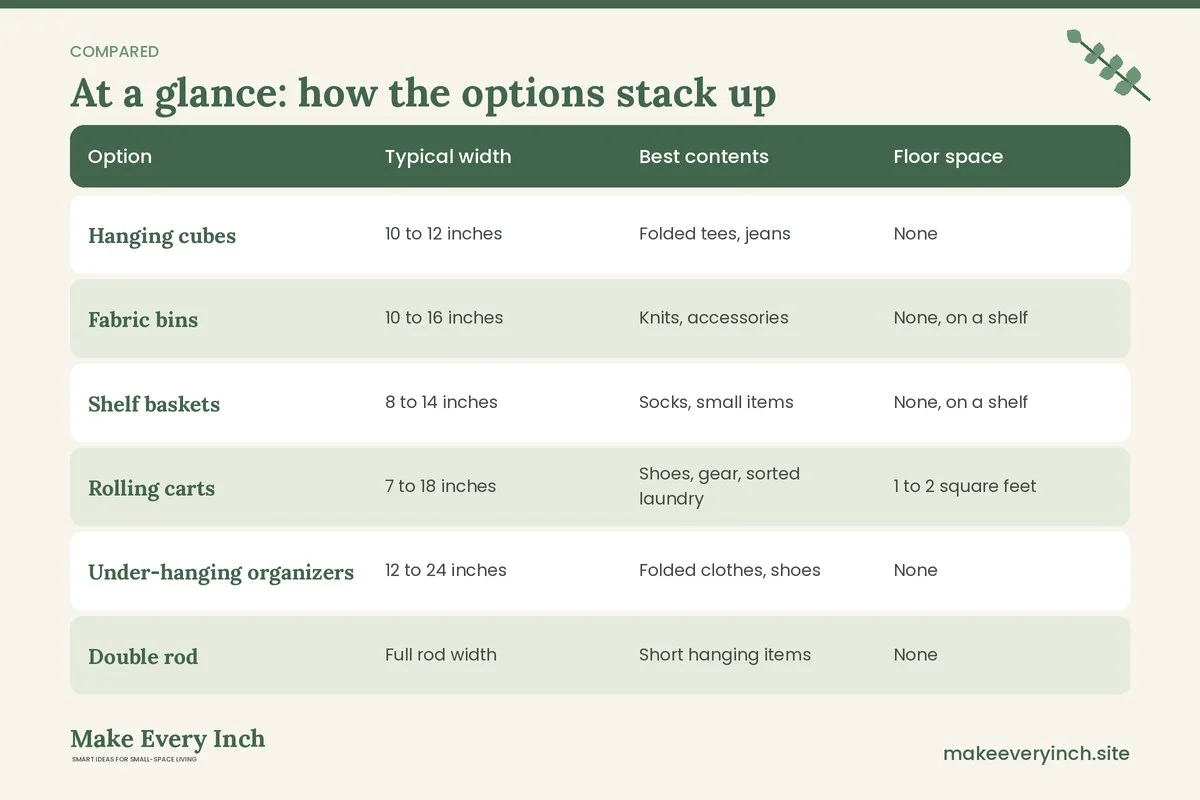
Use this table to match the item to the container. The ranges are approximate and depend on the model you choose.
| Option | Typical width | Best contents | Floor space | Main limit |
|---|---|---|---|---|
| Hanging cubes | 10 to 12 inches | Folded tees, jeans | None | Rod weight and sag |
| Fabric bins | 10 to 16 inches | Knits, accessories | None, on a shelf | Needs a shelf |
| Shelf baskets | 8 to 14 inches | Socks, small items | None, on a shelf | Rough edges on some types |
| Rolling carts | 7 to 18 inches | Shoes, gear, sorted laundry | 1 to 2 square feet | Tipping and clearance |
| Under-hanging organizers | 12 to 24 inches | Folded clothes, shoes | None | Hem length of nearby clothes |
| Double rod | Full rod width | Short hanging items | None | Rod weight rating |
| Cube stack | 11 to 13 inches | Folded clothes | 1 to 3 square feet | Anchoring if tall |
| Pocket systems | 12 to 24 inches | Socks, scarves, belts | None | Weight of contents |
Three example closets
A 4-foot-wide reach-in closet, 24 inches deep
The closet has one rod and one shelf above it. Hang a three-cube organizer on the left of the rod for t-shirts and leggings. Put two fabric bins on the shelf, one for sweaters and one for scarves. On the floor, park a narrow cart with two baskets for shoes and gym gear. Between the cart and the organizer you keep a hand’s width free, so the cart pulls out freely. This setup replaces a 3-drawer dresser, and the door still closes.
A rental closet with a sliding door
A sliding door means the opening is only half the closet’s width, so you cannot use anything that blocks one side. Use a hanging organizer in the center of the opening, where it is easy to reach, and a pair of baskets on the shelf at each side. Keep the floor clear except for a single cart with wheels. Avoid anything that sticks out beyond the door track. For more ideas that work around the door, read our companion on small closet door storage ideas.
A bedroom with no closet
When a bedroom has no closet at all, use the same containers in the open. A freestanding rack takes the place of the rod, and cubes and bins sit on or beside it. Fabric covers hide the clutter. Our guide to small bedroom ideas without a closet goes deeper, and our post on renter-friendly bedroom storage ideas lists pieces that need no drilling.
How to fold for bins and cubes
A container works only if the clothes fit it in a way you can see. Two folding methods suit most closets.
- File folding: fold each item into a small rectangle and stand it on its edge, like files in a cabinet. You see every item from above, and you can pull one without toppling a stack. This works well in bins and baskets that are deeper than 8 inches.
- Shelf folding: fold flat and stack up to five items. Use this in hanging cubes and on shelves, where the front is visible. Keep the stack at 8 inches or less.
Fold bulky sweaters in thirds, fold jeans in half and roll them for baskets. Roll socks and underwear, or stand them in small dividers. Group by type, so each bin has a single purpose: tees, sweaters, workout gear. Label the front. If you share a closet, give each person a color of bin.
Safety notes
Small changes to a closet can still create hazards, so keep these points in mind.
- Rod and shelf limits: a closet rod and a shelf carry only so much. Many standard closet rods are rated for modest loads, and a heavy organizer full of denim can overload it. Check the rating, distribute the weight and take things out if the rod bends.
- Anchor tall units: any tall freestanding unit, including a stack of cubes, should be anchored to a wall, and only with permission in a rental. If you cannot anchor it, keep the stack short.
- Hanging hardware: add hooks, rods and brackets only with permission, and use the right anchors for the wall type. If you rent, choose options that need no drilling.
- Mothballs and chemicals: avoid mothballs and strong chemical sachets in a small, closed closet, especially around children or pets. Cedar blocks or sachets are gentler, and still keep them out of reach and away from textiles that could stain.
- Child safety: keep heavy bins low, and keep small items, cords and sharp tools out of reach. Do not let children climb on shelves or carts.
- Low-VOC finishes: if you paint or seal a wooden shelf or cube, use a low-VOC product and ventilate the closet and the room until the smell clears.
- Ventilation and moisture: do not pack a closet so tightly that air cannot move. Damp clothes in a closed space can grow mildew.
Mistakes to avoid
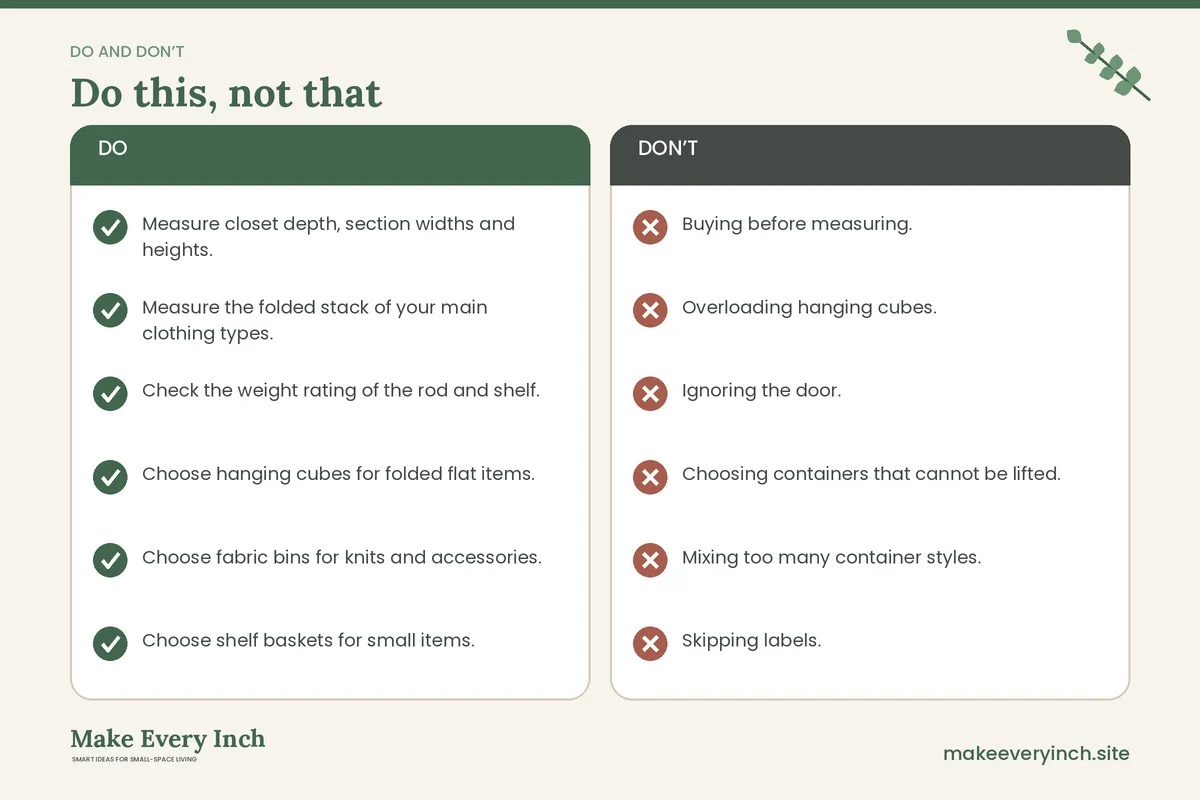
- Buying before measuring. A cart that is 2 inches too wide cannot go in.
- Overloading hanging cubes. Heavy jeans can pull a cube tower down. Fill them lightly and spread the load.
- Ignoring the door. Check that the door closes. A bin that sticks out 1 inch can stop it.
- Choosing containers that cannot be lifted. A bin should come out with one hand. If it is too heavy, split the contents.
- Mixing too many container styles. Three to four types look orderly, and ten look chaotic.
- Skipping labels. Without labels, every bin becomes a catchall.
- Forgetting to purge. Clothes you no longer wear take up space that bins can never fix. Edit first.
A simple setup plan
1. Empty the closet and sort clothes into keep, donate and store elsewhere.
2. Measure the depth, width and height of each zone.
3. Decide what hangs and what folds. Hang anything that wrinkles, and fold knits.
4. Pick the container for each folded group using the table.
5. Install nothing that needs drilling unless you have permission.
6. Test the layout on the floor with tape before you load the closet.
7. Load heavy items low and light items high.
8. Label each container and walk through a week of use.
9. Adjust one thing at a time.
For more on planning the full room, our post on small bedroom storage ideas shows how to combine closet storage with under-bed and wall options, and our guide to vertical storage ideas explains how to use height without drilling heavy holes.
Closet drawer alternatives checklist
- Measure closet depth, section widths and heights.
- Measure the folded stack of your main clothing types.
- Check the weight rating of the rod and shelf.
- Choose hanging cubes for folded flat items.
- Choose fabric bins for knits and accessories.
- Choose shelf baskets for small items.
- Choose a rolling cart only if the floor has room.
- Test the door with each container in place.
- Anchor tall stacks, with permission in a rental.
- Keep heavy items low and out of children’s reach.
- Avoid mothballs and ventilate any freshly finished piece.
- Label every container.
FAQ
What can I use instead of drawers in a small closet?
Hanging cube organizers, fabric bins, shelf baskets, slim rolling carts and under-hanging organizers all replace drawers. Choose by what you store and how much depth you have.
Are hanging cube organizers strong enough for jeans?
Many can hold several pairs, but weight varies. Read the rating, fill the cubes lightly and watch the rod for bending. If the rod sags, move the load to a shelf or a cart.
How do I keep fabric bins from sagging?
Choose bins with a firm base and sides, or add a stiff insert. Fill them to about two thirds so the walls stay upright.
Will a rolling cart fit in my closet?
Measure the gap under the hanging clothes and the width of the floor space. A cart of 7 to 9 inches fits many closets, while a wider one needs a deeper floor area.
Do I need to anchor stackable cubes?
A short stack on a flat floor is usually stable, while a tall stack should be anchored to a wall. In a rental, ask first. If you cannot anchor it, keep the stack low.
How do I store sweaters without drawers?
Fold them in thirds and place them in fabric bins on a shelf, or in the cubes of a hanging organizer. Avoid hanging heavy knits since they stretch.
Keep going: Keep going with our pillar guide to small closet ideas, the companion post on small closet door storage ideas and our tips on small space organization ideas.
Save this guide for later
Pin the ideas you like to Pinterest so you can come back to them when you plan your space.