11 Small Laundry Room Drying Rack Ideas for Tight Spaces
Quick answer: The right small laundry room drying rack depends on the space you can spare when it is open and when it is folded. Wall-mounted fold-down racks, over-door racks and tension rods use almost no floor, while freestanding racks give the most capacity. Leave air moving around wet clothes, keep racks away from the dryer vent and heat sources, and ask permission before you drill into walls or ceilings.
A small laundry room drying rack solves a problem that machines cannot: what to do with knits, delicates, gym wear and anything the care label says to air-dry. In a tiny room, a rack that stays open all week quickly takes over, so the goal is a rack that works hard when it is loaded and nearly disappears when it is not. This guide explains how to measure your drying needs, compares the main rack types, shares 11 ideas, a table with capacity and footprint, three example rooms, moisture and safety advice, and a checklist. For the wider plan, read our pillar on small laundry room ideas, and for storage next to the machines, see our guide to small laundry room shelf ideas.
Work out how much drying you actually need
Before choosing a rack, think about what you air-dry and how often. A person who air-dries a few shirts and a pair of leggings a week needs far less than a family that line-dries towels and bedding. Count the pieces from one typical week and sort them.
- Small items: socks, underwear, washcloths and baby clothes. These can hang from clips and small racks.
- Medium items: shirts, tops, leggings and dresses. These need hanging length of about 24 to 40 inches.
- Long items: trousers, sweaters laid flat and sheets. These need either a long bar or a flat mesh drying surface.
- Bulky items: towels, jeans and bedding. These take the most space and the longest to dry.
As a very loose guide, a single load of laundry might need around 20 to 40 feet of hanging line or bar if everything is spread out, but the real figure depends on the garments, so treat this as a rough planning range. If you see that you need more than your room can give, plan to dry in two rounds, or use the machine dryer for towels and the rack for delicates.
Measure the space in two states
Every drying rack has a working state and a stored state. Measure both.
- Open footprint: how wide and deep the rack is when loaded. Leave 24 to 30 inches of walkway around it if you can.
- Folded size: how thin and tall it is when stored. A rack that folds to 2 to 4 inches thick fits behind a door or in the gap beside a machine.
- Height of the ceiling and any pipes: this decides whether a ceiling-mounted rack is possible.
- Light and airflow: check where the window, fan or vent is, because drying works better where air moves.
Draw the open rack as a rectangle on the floor with painter’s tape. Walk around it, open the machine doors, and open the room door. If the tape blocks any of these, choose a smaller or wall-mounted rack.
11 small laundry room drying rack ideas
Wall and door racks
1. A wall-mounted fold-down rack
A fold-down rack attaches to the wall and swings out when needed. It can hold a full load of delicates, and it folds flat when not in use. It must be fixed into studs or with suitable anchors, so check the maker’s weight rating and ask your landlord before you drill. Keep it away from the dryer vent and any hot surface, and make sure it locks open.
2. An accordion wall rack
An accordion rack extends outward on a scissor mechanism, with bars across. It folds to a slim stack when not in use. It also needs secure fixings, and it should be loaded evenly.
3. An over-the-door rack
An over-the-door drying rack hooks on top of a door and gives several bars without drilling. It suits shirts and small items. Check that the door still closes, and keep wet items from touching paint or wallpaper. Do not hang heavy wet towels on a light rack, because the extra weight can strain the hooks and the door.
4. A rack that hangs on the back of the door
A flat folding rack can hang from hooks on the back of a door. It is useful for a single bar of socks and delicates. Choose hooks that are rated for the weight when the rack is wet.
Rods and lines
5. A tension rod over the machines
A tension rod placed between two walls above the washer and dryer creates an instant drying bar. Hang items on hangers, and keep the weight light so the rod does not slip. Keep the rod clear of the dryer vent and heat. A spring or tension rod is best for light garments, and it is not for heavy wet towels.
6. A retractable clothesline
A retractable line stretches across the room when needed and pulls back into a small case. It needs a firm fixing at each end, so you will have to ask permission to drill in a rental. Keep the line above head height and out of the walkway, and take it down when not in use.
7. A ceiling-mounted pulley rack
A pulley rack lifts a wooden or metal frame up toward the ceiling. It uses space that is otherwise empty, and warm air near the ceiling helps clothes dry. It must be fixed into joists with fittings rated for the load, and the ceiling must be strong enough. Do not mount it yourself unless you are confident, and ask a qualified person if you are unsure. Keep the rope tied off safely, away from children and pets.
8. A rod in the shower or tub
A bathroom with a shower rod can double as a drying spot. Hang garments on hangers, keep them out of the splash zone, and run the fan. If you share the bathroom, do not leave wet clothes on the rod all day.
Floor-standing racks
9. A slim folding rack that stores behind the door
A folding rack with a narrow profile stands open when loaded and folds flat to slide behind a door or into a gap. Choose a stable one with locking legs, and place it on a dry, level floor. Check that it does not block the door swing.
10. A tiered rack with a mesh top
A tiered rack with a flat mesh shelf suits sweaters and delicates that need to dry flat. Lay sweaters flat to prevent stretching, and turn them partway through drying. Keep the rack away from the dryer, and check that the legs are stable.
11. A rolling rack that tucks into a gap
A rolling rack on casters can sit in the gap beside a machine, roll out when loaded and roll back when dry. Lock the wheels when it is parked. Keep the rack away from the dryer’s exhaust and give appliances the clearance the manual asks for.
Comparison table: which rack for which room
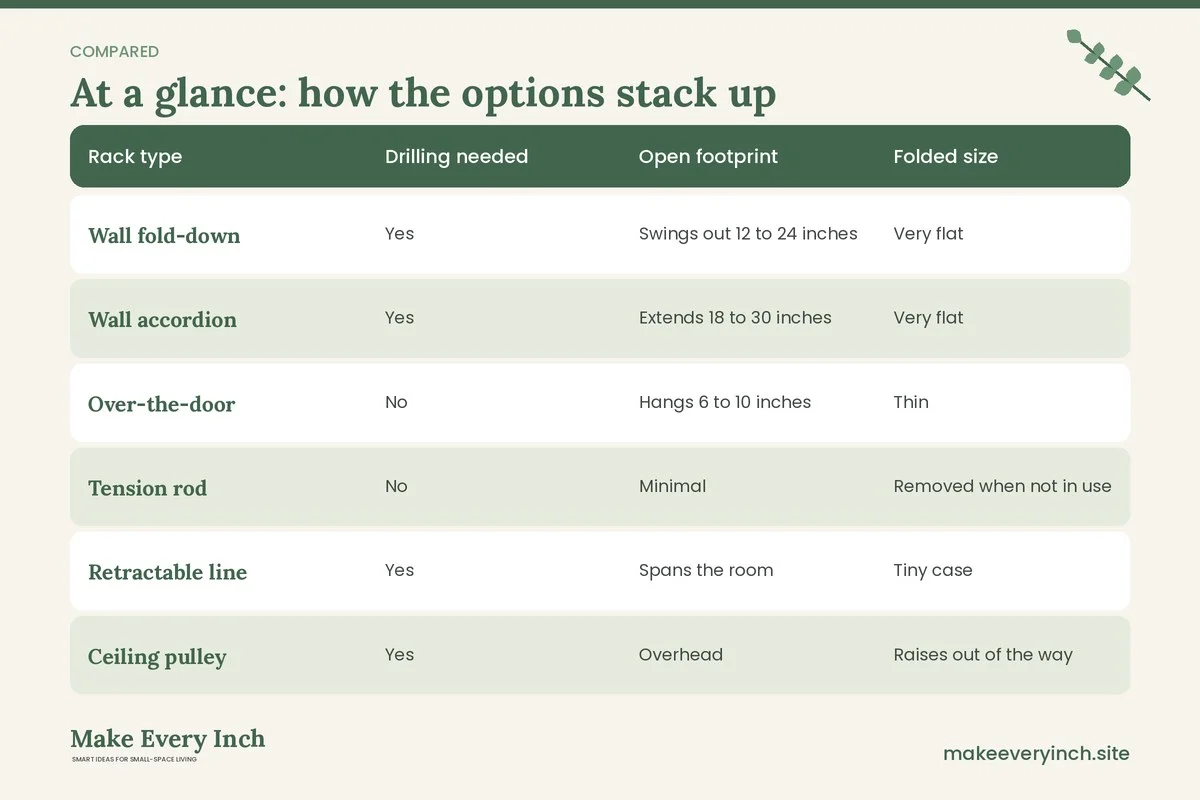
| Rack type | Drilling needed | Open footprint | Folded size | Best for | Main caution |
|---|---|---|---|---|---|
| Wall fold-down | Yes | Swings out 12 to 24 inches | Very flat | Full loads of delicates | Needs secure fixings |
| Wall accordion | Yes | Extends 18 to 30 inches | Very flat | Shirts and small items | Load evenly |
| Over-the-door | No | Hangs 6 to 10 inches | Thin | Light items | Do not overload |
| Tension rod | No | Minimal | Removed when not in use | Hangers and shirts | Light loads only |
| Retractable line | Yes | Spans the room | Tiny case | Many small items | Keep above head height |
| Ceiling pulley | Yes | Overhead | Raises out of the way | Large loads in a tall room | Fix to joists and tie off rope |
| Shower rod | No | Bathroom | None | Hangers | Keep out of splash zone |
| Slim folding floor | No | 2 to 4 feet wide | 2 to 4 inches thick | General use | Stable legs |
| Tiered mesh rack | No | 2 feet by 3 feet | Folds flat | Sweaters | Keep away from heat |
| Rolling rack | No | 1.5 to 2 feet wide | Stays in gap | Small gaps | Lock the wheels |
All sizes in the table are rough planning ranges. Measure your own room and read the product details before you buy.
Three example rooms
Room 1: a closet laundry with no floor space
A stacked washer and dryer fills a hall closet, and there is no floor space to spare. The best answer is a combination of a tension rod above the unit for hangers and an over-the-door rack for small items. Keep the rod at least a hand’s width from the dryer’s vent, and check the manual for the clearance above the unit. If the lease allows, a small wall-mounted fold-down rack on the side wall adds a full load of capacity. Run a fan or leave the door open while clothes dry, so humidity does not build up in a closed closet.
Room 2: a bathroom laundry with a washer under the counter
A compact washer sits under the vanity, and the room has a shower. Use the shower rod for hangers and a slim folding rack in the tub for flat items. Keep power outlets away from wet clothes, and make sure any outlet near water is protected by a GFCI. Run the exhaust fan during drying and for a while after, and wipe down the walls if condensation forms. Our guide to small bathroom ideas covers storage that suits the same room.
Room 3: a kitchen alcove with a tall ceiling
A side-by-side pair sits at the end of a kitchen, and the ceiling is over eight feet high. A ceiling-mounted pulley rack lifts clothes above head height, and a slim rolling rack handles the rest. Because the room doubles as a kitchen, keep wet laundry away from the stove, and keep clothes from hanging above any cooking area. See our guide to small kitchen ideas for ways to keep the two zones separate.
Airflow, humidity and moisture
Wet clothes release water into the air, and a small room can hold damp air for a long time. This can lead to condensation, musty smells and mold on walls and ceilings. A few habits help.
- Spin well first. Use the highest spin your care labels allow, so clothes begin drying with less water.
- Space the items. Leave a gap of a couple of inches between garments so air can move around each one.
- Move air. Open a window, run an exhaust fan or use a small fan pointed across the rack, and keep cords and plugs away from wet clothes.
- Use a dehumidifier if the room stays damp. Keep it on a dry, level surface, empty the tank regularly and follow its manual.
- Do not dry in a closed, unventilated closet. Leave the door open or use a vented door.
- Watch for mold. If you see dark spots on walls or ceilings, clean them and improve ventilation, and tell your landlord if it keeps returning.
Safety notes
Keep racks away from the dryer and heat
Do not place a rack directly against the dryer’s exhaust or vent, and do not drape clothes over a running dryer. Lint and heat are a fire risk, so keep the area around the dryer clear, empty the lint trap after every load and follow the clearance your manual gives. Do not drape wet clothes over a space heater, radiator or heater vent, because they can scorch or catch fire.
Venting rules
A dryer should vent outdoors through a proper duct, not into the room. Do not block or reroute the vent to dry clothes in the room. If you are not sure what applies in your home, ask your landlord or a licensed professional.
Water and electrical safety
Wet clothes drip. Keep them away from outlets, power strips and cords. Outlets near water should have ground-fault protection (GFCI). Use a drip tray or a towel under the rack, and wipe the floor so nobody slips. Know where the washer’s shutoff valves are, and keep them clear of racks and clothing.
Weight and stability
Wet laundry is heavy. A towel can weigh several times its dry weight, so a rack that holds a dry load may sag with wet ones. Follow the weight rating, spread the load evenly and put the heaviest items on the lowest bar. Tall racks should stand on a level floor, and wall-mounted racks should be fixed with fittings rated for the load.
Chemicals, children and pets
Do not store bleach, stain removers or concentrated cleaners near the rack where drips or reaching hands could meet them. Keep cleaners in original containers, never mix products, and store them high or locked away from children and pets. Keep cords and ropes from pulley racks out of children’s reach.
Rentals and permission
Racks that need drilling, such as wall, ceiling and clothesline systems, need your landlord’s permission in a rental. Read the lease, ask in writing and photograph the walls first. Many of the ideas above need no drilling at all. For more, see our guides to no-drill storage ideas for renters and renter-friendly apartment decorating ideas.
Care labels and what to dry flat
A rack is only useful if you use it for the right things. Check each care label.
- Sweaters and knits: dry flat to avoid stretching, away from direct heat.
- Delicates and lingerie: hang or lay flat in a mesh drying surface.
- Activewear: usually hang on a bar and avoid heat so the fabric keeps its stretch.
- Shirts: hang on hangers to reduce wrinkles.
- Towels: hang over two bars to speed airflow, or use the machine dryer for thick ones.
- Jeans: hang by the waistband or flip halfway through drying.
Making the rack disappear
In a small laundry area, the rack should be easy to put away. A few ideas keep the room tidy.
- Pick a rack that folds to the depth of a shelf, and give it a permanent spot behind a door.
- Use hooks at the end of a wall to store a folded rack, with the weight of the rack within the hook rating.
- Keep clips and hangers in a small basket on a shelf, such as the ones in our post on small laundry room shelf ideas.
- Dry in the evening and fold the rack away in the morning.
- Move the rack to another room, such as a bedroom with a window, if the laundry room is too small. See our post on small space organization ideas for ways to keep it neat.
Common mistakes
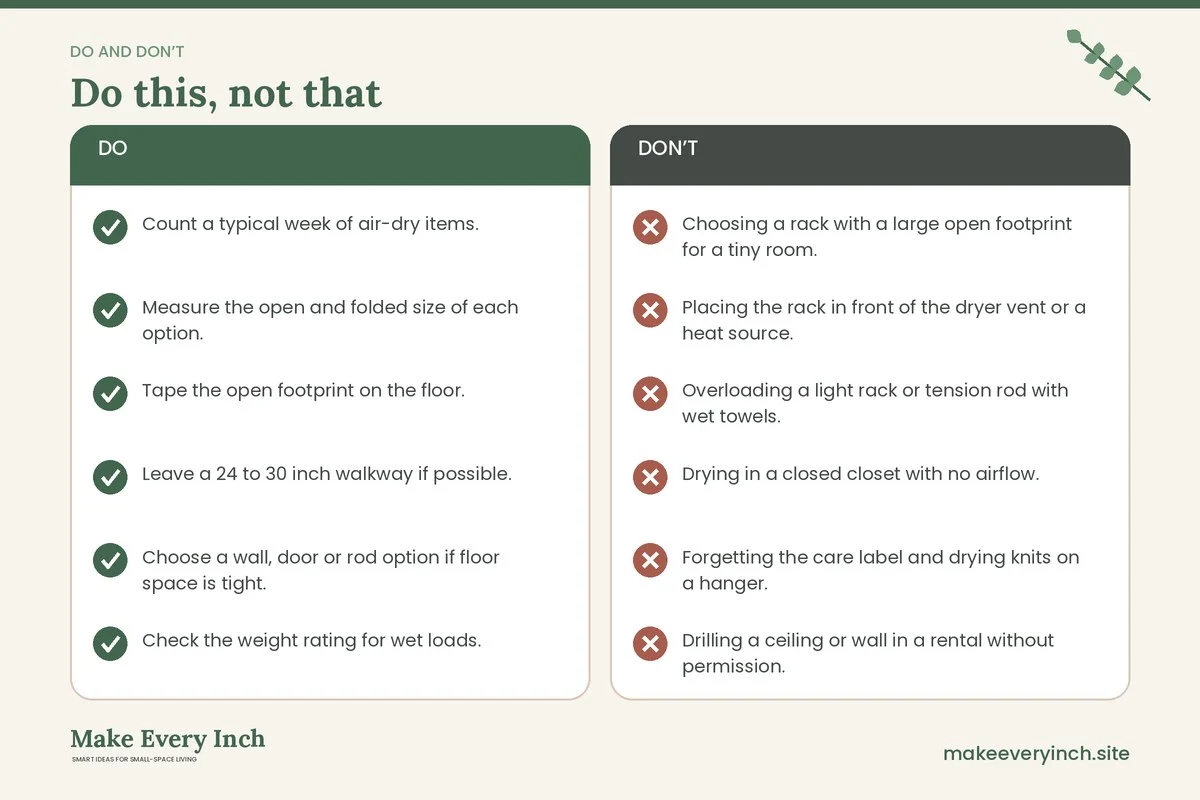
- Choosing a rack with a large open footprint for a tiny room.
- Placing the rack in front of the dryer vent or a heat source.
- Overloading a light rack or tension rod with wet towels.
- Drying in a closed closet with no airflow.
- Forgetting the care label and drying knits on a hanger.
- Drilling a ceiling or wall in a rental without permission.
- Letting wet clothes hang near outlets.
- Leaving the rack open all week.
Drying rack checklist
- Count a typical week of air-dry items.
- Measure the open and folded size of each option.
- Tape the open footprint on the floor.
- Leave a 24 to 30 inch walkway if possible.
- Choose a wall, door or rod option if floor space is tight.
- Check the weight rating for wet loads.
- Keep racks clear of the dryer vent, heaters and outlets.
- Check your appliance manuals for clearance.
- Confirm outlets near water have GFCI protection.
- Open a window or run a fan during drying.
- Store cleaners in original containers and never mix them.
- Get permission before you drill.
- Fold the rack away once clothes are dry.
FAQ
What is the best small laundry room drying rack for a tiny space?
A wall-mounted fold-down rack uses the least floor space, and an over-door rack or tension rod is the best choice if you cannot drill. A slim folding floor rack is a good middle option.
Can I dry clothes in a laundry room with no window?
Yes, if you run an exhaust fan, leave the door open or use a dehumidifier. Dry in small loads so the room does not stay damp.
How far should a rack be from the dryer?
Follow your appliance manual, and keep the rack clear of the vent and any hot surface. Do not drape clothes over or against a running dryer.
How do I stop clothes smelling musty on a rack?
Spin them well first, give them space, keep air moving and avoid drying in a closed room. If the smell persists, wash again with the setting your care label allows.
Is a ceiling pulley rack safe?
It can be, if it is fixed into joists with rated fittings and the rope is tied off out of reach of children and pets. Ask a qualified person if you are unsure, and ask your landlord first if you rent.
What can I use in a rental where I cannot drill?
Try an over-the-door rack, a tension rod, a slim folding floor rack or a rolling rack. See our guide to budget small space ideas for more low-cost options.
Keep going: Keep planning with our small laundry room ideas pillar, the companion guide to small laundry room shelf ideas and our guide to small space organization ideas.
Save this guide for later
Pin the ideas you like to Pinterest so you can come back to them when you plan your space.