21 Small Apartment Decluttering Ideas That Actually Stick
Quick answer: The best small apartment decluttering ideas start small: one drawer, one shelf or one category at a time. Sort into keep, donate, sell and throw away, set a limit for each category and use a one-in, one-out rule. Declutter by category, start with the easy items and finish with sentimental ones.
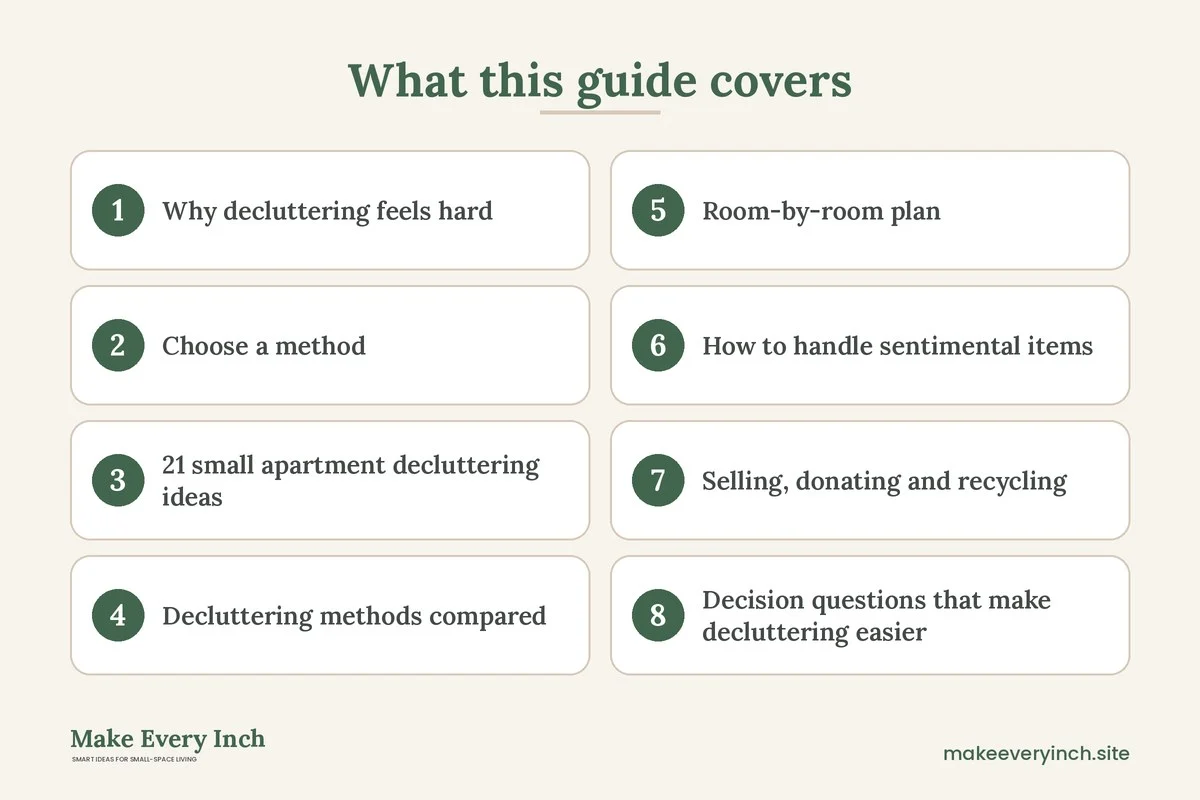
Small apartment decluttering ideas matter more than in a large home, because a small apartment has no place to hide excess. Ten extra items in a studio can make it feel crowded, while ten extra items in a house disappear. The good news is that small spaces respond fast: a few hours of editing can change how an apartment looks and feels. This guide gives you a method, 21 ideas, a room-by-room plan, advice for sentimental items, ways to sell and donate, a 30-day challenge and a checklist. When you are ready to store what is left, see our guide to small space organization ideas.
Why decluttering feels hard
Decluttering is emotional as much as practical. Items hold memories, guilt, hope and fear. You may keep a dress for the version of you that fits, a gadget because it was expensive or a gift because it came from someone you love. Naming the feeling helps you decide. Ask what the item is for, and whether it serves your life now. Decluttering is not about getting rid of everything, but about making room for what matters.
Choose a method
The category method
Declutter by category rather than room. Start with clothes, then books, papers, kitchen items, miscellaneous and sentimental items. Gather everything in a category in one spot so you can see the total.
The room-by-room method
Take one room at a time, beginning with the one that bothers you most. Empty each drawer or shelf, sort and put back only what belongs.
The 12-12-12 method
Find 12 things to throw away, 12 to donate and 12 to put back where they belong. It is a quick way to start.
The 30-day challenge
On day one, remove one item. On day two, remove two, and so on. By day 30 you will have removed 465 items. Adjust the numbers to suit your home.
The box method
Put things you are unsure about in a box with a date. If you have not needed anything in six months, donate the box without opening it.
21 small apartment decluttering ideas
Getting started
1. Start with the easy items
Throw away trash, expired food and empty containers. Quick wins build momentum.
2. Set a timer
Fifteen minutes a day is better than a rare marathon. Stop when the timer rings.
3. Take before photos
Photos show how far you have come, and make hidden clutter visible.
4. Set up four boxes
Label them keep, donate, sell and throw away. Add a fifth for items that belong elsewhere.
5. Define the goal
Decide what you want the room to do, and edit to match. A goal makes decisions easier.
Clothes and closet
6. Try on and decide
Try on items you are unsure about. If they do not fit or flatter, let them go.
7. Turn hangers around
Turn all hangers backward. When you wear an item, turn the hanger the right way. After six months, donate what is still backward.
8. Limit duplicates
Keep the best two of anything that has many versions.
Kitchen and bathroom
9. Empty a drawer at a time
Sort utensils and gadgets. Keep what you use weekly, and donate the rest.
10. Check expiry dates
Throw away expired food, medicine and cosmetics.
11. Limit mugs, glasses and plates
Keep as many as people in the home, plus a few for guests.
Papers and digital clutter
12. Scan and shred
Scan the documents you need and shred the rest. Keep originals only when required by law.
13. Unsubscribe from mail
Cancel catalogs and credit offers to reduce paper.
14. Clear your phone and computer
Delete duplicate photos and old files, and organize into folders.
Sentimental items
15. Keep the best, photograph the rest
Choose a small number of items and take photos of the others.
16. Make a memory box
Choose a single box. When it is full, edit before adding more.
17. Pass things on
Offer family heirlooms to relatives who will treasure them.
Habits that keep the space clear
18. Use one-in, one-out
Remove an item for every new one you bring in.
19. Create a donation bag
Keep a bag in the closet and add items as you notice them. When it is full, drop it off.
20. Reset daily
Put things back every night for ten minutes.
21. Pause before you buy
Wait 48 hours, and ask where it will live before you purchase.
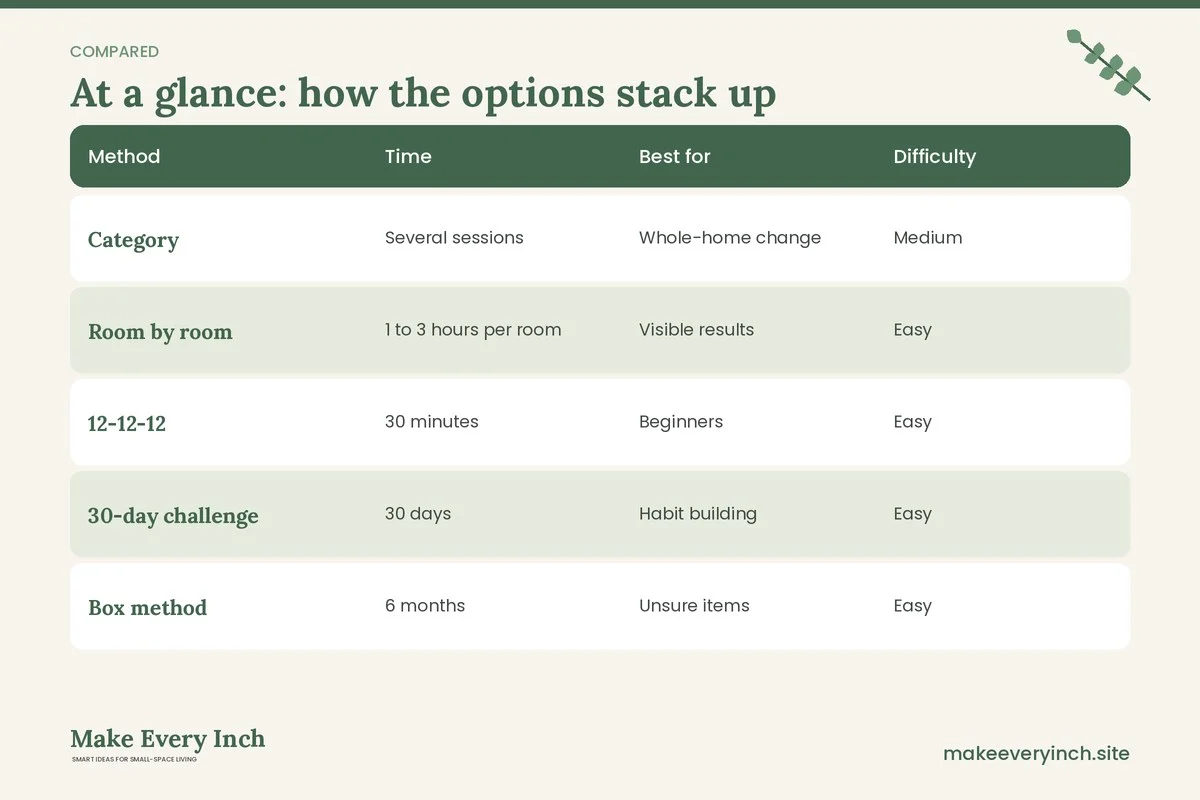
Decluttering methods compared
| Method | Time | Best for | Difficulty | Notes |
|---|---|---|---|---|
| Category | Several sessions | Whole-home change | Medium | Show total volume |
| Room by room | 1 to 3 hours per room | Visible results | Easy | Can miss categories |
| 12-12-12 | 30 minutes | Beginners | Easy | Quick start |
| 30-day challenge | 30 days | Habit building | Easy | Daily rhythm |
| Box method | 6 months | Unsure items | Easy | Slow but gentle |
Room-by-room plan
Entry and living room
Clear surfaces, empty baskets and sort mail and magazines. Remove extra throws and decor. Limit coffee table items to a few. See small living room ideas.
Kitchen
Empty the counter, then the cabinets, one at a time. Donate duplicate tools, and keep a few appliances. See small kitchen organization ideas.
Bedroom
Edit the closet and dresser, clear under the bed and set up a donation bag. See small bedroom organization ideas.
Bathroom
Throw away expired products and sort what is left into daily and backup. See small bathroom organization ideas.
Storage areas
Open boxes and bins that you have not touched in a year. Decide quickly, and keep only what you want to find.
How to handle sentimental items
Sentimental items are the hardest because the object is a stand-in for a person or a time. Remember that the memory lives in you, not in the object. Keep the items that bring you joy when you see them, and let go of the ones that feel like a weight. Photograph large items such as a child’s artwork or a piece of furniture, and keep a representative sample. Store sentimental items in one box per person, and make it a rule that the box cannot grow.
Selling, donating and recycling
Sell items worth more than $30 on a local marketplace, and set a deadline. If it does not sell in a week, donate it. Donate clothes, books and household items in good condition to a charity shop or a shelter. Use a textile recycling bin for worn clothes. Take electronics to a recycling point, and ask a pharmacy about expired medicine. Do not keep a donation pile at home for weeks, since it will drift back into the home.
Decision questions that make decluttering easier
When you hold an item and cannot decide, ask a few simple questions.
- Have I used it in the past year?
- Do I love it, or does it make my life easier?
- Does it fit the space, the size and the style of my home?
- Would I buy it again today?
- Is it in good condition, or does it need repair I will never do?
- Do I have another that does the same job?
- Could I borrow or replace it if I needed it?
If the answer to most is no, let it go. If you are still stuck, set it aside in a box for a set period and check again. The aim is to make a decision, not to be perfect.
Declutter by room type: special cases
A studio apartment
In a studio, the bed, the sofa and the kitchen share one room, so clutter in one area spills over everywhere. Begin with surfaces that are visible from the bed, since they shape how you feel. Use the closet and under-bed space to store what you keep, and aim for clear counters and a clear floor. Use the cleared floor as a reward, such as space for yoga or a rug.
A shared apartment
Divide the space into personal and shared zones. Declutter your own zone first and invite roommates to do the same. Agree on limits for the kitchen and the bathroom, and label shelves. Hold a monthly check-in to remove items that have been left in common areas.
An apartment with kids
Children outgrow toys and clothes quickly. Rotate toys by keeping only a few out, and store the rest. Involve children in choosing what to donate, and teach them that letting go helps others. Keep a bin for outgrown clothes and pass them on every season.
A home office corner
Papers and cables pile up fast. Scan and recycle, label cables and keep only one set of supplies. Clear the desk at the end of the day, so the corner resets for the evening.
Decluttering when you are about to move
Moving is the best moment to declutter, because every item will cost you time and money to pack, carry and unpack. Start early, and begin with rooms you use least. Sell or donate large items that will not fit in the new place. Measure the new home so you know what will fit. Pack a first-week box with essentials, and label every other box by room. Ask yourself of each item: do I want to unpack this? If not, leave it behind. You will arrive in a lighter, calmer home.
Keeping a clutter diary
For two weeks, note each time you feel stress about clutter, and write the cause. You may find patterns, such as mail piles, shoes by the door or a chair full of clothes. Each pattern points to a missing home or a missing habit. Fix the cause with a hook, a basket or a new routine. A small diary reveals problems that decluttering alone will not fix, and helps your new habits last.
Seasonal decluttering checklist
Spring
Clear winter clothes and gear, wash and donate. Check the pantry and the cleaning cupboard, and clean under furniture. Edit books and papers, and refresh the entry.
Summer
Declutter toys, sports gear and travel items. Edit the bathroom of old sunscreen and make-up, and clear the kitchen of unused gadgets.
Autumn
Check the closet for coats, scarves and boots, and donate what does not fit. Edit blankets and bedding, and clear the entry to make room for winter items.
Winter
Review gifts and holiday decor, and donate what you did not use. Check papers and receipts for the year and file or shred them. Set intentions for the year ahead.
Rewarding yourself after decluttering
Decluttering is work, so mark the finish. Enjoy an empty surface, a clean floor or a clear shelf. Add one thing you love, such as a plant, a candle or a new throw, in the space you cleared. Invite a friend over, or enjoy a quiet evening in the tidy room. Positive feelings help the new habits stick, and they remind you why you started.
Helping a friend or family member declutter
If you help someone else, listen first and let them lead. Ask what they want the space to feel like, and focus on what to keep rather than what to throw away. Do not push, and avoid judgment. Offer to help with practical tasks such as hauling bags or listing items online. Celebrate small wins. A kind, patient helper makes the difference between a stressful day and a fresh start.
A 30-day small apartment decluttering plan
Week 1: the easy wins
Day 1, trash and expired items. Day 2, the fridge and the pantry. Day 3, the bathroom. Day 4, the junk drawer. Day 5, the entry and the mail. Day 6, the coffee table and the sofa area. Day 7, drop off a donation bag.
Week 2: the closet
Day 8, tops. Day 9, bottoms. Day 10, dresses and jackets. Day 11, shoes. Day 12, bags and accessories. Day 13, underwear and socks. Day 14, tidy and drop off donations.
Week 3: the rest of the home
Day 15, books. Day 16, kitchen gadgets. Day 17, dishes. Day 18, linens. Day 19, cleaning supplies. Day 20, decor. Day 21, electronics and cables.
Week 4: papers and sentimental items
Day 22, papers. Day 23, digital files. Day 24, photos. Day 25, gifts and keepsakes. Day 26, storage areas. Day 27, memory box. Day 28, final sweep. Days 29 and 30, set up your habits and celebrate.
Keeping clutter away
Make decluttering a habit rather than an event. Do a ten-minute reset each night, and a monthly check of one area. Keep a donation bag ready. Use the one-in, one-out rule. Notice what you bring in: if the same type of item keeps appearing, ask why, and break the pattern. Share the rules with everyone in the home, and make decisions as a team.
Common decluttering problems and fixes
“I feel guilty getting rid of things”
Remind yourself that the item will help someone else if you donate it, and that the guilt is about the past, not the present.
“I keep it in case I need it”
Ask whether you could borrow, rent or replace it easily. If yes, let it go.
“My partner or roommate won’t declutter”
Start with your own things, and make shared spaces a joint decision. Do not touch their things without asking.
“I run out of energy”
Work in short sessions, and stop when you are tired. Reward yourself after each step.
“The clutter comes back”
Review your habits and your storage. If an area keeps collecting items, give it a home or remove the cause.
Mistakes to avoid
- Buying organizers before editing
- Trying to do the whole home in one day
- Moving clutter from room to room
- Keeping donations at home for weeks
- Letting guilt decide
- Skipping the habit step
- Forgetting digital clutter
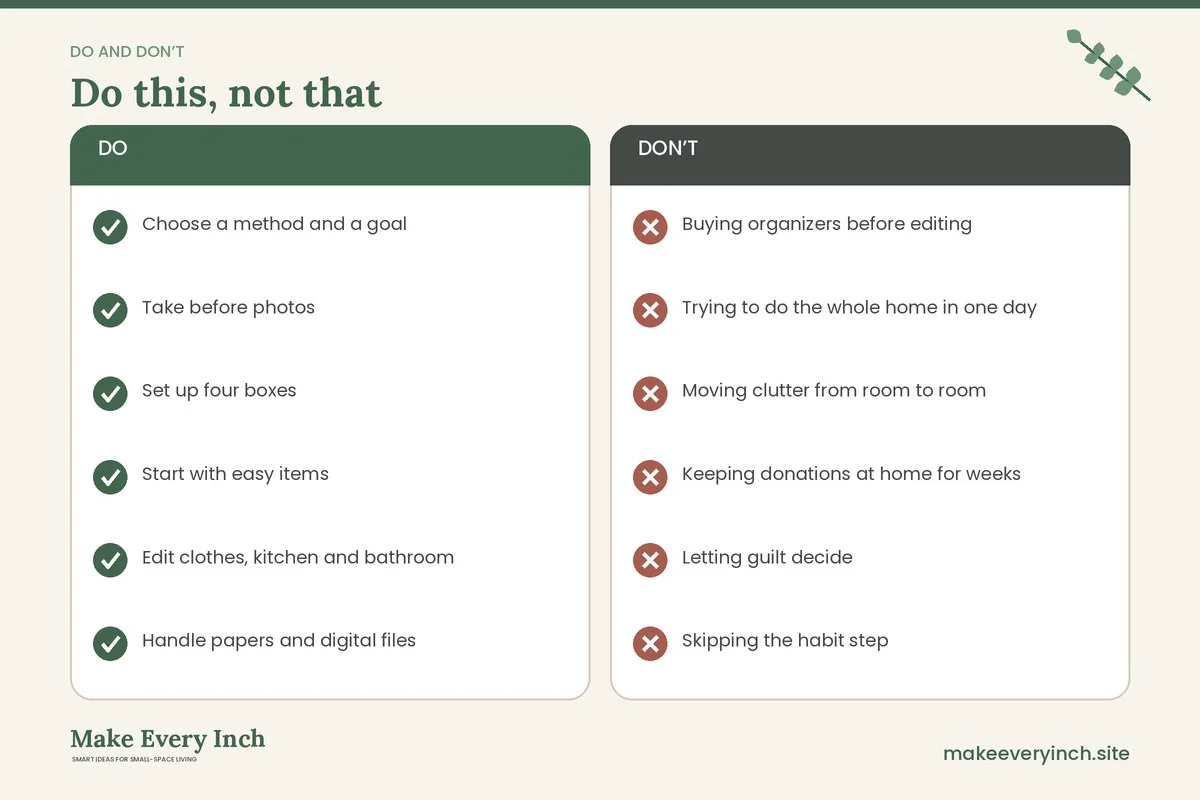
Decluttering checklist
- Choose a method and a goal
- Take before photos
- Set up four boxes
- Start with easy items
- Edit clothes, kitchen and bathroom
- Handle papers and digital files
- Treat sentimental items gently
- Donate or sell within a week
- Set one-in, one-out
- Reset ten minutes daily
FAQ
Where do I start decluttering a small apartment?
Start with trash and easy categories such as expired items, then do one drawer or shelf at a time.
How do I declutter quickly?
Use a timer, four boxes and the 12-12-12 method.
How do I let go of sentimental items?
Keep the best, photograph the rest and use one memory box.
How much should I keep?
Only what you use, need or love and what fits in the space.
How do I stop clutter coming back?
Use one-in, one-out, a daily reset and a pause before buying.
What should I do with donations?
Drop them off within a week, and do not let the pile grow at home.
Is the 30-day challenge worth it?
Yes, if you like a daily rhythm. It builds a habit and removes hundreds of items.
How do I declutter with a partner?
Start with your own items, agree on shared rules and respect each other’s decisions.
Keep going: Explore our small space organization ideas, small closet organization ideas and hidden storage ideas.
Save this guide for later
Pin the ideas you like to Pinterest so you can come back to them when you plan your space.