15 Small Laundry Room Mistakes to Avoid: Errors That Waste Space
Quick answer: The small laundry room mistakes avoid list starts with safety, then layout. Never block dryer airflow, let lint build up, or store chemicals within a child’s reach. Then fix the space killers: shelves hung too low, doors that swing into the washer, no sorting plan and no spare surface. Check each appliance manual for clearances, and ask your landlord before you drill anything.
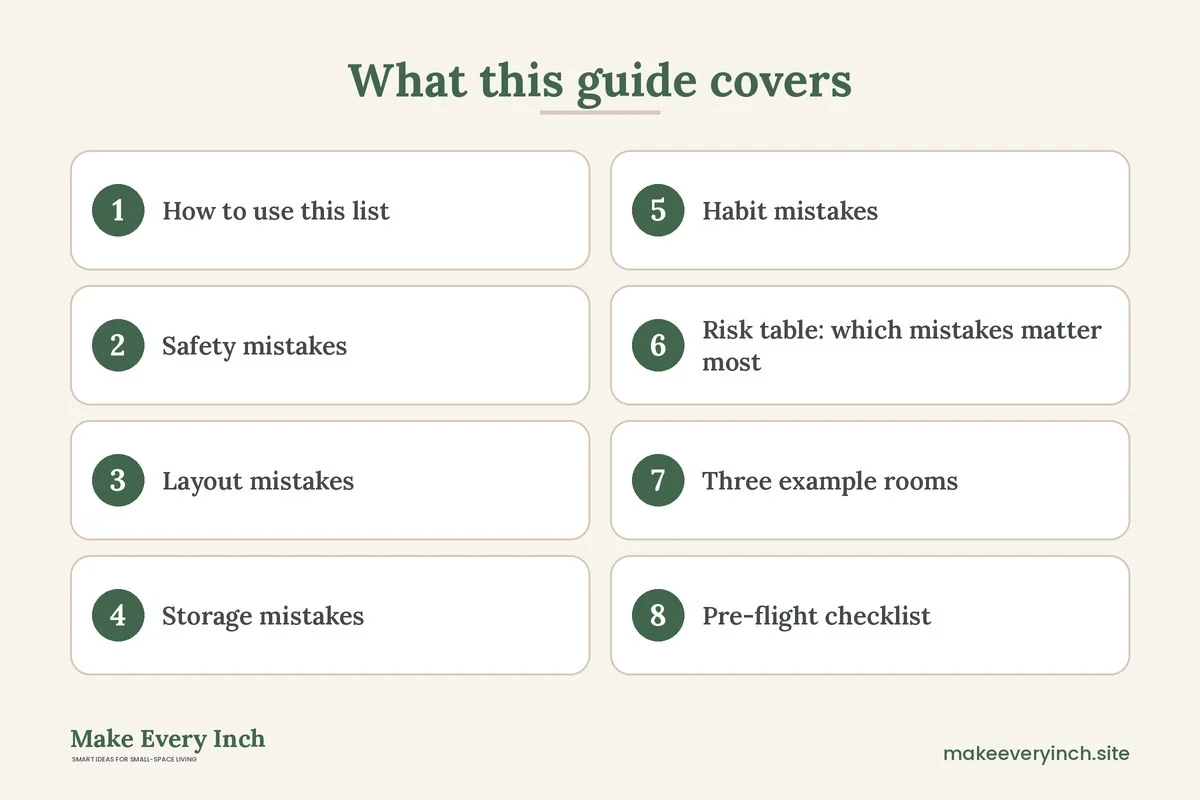
The small laundry room mistakes avoid list is mostly made of small decisions that seem harmless on the day you make them. A shelf goes up a few inches too low. A detergent bottle lands on a high shelf because it was handy. A basket sits against the back of the dryer because that gap looked wasted. Months later the room is cramped, the clothes pile up and a few of those choices have turned into real hazards. This guide walks through 15 common errors, grouped by safety, layout, storage and daily habits, and gives a practical fix for each one. It also includes a risk table, three example rooms, a pre-flight checklist and a short FAQ. If you want the wider picture first, start with our pillar guide on small laundry room ideas, then come back here to check your own room against the list. For a step-by-step system for what goes where, see our post on small laundry room organization.
How to use this list
Read the whole list once, then walk into your laundry area with a tape measure, your appliance manuals and a phone camera. Photograph the space as it is. Look at it the way a stranger would: where would a child reach, where would heat gather, where would water go if a hose let go? Most of the mistakes below show up in the first five minutes of that walk.
Mistakes in a laundry area are not equal. Some only cost you convenience, such as a basket that is hard to reach. Others affect safety, such as a blocked dryer vent. Fix the safety items first, whatever your budget or timeline. Then work on layout, storage and habits in the order that bothers you most.
One general note before the list. Every appliance has its own manual, and every home has its own venting, wiring and plumbing. This article gives general guidance only. When it conflicts with your manuals, your local rules or your landlord’s instructions, follow those. If something looks unsafe, such as scorched wiring, a damp wall behind the washer or a vent that you cannot reach, call a qualified professional.
Safety mistakes
1. Blocking the airflow around the dryer
A dryer needs room to breathe. Warm air and lint have to leave through the vent, and the machine itself needs space for cooling and for the exhaust connection. Many small-room plans shove the dryer into a tight alcove, then stack boxes and baskets around it. That is the most common safety error in a small laundry room.
Fix: Read the clearance section of the dryer manual. Typical guidance asks for a few inches behind the machine and some space at the sides, but the exact numbers vary by model and by whether it is vented or ventless. Keep the area around the appliance clear of fabric, paper and storage. Never use the top or back gap as a shelf for baskets, and never drape a hanging rack over a running dryer.
2. Letting lint build up
Lint is fuel. It collects in the filter, in the housing around the filter and inside the vent. A dryer that takes longer to dry a load, a laundry room that feels unusually hot or a burning smell are all warning signs that airflow is restricted. Small rooms make it worse, because the lint trap is easy to forget when a pile of towels is blocking the front.
Fix: Clear the lint filter after every load. Check the filter housing and the area around it regularly. Follow your manual’s instructions about vent cleaning and, for a hard-to-reach or long vent, consider having a professional do it. Keep a small lidded bin next to the dryer for lint so that it does not end up on the floor or the shelf.
3. Using the wrong venting or crushing the hose
A vent that runs through too many bends, a flexible hose squashed behind the dryer or a vent that ends inside a cabinet or closet will trap moist, lint-filled air. Some small apartments push the dryer so close to the wall that the duct is kinked sharply, which cuts airflow.
Fix: Check the manual for the recommended duct type, the maximum run length and the bends allowed. Pull the dryer out far enough to see the connection, and make sure the hose is not crushed. If you live in a rental, report any vent that looks damaged, disconnected or blocked to your landlord instead of repairing it yourself. If your unit is ventless or condensing, follow the manual for emptying the water tank and cleaning the heat exchanger or filters.
4. Ignoring ventilation in the room itself
A tiny laundry closet with a closed door traps heat and moisture. Damp air encourages mildew on walls, caulk and the backs of cabinets. It can also make an enclosed laundry space uncomfortable to use.
Fix: Check whether your room has an exhaust fan, a louvered door or a window. If the closet door is solid, a louvered or vented door may help, but only if that fits your lease and the building rules. Leave the door ajar after a load, wipe water from the washer gasket and leave the washer door open so that the drum can dry.
5. Skipping the water shutoff valves and leak plan
Washers connect to hot and cold supply lines, and the drain hose empties into a standpipe or a sink drain. A failed hose or a loose connection can release water quickly. In a small room, water finds its way into walls, floors and neighbors’ ceilings.
Fix: Find the shutoff valves. Everyone in the home should know where they are and how they work. Some people turn the valves off when away for long periods, but follow your manual and your landlord’s guidance. Inspect supply hoses for bulges, cracks and rust, and replace worn hoses according to the manual. Keep the area behind and under the washer clear enough that you can see a drip. A shallow drain pan under a washer is a common idea, but only where the manual and the building rules allow it and where it drains properly.
6. Plugging everything into one overloaded outlet
Washers, dryers, small heaters, irons and steamers all draw power. In a small room people tend to add power strips and extension cords for a lamp, a steamer and a charger, and the cords end up near water.
Fix: Plug large appliances into outlets rated for them, as described in the manual. Keep power strips and extension cords away from the washer and from any place water might splash. Look for GFCI protection on outlets near a sink or a wet area, which cuts power quickly if it detects a ground fault. If an outlet near the water is not protected, mention it to your landlord or ask an electrician. Never modify wiring yourself.
7. Storing chemicals within reach of children and pets
Detergent pods, bleach, stain removers and cleaning sprays are some of the most hazardous items in a home. The laundry room is where most of them live, often on an open shelf at a handy height.
Fix: Store all laundry chemicals high or in a locked or latched cabinet, in their original labeled containers, with the caps closed. Never mix cleaners, especially bleach with ammonia or with acidic products, because the fumes can be dangerous. Ventilate the room when using strong products. Keep a list of local poison control contact details somewhere visible. If small children or pets live with you, a childproof latch on the cabinet is a simple and inexpensive precaution.
Layout mistakes
8. Forgetting door swings and appliance doors
A front-loading washer door and a laundry-closet door can collide, and so can a dryer door and a nearby wall. In a small room the arc of each door decides where you can stand.
Fix: Before you buy or rearrange anything, mark the swing of every door on the floor with painter’s tape. Measure the opening of the washer door when fully open. Leave enough space to kneel or bend in front of a front-loader and to pull out a full basket. If doors collide, think about a reversible door, a sliding door or a curtain, where the building allows it.
9. Hanging shelves too low or too deep
Shelves over a washer and dryer are one of the best uses of vertical space, but they can be a trap. A shelf hung too low means you cannot open the lid of a top-loader or lean over to reach the back of the machine. A shelf that is too deep makes you hit your head, and it can hide the area behind the machines.
Fix: Measure from the top of the machines, including the lid in its fully open position, and add a margin so that you can reach in comfortably. Choose a depth you can reach across without straining. Keep the heaviest items low and the lightest items on the highest shelf. Anchor every shelf into studs or with appropriate anchors, and never drill without your landlord’s permission. If you rent, use a freestanding shelf that sits beside the machines or a rolling cart, and anchor tall pieces according to the manufacturer’s instructions.
10. Stacking without checking weight and vibration
Stacking a dryer on top of a washer saves floor space, but only with machines designed to stack and with the right stacking kit. Washers vibrate during spin cycles. A stack that is not secured or sits on an uneven floor can walk across the room. Washers are also heavy when full of water and wet laundry.
Fix: Follow the manual for both machines, and use the correct kit. Do not stack any two machines that the manufacturer does not approve for stacking. Check that the floor is level and strong enough, and that the load is not near a weak spot. If you are not sure, ask a professional installer, and check your lease before moving large appliances.
11. Leaving no clear spot to fold and sort
Many small laundry rooms have two machines and nothing else. People then fold on the bed, on the sofa or on top of the dryer, which is a hot surface when it runs. The pile moves from room to room and nothing gets put away.
Fix: Plan one small flat surface. Options include a counter over front-loaders (if the manual permits it), a wall-mounted drop-leaf shelf that folds away, a rolling cart that tucks beside the machines or a cutting board-sized shelf. A surface only needs to be large enough for a towel. If the top of a machine is your folding spot, check the manual first, and never fold on a dryer that is running.
Storage mistakes
12. Buying containers before you have a system
It is tempting to buy baskets, bins and caddies as the first step. Without a plan they pile up, they do not fit and they add clutter. A small laundry room looks messy when every container is a different size.
Fix: Measure first. List what you actually need to store: detergent, softener, stain remover, dryer sheets or balls, spare hangers, lint brush, a mending kit. Count how many shelves or bins that needs. Then buy one coordinated set. Label each container so that everyone in the home puts things back in the same place. For ideas that suit a small footprint, see our guide to vertical storage ideas.
13. Using the floor for everything
Floor baskets, buckets and drying racks eat the little floor space a tiny room has. They also trap lint and make cleaning harder.
Fix: Move storage up and out of the way. Use the back of the door for an over-the-door organizer or hooks (check the door’s weight limit and your lease), a wall shelf above the machines, a slim rolling cart in the gap beside them, or a pole between the machines and the wall. Keep the floor free of anything you could trip on while carrying a full basket. For renters, our post on no-drill storage ideas for renters shows options that need no tools.
Habit mistakes
14. Having no sorting plan
A single hamper means the first step of every laundry day is sorting, and sorting takes floor space. In a small room this is a bottleneck.
Fix: Sort at the source. A two- or three-compartment hamper in the bedroom or hallway splits whites, darks and delicates before they reach the machines. Some households use one bag per person, which also keeps the loads moving. A narrow slot between the machine and the wall can hold a slim sorter on wheels. The goal is that clothes arrive already sorted.
15. Letting the room become a dumping ground
Because it is a utility space, the laundry area attracts items that belong elsewhere: cleaning supplies, tools, pet food, seasonal decor and overflow from the pantry. Soon the machines are hard to reach.
Fix: Set a limit. Decide what belongs in the room and what does not. Move the rest to other zones, using ideas from our guides on small space organization ideas and hidden storage ideas. Do a five-minute reset at the end of each laundry day, and a deeper review each season.
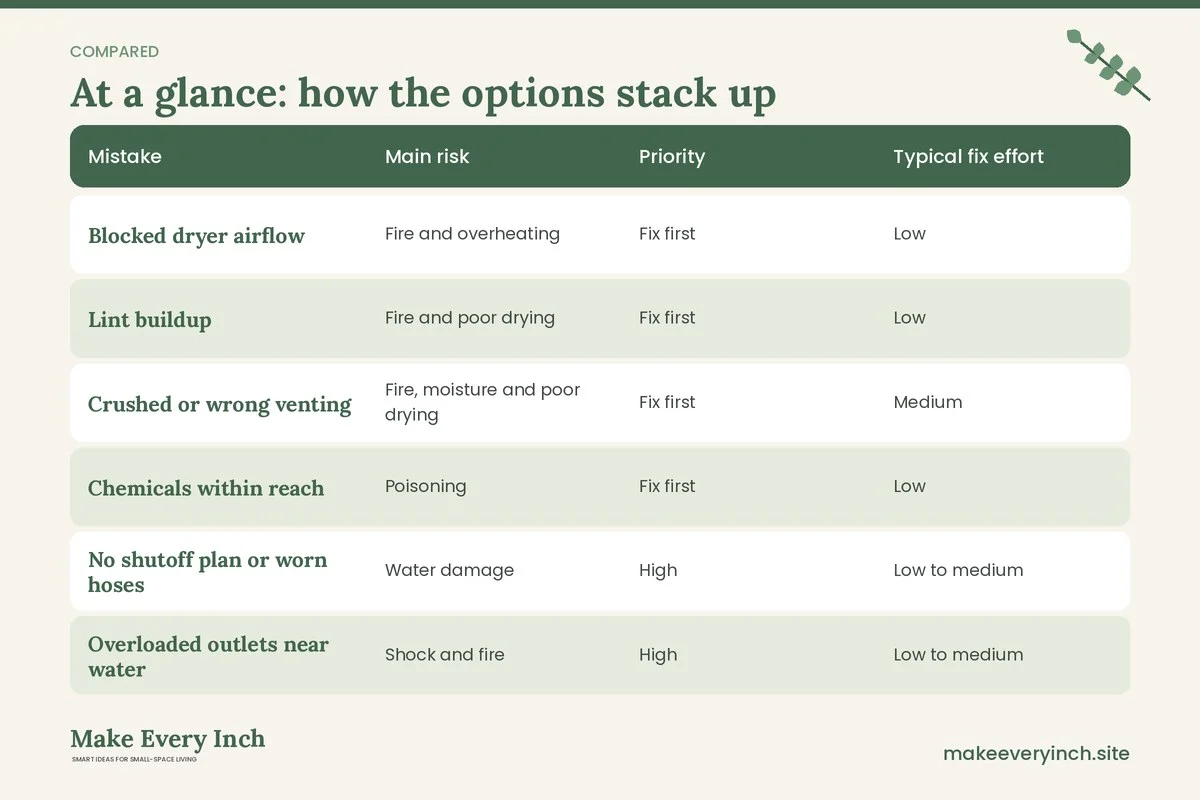
Risk table: which mistakes matter most
Use this table to decide what to fix first. Severity is a general guide, not a measurement.
| Mistake | Main risk | Priority | Typical fix effort |
|---|---|---|---|
| Blocked dryer airflow | Fire and overheating | Fix first | Low |
| Lint buildup | Fire and poor drying | Fix first | Low |
| Crushed or wrong venting | Fire, moisture and poor drying | Fix first | Medium |
| Chemicals within reach | Poisoning | Fix first | Low |
| No shutoff plan or worn hoses | Water damage | High | Low to medium |
| Overloaded outlets near water | Shock and fire | High | Low to medium |
| Unsecured stack | Injury and damage | High | Medium |
| Unanchored tall shelf | Tipping | High | Low |
| No ventilation in room | Mildew and heat | Medium | Low to medium |
| Door swing clash | Daily frustration | Medium | Low |
| Shelves too low or deep | Bumps and wasted space | Medium | Low |
| No folding spot | Messy habits | Medium | Low |
| Container chaos | Clutter | Low | Low |
| Floor clutter | Trip hazard and dirt | Medium | Low |
| No sorting plan | Time lost | Low | Low |
Three example rooms
Example 1: The hallway closet
A couple in a rental has a stacked washer and dryer behind bifold doors in the hallway. Their mistakes were an overstuffed closet, a floor basket in front of the doors and chemicals on a high-traffic shelf at about waist height. They fixed it in an afternoon. The doors stay open while the dryer runs, a lidded caddy now lives on the highest shelf and the floor basket became a hamper in the bedroom. They checked the manual for the stack kit and found it matched. They asked the landlord before adding a tension-rod hanging space. Nothing was drilled.
Example 2: The kitchen corner
A single renter has a front-loader tucked beside the refrigerator, with a dryer in a cupboard. The dryer vent ran behind a stack of storage bins. The fix was to move the bins out and to give the vent a few inches of clearance as the manual directed. They added a narrow rolling cart for detergent, with a latch on the side facing the room, and a folding drying rack that hangs over the bathtub instead of standing in the kitchen. The kitchen also needed a rethink, which is covered in our post on small kitchen ideas.
Example 3: The basement nook
A family has machines in a corner of a basement where the floor is uneven and damp. Their errors were no sorting plan, baskets on the damp floor and an extension cord near the washer. They raised the baskets onto a shelf, moved the cord to a protected outlet with the landlord’s approval and added a small dehumidifier. They also found that the cabinet where chemicals were stored had no latch, so they added one. A GFCI outlet was requested near the sink, and a qualified electrician installed it.
Pre-flight checklist
Print this and walk through your laundry area.
- Clearance around the dryer matches the manual
- Lint filter cleaned after every load
- Vent is not crushed, kinked or blocked, and ends where the manual allows
- Water shutoff valves located and working
- Supply hoses free of bulges, cracks and rust
- Outlets near water are GFCI-protected, and no cords run through splash zones
- Chemicals are stored high or locked, in original containers, never mixed
- Tall shelves are anchored, or freestanding pieces are secured per instructions
- Stacked machines are approved for stacking and secured
- Door swings mapped with tape and clear
- One flat folding surface planned
- Floor kept free of trip hazards
- Sorting system set up before the machines
- Lease checked for drilling, appliance changes and venting
- Photos taken before any changes
Mistakes renters should especially avoid
Renting adds a few rules of its own. First, do not drill, cut, relocate a vent or change plumbing without written permission. Many landlords will say yes to small changes if asked, particularly when the change protects the property. Second, do not store anything that could damage a floor or wall, such as damp baskets resting on bare wood. Third, never alter a gas line or a dryer vent. If either is damaged, report it.
Many of the best fixes for rental laundry areas need no tools: tension rods, over-the-door hooks, adhesive hooks rated for light items, freestanding racks and rolling carts. For a longer menu, see our guide to renter friendly apartment decorating ideas and the post on budget small space ideas, which covers low-cost ways to change a room without a big project.
Mistakes shared with other small rooms
Laundry errors often mirror errors elsewhere. A closet organized without a plan fails in the same way as a laundry shelf with no system. A bathroom with no counter and a laundry room with no folding spot suffer from the same lack of a single flat surface. If your laundry area shares a space with a bathroom or a closet, our guides to small bathroom ideas and small closet ideas cover the neighboring zones. If the machines live near an entry, the advice in small entryway ideas helps keep shoes and bags from invading the laundry floor.
A simple monthly and seasonal routine
Good habits keep mistakes from returning. Once a week, empty the lint trap after every load, wipe the top of the machines and put away anything that does not belong. Once a month, check hoses for wear, wipe the washer gasket and door, clean the soap drawer and look at the vent for lint. Once a season, pull the dryer out carefully, if the manual allows and if it is safe to move, to check the connection and clear lint from behind it. Review the chemical cabinet, discard anything old or unlabeled according to local disposal guidance and confirm that the latch still works.
Write the routine on a card and tape it inside a cabinet door with a low-tack tape. The best routine is one you will actually follow, and a visible card removes the need to remember.
Frequently asked questions
How much space does a dryer need around it?
It depends on the model and the installation. Manuals usually give minimum clearances for the back, sides and top, and venting needs may add more. Treat any number in a general article as a rough guide and use the number in your own manual.
Can I store things on top of the washer and dryer?
You can use the top of a washer or dryer for light, non-flammable items when the manual allows it, but never leave items on a running dryer, and keep them away from vents. Vibration can make items slide off, so a non-slip mat or a small shelf above is often safer.
Is it safe to keep detergent under a utility sink?
Only if the cabinet is latched or out of reach of children and pets, the containers are closed and the area stays dry. Check regularly for leaks, because moisture can damage packaging and make labels unreadable.
Do I need a GFCI outlet in a laundry room?
Many codes require GFCI protection near sinks and wet areas, and the rules differ by location and age of the building. Look for outlets with test and reset buttons, and ask a licensed electrician or your landlord if you are unsure. Do not alter wiring yourself.
What is the biggest mistake in a small laundry room?
Blocking dryer airflow and ignoring lint are usually the most serious, because they involve fire risk. After that, unsecured chemicals and unanchored tall furniture are the next priorities.
Can I stack my washer and dryer myself?
Only if both machines are approved for stacking and you have the correct kit and help. Washers are heavy and vibrate, so follow the manuals and consider hiring a professional.
Final thoughts
The best small laundry room is not the one with the most storage but the one with the fewest surprises. Clear airflow, dry floors, locked chemicals, anchored shelves and a place to fold turn a cramped room into a safe and easy one. Fix the safety items first, then use the layout and storage fixes to reclaim space. Return to the checklist each season, and update it as your household and appliances change.
Keep going: Keep improving your laundry area with our guides to small laundry room ideas, small laundry room organization and renter friendly shelving ideas without drilling.
Save this guide for later
Pin the ideas you like to Pinterest so you can come back to them when you plan your space.