Small Home Office Desk Ideas
Quick answer: The best small home office desk ideas start with the desk type, because each type solves a different problem. A wall-mounted or fold-down desk saves floor space, a narrow console suits a hallway, a compact writing desk suits a bedroom corner, a corner desk uses dead space and a rolling cart suits occasional work. Look for roughly 20 to 30 inches of depth, a height near 28 to 30 inches, and a chair that tucks fully underneath.
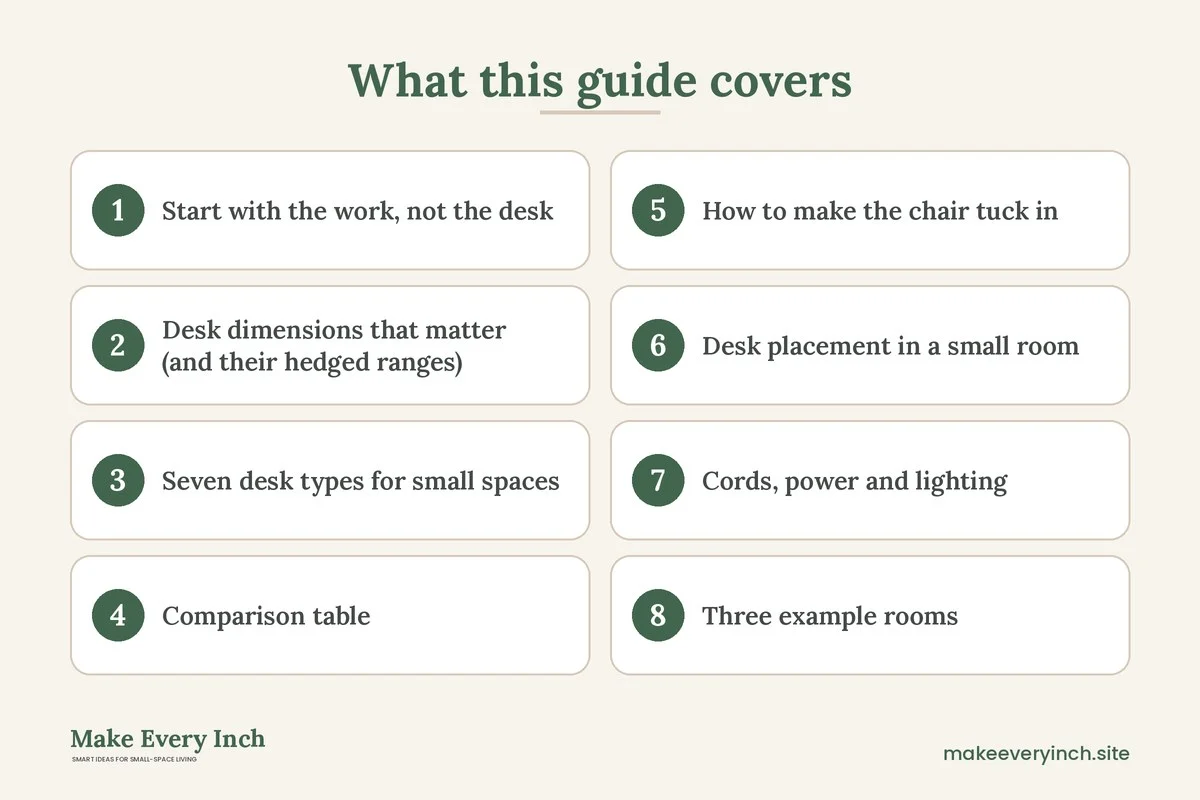
Small home office desk ideas are really a series of trade-offs. A desk that is perfect for a laptop may be too shallow for a monitor, a desk that tucks away may be too wobbly for a long day and a desk that fits a corner may leave no room for the chair. This guide helps you compare desk types by what matters in a small space: depth, width, height, leg room, chair tucking, cord needs and how easily the desk moves or folds. It does not repeat the build-it-yourself approach from our post on DIY desk ideas for small spaces. Instead, it focuses on choosing the right type of desk, measuring it properly and living with it. You will find a type-by-type breakdown, a comparison table, a section on dimensions with hedged ranges, a chair-tucking guide, three example rooms, a cord plan, safety notes and a checklist. For the larger picture, read our pillar on small home office ideas, and for a related post about converting an alcove, see small home office ideas in a closet.
Start with the work, not the desk
Before choosing a type, describe what you do at the desk. A person who answers email on a laptop for an hour needs very different furniture from someone who works on two screens all day. Ask yourself these questions.
- How many hours a day? Under two hours suggests a flexible desk you can fold or move. Over four hours suggests a stable surface and a proper chair.
- What equipment sits on it? A laptop alone needs less than a laptop with a monitor, a keyboard, a mouse, a lamp and a notebook.
- Do you write by hand or draw? Handwork wants a larger, flat surface and more elbow room.
- Do you take video calls? You need a spot where a plain background sits behind you.
- Does the desk need to disappear? If the desk lives in a living room or a bedroom, hiding it may matter as much as using it.
- Do you rent? Wall-mounted options need fixings, so check the lease.
Write the answers on a card. They will tell you which desk type to pick and which dimensions to prioritize.
Desk dimensions that matter (and their hedged ranges)
Every person and every setup is different, so treat these numbers as ranges. Measure your own equipment and body, and try the sizes with tape and boxes before you buy.
- Depth. About 20 to 24 inches is a minimum for a laptop. About 24 to 30 inches suits a monitor placed at a comfortable distance. Very deep desks, over 30 inches, take floor space without adding much value in a small room.
- Width. Around 30 to 36 inches holds a laptop and a notebook. Around 40 to 48 inches holds a monitor, a keyboard and a lamp. Around 55 inches or more suits two screens or a person who spreads out.
- Height. Many standard desks sit around 28 to 30 inches high. Some people prefer a bit lower or higher, and adjustable options exist. The right height lets your forearms rest roughly level with the keyboard, but this varies, so adjust the chair first.
- Leg room. Look for at least 24 to 27 inches of clear width between the legs, and a clear height under the desk of about 25 to 27 inches, so your knees and thighs do not hit a drawer or a crossbar.
- Apron or drawer clearance. A thin drawer can steal the room your thighs need. In small desks, a shallow drawer is fine, but check the clearance under it.
- Clear floor behind the chair. Plan for 30 to 36 inches behind the desk if people need to walk past, and about 24 inches if the space is used only by you.
This is general guidance and not medical advice. If you spend long hours at a desk and feel discomfort, talk with a professional about your setup.
Seven desk types for small spaces
1. The wall-mounted or fold-down desk
A desk that attaches to a wall folds up flat when you finish, leaving the floor clear. It is the best type for a room that serves another purpose, such as a bedroom or a living room. Check the lease before you drill, and attach the desk to studs or with fixings rated for the load, following the maker’s instructions. A fold-down desk is usually shallower than a fixed one and not suited to heavy equipment. It works well for a laptop and a notebook, and it vanishes at the end of the day.
2. The narrow console desk
A console is a tall, slim table, often 10 to 18 inches deep, that stands behind a sofa or in a hallway. Some are deep enough, around 18 to 22 inches, to double as a laptop desk. A console works if you use a laptop and need little space. It rarely suits a monitor, and the chair may not tuck well. Pair it with a stool that slides underneath.
3. The compact writing desk
A small writing desk, with a flat top and slim legs, is the classic choice for a bedroom corner. These typically run 30 to 42 inches wide and 18 to 24 inches deep. They look light and fit in a nook beside a window. Some have a single shallow drawer. They suit handwriting and a laptop, and they are less comfortable for a monitor setup. See our guide to small bedroom ideas with a desk for placement ideas.
4. The corner desk
An L-shaped or corner desk uses the dead space where two walls meet. It gives you two work surfaces and lets you place a laptop on one side and papers on the other. The downside is that it can swallow a small room, and the chair may stick out into the walkway. Look for a model with arms about 24 inches deep and a combined span of 48 to 60 inches. A corner desk is best in a room where the corner is otherwise wasted.
5. The desk with built-in storage
A desk with shelves, a hutch or a hanging cabinet keeps supplies off the surface. In a tiny room it replaces a separate bookcase. The risk is bulk. A tall hutch can feel heavy, and it needs anchoring if it can tip. A desk with a lower shelf can look neater if you keep the surface empty. See our post on small space organization ideas for ideas on how to store what the desk collects.
6. The rolling cart or trolley desk
A cart on wheels is a laptop desk that moves. It works for occasional work, for sitting on a sofa or for pushing to the wall after hours. A cart is usually 14 to 20 inches deep, so it gives you less surface. Lock the wheels when you work, and check that the top is stable. It suits people who work an hour or two at a time.
7. The convertible or multi-use desk
Some tables serve as a desk, a dining spot and a console. A drop-leaf table, for example, is a narrow console when closed and a work surface when open. A convertible piece is a good fit in a studio, where one table must do several jobs. See studio apartment ideas for working from home for ways to blend work and home.
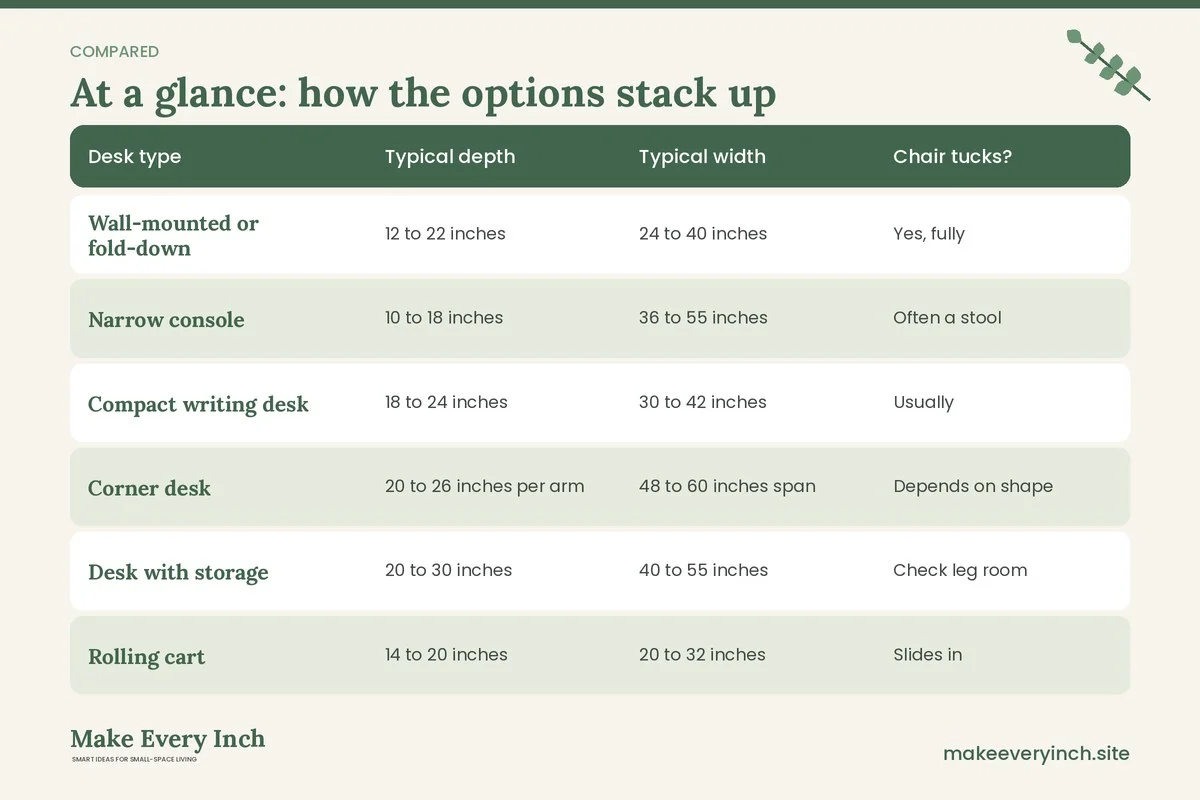
Comparison table: desk types at a glance
| Desk type | Typical depth | Typical width | Chair tucks? | Best for | Watch out for |
|---|---|---|---|---|---|
| Wall-mounted or fold-down | 12 to 22 inches | 24 to 40 inches | Yes, fully | Part-time laptop work | Needs fixings, light loads only |
| Narrow console | 10 to 18 inches | 36 to 55 inches | Often a stool | Hallways and living rooms | Too shallow for a monitor |
| Compact writing desk | 18 to 24 inches | 30 to 42 inches | Usually | Bedrooms and handwriting | Limited surface area |
| Corner desk | 20 to 26 inches per arm | 48 to 60 inches span | Depends on shape | Two work zones | Takes up a lot of floor |
| Desk with storage | 20 to 30 inches | 40 to 55 inches | Check leg room | Rooms with no other storage | Bulky, may need anchoring |
| Rolling cart | 14 to 20 inches | 20 to 32 inches | Slides in | Occasional work | Small surface, wheels must lock |
| Convertible table | 14 to 30 inches | 24 to 48 inches | Depends | Studios and shared rooms | Setup time each day |
Numbers are typical ranges only. Always check the exact measurements of the piece in front of you.
How to make the chair tuck in
In a small room, the chair often takes more space than the desk. A chair that does not tuck under leaves a 20 inch obstacle in your walkway. Here is how to solve it.
- Measure the chair and the opening. Check the width of the chair seat and the clear width under the desk. Many people forget the arms.
- Check the height. The seat must slide under the desk top with a gap. A chair with a high, thick seat or a tall back may not.
- Use a stool. A stool or a backless chair slides fully under and takes almost no visual room.
- Pick a slim chair. A chair with a narrow back and no arms tucks under easily. A larger task chair may be better for long days, and you can store it elsewhere when you finish.
- Add a cushion. A firm cushion on a hard chair gives some comfort without bulk.
- Mark the floor. Tape the chair’s pulled-out footprint on the floor and test the walkway.
- Protect the floor. A chair on wheels can scratch hard floors. A mat or felt pads help. Check the lease for rules about flooring.
If the chair has to stay out in a living room, choose one that looks like a dining or accent chair, so that it blends in.
Desk placement in a small room
Where the desk goes matters as much as which desk you choose.
- Against a wall. This is the most space-efficient option. You face the wall, so sound and visual distractions drop, but you lose the view.
- Facing a window. Natural light is lovely, but glare on a screen is a risk. Place the screen at a right angle to the window where possible, so the light falls from the side.
- Floating in the room. A desk that stands away from walls divides a space, and it needs a finished back and tidy cords. This works in a studio.
- Behind a sofa. A console behind a sofa creates a work zone without extra floor space.
- In a nook or an alcove. A built-in alcove makes a good office. Measure carefully and keep the chair tucked in when you finish.
- Under a loft bed. A desk beneath a raised bed uses vertical space, but check the clearance, the light and the ventilation. Read our guide to how to fit a desk into a studio apartment for more.
Keep desk legs and chair away from heating vents and radiators, and do not block an exit or a door swing.
Cords, power and lighting
A desk with a tangle of cables looks cramped even when it is not. Plan the cords before you finalize the layout. Our guide to renter-friendly ways to hide cords has options.
- Use one power strip. Choose a strip with a built-in circuit breaker, plug it directly into a wall outlet and never plug one strip into another. Mount it under the desk or on the wall where you can reach the switch.
- Check the load. Add up the power ratings of what you plug in. A laptop, a monitor and a lamp are usually modest, while a heater or a printer adds more. If a breaker trips, unplug something and ask for help.
- Keep cords off walkways. A cord across a path is a trip hazard. Run it along the wall and cover it with a removable channel.
- Do not hide cords under a rug. Cords under a rug can overheat and be damaged by foot traffic.
- Add clips and sleeves. Adhesive clips along the desk edge hold cords in place without drilling.
- Pick a lamp that avoids glare. Place a task light to the side of your screen, and avoid a bare bulb in your line of sight. A shaded or adjustable lamp is easier on the eyes. See our post on renter-friendly lighting ideas.
- Leave airflow around devices. Do not bury a laptop charger or a router under papers.
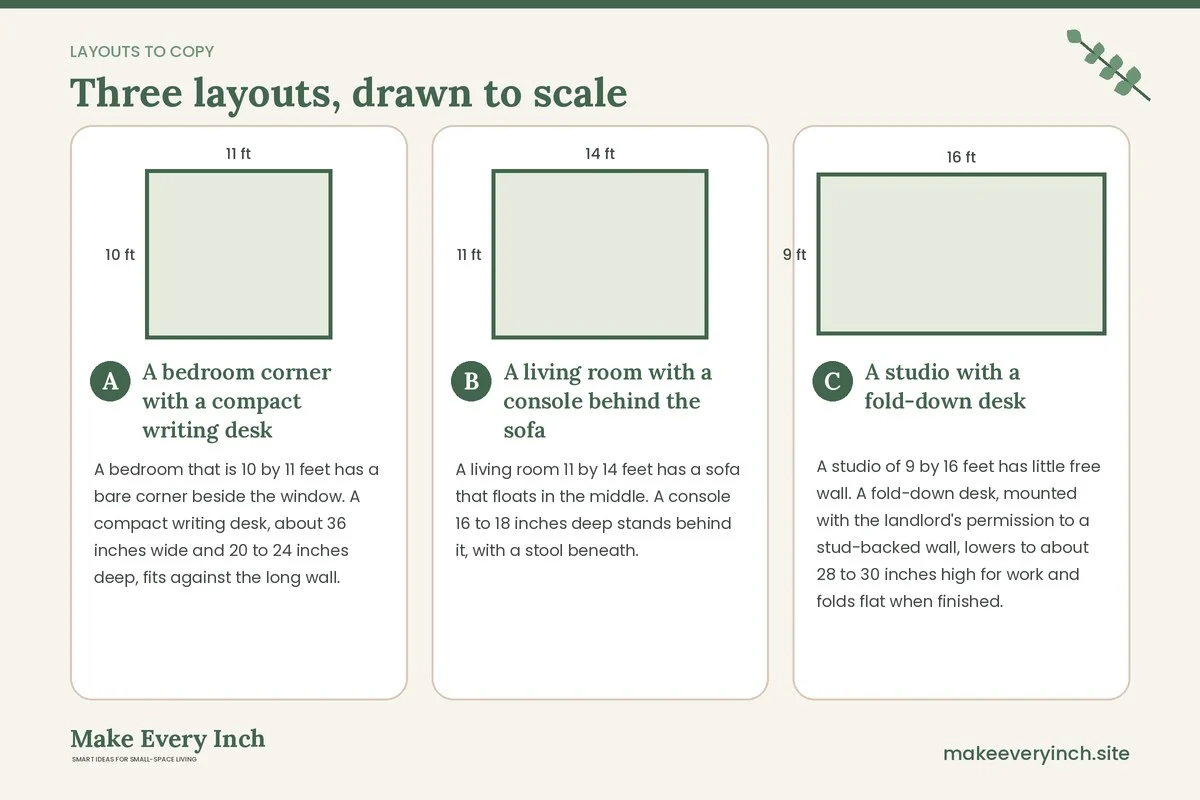
Three example rooms
A bedroom corner with a compact writing desk
A bedroom that is 10 by 11 feet has a bare corner beside the window. A compact writing desk, about 36 inches wide and 20 to 24 inches deep, fits against the long wall. A slim chair tucks fully beneath, and a small lamp sits at the right corner. A shelf above holds papers, kept low enough that it does not feel heavy. The desk is a fixed work spot, and the bedroom keeps about 30 inches of walkway to the bed. This layout suits someone who works two to four hours a day and wants a place to close at night.
A living room with a console behind the sofa
A living room 11 by 14 feet has a sofa that floats in the middle. A console 16 to 18 inches deep stands behind it, with a stool beneath. During the day the console holds a laptop and a lamp, and at night it holds a bowl and a plant. The sofa back hides the work zone from the TV area. A power strip hides on the wall behind, with a cord cover along the baseboard. This setup suits a hybrid worker with a laptop and not much else.
A studio with a fold-down desk
A studio of 9 by 16 feet has little free wall. A fold-down desk, mounted with the landlord’s permission to a stud-backed wall, lowers to about 28 to 30 inches high for work and folds flat when finished. A stool slides into the sleeping area, and a pegboard or pocket organizer holds supplies. When the desk is up, the wall looks like a shelf or a framed panel. This works for someone who needs a work zone only on weekdays. For renters who cannot drill, a small freestanding drop-leaf table gives the same effect.
Safety notes
- Anchor tall pieces. A hutch, a tall shelf or a heavy cabinet can tip. Use the manufacturer’s anchoring hardware, and only drill if your lease allows it.
- Check wall fixings. A wall-mounted desk must be attached into studs or with fixings rated for the load. Follow the installation instructions, and ask a professional if you are unsure.
- Respect weight limits. Fold-down and rolling desks have limits. A monitor, a printer and a pile of books can exceed them.
- Keep walkways clear. A pulled-out chair should not block a door, a vent or an exit.
- Watch the heat. Keep devices ventilated, and do not stack paper over a charger or a lamp.
- Use low-VOC finishes. If you refinish a secondhand desk, work with the windows open and choose low-VOC products.
- Never drill without permission. In a rental, ask in writing before you attach anything to a wall or a ceiling.
Mistakes to avoid
- Buying for looks. A desk that photographs well but has no leg room is a chore to use.
- Ignoring depth. A desk that is too shallow forces your screen too close to your eyes.
- Forgetting the chair. A great desk with an oversized chair leaves no room for anything else.
- Choosing too big. A desk wider than the wall section looks crowded and blocks light.
- Skipping a trial. Tape the footprint and sit at a box before you buy.
- Hiding the outlet. A desk that blocks the only outlet creates a cord problem.
- Working on the sofa. Without a proper surface, many people end up with an awkward posture.
- Neglecting storage. A tidy desk needs a home for paper, chargers and supplies.
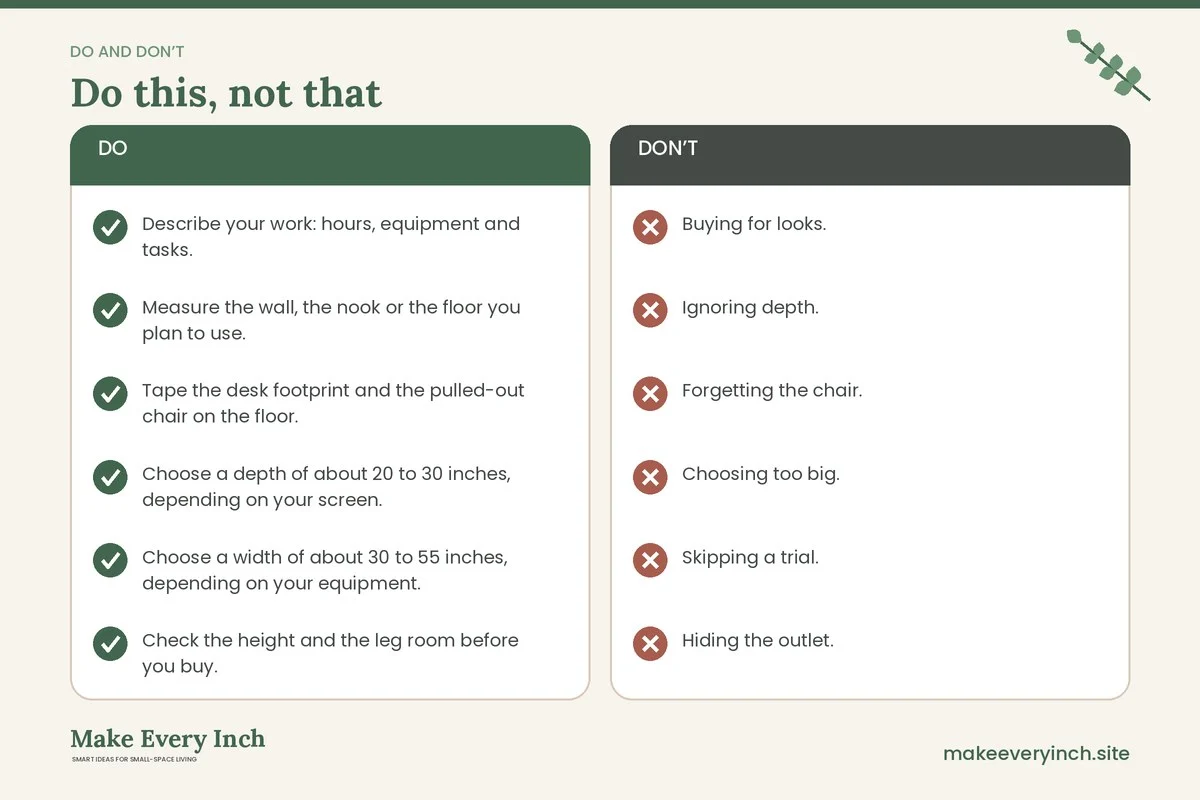
Desk selection checklist
- Describe your work: hours, equipment and tasks.
- Measure the wall, the nook or the floor you plan to use.
- Tape the desk footprint and the pulled-out chair on the floor.
- Choose a depth of about 20 to 30 inches, depending on your screen.
- Choose a width of about 30 to 55 inches, depending on your equipment.
- Check the height and the leg room before you buy.
- Confirm that the chair tucks fully under.
- Check the lease before attaching anything to a wall.
- Plan for a single power strip with a breaker, plugged into the wall.
- Route cords along the wall and keep them out of walkways.
- Place a task light to the side of the screen.
- Anchor tall furniture where allowed.
- Allow 30 to 36 inches of clear space behind the chair if people pass.
- Plan storage for papers and supplies.
- Sit at the setup for ten minutes before you commit.
FAQ
What is the best desk for a very small room?
It depends on how you work. A wall-mounted or fold-down desk saves the most floor space, a compact writing desk suits a bedroom corner and a narrow console suits a hallway. Pick the one that fits your equipment and your routine.
How deep should a small desk be?
Roughly 20 to 24 inches suits a laptop, and 24 to 30 inches suits a monitor. These are general ranges, so check your own equipment and sit at a trial setup first.
How wide should a small home office desk be?
About 30 to 36 inches works for a laptop and a notebook, 40 to 48 inches suits a monitor and a lamp, and 55 inches or more suits two screens. Choose according to what you place on it.
How do I make a chair fit under a small desk?
Measure the clear width and height under the desk, and choose a slim chair, a stool or a backless chair. Remove arms if the chair has them, and check that the seat clears the desk top.
Can I use a desk in a rental without drilling?
Yes. Freestanding desks, consoles, drop-leaf tables and rolling carts need no fixings. If you want a wall-mounted desk, get written permission from the landlord.
Is a standing desk worth it in a small space?
Some people like to alternate between sitting and standing, and a desk with adjustable height can help. It may be bulkier, so check the size and the weight, and see what suits your own comfort. This is not medical advice.
How do I stop cords from making a small desk look messy?
Use one power strip with a breaker, route cords along the wall with adhesive clips or a removable cover and keep the surface clear of extra cables. Never run cords under a rug.
Keep going: Keep planning with our pillar guide to small home office ideas, the companion post on small home office ideas in a closet and our list of the best desks for small apartments.
Save this guide for later
Pin the ideas you like to Pinterest so you can come back to them when you plan your space.