12 Small Laundry Room Shelf Ideas That Use Every Inch Safely
Quick answer: A small laundry room shelf works best when it sits where the room wastes space: above the machines, in the gap beside them, over the door or in a corner. Plan the shelf height around your detergent bottles, keep heavy items low, leave clear space around the dryer and its vent, anchor anything tall to the wall, and ask permission before you drill in a rental.
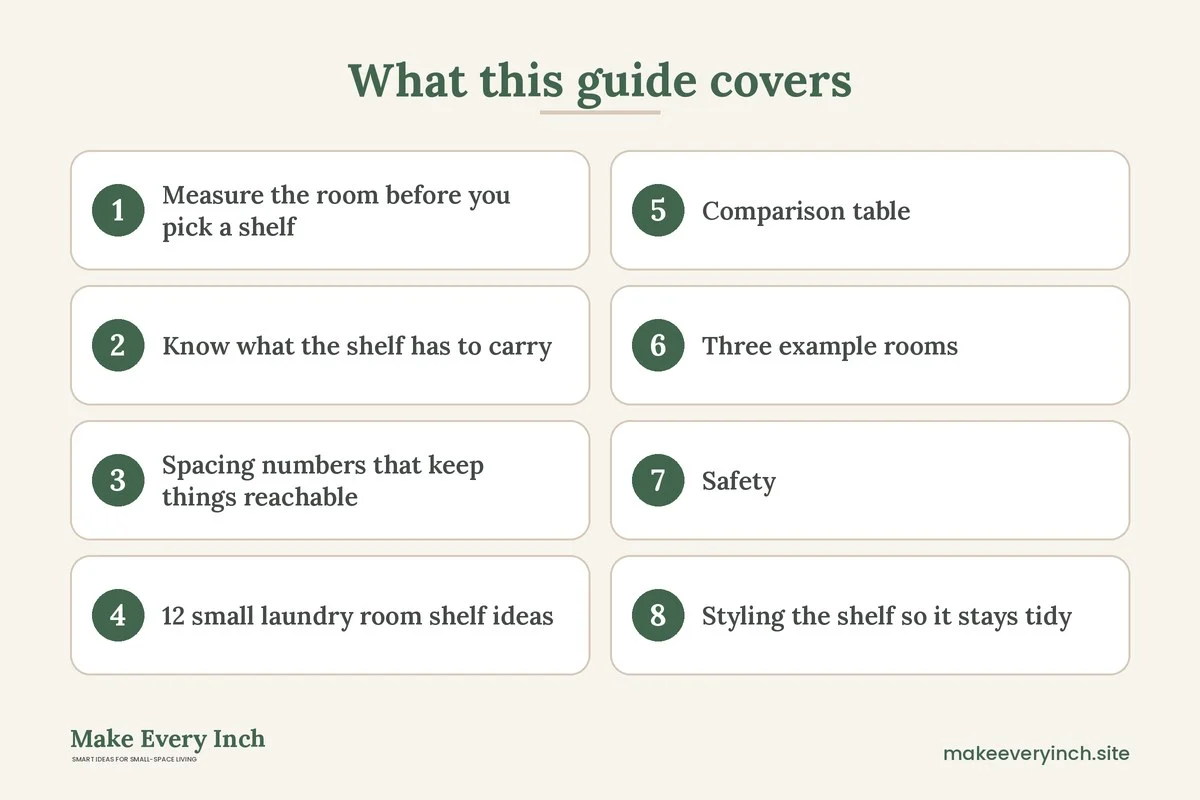
A small laundry room shelf has to do more work than almost any other shelf in the home. It holds heavy bottles, damp baskets, folded towels and cleaning products, and it sits next to machines that shake, heat up and sometimes leak. That makes the layout and the safety details matter as much as the look. This guide walks through how to measure the room, which shelf types suit which walls, the spacing numbers that keep things reachable, 12 ideas, a table that compares options, three example rooms, a safety section and a checklist. For the wider plan, read our pillar on small laundry room ideas, and for sorting what goes on the shelves, see our guide to small laundry room organization.
Measure the room before you pick a shelf
Most laundry spaces are a closet, a hallway alcove, a bathroom corner or a strip of kitchen wall. Before you shop, take five measurements and write them on your phone.
- Width of the wall above the machines. Measure from side wall to side wall, since this is the widest shelf you can fit.
- Height from the top of the machines to the ceiling. Many rooms have somewhere between 24 and 48 inches here, though yours may differ.
- Door swing and clearance. Note which way the door opens and whether the shelf will block it or the washer lid.
- Gap beside or behind the machines. Even a narrow gap can hold a slim rolling unit, but check your appliance manual for the clearance it asks for.
- Where the pipes, vent and outlets are. Mark the water shutoff valves, the dryer vent, the power outlets and any gas line, because you must keep these reachable.
Draw the wall as a simple rectangle on paper and sketch the shelves on it. A drawing takes five minutes and prevents the most common mistake, which is buying a shelf that blocks a valve or a vent.
Know what the shelf has to carry
Laundry supplies are heavier than they look. A large liquid detergent bottle can weigh several pounds when full, and a basket of wet laundry can weigh more. Group what you plan to store into three loads.
- Heavy: large detergent and softener bottles, pods in tubs, stain-treatment containers and full baskets.
- Medium: folded towels and sheets, stacks of clean clothes, cleaning supplies in small bottles.
- Light: lint-free cloths, dryer sheets, clothes pins, mesh bags, small baskets and decor.
Put heavy items on the lowest shelf, medium in the middle and light at the top. A shelf that is rated for a certain load is only as strong as its fixings, so read the weight rating on the packaging and keep your load well below it. If you do not know what a shelf can hold, treat it as a light-duty shelf.
Spacing numbers that keep things reachable
These ranges are starting points, and you should adjust them for your own bottles and your height.
- Space above the machines: keep the lowest shelf at least 12 to 18 inches above the top of the washer or dryer if the lid or a control panel opens upward. Check your manual for the lid swing.
- Shelf depth: 8 to 12 inches suits bottles and baskets without sticking out into the walkway. Deeper shelves collect clutter at the back.
- Gap between shelves: 10 to 14 inches fits most detergent bottles, and 14 to 18 inches is better for baskets. Taller bottles may need more.
- Top shelf height: keep the things you use weekly between about 30 and 66 inches from the floor, which is comfortable for most adults. Use higher shelves for rarely used items.
- Walkway: leave about 24 to 30 inches in front of the machines if you can, so you can open the doors and load the drum.
12 small laundry room shelf ideas
Shelves above the machines
1. A single shelf above the washer and dryer
One long shelf across the wall is the simplest answer. Keep the shelf clear of the dryer vent and any hot exhaust, and leave room for the washer lid to open fully. If you rent, check the lease before you drill, and see option 11 for no-drill choices.
2. Two stacked shelves with a gap for bottles
Two shelves, spaced about 12 to 14 inches apart, can hold detergent bottles on the lower one and baskets on the upper one. Place the heavier items on the lower shelf so the upper one stays lightly loaded.
3. A shelf with a hanging rod beneath
A shelf with a small rod under it turns the wall into a drip-dry spot for delicates. Keep the rod clear of the dryer vent and heat. Our companion post on small laundry room drying rack ideas covers how to dry clothes safely in a small space.
4. Open shelves with matching baskets
Baskets hide mess and let you label by task, for example stain treatments, socks and cleaning cloths. Pick baskets that are slightly narrower than the shelf so they can slide out easily.
Shelves in awkward spaces
5. A slim rolling shelf in the gap
A narrow rolling unit can slide into a gap between the machine and the wall. Check your manual for the clearance the appliance needs for airflow and vibration, and keep the cart from touching the machine while it runs. Lock the wheels when it is parked. Never wedge anything behind a dryer, because lint and heat build up in tight spaces.
6. A corner shelf
Corners are often wasted. A corner unit uses that dead space, and it works well for cleaning tools and light items. Anchor it to the wall if it is tall, and keep heavy items low.
7. An over-the-door shelf unit
An over-the-door organizer adds storage without drilling. Check the door thickness, and test the door for smooth closing before you load the pockets. Keep heavy bottles off, since extra weight can strain the door and the hinges.
8. A ladder or leaning shelf
A leaning ladder shelf stands on the floor and rests against the wall. It is easy to move, but tall units can tip. Place a wall strap or anchor to hold it, and ask your landlord before you fix it to the wall.
Shelves with a specific job
9. A fold-down shelf for folding clothes
A fold-down shelf gives you a folding surface only when you need it. Look for a shelf that locks open, and follow the maker’s weight rating. Mount it into studs or with rated anchors, and only with permission.
10. A shelf with hooks for the iron and board
A shelf with hooks beneath keeps the iron, spray bottle and small items in one spot. Store the iron when it is fully cool, and keep its cord away from the edge so nobody pulls it down.
11. A no-drill tension pole shelf
Floor-to-ceiling tension poles with shelves can hold light and medium items without drilling. Check the weight rating and the ceiling type. Tension units are generally best for lighter loads and for rooms where the ceiling is smooth and solid, and they are not a good choice for heavy bottles.
12. A locked high shelf for chemicals
Put bleach, stain removers and concentrated cleaners on a high shelf with a lid, a latch or a lockable cabinet door. This is safest if you share the home with children or pets. Store each product in its original container, with the label facing out.
Comparison table: which shelf for which wall
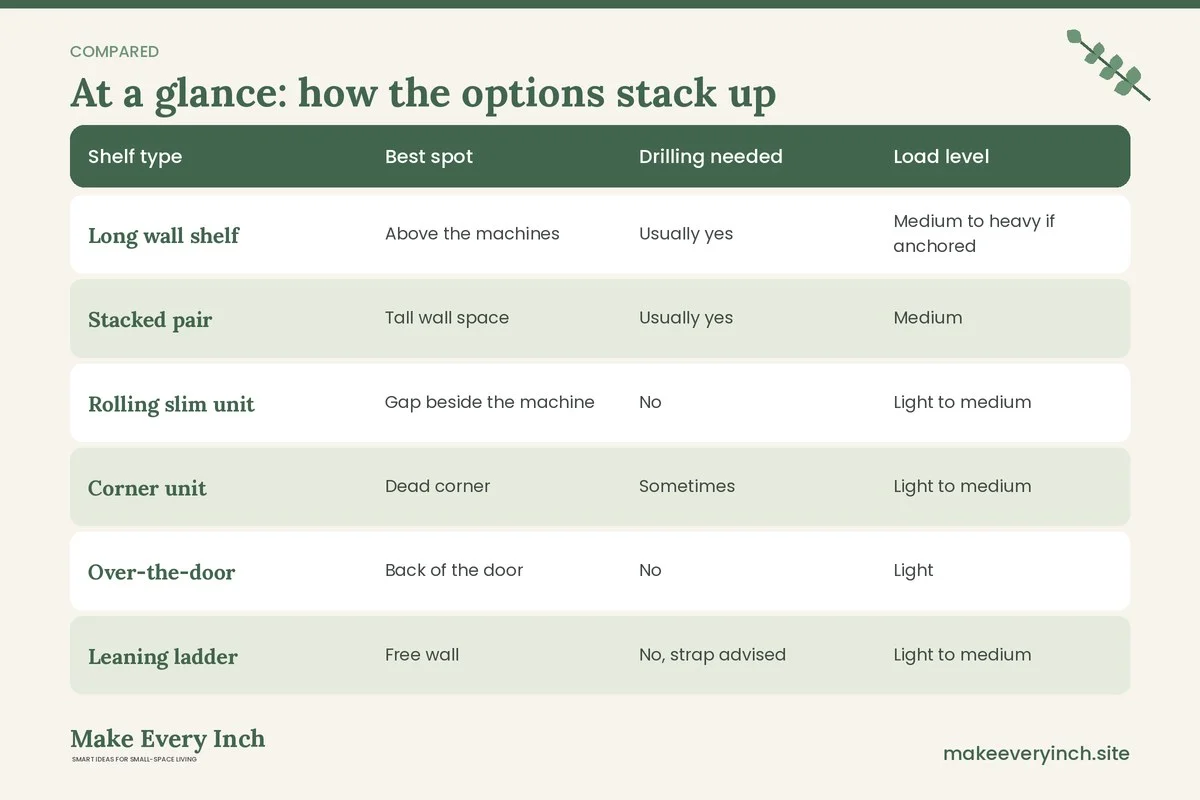
| Shelf type | Best spot | Drilling needed | Load level | Main caution |
|---|---|---|---|---|
| Long wall shelf | Above the machines | Usually yes | Medium to heavy if anchored | Keep clear of vent and lid swing |
| Stacked pair | Tall wall space | Usually yes | Medium | Heavy items on the lower shelf |
| Rolling slim unit | Gap beside the machine | No | Light to medium | Check clearance and lock wheels |
| Corner unit | Dead corner | Sometimes | Light to medium | Anchor if tall |
| Over-the-door | Back of the door | No | Light | Do not overload the door |
| Leaning ladder | Free wall | No, strap advised | Light to medium | Can tip if loaded unevenly |
| Fold-down shelf | Wall near machines | Yes | Light | Lock it open and use rated fixings |
| Tension pole | Floor-to-ceiling gap | No | Light | Not for heavy bottles |
| Locked cabinet | High wall | Yes | Medium | Keep chemicals in original containers |
Three example rooms
Room 1: a closet laundry, 36 inches wide
A stacked washer and dryer sits in a hall closet with the door removed or folded. There is about 40 inches of space above the unit. The best plan is one sturdy shelf about 12 to 16 inches above the top of the stacked unit and a second, lighter shelf near the top. The lower shelf holds detergent and a small basket of stain treatments. The upper one holds towels and spare sheets. A hook on the inside of the door holds a mesh bag. Because the stack is tall, check the manual for the weight and the stacking kit, and make sure the machines are secured, as the vibration from a stacked pair can loosen shelves over time.
Room 2: a bathroom corner with a washer
A single washer fits beside the sink in a bathroom, and the room has a window. The space above the washer is the only free wall. Use a narrow shelf above the machine and a ladder shelf in the corner, both kept clear of the splash zone from the shower or sink. Make sure any power outlet near water is protected by a GFCI, which is the type with test and reset buttons. Do not store plug-in appliances next to water. Use the shelf for towels, a hamper and a small basket of cleaning supplies, and keep the room ventilated by running the fan when you do laundry.
Room 3: a kitchen alcove, front-loading pair
A side-by-side washer and dryer sits at the end of a galley kitchen with a bare wall above. A single long shelf can hold baskets and detergent, and a rolling cart can slide in the gap on the side. Because the room doubles as a kitchen, keep the laundry chemicals on a high shelf away from food and out of reach of children. Our guide to small kitchen storage ideas has more ways to keep the two zones separate.
Safety: read this before you install anything
A laundry room has more risks than most rooms, so build the safety checks into the plan.
Dryer clearance, lint and fire risk
A dryer produces heat and lint. Lint buildup is a known fire risk, so keep shelves and storage clear of the dryer, its exhaust and the vent hose. Check your manual for the clearance it recommends at the sides, back and top, and leave at least that much. Do not store cloths, paper, aerosol cans or cleaners on top of or directly behind a dryer. Clean the lint trap after every load, and have the vent duct checked and cleaned on a regular schedule. If the vent hose is crushed or kinked, call a qualified person.
Venting rules
Dryers should vent outdoors through a proper duct, and local codes set rules on the type of duct and the length. Do not block the vent, and do not route it into a closet or behind a shelf. If you are not sure what applies in your home, ask your landlord, building manager or a licensed professional.
Water leaks and shutoff valves
Keep the washer’s water valves, hoses and drain easy to see and reach. Shelves should never block the valves. A hose that bulges, drips or looks worn should be reported or replaced. If you can, place a tray or leak sensor under the machine. Keep paper goods and cardboard off the floor in case of a leak.
GFCI and electrical safety
An outlet near water should have ground-fault protection, often called a GFCI. Do not run an extension cord across a wet floor, and do not overload a power strip with a dryer, iron and other heat-producing appliances. If an outlet trips often or feels warm, stop using it and call an electrician.
Weight, vibration and stacked units
Washers shake during the spin cycle, and a stacked pair can vibrate the wall. Shelves attached to a thin partition wall can shift. Do not rest a shelf on the machines unless the manual says it is fine, and avoid putting heavy items on top of a stacked unit.
Anchor tall shelves
Any shelf taller than your waist should be anchored to the wall with a strap or a bracket rated for the load. Anchoring prevents tipping, which is a hazard for children and pets. Use the right anchor for the wall type, such as a stud, a masonry anchor or a toggle for hollow walls.
Chemicals, children and pets
Keep cleaners and detergents in their original containers, with labels. Never mix cleaning products, especially bleach with ammonia or acids, because the fumes can be dangerous. Store pods and concentrated products high or locked away from children and pets. Keep the room ventilated when you use strong products.
Rentals and permission
If you rent, read the lease and ask in writing before you drill. Take photos of the walls first. Many of the shelves above need no drilling, so start there. For more ideas, see our guides to no-drill storage ideas for renters and renter-friendly shelving.
Styling the shelf so it stays tidy
A laundry shelf looks best when it has a small set of rules.
- Decant carefully. Decanting detergent into a jar looks neat, but only do it if you label the jar clearly and keep the original instructions. Do not decant cleaners into food containers.
- Label by task. Use labels such as delicates, stain care, socks and cloths.
- Use one color family for baskets. Matching baskets calm the look of a busy wall.
- Leave one empty zone. A bare 4 to 6 inch space on each shelf stops the area from filling with clutter.
- Add a small plant only if the room has light and no heat. Keep it away from the dryer, and do not place water-filled containers above the machines.
If you want more ideas for storage in nearby rooms, our guides on small space organization ideas and small bathroom ideas share many of the same principles.
Budget and phasing
You do not need to do everything at once. Start with a plan for the cheapest, safest change, which is usually a rolling unit or an over-the-door organizer. Live with it for a few weeks and see what you use. Then add one sturdy wall shelf above the machines, if the lease allows it. Check second-hand sources for shelves, but inspect the brackets and the finish. For more low-cost ideas, read our post on budget small space ideas.
Common mistakes
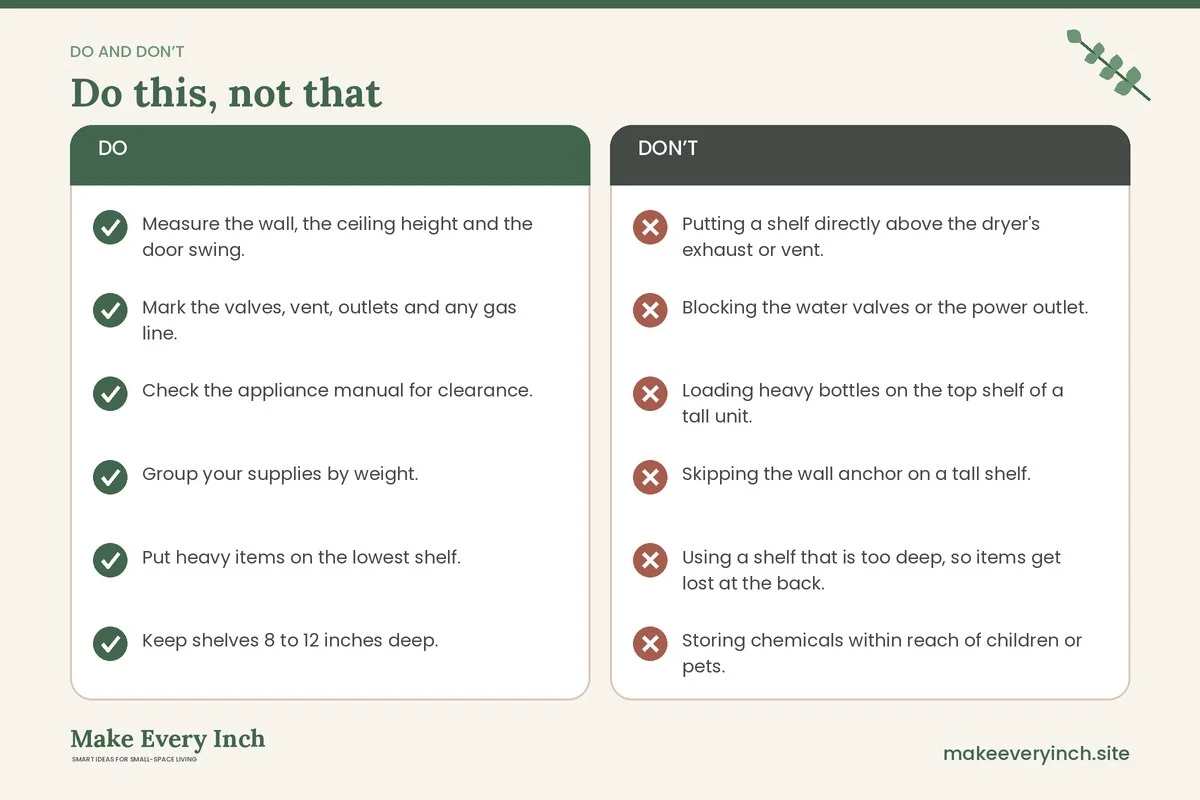
- Putting a shelf directly above the dryer’s exhaust or vent.
- Blocking the water valves or the power outlet.
- Loading heavy bottles on the top shelf of a tall unit.
- Skipping the wall anchor on a tall shelf.
- Using a shelf that is too deep, so items get lost at the back.
- Storing chemicals within reach of children or pets.
- Drilling in a rental without asking.
- Ignoring the manual’s clearance numbers.
Shelf checklist
- Measure the wall, the ceiling height and the door swing.
- Mark the valves, vent, outlets and any gas line.
- Check the appliance manual for clearance.
- Group your supplies by weight.
- Put heavy items on the lowest shelf.
- Keep shelves 8 to 12 inches deep.
- Space shelves 10 to 14 inches apart for bottles.
- Anchor tall units to the wall.
- Keep chemicals high, closed and in original containers.
- Never mix cleaning products.
- Confirm that outlets near water have GFCI protection.
- Get permission before you drill.
- Clean the lint trap and check the vent after each load.
FAQ
What is the best small laundry room shelf for a tiny space?
A single sturdy wall shelf above the machines suits most rooms, and a slim rolling unit works for a gap. Choose according to where your free wall or floor space is.
How high above the washer should the shelf be?
Leave enough room for the lid or door to open, often 12 to 18 inches above the top of the machine, and check your manual. A taller gap is more comfortable for loading and reaching.
Can I put a shelf directly above a dryer?
You can often fit one above the dryer, but keep it clear of the vent and check the manual for the clearance it asks for. Do not store flammable items or cloths close to the heat.
How much weight can a laundry shelf hold?
It depends on the shelf, the bracket and the wall. Read the rating on the packaging, stay well below it and keep heavy items low. If unsure, treat the shelf as light duty.
What can I use in a rental where I cannot drill?
Try a rolling unit, an over-the-door organizer, a ladder shelf with a strap you have permission to use, or a tension pole shelf for light items. See our guide to renter-friendly apartment decorating ideas for more.
Is it safe to store detergent above the washer?
It is usually fine if the shelf is secure and the bottles are closed. Keep them out of reach of children and pets, keep them in their original containers, and wipe up any drips.
Keep going: Keep planning with our small laundry room ideas pillar, the companion guide to small laundry room drying rack ideas and our tips on small closet ideas.
Save this guide for later
Pin the ideas you like to Pinterest so you can come back to them when you plan your space.