Small Living Room TV Wall Ideas Renter Friendly: 15 Deposit-Safe Plans
Quick answer: The best small living room tv wall ideas renter friendly plans keep the screen on a stand, console or floor mount that needs no drilling, then build the look around it with leaning art, plug-in lights, tension poles, fabric and freestanding shelves. If you do want a wall mount, read the lease first, ask in writing, choose the smallest repair, and follow the TV and mount instructions. Photograph the wall before and after to protect your deposit.
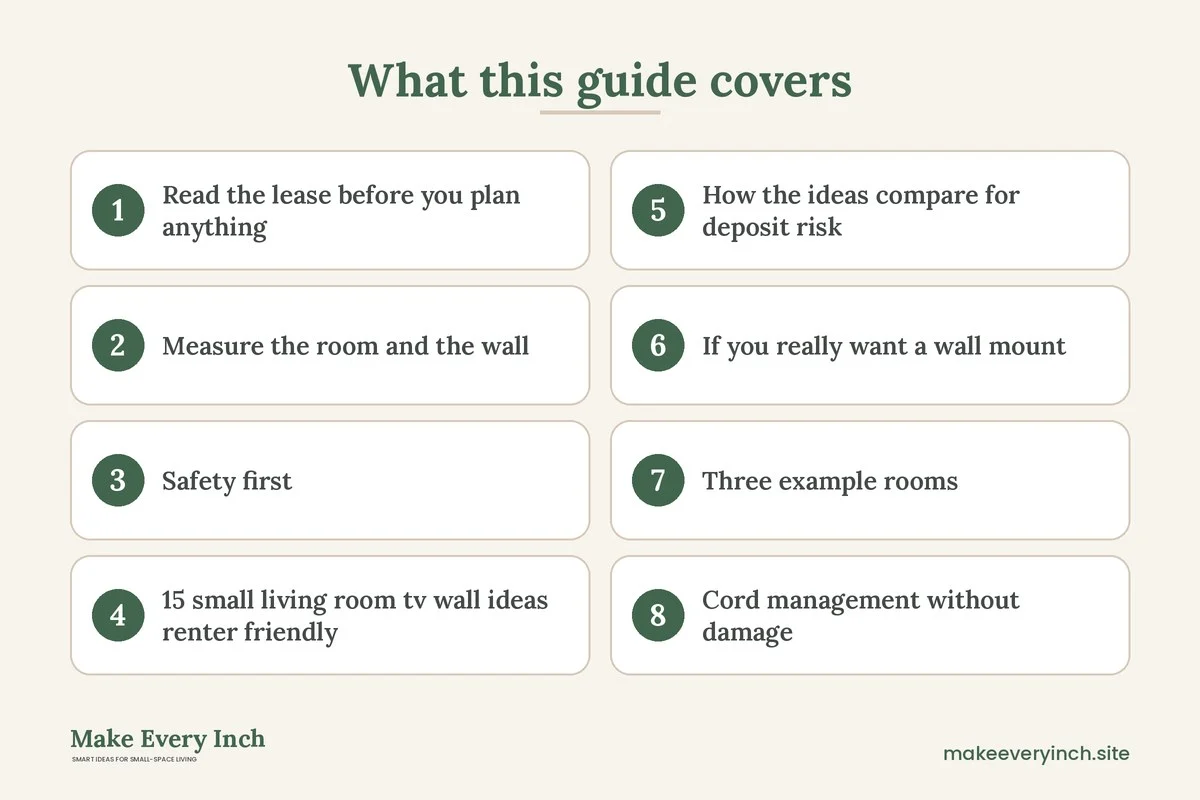
Small living room tv wall ideas renter friendly plans have to solve two problems at once. The room is small, so the TV wall carries a lot of visual weight, and the home is not yours, so every hole is a possible deduction from your deposit. The usual advice, which is to mount the screen on the wall and hide the cords inside it, is exactly the advice a lease tends to forbid. This guide takes a different route. It starts with what the lease may allow, shows how to check your wall, then walks through 15 ideas that range from fully no-drill to low-damage, with a risk table, measurements for height and viewing distance, tip-over safety rules, cord tricks, three example rooms, a move-out routine and a checklist. For the wider picture, read our parent guide on small living room tv wall ideas, the pillar post on small living room ideas and our rental-focused guide to small living room ideas for renters.
Read the lease before you plan anything
Every rental agreement is different, and this guide is not legal advice. What it can do is show you what to look for so that you ask the right questions. Read the sections on alterations, wall damage, nails and screws, adhesives, painting and the condition of the home at move-out. Rules vary a lot by building, landlord and region.
What to look for
- Nail and screw language. Some leases allow small holes for pictures but not for anything heavy. Some ban all holes. Some allow a TV mount if you repair the holes at move-out.
- Adhesive language. A few leases ban tape and strips because they can pull paint. Others allow removable products.
- Painting rules. Painting a wall may need written consent, and you may have to repaint before you leave.
- Normal wear and tear. Many places treat a few tiny pin holes as normal wear, but a large or repeated hole may not count. The line differs from place to place.
- Deposit rules. Check how the deposit is handled and how disputes work, and keep any inspection report.
Ask in writing
If a mount would make your living room much better, ask the landlord or property manager in an email. Describe exactly what you want: the TV size, the number of holes, the spot, and your offer to repair them. A written yes protects you later, and a written no saves you from a costly mistake. Keep a copy. If the answer is vague, treat it as a no and use a no-drill plan.
Photograph the wall
Before you do anything, take dated photos of the TV wall, the outlets, the baseboard and the floor. Include a close-up of any marks that are already there. Take another set when you move out. Photos are the best evidence in a deposit dispute.
Measure the room and the wall
Renting means you may move again, so choose pieces that fit this room and the next one. Take these numbers.
- Screen center height: about 40 to 44 inches from the floor, near seated eye level. If the TV is on a stand, the top of the stand sets this height, so aim for a stand or console top at roughly 18 to 24 inches for a mid-size screen, and check the screen’s own base height.
- Viewing distance: a rough guide is about 1.5 to 2.5 times the screen’s diagonal for relaxed viewing. In a small room, 5 to 8 feet is common. A 43 inch screen suits about 5 to 7 feet, and a 55 inch screen suits roughly 6 to 9 feet.
- Stand width: the stand should be at least as wide as the TV’s feet, or the TV’s base, and many people choose a stand 4 to 8 inches wider than the screen for a stable look.
- Console depth: 12 to 16 inches suits most small rooms, and the TV’s base must fit within it with a little spare room.
- Walkway: keep 30 to 36 inches clear in the main path, and at least 24 inches in a side path.
- Outlet reach: measure from the TV position to the nearest outlet, and check that the cord is long enough without a stretched run across the floor.
- Door and window swing: make sure a door can open fully and that no window sits behind the screen where it will cause glare.
Tape the footprint of the stand on the floor and sit on the sofa. If the screen feels too big or too close, choose a smaller stand or push the sofa back.
Safety first: stands, straps and tip-over risks
A TV is heavy and top-heavy, which is why stands and consoles can tip. In a rental you may rely on furniture more than on the wall, so the safety steps matter even more.
- Follow the TV and furniture instructions. The manual shows how to attach the base, the weight limit and the correct screws.
- Check the weight rating. The stand or console must carry the TV with room to spare. If the furniture has no rating, choose a sturdy piece with a solid top and legs, and do not guess.
- Use anti-tip hardware. Many TVs and consoles include straps or brackets for securing them to the wall. If anchoring means a hole, use the smallest hole, ask the landlord, and repair it at move-out. If you cannot anchor, choose a low, wide, stable piece and keep it away from places where children or pets might pull on it.
- Keep the center of gravity low. A low console is steadier than a tall one. Place heavy items on the lower shelf.
- Do not place the TV on a bench with wheels. If you use a cart, lock the wheels.
- Keep it level. A wobbly stand on a soft rug is risky. Use a firm, flat surface.
- Watch the cords. Do not let power cords hang where a child or pet could pull them.
- Ask for help. Lift a large screen with two people.
If you use a wall mount, follow the mount and TV instructions, find the studs, and use hardware rated for the load. If you are unsure about the wall, ask a professional. Never mount a TV with adhesive only.
15 small living room tv wall ideas renter friendly
No-drill stands and floor setups
1. A low console with a dark wall color on paper
Choose a low, solid console and place the TV on it. For the wall, use removable products, such as a large peel-and-stick panel or a framed canvas leaning behind the screen. A console gives you storage for cords and boxes, and it costs nothing to the wall. See our guide to removable wallpaper ideas before you buy a panel, and test it on a hidden spot.
2. A floor stand with a pole
A freestanding floor stand has a base that rests on the floor and a pole that holds the screen at eye height. It does not touch the wall. It suits small rooms because the base is narrow, and you can move it when you move. Follow the assembly instructions, check the weight rating and keep the base clear of foot traffic.
3. A TV on a bench with baskets
A wide bench with baskets below the screen gives you a relaxed look and storage for remotes and games. Make sure the bench is sturdy, and strap it if it is light. Add a plant on one end to soften the black screen.
4. A corner TV stand
A triangular or corner stand tucks the TV into an unused corner and frees the main wall for a shelf or art. It works well in a small room where the wall is broken by doors and windows. Keep the angle toward the sofa within a comfortable range, and avoid placing it where sunlight causes glare.
5. A rolling cart for flexibility
A cart with locking wheels lets you move the TV to face the sofa or hide it in a corner. It suits studios and shared spaces. Lock the wheels when in use, and choose a cart with a flat shelf and a lip around it.
Low-damage and removable wall ideas
6. A tension pole shelf beside the screen
A floor-to-ceiling tension pole with shelves stands beside the TV and holds plants, books and a lamp. It presses against the ceiling and floor, so there is nothing in the wall. Check the pole’s rating and the ceiling type, since some ceilings are too soft for pressure. Use a pole only for light items, and never for the TV itself.
7. Leaning art and a leaning mirror
A large piece of art or a floor mirror leans on the wall beside the screen. The piece frames the TV, and you can swap it whenever you like. Anchor tall mirrors with the hardware that comes with them if the lease allows it, or place a felt pad under the base to keep it from sliding, and keep it where a person will not bump it.
8. A fabric panel or curtain behind the TV
A wide curtain hung from a tension rod across an alcove, or a fabric panel leaned in a frame, softens the wall behind the screen. A neutral fabric hides marks and echoes the sofa. Keep the fabric away from heat vents and from the back of the TV, so air can circulate.
9. A plug-in sconce pair
Two plug-in wall sconces, one on each side of the screen, add light and symmetry. Choose a model with a cord cover that you can paint the wall color, or with a stick-on channel. If the lease bans screws, pick a version that hangs from a single hook rated for the weight, or a stand-alone lamp instead.
10. Adhesive-hung frames in a small group
Hang a few lightweight frames beside the TV using removable strips, following the weight chart on the package. Keep them well above the console, and test a strip on a hidden spot first. Strips can pull paint from fresh or flat walls, so wait until paint has cured, and remove them slowly. Our guide to renter friendly wall decor ideas covers strips in detail.
Cord, light and storage ideas
11. A cord raceway with removable adhesive
A small raceway runs from the TV to the outlet and hides the cords. Use one with a removable adhesive, and paint it the wall color only if the lease allows. Test it on a hidden spot, and remove it slowly with a hair dryer when you leave.
12. A bias light on the back of the screen
An LED strip stuck to the back of the TV glows on the wall behind it and reduces eye strain. It leaves no mark on the wall at all. Keep the strip away from vents and hot parts.
13. A freestanding ladder shelf
A leaning ladder shelf stands against the wall without a screw, and holds books, baskets and a lamp beside the TV. Choose one with a wide base and a rubber foot. Do not put heavy items on the top rung, and do not let children climb on it.
14. Storage ottomans and baskets for media
A storage ottoman or a basket keeps controllers, cables and streaming boxes out of sight. It also doubles as a seat. See our guide to the best storage ottomans for what to look for.
15. A room divider as a backdrop
In a studio, a folding screen or a bookcase placed behind the TV stand turns the area into a media nook and hides the bed or the entry. Anchor tall units with the supplied hardware, and make sure the TV’s stand is separate from the divider.
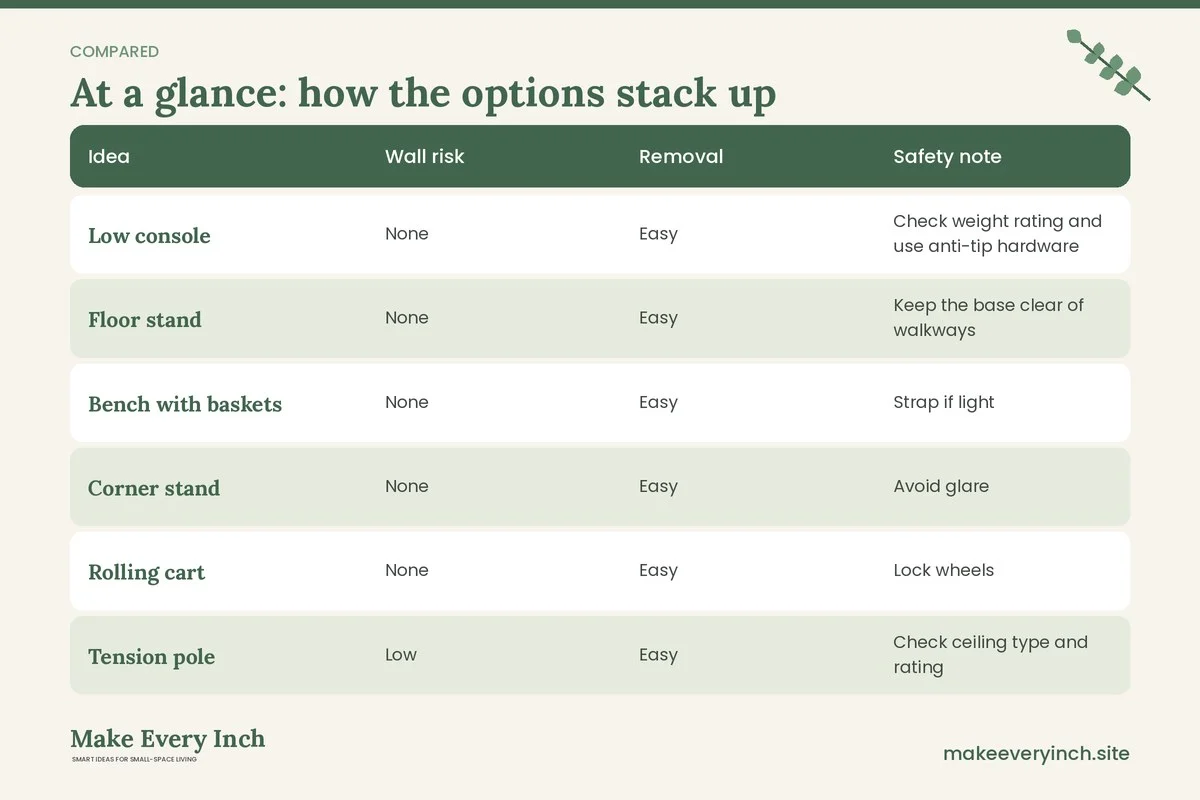
How the ideas compare for deposit risk
The table below ranks each idea by how likely it is to affect the wall, how easy it is to remove and what to check. Risk levels are general, and you should still read your lease.
| Idea | Wall risk | Removal | Safety note |
|---|---|---|---|
| Low console | None | Easy | Check weight rating and use anti-tip hardware |
| Floor stand | None | Easy | Keep the base clear of walkways |
| Bench with baskets | None | Easy | Strap if light |
| Corner stand | None | Easy | Avoid glare |
| Rolling cart | None | Easy | Lock wheels |
| Tension pole | Low | Easy | Check ceiling type and rating |
| Leaning art | None | Easy | Keep stable |
| Fabric panel | Low | Easy | Keep away from heat |
| Plug-in sconce | Low | Easy | Hide the cord |
| Adhesive frames | Medium | Careful | Follow the weight chart |
| Cord raceway | Medium | Careful | Test first |
| Bias light | None | Easy | Keep away from heat |
| Wall mount | High | Repair needed | Ask the landlord, follow instructions |
If you really want a wall mount
Sometimes a wall mount makes the room work, especially where the floor space is tight. It is not always forbidden, but it needs care. Here is a sensible route.
Ask first, offer to repair
Send a written request that says where the mount will go, how many holes it needs, and that you will repair them. Many landlords agree when they see a plan. Some prefer to do the work themselves, or to use their own contractor, and that is fine.
Choose the smallest footprint
A fixed, low-profile mount uses fewer holes than a large articulating arm. Pick the simplest type that does the job, with a weight rating well above your TV. Check that the mounting pattern fits your TV, as the manual explains.
Mount safely
Find the studs, and follow the mount and TV instructions. Use the screws supplied, and do not substitute. Use a level. If the wall is plaster or masonry, or if you cannot find a stud, ask a professional rather than guessing. A fall can injure someone and damage the home.
Repair at move-out
Small holes can often be filled with spackle, sanded and touched up, if the lease allows it. Match the paint, and use the landlord’s color if they have supplied it. Photograph the repair. If you are not confident, ask the landlord if they prefer to handle it, and ask how they handle the cost.
A middle path
If the landlord says no, put the TV on a floor stand or a console and add the wall styling from the ideas above. Many small rooms look better this way, since a low console grounds the room and gives you storage.
Three example rooms
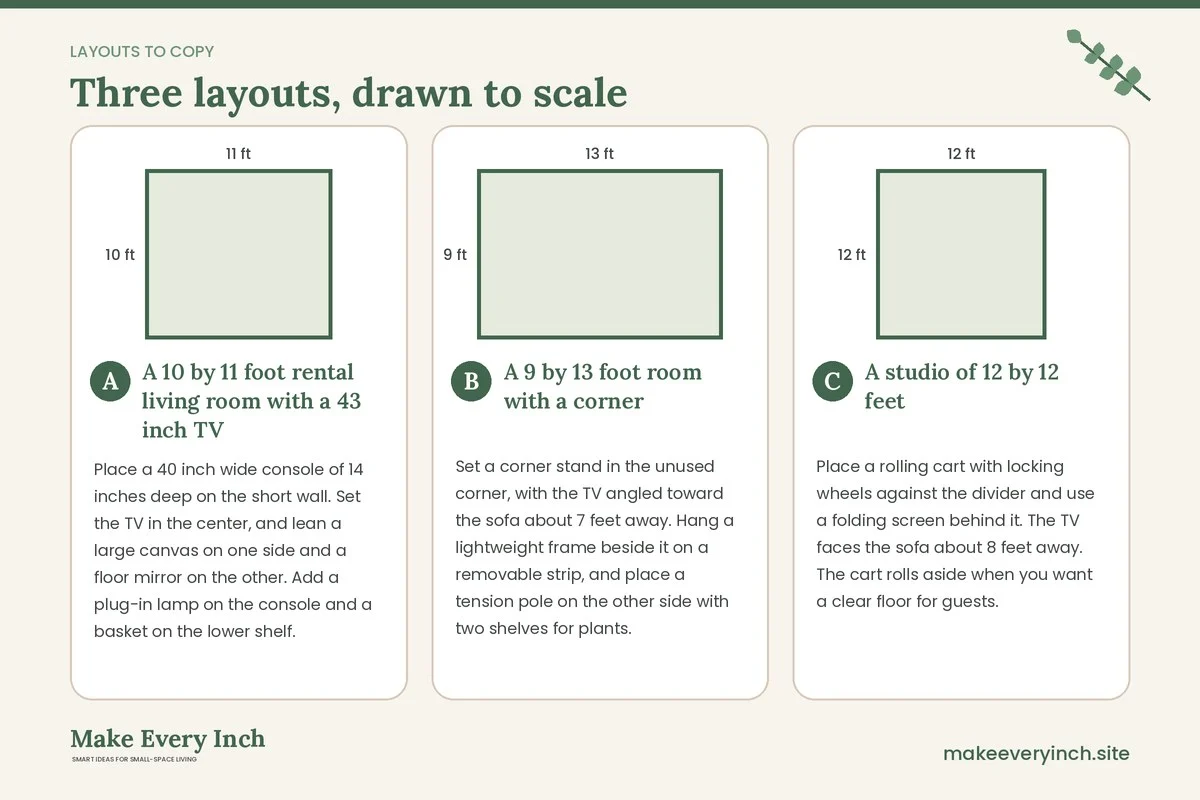
A 10 by 11 foot rental living room with a 43 inch TV
Place a 40 inch wide console of 14 inches deep on the short wall. Set the TV in the center, and lean a large canvas on one side and a floor mirror on the other. Add a plug-in lamp on the console and a basket on the lower shelf. The sofa sits about 6 feet from the screen. The walkway stays at 36 inches. There is no drilling, and the whole setup moves with you.
A 9 by 13 foot room with a corner
Set a corner stand in the unused corner, with the TV angled toward the sofa about 7 feet away. Hang a lightweight frame beside it on a removable strip, and place a tension pole on the other side with two shelves for plants. A rug of 5 by 8 feet sits under the sofa front. The long wall stays free for a bookcase.
A studio of 12 by 12 feet
Place a rolling cart with locking wheels against the divider and use a folding screen behind it. The TV faces the sofa about 8 feet away. The cart rolls aside when you want a clear floor for guests. A bias light and a small lamp give the nook a soft glow at night. When you move, everything folds, rolls or lifts away.
Cord management without damage
Cords are the biggest mess on a TV wall, and fixing them does not need a drill. Label each cord at both ends. Group them with reusable ties and run them along the back of the stand. Place a power strip with surge protection behind the console, off the floor. A removable cord cover hides the line between the TV and the outlet, and a cord clip keeps the loose ends tidy. Use only products made for the purpose, and do not run mains cords through the wall. Leave a little slack so you can pull out the TV without yanking the cords. Keep power cords away from heat and out of reach of children and pets. When you move, peel the cord covers slowly, and clean any residue with a damp cloth.
Styling a TV wall you cannot paint
If the lease bans paint, you can still shape the wall. Use a large rug on the floor to define the zone. Lean a tall piece of art beside the screen, and hang a curtain on a tension rod to soften a bare wall. Place plants at different heights, and add a lamp so the screen is not the only light. A peel-and-stick panel, if allowed, gives you a feature wall for a short time. Choose a color that suits the sofa and the rug. Keep the console top styled with an odd number of items, and keep the area clear so that the TV does not feel crowded. If you want more ideas, read our guide to renter-friendly apartment decorating ideas.
Glare, light and screen position
A small room often has one window, and the TV may end up opposite or beside it. Glare is the main problem. Place the screen at a right angle to the window, not in front of it. Use curtains or blinds to cut reflections in the afternoon. Avoid a bright lamp facing the screen. A dark, matte background behind the TV helps, and a bias light reduces eye strain. Check the glare at different times of day before you commit to a position, and move the sofa if you can. If the TV must sit between two windows, choose a matte screen and use blackout curtains for evening viewing.
Mistakes renters make
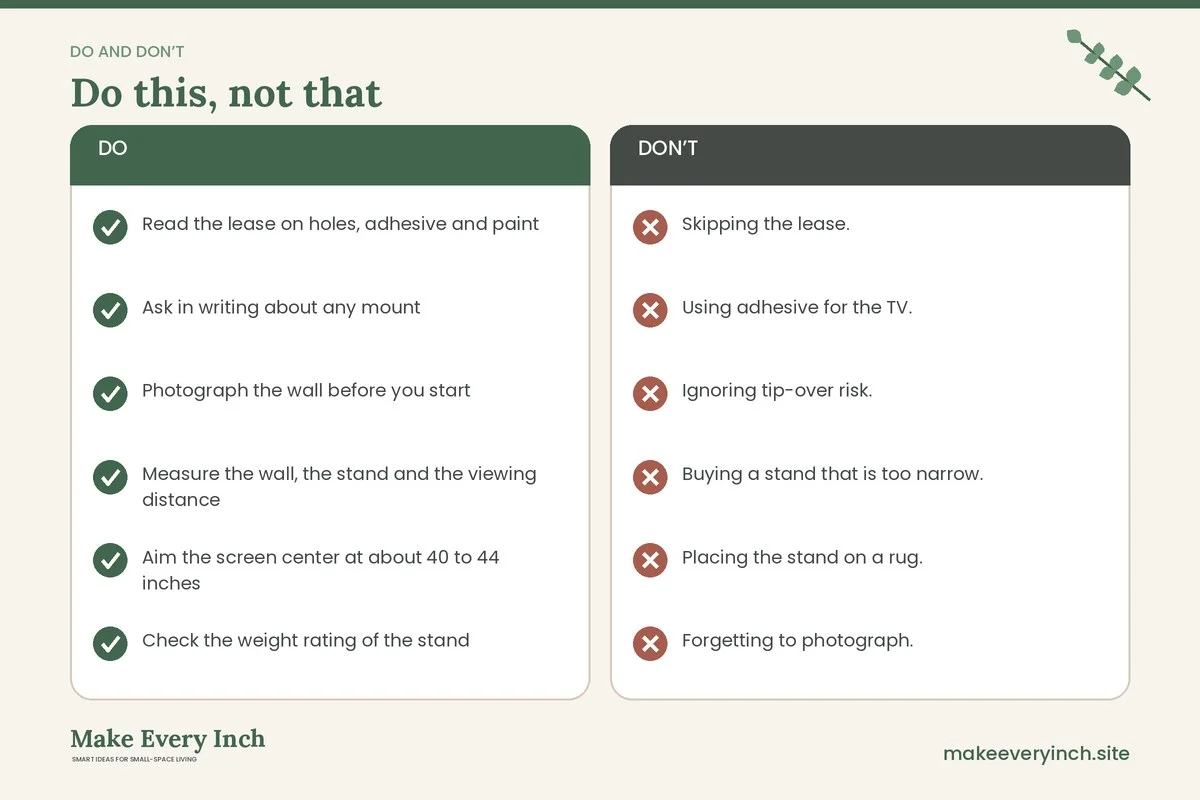
- Skipping the lease. A single hole can cost more than the stand you avoided.
- Using adhesive for the TV. Adhesive is for light items only, not for a screen.
- Ignoring tip-over risk. A stand without straps can fall, especially with children or pets.
- Buying a stand that is too narrow. The TV’s feet must sit fully on the top.
- Placing the stand on a rug. A soft rug makes the stand wobble.
- Forgetting to photograph. Take photos before you start and after you finish.
- Pulling strips straight out. Peel slowly and parallel to the wall.
- Choosing pieces that will not fit the next place. Pick items that suit different rooms.
Move-out routine
A week before you leave, remove the strips and cord covers slowly, using a hair dryer on low heat to soften the adhesive. Wipe residue with a damp cloth. Fill any approved holes, and touch up the paint if the lease allows. Take photos of the wall, the floor and the outlets. Clean the area, and pack the TV in its original box if you still have it, or in blankets. Keep your photos and your written permissions together with the inspection report. Then compare the final state against your first photos.
Weekend plan
Saturday
Read the lease, take photos, and measure the wall and the room. Decide whether you will ask about a mount. Choose a stand or console that fits the measurements and the weight rating.
Sunday
Set up the stand and the TV following the instructions, add the anti-tip hardware, run the cords, and style the top. Add a lamp and a leaning piece of art. Sit on the sofa and check the height and the distance.
Checklist
- Read the lease on holes, adhesive and paint
- Ask in writing about any mount
- Photograph the wall before you start
- Measure the wall, the stand and the viewing distance
- Aim the screen center at about 40 to 44 inches
- Check the weight rating of the stand
- Use anti-tip hardware as instructed
- Test any adhesive on a hidden spot
- Hide cords with removable covers
- Keep the walkway at 30 to 36 inches
- Remove adhesive slowly at move-out
- Photograph the wall again when you leave
FAQ
Can I mount a TV in a rental?
Maybe. It depends on the lease and the landlord. Ask in writing, offer to repair the holes, and follow the TV and mount instructions. If the answer is no, use a stand, a console or a floor stand.
How do I hang a TV without drilling?
Do not hang a TV with adhesive. A screen is heavy, and adhesive is not meant to carry it. Use a stand, a console, a cart or a floor-standing mount that needs no holes.
What is the best no-drill option for a small living room?
A low, narrow console is usually the simplest, and a floor stand saves floor space. Choose according to your room and the weight of the TV.
How high should the TV be if it sits on a stand?
Aim for the center of the screen at about 40 to 44 inches from the floor. Check the stand height and the screen base, and adjust until it is near seated eye level.
How far should I sit from the TV?
A rough guide is about 1.5 to 2.5 times the screen’s diagonal, so 5 to 8 feet in many small rooms. Adjust to your own comfort.
Are adhesive strips safe on rental walls?
They can be, on cured, smooth paint, for light items. They may pull paint on fresh or flat walls. Test first and remove slowly. Check the lease, as some ban them.
How do I stop a stand from tipping?
Use a wide, low piece, follow the anti-tip instructions and place heavy items on the bottom. Anchoring may need a small hole, so ask your landlord first.
Will small holes cost me my deposit?
It depends on the lease and the local rules. Some treat tiny holes as normal wear and tear, and others charge for repairs. Ask in writing and keep photos.
How do I hide cords in a rental?
Use removable cord covers, ties and a power strip behind the stand. Do not cut into the wall or run mains cords inside it.
Can I paint the wall behind the TV?
Only if the lease allows it. Otherwise use a leaning canvas, a curtain on a tension rod or a removable panel, after testing a hidden spot.
Keep going: Keep planning with our no-drill storage ideas for renters, security deposit safe apartment upgrades and renter friendly lighting ideas.
Save this guide for later
Pin the ideas you like to Pinterest so you can come back to them when you plan your space.