15 Renter-Friendly Furniture Ideas for Small Spaces
Quick answer: Good renter friendly furniture small spaces plans pass four tests: it fits through your doors and stairs, it protects the floor, it needs nothing from the walls and it moves again in a few pieces. Favor legged, light-scale pieces, modular units, folding or nesting items and furniture that stands without a wall fixing. Measure first, anchor tall pieces only with permission and keep walkways at 30 to 36 inches.
Renter Friendly furniture small spaces is a two-part problem. The room is small, so every piece must earn its footprint. The home is rented, so every piece must also cope with strict floors, bare walls, narrow stairwells and the certainty that you will move again. Most furniture advice covers only the first part. This guide adds the second, with a four-part test you can apply to any piece before you buy, 15 ideas sorted by what they solve, a table of footprints, three example rooms, safety notes and a moving-day plan. For the wider approach to a rented home, read our hub on renter-friendly apartment decorating ideas, and for room-by-room picks, see our guide to the best furniture for small apartments.
The four-part rental furniture test
Run each piece through four questions. A piece that fails one is not wrong, but you should know why you are accepting the risk.
1. The door test
Rental buildings often have narrow hallways, tight turns and older doors. Measure the narrowest door, hallway and stair turn on the route from the street to the room. A common interior door opening is around 28 to 32 inches wide, and some older buildings are narrower. Check the diagonal depth of a sofa, because many pass through a door only when tipped on end. A piece that arrives in sections, such as a modular sofa or a bed with a slatted base, solves most of this. Also note whether the lift or stairs have a turn or a low ceiling.
2. The floor test
Floors are among the most expensive things to damage in a rental, so protect them. Look under the piece: wooden or felt-padded feet spread weight, while bare metal or plastic edges scratch. Add felt pads on every leg and rubber cups under heavy items on hard floors. Avoid wheels on soft vinyl or soft wood, and lift rather than drag. On carpet, check that heavy legs do not leave dents, and use wide cups to spread the load. For rolling carts, soft-tread casters protect hard surfaces.
3. The wall test
If a piece needs a screw into the wall to be safe, it is not renter friendly unless you have written permission. Prefer freestanding items with a wide base and a low center of gravity. When tall furniture is unavoidable, such as a bookcase or a wardrobe, ask the landlord if one anchor screw into a stud is acceptable. If the answer is no, choose a shorter, wider piece or place heavy items low. Never drill without permission.
4. The moving test
Imagine moving day. Can two people carry it? Does it break down with a few screws and a hex key? Does it fit in a small van or a hatchback? Pieces that fold, stack, nest or come apart travel well. Keep the screws and tools in a labeled bag taped to the back. If you expect to move often, choose fewer, more flexible pieces rather than a matching set.
Know your footprint before you buy
Small spaces punish guesswork. Mark every piece with painter’s tape on the floor at its real size and live with the tape for two days. The numbers below are reliable starting points for adults in a small rented room.
- Walkways: 30 to 36 inches for main paths, and 24 inches for a side path used occasionally.
- Sofa depth: 30 to 38 inches. A shallow sofa saves a few inches of floor and can still be comfortable with a good cushion.
- Bed clearance: at least 24 inches on the side you enter, and 18 inches on the other side if you must.
- Dining space: around 36 inches from table edge to wall behind a chair, so a person can sit and stand.
- Door swing: keep furniture out of the arc of every door, including closets and cabinets.
- Chair space: 16 to 18 inches seat height, and a clear 18 inches in front of a desk drawer.
- Radiators and vents: leave a few inches of airflow around heaters, and never cover a vent with furniture.
15 ideas for renter friendly furniture small spaces
Seating that does not take over
1. A loveseat with raised legs
A loveseat of 60 to 72 inches is often enough for two. Legs that lift the body 6 to 8 inches off the floor let light and a vacuum slip under it, so the room reads larger. Choose removable legs for easier moving, and add felt pads for floors.
2. A modular sofa that comes in pieces
A sofa of two or three sections passes through narrow doors and reconfigures in a new home. Check that the connectors hold the sections together, so they do not drift apart. Our guide on the best sofas for small apartments covers features to compare.
3. Stools and poufs for flexible seating
A pair of lightweight stools or poufs seats guests and tucks under a console. They add seating on request without a permanent footprint, and they are easy to carry.
4. A bench instead of dining chairs
A bench pushed under a small table seats two or three and slides fully out of the way. It also works as an entry seat when you leave it near the door.
Tables that shrink
5. A drop-leaf table for meals and work
A drop-leaf table with leaves down can be as shallow as 10 to 12 inches against a wall. Open it for dinner or a laptop session. Choose one that stays stable when open, and keep the legs from blocking a walkway.
6. Nesting tables
Nested tables occupy the footprint of one, then spread when needed. They suit a living room, a bedside and a guest night. For more on tables in a small living room, see our guide to small living room furniture ideas.
7. A narrow console as a desk
A console 12 to 16 inches deep can hold a laptop, a lamp and a small stool tucked beneath. It slides against the wall when not in use. Check that cords have a safe path and do not cross the walkway.
Beds and sleep
8. A bed on low legs with storage beneath
A bed raised to allow under-bed bins gives a closet of storage with no wall fixing. Use lidded boxes on low wheels or flat drawers that slide out. Keep the heaviest items in the middle where the frame is strongest, and do not stack so high that the bed shifts.
9. A daybed or sofa bed for a guest room
A sofa that converts to a bed saves the footprint of a second bedroom. Check the opened dimensions as well as the closed ones, and make sure there is 24 inches of floor beside the open bed. See our ideas for convertible furniture in studio apartments for more examples.
Storage that stands alone
10. A low, wide bookcase
A bookcase under 36 inches tall with a wide base can serve as a room divider, a TV stand and a shelf. Because it is low, it can stay unanchored if the landlord says no. If you use a taller case, anchor it with the supplied strap when permitted, and keep heavy books at the bottom.
11. A ladder shelf
A ladder shelf leans against the wall and has wide steps at the bottom and narrow ones at the top. It uses little floor, though its lean means it should sit on a non-slip surface. Do not climb it, and keep it away from children.
12. A rolling cart
A cart on soft-tread wheels is a bar, a bathroom helper, a craft center and a bedside table. Lock the wheels when it holds anything heavy, and keep it clear of door swings. Our ideas for small-space storage furniture include more options like this.
Pieces that do two jobs
13. A storage ottoman
An ottoman with a lid holds blankets, doubles as a coffee table with a tray and adds seating for guests. Pick one with a hinge that holds the lid open, so it cannot fall on fingers.
14. A fold-down desk or table on a stand
Freestanding fold-down tables take little space and can be stored behind a door. If a wall-mounted version appeals, ask first, because it needs fixings. For more, see our guide to small-space ideas with fold-down furniture.
15. A room divider that also stores
A freestanding shelf unit or a folding screen can mark a sleeping area in a studio without any wall fixings. Our post on renter-friendly ways to divide a studio apartment explains how to place it. Keep a divider low if you want light to pass, and choose a stable base.
Comparison table: footprints and trade-offs
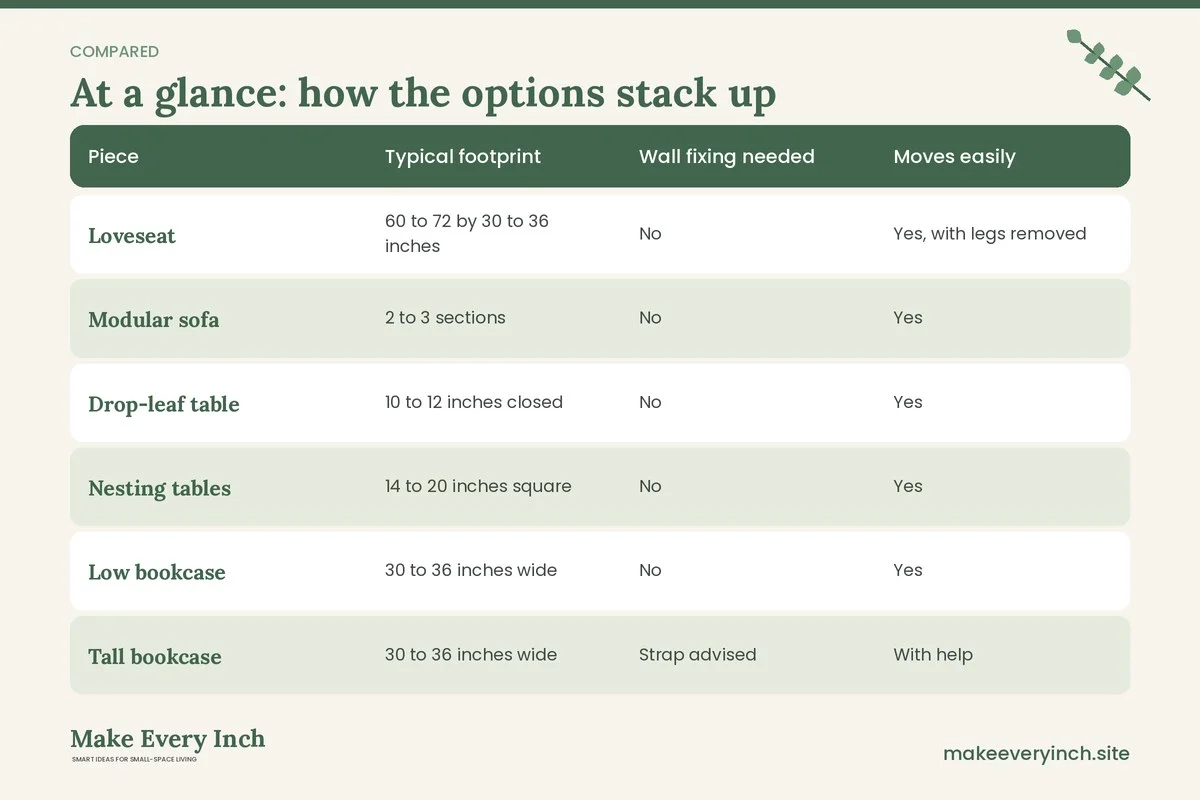
The table lines up common pieces so you can see what each one costs in floor space and in effort.
| Piece | Typical footprint | Wall fixing needed | Moves easily |
|---|---|---|---|
| Loveseat | 60 to 72 by 30 to 36 inches | No | Yes, with legs removed |
| Modular sofa | 2 to 3 sections | No | Yes |
| Drop-leaf table | 10 to 12 inches closed | No | Yes |
| Nesting tables | 14 to 20 inches square | No | Yes |
| Low bookcase | 30 to 36 inches wide | No | Yes |
| Tall bookcase | 30 to 36 inches wide | Strap advised | With help |
| Ladder shelf | 16 to 20 inches deep | No | Yes |
| Rolling cart | 14 to 18 inches wide | No | Yes |
| Sofa bed | Open depth up to 80 inches | No | Heavy |
Three example rooms
A 9 by 11 foot studio living area
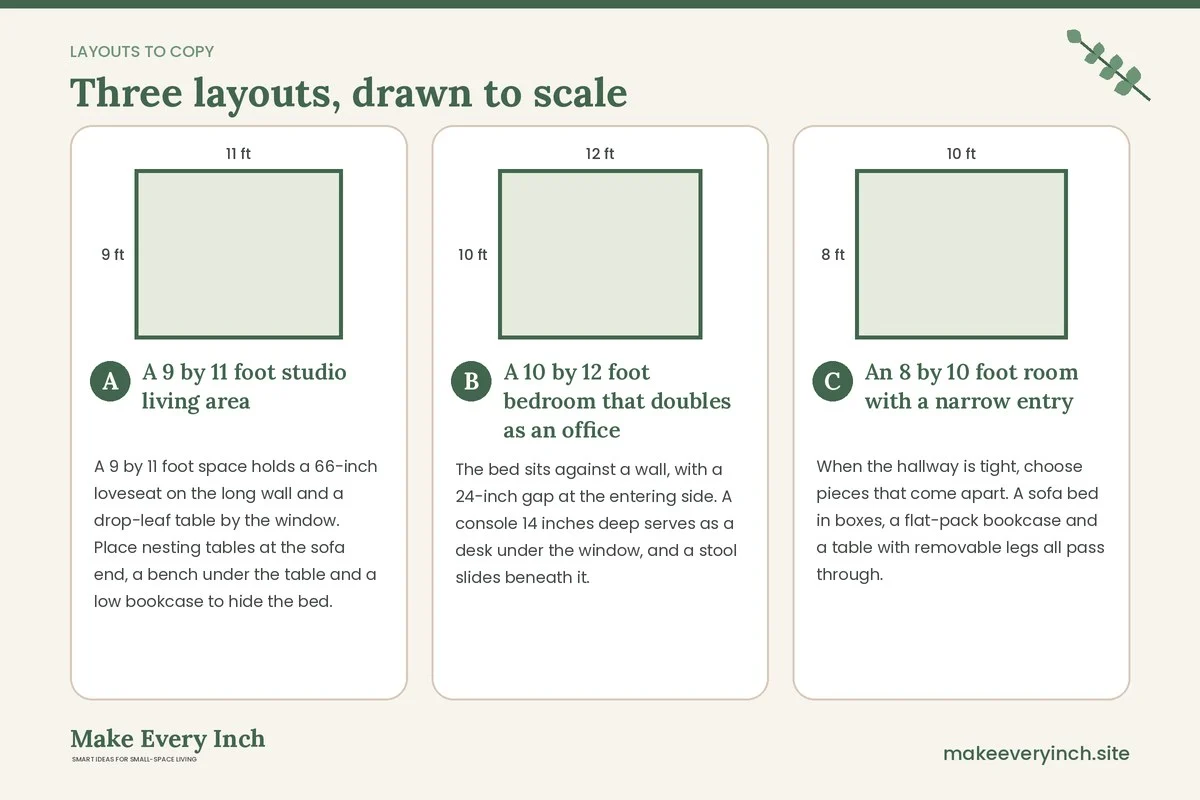
A 9 by 11 foot space holds a 66-inch loveseat on the long wall and a drop-leaf table by the window. Place nesting tables at the sofa end, a bench under the table and a low bookcase to hide the bed. The path from door to window stays at 32 inches. The sofa has legs, so the floor reads open, and the bookcase stays unanchored because it is only 30 inches tall.
A 10 by 12 foot bedroom that doubles as an office
The bed sits against a wall, with a 24-inch gap at the entering side. A console 14 inches deep serves as a desk under the window, and a stool slides beneath it. A storage ottoman at the foot of the bed holds linens, and a rolling cart sits beside the bed as a nightstand. Use felt pads under every leg and keep the desk lamp cord along the baseboard. For clothing storage with the same lease rules, look at our guide to renter-friendly bedroom storage ideas, and for the closet itself, see our post on renter friendly closet upgrades.
An 8 by 10 foot room with a narrow entry
When the hallway is tight, choose pieces that come apart. A sofa bed in boxes, a flat-pack bookcase and a table with removable legs all pass through. Inside, the layout is simple: sofa bed on the long wall, a ladder shelf at the end, a stool for visitors and a rolling cart in the corner. The 30-inch path is clear, the door swings freely and everything breaks down for the next move.
Safety notes for furniture in a rental
- Anchoring: tall or top-heavy furniture can tip, especially with children around. Ask for permission to anchor to a stud, and if refused, choose low, wide pieces.
- Electrical: do not overload a power strip, keep cords out of walkways and away from heaters, and never run a cord under a rug.
- Ventilation and heat: leave space around radiators, vents and the back of any appliance. Do not block a smoke alarm or a thermostat.
- Finishes: new furniture and flat-pack boards can release odors. Air it near an open window before using it, and choose low-VOC finishes when you refinish a secondhand piece.
- Weight limits: shelves, beds and stools have ratings. Check them and keep heavy items low.
- Wet areas: in a bathroom, keep electrical items away from water and use a GFCI outlet. Choose water-resistant materials.
- Children and pets: secure anything that can tip, avoid small removable parts and check that folding pieces cannot pinch fingers.
- Lease permission: never drill without written permission, and keep any approval with your lease papers.
Where to find pieces that pass the test
You do not need to buy everything new. Secondhand shops, community groups and online marketplaces often carry legged tables, stools and bookcases. Inspect for wobble, split joints and strong smells. Measure before you go, and carry a tape. If a piece needs repair, use a wood glue and a clamp, and let it cure fully. For more on stylish finds, see our guide to thrifted furniture ideas for small homes. When you buy new, favor simple joints, replaceable feet and parts you can order again.
A moving-day plan for small furniture
Plan the move before you buy. Label each piece with its room and take photos of how it assembles. Keep hardware in a bag taped to the underside of the piece. Wrap legs and corners in blankets, lift rather than slide and carry long items on their side through doorways. Lay a runner on the floor from the door to the room, and tape it down so no one slips. At the new place, measure again before you commit to a layout.
On move-out day, vacuum under each piece and check the floor for dents. Fill nothing and paint nothing unless your lease says so. Photograph the empty room and compare it with your move-in photos.
Checklist
- Measure doors, hallways, stairs and lifts.
- Tape each piece’s footprint on the floor.
- Keep walkways at 30 to 36 inches.
- Add felt pads or cups to every leg.
- Choose legged, light-scale furniture.
- Prefer folding, nesting or modular pieces.
- Ask before anchoring or drilling anything.
- Place heavy items low and anchor tall ones with permission.
- Keep cords tidy and outlets uncrowded.
- Leave space around vents, heaters and alarms.
- Keep hardware in a labeled bag.
- Photograph the room at move-in and move-out.
FAQ
What makes furniture renter friendly?
It stands without wall fixings, protects the floor, passes through narrow doors and breaks down for the next move. Light scale and legs help in small spaces.
Can I anchor a bookcase in a rental?
Only with the landlord’s permission. Ask if a single screw into a stud is acceptable. If not, choose a low, wide bookcase and keep heavy items on the bottom shelf.
How do I protect floors from furniture?
Use felt pads on legs, wide cups under heavy pieces and soft-tread casters on carts. Lift rather than drag, and use a runner on moving day.
What is the best sofa size for a small room?
Many small rooms suit a 60 to 72 inch loveseat or a modular sofa. Measure the walkway first and keep 30 to 36 inches clear.
How can I add a desk without a spare room?
Use a narrow console, a drop-leaf table or a fold-down table on a stand. Choose one that slides away when you finish work.
Should I buy secondhand furniture for a rental?
It is a good option if you inspect for stability and odors, measure carefully and choose pieces that come apart. Check that nothing needs a wall fixing.
Keep going: Keep going with our guides to small space furniture layout rules, furniture that makes small rooms feel bigger and studio apartment furniture ideas.
Save this guide for later
Pin the ideas you like to Pinterest so you can come back to them when you plan your space.