Best Coffee Tables for Small Living Rooms: A Buying Guide
Quick answer: The best coffee tables small living rooms can use are usually 16 to 18 inches tall, about two thirds the length of the sofa, and leave roughly 14 to 18 inches between the table and the sofa seat and a walkway of about 30 inches. Round, oval and nesting shapes forgive tight rooms, lift-top and storage models earn their bulk only if you use the space, and open bases make a room feel larger. Measure first, tape the footprint on the floor and check the lease and the rug before you buy.
Coffee tables small living rooms depend on have a harder job than the ones in a large lounge. They must hold a drink, a remote and a book, but they also sit in the busiest part of the floor, between the sofa and the rest of the room. A table that is a few inches too long or too deep can turn a walkable room into an obstacle course. This buying guide explains what to look for, which sizes tend to work, how shapes and materials compare, where multipurpose models help and where they do not, and what trade-offs to expect. It names no brands and no prices, because both change often and neither tells you whether a table will fit your room. If you are furnishing the whole space, our pillar guide to the best furniture for small apartments covers the bigger picture, and the small living room layout ideas post shows how the table fits into the floor plan.
Do coffee tables small living rooms need to be big? Start by asking if you need one
Before comparing styles, ask what the table will do. A coffee table is a convenience, not a requirement, and in a very small room it can cost more floor space than it gives back. List the real jobs: holding drinks, serving snacks, resting feet, hiding clutter, displaying a plant or serving as a desk for a laptop. If the list has only one or two items, a pair of side tables or a tray ottoman may do the work with less bulk. Our guide to small living room ideas without a coffee table walks through those options in detail.
If you do want a table, the jobs shape the choice. A table that must hold a laptop needs a firm, flat top and a height close to the sofa seat. A table that must hide remotes and throws needs a shelf, drawer or lid. A table that must seat guests at floor level needs a sturdy top and enough width for a few plates. A table that mostly holds a mug and a candle can be tiny. Matching the table to the job is the single best way to avoid buying something too big.
Start with the measurements that matter
Most coffee table regrets come from skipping measurements. These ranges are common starting points, not strict rules, and your sofa, rug and walkway may push them either way.
- Length: about one half to two thirds the length of the sofa. For an 72-inch sofa that is roughly 36 to 48 inches. In a very small room, stay at the lower end or even go shorter.
- Height: close to the height of the sofa seat, often 16 to 18 inches, or 1 to 2 inches below the seat cushion. A lower table is easier to see over and suits low sofas. A table higher than the seat is awkward for a drink.
- Distance from the sofa: roughly 14 to 18 inches between the sofa seat front and the table edge. Closer than 12 inches makes it hard to stand up. Farther than 20 inches and you will lean for a mug.
- Walkway: about 30 inches for the main path, and 24 inches for a side path that you use less often. If a path is shorter than that, choose a smaller or rounder table.
- Depth or width: 18 to 24 inches deep for most small rooms. A deep table over 28 inches takes a large share of a narrow floor.
- Space around the table in the room: if the table sits between a sofa and a chair, keep about 18 inches on each side, or let the chair pull slightly back.
Tape the footprint on the floor with painter’s tape and live with it for a day. Sit on the sofa, reach for an imaginary mug, walk to the kitchen, open the door and carry a tray. If you have to turn sideways, the table is too large. If you can move around it without thinking, it is the right size. Remember that a table will also be at the same height as your shins, so a sharp corner is more than a style issue.
Which shape suits a small living room
Shape changes how a table feels in a room even when its footprint is the same.
Round and oval
Round tables have no corners, so people can move around them with less risk of a bumped hip. An oval, with its longer line, suits a narrow room and a long sofa. Round tables often feel smaller than a square table of the same width because the corners are missing. The trade-off is that you cannot push a round table flush against a sofa, and you lose a little surface for objects with straight edges.
Rectangular
A rectangle lines up with the sofa, and it has the most usable surface per inch. It is the natural choice for a tray, a laptop or a board game. The corners can bruise in a tight room, so look for softened edges and keep the walkway wide. A slim, shallow rectangle of 16 to 20 inches deep can work in a narrow room where a square would not.
Square
Square tables suit a room with a sectional or two chairs facing each other. They offer even reach from every side, but they can feel boxy when the space is small. A square of 24 to 30 inches is often enough for a pair of chairs.
Nesting sets
Nesting tables are two or three tables of graduated sizes that tuck together. They give a larger surface when you need it and a compact one when you do not. They are among the most flexible choices, and they pair well with our guide to small space side table alternatives, which covers other movable surfaces. The trade-off is that the smaller tables are usually lower, so check the heights against your seat.
Ottoman or tray style
A cushioned ottoman with a tray on top works as a footrest, a seat and a table. It has soft edges and is forgiving if you walk into it. The trade-off is a less stable surface unless the tray is firm, and the fabric may need cleaning more often. See our best storage ottomans guide for what to check.
Materials: what to look for and what to expect
Material affects weight, durability, cleaning and how a table looks in a small room. Visual weight matters as much as real weight. A heavy dark table can dominate a room, and a light open one can nearly disappear.
- Solid wood: sturdy and repairable, and it can be sanded and refinished. It is heavy, which can be a problem for rental moves, and it may mark from rings and heat unless you use coasters.
- Veneer or engineered wood: lighter and usually more stable in changing humidity. The surface is a thin layer, so deep scratches and water damage are harder to repair. Check the edges for chipping.
- Metal: a slim metal frame gives an open look and good strength with little visual weight. Powder-coated finishes resist scratches, though sharp corners and cool surfaces can be less welcoming. Check the feet for floor protectors.
- Glass: reflects light and keeps a room airy, but it shows fingerprints and dust, and it can feel risky around children and pets. Look for tempered glass with softened edges, and think about whether the noise of a glass on glass bothers you.
- Stone or stone-look: durable and heavy. A real stone top can be very heavy to carry upstairs and can stain. A lighter stone-look surface lessens that, but check how well it resists water rings.
- Rattan, cane or woven: warm and light, and it adds texture. A woven top is not flat, so you will usually need a tray for a glass. It can snag clothing and may be harder to clean.
- Painted or lacquered finishes: easy to wipe, though they can chip. A matte finish hides marks better than a gloss.
- Plastic or resin: light and easy to clean, and it suits a small room that must be moved often. Check that it feels sturdy when you press on a corner and that it does not warp near a heater.
Whatever the material, look at the finish on the top. A water-resistant coating or a sealed surface helps a table last, and a flat top with a slight edge lip keeps a mug from sliding. If you rent, ask whether the legs have felt or rubber feet, so the table does not scratch the floor.
Base styles and how they change the feel of a room
The base is as important as the top. Open bases let you see the floor beneath the table, and the room feels larger. Closed bases hide clutter but add visual weight.
- Four legs: the classic base, with a clear view of the floor. Look for slim legs that angle slightly outward for stability.
- Pedestal: a single central column. It leaves foot room on all sides and suits round tops. Check the base size, because a narrow pedestal under a large top can tip if someone leans on one edge.
- Sled or C-base: a base shaped like a C or a sled. It slides under a sofa or a chair, which brings the top closer to the user and saves floor space.
- Trestle or panel: two solid sides support the top. It looks substantial and is usually very stable. It also blocks the view under the table, so it suits a bigger room.
- Hairpin or rod legs: thin legs that give a light look. Check how many joints the legs have and whether they wobble when you press a corner.
A lower base with a lower top can also make a ceiling feel higher. In a room with a low ceiling, a table that is about 14 to 16 inches tall can preserve sight lines across the room.
Multipurpose features: when they earn their space
Multipurpose coffee tables are popular in small rooms because they promise more function from one footprint. Many deliver, but some add moving parts and weight that you may not need. Think of each feature as a trade-off.
Storage shelves and drawers
An open shelf under the top holds magazines, a basket of remotes and a tray. A drawer hides clutter but adds depth and weight, and the runners can wear. A shelf is usually the simplest answer. Keep the shelf for baskets rather than loose items, since an open shelf quickly turns into a pile.
Lift-top tables
A lift-top table raises its top to a desk or dining height, and some include hidden storage. They can serve a person who works or eats on the sofa. The trade-offs are weight, a more complicated mechanism and a narrower top when lifted. Check the mechanism for pinch points, since the hinge and lift arms can trap fingers. Keep the lifted top clear of children’s hands, and read the weight limit before you place a laptop and a meal on it.
Folding or extending tables
A fold-down or extending coffee table can switch between a small top and a large one. The advantage is the saving of floor space. The risk is also in the hinge, which can pinch fingers and loosen over time. Look for locking leaves, and check that the table cannot collapse under a heavy load. Never leave a child to play near a folding mechanism.
Tables on wheels
Casters make a table easy to move for cleaning and entertaining. Choose locking wheels if your floor is slightly sloped, and choose wheels with soft treads to protect floors. A wheeled table can slide when someone sits or leans on it, so use locks if the room is busy.
Nesting and stacking sets
A nest saves floor when you need only one surface, and gives extra tops for guests. This may be the most useful feature in a small room because it needs no mechanism. The set should have a clear gap so the smaller tables slide in without scraping.
Built-in power
Some tables include outlets or USB ports. If you choose one, make sure the cord reaches a wall outlet without crossing a walkway, and do not overload a power strip. Follow the product’s instructions, and never run cords under a rug where they can overheat or be tripped on.
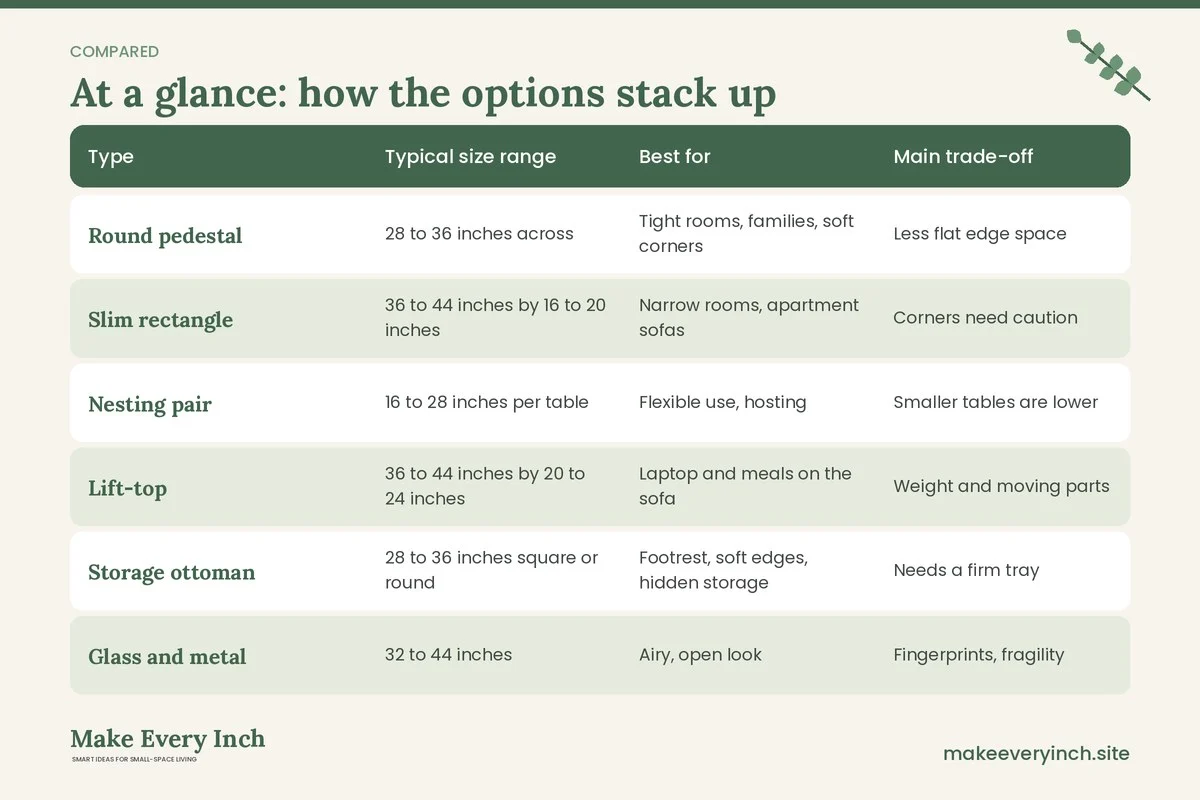
Comparison table: common coffee table types
The table below summarizes typical trade-offs. Sizes are common ranges, not promises, so always compare against the dimensions listed on a specific product.
| Type | Typical size range | Best for | Main trade-off |
|---|---|---|---|
| Round pedestal | 28 to 36 inches across | Tight rooms, families, soft corners | Less flat edge space |
| Slim rectangle | 36 to 44 inches by 16 to 20 inches | Narrow rooms, apartment sofas | Corners need caution |
| Nesting pair | 16 to 28 inches per table | Flexible use, hosting | Smaller tables are lower |
| Lift-top | 36 to 44 inches by 20 to 24 inches | Laptop and meals on the sofa | Weight and moving parts |
| Storage ottoman | 28 to 36 inches square or round | Footrest, soft edges, hidden storage | Needs a firm tray |
| Glass and metal | 32 to 44 inches | Airy, open look | Fingerprints, fragility |
| C-base or sled | 14 to 20 inches deep | Lap use, tight spaces | Smaller surface |
| Wheeled cart style | 16 to 24 inches wide | Moving between rooms | Can roll when leaned on |
Three example rooms
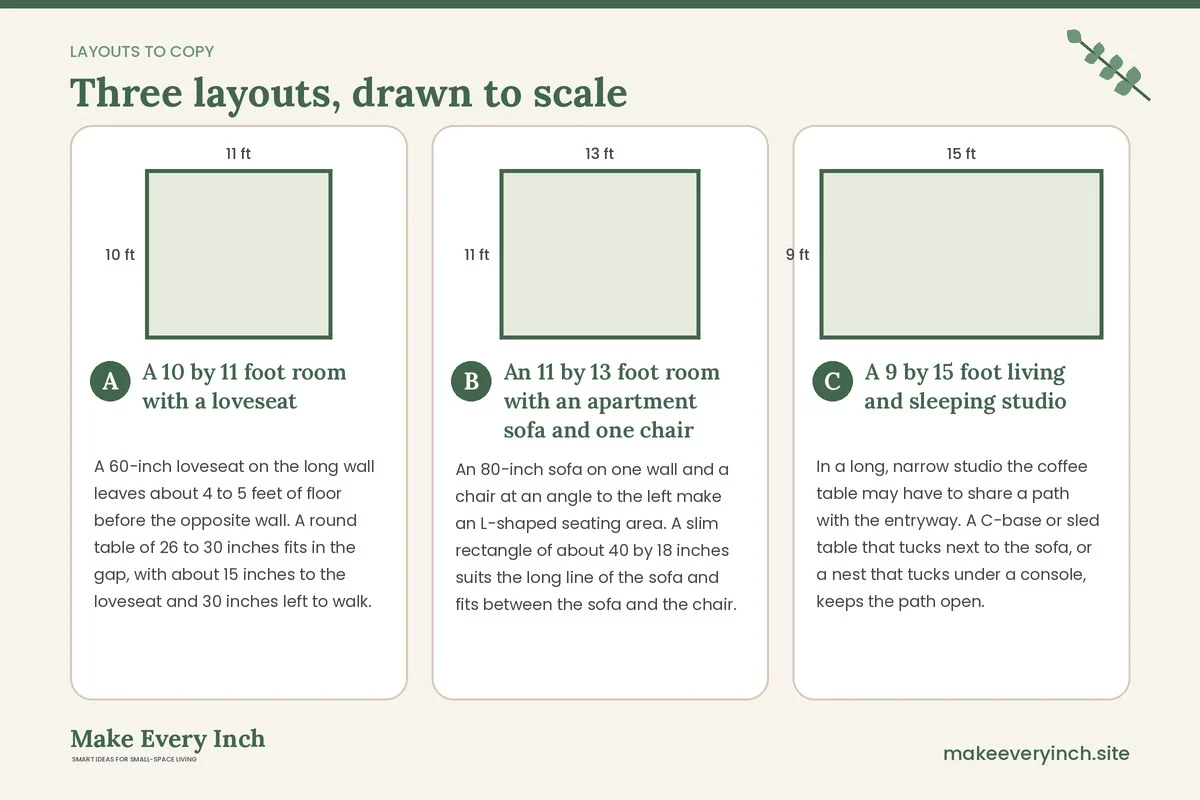
A 10 by 11 foot room with a loveseat
A 60-inch loveseat on the long wall leaves about 4 to 5 feet of floor before the opposite wall. A round table of 26 to 30 inches fits in the gap, with about 15 inches to the loveseat and 30 inches left to walk. A pedestal base keeps the floor open. If you need a bigger surface for a meal, keep a nesting stool nearby. This room benefits from a rug about 5 by 7 feet so that the table sits entirely on the rug.
An 11 by 13 foot room with an apartment sofa and one chair
An 80-inch sofa on one wall and a chair at an angle to the left make an L-shaped seating area. A slim rectangle of about 40 by 18 inches suits the long line of the sofa and fits between the sofa and the chair. Put the chair about 18 inches from the table edge and leave 30 inches in the walkway. A lower shelf holds a basket for throws and remotes. This room can also take a pair of nesting tables instead of one rectangle, so the pieces can separate when guests sit in a circle.
A 9 by 15 foot living and sleeping studio
In a long, narrow studio the coffee table may have to share a path with the entryway. A C-base or sled table that tucks next to the sofa, or a nest that tucks under a console, keeps the path open. Choose a narrow top of 14 to 18 inches deep and keep it close to the sofa. A table with a lift top can serve as a desk, but plan to fold it away when not in use. For more studio layouts, see our studio apartment ideas.
How to place the table
Where you put the table matters as much as which table you buy. In a small room, follow a few placement rules.
- Center the table on the sofa, or the seating area, rather than the room. A table centered on the seating helps the group feel together.
- Let the table sit on the rug when possible. If the rug is too small, the table can perch on the edge, though it may rock. Use a rug at least 5 by 8 feet in most small rooms.
- Leave at least 30 inches on the main path, and 24 inches on a side path.
- Keep sharp corners away from where children and guests walk.
- If the room has a radiator or a vent, keep the table away from it. Heat can warp some materials and block airflow.
- If you use a sofa with a sleeper function, make sure the table can move out of the way.
If the room feels cramped, try the room without the table for a week, and use a tray on an ottoman. Our guide to small living room ideas shows ways to use floor space in a compact room.
Safety and lease notes
A coffee table sits at shin height, so safety belongs in the buying decision.
- Edges and corners: with young children, choose rounded or softened edges. Corner guards are an option, though they are a short-term fix.
- Glass: if you choose glass, look for tempered glass, and check that the top sits securely in its frame. Do not use a cracked glass table.
- Folding and lift mechanisms: hinges and lift arms can pinch fingers. Keep children away while the table is moving, and read the instructions before use.
- Stability: press down on a corner and lean on an edge before you rely on a table. A table that rocks may not be safe under a laptop or a hot drink.
- Heat and flame: do not leave candles or hot dishes on surfaces that are not rated for heat.
- Lease and floors: use felt or rubber feet to prevent scratches on rental floors. If a table is heavy, lift it rather than dragging it. Do not attach anything to the floor or wall without the landlord’s permission, and never drill without it.
- Cords: if you use a table with power, keep cords out of walkways.
If you also plan to add a tall bookcase or shelf next to the table, anchor it to a wall stud with the hardware that suits your wall type, but only if the lease allows it. Otherwise choose a lower unit that does not tip.
Common mistakes to avoid
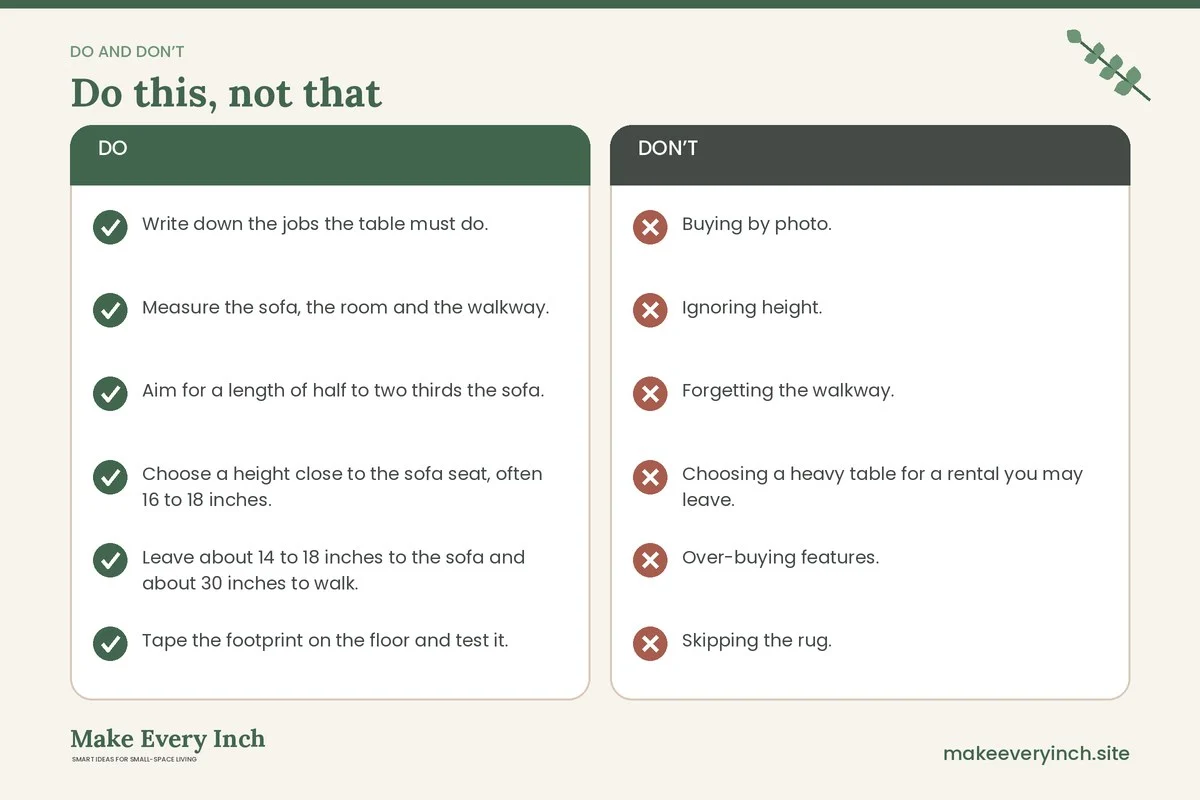
- Buying by photo. Photos are cropped, and a table that looks small in a photo may be large in your room. Always read the dimensions.
- Ignoring height. A table much taller than the seat makes it hard to reach a mug. A table much lower can make a glass hard to pick up.
- Forgetting the walkway. A table that blocks the path to the kitchen will be a daily annoyance.
- Choosing a heavy table for a rental you may leave. Lighter tables are easier to move, and you will thank yourself on moving day.
- Over-buying features. A hidden compartment you never open is just weight. Choose features for real jobs.
- Skipping the rug. A table floating off a rug looks adrift. Measure the rug and the table together.
- Buying a perfect table before the sofa. Choose the sofa and the layout first. Our guide to the best sofas for small apartments can help.
Smart shopping approach
You do not need to buy the first table you see. Start with measurements, a list of jobs and a short list of two or three shapes. Check the product dimensions, weight limits, materials and care instructions. Read return policies, since a table that looks right online can look wrong in your room. Second-hand shops and online marketplaces often have solid tables, and a coat of paint or a new finish can refresh one. If you buy used, check the legs for wobble, the top for deep marks and the joints for looseness.
Think about how long you will keep the table. If you expect to move, favor a table that dismantles or nests. If you plan to stay, a sturdy wood table may serve for years. Either way, a table that you can carry through a door and up a stairwell is worth more than one you cannot.
Buyer’s checklist
- Write down the jobs the table must do.
- Measure the sofa, the room and the walkway.
- Aim for a length of half to two thirds the sofa.
- Choose a height close to the sofa seat, often 16 to 18 inches.
- Leave about 14 to 18 inches to the sofa and about 30 inches to walk.
- Tape the footprint on the floor and test it.
- Pick a shape that suits the room: round, oval or slim rectangle.
- Prefer an open base in a very small room.
- Check the material for weight, cleaning and finish.
- Read the weight limit and the instructions for any lift or folding parts.
- Look for rounded edges if children are in the home.
- Add felt feet to protect the floor.
- Check the lease before attaching anything.
- Plan the rug and the lighting around the table.
FAQ
What size coffee table is best for a small living room?
Many small rooms do well with a table about 30 to 44 inches long, 16 to 24 inches deep and 16 to 18 inches tall. The best size depends on the sofa, the walkway and the rug, so measure and tape the footprint first.
Is a round or rectangular coffee table better for a small room?
Round and oval tables are easier to walk around and avoid sharp corners. A slim rectangle offers more usable surface and lines up with the sofa. Choose according to the room’s shape and your traffic path.
How much space should be between the sofa and the coffee table?
About 14 to 18 inches is a common range. It is close enough to reach and far enough to stand up. Adjust a little to suit your legs and your habits.
Are lift-top coffee tables worth it?
They can be, if you work or eat on the sofa. They add weight and a mechanism, so check the lift arms and hinges for pinch points and read the weight limit before using one for meals or a laptop.
Should the coffee table match the other furniture?
It does not need to match, but it should share a material, color or line with something in the room. A wood table can pair with a metal lamp, and a glass top can pair with a wood sofa leg.
What is the best coffee table material for a rental?
Light and durable materials are good for rentals because they are easy to move. Look for a sealed top and soft feet, and avoid anything you could not carry on your own.
Can a coffee table double as a desk?
Some can, particularly lift-top models. Check that the height suits your seat and that your posture is comfortable. For a dedicated workspace, our guide to the best desks for small apartments is a better place to start.
How do I stop a small coffee table from looking cluttered?
Use a tray to group items, keep a basket on the lower shelf and limit the top to three or four objects. Clear it each evening so it never turns into a pile.
Keep going: Keep planning with our small space side table alternatives, small living room furniture ideas and small space organization ideas.
Save this guide for later
Pin the ideas you like to Pinterest so you can come back to them when you plan your space.