Studio Apartment Lighting Ideas: Layered Light Zones for One Room
Quick answer: The best studio apartment lighting ideas split one room into light zones, each with its own lamp or sconce: a task light for the kitchen and desk, a soft ambient light for the living area, and a low, warm light for the bed. Use warm bulbs around 2700 kelvin for evening zones, add dimmers or dimmable smart plugs, choose plug-in sconces and clip lights to avoid hardwiring, and keep every cord and power strip safe.
Studio apartment lighting ideas have to solve a problem that larger homes never face: one room must feel like a kitchen at 7 a.m., an office at noon, a living room at 8 p.m. and a bedroom at 11 p.m. A single ceiling fixture cannot do all four jobs, and in many rentals it is a flat, builder-grade fixture that makes everything look like a waiting room. The answer is to treat the studio as several small rooms of light. This guide explains how to plan light zones, how much light each zone needs, which lamps and plug-in sconces suit a renter, how bulb color changes the mood, how to handle dimmers and cords safely, and how to light three typical studio layouts. For the full picture of making one room work, start with our pillar guide to studio apartment ideas.
Why studio apartment lighting ideas start with zones
In a one-bedroom apartment a closed door separates the place where you sleep from the place where you cook. In a studio, everything is visible at once. That has a lighting consequence. If the kitchen is bright while you are trying to wind down, you see the dishes, the pan and the mess, and your brain stays in work mode. If the bed is lit by the same harsh light as the kitchen, the room never signals that the day is over.
Zoned light solves both problems. Each area gets its own light source, and you switch zones on and off through the day. In the evening, the kitchen goes dark, the sofa glows and the bed waits in shadow. The unlit parts of the room visually disappear, which makes the studio feel more like a series of rooms and less like one big space. This is the same trick behind a good divider. If you are also separating zones with furniture, see our guides to renter-friendly ways to divide a studio apartment and DIY room divider ideas for studio apartments, because light and dividers work best together.
The three layers of light
Designers talk about three layers, and a studio needs all of them in small doses.
- Ambient light: the general glow that lets you move around. In a studio this should come from several soft sources rather than one bright ceiling light.
- Task light: focused light where you read, cook, chop, work or apply makeup. It is brighter and aimed at the surface, not the room.
- Accent light: low, decorative light that adds depth, such as a glow behind a plant, a strip along a shelf or a small lamp on a bookcase.
A common mistake is to buy only ambient light and then compensate with a very bright bulb. A better approach is to keep ambient light gentle and put the brightness exactly where your hands are working. The result feels calmer and uses less energy.
Plan your light zones on paper
Before buying anything, sketch the floor plan and mark each zone. Most studios have five.
- Entry and drop zone: needs enough light to find keys and see a mirror.
- Kitchen or kitchenette: needs bright, neutral task light over the counter and the stove.
- Living area: needs soft, adjustable ambient light and a reading light.
- Sleeping area: needs a low, warm light at the bed and ideally nothing overhead.
- Work area: needs a desk lamp with an adjustable arm and glare-free light on the screen.
Next to each zone, write where the nearest outlet is and whether there is a wall switch. That one note decides the whole plan. A lamp that has no outlet nearby leads to an extension cord across the floor, which is a trip hazard and a safety problem. Plan the lamp positions around the outlets you have, and use cord covers or the techniques in our guide to renter-friendly ways to hide cords for the rest.
How much light each zone needs
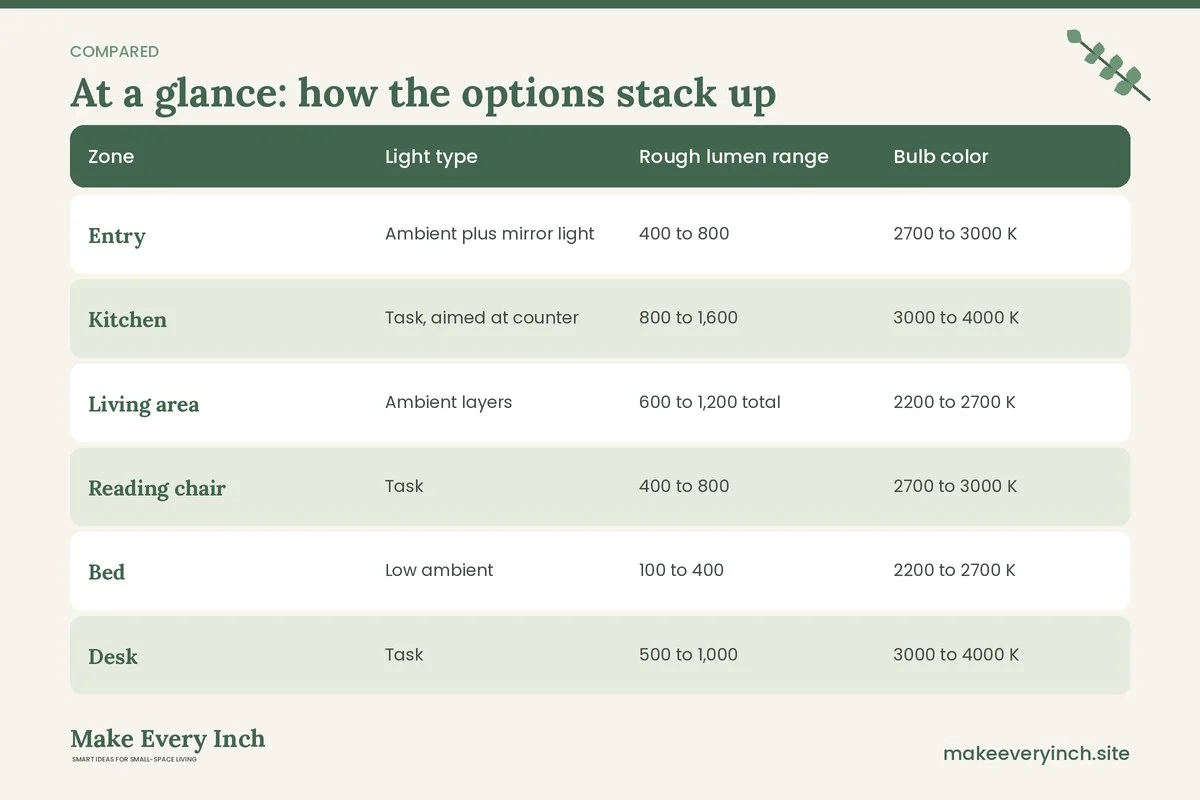
Light levels are measured in lumens, and the numbers below are hedged ranges rather than rules. Rooms differ, and you should adjust to your eyes, your age and the color of your walls.
| Zone | Light type | Rough lumen range | Bulb color | Control |
|---|---|---|---|---|
| Entry | Ambient plus mirror light | 400 to 800 | 2700 to 3000 K | On/off or motion |
| Kitchen | Task, aimed at counter | 800 to 1,600 | 3000 to 4000 K | Full bright, switchable |
| Living area | Ambient layers | 600 to 1,200 total | 2200 to 2700 K | Dimmable |
| Reading chair | Task | 400 to 800 | 2700 to 3000 K | Adjustable arm |
| Bed | Low ambient | 100 to 400 | 2200 to 2700 K | Dimmable, within reach |
| Desk | Task | 500 to 1,000 | 3000 to 4000 K | Adjustable, glare-free |
As a rough starting point, many people find that a living area needs about 10 to 20 lumens per square foot for general light, while kitchen counters and desks need more at the work surface. A 300 square foot studio therefore might use 3,000 to 6,000 lumens spread over the whole room, but you almost never turn everything on at once. Think of the total as a ceiling, not a target. Check the lumen number on a bulb package, not the watts, because LED watts say little about brightness.
Lamps that earn their place
In a studio, every lamp should work hard. Here is how to choose.
Floor lamps
A floor lamp provides ambient light without using any table space. An arc lamp reaches over a sofa from a corner, and a torchiere that bounces light off the ceiling lifts a dark room. Choose a stable, weighted base, especially if you have pets or children, and keep the shade clear of curtains and bedding. For a closer look at how to choose, our guide to the best floor lamps for small rooms covers shapes and footprints. A slim floor lamp has a footprint of about 10 to 12 inches, which fits behind a sofa or beside a bed.
Table lamps
A table lamp on a nightstand, a console or a bookcase makes the room feel finished. In the sleeping zone, two small lamps at the head of the bed look balanced and give each side its own switch. Choose shades with a soft, opaque fabric so the bulb does not show. Table lamps work best when the base is no more than 24 to 28 inches tall, so the bulb sits near eye level when you sit up in bed.
Desk and clamp lamps
A desk lamp with a swing arm sends light onto the page, not into your eyes. A clamp lamp that grips the edge of a shelf or a table saves surface area. Check that the clamp protects the finish, and add a felt pad under the jaw so it does not mark furniture. If your desk is in a corner, aim the lamp from the opposite side of your writing hand to avoid shadows.
Clip lights and puck lights
Small clip-on lights can aim at art, plants or a bookshelf. Battery-powered puck lights stick under a shelf or inside a cabinet, which is useful when there is no outlet. Rechargeable versions avoid the cost of replacing batteries. These are good accent lights, but they are not a substitute for a real task light at the stove.
Plug-in sconces: wall light without an electrician
A plug-in wall sconce looks like a hardwired fixture but ends in a cord and a standard plug. It hangs from a hook or a screw and plugs into the nearest outlet. For a renter, it is one of the most useful tools in the box, because it gives light at a high level without taking up floor or table space. In a studio, a plug-in sconce beside the bed replaces a nightstand lamp, which leaves the nightstand free for a book and a glass of water.
Check these points before you choose one.
- Lease first: a sconce usually needs a hook or a screw in the wall. Ask the landlord in writing, and never drill without permission. If the answer is no, choose a lamp that stands on a surface, a clamp lamp, or a sconce that hangs from adhesive hooks rated for its weight.
- Weight: check the weight on the product label and use only hardware rated for that weight. Ceramic and glass sconces can be heavy.
- Cord position: a long cord hanging down the wall can look messy and can be grabbed by a pet. Use a cord cover that matches the wall color, or tuck the cord along the baseboard with removable clips.
- Height: hang bedside sconces so the bottom edge of the shade sits about 6 to 10 inches above your shoulder when you sit up in bed. Reading sconces beside a chair sit around 50 to 60 inches from the floor to the center of the fixture.
- Switch: choose one with an inline switch or a dimmer on the cord so you can reach it from bed.
If you do not want to put holes in a wall, ask whether a freestanding “sconce style” floor lamp, a wall-leaning lamp or a lamp that clamps to a headboard fits your situation. Our guide to renter-friendly lighting ideas lists more no-hardwire options.
Dimmers, smart plugs and soft control
Dimming is the single biggest upgrade for a studio, because it lets one lamp do several jobs. There are four renter-friendly ways to get it.
- Dimmable bulbs in an ordinary lamp: the bulb itself dims through a plug-in dimmer or a smart controller. Check that the bulb is labeled dimmable and that it works with the control you plan to use.
- Inline cord dimmers: a small dial or slider on the lamp cord. These work with many lamps, but check the wattage range and the compatibility notes on the package.
- Plug-in dimmers: a dimmer that sits between the wall and the lamp. Check that the load, such as an LED bulb, matches the device.
- Smart bulbs and smart plugs: an app or voice control sets the brightness and the schedule. A smart plug usually switches a lamp on and off but does not dim a regular bulb. For dimming you need a smart bulb or a dimmer plug.
Match the dimmer to the bulb type. Some LED bulbs flicker or buzz on the wrong dimmer. If a lamp flickers, try another bulb or another control, and do not force the combination. A dimmer is not a fix for an overloaded circuit.
Do not replace a wall switch in a rental. Swapping a switch for a dimmer is electrical work that your lease almost certainly restricts, and in many places it must be done by a qualified person. Keep all control at the lamp, on the cord or in an app.
Bulb color: the quiet mood switch
The color of a bulb is measured in kelvin. Lower numbers are warmer and more orange, and higher numbers are cooler and bluer.
| Kelvin range | Look | Best studio use |
|---|---|---|
| 2000 to 2400 K | Candle-like amber | Bed zone in the last hour before sleep |
| 2500 to 2700 K | Warm white | Living area, bedside, accent lights |
| 3000 K | Soft white | Entry, bathroom mirror, reading |
| 3500 to 4000 K | Neutral white | Kitchen counters, desk, closet |
| 5000 K and above | Daylight, blue-white | Rarely needed; can feel harsh at night |
The rule is to keep the evening zones warm and the work zones neutral. Mixing a very warm lamp and a very cool one in the same sightline can make the room look patchy. If you mix, keep the difference within roughly 500 to 800 kelvin in any one view, and keep bulbs of the same brightness in matching lamps.
Check the CRI, or color rendering index, on the package. A higher CRI shows food, skin and fabrics more truthfully. A kitchen with low-CRI light can make fresh food look dull, and a mirror area with it can make makeup look wrong. Many people find that 90 or higher is pleasant, but any decent LED will work for general zones.
If you like to change the mood, tunable bulbs shift from warm to cool. Use them in the zone that does the most jobs, such as the living area that doubles as a desk. Keep them off the bed zone if you find color shifts distracting.
Cords, outlets and electrical safety
Electrical safety is not optional in a studio. You have one room, a handful of outlets and many devices. These habits protect your home.
- Never overload an outlet or a power strip. Check the rating on the strip and the wattage of the devices. Do not plug a space heater, a microwave or an air conditioner into a power strip or an extension cord. LED lamps draw very little power, but the same outlet may also feed a fridge or a kettle.
- Use a power strip with built-in surge protection and a switch for the desk and TV area, and check it is rated for the load.
- Do not run cords under rugs. The cord can overheat and wear without being seen, and it is a fire risk. Use a flat cord cover on the floor only where you cannot avoid crossing a path, and keep it out of walkways when you can.
- Do not staple, nail or tightly bend cords. Damaged insulation is a shock and fire hazard. Use removable clips that hold the cord without piercing it.
- Check cords for damage. If a cord is frayed, hot, cracked or scorched, stop using it.
- Keep bulbs and shades away from fabric. Use the maximum wattage on the lamp label, which for LED lamps is generally not an issue, but a hot incandescent or halogen bulb near a curtain or bedding can start a fire.
- Do not daisy-chain power strips. Plug each strip directly into a wall outlet.
- Cover unused outlets with child-safe caps if children visit.
- Use bulbs and lamps with a recognized safety listing from an independent testing lab. Look for the mark on the cord or label.
- Smoke alarms come first. Do not block or cover one with a lamp, a plant or a decoration. If the alarm is near the bed, keep a clear space around it, and ask the landlord to fix a missing or expired alarm.
- String lights: use only indoor-rated strings in indoor rooms, and follow the maximum connected length on the label. Do not hang them over a heat source, and turn them off when you leave.
If an outlet is warm, discolored, loose or crackling, stop using it and tell your landlord. That is a repair, not a project to do yourself. For a rental, do not open the wall or the fixture, and do not change anything that the lease forbids.
Light zones that also divide the room
Light can do part of the job of a wall. A lit zone reads as a room, and a dark gap reads as a boundary. A few tactics help.
- Put a lamp behind a sofa or a bookcase that divides the sleeping area from the living area. The back of the shelf glows and the divider looks intentional.
- Use a different bulb color in each zone. A warmer bed zone and a neutral kitchen zone make the zones visually distinct.
- Keep a dark transition. A short stretch of unlit floor between zones, around 3 feet, tells the eye that one area ends and another begins.
- Use a curtain or a screen with a lamp behind it. A translucent panel glows like a lantern at night. If you use a floor-standing divider, keep it stable, leave an unblocked path to every door and window, and keep it away from any lamp that gets hot. See our guide on DIY room dividers for safe ways to build one.
Remember the exit path. Do not block the front door, a window used for escape or a path from the bed to the door with a divider, a plant or a tall lamp. Anchor tall bookcases and tall floor lamps to the wall only with the landlord’s permission, and otherwise choose low, heavy-based furniture that does not tip. Tall, narrow lamps with a light base can fall, especially near a bed.
Three example studios
A 350 square foot rectangular studio
The room is 14 by 25 feet, with windows at one short end and the kitchenette at the other. Start with the kitchen: a plug-in under-cabinet or clip light for the counter, and one bright but soft ceiling fixture left as it is. Place a floor lamp at the sofa, an arc lamp over the reading chair, and a table lamp on each side of the bed. The desk sits at the window, with a swing-arm lamp for evenings. At night, the kitchen and desk are off, the sofa lamp is at 30 percent, and the bedside lamps glow at a lower level. The room reads as three zones, each lit by lamps at eye level or lower.
A 250 square foot L-shaped studio
The short leg of the L holds the bed, which is hidden from the entry. Use a plug-in sconce or a clamp light on the bed side so the bed corner has its own glow. The living area sits at the bend, with a torchiere in the corner for ambient light and a small table lamp on a shelf. The entry has a mirror, lit by a pair of simple lamps on a narrow console. The L shape means each zone is already out of view of the others, so warm 2200 to 2700 K bulbs everywhere make a calm and cozy place.
A 200 square foot micro studio with one window
This room has little daylight and few outlets. Choose multi-purpose pieces. A single floor lamp with a dimmable bulb handles the living area, and a rechargeable clip light aims at a shelf. Put a mirror opposite the window to bounce light. A bedside lamp doubles as a desk lamp when the desk is a fold-down shelf. Use a single power strip with surge protection, plugged directly into the wall, and keep the cord out of the walkway. Use light-colored shades and white or pale walls to reflect light. If you plan to paint, ask first, and see the color tips in studio apartment color schemes.
A day of light in one room
Plan the day as a sequence. This scene order is a useful template.
- Morning: open the curtains and turn on the kitchen task light. Keep the rest off.
- Midday: use daylight and the desk lamp only if the window is dim. Keep screens from glaring.
- Late afternoon: turn on one lamp in the living area before it gets dark, because a dim room at dusk makes the eyes tired.
- Evening: kitchen off, living lamps on and dimmed. Add accent lights for depth.
- Bedtime: switch to the bedside lamp at its lowest comfortable level. Many people sleep better with warm, low light for the last hour of the day.
- Night: leave a tiny motion-sensor or low-glow night light on the path to the bathroom, so you do not need to turn on a bright light.
Mirrors, surfaces and shades
Lighting works with what it hits. A mirror placed at a right angle to a window catches daylight and throws it deeper into the room. A glossy surface bounces light, and a matte dark surface absorbs it. Light, translucent shades spread the glow. Dark or metal shades throw light up and down in narrow cones, which is better for a task than for a room. Sheer curtains soften daylight without blocking it, and a blackout curtain or a liner gives you the option to sleep late. Our guide to renter-friendly window treatment ideas shows ways to hang them without drilling.
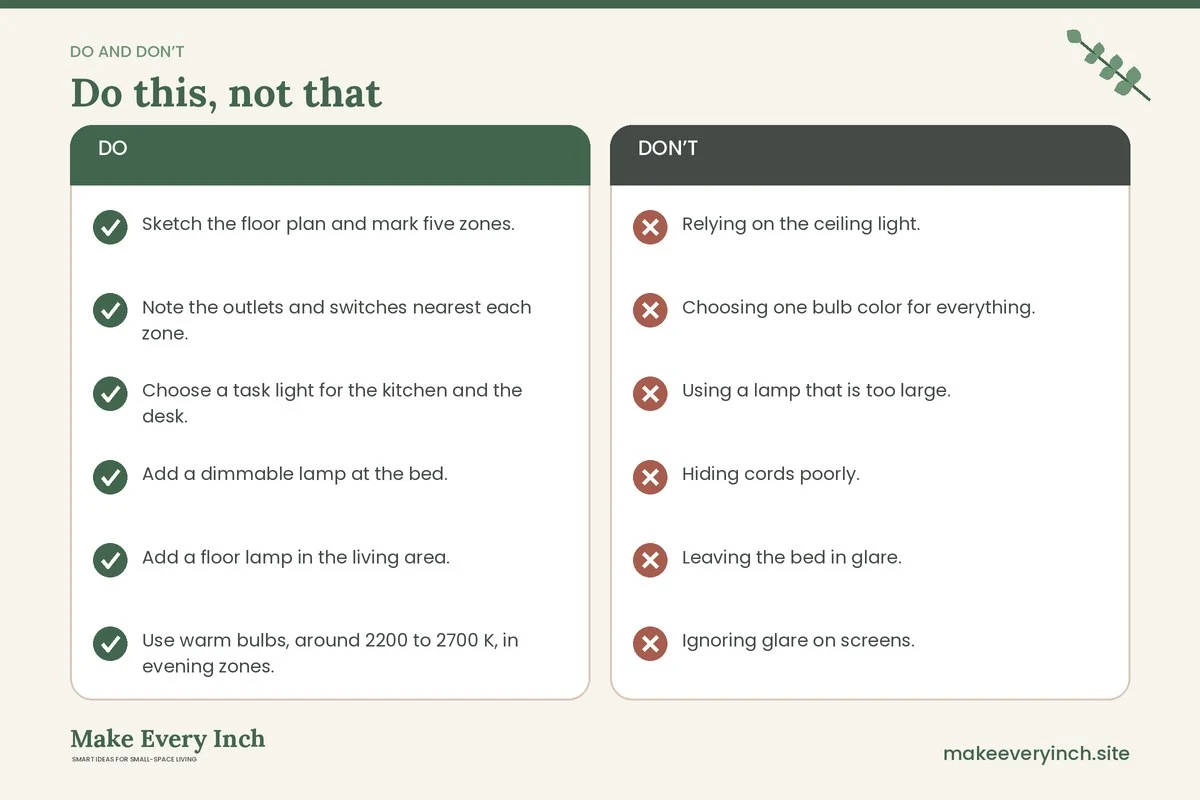
Common mistakes to avoid
- Relying on the ceiling light. One fixture flattens the room. Use it as a backup, not as the main source.
- Choosing one bulb color for everything. Warm light in the kitchen can make it look dull, and cool light in the bed zone can keep you awake.
- Using a lamp that is too large. In a small room, a huge shade eats space. Check the width and the height.
- Hiding cords poorly. A cord across the floor is a hazard. Move the lamp or use a cover.
- Leaving the bed in glare. If a light shines directly into your eyes when you lie down, shift the lamp or change the shade.
- Ignoring glare on screens. A lamp behind a screen creates reflections. Place the lamp to the side.
- Buying by watts. Use the lumens on the box.
- Skipping the lease. Ask before you hang anything on the wall.
A starter plan by priority
If you can only buy a few things, buy them in this order. Costs vary widely, so treat this as a sequence, not a bill.
- First: a task light for the kitchen counter and one for the desk.
- Second: a dimmable lamp for the bed.
- Third: a floor lamp for the living area.
- Fourth: a plug-in sconce or clip light for accent and reading.
- Fifth: a power strip with surge protection, cord clips and covers.
- Sixth: smart plugs or smart bulbs if you want schedules.
Buying second-hand lamps is a common way to save. If you do, inspect the cord and the plug, check the socket for scorch marks and replace any bulb that is not rated for the lamp. Skip a lamp with a cracked socket or a damaged cord.
Studio lighting checklist
- Sketch the floor plan and mark five zones.
- Note the outlets and switches nearest each zone.
- Choose a task light for the kitchen and the desk.
- Add a dimmable lamp at the bed.
- Add a floor lamp in the living area.
- Use warm bulbs, around 2200 to 2700 K, in evening zones.
- Use neutral bulbs, around 3000 to 4000 K, in work zones.
- Check lumens on the package.
- Use dimmable bulbs with a compatible dimmer or smart bulb.
- Keep all cords out of walkways and never under rugs.
- Plug power strips directly into the wall and do not daisy-chain them.
- Keep the smoke alarm and exits clear.
- Ask the landlord before using any wall hardware.
- Anchor tall furniture only with permission, or choose low heavy pieces.
- Test each scene: morning, work, evening, bedtime and night.
FAQ
How many lamps does a studio apartment need?
Most studios do well with five to eight light sources: one or two task lights, two or three lamps in the living area, one or two at the bed and an accent light or two. The number depends on room size and the outlets you have, so plan around the outlets.
What is the best bulb color for a studio?
Use warm white, around 2700 K, in the living and sleeping zones, and neutral white, around 3000 to 4000 K, for the kitchen and desk. Dimmable or tunable bulbs let one lamp serve more than one purpose.
Can I use plug-in sconces in a rental?
Usually yes, if the lease allows the hardware that holds them. Ask for permission before drilling or using screws. If the answer is no, use lamps that stand or clamp, or adhesive hooks rated for the weight.
Is it safe to use a power strip for lamps?
Often yes, if the total load is within the strip’s rating and you do not chain strips together. Do not use a strip for heaters or other high-draw appliances. If the strip gets warm, stop using it.
How do I light a studio without overhead lights?
Combine a floor lamp for ambient light, task lamps for work, a bedside lamp and accent lights. Aim some light at walls and the ceiling to make the room feel larger.
Can I put a dimmer on the wall switch?
In most rentals, no. Changing a switch is electrical work that the lease typically restricts, and it should be done by a qualified person. Use plug-in dimmers, cord dimmers or smart bulbs at the lamp instead.
How do I stop lights from flickering when dimmed?
Check that the bulb is dimmable and that the control suits the bulb type. Try a different bulb or a different dimmer. If flicker persists in a wall circuit, tell your landlord.
Keep going: Keep planning with our studio apartment ideas, studio apartment color schemes and small apartment living room ideas.
Save this guide for later
Pin the ideas you like to Pinterest so you can come back to them when you plan your space.