Renter Friendly Window Treatment Ideas
Quick answer: The best renter friendly window treatment ideas use tension rods, adhesive hooks, static-cling or removable film, cordless shades that fit inside the frame and curtains hung from rods that need no screws. Check the lease first, photograph each window before you start, keep every cord out of reach of children and pets, and choose each treatment by the light you want to control.
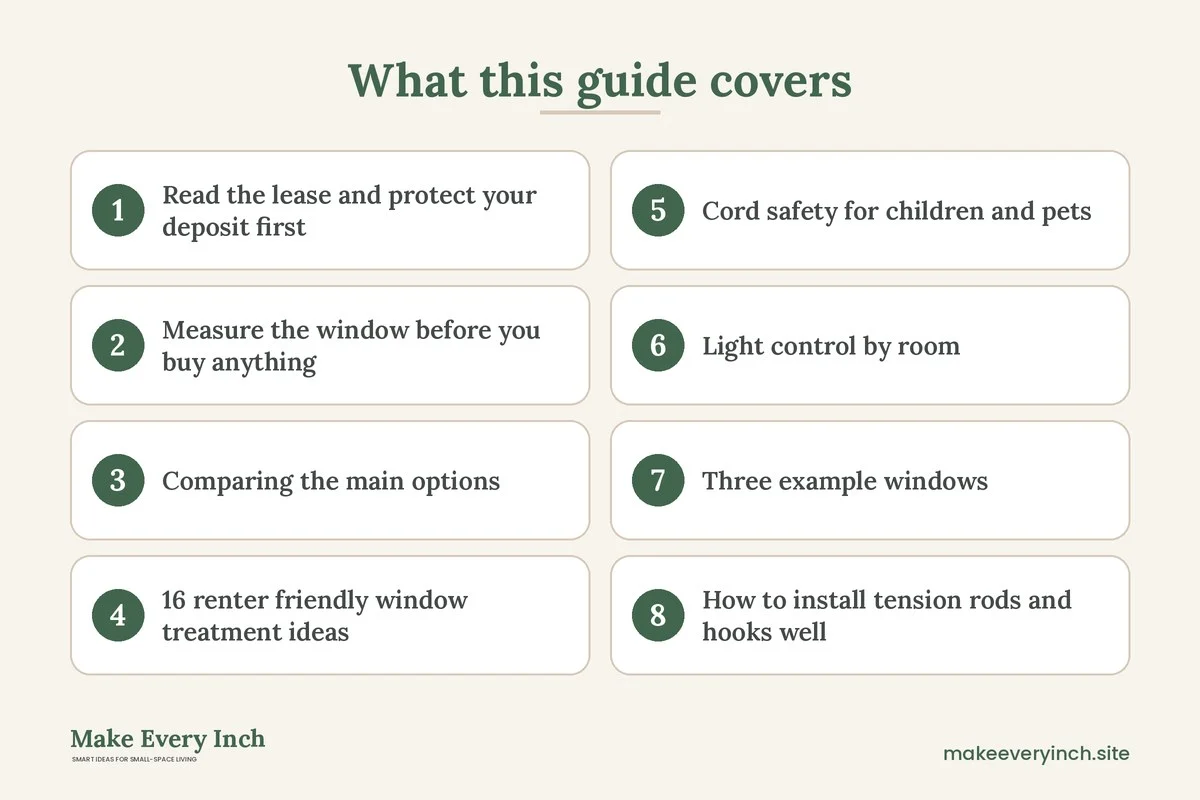
Renter friendly window treatment ideas matter more than most people expect, because bare windows are the first thing you notice in a rental. Builder blinds are often bent, the curtain rod holes are in the wrong place, and the glass faces a street or a neighbor. A window is also where privacy, heat, glare and sleep all meet, so it deserves more thought than a quick curtain. This guide shows how to treat windows without drilling, painting or leaving marks. It covers the lease check, how to measure, a table that compares the main options, 16 specific ideas, cord safety for children and pets, light control by room, three example windows, removal steps and a checklist. For the wider approach to making a rental feel like home, start with our hub guide on renter-friendly apartment decorating ideas, and pair this post with our advice on no-drill storage ideas for renters.
Read the lease and protect your deposit first
Windows are part of the building, so leases often say more about them than renters realize. Look for clauses about screws or nails in window frames, anything attached to the glass, and any blinds or shades that came with the unit. Some landlords want the existing blinds left in place, and others allow you to remove them as long as you store them and reinstall them at move-out. Ask in writing, and keep the reply. A short email that says what you plan to hang and how you will attach it protects you later.
Before you touch anything, photograph each window. Take one wide shot of the whole window and wall, then close-ups of the frame corners, the sill, the glass, the existing blinds and any marks or chips already there. Date the photos by keeping them in a folder named with the move-in date. At move-out, take the same shots again so you can compare them. This habit is the most effective deposit protection there is, and it costs nothing.
Then choose damage-free methods only. A few rules keep the risk low.
- No screws, nails or drill holes unless the lease allows them and you have permission in writing.
- Test every adhesive on a hidden spot, such as the inside of a closet door frame, and leave it for several days before you commit.
- Never stick anything onto old, flaking or recently painted frames without testing. Fresh paint can peel with the adhesive for weeks after it was applied.
- Never cover vents, radiators or baseboard heaters with fabric. Keep curtains clear of heat sources by a safe distance.
- Keep all window hardware where you can reverse it, and store anything you remove in a labeled box.
Measure the window before you buy anything
A treatment that fits well looks intentional, and one that is the wrong size looks like a stopgap. Use a metal tape measure, and write the numbers down. Measure each window separately, because windows in the same room can differ by an inch or more.
- Inside width: measure at the top, middle and bottom of the opening, from one side of the frame to the other. Use the smallest number for inside-mount items, such as tension rods and some shades.
- Inside height: measure at the left, middle and right. Use the smallest number again.
- Depth of the recess: measure from the glass to the front edge of the frame. A shallow recess of less than 2 inches limits inside-mount options.
- Outside width: measure the frame including the trim. For curtains, a rod about 6 to 12 inches wider than the frame on each side makes the window look larger and lets the curtains stack off the glass.
- Height from the floor: measure from the floor to the top of the frame and to where you want the curtain rod. Hanging a rod 4 to 6 inches above the frame, or close to the ceiling, makes a room feel taller.
- Sill depth: measure the sill, because a deep sill can hold plants and a shallow one cannot.
If a tension rod will sit in a recess, check the inside width at several points and choose a rod whose range covers that number with a little room to spare. A rod stretched to the end of its range may slip, and a rod at the very start of its range may be loose. Aim for the middle of the range.
Comparing the main options
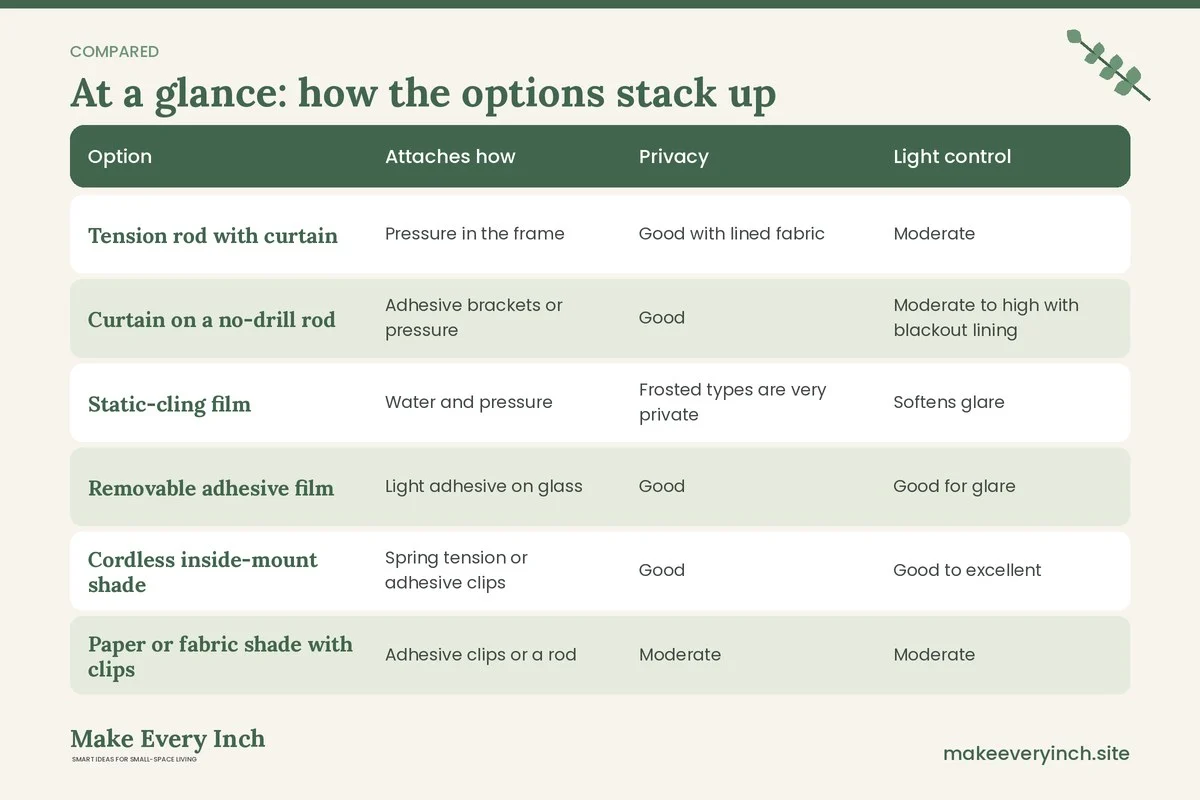
The table below compares common renter friendly window treatment ideas on the points that matter most in a rental. Use it as a first filter before you read the detailed ideas.
| Option | Attaches how | Privacy | Light control | Damage risk | Best for |
|---|---|---|---|---|---|
| Tension rod with curtain | Pressure in the frame | Good with lined fabric | Moderate | Low if not overtightened | Inside-mount recesses, bathrooms, small windows |
| Curtain on a no-drill rod | Adhesive brackets or pressure | Good | Moderate to high with blackout lining | Low to moderate, test adhesive | Wide windows and sliding doors |
| Static-cling film | Water and pressure | Frosted types are very private | Softens glare | Very low | Bathrooms, street-facing glass |
| Removable adhesive film | Light adhesive on glass | Good | Good for glare | Low, but follow the maker’s directions | Old or single-pane glass |
| Cordless inside-mount shade | Spring tension or adhesive clips | Good | Good to excellent | Low | Bedrooms and offices |
| Paper or fabric shade with clips | Adhesive clips or a rod | Moderate | Moderate | Low | Short-term fixes |
| Sheer panel layering | Any rod | Daytime privacy only | Softens light | Low | Living rooms |
| Window quilt or insulating liner | Hooks or tracks | Good | High | Low | Cold rooms |
| Valance on tension rod | Pressure in the frame | Low | Low | Very low | Hiding bent blinds |
16 renter friendly window treatment ideas
Hanging without drilling
1. A tension rod inside the frame
A tension rod fits snugly inside the window recess, held in place by spring pressure. It is the simplest way to hang a curtain, a café curtain, a lightweight valance or a panel of fabric in a rental. Choose a rod rated for the weight of the fabric, and keep curtains light. Set the rod at the right height, then twist until it grips. Do not overtighten, because too much pressure can mark soft plaster or dent a wood frame. Place a small piece of felt or a rubber cap on each end to protect the surface.
2. A café curtain on a mid-window rod
A short curtain that covers only the lower half of the window gives privacy at eye level while letting light in from above. Mount a tension rod about halfway up the glass, and clip on a half-height panel. This works well in kitchens, bathrooms and ground floor rooms that face the street.
3. Adhesive hooks above the frame
Hooks rated for the weight of a curtain rod can hold a lightweight rod above the trim. Use two or three hooks for a longer rod, and spread them evenly. Press each firmly for the time the maker recommends, wait before hanging weight, and keep the curtain light. Do not use adhesive hooks for heavy blackout curtains unless the combined weight is well within the rating, and always test a hook first on a hidden spot.
4. A rod hung from the ceiling track
If the ceiling already has a curtain track, use it. Many older apartments have a track above the window. Hang the hooks and the fabric from it with no new hardware at all.
5. A curtain on a rod that rests on the sill hardware
Some window frames have small ledges or existing brackets from earlier blinds. If the brackets are already there, ask the landlord whether you may use them. A rod resting on existing hardware leaves no new marks.
6. A floor-to-ceiling tension pole
For a wide window or a sliding door, a tall pole that pushes between the floor and the ceiling can hold a curtain panel or two. Make sure the ceiling is solid and the floor is stable, and avoid using it where the ceiling is textured or soft. This idea suits corner windows, where a wall-mounted rod would otherwise be needed.
Working with the glass itself
7. Frosted static-cling film
Static-cling film sticks to clean, wet glass with no glue, and peels away when you are ready. A frosted pattern lets daylight in and blocks the view from outside. It suits bathrooms, ground floor windows and glass in entry doors. Cut it to size with a small gap around the edges so it lies flat, and smooth out the water with a soft squeegee.
8. Removable adhesive film for glare
A thin tinted film can cut glare on a sunny window and soften the heat in summer. Follow the maker’s directions for removal. Check the lease first, because some landlords object to anything stuck on the glass, and some windows, such as double-glazed units with special coatings, should not be covered with film because of heat build-up. If you are unsure, ask the landlord or skip this idea.
9. A decorative film panel on a lower pane
Use a patterned film on one pane instead of the whole window. A single frosted panel at the bottom hides the street view and leaves the top of the window clear for light.
10. A fabric panel hung just inside the glass
Where you cannot put film on the glass, hang a sheer panel on a tension rod inside the frame. The fabric diffuses the light and hides the street view during the day.
Shades and blinds
11. A cordless inside-mount shade
A cordless shade that sits inside the frame removes the risk from dangling cords and gives clean lines. Some designs are held in place by spring tension or small clips and need no screws. Measure the inside width carefully, since these shades must fit within a small tolerance. For homes with young children or pets, a cordless version is the safer default.
12. A paper or fabric pleated shade with stick-on clips
A lightweight pleated shade attaches with adhesive strips inside the frame. It is simple, cheap to replace and suits short-term stays. Keep expectations modest: light paper shades diffuse light and add privacy, but they do not block it entirely. They are also not meant for damp rooms.
13. Slats on a sill-mounted frame
A freestanding frame that holds a shade can sit on the sill and lean against the glass. This is useful for odd windows. Check that it cannot tip or fall out if the window is opened.
Layering and insulation
14. Sheers plus a heavier panel
Hang a sheer panel on one rod and a heavier panel on a second rod. Close the sheers for daytime privacy, and add the heavy panel at night. If the lease allows only one tension rod, a double rod with two tracks does the same job.
15. A thermal liner or quilt
A heavy insulating liner on the back of a curtain slows drafts and heat loss. It works best when the curtain reaches the sill or the floor and extends past the edges of the frame. Do not let a liner touch a radiator or a heater.
16. A valance to hide old blinds
If the landlord requires you to keep the existing blinds, hide the headrail and any worn slats with a valance on a tension rod. The blinds stay intact, you get a fresh look and you can remove the valance at move-out.
Cord safety for children and pets
Cords on blinds and shades are a known hazard. Loops can catch a child’s neck, and a cat or a dog can get caught in a pull cord or tangle in a chain. Treat every cord as something to remove or secure, even in a rental.
- Choose cordless products wherever you can. A cordless shade has no loop to catch, and a spring-tension design needs no wand or chain.
- If the existing blinds have cords, ask the landlord whether they can be replaced or whether you may add a cord cleat or a tension device. Cord cleats attach to the wall or frame with adhesive, but test the adhesive and place it high enough that a child cannot reach it.
- Keep furniture away from windows. Cribs, beds, sofas and shelves under a window give children a way to climb to the cords. Move them to another wall.
- Do not tie cords in loops, and do not drape a pull cord over a hook near the floor.
- Check the weight of curtains on tension rods, because a rod that falls onto a child or pet is its own hazard. Choose lightweight fabric and secure the rod.
- Keep window treatments away from heaters and candles. Fabric should never touch a space heater, a radiator or a lit flame.
- Secure curtain ties and tiebacks so that they sit high on the wall or on the curtain itself and do not hang low.
- Watch for curtain climbing. Kittens and some dogs enjoy hanging off long fabric. Short curtains and sheers that stop at the sill are easier to manage.
Look for current product safety guidance from consumer safety bodies, because standards for window coverings are updated from time to time. If a product claims to be safe for children, read the label and the instructions carefully. When in doubt, choose the simplest option, which is a cordless treatment with no loops.
Light control by room
Each room needs a different balance of light, privacy and heat. Think of the window as a dial rather than a switch.
Bedroom
Sleep needs darkness. A blackout liner behind a curtain, or a cordless blackout shade inside the frame, blocks most morning light. For more on lamps that make a dark bedroom comfortable, see our small bedroom lighting ideas. Leave a gap of an inch or two at the sides if you hang the curtain outside the frame, since light seeps around the edges. A curtain that is wider than the window by several inches and reaches the floor reduces the leak. If a bedroom faces a streetlight, consider a lined panel plus a shade.
Living room
A living room benefits from layers. Sheers soften the light during the day, and heavier curtains close for movie nights. Pair the window with the right lamps from our small living room lighting ideas for renters. Hang the rod high and wide so the window looks larger, and let the fabric stack beside the frame, not across the glass.
Kitchen
Kitchens produce steam and grease, so choose washable fabric, a café curtain or a film. Keep fabric away from the stove. A short tension rod with a small panel offers privacy without adding bulk near the cooktop.
Bathroom
Humidity ruins many fabrics and some adhesives. Static-cling film is a good fit, since it does not rely on glue and handles moisture well. A fabric curtain should be quick-drying and washable. If the bathroom has an exhaust fan, run it after showers to keep the window dry.
Home office
Glare on a screen causes eye strain. Cordless light-filtering shades reduce glare while keeping daylight. Our best desks for small apartments guide helps with the desk itself. Position the desk perpendicular to the window when you can, so the light falls on the side of the screen.
Three example windows
A bedroom window facing the street
A 36-inch-wide window in a rented bedroom faces a streetlight, and the landlord bans screws. The renter measures an inside width of about 35 and a half inches and fits a cordless blackout shade that grips the frame with spring tension. To block the light that leaks at the sides, a curtain on a tension pole at the wall corner frames the window, with panels that stack past the frame. The shade handles darkness, the curtain handles the look, and no hole is drilled. Because the room has a bed under the window, the renter moves the bed to the opposite wall to keep children and pets away from any cords.
A kitchen window above the sink
A small window above the sink steams up and splashes. The renter uses frosted static-cling film on the lower half, which lets light in and blocks the neighbor’s view, and puts a short tension rod across the top with a washable valance. Nothing touches the stove, and the film comes off with water when the lease ends. This setup keeps the sill clear for a small herb pot or a soap dish.
A wide living room window with old blinds
A living room has a 72-inch window with bent vinyl blinds that the landlord wants left in place. The renter hangs a rod above the frame on adhesive hooks rated well above the weight of two light linen panels, and keeps the blinds raised behind them. The fabric hides the damaged slats, and a sheer panel behind the linen softens the glare. At move-out the renter removes the hooks with the stretch-release method described in the maker’s directions, wipes the wall and checks it against the move-in photographs.
How to install tension rods and hooks well
Good installation prevents most damage. These steps work for most rentals.
- Clean the surface with a damp cloth and let it dry fully. Dust and grease weaken adhesives.
- Test first. Stick a small piece of adhesive to a hidden spot, wait a few days and remove it slowly to see whether it lifts paint.
- Mark the position with painter’s tape so that the rod or hook sits level. Use a level or a phone app to check.
- Press firmly for the time the maker recommends, and wait the recommended time before adding weight.
- Adjust a tension rod gently, twisting until it holds, then give it a light tug. Add a final quarter turn only if needed.
- Keep a weight margin. Use a rod and hooks rated for more than the weight of the fabric. Wet or lined curtains weigh more than they look.
- Check monthly. Adhesive can weaken with heat, humidity and sunlight, so look at hooks and rods now and then.
Removing treatments without damage
At move-out, take down each item in the reverse order. Pull stretch-release adhesive slowly and parallel to the wall, following the maker’s directions. If a hook resists, a hair dryer on low can soften the adhesive, but keep it moving and do not heat the paint. Remove film by lifting a corner, peeling slowly and washing off any residue with warm soapy water. Wipe the frame, and compare it with your move-in photographs. If you used felt or rubber caps on a tension rod, check that they did not leave a ring. Return any original blinds to their positions so the unit looks as you found it.
Window upgrades fit into a wider plan, and our budget renter upgrades post shows where else small changes add up.
Common mistakes
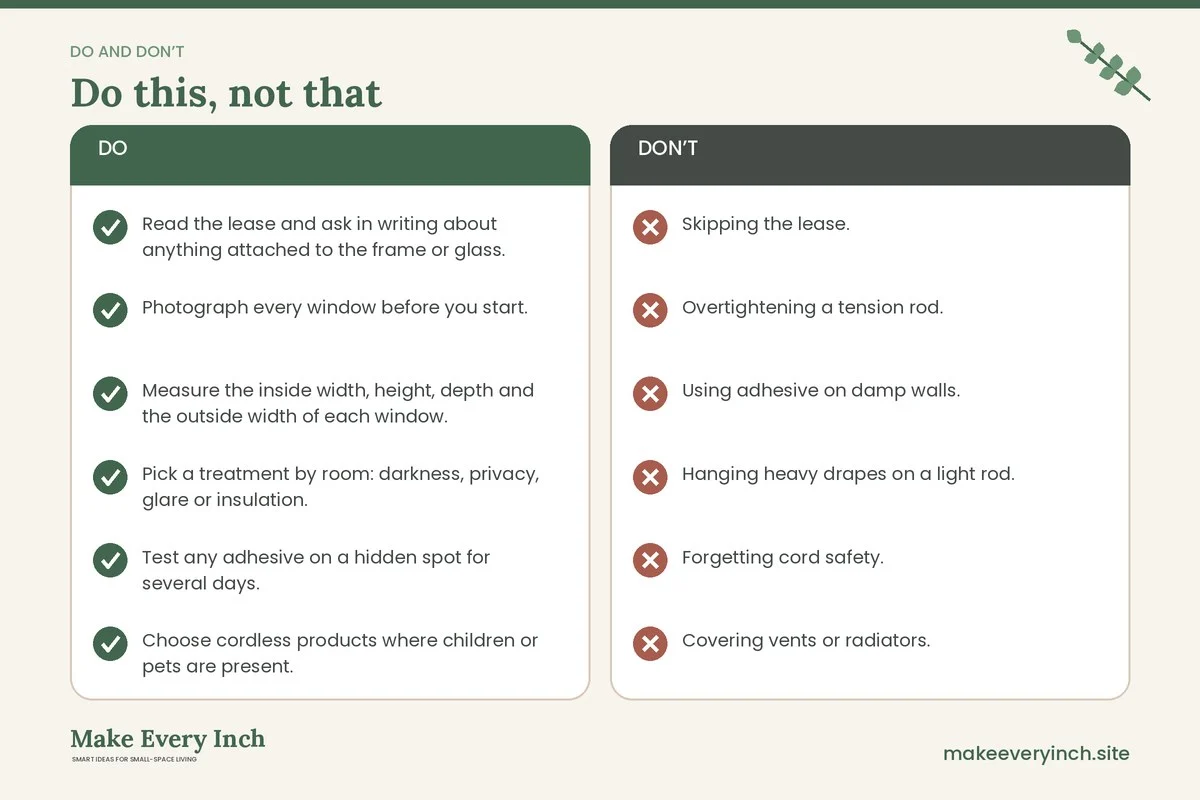
- Skipping the lease. A treatment that breaks a clause can cost you part of the deposit.
- Overtightening a tension rod. More pressure does not mean more strength, and it can dent soft surfaces.
- Using adhesive on damp walls. Bathrooms and kitchens weaken adhesives, so choose pressure or static-cling methods there.
- Hanging heavy drapes on a light rod. Weight pulls a tension rod loose.
- Forgetting cord safety. Choose cordless wherever a child or pet lives or visits.
- Covering vents or radiators. This blocks heat and can create a fire risk.
- Buying before measuring. Windows differ even in the same unit, so measure each one.
- Ignoring the sun. Sunlit fabric fades, and sunlit adhesive softens. Use lined curtains and check adhesive more often on a south or west window.
Window treatment checklist
- Read the lease and ask in writing about anything attached to the frame or glass.
- Photograph every window before you start.
- Measure the inside width, height, depth and the outside width of each window.
- Pick a treatment by room: darkness, privacy, glare or insulation.
- Test any adhesive on a hidden spot for several days.
- Choose cordless products where children or pets are present.
- Keep furniture and cribs away from windows.
- Keep fabric clear of heaters, radiators and flames.
- Match rod and hook ratings to the real weight of the fabric.
- Save the original blinds if you remove them.
- Take move-out photographs and compare them with the move-in set.
FAQ
Can I use a tension rod in any window?
Most windows with a firm frame accept one, but soft plaster, thin trim or a very wide opening can fail. Test the rod with the curtain on it before relying on it, and use a lighter fabric on wider spans.
Are there window treatments that need no tools at all?
Yes. Tension rods, static-cling film, spring-tension shades and clip-on panels need no tools. Adhesive hooks need only a clean surface and a bit of patience.
What is the safest option for small children and pets?
A cordless treatment that fits inside the frame is the safest default. Keep furniture away from the window, and avoid any loops or hanging cords.
Will window film damage the glass?
Static-cling film does not use glue and is generally gentle on glass. Adhesive films vary, and some are not suitable for coated or double-glazed windows. Follow the maker’s directions and ask the landlord if you are unsure.
How do I block light in a rental bedroom without drilling?
Combine a cordless blackout shade inside the frame with a lined curtain on a tension pole or no-drill rod. Make the curtain wider than the frame, so light does not leak around the edges.
How do I keep my deposit safe?
Read the lease, use damage-free methods, photograph every window before and after, and keep any original blinds in storage. If the landlord approves something, get it in writing.
Keep going: Keep going with our guides to renter-friendly lighting ideas, removable wallpaper ideas and security deposit safe apartment upgrades.
Save this guide for later
Pin the ideas you like to Pinterest so you can come back to them when you plan your space.