21 Minimalist Apartment Ideas for Small Spaces You Can Live In
Quick answer: The best minimalist apartment ideas focus on editing, not emptiness. Remove what you do not use, keep a short list of belongings per category, choose furniture that does two jobs, limit your palette to three or four tones, hide storage behind doors and add warmth with texture. Follow a one-in-one-out rule so the result lasts, and keep a few items that make you happy.
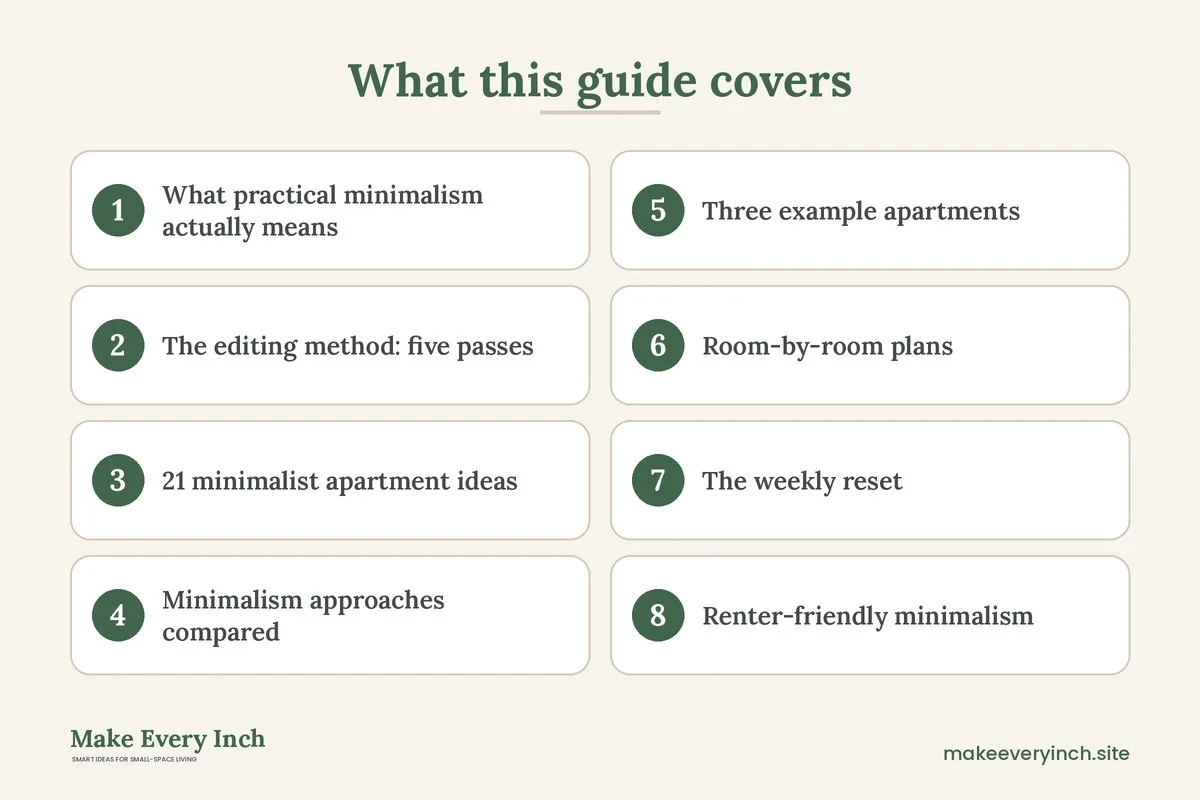
Minimalist apartment ideas work best in small homes, because every object competes for a few hundred square feet. But many minimalist rooms online look like empty showrooms, and nobody can live in a showroom. Real minimalism means keeping what you use and love, giving each item a home and leaving room to breathe. This guide covers a step-by-step editing method, a capsule approach to belongings, 21 ideas, a comparison table, three example apartments, room-by-room plans, how to add warmth, a budget guide, common pitfalls and a checklist. If you are starting from a very cluttered place, read small apartment decluttering ideas first, then come back here.
What practical minimalism actually means
Minimalism is a way of deciding what earns space. It does not require white walls, no art or three plates. A person who cooks daily needs a good knife, a pan and a few bowls close at hand. A person who works from home needs a real chair. The test is simple: does this object serve a regular use or bring clear pleasure? If neither, it is taking space, and in a small apartment space is the most valuable thing you own.
Aim for calm, not austerity. A minimalist apartment can have books, plants, art and a favorite blanket. What it avoids is surplus: duplicate tools, unused gadgets, piles on every flat surface and furniture bought only to fill gaps.
The editing method: five passes
Do not try to declutter the whole home in a day. Work by category, in this order, and finish each before moving on.
- Pass 1: Clothes and shoes, since they are easy to judge by fit and use
- Pass 2: Kitchen items, starting with duplicates and rarely used appliances
- Pass 3: Paper, books and media, keeping only what you will reread or need
- Pass 4: Bathroom and cleaning supplies, discarding expired and half-used products
- Pass 5: Sentimental items, last, when your decision-making is warmed up
For each item, ask three questions: Have I used this in the last year? Would I buy it again today? Do I know where it lives? Two or more no answers means it goes. Use four boxes: keep, donate, sell and trash. Move donations out of the apartment the same week, or they will drift back. Any item you are unsure about goes into a “maybe” box with a date written on it, and if you have not opened the box in 90 days, donate it unopened.
21 minimalist apartment ideas
Edit and own less
1. Build a capsule wardrobe
Aim for roughly 30 to 40 pieces for a season, built around a few colors that mix. Count shoes, coats and accessories separately if you wish, but set a number. A single rail or a small closet that is never jammed is a sign the number is right.
2. Keep a kitchen capsule
A small kitchen usually needs one chef’s knife, one paring knife, two pans, a pot, a baking sheet, a few mixing bowls and a service set for the number of people you actually host. Remove the single-use gadgets. Keep what you used in the past month within arm’s reach and put the rest in higher cabinets or give it away.
3. Adopt one-in-one-out
When something new enters, something similar leaves. Buy a new sweater and donate an old one the same day. This rule alone stops clutter from returning, and it works for books, mugs, bags and decor.
4. Digitize paper
Scan bills, manuals and kids’ artwork with a phone app, and shred the originals unless the law requires paper. Keep one slim folder or a small box for passports, lease and tax documents. A drawer of loose paper is clutter in disguise.
5. Set a limit for sentimental items
Give sentimental belongings a single container, such as a 12 by 18 inch memory box. Take a photo of anything that no longer fits, and let it go. This keeps memories without turning the apartment into a storage unit.
Furniture and layout
6. Choose multi-use furniture
A storage ottoman, a sofa bed, a drop-leaf table or a bed with drawers can replace two or three separate pieces. Choose items with simple lines, since fussy details collect dust and visual noise. See small space storage furniture for ideas that work twice as hard.
7. Float fewer, larger pieces
Several small pieces look cluttered, while one good sofa and one coffee table look calm. Leave about 30 to 36 inches for main walkways and at least 18 inches between a sofa and a coffee table. Furniture with exposed legs lets the floor show, which makes the room feel larger.
8. Keep one clear surface per room
Pick one surface, such as the coffee table, a desk or the kitchen counter, and keep it clear except for one or two chosen items. A clear surface gives the eye a rest, and it makes cleaning take five minutes instead of thirty.
9. Use a tight color palette
Choose three or four tones, such as warm white, oatmeal, charcoal and one earthy accent like olive or terracotta. Repeating the same colors makes a room feel quiet even with many objects. Use pattern sparingly, in one rug or one pillow.
10. Hide storage behind doors
Closed storage keeps visual noise down. Use a low cabinet with doors under a window, bins with lids in a closet and under-bed boxes. Open shelving works only when you edit it to a few chosen objects. See hidden storage ideas for more ways to conceal things.
11. Go vertical, quietly
Tall, narrow storage uses height without taking floor space. A shelf 6 to 8 feet high in a matching color to the wall almost disappears. Keep the top shelves for rarely used items and use identical boxes to make them look orderly. See vertical storage ideas.
12. Let a bed be the bedroom
Choose a simple frame with storage drawers or a low platform, one pair of bedside tables and nothing else on the floor. Keep the surface of the dresser limited to a tray and a lamp. See small bedroom ideas for layouts that fit.
Warmth and calm
13. Add warmth with texture
Texture replaces clutter. Layer a wool throw, linen curtains, a jute rug and a ceramic lamp in similar tones. A minimalist room with only smooth, hard surfaces feels cold, and four or five textures fix that without adding items. The related Japandi apartment ideas show a very warm version of this.
14. Use natural materials
Wood, linen, cotton, wool, clay and stone look good for years and age well. A single wooden bench, a clay vase or a wool rug gives more character than a shelf of mass-produced trinkets. Choose fewer, better items, and repair them when possible.
15. Light the room softly
Replace harsh ceiling light with two or three lamps at 2700K and about 450 to 800 lumens each. Soft light makes simple rooms feel warm and designed. Hide cords with cable clips or a cover painted the wall color.
16. Display, do not store, a few favorites
Choose three to five objects you love, and give them space on a shelf or a tray. Leave a hand-width of empty room around each. Rotate the display every season, and keep the rest in a box.
17. Bring in one plant
One large plant, such as a rubber plant or a fiddle leaf fig in a plain pot, brings life and a soft shape to a spare room. Two or three small ones on a sill do the same. Skip a collection of ten.
Kitchen, bathroom and entry
18. Clear the counters
Keep only the coffee maker, a knife block or a magnetic strip and one fruit bowl out. Store the toaster and blender in a cabinet. A clear counter makes cooking easier, and the kitchen looks twice as large. See small kitchen counter organization.
19. Simplify the bathroom
Use matching dispensers or refill bottles, one set of towels per person and a basket for extras. Keep only daily products on the counter. A small shelf over the toilet holds the rest in lidded bins. See small bathroom organization ideas.
20. Create a drop zone, not a pile
A hook, a tray and a small bench by the door keep keys, mail and bags from landing on the table. Limit coats to what the hooks hold, and store the off-season in a closet bin. See small entryway storage.
21. Keep the floor mostly clear
Avoid floor clutter such as baskets of toys, stacked shoes and drying racks. Anything on the floor makes the room look smaller. Store or fold items away at night, and use wall hooks, under-bed boxes and tall storage to lift things off the floor.
Minimalism approaches compared
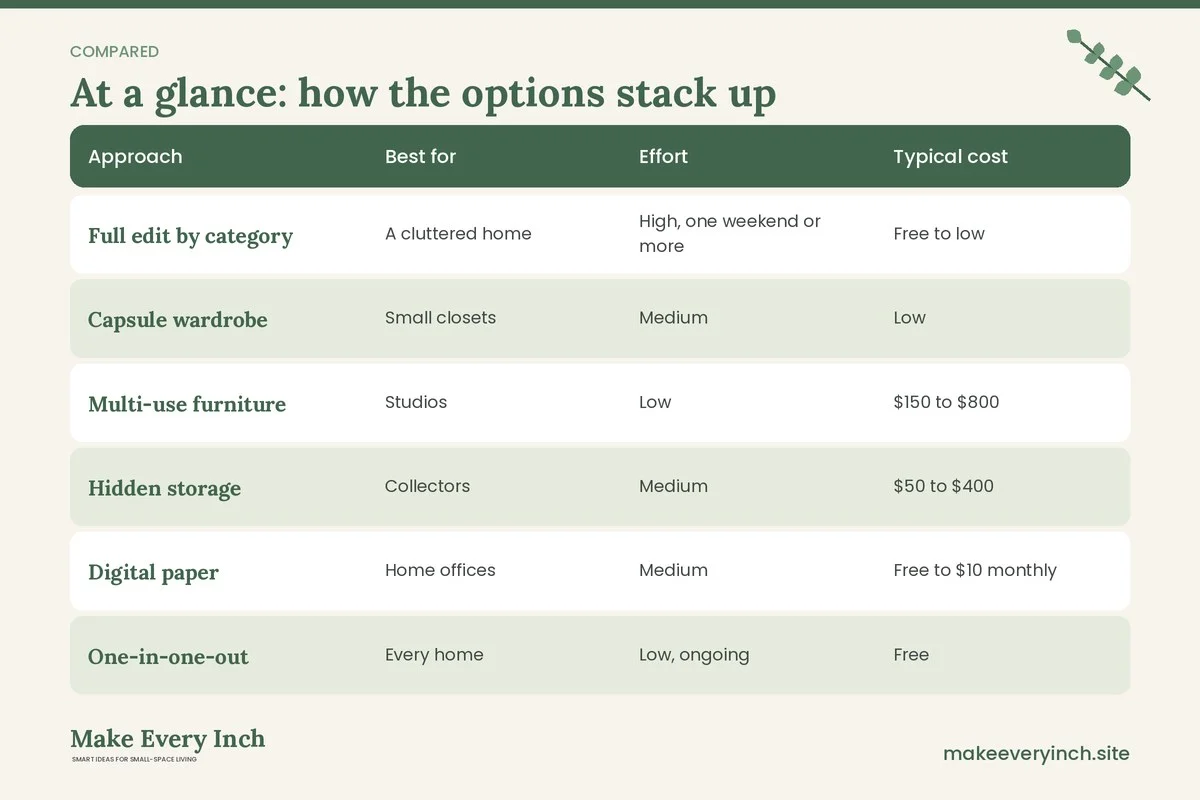
| Approach | Best for | Effort | Typical cost | Risk of clutter returning |
|---|---|---|---|---|
| Full edit by category | A cluttered home | High, one weekend or more | Free to low | Low if one-in-one-out is used |
| Capsule wardrobe | Small closets | Medium | Low | Medium |
| Multi-use furniture | Studios | Low | $150 to $800 | Low |
| Hidden storage | Collectors | Medium | $50 to $400 | Medium |
| Digital paper | Home offices | Medium | Free to $10 monthly | Low |
| One-in-one-out | Every home | Low, ongoing | Free | Very low |
| Texture and color edit | Cold or sterile rooms | Low | $40 to $250 | None |
Three example apartments
A 350 square foot studio
The renter keeps a sofa bed, a drop-leaf table, a wall of closed storage and a narrow rail for clothes. The palette is warm white, oatmeal and black, and the sofa is the only large object. The floor is almost fully clear, and the room works as a living room, bedroom and office. Estimated cost for the key furniture is about $900 to $1,500 secondhand and new combined.
A one-bedroom shared by two
Each person gets a capsule wardrobe in half of a closet and one memory box. The kitchen has a shared set of tools and no duplicates, and a weekly five-minute reset clears surfaces. The couple keeps colorful art on one wall, and neutral colors elsewhere, so the home feels personal. The one-in-one-out rule applies to both.
A rental with a work-from-home desk
A freelancer uses a slim desk with a drawer, a closed cabinet and a single shelf for a few books. Every cable runs through one cord organizer, and the desk is cleared at the end of each day, so the room becomes a living space again. The tenant uses a lamp, a rug and a linen curtain, with no holes in the walls.
Room-by-room plans
Living room
One sofa, one table, one lamp, a rug and a storage cabinet. Limit decor to a few chosen objects, and add a throw for warmth. See small apartment living room ideas.
Bedroom
A bed, two lamps and one dresser or a built-in closet. Keep surfaces clear, and use bedding in one or two textured fabrics, such as washed linen and cotton. See small bedroom storage ideas.
Kitchen
Cabinets handle most items, and the counter holds just the daily essentials. Use matching containers for dry goods, and rotate pantry items using a first-in, first-out rule. See small kitchen organization ideas.
Bathroom
One towel set per person, a single shelf of products and a small bin. Replace old products only when empty.
Entry
Three hooks, a tray and a shoe rack that holds four pairs. Everything else lives in the closet.
The weekly reset
Minimalism is a habit more than a project. Spend ten minutes each evening returning items to their homes, and twenty minutes on Sunday doing a larger reset. Clear the counters, wipe the tables, empty the bag and check the fridge. Scan any paper that has arrived, and remove one unused item from a shelf or drawer. Because everything has a home, the reset is fast. If an item has no home, either create one or let the item go.
Renter-friendly minimalism
You can create a minimalist home without touching the walls. Use freestanding storage instead of built-ins, and choose furniture that you can take with you. Use lamps instead of replacing fixtures, and leaning mirrors and art instead of drilling. Check the lease for rules about adhesives, and photograph each room before you start. Hide cords with clips. Choose neutral items that will work in your next home as well, since furniture that suits any room is the best long-term investment. For more, see no drill storage ideas for renters.
Adding warmth so it does not feel sterile
The most common complaint about minimalist rooms is that they feel cold. Fix that with warm light, a mix of materials and a few personal objects. Choose warm whites, not blue-toned whites. Add a wool or cotton throw, linen curtains and a rug with some pile. Keep a few photos or art pieces that mean something to you. Add scent with a candle or a diffuser. A plant, a wooden bowl and a stack of books you love make the space feel lived in. The goal is a room that is quiet but not empty.
Budget guide
Under $100
Storage bins with lids, hooks, matching hangers and a few bulbs. Most of the work is free, because it means removing things.
About $300
Add a storage ottoman, a floor lamp, linen curtains and a large plant. Sell unwanted items to offset the cost.
$800 and up
Add a sofa bed or a bed with drawers, a closed cabinet, a quality rug and a wool throw. Buy fewer, better items, and look at secondhand shops first.
Mistakes to avoid
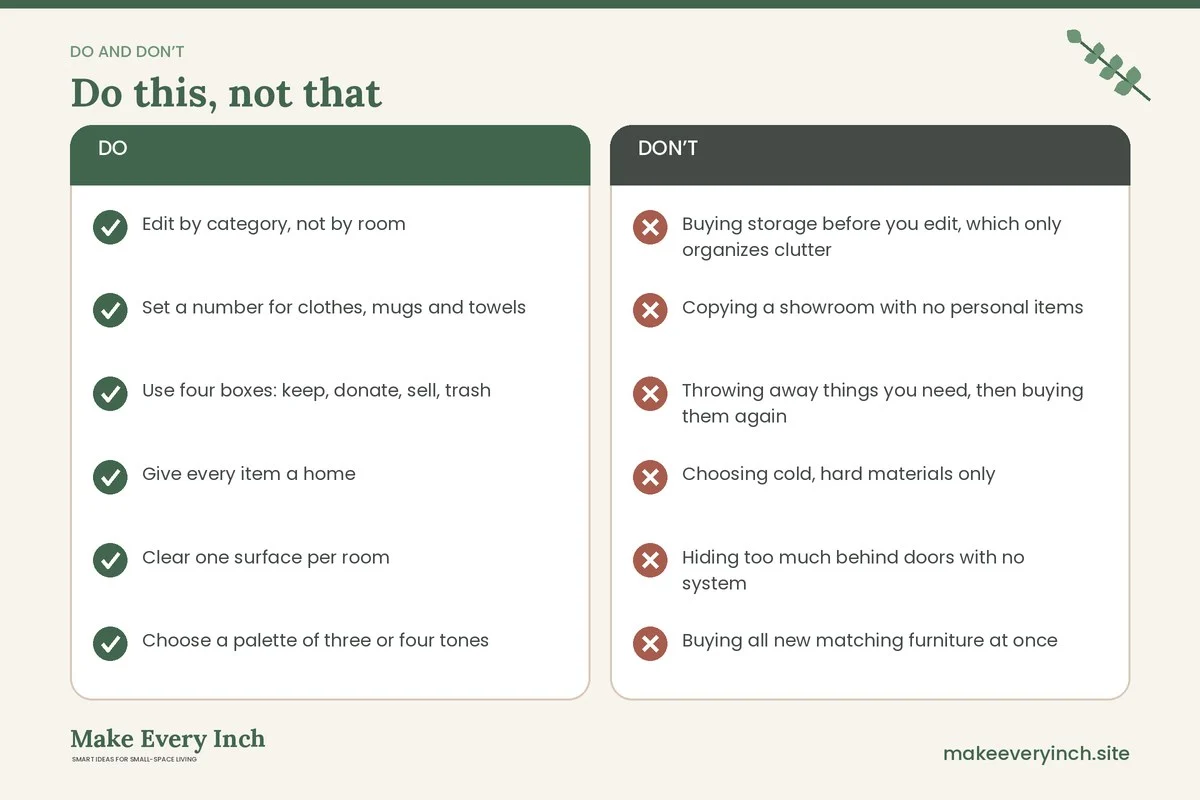
- Buying storage before you edit, which only organizes clutter
- Copying a showroom with no personal items
- Throwing away things you need, then buying them again
- Choosing cold, hard materials only
- Hiding too much behind doors with no system
- Buying all new matching furniture at once
- Forgetting a plan for gifts and impulse purchases
- Expecting perfection every day
Minimalist apartment checklist
- Edit by category, not by room
- Set a number for clothes, mugs and towels
- Use four boxes: keep, donate, sell, trash
- Give every item a home
- Clear one surface per room
- Choose a palette of three or four tones
- Add three or more textures
- Use warm, soft light
- Adopt one-in-one-out
- Do a ten minute reset each evening
FAQ
What is a minimalist apartment?
It is a home with fewer, chosen belongings, clear surfaces and furniture that serves a purpose. It is not empty, and it keeps things that you use or love.
How do I start decluttering for minimalism?
Start with clothes, then kitchen, paper, bathroom and sentimental items. Use keep, donate, sell and trash boxes, and finish each category before moving on.
How do I make a minimalist apartment feel cozy?
Use warm 2700K lighting, layered textures such as wool, linen and jute, a few personal items and a plant.
How many clothes should a minimalist have?
There is no set number, but 30 to 40 pieces for a season is a common starting point. Adjust for your job, climate and laundry habits.
Can I be a minimalist with a partner or children?
Yes. Agree on shared categories, give each person a small personal space and use one-in-one-out. Children’s items need rotating bins.
Is minimalism expensive?
It can be cheap, since the main step is removing things. Buy quality pieces slowly, and sell what you remove to pay for them.
What colors suit a minimalist apartment?
Warm white, beige, gray, black and one earthy accent. Repeating a few tones keeps a room calm.
How do I stop clutter from coming back?
Use one-in-one-out, a weekly reset and a home for every item. Pause before buying anything new for 48 hours.
Keep going: Keep going with small apartment decluttering ideas, hidden storage ideas and modern small apartment ideas.
Save this guide for later
Pin the ideas you like to Pinterest so you can come back to them when you plan your space.