21 Small Apartment Living Room Ideas Budget Plans Can Deliver
Quick answer: The best small apartment living room ideas budget plan is an order of purchases, not a shopping list. Rearrange for free first, then spend about $50 on lighting and a throw, about $150 on a rug or curtains, about $400 on seating or a table, and about $800 on the one big piece you will sit on every day. Buy the sofa, rug and lamps second-hand, and save money on frames, pillows and storage boxes.
Small apartment living room ideas budget guides usually hand you a pile of cheap products. This one gives you a sequence instead. A living room has about six jobs (seating, lighting, a surface, a rug, storage and a focal point), and each one does more for the room at some price points than at others. Buying in the wrong order is how people end up with a $60 gallery wall around a sagging sofa. The plan below starts with free moves, then walks through four spending tiers at roughly $50, $150, $400 and $800, with second-hand sourcing rules and a clear list of where to save and where to spend. If you want the general, non-money-based advice, start with our guides to small living room ideas and small apartment living room ideas. If you want a single finished makeover, see small living room makeover under $500 and small apartment decor under $100. This post is about the order in which the dollars should go.
How to read the tiers
Each tier is a stage, not a separate budget. You can stop at any tier and the room will look finished, and you can continue later without redoing earlier purchases. Prices are rough US ranges and vary by city, season and how patient you are with listings. Check the lease before you buy anything that attaches to a wall, and photograph the room before you start so that you have a record of the original condition.
21 small apartment living room ideas budget plans can deliver
Free changes: do these before you spend anything
1. Re-float the furniture
Pull the sofa 4 to 6 inches off the wall, even in a small room, and try it on the long wall, the short wall and at an angle. Walkways should stay at about 30 to 36 inches wide, and a path that runs straight from door to window rarely needs to be wider than that. Moving furniture costs nothing, and a better layout often beats any purchase.
2. Clear the surfaces to three items each
Take everything off the coffee table, TV stand and windowsill, then put back only three things per surface. A tray, a plant and one book looks deliberate, while twelve small objects look like clutter. Put the rest in a box for two weeks. Whatever you do not miss can be sold, which turns clutter into budget.
3. Shop your own home
Borrow a lamp from the bedroom, a stool from the kitchen and a blanket from the closet. A bedside lamp on a bookshelf at 40 inches high is a better reading light than a ceiling fixture. Swapping pillows between rooms also gives the sofa a new look.
4. Open the window treatments and clean the glass
Move curtains fully off the glass, wipe the window and take the screen off if the lease and building allow. In a small room, letting in every bit of daylight changes how big the room feels. Clean windows and pulled-back curtains cost nothing and make the room look bigger.
5. Sell what blocks the room
An oversized armchair, a bulky TV stand or an extra side table might be worth $30 to $150 each in local listings. Sell one item, then use the money as your first-tier budget. Take photos in daylight, and measure before you list so buyers can see the dimensions.
Tier one: about $50
6. Warm bulbs and one extra lamp
Replace cold white bulbs with warm white bulbs in the 2700K range, which cost a few dollars each. Add one table or clip lamp from a thrift store, usually $5 to $15, and put it at sofa height. Three low light sources make a living room feel larger and calmer than a single overhead light.
7. A real throw and two pillow covers
Buy covers rather than full pillows, since a 20 inch cover is often under $12 and fits the inserts you already own. Choose one texture (wool, chunky knit or linen) and one color from your rug or curtains. A throw folded over one arm makes a flat sofa look finished.
8. A tray and a plant
A tray on the coffee table or ottoman corrals remotes and candles, and a tough plant such as a snake plant or pothos adds life. Together they cost roughly $15 to $30 new and less second-hand. They tie loose objects together into one group.
9. Command-style hooks and cord control
Cord clips, a cable sleeve and removable hooks tidy the TV area for about $10 to $20. Hiding cables does more for a small living room than a new TV stand does. Test any adhesive in a hidden spot first and follow the weight rating on the package.
Tier two: about $150
10. A rug that is big enough
A rug that is too small is the most common mistake in a small living room. Aim for at least 5 by 8 feet, with the front legs of the sofa and chairs on it. Buy second-hand wool or a flat-weave synthetic on sale, and expect about $80 to $150 for this size.
11. Curtains hung high and wide
Hang a rod 4 to 6 inches above the window frame and 8 to 12 inches wider on each side. Use floor-length panels in a light color. Basic panels and a tension or standard rod usually cost $40 to $80 together, and the room gains height at once. Renters who cannot drill can see our guide to renter-friendly small apartment living room ideas.
12. A second light source at a different height
Add a floor lamp in the corner next to the sofa, where it lights the ceiling and walls. Choose a slim base, because a wide one eats floor space (see best floor lamps for small rooms). A basic arc or tripod lamp is often $30 to $60 new and half that second-hand.
13. A mirror that faces the window
A large mirror leaned on the wall opposite or beside the window bounces light across the room. Thrift stores and listings often have framed mirrors for $20 to $60. Lean it on the floor if you cannot hang it, and anchor a heavy one to prevent tipping.
Tier three: about $400
14. The right coffee table or nesting set
Two nesting tables, or a small round table 28 to 32 inches wide, fit a small room better than a rectangular table 48 inches long. Nesting tables are flexible and can slide away when guests arrive. Expect $60 to $150 new and $25 to $70 second-hand.
15. A TV stand or console at the right size
Choose a console 14 to 16 inches deep and 36 to 55 inches wide, with legs, so that the floor stays visible. Open shelves hold the router and a few baskets. A freestanding unit means nothing is mounted to the wall. Budget about $90 to $200 new.
16. An accent chair or pouf for the second seat
A compact armchair around 28 inches wide gives guests a seat without a second sofa. If the budget is tight, buy two poufs for $40 to $80 each, which tuck under a table when you do not need them. Check our small living room furniture ideas for more compact pieces.
17. Closed storage you can hide things in
One lidded basket, a storage ottoman or a cabinet with doors removes visual clutter. Closed storage looks calmer than open shelving in a small room. Budget $50 to $140, and look second-hand for solid wood versions.
Tier four: about $800
18. The sofa, bought second-hand or on sale
The sofa is the biggest purchase in the room and the one most worth waiting for. For a 12 by 14 foot room, look for a sofa 70 to 80 inches long and 32 to 36 inches deep, with raised legs and slim arms. Used sofas in good condition often sell for $150 to $500, while new apartment-size sofas generally start around $450 to $900. Our guide to the best sofas for small apartments covers the specs in detail.
19. A loveseat for rooms under 10 feet wide
If the room is under 10 feet wide, a 55 to 65 inch loveseat with a pouf may fit better than a full sofa. A loveseat leaves a 36 inch walkway where a standard sofa would not. It also costs less, often $300 to $600 new.
20. One piece of real wall art
Spend $50 to $150 on one large print or an original from a local artist, at least 24 by 36 inches, and lean it on a console. One large piece is cheaper and calmer than a grid of small frames. Frame it in a simple wood or black frame, using acrylic for lighter weight.
21. A quality lamp or a dimmer for the main light
If the room has a ceiling fixture, a plug-in dimmer or smart bulbs allow evening light at low levels. Dimmable bulbs often cost $5 to $15 each. Adjustable light is one of the few upgrades that makes every other purchase look better.
Sourcing second-hand: sofa, rug and lamps
Sofa
Search local marketplace listings and thrift stores by brand and size rather than style. Bring a tape measure, and check three things: sit on it for two minutes, lift one corner to feel for a solid frame, and sniff the cushions. Ask if it comes from a smoke-free, pet-free home. Avoid anything with a broken frame, sagging seat springs or a persistent smell. Check the stairs and doorways before you buy so that it will actually reach your living room. If a sofa is clean but ugly, a fitted slipcover at $60 to $150 can rescue it.
Rug
Look for wool or wool-blend rugs at estate sales and rental yard sales, since they last longer than cheap synthetics. Unroll the rug, check the back for moth damage and ask about pets. Professional cleaning costs money, so budget a rented carpet cleaner or a bath-tub soak for a small rug. A rug pad, about $25 to $50, makes any secondhand rug safer and thicker.
Lamps
Lamps are the safest second-hand buy. Check the cord for cracks, and replace the plug or socket for a few dollars if needed. Replace the shade if it is stained. A $6 lamp with a new shade and bulb looks like a $60 lamp.
Where to save and where to spend
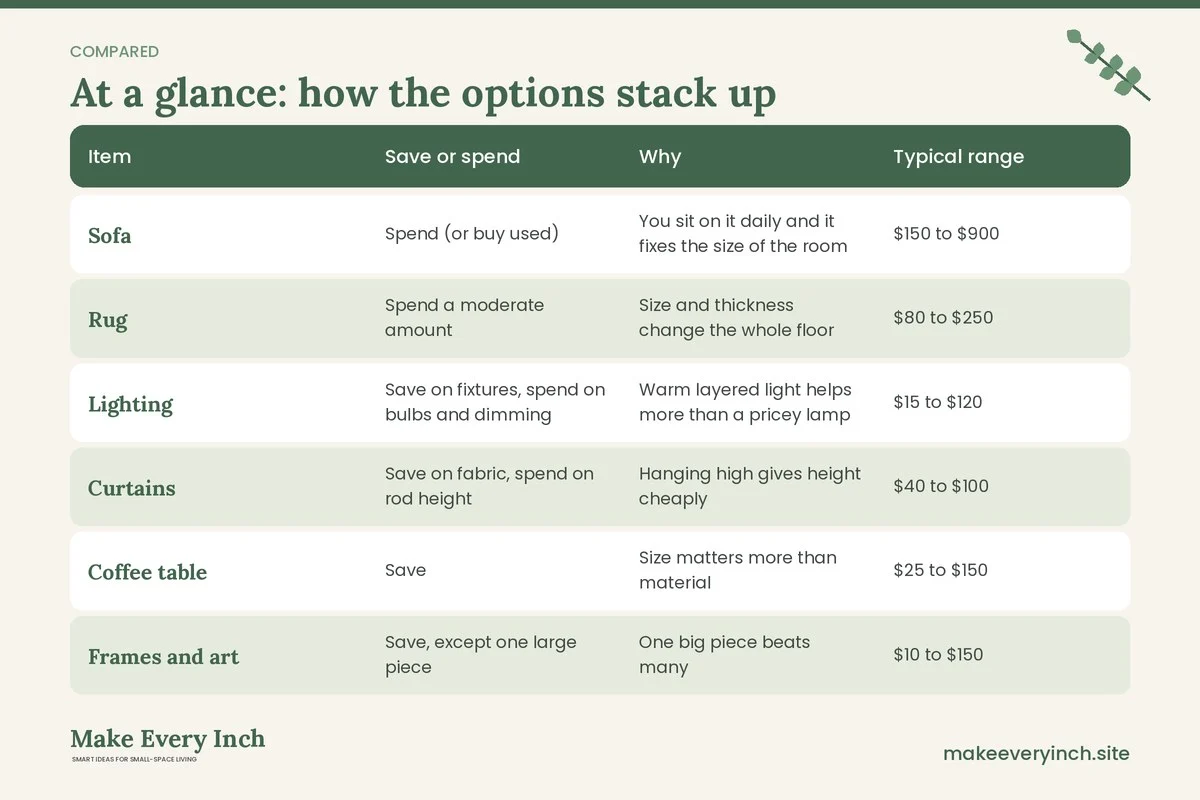
| Item | Save or spend | Why | Typical range |
|---|---|---|---|
| Sofa | Spend (or buy used) | You sit on it daily and it fixes the size of the room | $150 to $900 |
| Rug | Spend a moderate amount | Size and thickness change the whole floor | $80 to $250 |
| Lighting | Save on fixtures, spend on bulbs and dimming | Warm layered light helps more than a pricey lamp | $15 to $120 |
| Curtains | Save on fabric, spend on rod height | Hanging high gives height cheaply | $40 to $100 |
| Coffee table | Save | Size matters more than material | $25 to $150 |
| Frames and art | Save, except one large piece | One big piece beats many | $10 to $150 |
| Pillows | Save | Covers change in minutes | $10 to $40 |
| Storage | Save on baskets, spend on doors | Closed storage hides clutter | $20 to $140 |
Three example budget living rooms
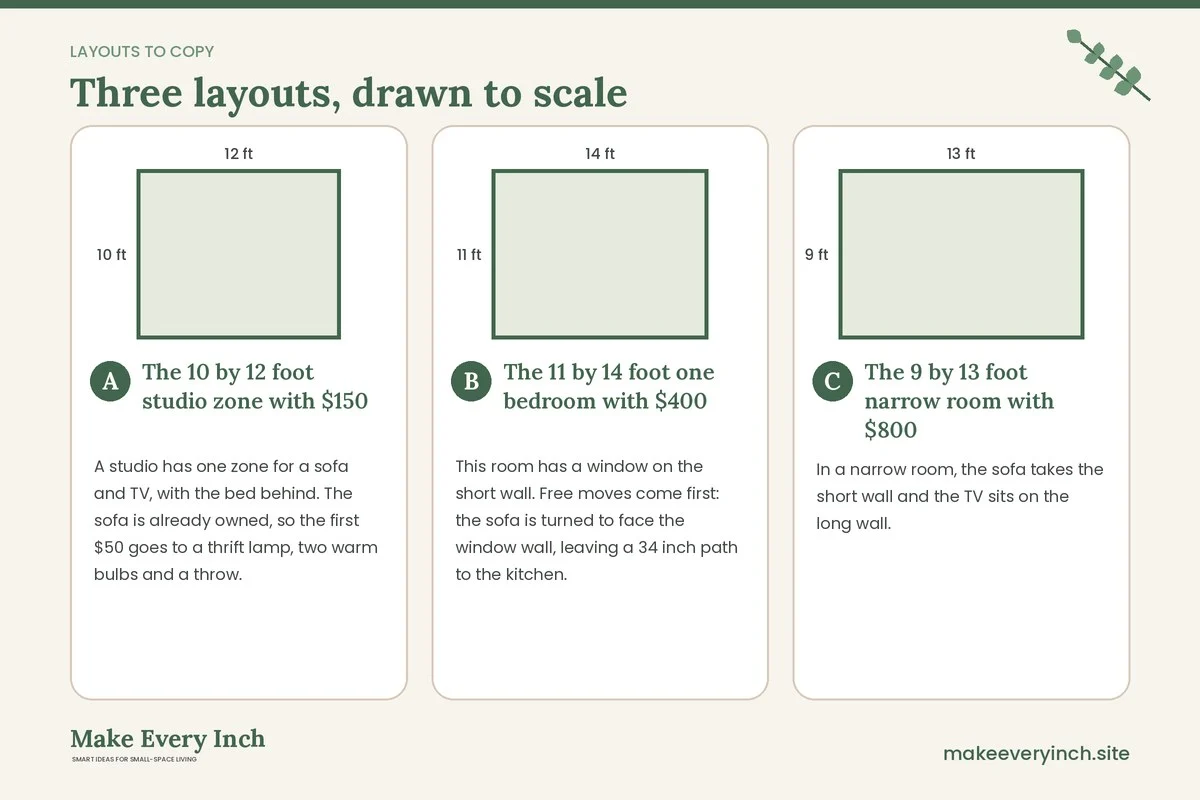
The 10 by 12 foot studio zone with $150
A studio has one zone for a sofa and TV, with the bed behind. The sofa is already owned, so the first $50 goes to a thrift lamp, two warm bulbs and a throw. The next $100 buys a 5 by 8 foot rug, which marks the living zone and keeps the sofa from floating. Furniture stays in an L: sofa along the 12 foot wall, a 14 inch deep console on the short wall, and a pouf that tucks beneath the console.
The 11 by 14 foot one bedroom with $400
This room has a window on the short wall. Free moves come first: the sofa is turned to face the window wall, leaving a 34 inch path to the kitchen. Then $60 buys curtains hung 6 inches above the frame, $120 buys a second-hand 6 by 9 wool rug, $90 buys a console, $70 buys nesting tables and $60 buys a floor lamp and a mirror. The room has a seating zone, a TV zone and two light levels.
The 9 by 13 foot narrow room with $800
In a narrow room, the sofa takes the short wall and the TV sits on the long wall. A $450 used 72 inch sofa fits against the wall, a $120 rug runs the long way, $90 buys a console, $60 buys a lamp and mirror, and $80 buys a pouf and a basket. This leaves a 36 inch path along one side and room for a small chair.
A method for spending your money in the right order
Step 1: Measure and map
Measure the room, windows, door swing and outlet locations. Draw a rough plan on graph paper, with one square equal to 6 inches. Mark the walkways first, then add furniture.
Step 2: List the six jobs
Write down seating, lighting, surface, rug, storage and focal point. Mark which jobs the room already handles well. The weakest job is where your first dollars go.
Step 3: Set the tiers
Decide how much you can spend now, and what you can add in three and six months. Put the sofa or rug in the first tier you can afford, not a decor item.
Step 4: Shop used first
Check local listings, thrift stores and neighbor groups before you buy new. Set alerts for brand names and sizes, and keep your measurements in your phone. Many good pieces sell within a day, so be ready to act.
Step 5: Buy one thing at a time
Add each piece, live with it for a week, then decide what is missing. This avoids buying a gallery wall and discovering that the real issue was a dark corner. Keep receipts and the return window dates in a folder.
Step 6: Photograph the room
Take photos at each stage, which helps you see what changed and gives you a record for the lease. Photos also help when you sell pieces later.
Budget guide
Prices are hedged US ranges and will shift by location.
About $50
Warm bulbs, a thrift lamp, a throw, pillow covers and cord control.
About $150
Add a 5 by 8 foot rug or curtains, a floor lamp and a mirror.
About $400
Add nesting tables, a console, a pouf or small chair and one closed storage piece.
About $800
Add a second-hand or sale sofa, one large piece of art and a dimmer or smart bulbs.
Mistakes to avoid
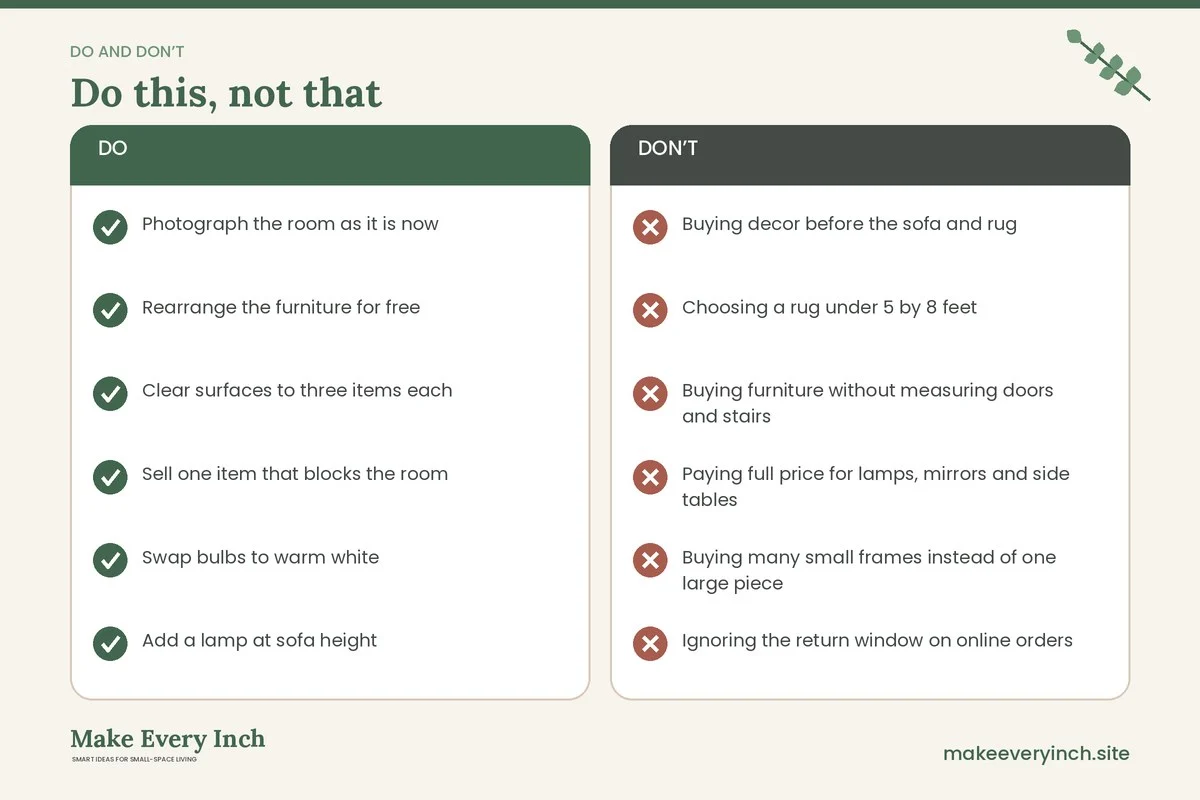
- Buying decor before the sofa and rug
- Choosing a rug under 5 by 8 feet
- Buying furniture without measuring doors and stairs
- Paying full price for lamps, mirrors and side tables
- Buying many small frames instead of one large piece
- Ignoring the return window on online orders
- Forgetting to check for pets, smoke and bed bugs on used upholstery
- Buying a sofa that is deeper than 38 inches in a room under 11 feet wide
Budget living room checklist
- Photograph the room as it is now
- Rearrange the furniture for free
- Clear surfaces to three items each
- Sell one item that blocks the room
- Swap bulbs to warm white
- Add a lamp at sofa height
- Set a rug size of at least 5 by 8 feet
- Hang curtains high and wide
- Set alerts for used sofas and rugs
- Buy one item at a time
- Keep receipts and return dates
FAQ
What should I buy first for a small apartment living room on a budget?
Start with free changes, then lighting and a throw. Lighting is cheap and changes how the room feels more than almost any other purchase. After that, a correctly sized rug is the next best spend.
How much does it cost to furnish a small apartment living room?
A bare-bones room with used furniture can come together for about $500 to $900, while a new-furniture room often costs $1,500 or more. Prices depend on your city and on how much you can find used.
Is it better to buy a used sofa or a cheap new one?
A clean used sofa with a solid frame usually outlasts a cheap new one. If you cannot inspect one in person, a sale-priced new apartment sofa with a return policy is the safer choice. See the best sofas for small apartments.
Where should I save money in a living room?
Save on pillows, frames, baskets, side tables and lamps. These items are easy to find second-hand and are easy to replace later.
How do I make a small living room look expensive for less?
Hang curtains high, use warm light at three levels, choose a rug big enough for the seating and edit the surfaces. These moves matter more than any individual item.
Can I do this as a renter?
Yes. Most of this plan is freestanding. See small apartment living room ideas that are renter-friendly for the no-drill version.
Should I buy from IKEA or second-hand?
Use IKEA for basic storage and tables when you need exact sizes, and second-hand for sofas, rugs and lamps. See small apartment living room ideas with IKEA for the new-furniture route.
How do I avoid overspending?
Set tier limits, shop with a written list and wait a week before any purchase above $100. Track each purchase against its tier.
Keep going: Keep going with small living room ideas, thrifted apartment decor ideas and small living room lighting ideas.
Save this guide for later
Pin the ideas you like to Pinterest so you can come back to them when you plan your space.