Small Home Organization Checklist: Room by Room, Step by Step
Quick answer: A good small home organization checklist works in four passes: measure and photograph, sort and remove, assign a zone to every item, then finish with labels, safety checks and a reset routine. Work one room at a time, in the order entry, kitchen, bedroom, bathroom, living area, and score each room out of ten so you can see progress.
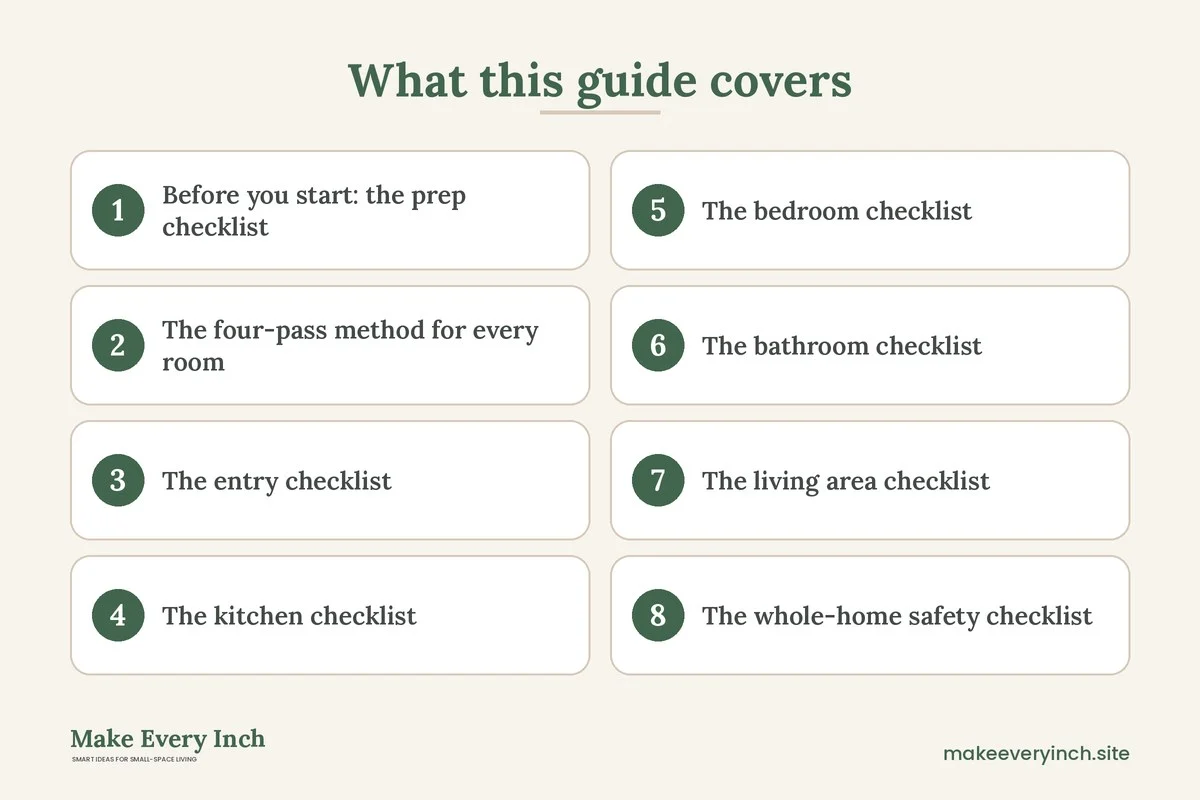
A small home organization checklist turns a vague wish to get organized into a list of small jobs you can finish and tick off. Small homes reward this approach, because every room does several jobs and one skipped step shows immediately. This guide gives you a complete checklist in five parts: a pre-start prep list, a list for each main room, a whole-home safety list, a scoring table to track progress and two sample schedules. It is designed to be printed or copied into your notes. For the bigger picture, see our pillar guide on small space organization ideas, and for the habits that keep the result, read the companion post on how to stop clutter from building up in a small home.
Before you start: the prep checklist
Spending 30 minutes on prep prevents the most common failure, which is starting with enthusiasm and stopping with half the home in piles.
- [ ] Read your lease for rules on drilling, adhesive, paint and wall fixings. Note anything you must ask the landlord.
- [ ] Choose a start date and block two hours for the first room.
- [ ] Gather supplies: three boxes or bags labeled keep, donate and recycle, a bin bag for rubbish, a marker, tape and a tape measure.
- [ ] Take a before photo of each room and each closet. The photos help you spot what changed and give you a reward at the end.
- [ ] Measure the key storage spaces: closet width and depth, shelf heights, drawer depths and the space under the bed. Write the numbers on one page. You will use them whenever you consider buying anything.
- [ ] Set a limit on the budget, and decide that you will buy nothing until the sorting is complete.
- [ ] Check where donations go, when bulk pickups run and whether your building has a recycling area for boxes.
- [ ] Clear a staging area, such as the hallway floor or a tabletop, that you can use for sorting.
Do not skip the measurements. The most common regret in small homes is a bin or a shelf that is a few inches too wide. A written list of dimensions stops that. If you need ideas for the sorting stage, our guide on the decluttering rules for small homes gives clear criteria.
The four-pass method for every room
Use the same four passes in each room. This makes the checklist repeatable, and you learn the rhythm by the second room.
Pass 1: Clear and look
- [ ] Remove everything from one surface, shelf or drawer at a time, not the whole room at once.
- [ ] Wipe the empty space.
- [ ] Group items by type on the floor or table.
Pass 2: Sort and remove
- [ ] Remove broken, expired and duplicate items.
- [ ] Ask of each item: Did I use it in the last year? Does it have a clear home? Do I like it?
- [ ] Put items into keep, donate, recycle or rubbish.
- [ ] Take the donate and recycle bags out of the home the same day, or at least by the next day.
Pass 3: Assign zones
- [ ] Give each category a zone, such as daily use in front and at eye level, weekly items in the middle, and rare items high or low.
- [ ] Keep items near where they are used, not where they are tidy.
- [ ] Put heavy items low and light items high.
Pass 4: Finish and maintain
- [ ] Add containers only after the sort, and measure before buying.
- [ ] Label anything that others in the home will use.
- [ ] Take an after photo.
- [ ] Add a ten-minute reset to your calendar.
The entry checklist
The entry sets the tone for the whole home because it catches whatever you carry in. In a small home, this might be a corner by the door, not a separate hall.
- [ ] Hooks or pegs are installed for current bags and coats, with one per person. Check lease rules before fixing anything. Where drilling is not allowed, use adhesive hooks within their weight rating, or a freestanding coat rack.
- [ ] A tray or bowl holds keys, wallet and sunglasses.
- [ ] A mat or tray holds the current shoes, one pair per person plus a spare for guests.
- [ ] Out-of-season coats and boots are stored elsewhere, in a closet or under a bed.
- [ ] A small bin or tray handles mail, and a recycling bin is within reach.
- [ ] Umbrellas have a defined place, such as a stand or a hook.
- [ ] Floors are clear enough that the door opens fully and no one trips on a bag.
- [ ] A mirror or a note shelf is optional, but only if it does not add clutter.
For narrow entries, see small entryway organization and the renter-friendly options in renter-friendly entryway organization ideas.
The kitchen checklist
Kitchens in small homes combine storage, prep and sometimes dining, so a short checklist saves time every day.
- [ ] Clear the counters except for items you use daily. As a guide, most small kitchens work well with three to five items out.
- [ ] Check the pantry and fridge for expired food and remove it.
- [ ] Group the food by type: breakfast, baking, tins, snacks. Put the most used items at eye level.
- [ ] Store rarely used appliances in a high cabinet or another room.
- [ ] Count duplicates, such as mugs, glasses, plates and spatulas, and remove extras beyond your regular needs.
- [ ] Put knives, chemicals and fragile items out of reach of children, and keep chemicals away from food storage.
- [ ] Use drawer dividers or a tray so utensils are not a tangle.
- [ ] Add a hook or rail for towels and tools if your lease allows it, or a freestanding rack.
- [ ] Keep the area around the stove clear of towels, paper and plastic, and keep flammable items away from heat.
- [ ] Keep electrical appliances away from the sink. Use the outlets protected for wet areas if available.
- [ ] Confirm the extractor fan or a window can vent steam and cooking smoke.
More detail is in how to organize a small kitchen, small kitchen counter organization and small kitchen drawer organization ideas.
The bedroom checklist
The bedroom is where most small homes keep the largest volume of belongings, which means clothes.
- [ ] Remove everything from the closet and sort by type: tops, bottoms, dresses, outerwear.
- [ ] Try on questionable items. Keep what fits and what you wear. Donate the rest.
- [ ] Hang clothes that wrinkle, and fold the rest. Use the same hanger type for a neater look and a slight space gain.
- [ ] Move out-of-season clothes to a box under the bed or on a high shelf. Make sure the box does not block a heater or vent.
- [ ] Check the under-bed space for height. Measure before you buy boxes. See under-bed storage ideas.
- [ ] Clear the bedside table of everything except a lamp, a glass and one book.
- [ ] Keep chargers in a single spot, and do not overload power strips or leave cords where someone can trip on them.
- [ ] Have a hook or a rack for worn-but-clean clothes, with a limit of three items.
- [ ] Anchor any tall dresser or bookcase to the wall if you are allowed to, especially with children or pets in the home.
- [ ] Keep the path from the bed to the door clear at night.
For deeper help, see small bedroom organization ideas and small closet organization ideas.
The bathroom checklist
Bathrooms are small, humid and shared, so the checklist focuses on space and safety.
- [ ] Throw out expired medicine, cosmetics and sunscreen, using local disposal rules for medicines.
- [ ] Keep only daily products on the counter, on one tray if possible.
- [ ] Group the rest by person or by use, in baskets under the sink or in a wall cabinet.
- [ ] Check that the towels are limited to two per person, plus a few spare.
- [ ] Use hooks, an over-door rack or a freestanding shelf, and respect the weight limits.
- [ ] Keep hair tools unplugged and away from water. Use outlets protected by a GFCI in wet areas, and never use extension cords near water.
- [ ] Store cleaners and medicines out of reach of children and pets, in a closed or locked cabinet.
- [ ] Confirm that a fan or window removes moisture, and clean it when needed to reduce mold.
- [ ] Put a non-slip mat on the floor of the tub or shower.
See small bathroom organization ideas for layouts.
The living area checklist
In many small homes, the living room is also the dining room, the office and the guest room. The checklist helps each role coexist.
- [ ] Remove items that do not belong, such as cups, laundry and shoes, and return them to their rooms.
- [ ] Give the remote, charger and a book a single home, such as a tray or a basket.
- [ ] Use a lidded basket or an ottoman with storage for blankets and toys.
- [ ] Keep the walkway at least 30 inches wide where possible.
- [ ] Place a bookcase or a shelf against the wall, and anchor it. Put heavy books on lower shelves.
- [ ] Keep cords tidy with clips or a cable box, and keep them off the floor where people walk.
- [ ] Limit surfaces for decor to a few items so that they do not collect clutter.
- [ ] If the table serves as a desk, set up a basket so you can clear it in under a minute.
- [ ] Keep heaters, radiators and vents clear of furniture and fabrics.
For a larger view of how a whole home fits together, see how to organize a small home room by room.
The whole-home safety checklist
Organizing often adds shelves, hooks and boxes. Run through these checks once the work is done.
- [ ] Anchoring. Tall or top-heavy furniture is fixed to the wall, or you have asked the landlord how to do so. If you cannot fix it, place heavier items low and keep the furniture away from beds and cribs.
- [ ] Drilling. No drilling or nailing has been done without written permission from your landlord. Adhesive items have been tested on a hidden spot.
- [ ] Weight. Every hook, rack and shelf is loaded below its rated limit, with extra margin for wet items.
- [ ] Electrical. No overloaded power strips, no cords under rugs, and nothing stacked on a heater, router or charger that can overheat. Leave access to the electrical panel.
- [ ] Ventilation. Vents, radiators and the dryer exhaust are clear. If you paint a shelf or a closet, choose a low-VOC product and open a window while it dries.
- [ ] Wet areas. Electrical items are away from the sink and tub, and outlets near water are GFCI-protected.
- [ ] Children and pets. Small items, batteries, cleaners, medicines and cords are out of reach. Check that bins with lids cannot trap a child or a pet.
- [ ] Exits. The path to the main door and any window used as an exit is clear.
Score each room out of ten
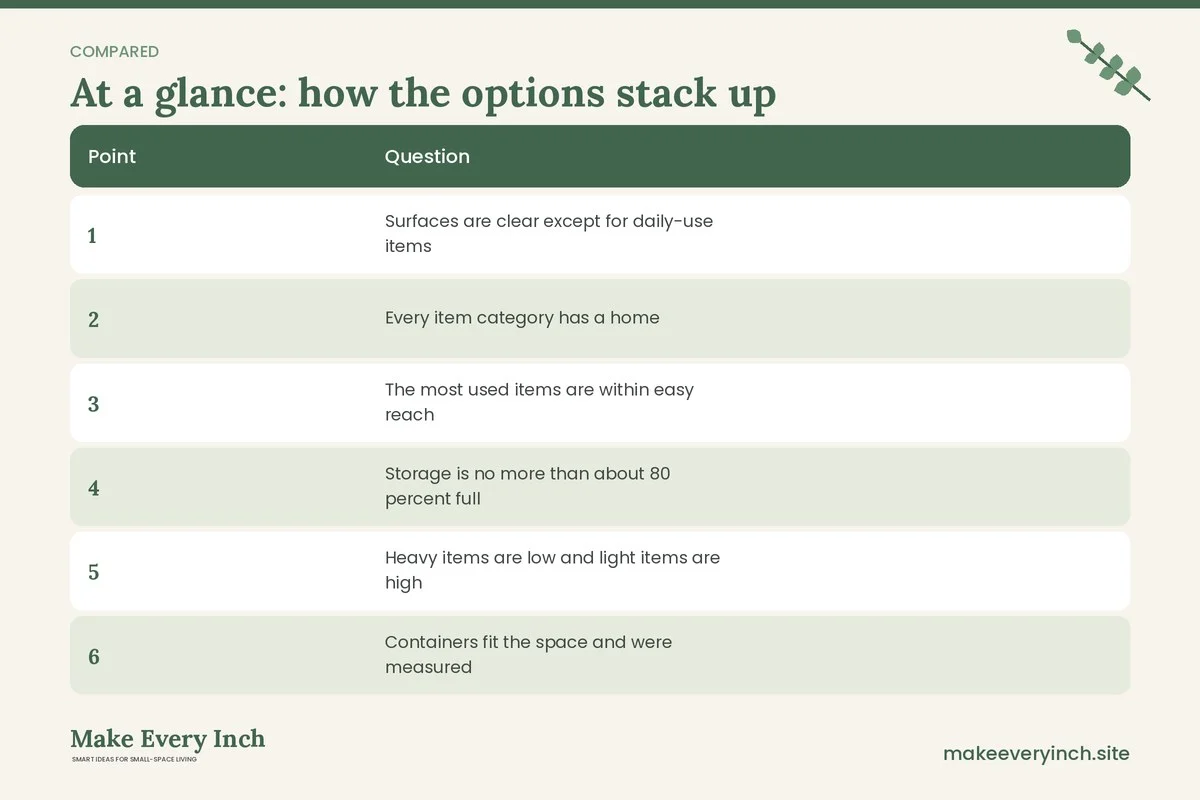
A simple scoring system lets you track progress without being hard on yourself. Give one point for each item that is true.
| Point | Question | |
|---|---|---|
| 1 | Surfaces are clear except for daily-use items | |
| 2 | Every item category has a home | |
| 3 | The most used items are within easy reach | |
| 4 | Storage is no more than about 80 percent full | |
| 5 | Heavy items are low and light items are high | |
| 6 | Containers fit the space and were measured | |
| 7 | Labels are on shared items | |
| 8 | Safety checks are done for the room | |
| 9 | The room can be reset in ten minutes | |
| 10 | You feel calm walking in |
A score of 8 to 10 means the room is in good shape. A score of 5 to 7 means a few small changes would help. Under 5, repeat the four passes, focusing on the lowest points. Re-score every month and write down the numbers. Seeing a room rise from 4 to 7 is motivating.
Two sample schedules
The weekend sprint
This plan suits people who prefer one focused push.
- Saturday morning: prep and entry, 2 hours.
- Saturday afternoon: kitchen, 3 hours.
- Sunday morning: bedroom and closet, 3 hours.
- Sunday afternoon: bathroom and living area, 3 hours, plus donations drop-off and the safety checklist.
Expect to be tired, so keep meals simple, and avoid starting more than one room at a time.
The four-week slow plan
This plan suits busy people, in line with our guide to small home organization for busy people.
- Week 1: prep and entry, 30 minutes per day for five days.
- Week 2: kitchen, 30 minutes per day.
- Week 3: bedroom and bathroom, 30 minutes per day.
- Week 4: living area, safety checklist and scoring.
A slower plan often lasts longer, because each room gets a full reset without exhausting you. For habits to protect the work, read small home organization ideas that actually last.
Common mistakes the checklist helps you avoid
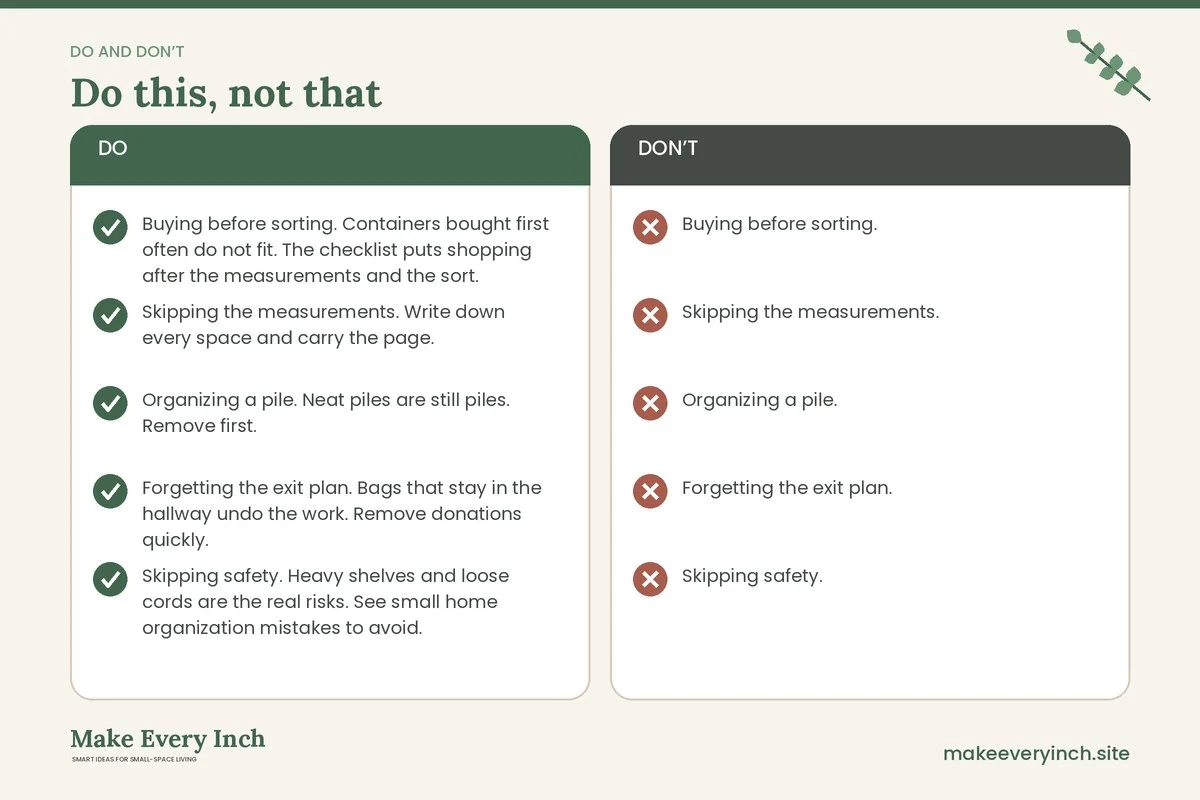
- Buying before sorting. Containers bought first often do not fit. The checklist puts shopping after the measurements and the sort.
- Skipping the measurements. Write down every space and carry the page.
- Organizing a pile. Neat piles are still piles. Remove first.
- Forgetting the exit plan. Bags that stay in the hallway undo the work. Remove donations quickly.
- Skipping safety. Heavy shelves and loose cords are the real risks. See small home organization mistakes to avoid.
FAQ
How long does a full small home organization checklist take?
It depends on how much you own. Many small homes take between 10 and 20 hours spread over a few weeks, though your time could be shorter or longer.
Which room should I start with?
Start with the entry or the room that frustrates you most. A quick win builds momentum for harder rooms like the closet.
Do I need to buy containers?
Not always. Sort first, measure, then decide. Many items fit existing boxes, jars and drawers. See small home organization without buying bins.
What if I rent?
Use freestanding furniture, tension rods, adhesive hooks within their limits and trays. Ask for written permission before drilling or painting.
How often should I repeat the checklist?
Run the full list once or twice a year, a short version each season, and the ten-minute reset daily.
What if my partner or family disagrees on what to keep?
Sort your own items first. For shared items, agree a limit for each category and a shared leaving box, and let each person decide on their own things.
Keep going: Keep going with the small space organization ideas pillar, learn how to stop clutter from building up in a small home, and plan each room with how to organize a small home room by room.
Save this guide for later
Pin the ideas you like to Pinterest so you can come back to them when you plan your space.