19 Small Apartment Living Room Ideas Japandi Style Inspires
Quick answer: The best small apartment living room ideas japandi style uses low seating, light oak and walnut tones, a paper lantern or two, a renter-safe shoji-style screen, a few handmade ceramics and plenty of empty floor. Keep furniture under about 30 inches tall, limit the palette to warm neutrals, and treat negative space as a feature.
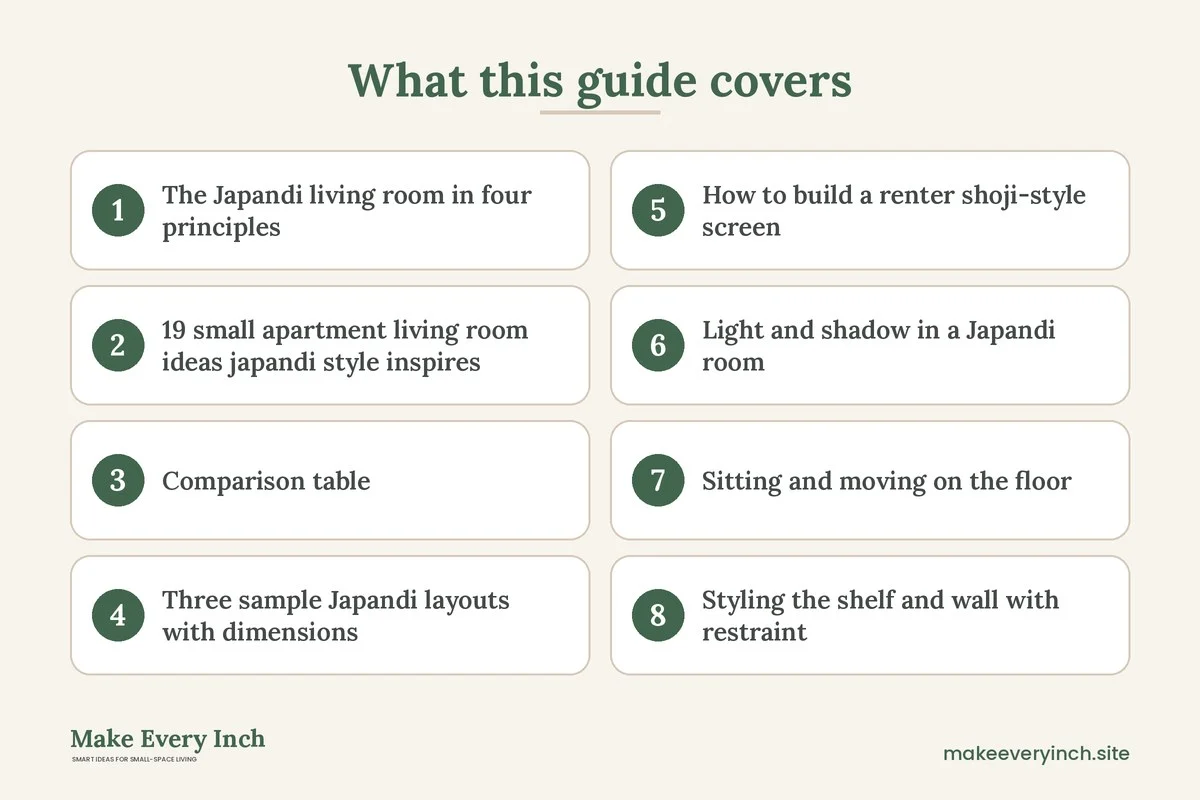
Small apartment living room ideas japandi in spirit mix Japanese calm with Scandinavian warmth, and the blend suits compact rooms very well. Low furniture makes ceilings feel higher, natural materials soften a rental’s plain walls and a deliberate amount of empty space stops the room from feeling packed. This guide covers the living room only, so for the whole home read our Japandi apartment ideas. Below you will find the core principles, 19 ideas, a comparison table, three sample layouts with dimensions, how to build a renter shoji screen, budget ranges, mistakes and a checklist. For the general layout and storage groundwork, see the pillars small living room ideas and small apartment living room ideas.
The Japandi living room in four principles
Japandi relies on a handful of rules that you can apply in any size of room. Learn them first, and the individual ideas follow easily.
Keep it low
Seating and tables sit close to the ground, with the sofa seat at about 14 to 16 inches and the table at 12 to 16 inches. Lower furniture leaves more wall visible, and the room reads as taller.
Choose natural, matte materials
Light oak, ash, walnut, paper, linen, cotton, wool, clay and rattan are the main players. Avoid high gloss, chrome and plastic, which break the calm.
Leave space on purpose
In Japandi, the empty areas are part of the composition, just as quiet is part of music. Aim for roughly a third of the floor and wall to stay clear.
Make each object count
Choose a few well-made pieces, such as a hand-thrown vase, a wooden stool or a paper lantern. One beautiful item beats five average ones.
19 small apartment living room ideas japandi style inspires
Low seating that anchors the room
1. A low-profile sofa with a wooden frame
Pick a sofa 70 to 80 inches wide with a seat height of 14 to 16 inches and exposed wood legs or a wooden base. A boxy shape in oatmeal, stone or warm gray linen suits the style.
2. Floor cushions and a zabuton
A zabuton is a flat square cushion, about 26 inches across, that sits directly on the rug. Two or three of them seat guests and fold away in a closet or under the sofa.
3. A low lounge chair
A wooden-framed chair with a seat around 12 to 14 inches off the floor, like a low rocker or a legless chair with a back, makes a reading spot that feels very different from a regular armchair. It works well in a corner by a window.
4. A tatami-style mat zone
Lay a rush or sisal mat about 3 by 6 feet, or a woven area rug, as the seating zone. It defines the space and adds a natural texture without any permanent flooring change.
5. A pouf or wooden stool
A rounded pouf or a small stool about 14 inches tall works as a footrest, extra seat or small table. It is the lightest way to add flexibility.
Tables, screens and storage
6. A low table around 14 inches tall
A table 36 by 20 inches and 14 to 16 inches tall suits a low sofa. Choose a rounded rectangle in oak or ash so the corners are friendly in tight spaces.
7. A renter shoji-style screen
A freestanding folding screen with paper or translucent panels, usually 70 inches tall and 18 inches per panel, creates a soft divider in a studio and diffuses light. It requires no drilling.
8. A window film that mimics shoji paper
Frosted or rice-paper-pattern window film lets daylight in while softening a view of a neighboring wall. It peels off in one piece on most smooth glass, so test a corner first.
9. A low credenza with sliding doors
A cabinet 14 to 16 inches deep and 24 to 28 inches tall in light oak holds media, blankets and papers. Sliding doors suit narrow rooms because nothing swings into the walkway.
10. An open shelf with a single display zone
Use one open shelf for ceramics and books, and keep the rest of your storage closed. Leave a third of the shelf empty so that each piece can be seen.
Light, color and materials
11. Paper lanterns for soft light
A round paper lantern, 16 to 20 inches across, with a warm bulb around 2700K casts a gentle, even glow. For a rental, use a plug-in cord version, or a lantern-style floor lamp.
12. A warm neutral palette with one dark accent
Combine cream, sand, clay and soft gray with a single dark note such as charcoal, black walnut or deep indigo. This is the simplest way to get the look.
13. Two wood tones, not five
Use a pale wood such as oak or ash for the larger pieces and one darker accent such as walnut in a small table or frame. Mixing too many tones breaks the calm.
14. Linen and cotton in the same family
Linen curtains, a cotton throw and a wool rug in similar warm neutrals add soft layers. Use natural fibers with visible weave and avoid shiny synthetics.
15. A single branch arrangement
In the spirit of ikebana, place one or three branches in a tall, narrow vase or a shallow dish. The asymmetry and empty space around it matter more than the number of stems.
Decor, negative space and rituals
16. Hand-made ceramics
A rough-glazed bowl, a small pitcher and a bud vase in earth tones add character. Group them in odd numbers, and leave breathing room between them.
17. One large piece of art
Use a calm print, a scroll-style hanging or a simple textile about 24 by 36 inches. Lean it on the credenza or hang it with a removable strip rated for the weight.
18. A tea or reading corner
A small tray, a kettle and two cups on a low table make a daily ritual. Pair it with a floor cushion and a lantern, and the corner looks intentional.
19. Negative space on the floor
Keep a clear patch of floor about 3 by 4 feet in the middle of the room. It lets you stretch, practice yoga or sit on the floor and keeps the layout from feeling crowded.
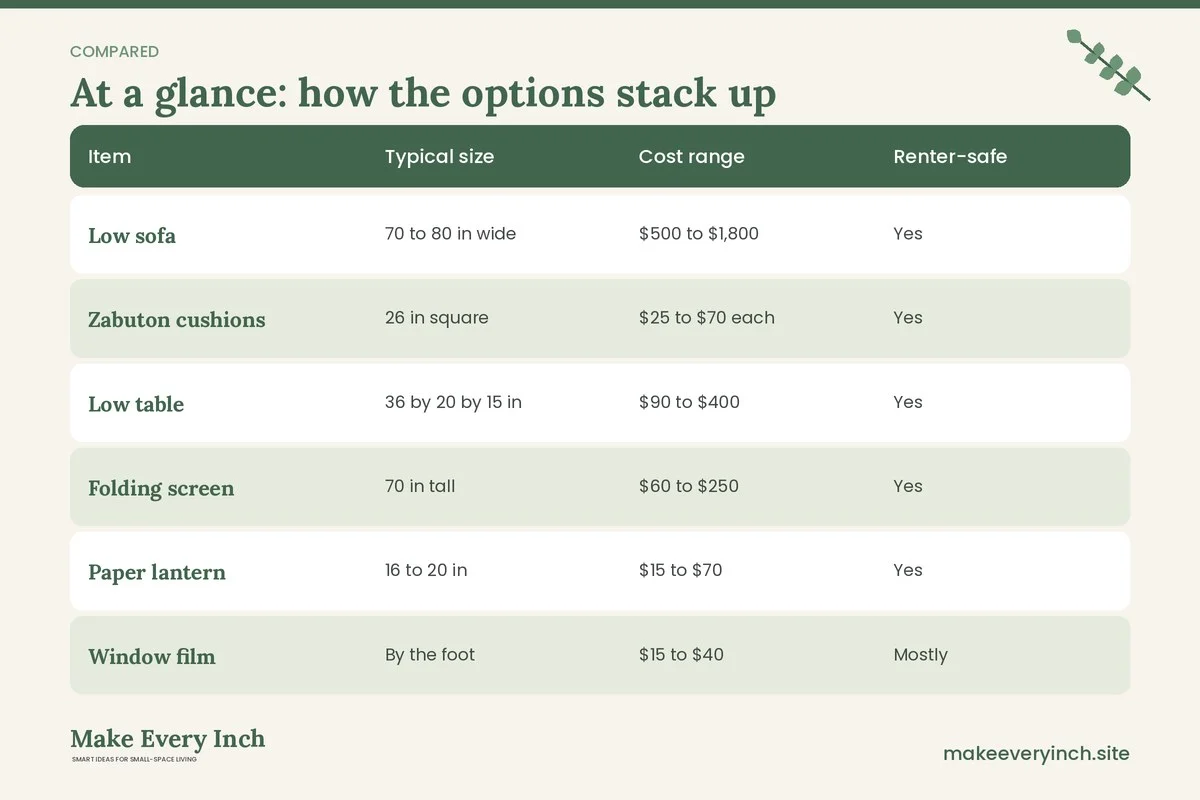
Comparison table: Japandi items for a small living room
| Item | Typical size | Cost range | Renter-safe | Notes |
|---|---|---|---|---|
| Low sofa | 70 to 80 in wide | $500 to $1,800 | Yes | Choose a 14 to 16 in seat |
| Zabuton cushions | 26 in square | $25 to $70 each | Yes | Stores flat |
| Low table | 36 by 20 by 15 in | $90 to $400 | Yes | Round corners help |
| Folding screen | 70 in tall | $60 to $250 | Yes | Divider and light filter |
| Paper lantern | 16 to 20 in | $15 to $70 | Yes | Use a warm bulb |
| Window film | By the foot | $15 to $40 | Mostly | Test a corner first |
| Sisal or jute mat | 5 by 8 ft | $60 to $250 | Yes | Rough on bare feet |
| Oak credenza | 48 to 60 in | $250 to $900 | Yes | Sliding doors save room |
Three sample Japandi layouts with dimensions
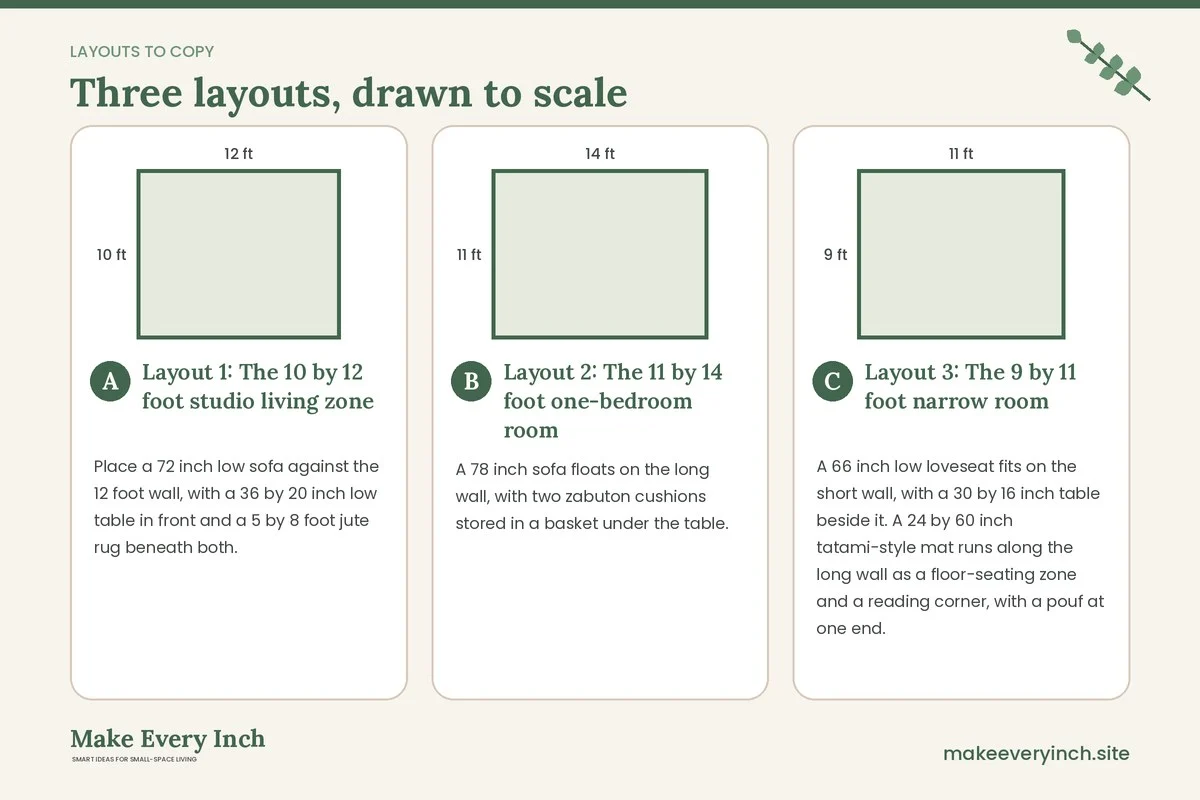
Layout 1: The 10 by 12 foot studio living zone
Place a 72 inch low sofa against the 12 foot wall, with a 36 by 20 inch low table in front and a 5 by 8 foot jute rug beneath both. A 70 inch folding screen stands at the end of the sofa to mark the edge of the zone and hide the bed or the desk beyond. A paper lantern floor lamp sits in the corner, and a 48 inch credenza on the opposite wall holds the TV. The center keeps a 3 by 4 foot clear floor patch.
Layout 2: The 11 by 14 foot one-bedroom room
A 78 inch sofa floats on the long wall, with two zabuton cushions stored in a basket under the table. A low round table 30 inches across sits in front, and a wooden-framed lounge chair with a 13 inch seat sits at an angle by the window. A 6 by 9 foot wool rug anchors the group, and a 60 inch sliding-door credenza lines the opposite wall. A single branch in a vase and one ceramic bowl are the only objects on top.
Layout 3: The 9 by 11 foot narrow room
A 66 inch low loveseat fits on the short wall, with a 30 by 16 inch table beside it. A 24 by 60 inch tatami-style mat runs along the long wall as a floor-seating zone and a reading corner, with a pouf at one end. A paper lantern hangs from a plug-in swag hook in the corner. The walkway stays 32 to 34 inches wide, and a pair of floor cushions slides behind the sofa when you need the floor.
How to build a renter shoji-style screen
A real shoji screen is a lattice of wood and paper, and you can make a light renter version in an afternoon. Buy a three-panel folding frame or build three frames from 1 by 2 inch pine, each 18 by 70 inches. Paint or stain them in a pale oak tone, then glue a grid of thin lath strips across each frame, spacing the cross pieces about 12 inches apart. Attach rice paper, translucent paper or a frosted film to the back with double-sided tape, keeping it taut. Join the panels with hinges so that they zigzag and stand without help. The screen weighs little, leaves no mark on the wall and folds flat to store behind a door.
A faster option is to hang rice-paper or linen panels from a tension rod across an alcove. For a window, apply paper-style film in panels so it looks gridded. Keep any screen at least 6 inches away from heaters and lamps, since paper is flammable, and use LED bulbs inside or near lanterns.
Light and shadow in a Japandi room
Japandi treats shadow as something to enjoy, not to eliminate. Skip the single bright ceiling fixture and spread three or four low sources around the room: a lantern floor lamp at the sofa, a small table lamp on the credenza and a plug-in uplight behind the screen. Warm bulbs at 2200K to 2700K make wood and linen glow. Sheer linen curtains in a pale tone let daylight in while softening it, and hanging them from a rod mounted high keeps the window looking tall.
Pay attention to what the light hits. A matte plaster-look wall, a rough ceramic and a woven mat all catch light differently from glossy surfaces, so the room gains depth without extra objects. In the evening, switch off the overhead light and run only the low lamps. The change in mood costs nothing and shows quickly how much the style depends on light.
Sitting and moving on the floor
Low seating changes how a small room is used, so plan for comfort. Keep a rug or mat at least 3 feet wide where you sit, with a thin layer of rug pad beneath it to stop sliding. Add a back support, such as a low sofa edge, a wall cushion or a legless chair, since sitting on the floor without back support tires most people within twenty minutes. A cushion about 3 to 4 inches thick under the hips helps. If anyone in the household has stiff knees or hips, keep a standard-height chair in the room and treat floor seating as occasional.
Low furniture also changes sight lines. With a sofa seat at 15 inches, a TV mounted at 40 to 44 inches to its center sits at a comfortable height, and a TV on a 24 inch credenza works for most layouts. Check the eye line from the sofa before you fix anything to the wall.
Styling the shelf and wall with restraint
Set the display shelf using the idea of three: one tall item, one wide item and one small item, with a gap between each. A tall branch vase, a low bowl and a stack of two books make a balanced group. Use a different group on each shelf, and leave at least one shelf plain. On the wall, hang a single piece off-center and slightly low, and let the empty plaster beside it do its work.
Ceramics are best chosen by hand and by feel. Look for irregular glazes in oatmeal, celadon, charcoal or rust, and avoid sets where every piece matches. A thrifted bowl or a local studio mug is more in keeping with the spirit than a perfectly uniform set. For more ideas on finding handmade pieces cheaply, try our thrifted apartment decor ideas.
Making Japandi work in a rental
Most Japandi pieces are freestanding, so renting is not a barrier. Lean art instead of drilling. Swap harsh ceiling lights for plug-in lanterns, and replace brass or chrome hardware only if you keep the originals. Use a large rug to cover patterned or worn floors, and a pair of linen curtains to hide a plain blind. Stick with removable window film, and avoid paint unless the lease allows it. For more ideas that leave no trace, see our small apartment living room ideas for renters.
Budget guide
Prices vary by city and brand, so treat these as hedged USD ranges.
Under $150
A paper lantern with a cord, window film, two zabuton cushions, a branch vase and one ceramic piece. This is enough to shift the mood of a room.
About $400 to $800
A low table, a jute or sisal rug, a folding screen and linen curtains. This tier shapes the layout and the textures.
$1,200 and up
A low wooden-frame sofa, an oak credenza and a lounge chair. Spend on the sofa first, since everything else relates to it. For a lower-cost route, see our budget small apartment living room ideas.
Common mistakes to avoid
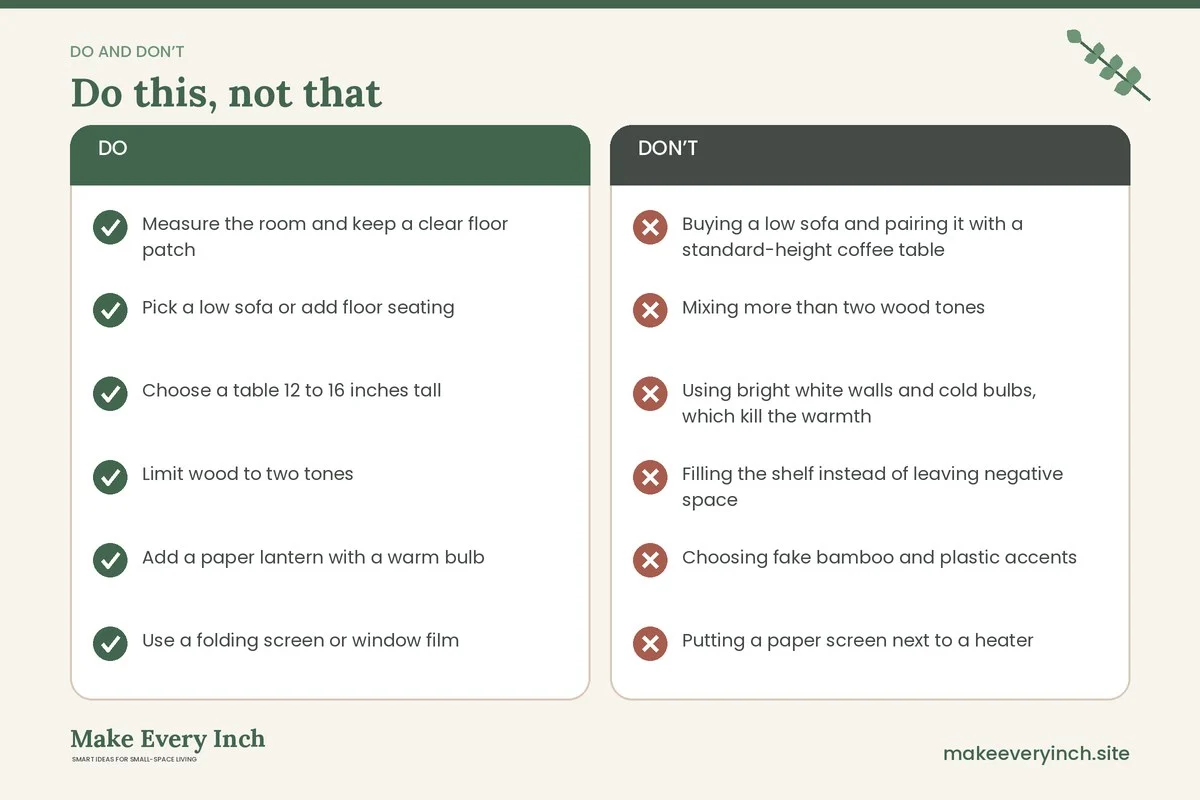
- Buying a low sofa and pairing it with a standard-height coffee table
- Mixing more than two wood tones
- Using bright white walls and cold bulbs, which kill the warmth
- Filling the shelf instead of leaving negative space
- Choosing fake bamboo and plastic accents
- Putting a paper screen next to a heater
- Ignoring knees and backs when planning floor seating
- Copying Japanese motifs as decoration instead of using the principles
Japandi living room checklist
- Measure the room and keep a clear floor patch
- Pick a low sofa or add floor seating
- Choose a table 12 to 16 inches tall
- Limit wood to two tones
- Add a paper lantern with a warm bulb
- Use a folding screen or window film
- Display three to five ceramics at most
- Hang or lean one calm piece of art
- Add linen curtains and a natural fiber rug
- Create a small tea or reading corner
FAQ
What is Japandi style in a living room?
It is a blend of Japanese minimalism and Scandinavian coziness, with low furniture, light wood, natural fibers, soft light and plenty of empty space.
Is Japandi good for a small apartment living room?
Yes. Low furniture keeps sight lines open, closed storage hides clutter and the focus on negative space prevents overcrowding.
How do I do Japandi on a budget?
Start with lighting, textiles and a few handmade-looking ceramics. Add a jute rug and floor cushions, then upgrade the sofa over time.
Can renters use shoji screens?
Yes. A freestanding folding screen or a paper-style window film needs no drilling. Test the film in a corner first.
What colors work best for Japandi?
Warm whites, sand, clay, soft gray, muted green and a dark accent such as charcoal or black. Keep the palette quiet.
Do I need floor seating?
No. A low sofa and a chair are fine. Floor cushions are a flexible add-on for guests and for tea or reading.
How is this different from Scandinavian style?
Scandinavian rooms tend to be lighter and brighter, with white walls and pops of color. Japandi leans warmer and darker, with earth tones and more restraint. See our Scandinavian small apartment ideas for comparison.
What is the difference between Japandi and minimalism?
Minimalism focuses on owning less. Japandi focuses on natural materials, craft and warmth. For a pared-back version, read about minimalist small apartment living room ideas.
Keep going: Keep going with modern small apartment living room ideas, cozy small apartment living room ideas and organic modern apartment ideas.
Save this guide for later
Pin the ideas you like to Pinterest so you can come back to them when you plan your space.