12 DIY Floating Shelf Ideas for Small Rooms You Can Build
Quick answer: A DIY floating shelf for small rooms works best when it is shallow (6 to 8 inches), screwed into studs or fitted with the right anchors for the wall, and hung where it frees floor space instead of adding clutter. Plan the load first, mark studs, level the bracket, finish with low-VOC paint or sealer, and only drill after you have permission from your landlord or building.
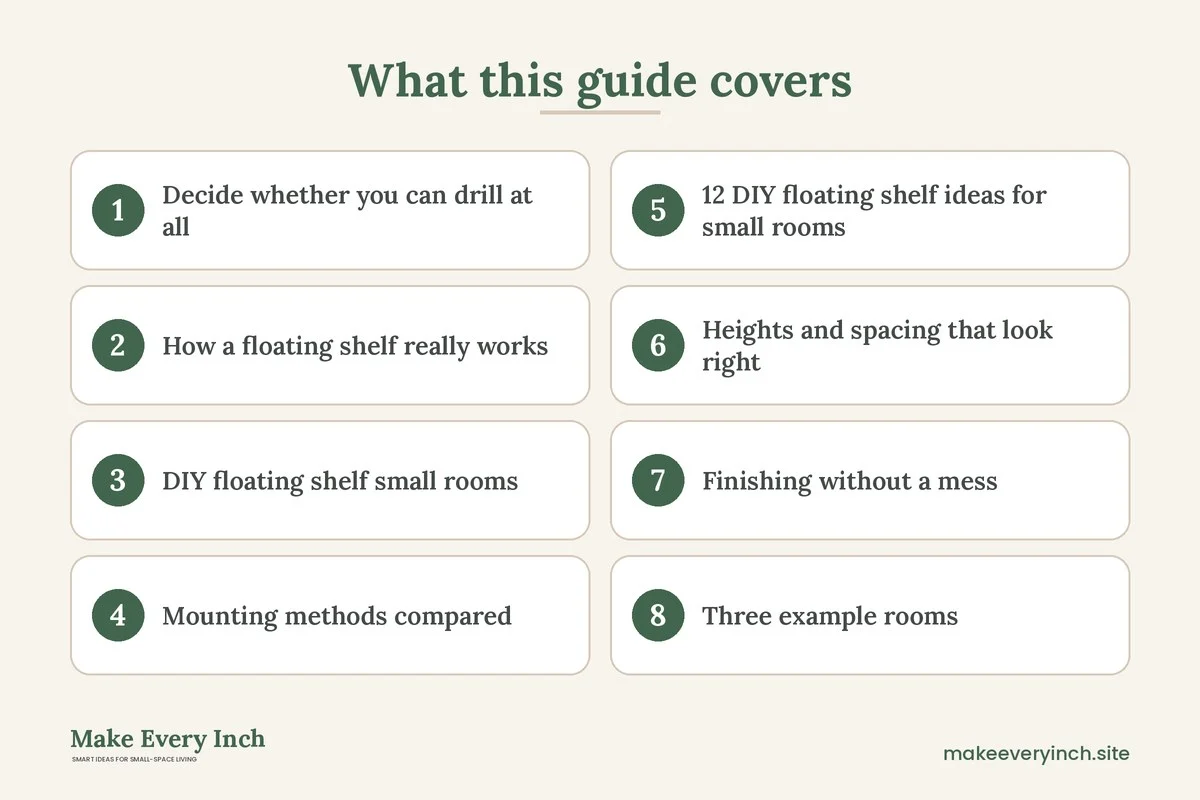
A DIY floating shelf small rooms can actually use is different from a decorative plank on the wall. In a small room, every shelf competes with the floor, the window and your sightlines, so the shelf has to earn its place by holding something real, staying out of the way and looking calm. This guide walks through the planning that matters before you pick up a drill, then 12 buildable ideas, a cut list for a basic shelf, a comparison table of mounting methods, three example rooms, finishing and safety notes, mistakes and a checklist. It is a build-focused companion to our budget pillar on budget small space ideas, and it takes a different angle from our posts on DIY wall storage ideas for small spaces and renter friendly shelving ideas without drilling, because it focuses on the shelf itself: how it is built, how it hangs and how much it can carry.
Decide whether you can drill at all
A floating shelf hides its hardware, which means it is screwed or bolted into the wall. Before you buy a board, check the lease. Many leases ban holes or require written permission, and some landlords allow a few small holes if you patch them at move-out. Never drill without permission. If the answer is no, skip to the no-drill alternatives later in this guide, or read our post on renter friendly shelving.
If drilling is allowed, ask a few extra questions. What is the wall made of: drywall over wood studs, plaster, brick, concrete or tile? Drywall and plaster need very different fasteners from masonry. Is there wiring or plumbing behind the spot? Walls beside switches, outlets, kitchen sinks and bathroom fixtures often hide cables and pipes, so keep shelves well away from them and use a stud finder with a live-wire detection mode if you are unsure. If you cannot say what is behind the wall, choose another spot or ask a qualified person to check.
How a floating shelf really works
A floating shelf looks like it is hanging in air, but it carries its load through a hidden bracket. The three common designs are a metal rod bracket that slides into drilled holes in a thick board, a hollow box shelf that slips over a wall-mounted wooden cleat, and a solid slab fixed to a rail. All three work by leverage. The deeper the shelf, the more force pulls the top screws out of the wall and pushes the bottom of the bracket in. That is why a shallow shelf is far stronger than a deep one on the same fasteners.
Three numbers decide how safe your shelf is.
- Depth: 6 to 8 inches suits books, plants, framed photos and bathroom or kitchen essentials. Past 10 inches the leverage rises quickly, and the shelf is better supported by a visible bracket.
- Length: 24 to 36 inches is easy to hang on two studs 16 inches apart. A 48 inch shelf needs three fixing points.
- Load: a typical shelf screwed into studs can hold light to moderate loads, but the real limit depends on the bracket, the screws and the wall. Treat any figure on packaging as a ceiling, not a target, and keep heavy items such as full book runs low and near the wall.
Anchors are not equal to studs. Hollow-wall anchors in drywall suit lighter items such as a few frames or a small plant. For books, cookware or anything that could injure someone if it fell, find studs or use a method rated for the load.
DIY floating shelf small rooms: tools and a basic cut list
You do not need a workshop. A tape, a pencil, a level, a stud finder, a drill, a driver, a hand saw or a store cut, sandpaper and a finish will do. For safety, wear eye protection and a dust mask when sanding or sawing, and ventilate the room when you paint or seal.
Here is a cut list for a simple box shelf that slips over a cleat. It makes one shelf about 30 inches long and 7 inches deep. Adjust the length to your wall.
- Cleat: one strip of pine or hardwood, about 1 by 2 inches, cut to 27 inches. It is screwed into studs.
- Top: one board, 30 by 7 inches, thickness 3/4 inch.
- Front: one board, 30 by 2 1/2 inches, thickness 3/4 inch.
- Ends: two small pieces, 6 1/4 by 2 1/2 inches, thickness 3/4 inch.
- Bottom: optional thin panel to cover the underside if the shelf will be seen from below.
Glue and nail or screw the top, front and ends into a shallow hollow box. The cleat then slides into the cavity and holds the shelf level. A little extra glue or a few small finish nails through the top into the cleat keep it from lifting.
Choose a board that suits your budget, such as pine, plywood with a veneer edge, or reclaimed lumber. Look for straight, dry boards. A warped board will always look crooked on the wall.
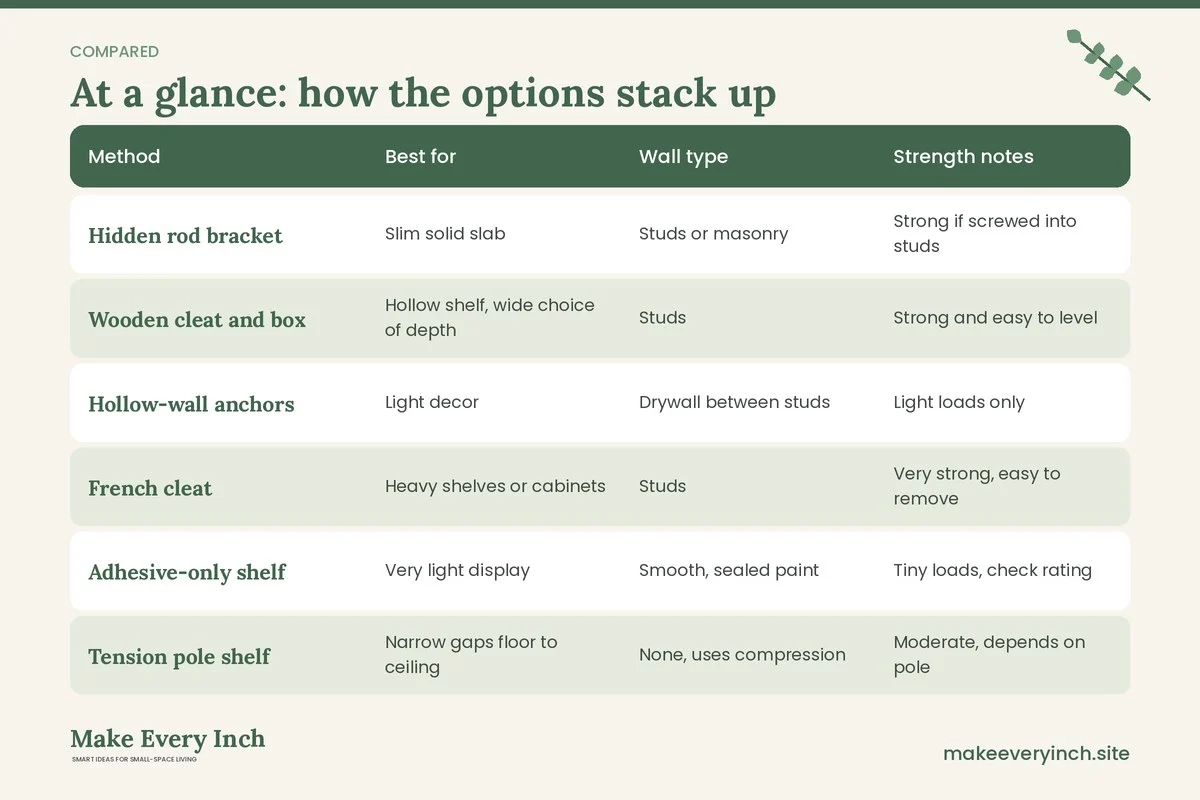
Mounting methods compared
| Method | Best for | Wall type | Strength notes | Reversible? | |
|---|---|---|---|---|---|
| Hidden rod bracket | Slim solid slab | Studs or masonry | Strong if screwed into studs | Leaves screw holes | |
| Wooden cleat and box | Hollow shelf, wide choice of depth | Studs | Strong and easy to level | Leaves screw holes | |
| Hollow-wall anchors | Light decor | Drywall between studs | Light loads only | Leaves holes | |
| French cleat | Heavy shelves or cabinets | Studs | Very strong, easy to remove | Leaves screw holes | |
| Adhesive-only shelf | Very light display | Smooth, sealed paint | Tiny loads, check rating | Often removable | |
| Tension pole shelf | Narrow gaps floor to ceiling | None, uses compression | Moderate, depends on pole | Yes |
The table shows why studs matter. When a method relies on the wall surface alone, the load limit drops sharply, and a failure can damage the wall and anything below it.
12 DIY floating shelf ideas for small rooms
Shelves that replace furniture
1. A single long shelf instead of a console
In a narrow entry or hall, a shelf at 36 to 40 inches off the floor can hold keys, mail and a small lamp, and it leaves the floor free. Keep it 6 inches deep so passing shoulders do not catch on it. For more entry ideas, see tiny foyer ideas.
2. A shelf desk
A deep shelf, about 14 to 16 inches, at 28 to 30 inches high can serve as a laptop desk. This is the one place where depth is worth the extra support. Use a French cleat or a pair of brackets fixed into studs, and test the load only after it is mounted. Our guide to small home office ideas with wall-mounted desks covers the layout.
3. A bedside shelf
A 10 to 12 inch shelf beside the bed replaces a nightstand and frees about 4 square feet of floor. Mount it so the top sits at the mattress height plus 2 to 4 inches. Keep lamps with cords tidy, and avoid heavy glass items above a pillow.
Shelves for display
4. A picture ledge shelf
A narrow ledge, 3 to 4 inches deep, with a front lip holds frames and small art. It works above a sofa or a desk, and the lip stops frames from sliding. It is a good first project because the board is light and the stakes are low.
5. A stair-step trio
Three short shelves staggered up a wall hold plants and books without a formal bookcase. Space them 10 to 12 inches apart vertically, and keep the heaviest item on the lowest shelf. See small space plants and planters ideas for plant choices, and use trays so water does not touch the board.
6. A shelf above a door
The space above a door or window is often empty. A shelf there, 8 to 10 inches below the ceiling, holds baskets, books or off-season items. Keep it for light things, and avoid anything that could fall on someone walking through.
Shelves for storage
7. A kitchen spice and oil shelf
A 5 inch deep shelf beside a stove holds jars and bottles. Keep it away from direct heat, steam and grease, and leave a gap above the burners. Seal the wood with a water-resistant finish. Our small kitchen wall storage ideas cover more kitchen options.
8. A bathroom shelf above the toilet
A shelf here uses dead wall. Mount it high enough that you can lift the toilet lid and clean behind it, usually 24 to 30 inches above the tank. Because bathrooms are wet areas, use a sealed or moisture-resistant board, rustproof screws and keep any lamp or electrical device away from water. Do not run cords near wet surfaces, and only install electrical fixtures with proper protection, such as a GFCI-protected outlet. For more ideas read best over the toilet storage.
9. A coat and bag shelf with hooks
A shelf 8 inches deep with a row of hooks below it gives an entry a place for hats, bags and keys. Anchor into studs, because hooks pull outward and sideways when loaded. Keep heavy bags to a limit your wall and fasteners can handle.
10. A closet shelf extension
Add a second shelf above an existing closet shelf, or a short shelf beside the hanging rod, for folded sweaters and boxes. See closet shelf organization ideas.
Shelves with a twist
11. A corner shelf pair
Two shelves meeting at a corner use a spot that is often wasted. Cut the edges at 45 degrees or butt them together, and align the fronts so they read as a single piece. Corners are often easier to anchor, since two walls give better reach for studs.
12. A pegboard and shelf combo
Fix a small pegboard to the wall and hang a shelf below it. The pegboard holds tools or craft supplies, while the shelf holds bins. It is useful in a studio corner or a laundry area. Check our post on small laundry room shelf ideas for how to use this in a utility space.
Heights and spacing that look right
Good shelves feel calm because the gaps follow simple rules.
- Above a sofa or bed: leave 8 to 12 inches between the furniture and the lowest shelf, and keep fragile items off shelves directly over a head.
- Eye level display: the center of a display shelf sits at about 57 inches from the floor.
- Between shelves: 10 to 12 inches for books and 14 to 16 inches for taller objects.
- From the ceiling: at least 6 inches, so the room does not feel crowded at the top.
- From a corner or a door: at least 12 inches, so doors open and bodies pass.
Measure with painter’s tape. Stick a strip where the shelf will be, stand back, and look at it from the doorway and the sofa. If it feels heavy, move it up or shorten it.
Finishing without a mess
Sand the board starting with a coarse grit, then medium and finally fine, and wipe away the dust with a damp cloth. Choose a low-VOC paint, stain or sealer, and open a window while you work. Let the finish cure fully before putting objects on the shelf, because a tacky surface can stick and peel. Keep the shelf away from children until the fumes have cleared.
For a soft look, paint the shelf the same color as the wall. It then disappears, and objects seem to float. For a light, airy feel, use a pale natural wood. For contrast, use a dark stain on a white wall. Avoid high-gloss finishes on small shelves, since they show every scratch and glare under lamps.
Three example rooms
A 9 by 10 foot bedroom
The bed is against the wall, and there is no space for a nightstand. A pair of 10 inch shelves, one on each side, are hung 22 inches above the floor. A longer shelf above the bed would be too heavy, so a picture ledge holds a few frames instead. Cords for lamps are routed along the wall with removable clips. The result frees about 8 square feet of floor.
A narrow galley kitchen
The wall beside the stove has a 5 inch shelf for oils and spices, and another shelf at 60 inches holds baskets. The shelves are sealed against steam, and they sit at least 12 inches from the burners. A short hook rail on the wall holds utensils. The counter gains about a foot of clear space.
A studio entry corner
A single 36 inch shelf at 40 inches high holds keys and mail, with three hooks below it. A mirror leans on the wall beside it. The shelf is screwed into two studs, so it can hold a bag. The corner reads as an entry without a console or a coat rack.
Common mistakes
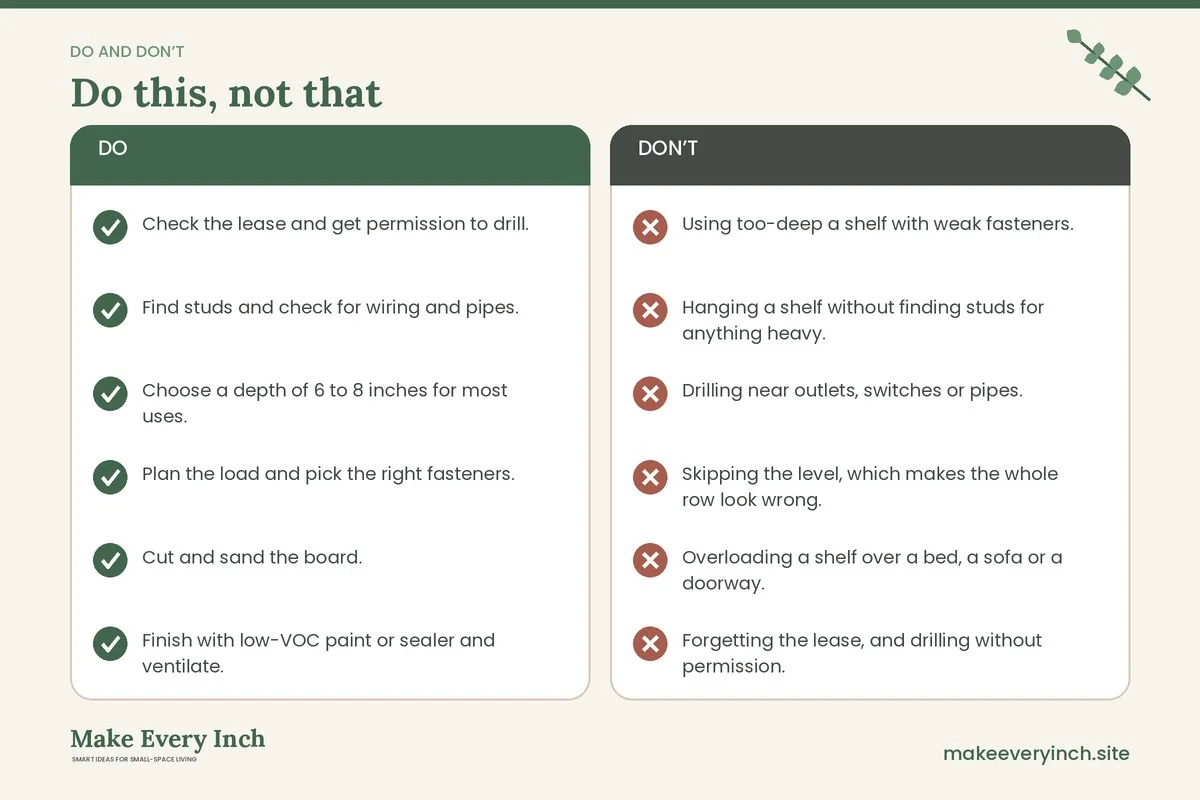
- Using too-deep a shelf with weak fasteners.
- Hanging a shelf without finding studs for anything heavy.
- Drilling near outlets, switches or pipes.
- Skipping the level, which makes the whole row look wrong.
- Overloading a shelf over a bed, a sofa or a doorway.
- Forgetting the lease, and drilling without permission.
- Painting in a closed room without ventilation.
- Using bare wood in a bathroom or beside a stove.
Safety notes
Treat the shelf as a structure. Place heavy items low, near the wall and over studs. Do not put heavy or sharp objects on a shelf above a bed or crib. In a child’s room or a home with pets, keep small items and breakables out of reach and fix any freestanding bookcase to the wall, since tall furniture can tip. If you are unsure about wiring or plumbing behind the wall, stop and ask a qualified person. Follow the weight limits stated for your bracket and fasteners, and recheck the shelf after a few weeks to see if it has loosened.
A short checklist
- Check the lease and get permission to drill.
- Find studs and check for wiring and pipes.
- Choose a depth of 6 to 8 inches for most uses.
- Plan the load and pick the right fasteners.
- Cut and sand the board.
- Finish with low-VOC paint or sealer and ventilate.
- Mount with a level, then check it is firm.
- Load heavy items low and near the wall.
- Recheck the fasteners after a few weeks.
FAQ
How deep should a floating shelf be in a small room?
Most small rooms do well with 6 to 8 inches. That depth holds books, frames and plants without poking into the walkway, and it keeps leverage on the hardware low.
Can a floating shelf hold books?
Yes, if it is screwed into studs and the bracket is rated for the load. Keep the books close to the wall, and consider a shorter run of books or a second shelf if the shelf bows.
Can I hang a floating shelf in a rental?
Only with the landlord’s permission, since the shelf needs holes. If you cannot drill, use freestanding units or the methods in our no drill storage ideas for renters.
What wood is best for a DIY shelf?
Pine is easy to find and work, plywood with an edge strip is stable and light, and hardwood is dense and strong. Choose straight, dry boards.
How do I stop a shelf from sagging?
Keep spans short, use thicker boards, support the shelf at more points and avoid overloading it. A hollow box shelf on a cleat resists sagging better than a thin plank.
Is it safe to put a shelf over a bed?
Only with a low, light load and a firm fixing. Keep heavy, sharp or fragile items elsewhere, and think about how an item would fall if the shelf failed.
What finish is safest indoors?
A low-VOC paint or water-based sealer is a gentle choice. Ventilate while you work and let the finish cure before use.
Keep going: Keep going with our guides to budget small space ideas, budget friendly ways to make a room look bigger and DIY storage ideas for small homes.
Save this guide for later
Pin the ideas you like to Pinterest so you can come back to them when you plan your space.