14 Small Entryway Mistakes to Avoid and the Quick Fix for Each
Quick answer: The small entryway mistakes to avoid most are blocking the door swing, buying furniture that is too deep, hanging too many hooks, ignoring light, skipping wall anchors on tall pieces, and storing everything in view. Keep 30 to 36 inches of walkway, choose pieces 8 to 12 inches deep, hang hooks at about 60 to 66 inches, and fix problems one at a time with the cheapest change first.
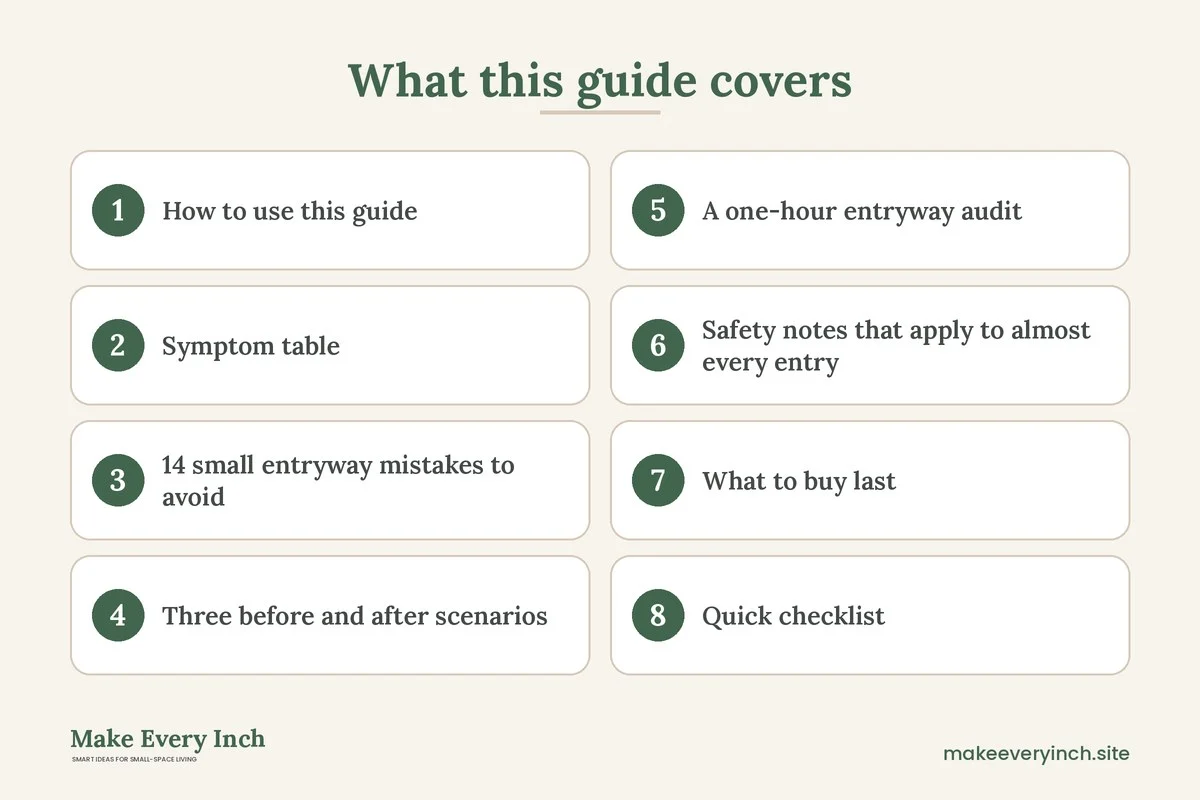
The small entryway mistakes avoid list is short, and almost every item on it comes from the same cause: treating a tiny space like a big one. A small entry is often just 3 to 5 feet wide, yet it handles every arrival and departure, every delivery, every wet coat and every pair of muddy shoes. A single wrong choice, such as a bench that is two inches too deep, can make the space feel jammed. This guide is a diagnostic, not a shopping list. It walks through 14 common mistakes, explains why each one hurts, and gives a measured fix that costs little or nothing. It also includes a symptom table, three before and after scenarios, a one-hour audit, safety notes and a checklist. If you want the broader plan first, read our main guide to small entryway ideas, and for related help see small entryway organization and narrow entryway ideas for better flow.
How to use this guide
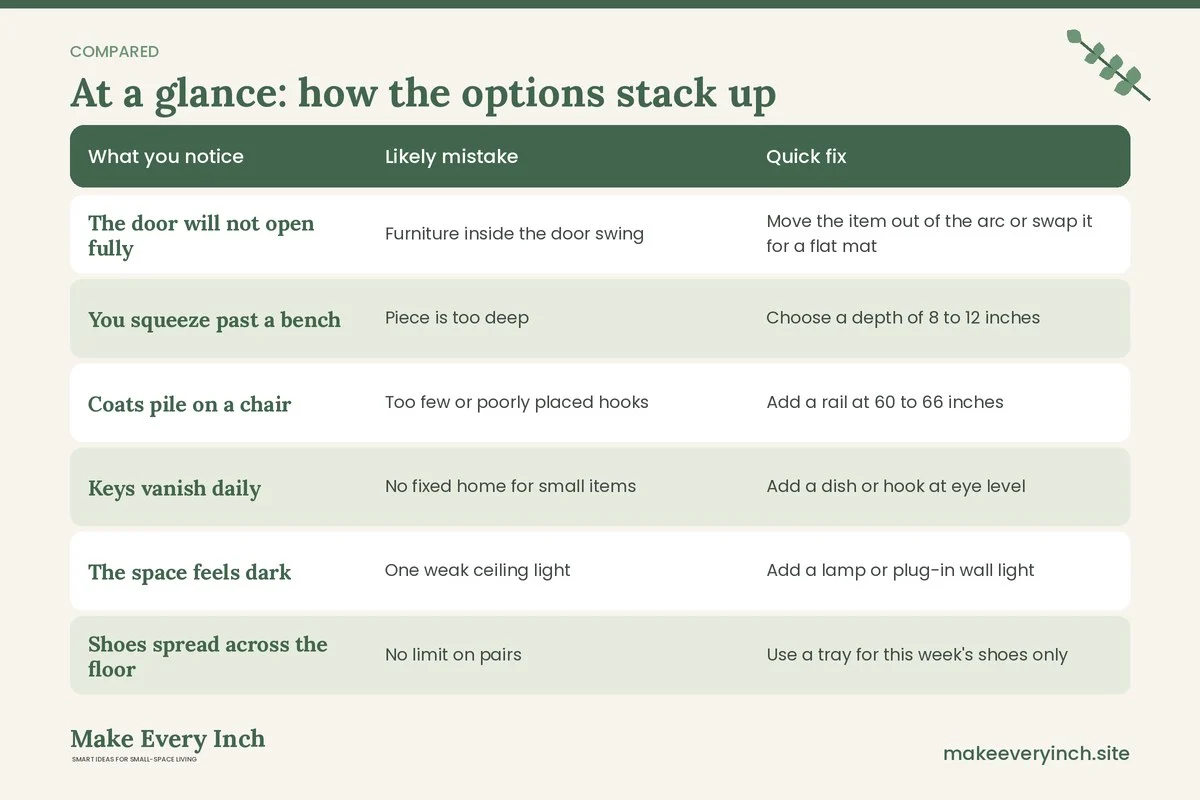
Stand in your doorway and ask one question: what annoys me every day? Maybe the door hits a shoe rack, maybe you can never find your keys, or maybe the hall feels dark and cluttered the moment you walk in. Find the matching symptom in the table below, then jump to the mistake that explains it. Fix one mistake at a time, and live with the result for a few days before you change anything else. Most entries improve a lot from three or four small changes.
Symptom table: what you notice and what causes it
| What you notice | Likely mistake | Quick fix |
|---|---|---|
| The door will not open fully | Furniture inside the door swing | Move the item out of the arc or swap it for a flat mat |
| You squeeze past a bench | Piece is too deep | Choose a depth of 8 to 12 inches |
| Coats pile on a chair | Too few or poorly placed hooks | Add a rail at 60 to 66 inches |
| Keys vanish daily | No fixed home for small items | Add a dish or hook at eye level |
| The space feels dark | One weak ceiling light | Add a lamp or plug-in wall light |
| Shoes spread across the floor | No limit on pairs | Use a tray for this week’s shoes only |
| The room feels crowded and busy | Too many decor items | Remove half of the objects |
| Rug slides or curls | No grip pad | Add a non-slip pad or switch rugs |
| Wall looks bare yet cluttered | Wrong scale of art | Use one larger piece instead of many small ones |
| Smell of damp in the entry | Wet items with no airflow | Dry items on a tray and open a window |
14 small entryway mistakes to avoid
Mistakes about layout and space
1. Blocking the door swing
Open the door fully and tape the arc on the floor. Anything that sits in that arc will be hit, scratched or trapped. The fix is to keep tall or rigid items outside the arc, and to use only a thin mat inside it. If the door opens against a wall, check that the handle does not strike a shelf. Also confirm that the door can open all the way in an emergency, since a blocked exit is a safety issue.
2. Choosing furniture that is too deep
A standard console is often 14 to 18 inches deep, which is far too much for an entry that is 40 inches wide. A piece 8 to 12 inches deep keeps the walkway at 30 inches or more. Measure the narrowest point of the walkway, subtract the depth of the piece, and make sure at least 30 inches remain. If you cannot reach 30, use a wall shelf instead of a floor piece.
3. Forgetting the walkway for a person with a bag
A path of 24 inches feels fine when you are empty-handed, but not when you carry groceries or a stroller. Plan for the widest thing you carry on a regular basis. Walk the route with a laundry basket to test it. If you bump, move the item or slim it.
4. Putting a mirror where it doubles the mess
A mirror makes a small space feel larger, but it also doubles whatever it reflects. If it faces a heap of shoes or a cluttered shelf, the entry looks even busier. Hang it where it reflects a window, a plant or a bare wall. Use hardware rated well above its weight, or lean a floor mirror and secure it so it cannot fall. If drilling is not allowed, choose a leaning mirror with an anti-tip strap or a safe stand.
Mistakes about storage
5. Hanging too many hooks, or hooks at the wrong height
Six hooks in a row invite six coats. Four is enough for most households, and a few of them can hold bags. Mount hooks at about 60 to 66 inches for adults, leave 6 to 8 inches between them, and add one low hook at 40 to 48 inches for a child. If you rent, use adhesive hooks rated far above the load, test a hidden spot, and follow the weight limits on the pack. Never hang a heavy bag on an adhesive hook that is only rated for a light item.
6. Letting shoes multiply
A shoe tray looks tidy with four pairs and chaotic with nine. The mistake is storing every pair you own by the door. Keep the pairs you wear this week there, and move the rest to a closet, a bed box or a shelf elsewhere. If you need more capacity, see best narrow shoe cabinets and shoe storage ideas for small closets.
7. Having no home for keys and mail
Keys, wallets and letters drift around the home without a spot. Add a small dish, a wall pocket or a hook right beside the door. Put it at hand height, about 48 to 54 inches, so you use it without thinking. Sort mail standing up and recycle the junk before you walk in.
8. Using open storage for everything
Open baskets and cubbies look good in photos, but in a small entry they show every item. If the entry is visible from your living area, consider doors or lidded boxes for the messy items. A tall slim cabinet 10 to 12 inches deep hides a lot. If you choose open storage, limit it to what looks good: three baskets, labeled, with matching shapes.
9. Skipping the anchor on a tall piece
A tall shelf, a cabinet or a coat rack can tip if a child climbs it or a heavy coat pulls the top. Always anchor pieces taller than about 30 inches using the supplied hardware. Ask permission before drilling into a rental wall. If you cannot anchor, choose a lower piece, a wall-hung unit installed with permission, or a freestanding rack with a wide, weighted base. Keep heavy items low and light items high.
Mistakes about style and comfort
10. Ignoring the light
Entries are often dark because there is no window and the fixture is far away. Adding a small lamp, a plug-in sconce or a rechargeable motion light can change the feel of the space. Keep cords tidy with clips, never run them under a rug, and avoid overloading a power strip. Choose warm white bulbs, and keep lamp shades away from coats and scarves. For more, see renter friendly lighting ideas.
11. Over-decorating a tiny wall
A gallery of eight small frames on a short wall looks busy in a small space. Choose one larger piece or a tight group of three, and let the hooks be part of the display. Leave 2 to 3 inches between frames and center art at about 57 inches from the floor. If you want ideas that stay quiet, see small entryway wall decor ideas.
12. Using a rug that slips or curls
A rug that slides is a trip hazard, and one with curled corners catches the door. Choose a low-pile or flat-weave rug, add a grip pad suited to your floor type, and check that the door clears the rug. Be careful with rubber backings on some floors, because they can stain or mark. Never place a rug over a cord.
13. Painting without ventilation
A fresh coat of paint can lift an entry, but an enclosed space holds fumes. Ask permission first, choose a low-VOC paint, and keep a window open or a fan running while you work and while the paint dries. Keep children and pets away until the smell fades. If you cannot paint, use removable wallpaper only if the lease allows, or add color with a rug or a large print.
14. Letting wet items sit
Wet boots and damp coats add moisture to a small enclosed space. Without airflow, you get a musty smell and sometimes mildew. Put a tray under wet shoes, hang coats where air can circulate, and open a window after rainy days. Avoid storing wet items in a closed cabinet.
Three before and after scenarios
A 36 inch wide entry in a one-bedroom
Before: a 16 inch deep bench, six hooks and a pile of shoes. The walkway was only 20 inches, and the bench blocked the door. After: the bench is replaced by a 10 inch shelf with a shoe tray under it, and the hooks are cut to four. The walkway is now 26 inches, and the door opens fully. The key dish sits on the shelf. No drilling was needed because the shelf is freestanding with a low profile.
A hallway entry in a rental with strict rules
Before: the tenant used adhesive hooks beyond their weight rating, and a hook fell with a heavy bag. After: heavy bags go on a freestanding rack with a weighted base, and the adhesive hooks hold only scarves and light jackets. The wall was tested first on a hidden spot. The rack is placed outside the door arc. The tenant reads the weight limits and keeps to them. For more renter-safe choices see no drill storage ideas for renters and renter friendly entryway organization ideas.
A door that opens straight into a studio
Before: a bright rug, a big plant and a stack of boxes by the door, all visible from the bed. After: boxes move out, a low screen about 50 inches tall blocks the view, and a hook rail holds the coat. A single mat marks the zone. The entry now looks like a small foyer. See small entryway ideas for studio apartments and tiny foyer ideas for more.
A one-hour entryway audit
You can diagnose most problems in an hour. Set a timer and work through these steps.
- Minutes 0 to 10: empty the entry and put everything on the floor in the next room. Look at the bare space.
- Minutes 10 to 20: measure the door swing, the walkway, the wall width and the height of any switch or vent. Tape the swing on the floor.
- Minutes 20 to 35: sort what you removed into four piles: daily, weekly, seasonal and not needed. Daily items return to the entry, and the rest go elsewhere.
- Minutes 35 to 50: choose one place for each daily item: hook, tray, dish or shelf. Mark them with tape.
- Minutes 50 to 60: place the items back and walk through with a bag, as you would on a normal day. Adjust anything that bumps.
The audit often shows that the entry did not need more storage. It needed fewer objects.
Safety notes that apply to almost every entry
- Anchor tall pieces. Use the supplied hardware, and ask the landlord before drilling.
- Respect weight limits. Adhesive hooks and shelves have limits, so stay well below them and distribute weight.
- Keep exits clear. Nothing should block the door or the walkway.
- Watch electrical loads. Do not overload a power strip or run a cord under a rug.
- Ventilate. Open a window when you dry wet items or paint, and use low-VOC paint with permission.
- Think about children and pets. Keep small objects, cords and heavy items out of reach, and use stable furniture.
- Do not drill without permission. Read the lease, ask in writing and keep a record.
What to buy last
Fix the habits and the layout before you shop. In most small entries, the order of improvement is: clear the clutter, set the zone with a mat, add hooks, add a tray, add light and only then add furniture. Buying a bench first often creates a new problem. If you do shop, measure twice, check the depth and the weight limit, and read the return policy. For storage that stays small see small entryway storage and small entryway ideas that keep clutter under control.
Quick checklist
- Tape the door swing and keep it clear.
- Keep a 30 to 36 inch walkway where you can.
- Choose furniture that is 8 to 12 inches deep.
- Use four hooks at about 60 to 66 inches.
- Add a dish or hook for keys at eye level.
- Limit the shoes by the door to this week’s pairs.
- Anchor any tall piece, with permission to drill.
- Add a lamp or plug-in light, with tidy cords.
- Use a grip pad under every rug.
- Dry wet items on a tray and open a window.
- Reduce wall decor to one larger piece or a tight group.
- Run the one-hour audit twice a year.
FAQ
What is the biggest mistake in a small entryway?
Blocking the door swing is the most common, because it makes the entire space harder to use. Tape the arc and keep it clear.
How deep should furniture be in a narrow entry?
Between 8 and 12 inches is a good range. Check that at least 30 inches of walkway remain after you place the piece.
How many hooks do I need?
Four is enough for most households. More hooks usually lead to more clutter. Add a low one for a child.
Is it safe to use adhesive hooks?
They are fine for light items if you follow the weight rating, clean the wall and test a hidden spot. Do not hang heavy bags on them.
Do I need a bench?
Not always. A bench helps if you sit to remove shoes, but it takes floor space. A wall hook and a tray often work better in a very narrow entry.
Can I paint my entryway in a rental?
Only with permission. Choose a low-VOC paint and keep the area ventilated while it dries.
Keep going: Keep going with small entryway ideas that keep clutter under control, small entryway bench ideas and small hallway decorating ideas.
Save this guide for later
Pin the ideas you like to Pinterest so you can come back to them when you plan your space.