14 Small Living Room Ideas With a Sectional for Families
Quick answer: The best small living room ideas with a sectional for families choose a durable, wipeable fabric category, a firm seat with a removable cover, rounded corners and a layout that leaves a clear play floor of at least 4 by 6 feet. Put the sectional against the walls, anchor shelves and the TV, keep cords out of reach, use a lidded ottoman for toys, and keep walkways at 30 inches so adults can carry a child through without bumping a corner.
Small living room ideas with a sectional for families have to work on three levels at once: the sectional must seat everyone, survive daily life with children, and still leave enough open floor for play. A small room makes each of those harder, because every inch given to the sofa is an inch taken from the play space, and every spill lands on the biggest piece of furniture you own. This guide gives you 14 plans built around kids, spills, durable fabric categories, play space and safety. It includes measurements in inches, a fabric category table, three example rooms with dimensions, a daily reset routine, a safety list, a checklist and an FAQ. For the wider topic, start with our guides to small living room ideas and small living room ideas with a sectional, which this post builds on.
What changes when kids share the sectional
A sectional in a family room is a bed, a fort, a table, a trampoline and a snack bar before it is a sofa. Plan for that use from the first measurement. Three things change.
The first is the seat. Children climb, so a firm seat that holds its shape beats a soft one that sinks and bunches. A seat height of 17 to 19 inches lets small children climb on and off without help, and a seat depth of 21 to 24 inches lets adults sit upright. Very deep seats of 28 inches or more are comfortable for adults but hard for a small child to use safely, because their legs do not reach the edge.
The second is the surface. Fabric takes spills, crayons, sticky hands and pet hair, so you need a category that you can wipe or wash. We cover the choices below.
The third is the floor. Kids play on the floor, so the room needs an open area that is not a walkway. A good target is 4 by 6 feet of clear floor next to the sectional, or about 24 square feet. In a 120 square foot room, that is one fifth of the space, and the sectional and the walkways must fit in the other four fifths. This arithmetic decides which shapes are possible, so do it before you shop.
Measure the room and plan the play floor
Measure the room wall to wall, and mark the door swing, windows, vents, outlets and the TV wall. Most small family living rooms are 11 by 13 feet to 12 by 16 feet, which is 143 to 192 square feet. An L-shaped sectional with a long side of 88 inches and a short side of 60 inches takes about 37 square feet of floor, a little less than a third of a 120 square foot room.
Next, decide where the play floor goes. It works best in the visible corner opposite the sectional, where a parent sitting on the chaise can see the child without turning. Avoid putting it in the doorway, since children playing in a walkway get stepped on. Avoid putting it in front of the TV, since it blocks the view.
Tape the plan with painter’s tape. Mark the sectional, the rug, the play floor and every walkway. Keep main paths at 30 to 36 inches, wide enough to carry a laundry basket or a child on one hip. Walk the route with a toy box in your arms, and notice where your elbows touch the tape.
Fabric categories for a family sectional
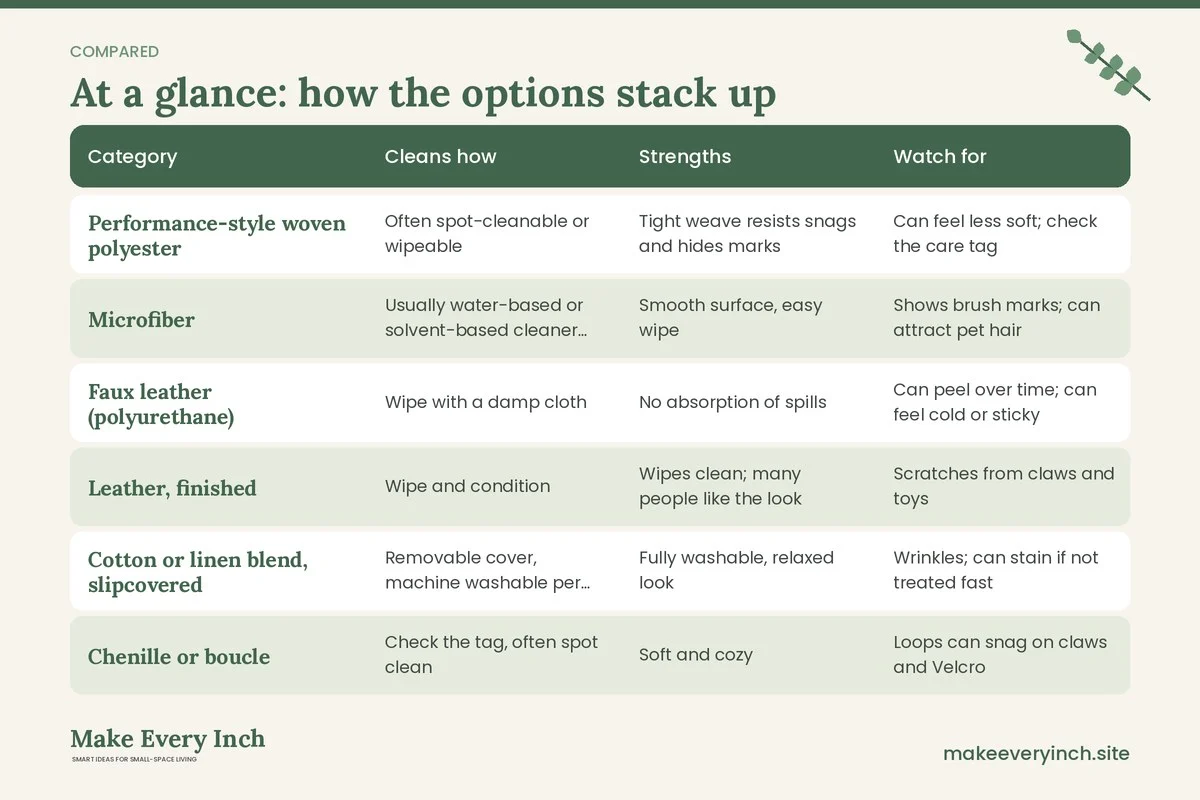
Fabric is the biggest decision for a family. You do not need to know brand names or chase a trend. Instead, think in categories and read the label of whichever product you consider. Care codes are printed on a tag or listed in the product details, and they tell you how to clean the cover. Check the code and the manufacturer’s cleaning instructions before you buy, because they differ by product.
| Category | Cleans how | Strengths | Watch for |
|---|---|---|---|
| Performance-style woven polyester | Often spot-cleanable or wipeable | Tight weave resists snags and hides marks | Can feel less soft; check the care tag |
| Microfiber | Usually water-based or solvent-based cleaner, per tag | Smooth surface, easy wipe | Shows brush marks; can attract pet hair |
| Faux leather (polyurethane) | Wipe with a damp cloth | No absorption of spills | Can peel over time; can feel cold or sticky |
| Leather, finished | Wipe and condition | Wipes clean; many people like the look | Scratches from claws and toys |
| Cotton or linen blend, slipcovered | Removable cover, machine washable per tag | Fully washable, relaxed look | Wrinkles; can stain if not treated fast |
| Chenille or boucle | Check the tag, often spot clean | Soft and cozy | Loops can snag on claws and Velcro |
| Velvet (polyester) | Often spot-cleanable | Hides crumbs; rich color | Shows pressed marks; check the tag |
Whichever category you choose, there are a few rules that help. Choose a mid-tone color, such as oatmeal, taupe, olive or slate, since they hide both light crumbs and dark stains better than white or black. Choose a tight weave over a loose or looped one. Look for removable cushion covers with a zipper, and ask whether the seat cushions can be flipped. Keep a stain-removal plan on hand: a cloth, a bottle of gentle cleaner suitable for the fabric, and a lint roller. Test any cleaner on a hidden patch first.
14 small living room ideas with a sectional for families
Layouts that save floor for play
1. The L tucked against the long wall
Push the long side of the L flush against the longest wall, and put the chaise on the side that keeps the door clear. This leaves a rectangle of open floor in front, often 6 by 8 feet in a 12 by 14 foot room. Use that open floor for a big rug and for play. This is the best-known layout for families, and it works because the sectional uses the walls and the middle stays open.
2. The corner L with a toy bench
Put the sectional in the corner and add a bench or a lidded chest with cushions along the open side. The bench is a seat for guests and for kids, and it holds toys inside. Choose a bench 36 to 42 inches long, 15 to 18 inches deep, and make sure the lid has a slow-close hinge or a lid stay that prevents the lid from slamming on small fingers.
3. The reversible chaise facing the play area
A chaise that points toward the play floor lets a parent lie down and watch a child at the same time. Choose a model with a reversible chaise if you may move rooms. A chaise of 60 to 66 inches also works as a nap bed for a child.
4. The sectional with a low back
A back of 28 to 32 inches lets you see over it, which helps you watch a child who is playing behind or beyond. A high back blocks sight lines in a small room and makes the space feel smaller.
5. The U shape for a larger family
In a 12 by 16 foot room, a three-sided sectional with a 60 inch chaise and 70 inch sides gives seating for five or six. Keep it only if you can still leave 3 feet of floor in front of the open side. Otherwise, stick to an L plus a pouf.
Spills, wear and cleaning
6. Slipcovers and washable layers
Choose a sectional with removable covers, or put a fitted slipcover over it. Throw blankets in the same color hide small stains, and you can wash them every week. Keep two spare covers so one is on the sectional while the other is in the wash.
7. The wipe-clean cushion plan
Use zip covers on every pillow, and place the pillows that children dislike (decorative ones) on the top shelf in a basket. A small family only needs two pillows on the sectional at one time, so keep the rest in storage.
8. A rug that hides crumbs
Choose a flat-weave or low-pile rug of 5 by 8 or 6 by 9 feet in a pattern or a mid-tone color. Add a non-slip pad underneath so the rug does not slide when children run. Many rugs have washable versions, and the label tells you how to clean them.
9. The no-shoes basket by the door
Put a bench or a basket at the entry for shoes and bags, so outdoor dirt does not reach the sectional. Our guide to small entryway storage covers shapes that fit a narrow wall.
Play space and storage
10. Toy storage behind the sectional
Float the sectional 10 inches off the wall and put a 12 to 14 inch deep console behind it, with baskets underneath. Toys disappear in one sweep at the end of the day, and the console doubles as a shelf for lamps and books. For options, see our post on small living room storage ideas.
11. A lidded ottoman for the clutter
A lidded ottoman at the end of the chaise holds blankets, board games and a pile of toys. Look for a model with a soft-close lid or a removable lid, and one with rounded corners. Our guide to best storage ottomans lists what to check.
12. Wall storage above kid height
Mount shallow shelves 52 to 60 inches above the floor to hold books, photos and art. Use the lowest shelf at 12 to 18 inches for the children’s books, so they can reach them without climbing. See our guide to vertical storage ideas for more.
Safety plans
13. Anchor everything that can tip
Anchor shelves, consoles and the TV to the wall with anti-tip straps or brackets, following the manufacturer’s instructions and your wall type. Renters should read the lease and check for no-drill options, as in no-drill storage ideas for renters. Place heavy items on low shelves, never on top of tall furniture.
14. Soften the edges and cords
Choose round or oval tables, or add corner guards to the ones you have. Use a cord cover or a cable box to keep wires out of reach, and keep window blind cords short, tied up or replaced with cordless versions. Keep floor lamps with a heavy base in a corner behind the sectional so a child cannot reach the cord or tip the lamp.
Comparison table: layouts by family stage
| Stage | Best layout | Seat plan | Play floor | Key safety step |
|---|---|---|---|---|
| Baby and crawler | L on the long wall | 4 seats plus chaise | 5 by 7 ft rug | Corner guards, gate near stairs |
| Toddler | Corner L plus toy bench | 4 seats plus bench | 4 by 6 ft open floor | Anchor TV and shelves |
| School age | L with console behind | 5 seats | 3 by 5 ft plus table | Cord management |
| Teens and guests | U or L plus ottoman | 5 to 6 seats | Small, flexible | Anchor tall units |
| Pets and kids | L with washable cover | 4 seats | 4 by 6 ft | Removable covers, scratch-resistant fabric |
A daily reset routine
A small family room stays calm when the reset takes five minutes. Try this routine at the end of each day.
- Return the toys to the baskets or the lidded ottoman
- Fold the blankets and put them in the basket
- Wipe the sectional with a damp cloth if needed
- Check that cords are in place and the lamp is upright
- Vacuum the rug if crumbs are visible
- Straighten the cushions and rotate the seat cushions weekly
Make the reset a game for the children. A basket with a clear label (such as a picture on the front) lets even a young child help. A routine means the sectional does not turn into a storage shelf, and the play floor is clear for tomorrow.
Three example rooms with dimensions
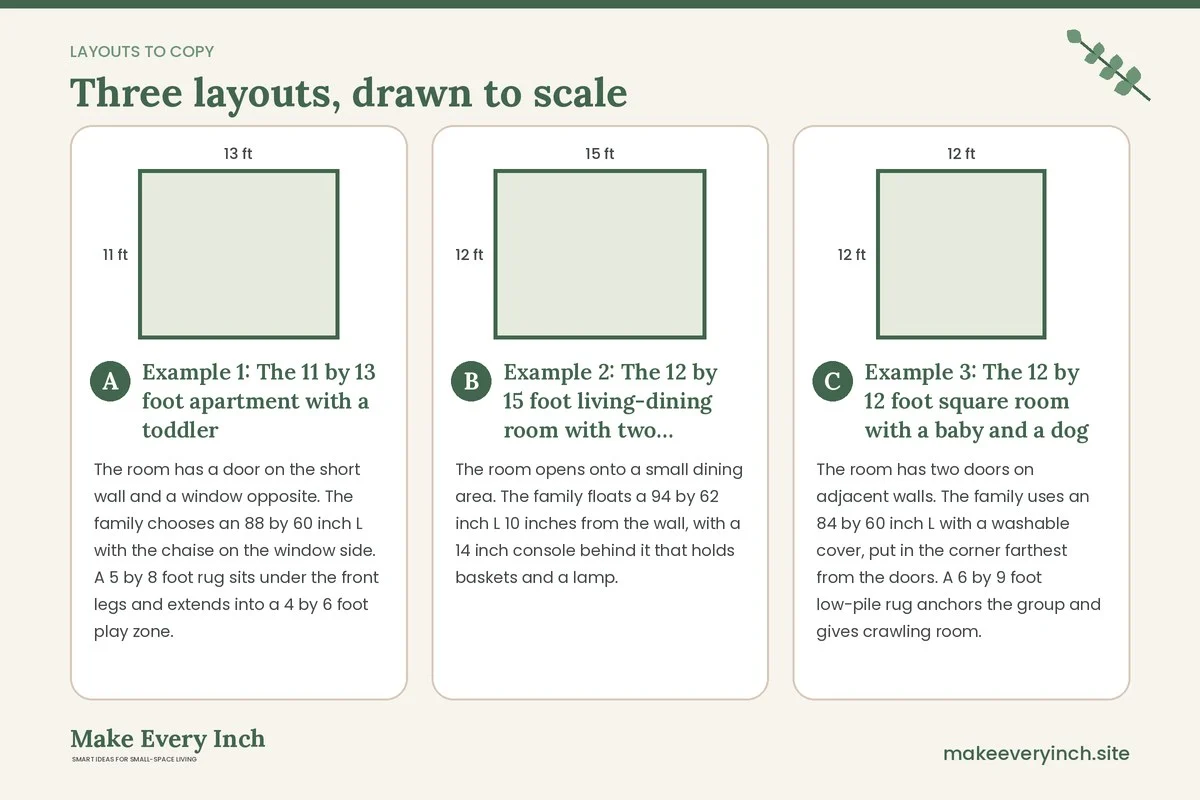
Example 1: The 11 by 13 foot apartment with a toddler
The room has a door on the short wall and a window opposite. The family chooses an 88 by 60 inch L with the chaise on the window side. A 5 by 8 foot rug sits under the front legs and extends into a 4 by 6 foot play zone. A 36 inch lidded bench stands at the open end for toys. The TV sits on a low console on the wall opposite at 8 feet, anchored with a strap. The door path stays at 34 inches, and a round side table with a lamp stands behind the arm.
Example 2: The 12 by 15 foot living-dining room with two school-age kids
The room opens onto a small dining area. The family floats a 94 by 62 inch L 10 inches from the wall, with a 14 inch console behind it that holds baskets and a lamp. A 6 by 9 foot rug sits under the sectional, and a second flat-weave 3 by 5 foot rug in the dining nook is for homework and games. Shelves 12 inches deep on the wall hold books. The path behind the console stays at 32 inches, and the TV hangs at 9 feet from the seats.
Example 3: The 12 by 12 foot square room with a baby and a dog
The room has two doors on adjacent walls. The family uses an 84 by 60 inch L with a washable cover, put in the corner farthest from the doors. A 6 by 9 foot low-pile rug anchors the group and gives crawling room. A pair of 30 inch round poufs on casters slide aside for floor time. Outlet covers, corner guards and a gate for the kitchen entry keep the baby safe, and a tall lamp in the far corner sits behind the sectional with its cord taped along the baseboard.
Mistakes to avoid
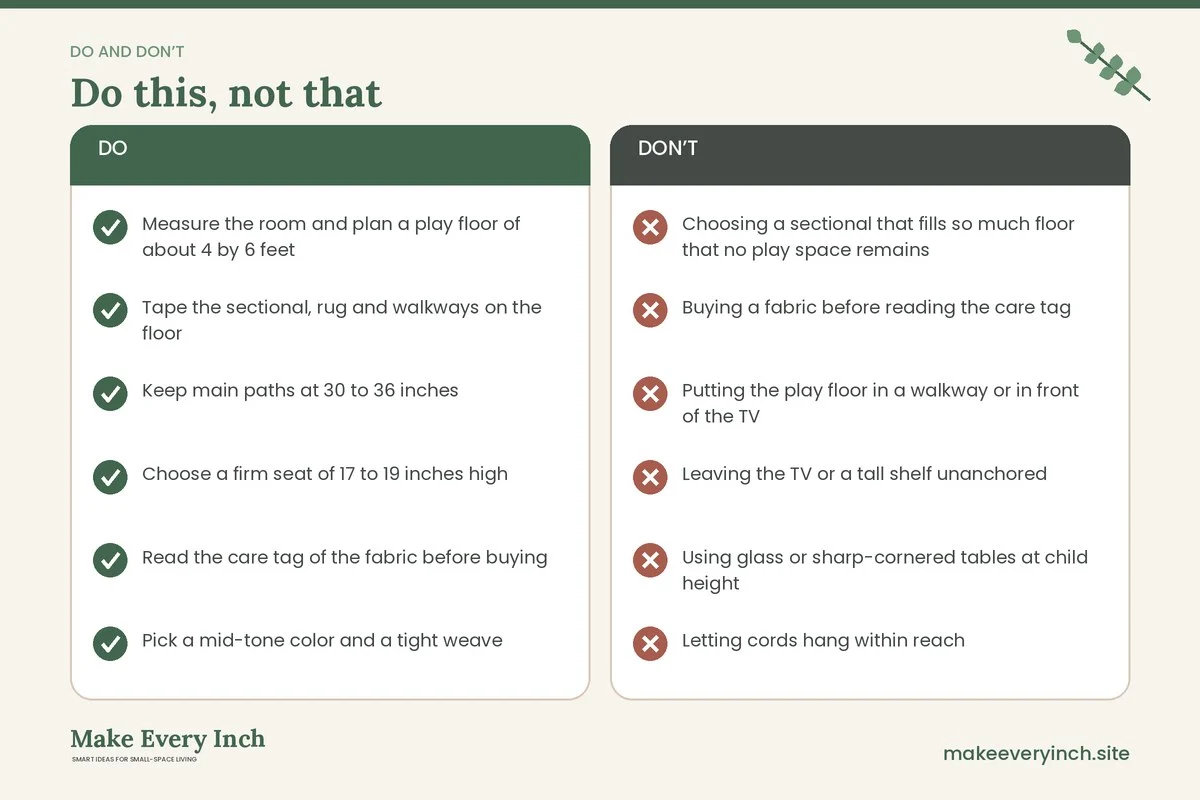
- Choosing a sectional that fills so much floor that no play space remains
- Buying a fabric before reading the care tag
- Putting the play floor in a walkway or in front of the TV
- Leaving the TV or a tall shelf unanchored
- Using glass or sharp-cornered tables at child height
- Letting cords hang within reach
- Choosing white or very pale fabric for the first sectional
- Forgetting a place for the toys, so they pile on the seats
Family sectional checklist
- Measure the room and plan a play floor of about 4 by 6 feet
- Tape the sectional, rug and walkways on the floor
- Keep main paths at 30 to 36 inches
- Choose a firm seat of 17 to 19 inches high
- Read the care tag of the fabric before buying
- Pick a mid-tone color and a tight weave
- Choose removable covers when possible
- Add a lidded ottoman or console storage for toys
- Anchor the TV, shelves and tall furniture
- Use round tables and corner guards
- Hide cords and shorten blind cords
- Set a five-minute daily reset
FAQ
What size sectional is best for a small family living room?
An L with a long side of 84 to 94 inches and a short side of 58 to 62 inches suits most rooms of 140 to 190 square feet, and it leaves space for a play floor of about 4 by 6 feet.
Which sectional fabric is best for kids?
There is no single best category. Tightly woven performance-style fabrics, finished leather or faux leather, and washable slipcovers are common choices. Read the care tag and pick one that you can wipe or wash.
How do I protect a sectional from spills?
Choose a mid-tone, tight-weave fabric, use washable throws and zip covers, and keep a cleaning cloth and a suitable cleaner on hand. Test any cleaner on a hidden patch.
Where should the play area go in a small living room?
Put it in the corner opposite the sectional, in view from the chaise, and away from the door and the TV.
Is a sectional safe for toddlers?
Choose rounded corners, a firm seat at a height they can climb, and keep the sectional away from windows and cords. Supervise climbing, and follow the manufacturer’s guidance.
How do I keep the TV safe around kids?
Mount it or anchor it with a strap following the manufacturer’s instructions, and keep cords out of reach.
Should I choose a chaise with kids?
A chaise is helpful for lying down and napping, but it uses floor. In a small room, choose a chaise on the wall side and keep the play floor open.
Can a family fit a sectional in a rental?
Yes. Measure doors, stairs and halls first, and read the lease on wall anchors. Our guide to small living room ideas with a sectional for renters helps with moving and anchoring.
Keep going: Keep planning with our small living room ideas with a sectional, small apartment living room ideas for families and small living room ideas with a sectional for couples.
Save this guide for later
Pin the ideas you like to Pinterest so you can come back to them when you plan your space.