15 Small Living Room Lighting Ideas for Families: Safe Cords, Homework and Play Zones
Quick answer: The best small living room lighting ideas for families put safety first and then split the room into zones. Use a bright, glare-free overhead layer for play and cleanup, a task light of roughly 400 to 800 lumens at the homework spot, and low, dimmable lamps for evenings. Keep cords short, flat and out of reach, choose stable or wall-fixed lamps, and never overload an outlet.
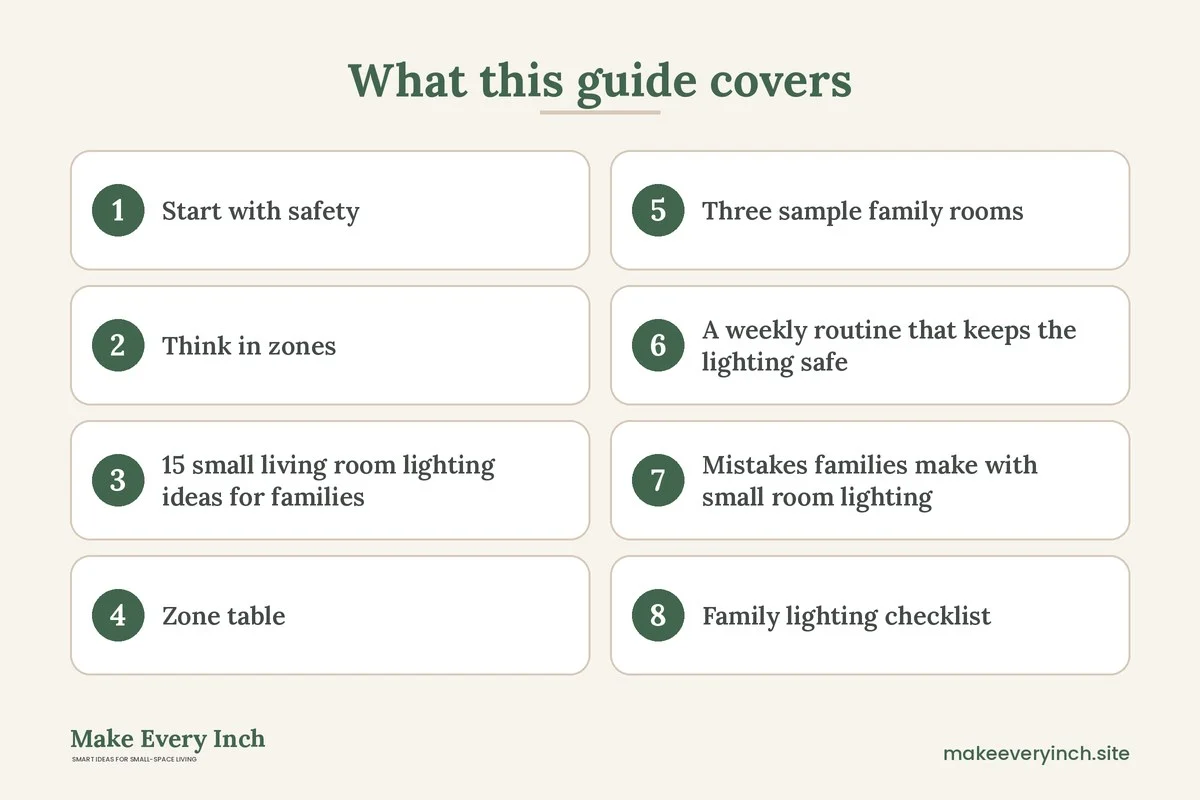
Small living room lighting ideas for families have to do more than make the room pretty. In a family home the living room is the play area, the homework table, the movie theater and the place where guests sit, often all in one afternoon. The lighting must be bright enough for crayons and spelling lists, soft enough for a calm evening, and safe around small hands, big feet and curious pets. This guide covers the cord and kid safety rules first, then how to divide a small room into homework and play zones, 15 specific ideas, a zone table with lumen ranges, three sample rooms, a weekly routine, mistakes to avoid and a checklist. For the full overview of the topic, start with our parent guide on small living room lighting ideas, then come back here for the family-specific plan.
Start with safety: cords, tip-overs and hot bulbs
Before you think about style, walk the room at a child’s height. Get down on your knees, or lie on the rug, and look at what a toddler can see and reach. Every lamp, plug and cord you spot is something a child will eventually pull, chew, climb or trip over. Fixing these hazards first costs little and changes which lights you should buy.
The cord rules
- Keep cords short. A cord only needs to reach from the lamp to the nearest outlet. Excess cord is the real hazard, so coil it neatly and fasten it with a cable tie or a cord clip, away from the floor and out of reach.
- Run cords along walls, not across walkways. A cord that crosses the path between the sofa and the door is a trip risk for adults and a pulling risk for children. Route it along the baseboard, behind furniture or inside a cord cover rated for the job.
- Never run cords under rugs. Cords under a rug can overheat and become damaged without anyone noticing. Move the lamp or move the rug instead.
- Do not use staples or nails on cords. Piercing the insulation is a fire and shock risk. Use adhesive cord clips or a cord channel that fits the wire.
- Cover unused outlets with tamper-resistant covers or outlet caps. Many newer homes already have tamper-resistant receptacles, and you can check for the marking on the faceplate.
- Check the label. Use only lights and extension cords that carry a recognized safety certification mark, and follow the wattage limit printed on the lamp socket.
Stability and tip-overs
A tall floor lamp with a light base is a classic tip-over risk when a child grabs it or a ball hits it. Look for a heavy, wide base, and place the lamp in a corner behind the sofa, where the furniture itself blocks the swing of a ball or an elbow. You can also choose wall-mounted or clamped fixtures that do not stand on the floor at all. Check any wall fixture for secure fastening, and if you rent, read the lease before drilling. For rental-safe options, see our guide to renter-friendly lighting ideas.
Heat and bulb safety
- Use LED bulbs in family rooms. They run much cooler than older incandescent or halogen bulbs, which lowers the chance of burns when small hands touch a shade or a bulb.
- Respect the wattage limit. Every socket has a maximum, usually printed near the bulb. Because an LED uses far less power than the old bulb it replaces, a modest LED is almost always within the limit, but never put a bulb with a higher rating than the socket allows.
- Keep shades from touching bulbs and keep fabric, paper and decorations away from any hot lamp.
- Choose shatter-resistant shades or covers where a ball might land. Plastic or fabric shades are safer than thin glass in a play area.
- Buy lights with enclosed bulbs for low placements, so a child cannot unscrew or touch the bulb.
Outlets and electrical limits
Small living rooms often have only two or three outlets, and families add game consoles, a TV, chargers and a humidifier. Do not plug several heavy items into one power strip. A power strip is for low-draw devices such as lamps and chargers, and it should have its own switch and built-in overload protection. Do not daisy-chain strips, and do not leave a strip where a spill, a toddler or a pet can reach it. If a plug feels warm, if the outlet discolors or if breakers trip often, stop and call a licensed electrician. Any hardwired work, such as adding a ceiling fixture, moving a wall switch or installing recessed lights, should be done by a licensed electrician, not by a do-it-yourself guess. Local rules often require permits for new wiring, so ask before you start.
Think in zones: play, homework and relax
A small room does not need one great light. It needs three or four modest ones that you can switch on separately. The family version of layered lighting is zoned lighting, where each activity has its own light and nothing is left to a single glaring ceiling fixture. Divide the room on paper first, even if the zones overlap, using the same logic as in our small living room layout ideas. A living room of 10 by 12 feet can usually be split into a play corner of about 4 by 6 feet, a homework spot of about 3 by 4 feet and a sofa area for relaxing.
Play zone
Children play on the floor, so light that comes from above and spreads wide works best. Aim for even light at floor level, with no shadows cast by an adult standing over the toys. Roughly 300 to 500 lumens per square meter at the play surface is a comfortable general range for active play, though the exact amount depends on wall color and daylight. A diffused ceiling light, a wide shade or a ceiling-mounted flush fixture with a frosted cover spreads light evenly and avoids the glare that bounces off glossy toys and board games.
Homework zone
Reading and writing need more focused light than play. A task lamp placed on the side opposite the writing hand prevents the shadow of the hand from falling on the page. A right-handed child should have the lamp on the left, and a left-handed child should have it on the right. The lamp’s bulb should sit slightly below eye level when seated, with a shade that hides the bulb itself. Aim for about 400 to 800 lumens at the desk, and choose a neutral white color, around 3500 to 4000 kelvin, which many people find comfortable for focus without feeling clinical. The desk lamp should stand about 15 to 20 inches tall for a table at 28 to 30 inches, so the light source lands roughly 12 to 16 inches from the paper. Our guide to best desks for small apartments has tips for the surface itself.
Relax zone
Evening is for dimmable, warm light. Warm bulbs of about 2200 to 2700 kelvin and 200 to 450 lumens per lamp produce a gentle glow without the harshness of a bright overhead. Put the lamp at about 24 to 30 inches high beside the sofa, so the bulb sits below eye level when seated. Dimmers help children wind down after dinner, and they let adults enjoy a movie without the room going completely dark. For a softer look, read small living room lighting ideas for a cozy room. For more mood ideas, our guide to cozy small living room ideas pairs well with this approach.
15 small living room lighting ideas for families
Ceiling and overhead ideas
1. A flush-mount fixture with a frosted cover
In a room with a low ceiling, a flush or semi-flush fixture saves headroom for jumping children and tall adults. A frosted or opal cover hides the bulb and spreads the light evenly. A fixture for a small room commonly needs 800 to 1,500 total lumens, and a dimmer switch lets you reduce it at bedtime. If you have no ceiling fixture and you rent, a plug-in swag light on a hook is a safer and simpler choice, with the cord tucked along the wall.
2. Replace the bulbs before you replace the fixture
A bright, glare-free ceiling light can come from a simple bulb change. Swap an old bulb for a dimmable LED with a warm-to-neutral setting, check the packaging for the maximum wattage of the fixture and confirm that the bulb is compatible with your dimmer. This costs little and works in a rental.
3. A track or rail light, installed by a professional
A short track with three adjustable heads lets you aim one at the play corner, one at the homework spot and one at a wall for soft bounce light. Because tracks involve hardwiring, hire a licensed electrician. A plug-in track is possible in some rentals, but only choose one that has a safe, certified cord and fixings suited to your wall.
Floor lamps and corners
4. A stable arc or tripod lamp in the corner
A floor lamp with a wide, heavy base placed in the corner behind the sofa is less likely to be knocked over. Keep the shade above 5 feet 6 inches so a child cannot reach the bulb, and choose a model with a long shade skirt. For product-neutral help choosing, see our guide to the best floor lamps for small rooms.
5. A torchiere with a dimmer, used with care
Uplights bounce light off the ceiling and fill a room softly, which is useful where there is no overhead fixture. Choose a modern LED version and check the base weight. Never place anything combustible near the top, and avoid the older halogen types that run very hot.
6. A slim lamp behind the sofa
A lamp placed behind the sofa and angled at the wall lights the room from the back and keeps the cord out of walking paths. The sofa itself guards the lamp from rolling toys. Plan the cord to run straight down to the wall outlet, with no loops.
Task lights for homework
7. A clamp-on desk lamp
A clamp lamp attaches to the edge of a table or shelf and frees up surface space. Because it has no base, it cannot tip over. Check that the clamp matches the thickness of the desk and that the arm has a locking joint. Keep the cord short and clip it to the table leg.
8. A small adjustable desk lamp with a shade
A lamp 15 to 20 inches tall with a shade that covers the bulb gives direct light on a book without glare. Choose one with several brightness levels, so a child can use a lower level at night. If sharing the table with a laptop, point the lamp from the side to avoid reflections on the screen.
9. A battery or rechargeable reading light
For a child who reads on the sofa, a rechargeable clip light removes the cord completely. Look for models with a lock or a safe, enclosed battery compartment, and store them out of reach of toddlers, since small batteries are a swallowing hazard.
Play zone and wall ideas
10. A wall sconce with a hardwired or plug-in cord cover
A sconce about 60 to 66 inches from the floor lights a play corner without taking up floor space. A plug-in version needs a cord, so use a paintable cord cover to run it down the wall to the outlet. A hardwired sconce needs a licensed electrician.
11. A picture light over a family art wall
A slim picture light above a gallery of children’s drawings gives soft, warm light and a reason to keep the area tidy. Use a rechargeable or a plug-in type with a short, covered cord.
12. A sealed LED strip under a shelf
A strip under a shelf lights the play area from above and brings the surface into view. Only use sealed, certified strips with a proper power supply, keep the power supply off the floor and out of reach, and never stack strips beyond the maker’s limit. Avoid placing them where little fingers can pick at the adhesive.
Evening and mood ideas
13. A smart bulb scene for homework, play and movie time
A smart bulb or plug lets you set a “homework” scene with bright neutral light, a “play” scene with a wide, bright wash and a “movie” scene with dim warm light, all with one tap. A phone app or a simple remote is usually enough. Keep any remote or hub out of a toddler’s reach.
14. A night light in the hallway or at the baseboard
A tiny plug-in night light helps a sleepy child find the way to the bathroom without turning on a bright lamp. Choose one that stays cool to the touch and that sits flush against the wall.
15. A lamp on a high shelf, not a low table
A table lamp at 36 to 42 inches, on a shelf or console, is out of a toddler’s reach and away from the play floor. Use a lamp with a low-wattage LED bulb and a shade deep enough to hide the bulb, and keep the cord tucked behind the shelf.
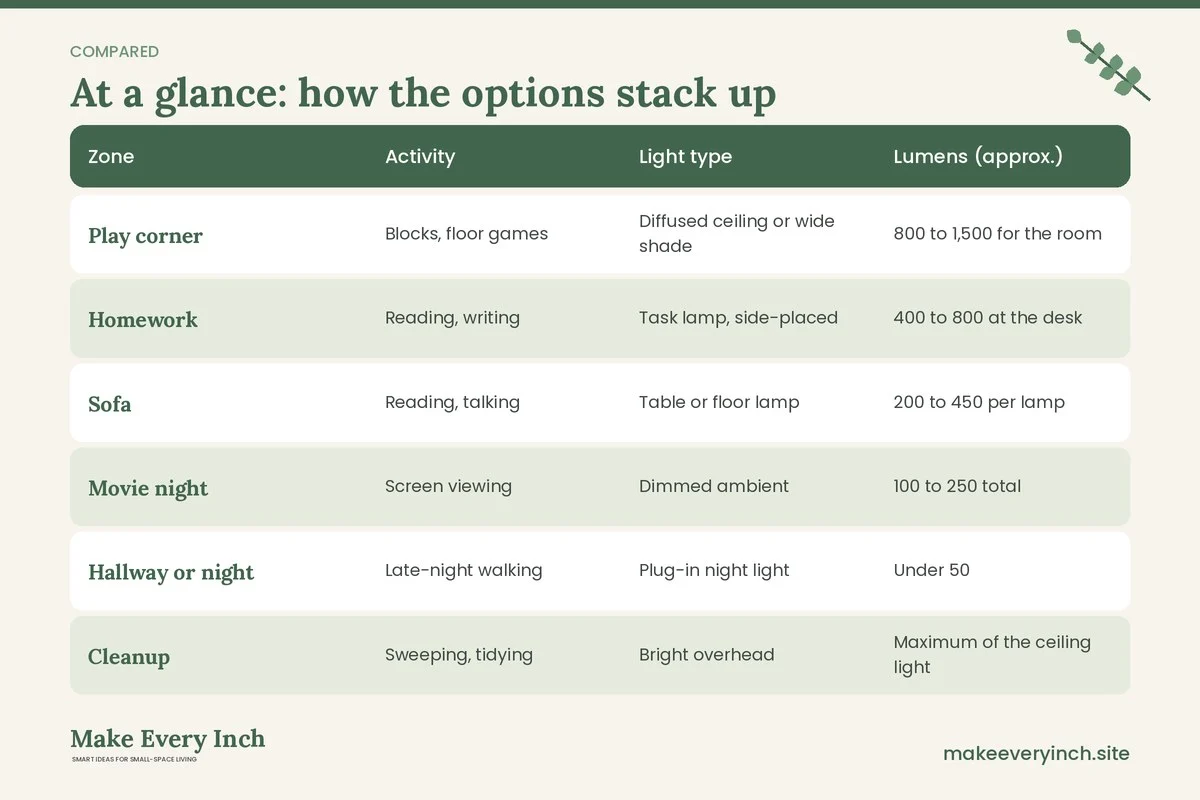
Zone table: how much light each family activity needs
Use the ranges below as starting points. They are general guidelines, not strict rules, and your wall colors, ceiling height and daylight will shift them. Always follow each fixture’s maximum wattage and any manufacturer instructions.
| Zone | Activity | Light type | Lumens (approx.) | Bulb color | Height / distance | |
|---|---|---|---|---|---|---|
| Play corner | Blocks, floor games | Diffused ceiling or wide shade | 800 to 1,500 for the room | 2700 to 3500 K | Ceiling or 60+ inches | |
| Homework | Reading, writing | Task lamp, side-placed | 400 to 800 at the desk | 3500 to 4000 K | Lamp 15 to 20 inches, 12 to 16 inches from the page | |
| Sofa | Reading, talking | Table or floor lamp | 200 to 450 per lamp | 2200 to 2700 K | 24 to 30 inches beside seat | |
| Movie night | Screen viewing | Dimmed ambient | 100 to 250 total | 2200 to 2700 K | Low, behind or beside screen | |
| Hallway or night | Late-night walking | Plug-in night light | Under 50 | Warm | At baseboard level | |
| Cleanup | Sweeping, tidying | Bright overhead | Maximum of the ceiling light | 3500 to 4000 K | Ceiling |
Three sample family rooms
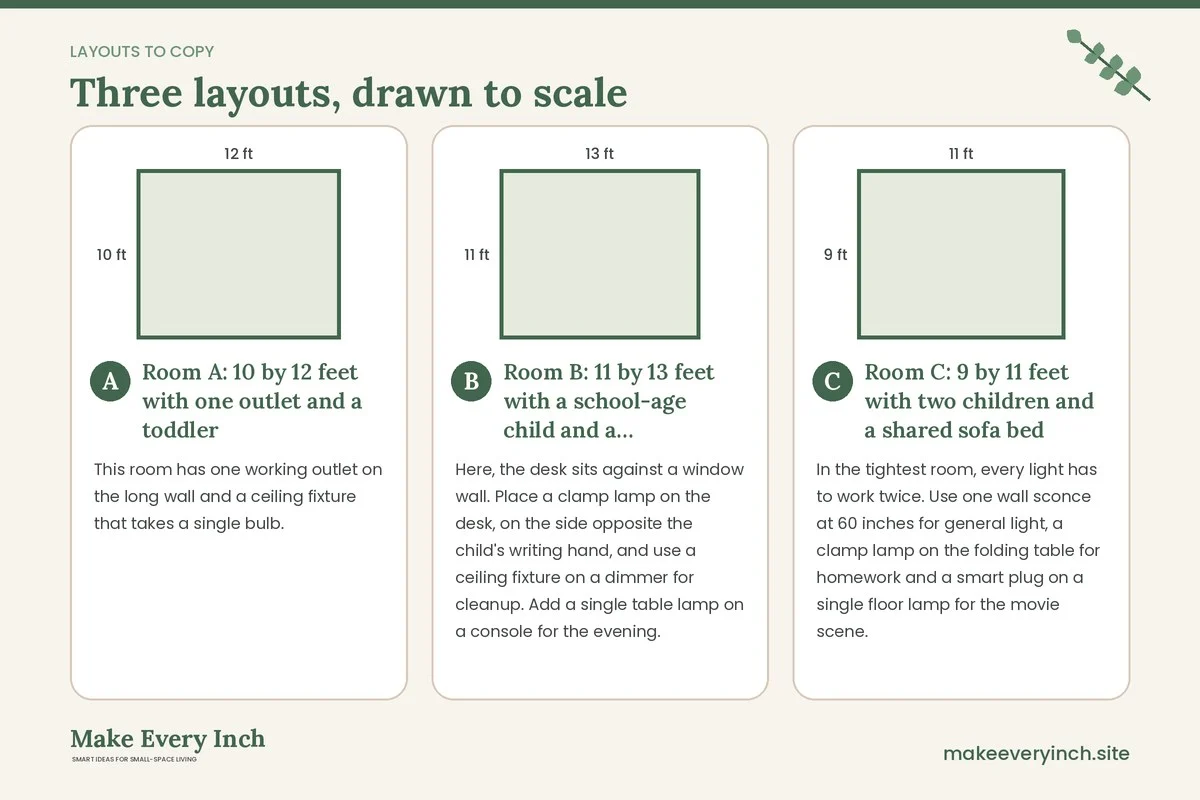
Room A: 10 by 12 feet with one outlet and a toddler
This room has one working outlet on the long wall and a ceiling fixture that takes a single bulb. Replace the bulb with a dimmable LED and add one tall, heavy-base lamp in the far corner, plugged into the outlet with a short cord clipped to the baseboard. Use a rechargeable clip light for evening reading, so no extra cords cross the floor. Keep the play zone under the ceiling light, which pairs well with the plan in small living room ideas without a coffee table for families, where there is plenty of even light, and leave the corners dim. A child cannot reach what is behind a sofa.
Room B: 11 by 13 feet with a school-age child and a homework spot
Here, the desk sits against a window wall. Place a clamp lamp on the desk, on the side opposite the child’s writing hand, and use a ceiling fixture on a dimmer for cleanup. Add a single table lamp on a console for the evening. Use a cord cover on the wall behind the desk to hide cords, and let the power strip live on the wall, mounted off the floor with its own switch. The desk should have 400 to 800 lumens of task light and the room should feel calm and dimmable once homework ends.
Room C: 9 by 11 feet with two children and a shared sofa bed
In the tightest room, every light has to work twice. Use one wall sconce at 60 inches for general light, a clamp lamp on the folding table for homework and a smart plug on a single floor lamp for the movie scene. Keep the cords in a cord channel along the wall. Because two children share the space, choose lamps with sturdy bases and shatter-resistant shades, and store the rechargeable lights in a basket on a high shelf.
A weekly routine that keeps the lighting safe
Good family lighting stays good only if someone checks it. Set a five-minute routine each weekend.
- Check cords. Look for frayed insulation, bent plugs, loose clips or cords pulled tight against furniture.
- Check bulbs and shades. Replace flickering bulbs and make sure the shades are straight and not touching the bulb.
- Check the outlets. Feel plugs and power strips for unusual warmth, and look for scorch marks. If you find any, stop using the outlet and call a licensed electrician.
- Reset the zones. Put the task light back at the homework spot and clear toys away from lamp bases.
- Dust the shades. Dust on a lamp can reduce light output and, on a hot shade, can smell burnt.
Mistakes families make with small room lighting
- Relying on one ceiling light. A single bright fixture creates glare at play time and a harsh feeling at night. Add at least two lamps.
- Trailing cords across the floor. This is the single most common cause of falls and pulled lamps. Plan every cord path before buying the lamp.
- Using decorative string lights as general lighting. They are often too dim for homework and risky if wrapped around furniture or beds. Use only certified sets and follow the length limits on the packaging.
- Ignoring glare on screens. A bright lamp behind the TV or a bare bulb opposite the screen causes reflections. Place the lamp to the side.
- Buying lamps with flimsy bases. A cheap, light base is a hazard. Test stability by pushing gently at shade height before you commit.
- Choosing bulbs by looks alone. Check lumens, color temperature, dimmer compatibility and the socket’s maximum wattage.
- Forgetting the quiet hours. If a child sleeps in the next room, a very bright ceiling light at night can wake the whole home. A dimmer solves that.
Family lighting checklist
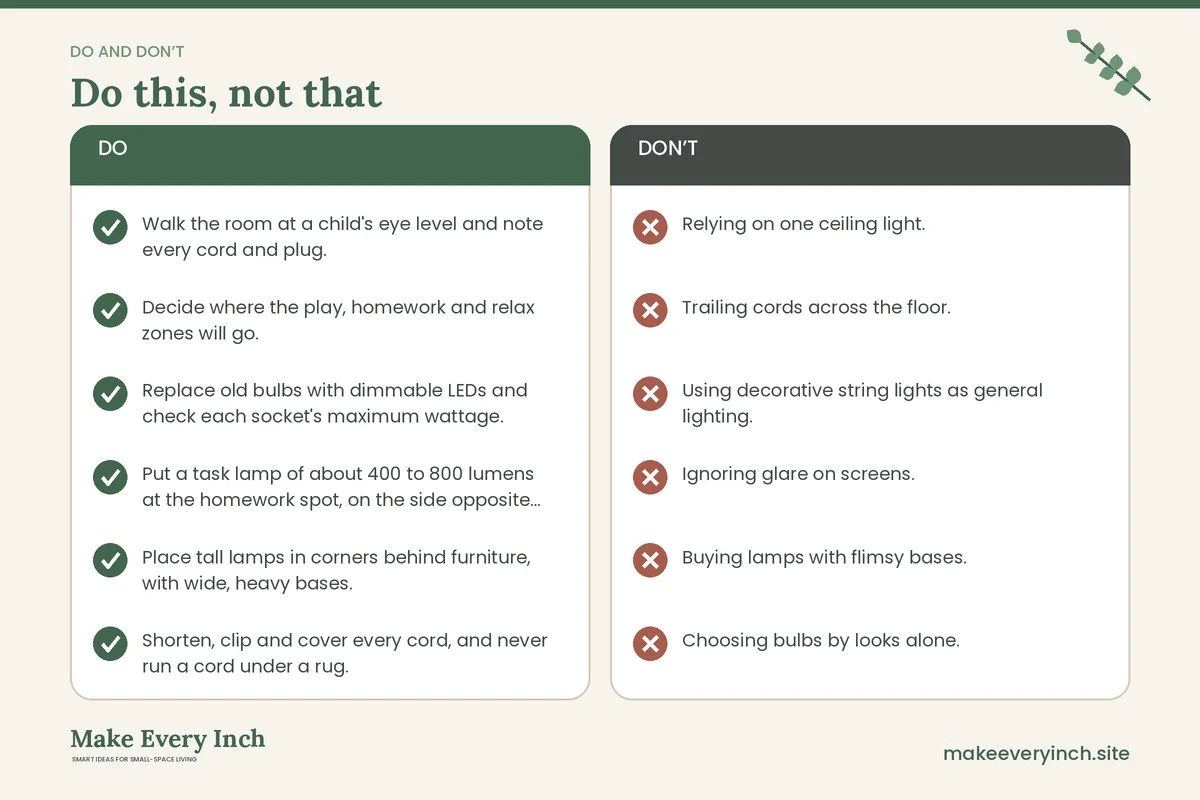
- Walk the room at a child’s eye level and note every cord and plug.
- Decide where the play, homework and relax zones will go.
- Replace old bulbs with dimmable LEDs and check each socket’s maximum wattage.
- Put a task lamp of about 400 to 800 lumens at the homework spot, on the side opposite the writing hand.
- Place tall lamps in corners behind furniture, with wide, heavy bases.
- Shorten, clip and cover every cord, and never run a cord under a rug.
- Use power strips with overload protection, and never daisy-chain them.
- Add a dimmer or a smart bulb scene for evenings.
- Add a plug-in night light for late trips.
- Call a licensed electrician for any hardwiring, wall switches or new fixtures.
- Repeat the five-minute safety check every weekend.
FAQ
What is the safest kind of lamp for a living room with toddlers?
Wall-fixed or clamped lights with short, covered cords, and heavy-based floor lamps tucked behind furniture, are the safest choices. Add LED bulbs, which stay cooler, and enclosed shades that hide the bulb.
How bright should a homework light be?
A common range is about 400 to 800 lumens at the desk, with the lamp on the side opposite the writing hand. Many people find a neutral white around 3500 to 4000 kelvin comfortable, but individual needs vary, so adjust to comfort.
Can I use extension cords in a family living room?
Only briefly and with care. Use a cord rated for the load, keep it uncoiled, never run it under a rug and never plug several heavy items into one. If you need many outlets, ask a licensed electrician about adding them.
Are string lights safe for a family room?
They can be, if the set is certified, used within the length and wattage limits, kept away from fabric and bedding and placed out of reach. Do not use them as main lighting, and unplug them when no one is home.
Do I need a licensed electrician for a new light?
Plug-in lamps do not. Any hardwired fixture, new wall switch, dimmer installation or recessed light does. Hire a licensed electrician, and check local rules on permits. If your TV wall needs power too, see small living room TV wall ideas for families.
How do I light a small living room without a ceiling fixture?
Use two or three lamps at different heights: a floor lamp in a corner, a table lamp on a console and a task lamp at the homework spot. Add a dimmable bulb to each, and aim some light at the walls to bounce it around the room.
What color of light is best for kids?
Warm light of about 2200 to 2700 kelvin suits evenings, and neutral white of about 3500 to 4000 kelvin suits homework. A smart bulb or two lamps with different bulbs lets you switch between them.
Keep going: Ready to build your family plan? Compare it with small living room lighting ideas, plan the layout with our small living room ideas pillar and keep the cords tidy with small living room storage ideas for families.
Save this guide for later
Pin the ideas you like to Pinterest so you can come back to them when you plan your space.