16 Small Living Room Storage Ideas for Families That Tame the Toy Pile
Quick answer: The best small living room storage ideas for families give every toy a low, labeled home that a child can reach, anchor every tall piece to the wall, keep heavy items on lower shelves, and use lidded bins that cannot pinch fingers. Pair that with a 10 minute daily reset and a rotation that keeps only a few toys out at a time, and a small room can stay playable and calm.
Small living room storage ideas for families have to do three jobs at once: hold a surprising number of toys, keep small people safe, and let the room look like a living room again by evening. A family room is rarely big, and it is often the only place where the children play, the adults relax and the guests sit. That means storage cannot be an afterthought. It has to be low enough for little hands, strong enough for climbers, and simple enough that a tired adult and a five-year-old can both put things back. This guide covers a zone plan, a safety checklist, 16 specific ideas with sizes, a table that matches each idea to a child’s age, a 10 minute daily reset, a toy rotation system, three example rooms and an FAQ. For the wider topic, see our pillar guides on small living room storage ideas and small living room ideas.
Start with zones, not containers
Most families buy bins first and then wonder why the room still looks messy. Reverse the order. Walk the room and decide what happens where. A family living room usually needs five zones: a play zone, a sit and watch zone, a grown-up zone for the remote, chargers and a laptop, a book zone, and a drop zone for the things that arrive daily, such as shoes, bags and mail.
Give each zone a home no bigger than it needs. A play zone can be a 4 by 6 foot rug with a low shelf along one wall. A book zone can be a single ledge or a basket by the sofa. The drop zone can be a bench and a few hooks near the door. When a zone has an edge, children learn where toys belong, and adults know when a zone has overflowed.
Next, count what you own. Gather every toy, book, art supply and game in a pile, even briefly, and sort it into four groups: used weekly, used monthly, outgrown and broken. Most families discover that a third of the pile is outgrown or broken. Removing that third often frees more space than any new furniture could. Keep the monthly group out of the room entirely, in a closet or under a bed, and use the room only for what is used weekly. The plan for that rotation appears later in this guide.
Finally, measure the wall space you could use. Measure the wall behind the sofa, the stretch beside the TV, the space under the window and the length of any wall between doors. Write down the width, the depth you can spare and the height. A shelf that is 12 inches deep is plenty for toy bins and books, and it leaves a walkway wide enough for a toddler and a stroller.
Safety rules that come before style
Storage in a family room carries risks that a child-free room does not. Furniture tips, drawers slam, lids drop and cords hang. Run through these rules before you buy anything.
- Anchor every tall piece. Bookcases, dressers and tall cabinets should be fixed to the wall with the hardware made for them. Children climb shelves like ladders, and a tall unit can fall. If you rent, ask the landlord about anchoring, or choose lower pieces that sit under 30 inches tall.
- Put heavy items low. Heavy bins, board games and books go on the bottom shelves. Light items such as soft toys go up high.
- Choose lids that do not slam. Look for soft-close hinges, lift-off lids, fabric lids or open bins. A lid that falls on fingers is a common hazard on toy chests.
- Avoid small gaps. Gaps that a head or limb could enter, such as wide slats on a bench or a gap between a cabinet and the wall, are best avoided or filled.
- Keep cords out of reach. Roll up blind cords, and use cord covers on lamp and charger cables. Place chargers on a high shelf or in a closed box.
- Watch for sharp corners. Round or cushioned corners matter on a coffee table and any bench at toddler height.
- Keep small objects away from little ones. Craft supplies, magnets, coins and button batteries belong on a high shelf or in a locked box.
Check product labels and manufacturer instructions for age guidance and anchoring directions, since each product differs. This guide gives general planning ideas and is not a substitute for those instructions.
16 small living room storage ideas for families
Toy storage children can use
1. The low open shelf with labeled bins
A shelf 24 to 30 inches tall and 12 inches deep, with four to six fabric or plastic bins, is the backbone of family storage. Children can see and reach their toys. Put a picture label on each bin so non-readers can sort building blocks from cars. Slide the shelf against a wall, and anchor it if it is more than a few feet tall. Fill the bottom row with the heaviest items.
2. A cube unit used on its side
A cube unit with four to eight cubes works well as a low room divider or a TV stand. Lay it on its side to make a bench-height unit at about 14 to 16 inches high, with a cushion on top for seating. Each cube takes a bin of about 11 inches square, and open cubes show what is inside. Keep the top clear of fragile objects.
3. A storage bench by the sofa
A lidded bench near the sofa holds blankets, a few toys or board games and gives an extra seat. Choose one with a hinge that holds the lid open or a lift-off cushion top, and make sure it has ventilation holes. A 36 to 48 inch bench fits beside most sofas. Use it for the monthly toys, not the daily ones, since a lid is a barrier for small children.
4. Under-sofa bins on wheels
Measure the space under the sofa, which is often 5 to 7 inches, then pick low wheeled bins that fit with 1 inch to spare. A bin on wheels lets a child pull out building sets, and it slides back in at tidy-up time. Choose smooth bins without sharp edges, and keep the sofa legs high enough for the bins to roll.
5. A toy hammock or corner net
A hanging net across a corner holds soft toys and stuffed animals above the floor. Fix it to wall hooks that suit your walls, and keep it above a child’s reach for hanging games. It frees the floor, yet it is only suitable for light, soft items. If you rent, use removable hooks within their weight limits and check the lease.
Books, art and games
6. Front-facing book ledges
Narrow ledges, 3 to 4 inches deep, hold picture books cover out at a child’s eye level. Mount one at about 20 to 28 inches from the floor, depending on the child’s height, and add one higher for adult books. Cover-out display makes it easier for a child to choose a book, and it takes almost no floor. See our guide to renter-friendly shelving for ways to mount a ledge without damage.
7. A rolling art cart
A three-tier rolling cart holds paper, crayons, markers and stickers in a single unit that rolls out for craft time and parks in a closet or beside the sofa. Keep sharp or messy supplies on the top tier for adults to hand out, and put crayons and paper on the lower ones. A cart about 15 inches wide fits in a gap beside a sofa arm.
8. A game stack on a high shelf
Board games are heavy, flat and rarely used daily. Stack them on a shelf at adult shoulder height or on top of a tall bookcase, with the heaviest at the bottom of the stack. Use a bookend to keep the pile stable. Remove any game with small pieces from a toddler’s reach.
9. A magnetic or cork wall for artwork
A rail with clips or a magnetic strip displays art without piles of paper. Hang it at a child’s eye level and rotate pictures weekly. Keep the rest of the artwork in a flat portfolio, a box under the sofa or a digital album. This stops the paper mountain on the table.
Seating that stores
10. Ottomans and poufs with storage
Two soft ottomans can serve as seats, a footrest and a coffee table with a tray on top. Choose ones with a removable top and a deep hollow for blankets or soft toys. Their soft, rounded edges suit a room where children run. See our guide to the best storage ottomans for what to look for.
11. A sofa with a chaise or a sofa with drawers
A chaise section often hides a storage box beneath, ideal for blankets and a few soft toys. Make sure the lid is lift-assisted or light, and keep it closed when children play nearby. Check that the mechanism has no pinch points for fingers.
12. The coffee table with shelf or drawers
A table with a lower shelf takes a basket of the day’s toys, a stack of books and the remote controls. Choose a table with rounded corners and a height under 18 inches. A round or oval top removes the corner that catches a running child. For ideas without a table at all, see small living room ideas without a coffee table.
Walls and doors
13. Over-the-door organizers
A pocket organizer on a closet or a pantry door holds shoes, mittens, small toys and craft sets. It uses space that is otherwise dead, and it needs no drilling. Use a sturdy fabric model and check the door will still close. Hang it where a child can reach the lowest pockets.
14. A wall-mounted shoe and bag rail
A rail or a row of hooks at 36 inches for adults and 24 inches for children turns the wall near the door into a drop zone. Add a narrow bench below it, 10 to 14 inches deep, so shoes can go underneath. Our guide on small entryway storage has more ideas for this spot.
15. A tall, narrow bookcase for grown-up items
Keep one tall unit, 10 to 12 inches deep, for adult items that need to be out of reach: chargers, craft tools, photo albums and fragile decor. Anchor it to the wall, and put a door or basket fronts on the lower half to keep little hands out of the wrong shelves. For options, see the best narrow bookshelves.
16. A closed cabinet for the TV zone
A low media cabinet with doors hides cables, consoles and game controllers, and it keeps the TV zone calm. Choose one with cable pass-throughs at the back and doors that close softly. If the TV is on the wall, make sure the wires are tucked in a cover. More ideas appear in small living room TV wall ideas.
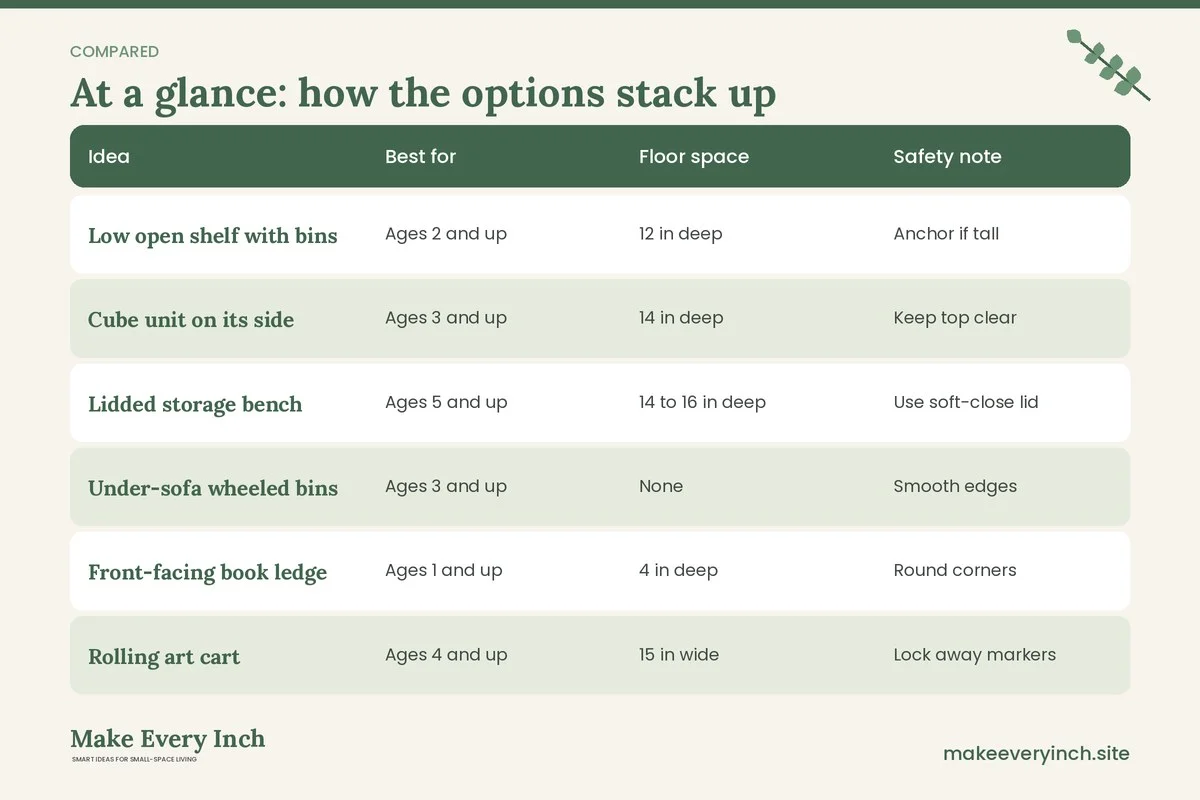
Comparison table: which idea fits which age
| Idea | Best for | Floor space | Safety note | Daily use |
|---|---|---|---|---|
| Low open shelf with bins | Ages 2 and up | 12 in deep | Anchor if tall | Toys and books |
| Cube unit on its side | Ages 3 and up | 14 in deep | Keep top clear | Toys and seating |
| Lidded storage bench | Ages 5 and up | 14 to 16 in deep | Use soft-close lid | Monthly toys |
| Under-sofa wheeled bins | Ages 3 and up | None | Smooth edges | Building sets |
| Front-facing book ledge | Ages 1 and up | 4 in deep | Round corners | Picture books |
| Rolling art cart | Ages 4 and up | 15 in wide | Lock away markers | Craft time |
| Storage ottoman | All ages | 18 in square | Soft lid | Blankets |
| Over-the-door organizer | Ages 4 and up | None | Check door closes | Shoes and mittens |
| Tall narrow bookcase | Adults | 10 to 12 in deep | Anchor to wall | Adult items |
The 10 minute daily reset
A system only works if it is easy to run on a bad day. The reset below takes about 10 minutes and works with children from age three, who can help with the sorting part.
- Minute 1 to 2: Announce it. Play one song, set a timer or say a phrase. A signal makes it a game.
- Minute 2 to 5: Toys to bins. Everyone puts toys into the nearest bin or onto the right shelf. Because every bin is open or lightly lidded, there is no sorting by type. A “fast bin” for odds and ends helps younger children.
- Minute 5 to 7: Books and art. Books go back on the ledge, and drawings go on the wall or into the portfolio.
- Minute 7 to 8: Blankets and pillows. Fold or stuff blankets in the ottoman or the basket, and plump the cushions.
- Minute 8 to 9: The drop zone. Shoes on the rack, bags on hooks and mail in a tray.
- Minute 9 to 10: Surfaces. Clear the coffee table and wipe it. Put the remote and the chargers back in their spot.
Do the reset at the same time each day, such as before dinner or just before the bath. Routine is what makes it stick, more than any bin. If the room is a wreck after a birthday or a rainy day, do a longer reset with a bag for donations and a bag for trash.
A toy rotation that shrinks the pile
Rotation is the most effective free storage idea for families. Instead of keeping all the toys in the room, keep about a third out and store the rest. Every two to four weeks, swap the groups.
- Sort the toys into three or four boxes by type, such as building, pretend play, puzzles and vehicles.
- Keep one or two boxes out in the living room shelves.
- Store the other boxes in a closet, under a bed or on a high shelf in another room.
- Swap one box each week, or all at once at the start of each month.
Children often play with a “new” toy with fresh interest after a break, and the room looks calmer with fewer items on view. Rotation also shows what the children never ask for, which is a good sign that the item can be passed on. Keep a small donate box in the closet, and when it is full, take it out of the house the same week.
Three example rooms
Example 1: The 11 by 12 foot rental with a toddler
The room has one long wall for the sofa and a short wall for the TV. The plan uses a 4 by 6 foot rug in front of the window, a 30 inch tall, 12 inch deep shelf with six bins against the short wall and a 36 inch storage bench beside the sofa. A narrow ledge at 22 inches holds board books. The tall cabinet for the adult items stands in the corner, anchored with the hardware that suits the wall. The walkway from the door to the sofa stays at 34 inches.
Example 2: The living-dining room with two school-age children
The room is open to a small kitchen. The plan uses a cube unit as a low divider behind the sofa, with the back facing the kitchen and the cubes facing the play area. A rolling cart holds homework supplies and art materials, and rolls into a closet when guests come. A rail near the door holds bags at 24 and 36 inches, with a bench below. The reset happens before dinner, and the dining table doubles as a craft table.
Example 3: The studio-style room with a baby and a toddler
The room serves as living room and sleeping area. The plan uses a lidded ottoman for blankets, under-sofa bins for the toddler’s blocks and a closed media cabinet for the TV and cables. A hammock net in the corner holds soft toys, and a tall bookcase anchored to the wall holds adult items on the upper shelves. The play mat folds up each night and slides behind the sofa. For other ways to divide a one-room home, see small apartment living room ideas for families.
Budget guide
These ranges are rough and vary by region and retailer.
Under $50
Fabric bins for an existing shelf, labels, a few removable hooks, a basket for the coffee table and a donation bag. Do the sort and the first rotation, which cost nothing.
About $100 to $300
A low shelf or cube unit with bins, a storage ottoman, an over-the-door organizer and a rolling cart. Look at second-hand shops and sales, and check that used furniture has all its hardware, including anchoring parts.
$400 and up
A new sofa with storage, a media cabinet and a custom shelf wall. At this level, measure the room and the delivery path twice, and think about how the children will use it in two or three years. For more savings ideas, see cheap storage ideas for apartments.
Mistakes to avoid
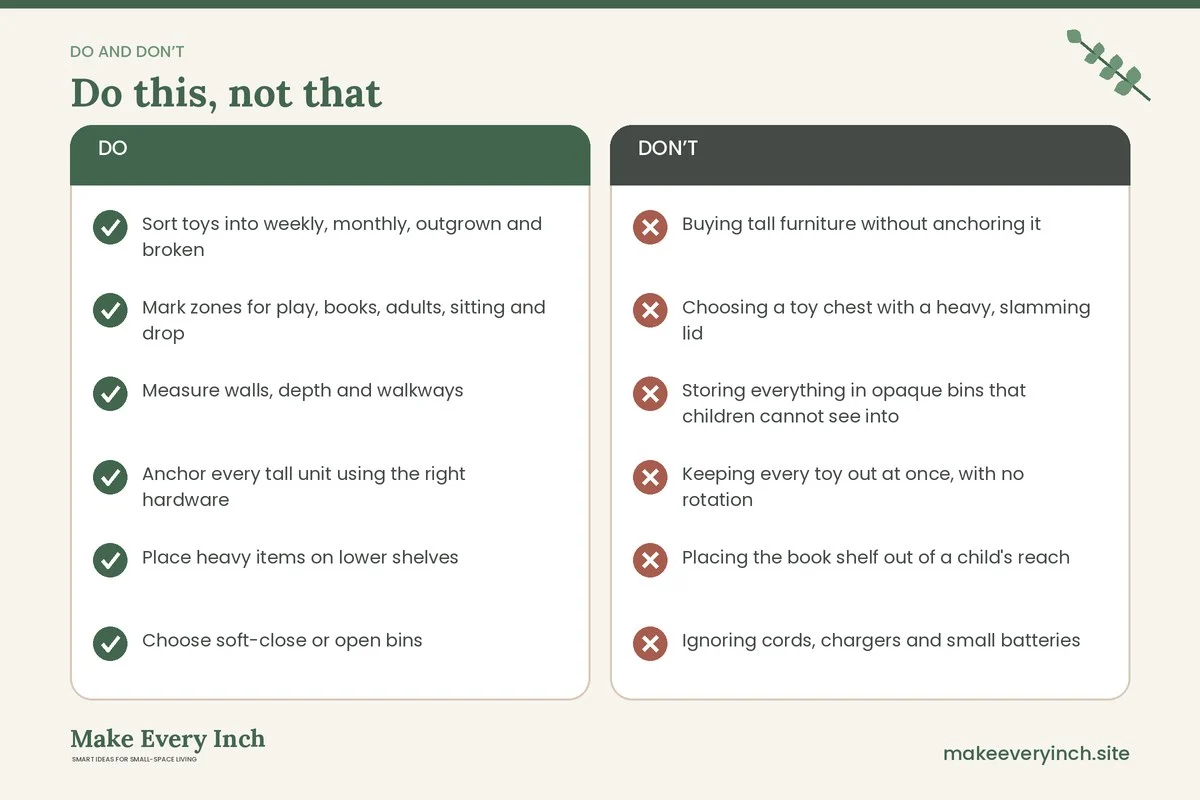
- Buying tall furniture without anchoring it
- Choosing a toy chest with a heavy, slamming lid
- Storing everything in opaque bins that children cannot see into
- Keeping every toy out at once, with no rotation
- Placing the book shelf out of a child’s reach
- Ignoring cords, chargers and small batteries
- Buying bins before sorting and measuring
- Leaving the adult items on the coffee table where little hands can grab them
Family living room storage checklist
- Sort toys into weekly, monthly, outgrown and broken
- Mark zones for play, books, adults, sitting and drop
- Measure walls, depth and walkways
- Anchor every tall unit using the right hardware
- Place heavy items on lower shelves
- Choose soft-close or open bins
- Label bins with pictures
- Keep markers, magnets and batteries out of reach
- Cover or tuck away all cords
- Set up the 10 minute daily reset
- Start the rotation with one box per week
- Keep a donate box by the door
FAQ
What is the best storage for toys in a small living room?
A low open shelf with labeled bins is the most flexible option. Children can reach it, and it suits many toy types. Add a lidded bench or ottoman for monthly toys and blankets.
How do I keep the living room tidy with kids?
Give every toy a home, rotate the toys and run a 10 minute reset at the same time each day. Fewer toys out means less to clean up.
Do I need to anchor a bookcase?
Anchoring is widely recommended for tall furniture, especially in homes with young children. Follow the manufacturer’s instructions, and ask your landlord if you rent.
What storage is safest for toddlers?
Open bins on low shelves, soft ottomans with removable tops and furniture with rounded corners. Avoid heavy lids, small gaps, loose cords and small parts within reach.
How can I store toys without a toy room?
Use zones in the living room, under-sofa bins, a storage bench, wall nets and a closet for the rotation boxes. Keep a small number of toys out and store the rest.
How many toys should be in the living room?
There is no fixed number. A useful rule is what fits in the shelf and bins you have, with a little room to spare. If the bins overflow, move some toys into rotation.
How do I store toys when I rent and cannot drill?
Use freestanding shelves, over-the-door organizers, wheeled bins and removable hooks within their stated limits. Look at our list of no-drill storage ideas for renters.
How do I get children to help put things away?
Make bins reachable, use picture labels, play a song and keep the system simple. Praise the effort, and let them choose the bin colors.
Keep going: Keep planning with our small living room storage ideas, small space organization ideas and vertical storage ideas.
Save this guide for later
Pin the ideas you like to Pinterest so you can come back to them when you plan your space.