15 Ideas for a Tiny Outdoor Space Without Grass
Quick answer: A tiny outdoor space without grass works best when you treat the hard surface as a floor to dress, not a problem to hide. Start with a sound surface and good drainage, add a removable ground layer such as an outdoor rug or interlocking tiles, group containers in layers, choose one multi-use seat, and light it with outdoor-rated fixtures. Check lease rules, weight limits and drainage before you buy anything.
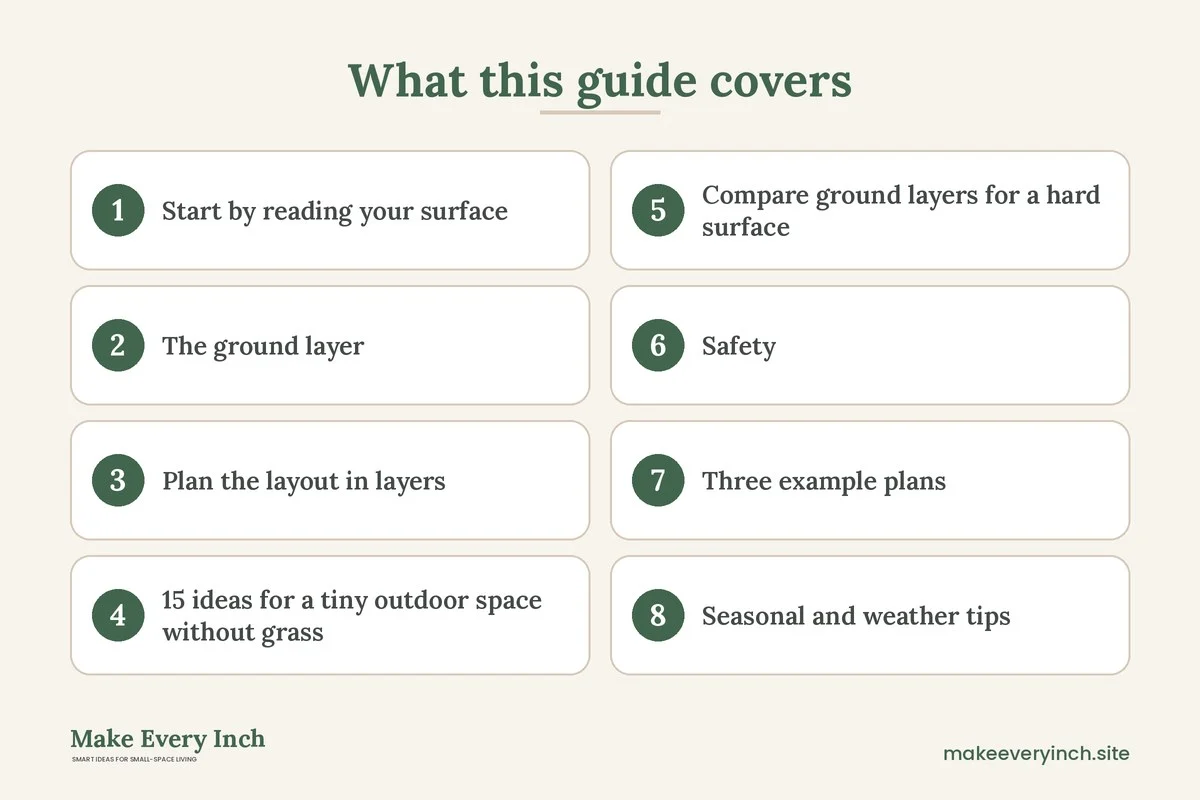
A tiny outdoor space without grass is more common than most garden advice admits. It might be a concrete slab behind a terrace house, a gravel strip beside a door, a paved courtyard, a rooftop corner, a wooden deck or a narrow patio outside a ground-floor flat. There is no lawn to mow, which is the good news, and no soil to dig, which is the challenge. Everything you add has to sit on top of a hard surface, cope with water running off it, and fit in a footprint that may be only a few feet across. This guide walks through how to read your surface, choose a ground layer, build a layout, pick 15 ideas, compare materials in a table, handle the safety checks that matter outdoors, and follow three example plans. It is a companion to our pillar guide on small balcony ideas, and it suits ground-level patios as much as upper floors. If you rent, also read our guide to renter-friendly small balcony ideas for the permission side of the job.
Start by reading your surface
Before you shop, find out what you are actually standing on. A hard surface that looks uniform can behave very differently once furniture, water and weather arrive. Walk the space after a rain shower and note where puddles sit, because that tells you where the surface falls and where water will head when you place a rug or a planter. Look for cracks, loose slabs, crumbling mortar, rotting boards and moss, since each one changes what you can safely put on top.
Then identify the material. Poured concrete is hard and flat, and it takes almost any removable layer. Paving slabs and pavers can rock or shift, which makes small tables wobble. Gravel looks pleasant but shifts underfoot and is awkward for chair legs. Timber decking can be slippery when damp and may have gaps that drop crumbs and dropped items below. A rooftop or a balcony floor may have a waterproof membrane under the surface, and damaging it can cause leaks that are expensive and unwelcome.
Measure the space in feet and inches, draw it on paper, and mark the door, any steps, drains, taps, downpipes and windows. Mark the sun path too. Note where the sun lands in the morning and the afternoon, because sun decides which plants live, how hot the floor gets and where you will want shade.
The ground layer: dress the floor first
On a lawn, the floor is already green and soft. Without grass, the floor is the largest visible surface and usually the least attractive, so deal with it first. A ground layer should be removable if you rent, drain freely so water does not pool, and fit the shape of the space. Common options include an outdoor rug woven from weather-resistant fibers, interlocking tiles that click together without glue, loose-laid pavers, a gravel or pebble tray, and artificial turf mats used as a removable accent. Each has trade-offs for grip, drainage, heat and cleaning, which the table later in this guide compares.
Whatever you pick, keep it loose and breathable. A solid, glued or heavy layer can trap water against the surface and hide damage you need to see. Lift any rug or mat every few weeks and sweep underneath, so leaves, soil and moisture do not build up. If your surface slopes toward a drain, never block the drain with a mat, and keep a gap so water can pass.
Plan the layout in layers
A tiny space looks larger when it is organized in three layers: the floor, the middle and the edge. The floor is your ground layer. The middle is the furniture and any tall plants that stand on the surface. The edge is the walls, the fence or the railing, where you can go vertical with hooks, trellis and wall-hung planters, with permission.
Keep a clear path from the door to the seat and to any tap or drain. A path 24 to 30 inches wide is comfortable for one person, and 36 inches suits two people passing. If the space is too narrow for that, plan around one seat and one standing area rather than a table and two chairs. Leave about 18 inches of floor in front of the seat so a person can sit down without bumping a pot.
Tape the footprint of each piece on the surface with painter’s tape or chalk. Live with the layout for a day. You will quickly feel whether the door still swings open, whether you can reach the tap and whether the seat looks out at something pleasant instead of a bin.
15 ideas for a tiny outdoor space without grass
Ground layer ideas
1. A weather-resistant outdoor rug
A rug defines the room, softens the surface and hides a patchy floor. Choose one made for outdoor use, with a quick-drying weave, and size it so the front legs of the chair sit on it. Lift it regularly so moisture does not stay underneath.
2. Interlocking deck tiles
Click-together tiles go over concrete, pavers or an old deck without glue. They give you a warm wood look and a flat surface for chairs. Check that they allow water to drain, and check the lease before covering any surface.
3. A loose paver panel
A few loose pavers laid in a grid create a small stable pad under a bistro set. They are heavy, so confirm the weight limit on a balcony or roof before you add them, and lay them on a flat, even base.
4. A pebble tray or gravel patch
A shallow tray of pebbles around a planter or a seat is a tidy way to add texture where a plant stand would otherwise leave a bare patch. Pebbles also help to stop soil splashing onto the surface. Keep trays contained so stones do not wash into drains.
5. An artificial turf mat as a small accent
A small piece of turf under a seat or a pet spot gives a hint of lawn. Choose a drainage-friendly type, cut it neatly and lift it often, because it can hold heat in strong sun.
Container and plant ideas
6. Grouped containers in odd numbers
Three pots of different heights look intentional, while five matching pots in a row look like a shop display. Group them in a corner so they act like a single planted feature.
7. A tiered plant stand
A stand with three levels lets you grow a lot in a footprint of about 2 square feet. Make sure it is stable, level and not near a railing or an edge. See our guide to small space plants and planters ideas for choosing species and pots.
8. A trellis or wire panel with climbers
A freestanding trellis in a large container gives you a green wall without touching the building. Choose a slow, tidy climber, and keep it tied so wind does not tip the whole thing.
9. A herb and salad box
A long, narrow box of herbs fits along a wall and gives you something to snip. Use a tray beneath it so water drains away from the surface instead of across it.
Seating and furniture ideas
10. A bistro set that folds
Two folding chairs and a small table fold flat against a wall when you need the floor. Choose pieces that fit your measured footprint, and brace the folded set so wind cannot knock it over. For ideas on picking compact pieces indoors and out, see our guide to the best furniture for small apartments.
11. A bench with hidden storage
A bench that opens up holds cushions, a watering can and gloves out of the rain. It is seating and storage together, which suits a tiny space. Read our small space furniture ideas that do double duty for more of this thinking.
12. Stools that tuck under a ledge
Light stools slide under a narrow shelf or a ledge when not in use. They also serve as extra plant stands or side tables.
Light, privacy and finish
13. Outdoor-rated string lights or lanterns
Warm light makes a hard space feel like a room after dark. Use fixtures rated for outdoor use, and read the safety section below for electrical rules. Battery or solar lanterns reduce cable risk. For lighting principles that also work outside, see renter-friendly lighting ideas.
14. Privacy screens and fabric panels
A freestanding screen, a bamboo roll or a shade panel can hide neighbours and soften wind. They act as sails, so they must be weighted, tied to a sound structure with permission and kept clear of the railing.
15. A single focal piece
One sculpture, a large lantern, a ceramic pot or a small water feature in a tray gives the eye somewhere to land. In a tiny space, one strong focal piece beats a scattered collection.
Compare ground layers for a hard surface
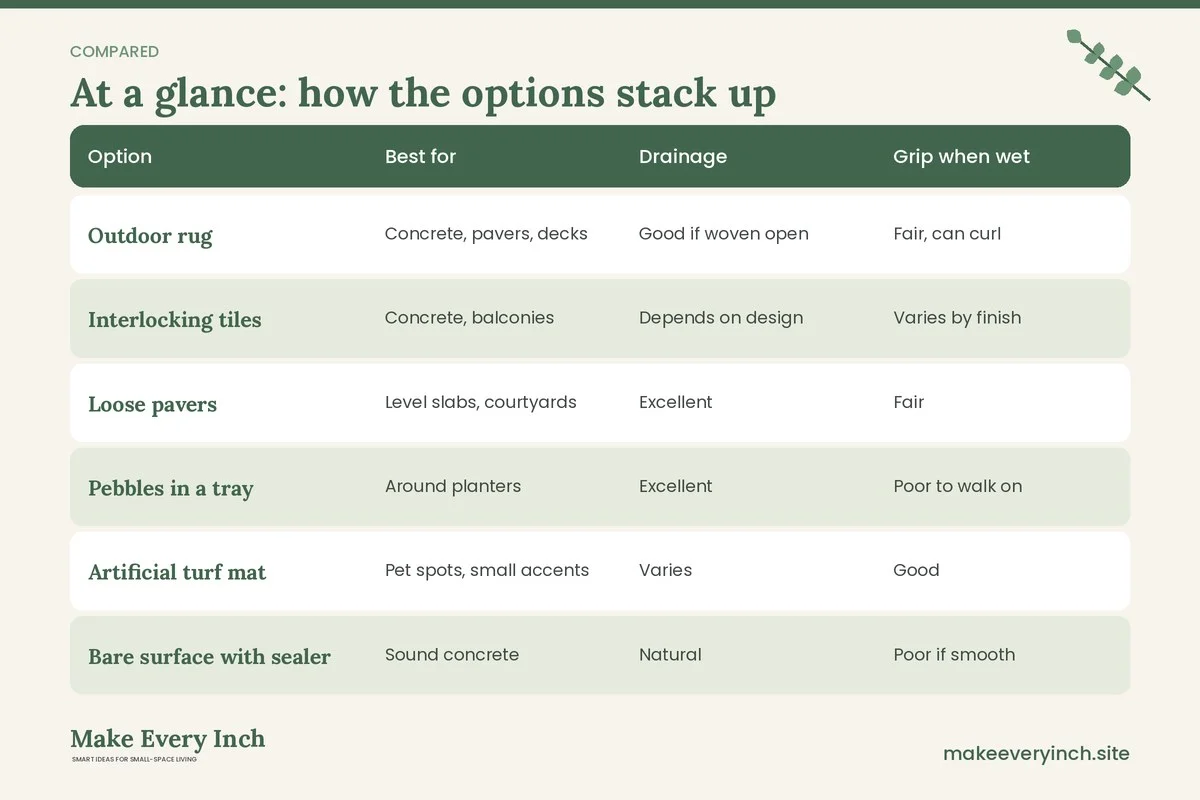
The table below compares common removable ground layers. Conditions vary, so use it as a rough guide and check product instructions for your own surface.
| Option | Best for | Drainage | Grip when wet | Watch out for |
|---|---|---|---|---|
| Outdoor rug | Concrete, pavers, decks | Good if woven open | Fair, can curl | Moisture trapped underneath |
| Interlocking tiles | Concrete, balconies | Depends on design | Varies by finish | Gaps that collect debris |
| Loose pavers | Level slabs, courtyards | Excellent | Fair | Weight, rocking, uneven base |
| Pebbles in a tray | Around planters | Excellent | Poor to walk on | Stones in drains |
| Artificial turf mat | Pet spots, small accents | Varies | Good | Heat in strong sun |
| Bare surface with sealer | Sound concrete | Natural | Poor if smooth | Needs permission to treat |
Safety: what to check before you add anything
Outdoor spaces carry risks that indoor rooms do not. A hard, tiny space on an upper floor, a roof or an old slab deserves a careful look before you fill it. Treat this section as a checklist, not an afterthought.
Weight limits and structure
Balconies, decks and roof terraces have load limits, and soil, water, pavers and furniture add up quickly. A set of large planters can be heavy once watered. Ask your landlord, building manager or the building rules what the surface can carry, and do not overload it. Spread heavy items out rather than stacking them in one corner. A ground-level slab usually has fewer weight worries, but a cracked or hollow-sounding slab still needs care.
Railings, children and pets
If there is a railing or a low wall, do not place anything climbable beside it. Keep chairs, stools, benches, planters and boxes away from the railing, because a child or a pet can use them as steps. Check the height and the gaps of the railing, and do not assume it is child-safe. If you have children or pets, ask the building manager about the safe height and gap sizes, and do not leave them unsupervised on an upper-floor space.
Wind, tip-over and falling objects
Wind can move light chairs, tip tall pots and turn a screen into a sail. Choose stable, low-slung pieces, put heavy items at the base of a shelf, and secure anything tall. Never put planters, pots or shelves on a ledge or a railing top where they could fall onto people below. Secure everything that could fall, and bring light items in during storms.
Fire, grills and flame
Many leases, buildings and local codes ban grills, fire pits and open flame on balconies, and some limit them in courtyards. Check the rules before you light anything. Candles near fabric, dry plants or screens are a fire risk, so choose flameless candles or lanterns that use batteries or solar charging instead.
Electrical safety
Use only string lights, plugs and extension cords rated for outdoor use. Plug into an outlet protected by a ground-fault circuit interrupter (GFCI), and do not overload sockets or daisy-chain cords. Keep plugs and connectors off the ground where water can reach them, and do not run a cord across a doorway where it can be tripped on or pinched. If an outlet is missing, use solar or battery lights, and do not run a cord through a window in a way that holds it open.
Drainage and water damage
Watering plants on a hard surface sends water somewhere. On an upper-floor space, that may be the neighbour below. Use saucers or trays, water slowly, keep drains clear and do not block a drain with a mat. Check for water stains on the ceiling or wall below the space, and fix any issue quickly. On a ground-level slab, make sure water drains away from the building rather than toward the door.
Toxic plants for pets and children
Some common garden plants are poisonous if chewed or swallowed. Check each plant against a trusted list for pets and children, and choose non-toxic species where you can. Keep pots out of reach and wash your hands after handling soil and plants.
Sun, heat and surfaces
Dark concrete, metal furniture and artificial turf can get very hot in strong sun. Test the surface with the back of your hand before children or pets use it, and offer shade. Cover metal seats with a cushion or a throw in hot weather.
Permission and drilling
Read your lease and any HOA or building rules before you change anything outdoors. Ask in writing before you cover a surface, add a screen or attach something to a wall. Do not drill into railings, walls or floors without permission, and avoid clamps that stress railings. Choose freestanding and removable ideas if you are unsure.
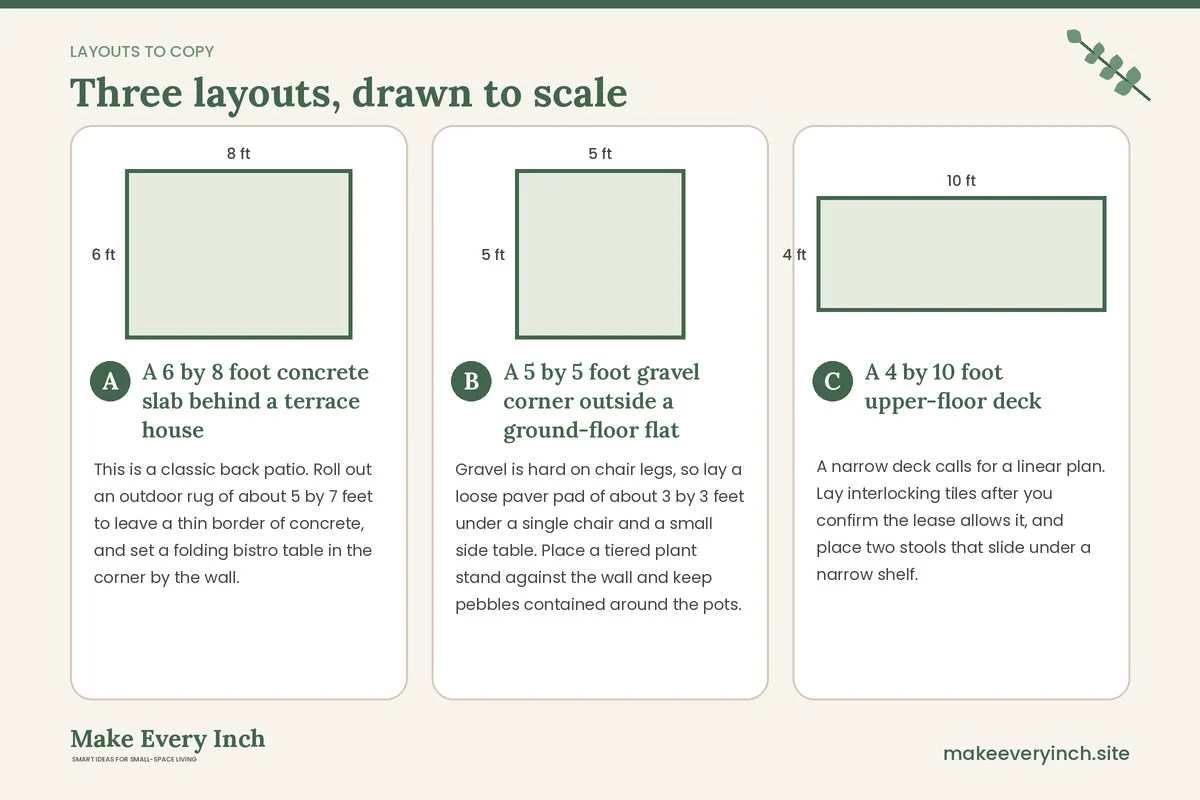
Three example plans
A 6 by 8 foot concrete slab behind a terrace house
This is a classic back patio. Roll out an outdoor rug of about 5 by 7 feet to leave a thin border of concrete, and set a folding bistro table in the corner by the wall. Group three pots of different heights beside the door, and run a trellis in a large planter along the fence. A bench with hidden storage along one side holds cushions and tools. Leave a 30-inch path from the door to the tap, and keep the drain clear. This plan suits a person who wants morning coffee and a few herbs.
A 5 by 5 foot gravel corner outside a ground-floor flat
Gravel is hard on chair legs, so lay a loose paver pad of about 3 by 3 feet under a single chair and a small side table. Place a tiered plant stand against the wall and keep pebbles contained around the pots. Add a lantern and solar string lights. Because it is small, choose one focal item, such as a large pot with a tall grass. Keep the gravel raked and clean of leaves. This plan suits a quiet reader.
A 4 by 10 foot upper-floor deck
A narrow deck calls for a linear plan. Lay interlocking tiles after you confirm the lease allows it, and place two stools that slide under a narrow shelf. Use a long herb box on the wall side, with a tray beneath it, and keep every item at least 12 inches from the railing. Avoid heavy pavers, and check the weight limit before adding planters. Use battery lanterns instead of cables. This plan suits a renter with children or pets who needs a calm, safe corner.
Seasonal and weather tips
Hard surfaces make the weather more obvious. In summer, they heat up and radiate warmth into the evening. In winter, they can ice over and become slippery. Plan seasonal changes so the space stays useful.
- Summer: add a shade sail or a parasol, group plants to cool each other and water in the early morning or evening.
- Autumn: sweep leaves from drains and from under mats, and clear gutters that discharge onto the space.
- Winter: bring in cushions, lanterns and tender plants, and keep a clear path for safe walking. Avoid using products on balcony surfaces that could damage them, and ask the building manager about de-icing rules.
- Spring: wash the surface, check for cracks, inspect furniture joints and refresh the soil in pots.
Wind is often the biggest daily factor in a tiny space, especially on upper floors and rooftops. Put your lightest items in the most sheltered corner, and use heavier pots as ballast on the windward side. Fold or store furniture before a storm.
Storage in a tiny hard space
Without a shed or a garage, storage is a puzzle. Choose pieces that store things while doing another job, such as a bench, a deck box, a stool with a lid or a rack on a fence if you have permission. Keep a small box for the items you use most: gloves, scissors, a watering can, a brush and a bin bag. Everything else lives inside. For help with the indoor side of storage, see our guide to small space organization ideas.
Store cushions indoors in wet weather, since damp foam grows mildew. Keep chemicals, fertilisers and sharp tools out of reach of children and pets, and out of the sun.
Budget approach
Outdoor furnishing can become costly quickly, so work in order of impact. Do the ground layer first, because it changes the look of the whole space. Add one seat next, then lighting, then plants. Borrow, swap and buy used where safe, and check that used furniture is stable and not rotted or rusty. Plants can be grown from cuttings and seeds, and containers can be reused. For more ways to stretch a small budget, read our guide to budget small space ideas.
Make the outside feel like an extra room
A tiny outdoor space works best when it feels connected to the room inside. Echo an indoor color in a pot, a cushion or the rug. Keep the door area clear so the view from inside is pleasant. If the outdoor seat is visible from the sofa, pay attention to that view. Our guide to small room decor ideas has more on color and styling that can carry through, and if you live in a studio, the principles in studio apartment ideas apply directly, because the outside area becomes a bonus zone.
Checklist
- Walk the space after rain and note puddles and the fall of the surface.
- Identify the material and check for cracks, loose slabs and rot.
- Read the lease, HOA and building rules before you change anything.
- Ask about weight limits and do not overload.
- Measure the space and mark the door, drain, tap and sun path.
- Choose a removable ground layer that drains.
- Keep a 24 to 30 inch path from the door.
- Keep climbable items away from the railing.
- Secure anything tall, and keep nothing on a railing top or ledge.
- Use outdoor-rated lights and a GFCI outlet, and do not overload sockets.
- Skip grills and open flame unless the rules clearly allow them.
- Use trays under pots and keep drains clear.
- Check every plant for toxicity to pets and children.
- Test surfaces for heat in strong sun.
- Do not drill into railings, walls or floors without permission.
FAQ
How do I make a tiny outdoor space without grass feel less bare?
Start with the floor. A removable rug or interlocking tiles adds warmth, color and softness. Then add grouped containers in odd numbers, a bench or a bistro set, and warm lighting.
What can I put on a concrete slab without damaging it?
Loose, breathable and removable items are the safest: outdoor rugs, tile systems that need no glue, loose pavers and plant stands. Ask the owner first, and avoid anything that traps water or needs fixings.
Is it safe to put pavers on a balcony?
Pavers are heavy. Check the weight limit with the building before you add them. If you cannot confirm it, choose a lighter option such as a rug or tiles.
Can I use string lights outside?
Yes, if they are rated for outdoor use and plugged into a GFCI-protected outlet. Do not overload sockets or join several strings together beyond their rating. Solar or battery lights avoid cord problems.
How do I protect the floor below when I water plants?
Use trays or saucers, water slowly, empty trays after rain and keep drains clear. If you live above others, take extra care so water does not run onto a neighbour’s space.
Which plants are safe for pets?
Many herbs and some common patio plants are safe, but others are toxic. Check each species against a trusted pet-safe list before you buy, and ask a vet if you are unsure.
Can I have a grill in a tiny outdoor space?
Check first. Many leases, buildings and local codes forbid grills and open flame on balconies and close to buildings. If it is not clearly allowed, do not use one.
Keep going: Keep going with our pillar guide on small balcony ideas, then see small porch decorating ideas and the renter-friendly apartment decorating ideas.
Save this guide for later
Pin the ideas you like to Pinterest so you can come back to them when you plan your space.