14 Small Living Room Lighting Ideas for Couples
Quick answer: The best small living room lighting ideas for couples give each person their own pool of light and a shared dimmable background glow. Use one lamp at each end of the sofa, a low-glare ambient source around 2200 to 2700 kelvin, 300 to 450 lumens per side lamp, and a separate task light for whoever reads or works. Keep every cord out of walkways and never exceed the wattage printed on the socket.
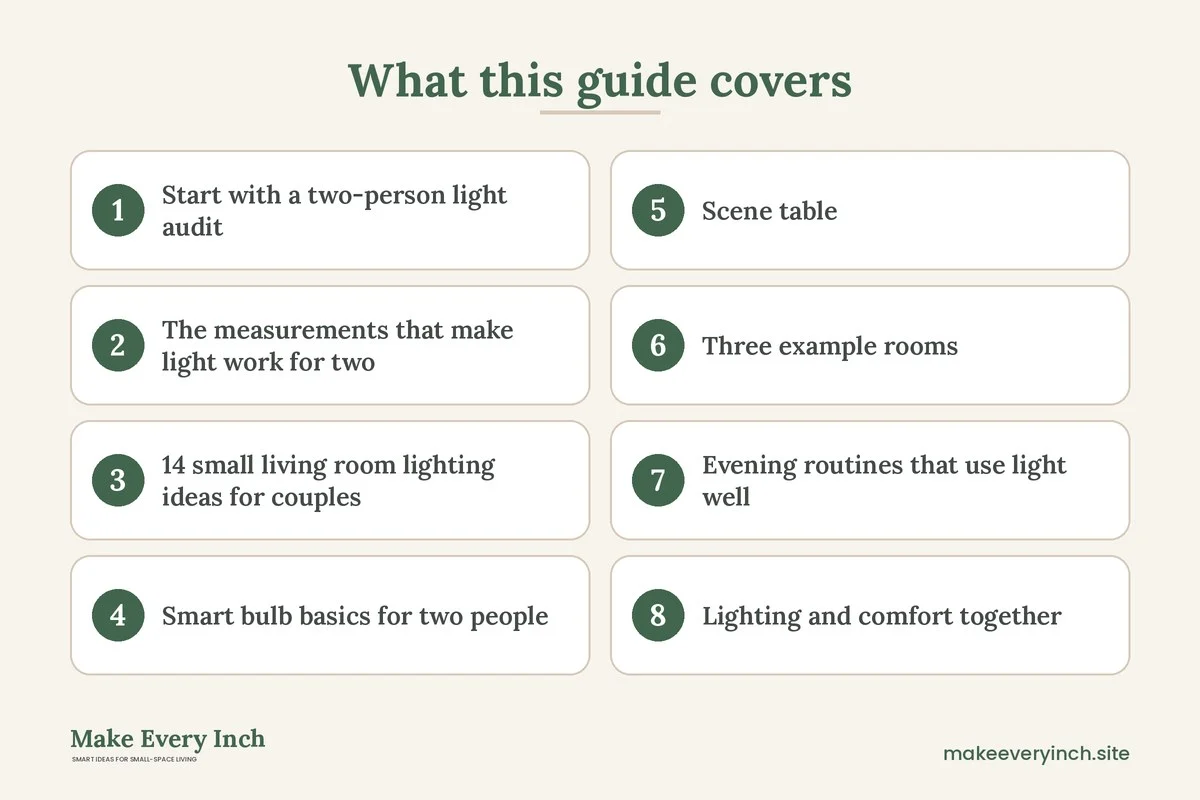
Small living room lighting ideas for couples have to solve a problem a single person never faces: two people in one small room often want different things at the same moment. One wants to read, the other wants to watch something on a low-lit screen. One is winding down, the other is finishing emails. A single bright ceiling fixture serves neither of you well. This guide shows how to design light for two people in a compact space. It covers the habits audit, the measurements for lamp height and distance, 14 ideas, a scene table, three example rooms, evening routines, safety notes, mistakes and a checklist. For the full overview, read our main guide on small living room lighting ideas, the broader small living room ideas pillar and the companion post on cozy small living room ideas for couples.
Start with a two-person light audit
Before buying a single bulb, spend a week noticing what each of you does in the room and when. Most couples find a handful of repeating activities. Typical examples are reading on the sofa, watching a show, working on a laptop, eating dinner, talking with friends and a late-night snack. Write down who does what, and at which time of day.
Then mark the clash points. A clash is any moment when one person needs light and the other needs dark. Movie night with a reader on the other end of the sofa is the classic one. A person on a laptop at 10 pm while the other tries to sleep in a studio is another. Each clash points to a specific fix, such as a directional reading lamp, a dimmer or a shaded task light. When you know your three biggest clashes, you know what to buy first.
Finally, decide on two or three scenes: for example “dinner”, “movie” and “wind down”. Each scene is a combination of lamps, brightness levels and color warmth. A room with three clear scenes feels much bigger than one with a single on-off setting, because the light changes the mood without changing the furniture.
The measurements that make light work for two
Lighting advice is vague unless you attach numbers to it. These are hedged ranges, and your room, ceiling height and wall color will shift them.
- Total light for the room: many designers suggest about 10 to 20 lumens per square foot in a living room. A 10 by 12 foot room is 120 square feet, so roughly 1,200 to 2,400 lumens total, divided among several sources. Dark walls push you toward the high end.
- Side lamps for each seat: 300 to 450 lumens each for ambient glow, and 450 to 800 for a person who reads.
- Color temperature: 2200 to 2700 kelvin for warm evenings, up to 3000 kelvin if you want a soft neutral. Keep all bulbs in a room within one narrow band so the light looks consistent.
- Table lamp height: the bottom of the shade should be near eye level when seated, about 38 to 44 inches from the floor. Total lamp height of 24 to 30 inches on a side table 20 to 26 inches tall usually does it.
- Reading light distance: 24 to 36 inches from the page, from behind or beside the shoulder, so the reader does not cast a shadow on the book.
- Distance between the two lamps: on a sofa of 72 to 84 inches, side lamps sit about 70 to 90 inches apart. Their pools of light should overlap slightly in the middle.
- Floor lamp reach: an arc lamp should place the shade about 18 to 24 inches above the seat cushion, with the base 12 to 24 inches from the sofa arm.
- Dimmer range: pick bulbs and dimmers that dim down to about 10 percent or lower so the “wind down” scene is truly low.
- Cord clearance: keep cords 12 inches or more from heat sources and out of any path that is 30 inches or narrower.
14 small living room lighting ideas for couples
Two lamps, two moods
1. A matching pair on the sofa ends
Put a compact lamp on a slim side table at each end of the sofa. Each person controls their own switch, so one can read while the other watches. Choose shades 8 to 10 inches wide and bulbs of 300 to 450 lumens. A matched pair also frames the sofa and makes the room look composed.
2. A mismatched pair for different needs
If one of you reads and the other does not, give the reader a taller, brighter lamp with a focused beam and the other a low, glowing one. The difference looks intentional if both lamps share a finish, such as the same metal or shade color.
3. One floor lamp and one table lamp
When only one side has room for a table, use an arc or slim floor lamp on the other end. A floor lamp of 58 to 66 inches takes about 10 to 12 inches of floor, and it often fits a corner that a table never could. See our guide to the best floor lamps for small rooms for shapes that save space.
4. A lamp each with its own dimmer
A cord dimmer or a dimmable smart bulb lets each person set the brightness. One person at 20 percent for a screen and the other at 70 percent for a book is a common pairing. Check the bulb is rated for dimming before you buy.
Directional light for the reader
5. A swing-arm wall lamp
A plug-in swing-arm lamp on the wall beside the sofa angles light onto a page without lighting the whole room. The shade stays narrow, so a partner watching a screen is not disturbed. Mount it with the base about 50 to 56 inches from the floor and 8 to 12 inches from the sofa edge. Hide the cord in a paintable channel, and check your lease before drilling. For no-drill options, read about renter-friendly lighting ideas.
6. A clip light on a shelf or headboard
A clip lamp grips the edge of a bookcase or shelf and aims a narrow beam. It needs no table and no floor space, and it works well for the person who reads at the far end of the sofa.
7. A shaded task lamp for the laptop person
An adjustable-arm lamp with a deep shade aims light down onto the work area and keeps spill off the screen of the other person. Place it on the side of the dominant hand, 16 to 20 inches from the laptop.
Shared mood lighting
8. A warm uplight in the corner
A torchiere or uplight bounces light off the ceiling for a soft background. It works as the “everyone” light, with both lamps off or low. Check the bulb wattage against the label, and keep the shade clear of curtains.
9. LED strip behind the TV
A strip of LED tape behind the TV reduces the contrast between a bright screen and a dark wall, which can be easier on the eyes in a movie scene. Choose 2700 to 3000 kelvin, and run it from the power supply that came with the strip.
10. A shelf lamp for depth
A small lamp, 14 to 18 inches tall, on a bookcase or console with a bulb of 100 to 250 lumens adds a soft pool at a third height. Three heights, floor, table and shelf, make a small room feel layered and larger.
11. Candles or flameless candles on a tray
A tray of flameless candles on the coffee table or console adds a romantic glow without the risk. If you use real candles, keep them away from fabric, in stable holders, never unattended and well out of the path of pets and curtains.
Control and convenience
12. Smart bulbs with scenes
A pair of smart bulbs can store scenes such as “dinner”, “movie” and “wind down”. Each scene is a set of brightness and warmth values, recalled with one tap or a voice command. Check connection type, and whether the bulb needs a hub. Keep the wall switch on, or the bulbs will lose power and ignore the app.
13. A smart plug for a lamp that does not dim
A smart plug turns an ordinary lamp on and off by schedule. It suits a lamp in a corner you walk past in the dark. Use only the lamp, and check the plug’s rated load before adding anything else.
14. A bedside-style switch within reach
Choose lamps with a switch you can reach from your seat, such as an inline cord switch, a base dial or a touch base. If the switch hides behind the lamp, one of you will leave it off.
Smart bulb basics for two people
Smart lighting is convenient for couples, because settings can be shared and personalized. A few points make it painless.
- Choose the connection first. Some bulbs use Wi-Fi, some Bluetooth and some a small hub. Pick one system and stay with it, so both of you use the same app.
- Share the app account or use household access. If only one phone controls the lights, the other person will be stuck. Check how the app lets you add a second user.
- Keep a manual option. Leave the lamp switch on and use a physical dimmer or a button, so guests and the partner without the app can still use the light.
- Pick tunable white. Warm to cool white covers the day, from a bright cleaning mode to a low, warm evening.
- Set a sunset schedule. Warm light in the evening supports a calm routine, and a morning schedule can brighten the room gently.
- Label the wall switch. A small note saying “leave on” avoids the dark-room surprise.
- Think about privacy. Use a strong, unique password for your home network and read the app permissions.
- Keep a spare plain bulb. If the network fails, you can swap it in quickly.
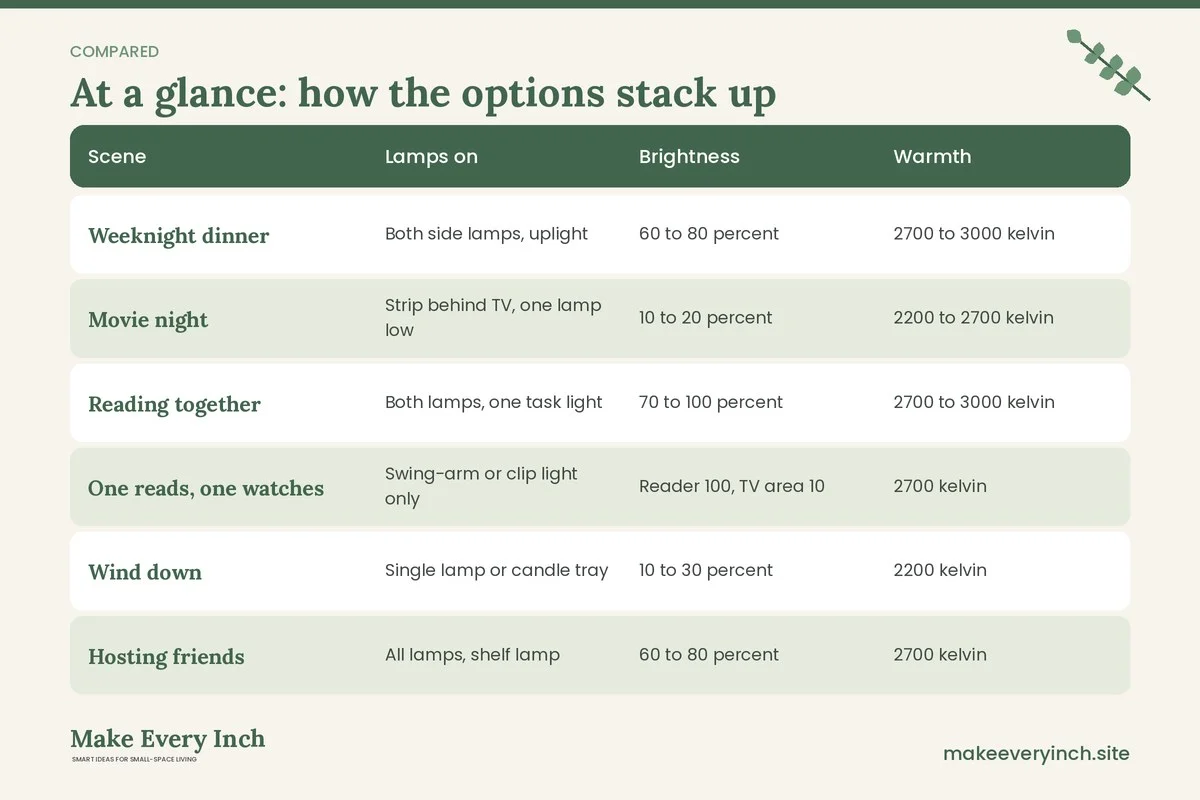
Scene table: lighting for the way you live
Use this table to choose lamp settings for a few common couple scenes. The numbers are hedged ranges, and you can adjust them to your room.
| Scene | Lamps on | Brightness | Warmth | Notes |
|---|---|---|---|---|
| Weeknight dinner | Both side lamps, uplight | 60 to 80 percent | 2700 to 3000 kelvin | Bright enough to see the plate |
| Movie night | Strip behind TV, one lamp low | 10 to 20 percent | 2200 to 2700 kelvin | Reduce screen contrast |
| Reading together | Both lamps, one task light | 70 to 100 percent | 2700 to 3000 kelvin | Aim from behind the shoulder |
| One reads, one watches | Swing-arm or clip light only | Reader 100, TV area 10 | 2700 kelvin | Shade stops spill |
| Wind down | Single lamp or candle tray | 10 to 30 percent | 2200 kelvin | Warm and low |
| Hosting friends | All lamps, shelf lamp | 60 to 80 percent | 2700 kelvin | Soft glow, no harsh light |
| Working from home | Task lamp, uplight | 80 to 100 percent | 3000 to 4000 kelvin | Daytime only, keep it away from the screen |
Three example rooms
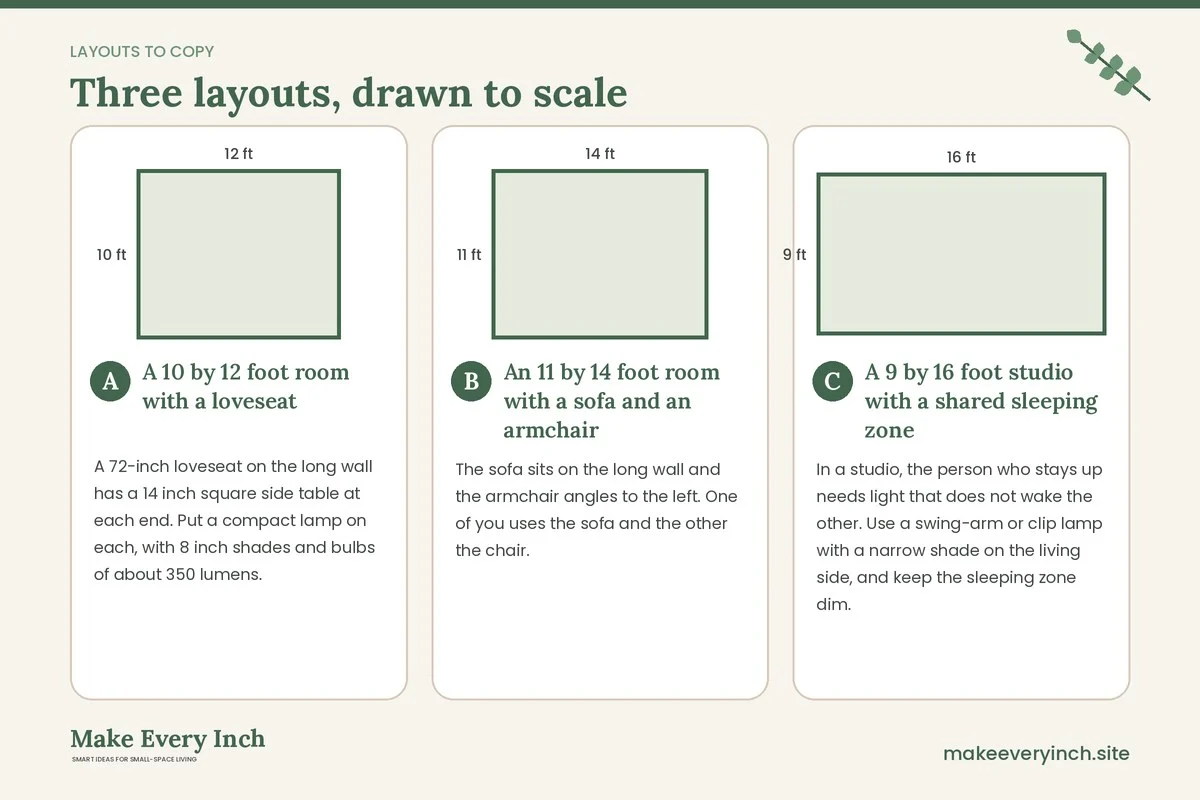
A 10 by 12 foot room with a loveseat
A 72-inch loveseat on the long wall has a 14 inch square side table at each end. Put a compact lamp on each, with 8 inch shades and bulbs of about 350 lumens. Add an LED strip behind the wall-mounted TV and a shelf lamp on a bookcase near the window. The walkway stays 36 inches wide, and the total light is roughly 1,300 to 1,600 lumens. Both lamps have their own switch, and the strip runs on a timer.
An 11 by 14 foot room with a sofa and an armchair
The sofa sits on the long wall and the armchair angles to the left. One of you uses the sofa and the other the chair. Place a slim floor lamp behind the armchair with a bulb of 450 to 600 lumens for the reader, and a table lamp at the far sofa end. The pair of lamps gives each person their own pool, and an uplight in the corner supplies the background glow. Keep the armchair lamp’s cord along the baseboard, not across the floor.
A 9 by 16 foot studio with a shared sleeping zone
In a studio, the person who stays up needs light that does not wake the other. Use a swing-arm or clip lamp with a narrow shade on the living side, and keep the sleeping zone dim. Float the sofa so its back faces the bed, which blocks spill, and add a console behind it with a lamp of 200 to 300 lumens. A sheer curtain or a screen at the zone edge softens the transition. For more on studio layouts, see our post on small apartment living room ideas for studios.
Evening routines that use light well
Light works best when it follows a routine. A few habits keep a shared room calm and avoid arguments about “too bright”.
- The sunset switch: at a set time, switch from the bright scene to the warm one. If you use smart bulbs, schedule it.
- The one-lamp rule: the person who stays up uses only their own lamp after a set hour, so the other can rest.
- The screen check: when watching, dim the overhead and lamps near the screen to reduce glare.
- The weekly bulb check: once a week, check for flickering, loose bulbs and warm sockets, and replace anything that looks off.
- The cord sweep: before bed, make sure no cords cross the walking path to the door or the kitchen.
- The hosting reset: before friends arrive, bring the shelf lamp and uplight to a middle setting, and switch the task light off.
Lighting and comfort together
Light interacts with the rest of the room. Warm lamps look best with textured fabrics, such as a wool throw or a linen cushion, which catch the glow. A rug under the sofa reflects a pool of light back up. A mirror placed across from a window, or opposite a lamp, doubles the effect. Pull curtains fully back in the daytime so the room needs less light. For furniture that supports good lighting, read our small living room furniture ideas, and for the layout that makes room for lamps, see our guide to small living room layout ideas.
Electrical safety notes
These are general guidelines. Your local codes and your lease may add more rules, and you should read the instructions that come with each product.
- Respect the wattage limit. Every socket lists a maximum wattage near the bulb base. Never use a bulb above that number. With LEDs, check the actual wattage, not only the equivalent.
- Inspect the cord. Do not use a cord with fraying, cracks or bare wire. Replace it before use.
- Keep cords out of the way. Do not run them under rugs, and do not pinch them behind furniture or doors. Use removable clips along baseboards.
- Never overload an outlet. Do not plug several lamps and devices into one outlet through stacked adapters. Use a power strip with built-in overload protection and do not chain strips.
- Keep fabric and paper away from bulbs. A lamp shade should clear the bulb, and curtains should not touch a lit shade.
- Check the bulb rating. Confirm it is rated for dimmers, enclosed fixtures and the socket size.
- Use proper power supplies for strips. Use the supply that came with the strip and do not exceed its rated length.
- Candles need care. Keep real flames away from fabric and never leave them unattended. Flameless versions are a safer option.
- Hardwiring is for licensed electricians. New ceiling fixtures, hardwired sconces, wall dimmers and new circuits should be installed by a licensed electrician.
Mistakes couples make with light
- Relying on the overhead light. It casts shadows and cannot serve two moods. Add lamps at two other heights.
- One shared switch. If one switch controls everything, the person who wants less light loses. Give each side its own control.
- Using bulbs that are too cool. Blue-white bulbs make a living room feel like an office. Choose 2200 to 2700 kelvin for evenings.
- Glare on the screen. A lamp that reflects in the TV or laptop is annoying. Move it to the side or lower the bulb.
- Mismatched warmth. A cool lamp next to a warm one looks patchy. Keep bulbs within one band.
- Long cords across the floor. They trip people in the dark. Plan outlets, or choose lamps with the cord on the right side.
- Forgetting the second person. Most setups are designed for one. Walk through the room together and test each seat.
Couple’s lighting checklist
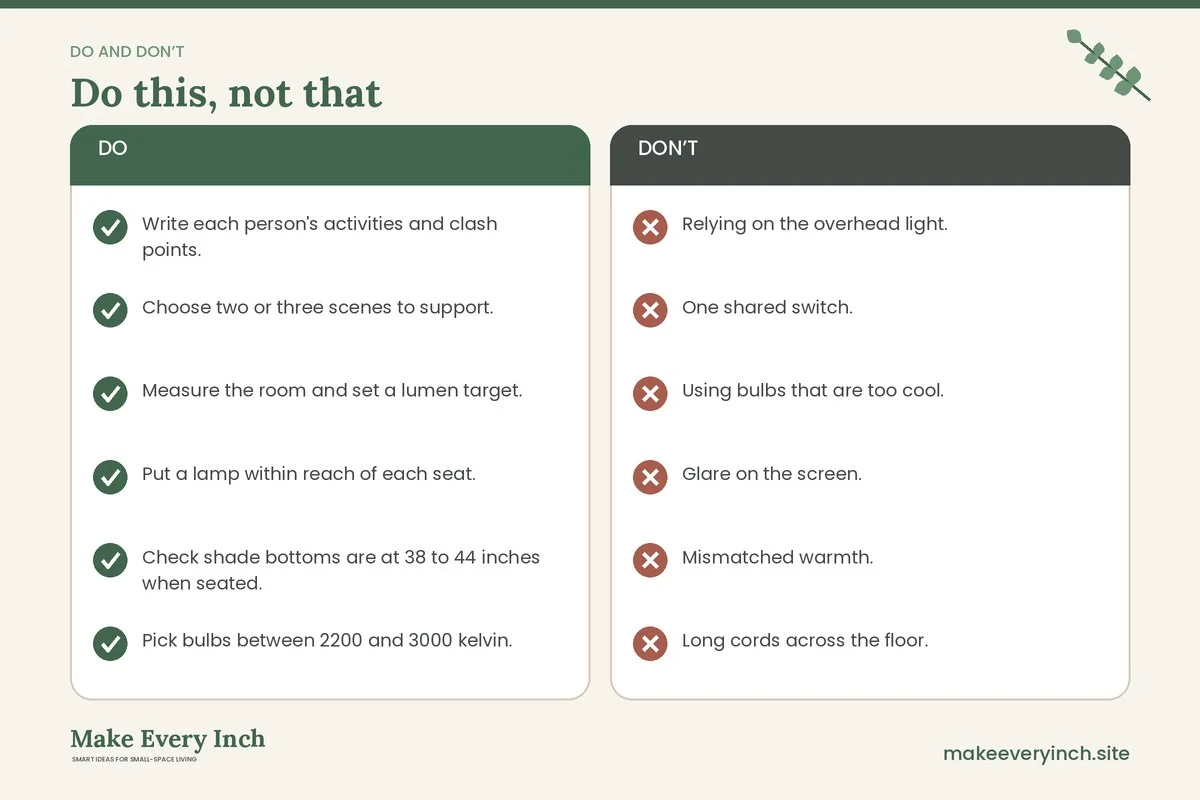
- Write each person’s activities and clash points.
- Choose two or three scenes to support.
- Measure the room and set a lumen target.
- Put a lamp within reach of each seat.
- Check shade bottoms are at 38 to 44 inches when seated.
- Pick bulbs between 2200 and 3000 kelvin.
- Make sure bulbs are dimmable where needed.
- Add a directional light for the reader.
- Add one background source, such as an uplight or a strip.
- Check every cord and outlet, and avoid overloading.
- Choose smart bulbs or a smart plug if you want scenes.
- Keep one spare plain bulb.
FAQ
How bright should a small living room be for two people?
Many guides suggest roughly 10 to 20 lumens per square foot, spread over several lamps. Add a brighter task light for whoever reads or works.
What if one of us reads and the other watches TV?
Use a directional light, such as a swing-arm lamp or a clip light with a narrow shade, for the reader. Keep the lamps near the screen low and add a strip behind the TV.
Are smart bulbs worth it for couples?
They are handy for scenes and shared control, but not essential. A pair of dimmable lamps with cord dimmers gives most of the benefit.
What color temperature is best for an evening together?
Choose 2200 to 2700 kelvin, which reads as warm and relaxing. Go up to 3000 kelvin if you want a softer neutral.
How far apart should two side lamps be?
On a sofa of 72 to 84 inches, about 70 to 90 inches apart is common, so their light overlaps slightly in the middle.
Can we install wall sconces ourselves?
Plug-in sconces need no wiring. Hardwired sconces, and any change to a wall switch or ceiling fixture, should be done by a licensed electrician.
How do we avoid cords in a small room?
Place lamps near outlets, use cord clips along baseboards and paintable cord channels on walls, and choose battery or plug-in options where it makes sense.
Keep going: Keep planning with our small living room lighting ideas, small living room storage ideas for couples and small living room TV wall ideas for couples.
Save this guide for later
Pin the ideas you like to Pinterest so you can come back to them when you plan your space.