14 Narrow Living Room Ideas Cozy Enough to Warm Up a Long, Thin Space
Quick answer: The best narrow living room ideas cozy turn the length of the room into a series of small, snug zones. Anchor one end with a deep-feeling seat or window bench, layer a rug 5 by 8 or 6 by 9 feet, add textiles in two or three textures, and keep a 30 inch walkway. Use soft, warm light at three heights, and strap any tall bookcase to the wall before filling it.
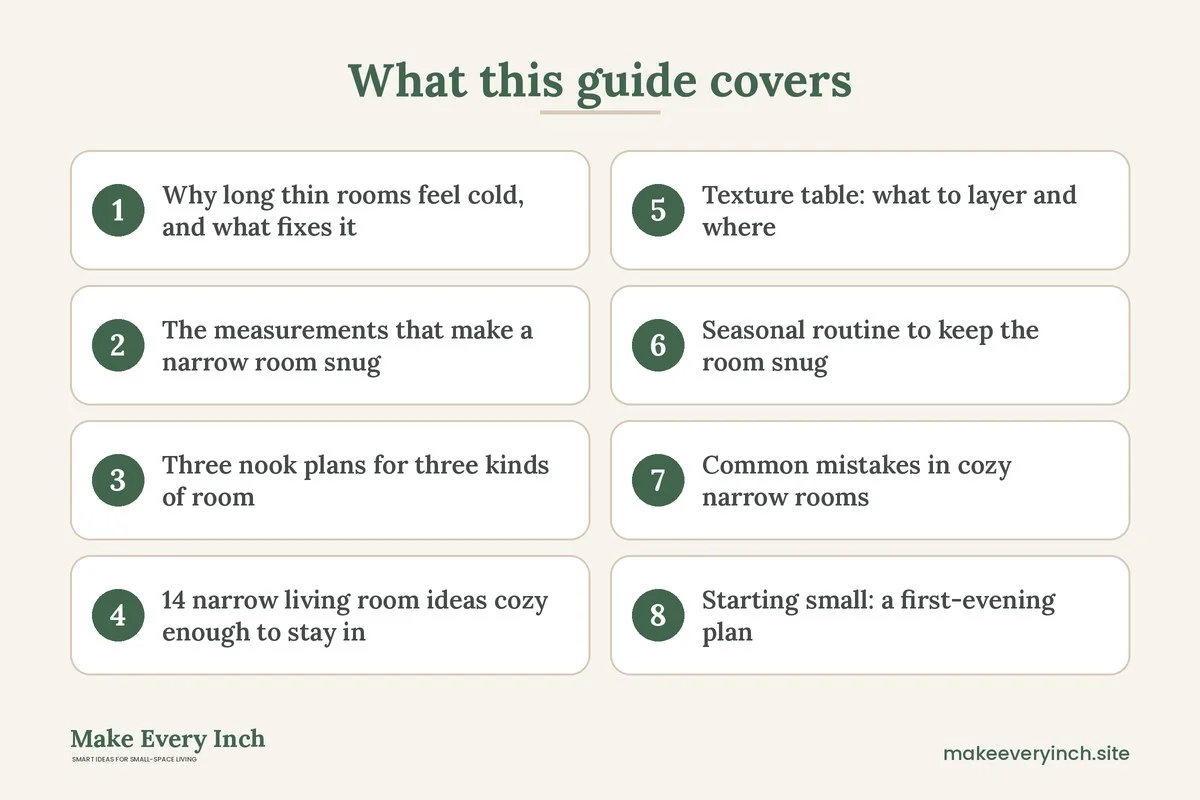
Narrow living room ideas cozy begin with a different question from the one most layouts ask. Instead of “how do I fit the furniture,” ask “where would I actually curl up?” A long thin room often feels cold because it is read as a passage: you walk through it, you do not settle in it. The cure is to give the room a few places to stop. A corner with a chair and a lamp, a window seat with cushions, a sofa end with a throw and a side table are all small decisions that change how the space feels. This guide builds on the layouts in our parent post on narrow living room ideas and focuses on warmth: how to create nooks, how to layer textiles, how deep a seat should be and how to keep a snug room tidy. You will find measurements, three nook plans, 14 ideas, a texture table, a routine for the seasons and a checklist. For the broader topic, see our small living room ideas pillar and our guide to cozy small living room ideas.
Why long thin rooms feel cold, and what fixes it
Three things make a narrow room feel unwelcoming. The first is echo: long parallel walls bounce sound, so hard floors and bare walls make a room feel hollow. The second is exposure: when the seat sits in the middle of a corridor, there is no back to lean against and no sense of shelter. The third is uniform light, with one ceiling fixture washing everything evenly. Cozy design answers each of these. Soft materials absorb echo, nooks and high backs provide shelter, and layered light creates pools of warmth.
The fix does not need a bigger room. It needs the room to feel like several smaller ones. Think of the length as a street with a few doorways, rather than a single long hall. Each doorway is a place to stop, and each one needs a seat, a surface and a source of light within arm’s reach.
The measurements that make a narrow room snug
Cozy is not the same as crowded. These ranges suit rooms that are roughly 8 to 11 feet wide, and you can adjust them to your household.
- Walkway: 30 inches clear along the main route is the minimum for comfort. A snug room can drop to 26 to 28 inches on a side route that only one person uses.
- Seat depth: 20 to 22 inches for an upright, supportive seat, and 24 to 26 inches for a relaxed lounge. Very deep sofas of 38 inches or more eat width fast, so add depth with cushions rather than a deeper frame.
- Seat height: 16 to 18 inches to the top of the cushion for most adults.
- Side table distance: 16 to 24 inches from the seat edge, so a mug is reachable without leaning.
- Window bench: 15 to 18 inches deep and 17 to 19 inches high, with a cushion 2 to 3 inches thick.
- Reading chair clearance: 18 to 24 inches from the knees to the next piece of furniture, so you can cross your legs.
- Rug: 5 by 8 feet for rooms about 8 feet wide, and 6 by 9 feet when the width is closer to 10 feet. Leave at least 6 inches of bare floor along each wall.
- Lamp height: reading lamps with the shade bottom about 40 to 44 inches from the floor, level with your eyes when seated.
Mark the footprints with tape and sit in each future seat for a few minutes. If your elbow knocks the wall or your knee touches the table, adjust before you buy.
Three nook plans for three kinds of room
A room 8 feet wide, with a window at the far end
Use the window end as your nook. Build a bench, 15 inches deep, across the window wall, with two cushions and a bolster. Put a slim 14 inch side table beside it and a low lamp on top. The sofa sits along one long wall at 30 to 32 inches deep, and a pair of floor cushions tuck under the bench for guests. The bench draws you down the length of the room, and the eye ends on a warm spot rather than a blank wall.
A room 9 to 10 feet wide, with a door at one end
Divide the length in two. Near the door, place a bench and a few hooks as a landing strip. Beyond it, a sofa floats across or sits against the long wall, with an armchair opposite in the center of the room. A floor lamp arches over the chair. Between them, a round pouf or small table sits on a 6 by 9 foot rug. The door end is practical, the far end is cozy, and a console behind the sofa gives you a surface.
A room 10 to 12 feet wide, with windows on one long side
Let the windows set the pattern. Place the sofa opposite them so you face the daylight, with a slim console behind it if the sofa floats. Add a reading chair in the corner by the last window and a rug that reaches under all three pieces. A long curtain, hung 4 to 6 inches above the window frame and falling to the floor, adds height and softens the echo. For help with furniture choices, see our guide to small living room furniture ideas.
14 narrow living room ideas cozy enough to stay in
Create places to settle
1. A window bench with cushions
A bench built into or placed under a window turns the end of a long room into a destination. Add a thin cushion, a bolster and a throw. Hide storage inside or underneath for blankets. See our post on the best storage ottomans for portable alternatives.
2. A reading corner at the far end
A chair angled across the corner, a floor lamp and a 12 to 14 inch side table need about 30 by 36 inches of floor. This is the smallest nook you can add, and it changes how people use the room. Put a basket of books on the floor beside it and a small rug beneath.
3. A sofa with a back wall behind it
A sofa against a wall feels sheltered, because nothing is behind you. If you must float the sofa, place a console or a bookcase behind it, so the back has a visual anchor. Our guide to the best sofas for small apartments lists features such as high backs and firm arms.
4. A pair of chairs facing each other
Two chairs placed across a small table at the center of the length create a conversation spot. Keep them 4 to 5 feet apart so voices carry without effort. This is a good use of the middle of a very long room, where a single sofa would feel stranded.
Layer the soft things
5. A rug with a pad underneath
A rug pad adds a cushioned feel, reduces slipping and absorbs sound. A pad about a quarter inch thick suits most rooms. Choose a pile that does not catch the door, and lay the rug lengthwise so it follows the room.
6. Two throws, two textures
Place a knit throw on the sofa arm and a woven one on the chair. Use a color in the same family so the room stays calm. The pair offers a place to snuggle in each zone, and the texture contrast reads as depth.
7. Curtains that hang high and full
Hang the rod near the ceiling and make the panels wide enough to be about twice the width of the window. Soft fabric absorbs echo and adds a vertical line that lifts the ceiling. If you rent, our post on no-drill storage ideas for renters shows ways to hang things without holes.
8. Cushions in odd numbers and mixed sizes
Three cushions on a sofa look more relaxed than two, and a lumbar pillow adds support. Keep to two colors and two patterns at most. In a small sofa, choose 18 to 20 inch squares rather than 24 inch ones, which crowd the seat.
Light, warmth and atmosphere
9. Three heights of light
Combine a floor lamp, a table lamp and a small light on a shelf. Light at different heights breaks the length into pools and makes the room feel gentle at night. Choose warm bulbs, around 2700 kelvin, for an evening glow. Use a plug-in sconce if you cannot wire anything.
10. A candle or a lantern cluster
A tray with three candles or battery lanterns on a low table gives a focal point at the center of the length. Keep real flames away from curtains and out of reach of pets and children, and always extinguish them when you leave the room.
11. Plants at the end of the room
A tall plant in a floor pot and a trailing plant on a shelf bring life to the far end and soften corners. Choose plants that suit your light, and set them on a tray so water does not mark the floor.
Storage that keeps it soft
12. A closed basket for blankets
A large lidded basket beside the sofa holds throws, and the lid becomes an extra surface. It looks warmer than a plastic bin, and it keeps the cushions from piling on the floor.
13. A low bookcase along the long wall
A bookcase 10 to 12 inches deep and about 30 to 36 inches high holds books, plants and framed photos without crowding the walkway. Its top can carry lamps and a tray. If you prefer a tall unit, choose a slim one from our list of best narrow bookshelves. Anchor every tall bookcase to the wall before you load it, because books are heavy and a narrow frame can tip.
14. Closed doors for the clutter
Cozy rooms avoid the look of visible mess. Use a cabinet with doors, a lidded ottoman or a set of baskets to hide cables, games and papers. See our hidden storage ideas for more.
Texture table: what to layer and where
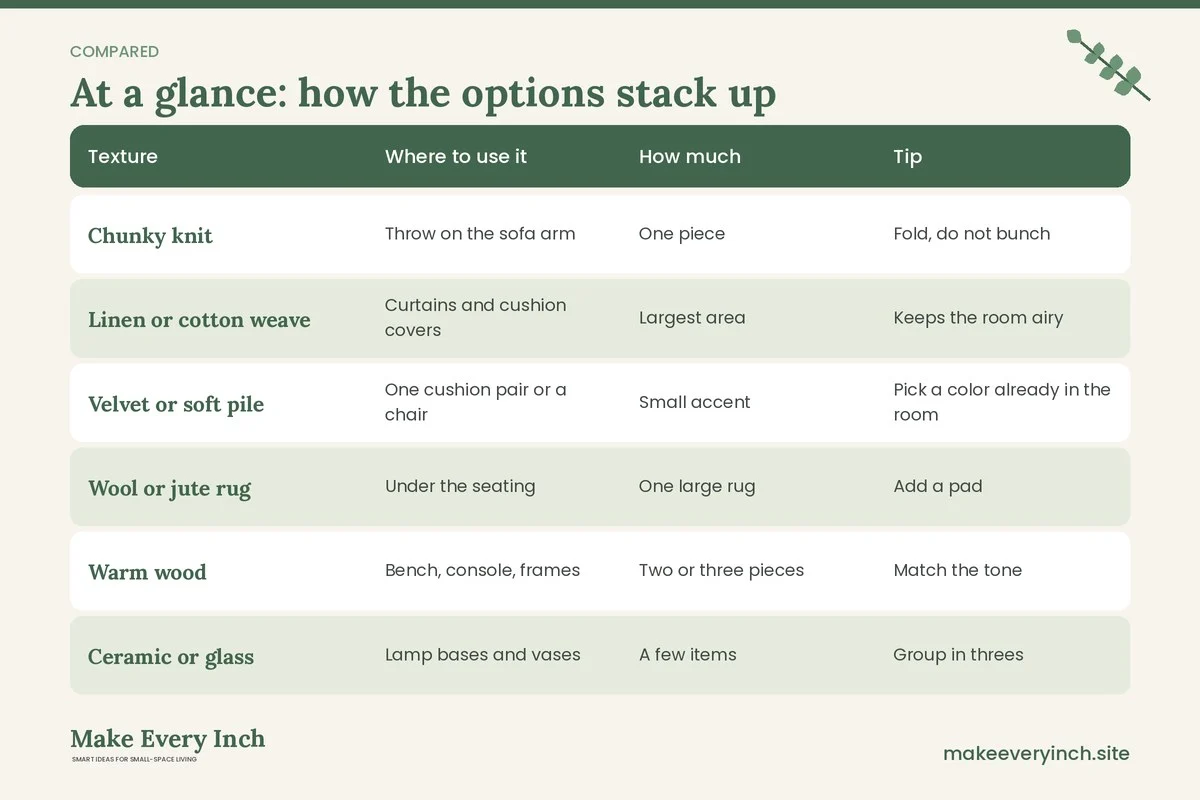
A cozy narrow room usually works with three or four textures in a single palette. Use the table below to decide where each belongs.
| Texture | Where to use it | How much | Tip |
|---|---|---|---|
| Chunky knit | Throw on the sofa arm | One piece | Fold, do not bunch |
| Linen or cotton weave | Curtains and cushion covers | Largest area | Keeps the room airy |
| Velvet or soft pile | One cushion pair or a chair | Small accent | Pick a color already in the room |
| Wool or jute rug | Under the seating | One large rug | Add a pad |
| Warm wood | Bench, console, frames | Two or three pieces | Match the tone |
| Ceramic or glass | Lamp bases and vases | A few items | Group in threes |
| Leafy plants | Far end and shelves | One tall, one trailing | Rotate for light |
Seasonal routine to keep the room snug
A cozy room changes with the weather, and small swaps are easier than new furniture. In autumn and winter, bring out heavier throws, a wool rug on top of a flat one, lined curtains and warmer bulbs. Move the reading chair closer to a radiator or a window with good light, but keep it at least a foot from any heater. In spring and summer, swap to lighter linen, remove the layered rug, open the curtains and let plants take over the window end. Store off-season textiles in a lidded bin or under a bed, rather than letting them pile up in the room. A short monthly reset helps: fold throws, wash cushion covers, wipe surfaces and clear the walkway.
Common mistakes in cozy narrow rooms
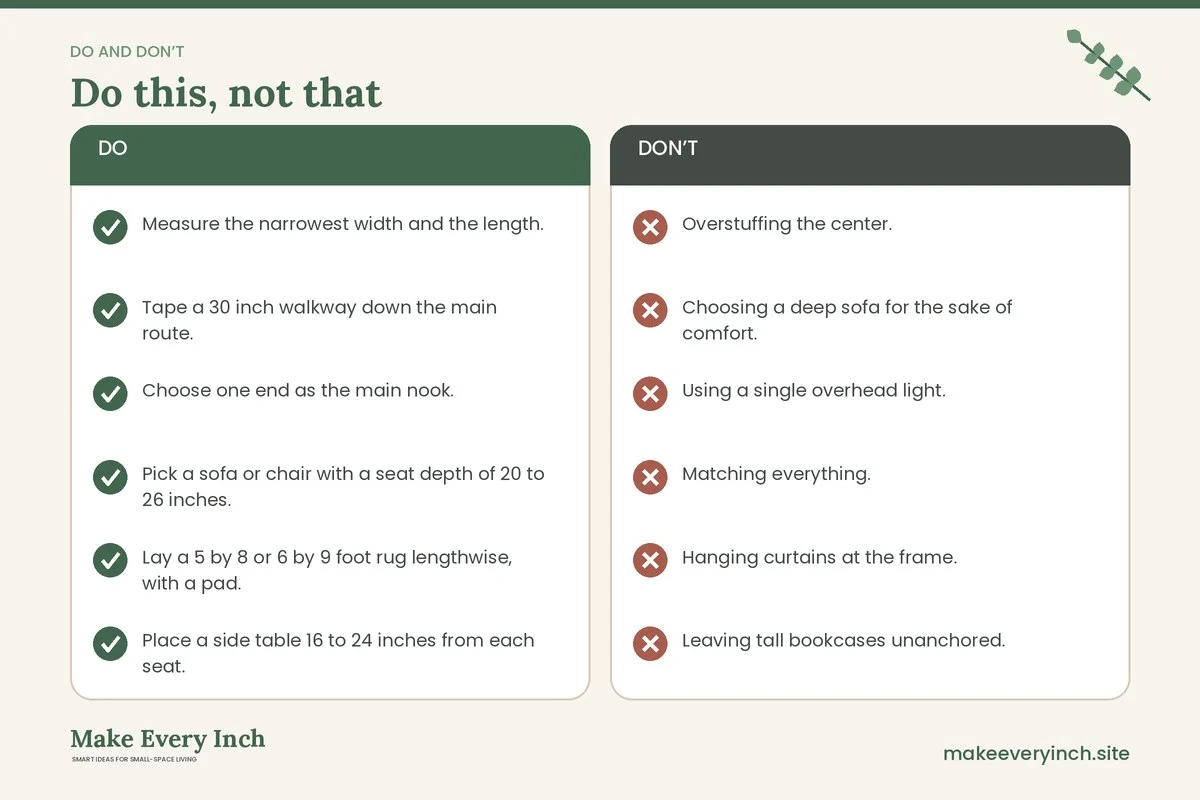
- Overstuffing the center. A cozy room still needs a clear route. If you must turn sideways to pass, remove one piece.
- Choosing a deep sofa for the sake of comfort. A 38 inch deep sofa takes too much of an 8 foot width. Add comfort with cushions and a throw.
- Using a single overhead light. One ceiling fixture flattens the room. Add at least two other sources.
- Matching everything. A room with one pattern, one color and one texture feels staged. Mix a few related tones.
- Hanging curtains at the frame. Curtains hung at the window top make the ceiling look low. Hang them near the ceiling.
- Leaving tall bookcases unanchored. Narrow, heavy, tall furniture needs a wall fixing, especially in rooms with children or pets.
- Forgetting the sound. Hard floors and bare walls echo. A rug, curtains and upholstered pieces solve it.
- Letting blankets pile up. Give them a basket, and the room stays calm.
Starting small: a first-evening plan
You do not need to redo the room to make it cozier. On your first evening, clear the walkway, drag the rug into place and put a lamp in the darkest corner. On the second, add a throw and two cushions to the seat you use most. On the third, move a chair to the end of the room and give it a side table. After a week you will know which zone you use, and you can invest in a bench, a bookcase or lined curtains where they matter. Look for second-hand tables, benches and baskets, which often have more character than new ones. If you rent, read our guide to small living room ideas for renters, and for a more affordable approach, read our post on narrow living room ideas on a budget.
Cozy narrow room checklist
- Measure the narrowest width and the length.
- Tape a 30 inch walkway down the main route.
- Choose one end as the main nook.
- Pick a sofa or chair with a seat depth of 20 to 26 inches.
- Lay a 5 by 8 or 6 by 9 foot rug lengthwise, with a pad.
- Place a side table 16 to 24 inches from each seat.
- Add light at three heights, with warm bulbs.
- Hang curtains near the ceiling and wide enough to look full.
- Add two or three textures in a single palette.
- Keep a lidded basket for blankets.
- Anchor every tall bookcase or cabinet to the wall.
- Hide cables and clutter behind doors.
- Plan one seasonal swap of textiles.
FAQ
How do I make a long narrow living room feel cozy?
Break the length into zones, each with a seat, a surface and a light. Add a rug, curtains and layered textiles to soften echo and add warmth.
What sofa depth is best in a narrow room?
Aim for 30 to 34 inches in rooms about 8 feet wide, and add comfort with cushions. Rooms closer to 11 feet can handle a deeper sofa, though you should still keep a walkway of 30 inches.
Where should the rug go in a narrow room?
Lay it lengthwise with the front legs of the seating on it. A 5 by 8 or 6 by 9 foot rug suits most rooms, and you should leave a few inches of bare floor on each side.
Can a cozy room work with white walls?
Yes. Warm light, wood tones, natural fabrics and a few plants make white walls feel soft. Choose a warm white rather than a cool one.
What is the cheapest way to add warmth?
Start with a rug, a throw, a couple of cushions and warm bulbs. These cost little compared with new furniture and change the feel of the room right away.
Is it safe to put a tall bookcase in a narrow room?
Yes, if you anchor it to the wall with the right hardware and follow the maker’s instructions. Put heavy items low, and keep the walkway clear in front of it.
Keep going: Keep planning with our narrow living room ideas, cozy small living room ideas and small apartment living room ideas.
Save this guide for later
Pin the ideas you like to Pinterest so you can come back to them when you plan your space.