Small Hallway Lighting Ideas
Quick answer: The best small hallway lighting ideas layer a flush or semi-flush ceiling light for general light with wall sconces or plug-in lights for glow, and add motion-activated low lights for night walks. Use warm white bulbs around 2700 to 3000 kelvin, aim for even light along the whole path, keep cords off the floor, never overload a circuit, and ask a licensed electrician for any wiring change.
Small hallway lighting ideas matter more than most people expect, because a hallway is the one space where you walk quickly, often carrying something, and often half asleep. It is also the space that most often gets a single bare ceiling bulb and nothing else. That leaves the middle bright, the ends dim and the walls flat. A good hallway lighting plan fixes three things at once: it makes the path safe, it makes a narrow space feel wider and friendlier, and it shows off the paint and art you chose. This guide explains how to size light for a narrow corridor, compares ceiling lights, sconces, plug-in lights, LED strips and motion lights, covers bulb color and brightness, walks through night safety and electrical safety, and offers renter-friendly options that need no wiring. It includes a comparison table, three example hallways, a mistakes list, a checklist and an FAQ. For the wider layout, see our pillar guide on small entryway ideas and our guide to narrow hallway ideas, and for the decor side, read our companion guide to small hallway decorating ideas.
How much light does a hallway need?
Hallways do not need the bright light of a kitchen or a workspace, but they need even light. The goal is a path that is visible from end to end without glare, deep shadows or dark pockets near doors.
Lighting is often described in lumens, which measure the amount of light a bulb produces. Rules of thumb vary, and no single number suits every home, but a hallway generally does well with a modest amount of general light, in the range of about 5 to 10 lumens per square foot, as a starting estimate. A hallway that is 3 feet wide and 10 feet long is 30 square feet, so roughly 150 to 300 lumens of general light might be a starting point, and many people choose more for dark finishes, long runs or low ceilings. Dark paint absorbs light, so a deep green hallway often needs more output than a pale one. Treat these numbers as a rough guide, not a code requirement, and adjust to taste by looking at the space.
More useful than a total is the spread. Aim for light every 6 to 8 feet along a long hallway, with extra light at doors, at the top and bottom of any steps and at corners. A single bulb in the middle of a long hall leaves both ends dim.
Think about three layers:
- General light: a ceiling fixture or a row of small lights that lights the floor and the walls.
- Accent or wall light: sconces, picture lights or plug-in lights that wash the wall and add warmth.
- Night light: very low, motion-activated light that shows the floor without waking you.
You do not need all three in every hallway, but even two layers look far better than a single bare bulb.
Ceiling lights: the base layer
A ceiling fixture is the usual main source in a hallway. In a small hallway, the fixture type matters because of height and glare.
Flush mount fixtures
A flush mount sits tight to the ceiling and is the best choice when the ceiling is low. If the ceiling is under about 8 feet, check that the fixture’s bottom is at least 7 feet above the floor so tall people do not hit it. Choose a shallow dome or a slim disc over a deep bowl.
Semi-flush fixtures
A semi-flush fixture hangs a few inches below the ceiling and gives more decorative impact. Use it only where the ceiling is 8 feet or higher, and keep it clear of the door swing and the head height of the tallest person in your home.
Recessed lights
Recessed lights, also called downlights, spread light without hanging anything into the space. In a long hallway, a row of lights spaced several feet apart gives an even wash. Installing new recessed lights involves cutting into the ceiling and wiring, so it is a job for a licensed electrician, and it needs the landlord’s permission in a rental. Check the fixture’s rating if there is insulation above, since some lights are not designed to contact insulation.
Track and rail lights
Track lights can be aimed at the wall to highlight art, which makes a corridor feel layered. They sit a little lower than recessed lights, so they suit hallways with ceilings of 8 feet or more. Aim them at the wall rather than into eyes.
Swapping a fixture
Changing a ceiling fixture can be a straightforward job for someone with electrical experience, but it involves wiring. Turn off the power at the breaker, and confirm it is off with a non-contact voltage tester. If you are not comfortable with this, hire a licensed electrician. In a rental, only swap a fixture if your lease allows it, and keep the original to reinstall at move-out.
Wall sconces: the layer that makes a hallway feel designed
Sconces light the walls, which makes a narrow hallway feel wider and warmer. They also keep the light low and soft, which many people prefer at night.
Sizing and spacing
- Height: mount sconces with the center at about 60 to 66 inches from the floor, or a bit lower where the ceiling is low. This keeps the light source near eye level without shining into eyes.
- Spacing: place sconces about 6 to 8 feet apart in a long hallway, and no closer than 4 feet in a short one. Stagger them on opposite walls only if the hallway is wide enough.
- Projection: in a narrow hallway, choose sconces that stick out less than 4 inches. A deep fixture at shoulder height is easy to bump, and in a 30-inch hallway, every inch counts.
- Shades: pick a shade or a diffuser that spreads the light. Bare bulbs look harsh at eye level.
Hardwired sconces
Hardwired sconces connect to the home’s wiring, so they should be installed by a licensed electrician, especially where new boxes or switches are needed. They often look the best, with no visible cord. In a rental, ask the landlord first, since wiring changes are usually not permitted without approval.
Plug-in sconces
Plug-in sconces have a cord and a plug, so no electrician is needed. They are common in rentals. Hang the sconce with adhesive hooks or small screws if allowed, run the cord along the wall edge, and use a cord cover painted to match the wall. Keep the cord neat and off the floor, and plug it into an outlet that is not overloaded. Some plug-in sconces have a switch on the cord, and others can be controlled with a smart plug or a remote. See our guide to renter-friendly lighting ideas for more no-wiring choices.
Battery sconces
Battery or rechargeable sconces need no cord at all and can be placed with adhesive or small hooks. They suit short runs and decorative accents, but they need new batteries or charging, so they are better for secondary light than for the main path.
Plug-in and portable options for rental hallways
If you cannot touch the wiring, you still have many choices. The main rule is to treat cords as part of the design and as a safety issue.
Slim table and floor lamps
A slim table lamp on a narrow console, or a floor lamp in a corner, adds a warm pool of light. In a tight hallway, only use a lamp where it does not narrow the path below about 30 inches and where it cannot be tipped. A tall, slim floor lamp with a weighted base fits a corner at the end. Our guide to the best floor lamps for small rooms explains what to check for stability and footprint.
Plug-in wall lights
These have a cord on the fixture and a plug that fits an outlet. Use the cord covers made for walls to keep wires tidy. Choose fixtures marked with a recognized safety certification for your region, and check that the plug and cord are in good condition.
Picture lights
A slim picture light above a frame lights the art and spills a soft glow on the wall. Battery versions avoid cords entirely. Plug-in versions need a neat cord run.
Outlet night lights
A small light that plugs into an outlet and switches on at dusk is an easy, low-cost way to light a dark hallway at night. Choose one with a low, warm glow and make sure the outlet is not covered by furniture or a curtain.
Smart bulbs and plugs
Smart bulbs and plugs let you set the brightness and color from a phone and schedule the light to dim at night. They are useful in a rental because they change a regular fixture into a flexible one without wiring. Check the bulb’s compatibility with your fixture and dimmer. A smart bulb can flicker on a dimmer switch not made for it, so read the packaging.
LED strips: handle with care
LED strips are popular in hallways because they are thin and can run along a baseboard, a shelf edge or the bottom of a ledge. They give a soft, indirect glow that outlines the path.
Where they work best
- Under a picture ledge or shelf, where the light washes the wall and is hidden from view.
- Along the baseboard, where it makes a low guide light for night walking.
- Behind a mirror, where it creates a halo around the frame.
Choosing and installing
Choose strips with a warm white color, in the 2700 to 3000 kelvin range, instead of cool white or fast-changing colors. Use a power supply that matches the strip’s voltage and wattage, and do not exceed the power supply’s rating. Buy products with a recognized safety mark, and avoid unmarked, very cheap units that have no information on the packaging, since poor power supplies can overheat. Keep the power supply in a ventilated place and not buried under cloth or insulation. Do not cover or coil a strip when it is on, since heat can build up.
Adhesive and rentals
Most strips use adhesive backing that can damage paint or wallpaper. Test a small piece in a hidden spot, and use removable mounting clips if the lease demands no damage. Use cable clips for the cord. Never run a strip’s power cable across a walking path.
Dimmers and controls
A strip on its own can look harsh when full brightness. Pair it with a dimmer, a remote or a smart plug that is rated for the load, and set it low. At night, 5 to 20 percent brightness is often enough to see the floor without waking the household.
Motion-activated lights for night walks
Nighttime is when hallway light matters most for safety. A motion light switches on when you walk in, and off after a set time, so you never have to hunt for a switch.
Types
- Plug-in sensor night lights: the simplest option. They plug into an outlet and switch on with motion or darkness.
- Battery sensor lights: stick on the wall or under a shelf, and need no outlet.
- Sensor LED strips: turn on along the baseboard as you walk, which makes a clear path.
- Smart sensors: connect to smart bulbs and set the brightness by time of day.
Placement
Place sensors near the floor or at about 24 to 36 inches high, aimed along the path, not at a bedroom door where they might wake someone. Test the sensor’s range and angle once installed, and adjust so that it does not trigger from a pet or a window. Set the timer to a minute or two, so the light stays on long enough for you to get through.
Light level and color
A night light should be dim, warm and low, because bright white light at night can wake you fully. Many people prefer amber or very warm white at night, because it is less jarring. Avoid blue-white light at night if you want to keep your sleep. For households with children or older adults, a night light that shows the floor edge is a real safety help. For related ideas in other rooms, see our guide to small bedroom lighting ideas.
Bulb color, brightness and glare
A hallway can look cold or cozy depending on the bulb.
Color temperature
Color temperature is measured in kelvin. Warm white is about 2700 to 3000 kelvin and feels cozy and flattering to skin and wood. Neutral white is 3500 to 4000 kelvin and feels clean and clear, but it can look stark in a small, windowless hall. Cool white, 5000 kelvin and up, looks sharp and clinical and is rarely a good match for a residential hallway. Use the same color temperature for all bulbs in the hallway, since a mix of warm and cool looks patchy.
Color rendering
Look for a color rendering index, often shown as CRI, of 80 or more, and ideally 90, if you want paint, wood and art to look true. Low CRI bulbs can make colors look dull.
Brightness
Choose bulbs by lumens, not watts. Watts only tell you how much power the bulb uses. Check the fixture’s maximum wattage rating and never exceed it, even with LED bulbs, since the heat rating is tied to the fixture. If you want flexibility, choose dimmable bulbs and a compatible dimmer switch.
Glare
Glare happens when you see the bulb directly. Choose frosted or shaded fixtures, mount sconces at or above eye level, and avoid bare bulbs at the end of a long hallway where you look straight at them.
Electrical safety in a hallway
Lighting is one of the easiest parts of a home to improve, but it involves electricity, so follow the basic rules.
- Turn off the power at the breaker before you touch any fixture, and confirm with a non-contact voltage tester.
- Hire a licensed electrician for new wiring, new switches, new boxes, recessed lights or anything that involves opening a wall or ceiling.
- Do not overload outlets or power strips. Check the rating of the circuit and the strip. Do not chain power strips.
- Check the wattage rating of every fixture and use bulbs at or below it.
- Use certified products. Look for a recognized safety mark on lights, cords and power supplies.
- Keep cords off the floor. Do not run cords under rugs or across a walking path, because they can overheat, wear out and trip people.
- Do not staple cords or run them through door frames. Use cord clips and covers that are made for the purpose.
- Protect from moisture. Keep lights away from water, and use fixtures with the right rating near a bathroom door or a damp area.
- Keep fixtures away from fabric. A hot bulb near curtains, a wall hanging or a runner is a fire risk.
- Check smoke and carbon monoxide alarms. Do not cover them, and do not install a light so that it blocks one.
- Replace damaged fixtures. If a light flickers, buzzes, smells hot or feels warm to the touch in the wall, turn it off and ask a professional to check it.
- Work from a stable ladder. Do not stand on a chair, and ask a second person to hold the ladder.
Renter-friendly hallway lighting
Rental hallways are often the worst lit parts of a home, and the lease may restrict changes. These options work without wiring or drilling.
- Swap the bulbs in the existing fixture for warm, dimmable LEDs with the right base and a wattage within the rating. This is allowed in most rentals.
- Add a plug-in sconce or a plug-in wall light with a cord cover.
- Use adhesive hooks to hang a plug-in light, if the weight is within the hook’s rating and the lease permits.
- Place a slim lamp on a narrow console or in a corner outside the path.
- Add motion night lights in outlets or on battery power.
- Use LED strips under a shelf or ledge, after a test of the adhesive.
- Choose battery picture lights for art.
- Keep the original fixture. If you change a fixture with permission, save the old one to reinstall at move-out.
- Ask in writing. If you want a hardwired change, ask the landlord and keep a record.
For more ideas that leave no trace, read our guides to security-deposit-safe apartment upgrades and no-drill storage ideas for renters.
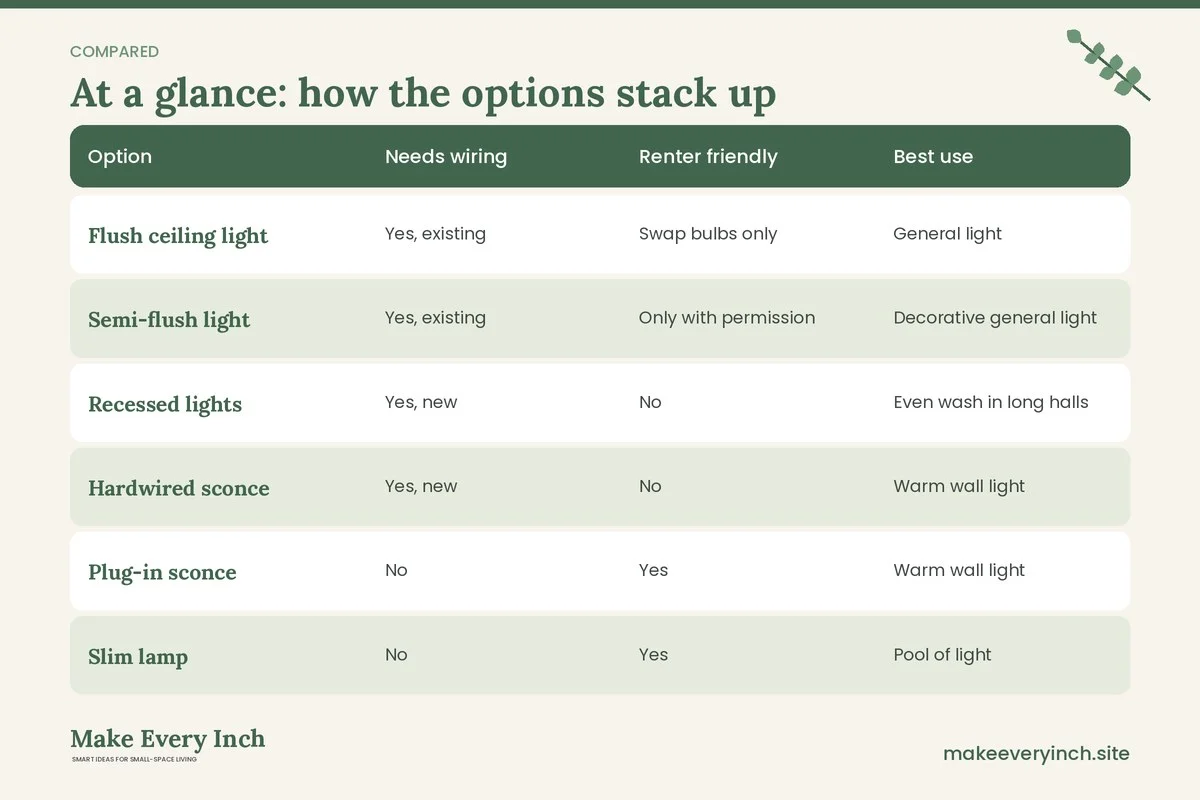
Comparison table: small hallway lighting ideas side by side
Use this table to pick the lights that fit your hallway, your budget of effort and your lease.
| Option | Needs wiring | Renter friendly | Best use | Main caution |
|---|---|---|---|---|
| Flush ceiling light | Yes, existing | Swap bulbs only | General light | Check ceiling height |
| Semi-flush light | Yes, existing | Only with permission | Decorative general light | Needs 8 foot ceilings |
| Recessed lights | Yes, new | No | Even wash in long halls | Hire an electrician |
| Hardwired sconce | Yes, new | No | Warm wall light | Hire an electrician |
| Plug-in sconce | No | Yes | Warm wall light | Hide the cord |
| Slim lamp | No | Yes | Pool of light | Keep it outside the path |
| LED strip | Low voltage | Yes, test adhesive | Guide light | Use a rated power supply |
| Motion night light | No | Yes | Night safety | Warm, dim, aimed low |
| Picture light | Sometimes | Battery versions | Highlights art | Mind the cord |
| Smart bulb | No | Yes | Dimming and schedules | Check dimmer compatibility |
Three example hallways
A windowless 30 inch hallway in a rental
This hallway has one ceiling light with a bare bulb, which is bright in the middle and dark at the ends. The fix starts with the bulb: a warm, dimmable LED at about 2700 kelvin, within the fixture’s wattage rating, and a diffuser if the fixture allows. Two plug-in sconces that stick out less than 3 inches go on the long wall, 7 feet apart, with the center at about 62 inches, and paintable cord covers run to the outlets. A motion-activated night light sits in a low outlet near the bedroom door, set to a warm glow. Nothing sits on the floor. The tenant keeps the lease in mind, uses only removable hooks and keeps the original hardware ready to restore.
A 36 inch by 14 foot hallway in a family home
A long hallway with four doors needs light along its length. Three small flush fixtures, or a row of recessed lights installed by a licensed electrician, are spaced about 4 to 5 feet apart, so no spot is dark. A dimmer switch rated for the bulbs lets the family lower the light in the evening. Soft LED strips under a picture ledge add a wall wash, and a baseboard motion strip lights the path to the bathroom for children at night. All bulbs share the same warm color. The strip’s power supply sits in a ventilated spot near an outlet at one end, and the cord is clipped along the baseboard.
A short 42 inch entry hallway in an older home
A short hallway between the front door and the living room has a darker wall color and a console. A semi-flush fixture with a fabric shade gives a gentle general light, and a pair of hardwired sconces, put in by an electrician, flank a mirror. The sconce bulbs have a high color rendering index so the green walls look rich. A small lamp on the console adds a glow when the main light is off, and a plug-in night light covers the late-night walk. For more entry layouts, see our guide on tiny foyer ideas.
Lighting the hallway as part of the whole home
Hallway light connects the rooms, so it should relate to the lighting next to it. Use the same color temperature as the neighboring rooms, so you do not walk from a cool corridor into a warm bedroom. Match the finish of fixtures, such as black, brass or white, across the hallway and the entry, and keep the style simple. If the hallway opens to a kitchen or a bathroom, read our guides to small kitchen lighting ideas and small bathroom lighting ideas to keep the transitions smooth.
A hallway is also a place where you can lean on switch placement. Put a switch at each end of a long hallway, if you can, so you do not walk in the dark. If you cannot add a switch, a smart plug, a smart bulb or a motion sensor does the same job without wiring. Use a switch cover with a glow ring if your switch is hard to find in the dark.
Common hallway lighting mistakes
- Relying on one bulb. One ceiling light leaves dark ends. Add a second layer.
- Choosing cool white. Cool light feels cold in a narrow space. Use warm white.
- Mixing bulb colors. A mix of warm and cool in one hallway looks patchy.
- Hanging a low fixture. A pendant or a semi-flush that hangs under 7 feet can hit tall heads.
- Using bulky sconces. A deep fixture in a narrow hallway is a bump risk.
- Running cords across the floor. This is a trip and fire risk. Use cord covers and clips along the wall.
- Overloading a power strip. Keep the load within the rating, and avoid chaining strips.
- Ignoring night. A hallway needs a gentle night path, not a bright white blast.
- Forgetting glare. A bare bulb at eye level makes the hallway harder to use, not easier.
- Covering alarms. Do not hide or block smoke alarms with a fixture.

A simple plan to light a small hallway
- Step 1: Measure the hallway and mark the doors, outlets, switches and alarms on a plan.
- Step 2: Decide how many layers you want, from one to three.
- Step 3: Swap existing bulbs for warm, dimmable LEDs with the right base and wattage.
- Step 4: Add wall light, hardwired with an electrician or plug-in for a rental, spaced 6 to 8 feet apart.
- Step 5: Add a motion night light at floor level near the bedrooms.
- Step 6: Tidy every cord with clips or covers along the wall edge.
- Step 7: Walk the hallway at night with the main light off, and fix dark spots or glare.
Hallway lighting checklist
- Measure the hallway and note outlets and switches.
- Aim for even light along the whole path.
- Choose warm white bulbs, around 2700 to 3000 kelvin.
- Use the same color temperature throughout.
- Check the maximum wattage on each fixture.
- Add a second layer, such as sconces or lamps.
- Mount sconces at about 60 to 66 inches, projecting less than 4 inches in a narrow hallway.
- Add a low, warm motion light for night.
- Keep cords off the floor and out of walkways.
- Do not overload outlets or strips.
- Hire a licensed electrician for any wiring change.
- Ask permission before changing fixtures in a rental.
- Keep alarms and exits clear.
- Test the hallway at night with the main light off.
FAQ
What is the best lighting for a small hallway?
A combination works best: a flush ceiling light for general light, a pair of sconces or plug-in lights for warmth and a motion-activated night light for safety. Use warm bulbs and keep the light even along the path.
What bulb color should I use in a hallway?
Warm white, around 2700 to 3000 kelvin, suits most homes. It feels welcoming and flatters paint and wood. Use the same color throughout the hallway.
How many lights does a hallway need?
It depends on the length and the output of each light. As a rough guide, place a light every 6 to 8 feet in a long hallway, with extra light at doors and corners. Look at the result at night and adjust.
How do I light a hallway with no ceiling light?
Use plug-in sconces, slim lamps, battery lights and motion night lights. Plan the cords so they stay along the wall and off the floor. See our guide to renter-friendly lighting ideas.
Are LED strips safe in a hallway?
They can be, if you use a rated power supply, buy products with a recognized safety mark, do not coil or cover them while on and keep the cable out of the path. Stop using any strip that gets hot or smells odd.
Can I install a sconce myself?
Plug-in sconces need no wiring. Hardwired sconces involve the home’s electrical system, so hire a licensed electrician, and get your landlord’s permission in a rental.
How bright should a night light be?
Dim and warm. It should show the floor and any steps without waking you. Aim for a low setting, and place the sensor so that it lights the path, not the bedroom door.
Keep going: Keep going with our guide to small hallway decorating ideas, the roundup of apartment entryway decorating and our ideas for small entryway organization.
Save this guide for later
Pin the ideas you like to Pinterest so you can come back to them when you plan your space.