Small Living Room Makeover Ideas Japandi: A 2-Weekend Plan
Quick answer: The best small living room makeover ideas japandi style blend Japanese calm with Scandinavian warmth: pale walls, low furniture with visible legs, light wood, a few handmade or natural-textured objects and soft diffused light. Work in this order: clear and clean, set a low layout, paint in warm neutrals, add natural materials, layer lamps, then style with one imperfect, handmade focal object. Two focused weekends are enough for most rooms.
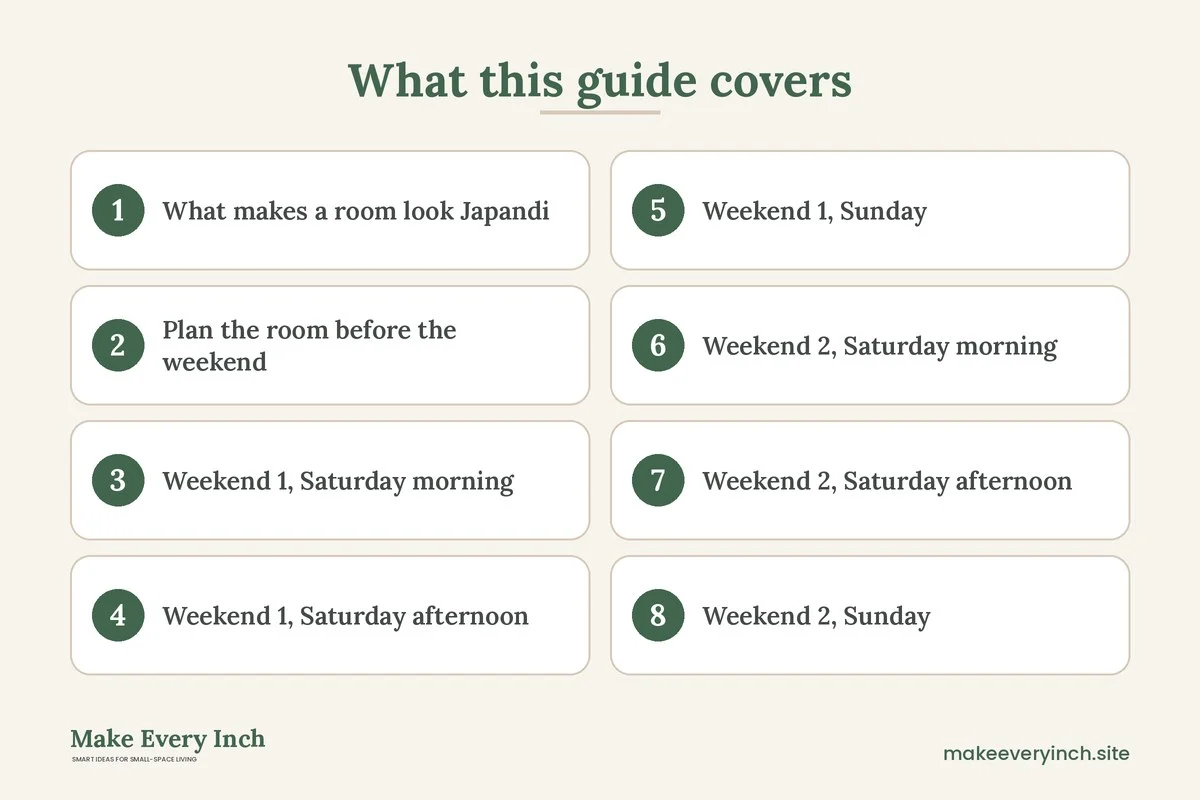
Small living room makeover ideas japandi fans love share one thread: the room should feel quiet, warm and a little handmade. Japandi borrows the restraint and craft of Japanese interiors and the soft comfort of Scandinavian ones, and it suits a small living room because it asks for fewer, better things at a low height. This guide gives you a two-weekend plan rather than a long list of ideas. It explains what makes the style work, the measurements for low seating and clear floor, the materials and colors to choose, a table of swaps, three example rooms, a weekend-by-weekend schedule, a checklist and an FAQ. For a wider look at makeover approaches, read our main guide to small living room makeover ideas, and for the general topic see small living room ideas.
What makes a room look Japandi
Japandi is easier to recognize than to describe. Think of a room where the walls are a soft, slightly warm off-white, the furniture sits low, the wood is pale or mid-toned and there is one dark accent such as charcoal or black to anchor the scheme. Surfaces are mostly bare, a few objects are placed with care and the textures are natural: linen, wool, cotton, paper, clay, rattan and unfinished wood. Nothing shouts, and nothing looks brand new and glossy.
Two ideas sit underneath the look. The first is a respect for empty space. In Japanese design, the space around an object matters as much as the object, and in a small room that translates into leaving shelves partly empty and floors mostly clear. The second is comfort through warmth. The Scandinavian side adds cozy layers, such as a thick throw or a sheepskin-style texture, and light that feels like candlelight. Together they give a room that looks calm but never cold.
It also helps to know what Japandi is not. It is not a strict minimalism that forbids anything personal, and it is not a faux-traditional room full of lanterns and decorative signs. The look is about restrained materials and honest craft, and you can reach it with second-hand wood, simple ceramics and a coat of paint. If you want a more stripped-back approach with a different order, our guide to small living room makeover ideas minimalist takes that route, while this post leans on warmth and natural texture.
Plan the room before the weekend
Spend an hour before the first weekend, not shopping, but planning. Take photos of the room, measure it and note windows, outlets and the direction of daylight. Then decide three things: the one wall that will be your calm focal point, the one seat where you most like to sit and the one corner that gets the most light. Those three decisions guide everything else.
Japandi leans on low furniture, and the numbers below suit a small room. Treat them as working ranges and adjust to your own body and furniture.
- Seat height: often 14 to 17 inches for a low sofa or a lounge chair, compared with about 17 to 19 inches for a typical sofa.
- Low table height: around 12 to 16 inches, a little below seat height, so it feels grounded.
- Main walkway: 30 to 36 inches wide, and 24 inches for a side path.
- Rug: a natural-fiber or wool rug around 5 by 8 feet, with the front legs of seating resting on it.
- Bare floor visible: try for roughly a third of the floor with no furniture on it.
- Shelf fill: aim to leave around a third of each shelf empty so that objects can breathe.
- Art height: center a single piece at about 57 inches from the floor, or lower if the seating is low.
Low furniture changes sight lines. When everything sits lower, the walls look taller and the room feels more open. That is one reason the style works so well in a compact room.
Weekend 1, Saturday morning: clear and clean
Begin with an empty surface. Remove all small objects, cushions, throws and decor from the room. Take everything off the walls, and clear the shelves. Clean the room thoroughly, including windows, skirting boards and the underside of furniture. A clean, clear room lets you see what actually belongs.
Sort the objects into three groups. Keep covers items you use or love. Rotate covers items that are lovely but would crowd the room, and these go into a box. Release covers anything you can donate or recycle. In a Japandi room, decor is placed one piece at a time, so be ruthless about duplicates and anything made of shiny plastic or loud printed fabric. Keep a small group of natural objects, such as a vase, a bowl, a wooden tray or a few books with quiet covers. For more on clearing, see our small apartment decluttering ideas.
Weekend 1, Saturday afternoon: set a low, open layout
Now work out the layout. Place the sofa or main seat against the longest wall and keep the center of the room open. Keep a path to the window and, if there is one, the balcony door. Where possible, let one wall stay nearly bare. In Japandi, a bare wall is a feature, not a gap.
If you can, replace one bulky piece with a lower alternative. A low sofa with slim arms, a daybed-style seat or a pair of lounge chairs can all work. A low coffee table, a round wooden table or a stool-style side table keeps the lines horizontal. For furniture ideas that suit this look, read our post on small living room furniture ideas japandi, and for the arrangement itself, see small living room layout ideas japandi.
Tape the new footprint on the floor and live with it for the evening. Walk the route from the door to the window, and sit in each seat. Move anything that stops your stride.
A safety note on tall and low furniture
Tall shelves and cabinets should be anchored to the wall with suitable hardware, and heavy items kept low. A Japandi room often uses open shelving, so check weight limits and avoid placing a heavy ceramic piece high on a narrow shelf. Low platforms and floor cushions are comfortable, but keep sight lines and walkways clear so nobody trips in the dark. In a rental, ask before drilling and consider freestanding low pieces instead.
Weekend 1, Sunday: paint and prepare surfaces
Choose a warm, soft off-white, a pale greige or a light sand for the walls. Pale, warm tones reflect daylight and help a small room feel open. If you want a darker touch, consider a deep charcoal or muted green-black on a single piece of furniture or a door, rather than a wall. Test samples on large boards and look at them in morning and evening light.
Paint safety is important in a small room. Open windows, keep a fan moving air out, take regular breaks and use a low-VOC product where available. Follow the label for drying and recoat times and keep children and pets out until the room is aired. Avoid sanding old paint without checking whether the home is old enough to include lead paint. If you rent, a lease check comes first, and our guide to removable wallpaper ideas lists non-paint options such as subtle textured finishes.
If you are not repainting, you can still shift the color mood with textiles and wood tones. Leave furniture and floors well covered and let everything dry before you move items back in.
Weekend 2, Saturday morning: bring in natural materials
The second weekend adds the warmth. Choose materials rather than objects. Light oak, ash, birch or similar pale woods read as Scandinavian, while darker walnut or stained woods and black metal read as Japanese. Use both, but in small doses, such as a pale coffee table and a dark lamp base. Rattan, cane, jute, paper and clay add texture without shine.
Textiles matter most. A linen curtain in a natural shade, a wool or cotton throw in oatmeal or stone and a couple of cushions in matching tones soften the room. Stay within three to four colors, and vary the texture instead. Skip bold prints, and if you like pattern, choose a subtle weave or a simple stripe. Hang curtains high and wide and let sheer fabric filter daylight.
For the floor, a flat-weave natural-fiber or wool rug in a plain tone defines the seating zone. Add a non-slip pad so that the rug lies flat. Low floor cushions or a zabuton-style cushion give flexible extra seating that can be stacked in a corner. A good plant, such as a single branch in a vase, a small bonsai-style tree or a leafy plant in a plain pot, brings life without clutter.
Weekend 2, Saturday afternoon: layer soft light
Light is where Japandi becomes cozy. Avoid a single bright ceiling light. Build several soft sources at different heights. A paper or fabric floor lamp gives a diffused glow, a small table lamp with a ceramic base adds warmth, and a low light on a shelf or the floor washes a wall gently. Choose warm bulbs, often around 2200 to 2700 kelvin, so everything has the same glow.
A paper-style shade can feel airy, but it needs care. Use only bulbs that suit the fixture, keep the shade clear of the bulb and avoid high-heat bulbs inside paper or fabric. Check that cords and plugs are undamaged, do not overload outlets or power strips and keep cables out of the walkway. Leave any change to fixed wiring to a qualified electrician, and in a rental, ask first. Our guide to small living room lighting ideas japandi has more on shades and placement, and the best floor lamps for small rooms list highlights features to check.
Weekend 2, Sunday: style with imperfection
Styling is the last step and the lightest. Japandi has a name for the beauty of imperfection, often called wabi-sabi, and you can use it freely. A hand-thrown bowl with an uneven glaze, a vase with a small chip, a wooden tray with grain marks and a linen cushion with soft creases all look right. Brand-new, perfectly matching sets look out of place.
Choose one focal wall. A single piece of art, such as a calm abstract, a simple ink-style print or a framed fabric, works better than a crowd. Or choose a shelf with three objects and a lot of air. Try a low arrangement on the coffee table: a tray, a small plant and a candle or a stack of two books. Keep the top of the TV unit nearly bare, or tuck the screen into a closed cabinet. For TV wall ideas that suit the style, see our small living room tv wall ideas japandi post. If you use candles, keep them away from paper, fabric and curtains and never leave them unattended.
Japandi swaps: from cluttered to calm
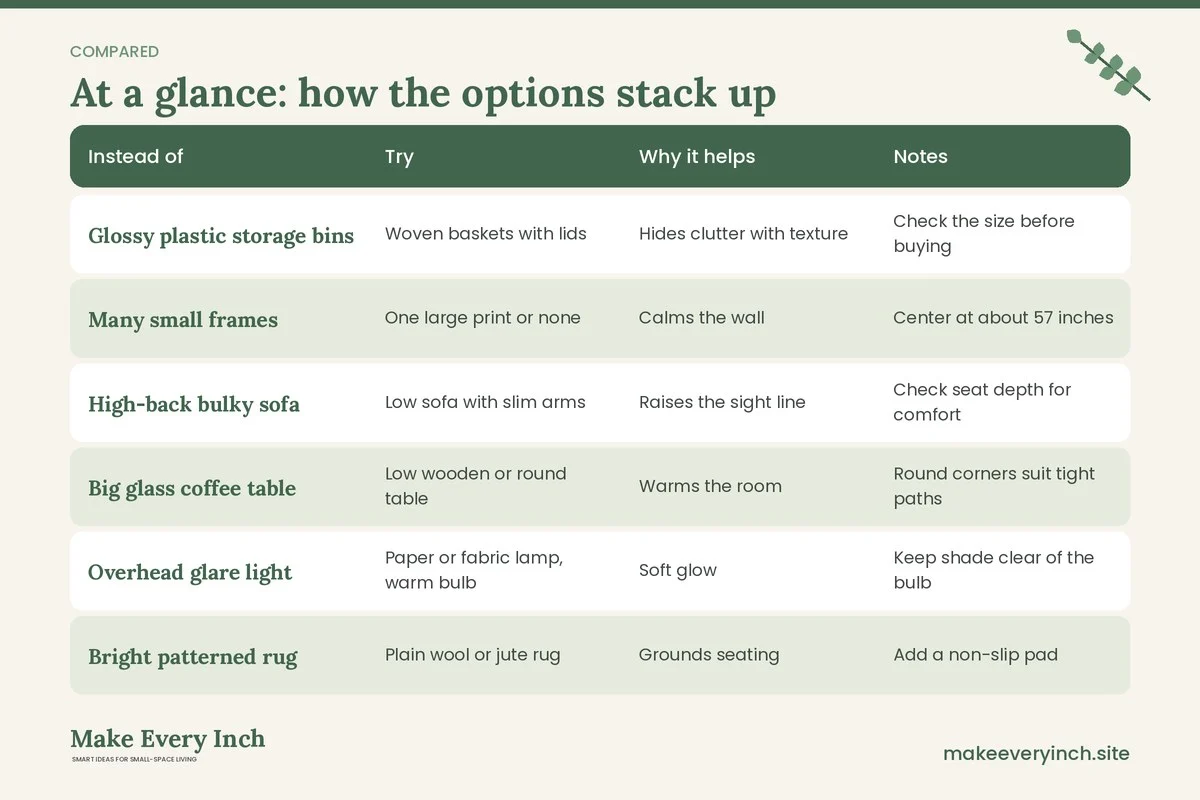
The table below shows common swaps to help you decide what stays and what goes.
| Instead of | Try | Why it helps | Notes |
|---|---|---|---|
| Glossy plastic storage bins | Woven baskets with lids | Hides clutter with texture | Check the size before buying |
| Many small frames | One large print or none | Calms the wall | Center at about 57 inches |
| High-back bulky sofa | Low sofa with slim arms | Raises the sight line | Check seat depth for comfort |
| Big glass coffee table | Low wooden or round table | Warms the room | Round corners suit tight paths |
| Overhead glare light | Paper or fabric lamp, warm bulb | Soft glow | Keep shade clear of the bulb |
| Bright patterned rug | Plain wool or jute rug | Grounds seating | Add a non-slip pad |
| Many cushions | Two or three in linen or wool | Cuts visual noise | Keep to the palette |
| Artificial plants | One real branch or small plant | Brings natural life | Match pot to the palette |
| Open clutter on shelves | Closed cabinet plus a few objects | Leaves space around items | Anchor tall units |
Three example rooms
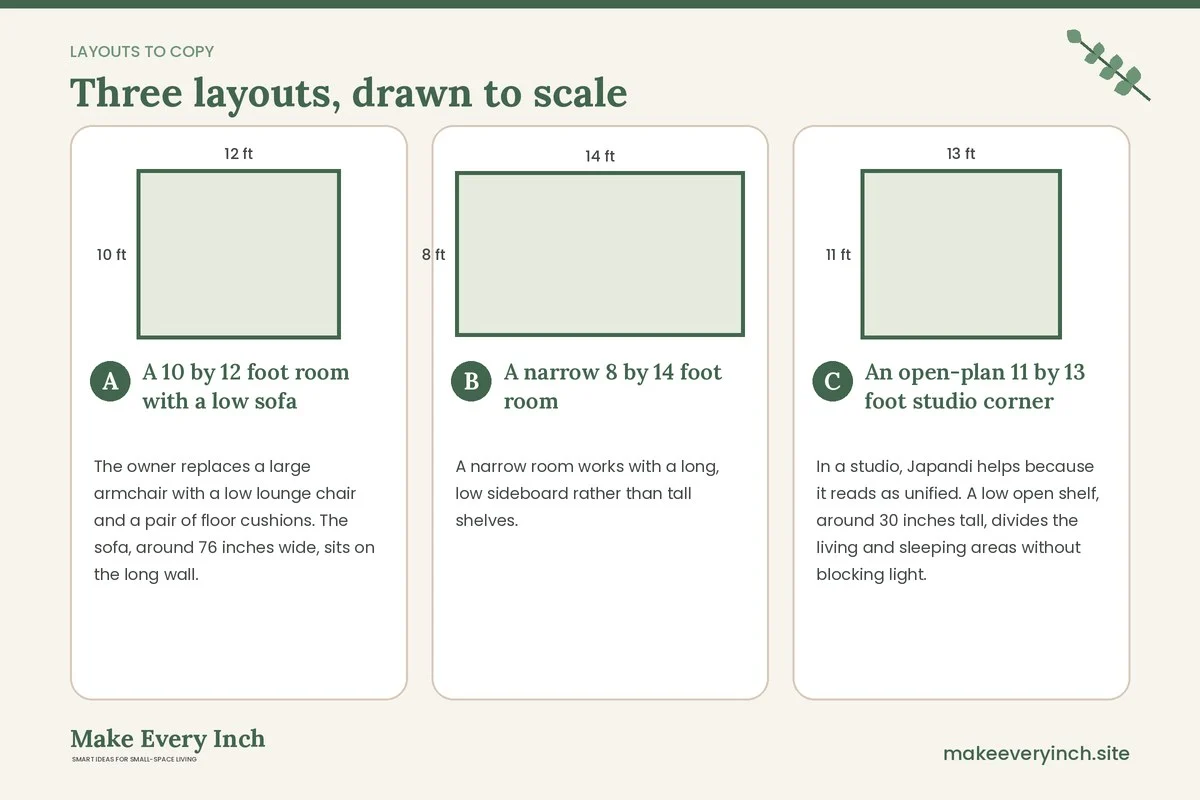
A 10 by 12 foot room with a low sofa
The owner replaces a large armchair with a low lounge chair and a pair of floor cushions. The sofa, around 76 inches wide, sits on the long wall. A 5 by 8 foot wool rug sits beneath the front legs, and a round wooden coffee table sits about 14 inches from the sofa edge. Walls are painted a warm, pale off-white. A paper floor lamp stands in the corner by the window, and a ceramic table lamp sits on a narrow side table. The only wall decor is one large print centered at about 57 inches. The walkway stays near 34 inches, and the room feels both bigger and softer.
A narrow 8 by 14 foot room
A narrow room works with a long, low sideboard rather than tall shelves. A wall-hung or floor-standing sideboard about 14 inches deep holds media and storage along one long wall, keeping its top mostly bare apart from a lamp and a bowl. The sofa sits at the short end, leaving a clear lane of about 30 inches along the other wall. A light-colored runner-style rug about 5 by 8 feet runs lengthwise. Curtains hang from a rod near the ceiling to draw the eye up. One tall plant in the corner adds height, and any tall storage is anchored to the wall.
An open-plan 11 by 13 foot studio corner
In a studio, Japandi helps because it reads as unified. A low open shelf, around 30 inches tall, divides the living and sleeping areas without blocking light. The sofa faces the window, and a low table in front doubles as a place to eat. Wood tones repeat across both zones, and a single paper pendant or floor lamp marks the lounge. A folding screen or a curtain on a ceiling track can close off the sleeping area for guests. Keep everyday clutter in baskets under the bed, so that the living area stays calm.
The two-weekend schedule at a glance
If you prefer a quick view, here is how the work breaks down.
Weekend 1: Foundation
- Saturday morning: clear, sort and clean the room.
- Saturday afternoon: set a low layout, tape the footprint and anchor tall units.
- Sunday: test samples and paint, with good ventilation and a low-VOC product where available.
Weekend 2: Warmth
- Saturday morning: add curtains, a rug with a pad, a throw and natural-material accents.
- Saturday afternoon: layer the lamps, using warm bulbs and checking cords.
- Sunday: style one wall and one surface, then take after photos.
If you cannot manage two weekends in a row, split the schedule across four weeks with one task a week. The order matters more than the speed.
Mistakes to avoid
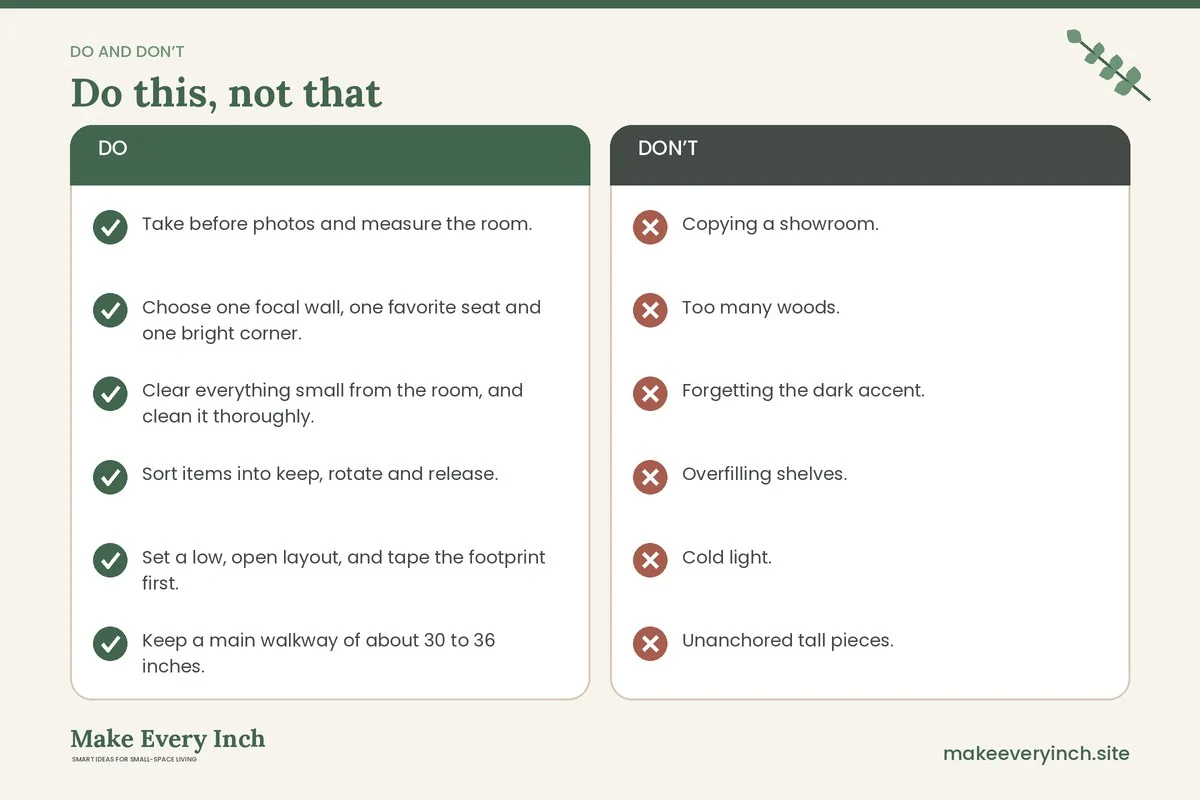
- Copying a showroom. A room with every item matching looks staged, so mix in one or two handmade or second-hand pieces.
- Too many woods. Choose one dominant wood tone and one accent tone.
- Forgetting the dark accent. One charcoal or black piece, such as a lamp base or frame, gives definition.
- Overfilling shelves. Leave about a third of each shelf empty.
- Cold light. Bright white bulbs flatten the warm palette, so stay in a warm range.
- Unanchored tall pieces. Fix bookcases and cabinets to the wall, especially in homes with children or pets.
- Paper shades near heat. Use suitable bulbs and keep shades clear of the bulb.
- Cluttered low surfaces. Low tables collect items fast, so keep them to a tray and one or two objects.
Budget thinking without prices
You can approach the makeover in layers without fixed figures. The first layer costs little: clearing, cleaning, rearranging and moving existing pieces into a lower, more open layout. The second layer is paint, bulbs, a lamp shade and textiles, which carry most of the mood. The third layer is larger furniture, such as a low sofa or a handmade table, which you can add slowly or find second-hand. Thrift shops, local marketplaces and craft fairs are good sources of simple wood pieces and ceramics, and slightly worn items suit the look. If you are spreading costs, our small living room makeover under 500 guide shows how to prioritize, and for the whole-home version of the style, read our guide to Japandi apartment ideas.
Keep the calm after the makeover
Japandi works only if the surfaces stay clear. Give every group of items a closed home, such as a lidded basket or a cabinet. Use a tray to gather small items on the coffee table, and clear it each evening. Once a month, rotate one object from the box of stored decor so that the room feels fresh without adding more. Open the windows regularly to air the room, since natural materials like wool and linen stay fresh with good airflow. For storage that suits the look, see our small living room storage ideas japandi post, and for a softer take, see cozy small living room ideas japandi.
Makeover checklist
- Take before photos and measure the room.
- Choose one focal wall, one favorite seat and one bright corner.
- Clear everything small from the room, and clean it thoroughly.
- Sort items into keep, rotate and release.
- Set a low, open layout, and tape the footprint first.
- Keep a main walkway of about 30 to 36 inches.
- Anchor tall shelves and cabinets to the wall.
- Choose a warm off-white or pale greige, and test samples first.
- Ventilate during painting and use a low-VOC product where available.
- Add one rug in a plain natural tone, with a non-slip pad.
- Hang curtains high and wide in a natural fabric.
- Layer two or three soft lamps with warm bulbs.
- Check bulb types, cords and outlet load.
- Keep paper shades clear of the bulb and candles away from fabric.
- Leave about a third of each shelf empty.
- Style one wall and one surface, then take after photos.
FAQ
What colors work best for a Japandi small living room?
Warm off-white, pale greige, sand and soft stone for walls and large textiles, with one dark accent such as charcoal. Add muted greens or clay tones in small amounts.
Do I need low furniture for Japandi?
Not strictly, but low seating and tables are a big part of the look and make a small room feel taller. Even one low table or a low chair helps.
Can I do this makeover in a rental?
Yes. Most of the plan relies on rearranging, textiles, lamps and rugs. Check the lease before painting or drilling, and use freestanding or removable options where needed.
Is a paper lamp safe?
It can be, if you use a bulb suited to the fixture, keep the shade clear of the bulb and avoid high-heat bulbs. Follow the maker’s instructions, and check cords for damage.
How is Japandi different from minimalism?
Minimalism focuses on removing, while Japandi adds warmth through natural materials, handmade objects and soft light. Both value empty space, but Japandi is a little cozier.
How many objects should I display?
Display fewer than you think, perhaps three on a shelf or table, with space around each. Rotate objects seasonally instead of adding more.
Is two weekends realistic?
For a small room, usually yes, if you decide on the layout and palette in advance. Allow extra time for paint drying and for any furniture you need to find.
Keep going: Keep going with our small living room storage ideas, small living room layout ideas and small living room furniture ideas.
Save this guide for later
Pin the ideas you like to Pinterest so you can come back to them when you plan your space.