Tiny Closet Ideas for More Hanging Space
Quick answer: The fastest tiny closet ideas for more hanging space are to measure your garments first, then match rod height to what you own. Short items such as shirts and folded trousers can hang in two tiers, long coats get one full-height spot, slim uniform hangers recover several inches of rod, and anything that does not need a hanger moves to a shelf or drawer. A hang-length audit shows how much of the closet height you are wasting.
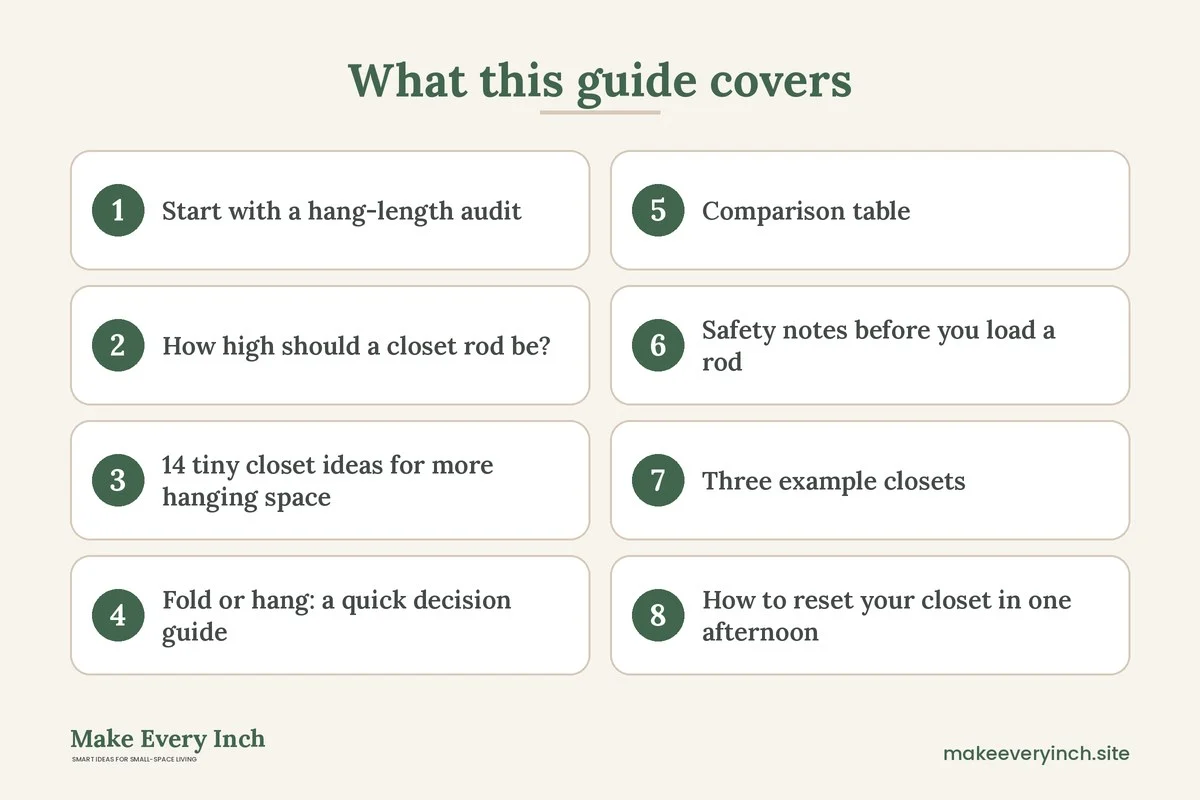
Tiny closet ideas for more hanging space begin with an uncomfortable fact: most small closets do not have too little hanging room, they have the wrong kind of hanging room. A single rod set at one height wastes the area under shirts and the gap above dresses. Bulky hangers steal width, and garments that would be happier folded take up a full slot on the rod. This guide walks through a practical sequence. First measure what you own, then reset the rod heights, then double the hanging where the clothes allow it, then change the hangers and decide what should be folded instead of hung. Along the way you will find a comparison table, a hang-length audit, three example closets, safety notes and a checklist. For the wider topic, start with our main guide to small closet ideas, then look at small closet organization ideas for sorting and routines. The companion post on small walk-in closet layout ideas covers closets large enough to step into.
Start with a hang-length audit
Before you buy a rod, a bracket or a single hanger, find out how long your clothes really are. Take everything you hang and sort it into four piles on the bed: short, medium, long and extra long. Then measure a representative item from each pile, from the hanger hook to the bottom hem. Write the numbers down. This five-minute exercise replaces guessing, and it is the single most useful step in the whole process.
Typical ranges, which vary by garment and by the person wearing it, look like this:
- Short hang, roughly 24 to 34 inches: shirts, blouses, cardigans, short jackets, folded-over trousers.
- Medium hang, roughly 34 to 48 inches: skirts, knee-length dresses, blazers, casual jackets.
- Long hang, roughly 48 to 60 inches: maxi dresses, long coats, robes.
- Extra long, over 60 inches: formal gowns and long evening coats, which are rare in most wardrobes.
Now count the items in each pile. Many people find that two thirds of what they hang is in the short pile. That is the key finding, because short items can share one vertical column of space in two layers. If your short pile is huge and your long pile is a handful of coats, your closet is a strong candidate for doubled hanging. If your long pile is big, your plan changes toward one tall rod and more shelf or drawer storage for the rest.
Finally, measure the closet itself. Note the interior width, depth and height, and the height of the existing rod and shelf above it. Write down the distance from the floor to the underside of the shelf, and from the rod to the floor. These measurements, along with your audit, are all you need to draw a plan on paper. Many standard closets are about 24 inches deep, though older or very tiny ones can be 20 inches or less, and depth affects which hangers fit.
How high should a closet rod be?
The usual advice puts a single rod roughly 60 to 66 inches above the floor, which suits most adults and leaves room for a shelf above. That height is a compromise, and a compromise wastes space in a tiny closet. A rod that is too high makes you reach, and a rod that is too low makes long clothes pool on the floor.
Use your audit to choose heights instead. For a single rod, hang it so that your longest garment clears the floor by at least an inch or two, and so that you can reach the hanger hook without stretching. If your longest item is 56 inches, a rod around 60 inches off the floor works. If your longest item is a 46 inch dress, you can lower the rod and gain an inch or two of space above for a shelf.
For a double-hang arrangement, a common pattern is an upper rod at roughly 80 to 84 inches and a lower rod at roughly 40 to 42 inches. These are starting points, not rules. The lower rod must clear the shortest hanging garments above the floor, and the upper rod must remain reachable. If you are shorter, consider a pull-down rod for the top, discussed below. Whatever you choose, test the heights with a broom handle propped on two chairs or a temporary tension rod before you commit to hardware.
Remember to leave breathing room. Garments need about 2 to 3 inches between the bottom of an upper hanging layer and the top of the lower layer so that they do not crush. A typical double-hang stack of short clothes needs a vertical span of roughly 70 to 76 inches in total, not counting the shelf. If your closet is only 78 inches high, it may work for shirts but not for blazers.
14 tiny closet ideas for more hanging space
Rod ideas
1. Lower the main rod to match your longest item
Many closets arrive with a rod hung high out of habit. If your audit shows nothing longer than 48 inches, you can drop the rod and use the freed height for a second shelf or an upper rod. Always check that clothes clear the floor and the rod is firmly supported at both ends and the middle for wide spans.
2. Add a second rod for short items
A lower rod under a higher one creates two hanging layers in a section where everything is short. Place the lower rod about 40 to 42 inches from the floor for shirts and folded trousers, and leave a different section at full height for dresses and coats.
3. Use a pull-down rod for the top layer
A pull-down rod is a hinged rod that lowers toward you when you grip it, and returns to place when you release it. It makes the top layer reachable for shorter people and for children. Check the rating on the packaging and the instructions, load it only with light, seasonal items and never use it as a place to hang heavy coats.
4. Choose a no-drill tension rod only for light loads
In a rental, a tension rod can create a temporary second hanging layer in a closet with solid side walls. Tension rods slip when overloaded, so use them for light shirts, scarves or a few kids’ clothes. Check the weight limit stated on the product and do not guess.
5. Hang a short rod from the main rod
Hanging dividers and short hanging rods suspend from the existing rod and create a second layer without any drilling. The weight sits on the main rod, so treat the combined load carefully, and see the safety section below.
Doubled hanging
6. Double-hang the shirts and blouses
Shirts are the best candidate because they have the shortest drop. A double-hang section can hold nearly twice as many shirts as the same width of single rod. Keep the heaviest items in the lower tier, where the weight is closest to the floor and the support.
7. Double-hang folded trousers
Fold trousers over the bar of a trouser hanger or a plain hanger, and they drop only around 20 inches. A folded pair on the lower rod and a shirt on the upper rod is a standard way to use a 24 inch wide section.
8. Keep one full-height section
Never double-hang the entire closet. Reserve at least one section, often 14 to 20 inches wide, at full height for dresses, coats and robes. The audit tells you exactly how wide this section should be.
9. Use a double-hang insert with a freestanding frame
A freestanding frame fits inside a closet and holds two rods, which is useful in a rental where drilling is not allowed. Because freestanding units can tip, choose a model with a base that sits flat, keep the heaviest load low, and follow the manufacturer’s weight limits.
Hangers, hooks and extenders
10. Switch to slim uniform hangers
Thick plastic and wooden hangers can be 1.5 inches wide or more, while slim ones are often under a quarter of an inch. On a 36 inch rod, that difference could mean fitting roughly a third more garments. Uniform hangers also make the row look calmer and make it easier to see what you own.
11. Use cascading hangers carefully
Cascading hangers let you stack several garments vertically on one hook. They suit light items for a season, but a stack of heavy knits will stretch the hanger and the rod. Keep them for light blouses and scarves.
12. Add hooks inside the door
A row of over-the-door hooks or a slim rail adds a place for tomorrow’s outfit, bags and belts. Only add hooks where they will not stop the door from closing, and choose ones rated for the load.
13. Hang a vertical belt and tie rack
A vertical rack for belts, ties and scarves clears the rod of small items that eat hangers. A tiny closet can free up several inches by moving them to the side wall or door.
14. Use a single hook row for daily wear
Install a single row of hooks at one end of the rod area for your five most-worn pieces. It keeps them visible and keeps the rod for the pieces you rotate.
Fold or hang: a quick decision guide
Doubling the hanging space is half of the solution. The other half is deciding which clothes should not hang at all. Hanging a heavy knit stretches the shoulders, and hanging a pile of tees uses up a whole hanger slot per item. Folding them into a shelf or drawer frees the rod for items that really need it.
Use this rule of thumb. If a garment wrinkles when folded, or has a structure that collapses (suits, blazers, tailored shirts, dresses), hang it. If a garment stretches on a hanger or has a soft drape that does not crease badly (sweaters, jeans, tees, activewear), fold it. If you are unsure, test it with one item for a week. Always hang items you wear daily if you enjoy the speed of grabbing them.
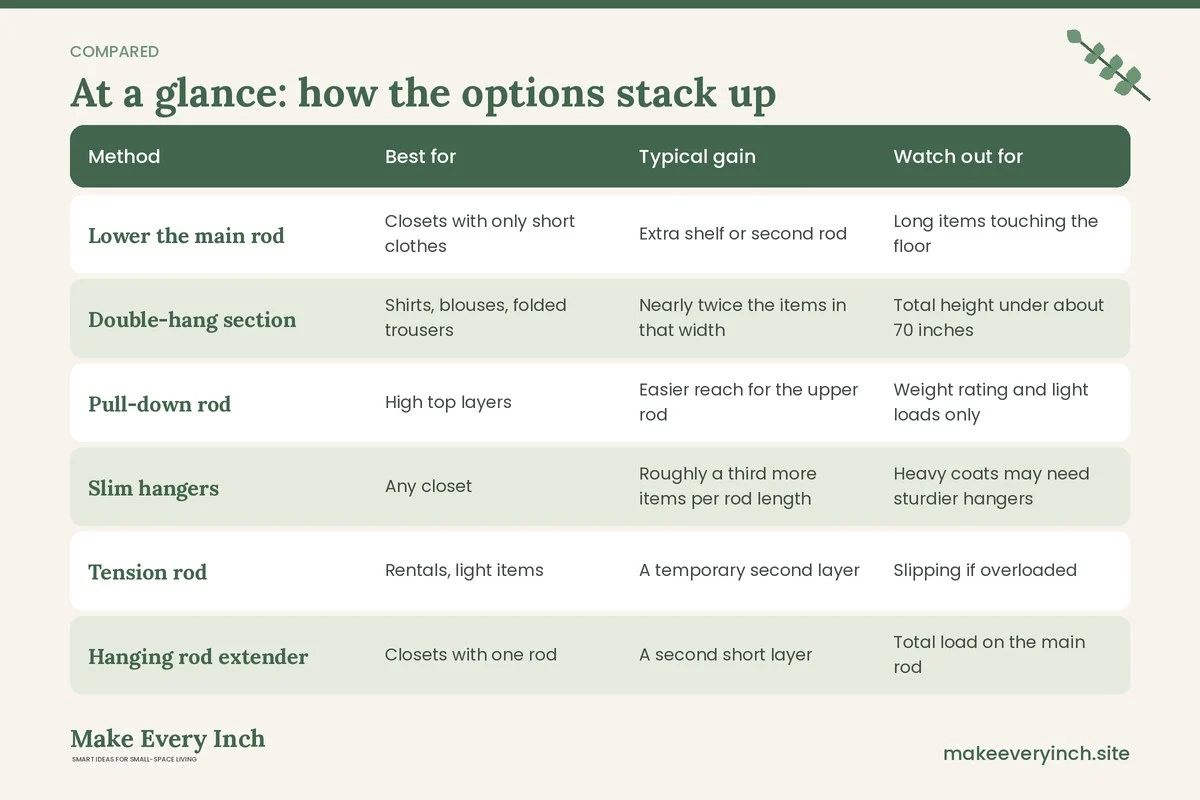
Comparison table: ways to gain hanging space
| Method | Best for | Typical gain | Watch out for |
|---|---|---|---|
| Lower the main rod | Closets with only short clothes | Extra shelf or second rod | Long items touching the floor |
| Double-hang section | Shirts, blouses, folded trousers | Nearly twice the items in that width | Total height under about 70 inches |
| Pull-down rod | High top layers | Easier reach for the upper rod | Weight rating and light loads only |
| Slim hangers | Any closet | Roughly a third more items per rod length | Heavy coats may need sturdier hangers |
| Tension rod | Rentals, light items | A temporary second layer | Slipping if overloaded |
| Hanging rod extender | Closets with one rod | A second short layer | Total load on the main rod |
| Fold instead of hang | Knits, tees, jeans | One hanger slot per item | Needs a shelf or drawer |
| Door hooks | Daily outfits, bags | A few extra places | Door clearance |
Safety notes before you load a rod
A rod holds more than it looks like it can, but not unlimited weight. A full row of winter coats can weigh a surprising amount, and an overloaded rod can sag or pull out of its brackets. Check the weight rating on every rod, bracket and shelf, and spread heavy items across the full width rather than bunching them in the middle. Use a center support for any span of roughly 48 inches or more. If you need to drill, ask your landlord or building manager for permission first, and use anchors appropriate for the wall, such as studs or the correct wall anchors for the wall material.
Freestanding closet frames and tall shelving units can tip, especially if you pull out a heavy drawer or if a child climbs them. Anchor tall units to the wall wherever the wall and the lease allow, and keep the heaviest items at the bottom. In households with small children, keep pull-down rods, cords and hanging chains out of reach and avoid anything with loops that could catch on a neck.
If you refresh the inside of the closet with paint, choose a low-VOC product and leave the door open and the room ventilated until it has cured. Avoid storing clothes inside a closet that smells of fresh paint. If you use mothballs or similar chemical repellents, follow the label closely, keep them away from children and pets, and consider cedar or lavender alternatives, which are gentler though they only deter moths mildly.
Three example closets
A 4 foot reach-in closet for one person
This closet is 48 inches wide, 24 inches deep and 84 inches high, with one rod and a shelf. The audit shows 22 short items, 8 medium items and 4 long coats. The plan splits the width into two sections. On the left, a 28 inch double-hang section holds shirts above and folded trousers below, with the rods at roughly 80 and 41 inches. On the right, a 20 inch full-height section holds dresses and coats at about 62 inches. The top shelf holds boxes of off-season items, and slim hangers throughout reduce the width each garment takes. The result is a hanging capacity that feels much larger without any wall changes beyond the rods.
A 6 foot rental closet shared by two people
This closet is 72 inches wide, with a single rod and no permission to drill into the walls. A freestanding double-hang frame fills the left 36 inches and holds both people’s shirts. The right 36 inches stays at one height for long items. A tension rod across the top shelf zone holds a few light scarves. Heavy items such as coats stay in the full-height section on the existing, fixed rod. The frame is anchored only where the lease allows, and the lower rod holds lighter garments so the frame stays stable.
A 30 inch kids’ closet
This closet is only 30 inches wide, and the child is under ten. A lower rod at about 36 inches lets the child reach the main layer. A pull-down rod is not suitable, so a high shelf holds out-of-season boxes that only an adult reaches. Most clothes are short, so a second rod at roughly 66 inches holds shirts that the adult changes seasonally. The child hangs their own school uniform at the lower rod, which builds a habit of putting things away.
How to reset your closet in one afternoon
You can complete the whole project in an afternoon. Work in order, and do not shop until you have measured and sorted.
- Empty and sort. Pull everything out and sort into keep, donate, repair and store. Be honest about the items you have not worn in a year.
- Audit. Group the keepers by hang length and measure each group. Record the numbers.
- Plan on paper. Draw the closet to scale, mark the sections and decide where each group goes.
- Check the hardware. Look at the rod, brackets and shelf, and replace anything that sags or wobbles.
- Set the rods. Install or adjust rods at the planned heights, with permission if the closet is a rental.
- Switch the hangers. Swap mismatched hangers for slim ones where they make sense and keep heavy ones for coats.
- Load by weight. Put heavy and long items in the full-height section and light short items on the upper rod.
- Add a fold zone. Place shelves, drawers or boxes for the items you decided to fold.
- Label and live with it. Use it for two weeks, then adjust anything that bugs you.
Common mistakes
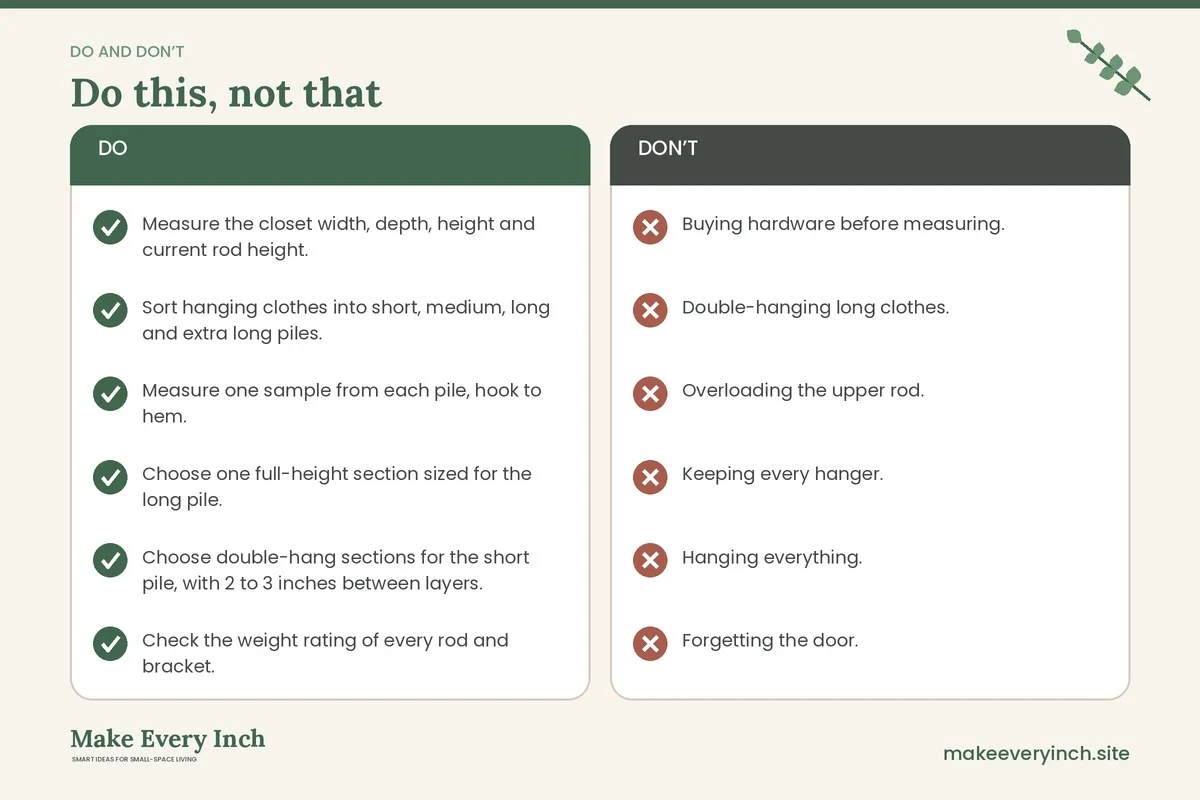
- Buying hardware before measuring. A rod bought without a plan often ends up in the wrong place.
- Double-hanging long clothes. If the lower garment touches the floor or the upper one touches the lower, the double-hang has failed.
- Overloading the upper rod. Heavy items belong low and near the supports.
- Keeping every hanger. A mix of thick and thin hangers wastes the width you just recovered.
- Hanging everything. Knits and tees live happily on a shelf.
- Forgetting the door. The inside of the door is an extra surface that costs no rod length.
- Ignoring the shelf height. After you lower a rod, adjust the shelf above it, or the new gap may be too small.
Hang-length audit checklist
- Measure the closet width, depth, height and current rod height.
- Sort hanging clothes into short, medium, long and extra long piles.
- Measure one sample from each pile, hook to hem.
- Choose one full-height section sized for the long pile.
- Choose double-hang sections for the short pile, with 2 to 3 inches between layers.
- Check the weight rating of every rod and bracket.
- Add a center support for wide spans.
- Decide which garments will be folded.
- Replace bulky hangers with slim ones where they fit.
- Anchor any freestanding frame wherever the lease allows.
- Keep cords, chains and loops away from children.
- Test the setup for two weeks before adding more hardware.
FAQ
How much hanging space do I actually need?
It depends on what you own, but many people need roughly 2 to 3 feet of hanging width for shirts and tops and another 1 to 2 feet for long items. A hang-length audit gives you your own numbers.
Can I double-hang any closet?
Only if the total height allows two layers with room between them. A closet that is much shorter than about 70 inches in the usable zone is hard to double-hang for anything but very short items.
Are slim hangers strong enough for coats?
Slim hangers suit shirts, blouses and light jackets. For heavy coats and structured blazers, a sturdier hanger protects the shoulders. Mixing the two is fine, as long as the heavy ones are kept in the full-height section.
What if I rent and cannot drill?
Use tension rods for light items, rod extenders that hang from the main rod, or a freestanding double-hang frame. Check weight ratings and ask for written permission before you drill into anything.
Should I fold or hang jeans?
Most people fold jeans, because they take a full hanger slot and do not wrinkle easily. Fold-and-hang is also possible, by folding them over a hanger bar, if shelf space is short.
How do I stop clothes from slipping off slim hangers?
Choose hangers with a slight texture or a flocked finish, and hang straps on a hook. For items that slip, fold the garment over the bar instead.
Keep going: Keep going with our small closet organization ideas, DIY closet organization for small spaces and small walk-in closet layout ideas.
Save this guide for later
Pin the ideas you like to Pinterest so you can come back to them when you plan your space.