Small Closet Mistakes That Waste Space
Quick answer: The most common small closet mistakes that waste space are leaving the zone above the shelf empty, using a single rod, piling things on the floor, mixing hanger types, keeping clothes you never wear and storing items at the wrong height. Fix them by adding a second rod or shelf, using slim matching hangers, giving the floor a few bins, and sorting items by how often you reach for them.
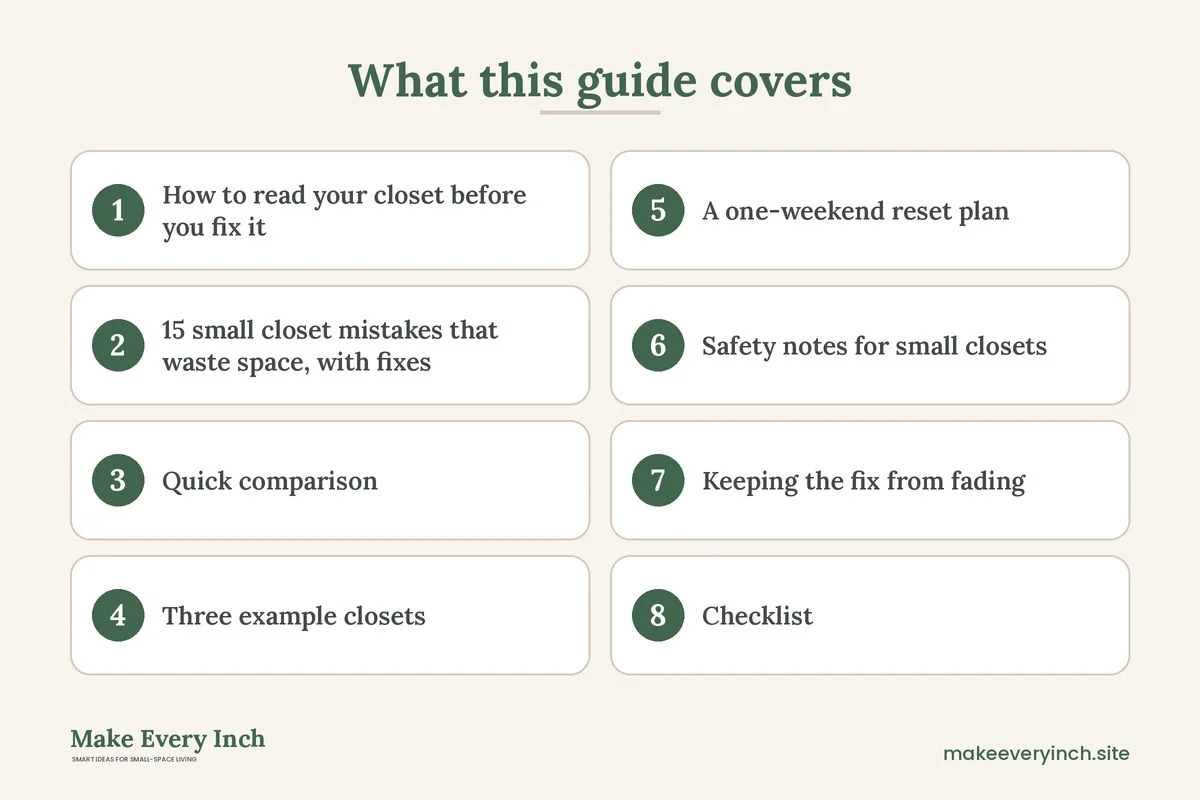
Small closet mistakes that waste space are rarely about the closet itself. Most closets are fine as built, but they are used in a way that leaves half the volume empty while the other half overflows. A closet that is 24 inches deep and 4 feet wide holds a surprising amount when every zone has a job. It holds far less when the top is dead, the floor is a heap and the rod carries three different hanger shapes. This guide walks through 15 mistakes, explains why each one costs you room, and gives a specific fix with measurements. It also includes a comparison table, three example closets, a one-weekend reset plan and a checklist. For the full overview of the topic, start with our pillar guide to small closet ideas, and when you are ready to build, read the companion post on how to organize a closet with no built-in shelves.
How to read your closet before you fix it
Before you change anything, take everything out and look at the empty box. Measure the width, the depth and the height, and write the numbers down. Note where the rod sits, how high the shelf is and whether the door opens fully. Many small closets have a rod at about 66 to 72 inches and a single shelf at about 80 inches. That arrangement leaves a band of unused air between the clothes and the floor, and another above the shelf.
Then divide the volume into three horizontal zones. The prime zone runs from about 24 to 60 inches off the floor, where you can see and reach without bending or stretching. The upper zone runs above about 60 inches and suits things you use a few times a year or less. The floor zone runs from the floor to about 24 inches and suits heavy, stable or rarely folded items. Most of the mistakes in this guide come from using the wrong zone for the wrong item. If you keep the zones in mind, the fixes below will make sense quickly.
15 small closet mistakes that waste space, with fixes
Mistakes with the vertical space
1. Leaving the zone above the shelf empty
The area above the top shelf is often 12 to 24 inches of unused height. It is out of easy reach, so people leave it bare or toss a bag up there. The fix is to treat it as the long-term zone. Add a second shelf if the shelf can carry it, or use lidded boxes that fit between the shelf and the ceiling. Label the front of each box. Keep to light items, such as spare bedding, off-season scarves and travel bags, and place anything heavy lower. Use a stable step stool for access, and never stand on a chair or a box.
2. Using a single rod for everything
One rod at 66 to 72 inches wastes the space beneath shirts, folded trousers and skirts. Those items are short, and 30 to 40 inches of air hangs below them. A double rod setup lets you hang short items on two levels, with the upper rod at about 80 inches and the lower rod at about 40 inches. Check the weight limit on the rod and the support points before you add anything, and never hang a second rod from a bracket that was only designed for one. If the closet has no way to carry a second rod safely, use a freestanding shelf instead.
3. Hanging long items at the wrong rod height
A long coat or dress needs about 60 to 65 inches of clearance. If these hang at the same height as shirts, they drag over the floor or sit on top of shoe boxes. Put the long items at one end, under the high rod only. Keep the other end for shorter pieces on a double rod. Splitting the rod by garment length frees up the area below the short items for shelves or bins.
4. Ignoring the back of the door
The back of the door is flat, free and often unused. A hanging organizer over the door can hold shoes, scarves, belts or small accessories, and it takes almost no room. Check the clearance between the door and the frame first, because a bulky organizer can stop a door from closing. Choose a slim one, and do not overload it. If the door swings against a wall, check that the organizer does not scrape the paint.
Mistakes with hangers and rods
5. Mixing hanger types
Wire, wood and plastic hangers in different shapes make the rod look messy and waste width. Thick wooden hangers can take 1.5 inches each, while slim ones need about a half inch. A rod 36 inches wide holds around 70 slim hangers, but only about 24 bulky ones. The fix is to pick one slim style and replace the rest over time. Velvet-style or thin plastic hangers are both fine. Keep a few padded ones for delicate knitwear if needed.
6. Hanging knitwear that should be folded
Heavy sweaters stretch on a hanger and leave shoulder bumps, and they also waste vertical space. Fold them and place them on a shelf, in a drawer or in a bin. A stack of five folded sweaters takes about 12 inches of shelf, while five hanging ones take much more width. If you do not have room for shelves, a fabric hanging organizer with compartments holds folded items on the rod.
7. Overloading the rod
A packed rod is hard to use, wrinkles clothes and puts stress on the rod and the brackets. A rod is made to carry a limited weight, which varies by material and span. A long span with heavy coats can bend or pull out of the wall. Keep a hand’s width of free space on the rod, and look at the manufacturer’s weight rating if there is one. If a rod bows in the middle, reduce the load or add a center support.
8. Using hangers for every item
Belts, scarves, ties and bags can hang on hooks or slim rails instead of on separate hangers. A single hanger with multiple loops or a few small hooks can hold a whole group. Hooks on the side wall are a good place for bags and belts. If you are a renter, use adhesive hooks rated for the weight, and ask permission before drilling. See our guide to no-drill storage ideas for renters for options.
Mistakes with the floor and low areas
9. Letting the floor turn into a pile
The floor of a small closet quickly becomes a catch-all for shoes, bags, laundry and boxes. That makes it hard to reach anything at the back. The fix is to define the floor with a few bins or a shoe rack, and to leave a visible strip of open floor. Aim to keep a third of the floor visible. Shoes you wear daily go at the front, and rarely used pairs go in a box on the shelf. A floor that is clear is also easier to vacuum.
10. Stacking shoe boxes in the wrong place
Shoe boxes are bulky, and stacked four high they tip over and bury the pair you want. Move shoes out of their boxes into a rack, a slim shelf or an over-the-door pocket organizer. Keep a few boxes only for special or seasonal pairs and put them on the upper shelf. A shelf that holds shoes angled in a staggered row can hold nearly twice as many pairs as one that lays them flat.
11. Storing heavy items high up
Heavy items such as boxes of books, luggage or tools on a high shelf are a safety risk. A box can slip when you reach for it, and a shelf can overload. Put heavy things at the bottom, and keep the top for light, bulky goods. Use sturdy containers and never go above the weight the shelf is made to carry. If the closet is in a child’s room, make sure nothing heavy can fall, and keep mothballs, cedar oil and any chemical cleaners out of reach in a sealed container, away from children and pets.
12. Forgetting the corners
The corners of a closet are hard to reach, so they become dead zones. Use a corner shelf, a lazy approach with a basket on a slide-out tray, or a hook for a bag in the corner. A tall, narrow bin that fits the corner can hold umbrellas, a mop or sports gear. Do not push in more than you can pull out without moving other things.
Mistakes with habits and planning
13. Keeping what you do not wear
Clothes you never wear still take up rod space. If an item has not been worn in a year and you have no plan for it, let it go. Set a limit of about 10 percent free space on the rod after sorting, so that new items have a place. Donate or sell what is in good condition. Keep a small bag at the closet door for items you decide to remove, and empty it every month.
14. Not sorting by how often you use things
Everyday clothes should sit in the prime zone, and formal or seasonal pieces higher or deeper. When it is the other way around, you dig through the occasional items every morning. Group by category first, such as tops, trousers and dresses, then by color within each group. Keep the five or six items you grab most often at the front.
15. Skipping the light and the air
A dark closet means you cannot see what you own, and a crowded, damp closet can develop odors or mildew. Add a battery-powered stick light, or one that plugs in if you are allowed to run one safely, and do not place bulbs close to fabric. Leave gaps so air circulates. Avoid strong-smelling mothballs and use cedar blocks or lavender sachets sparingly, since the fumes can bother people and pets. If you notice a musty smell, check for moisture on the walls and ventilate the room.
Quick comparison: the cost of each mistake
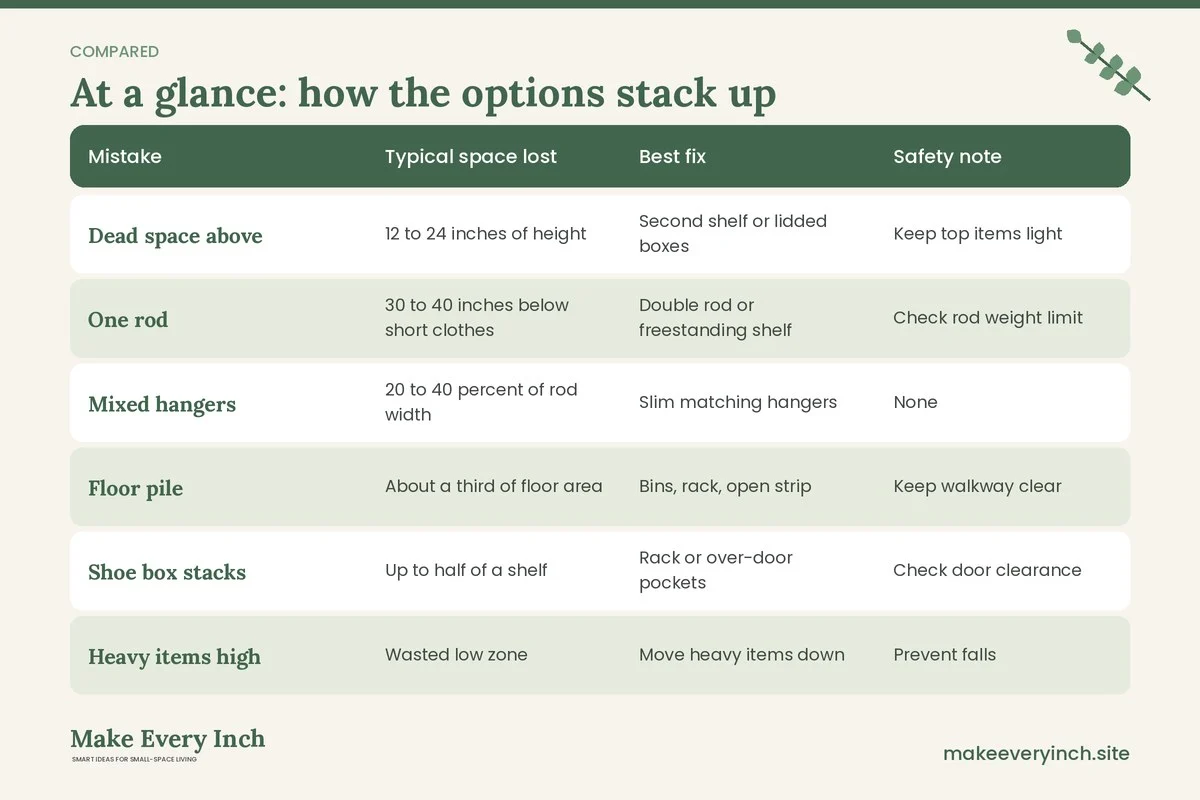
The table below sums up how much room each mistake can waste and what the fix gains. The figures are rough, hedged ranges that depend on the closet, and they are meant as a guide rather than a promise.
| Mistake | Typical space lost | Best fix | Safety note |
|---|---|---|---|
| Dead space above | 12 to 24 inches of height | Second shelf or lidded boxes | Keep top items light |
| One rod | 30 to 40 inches below short clothes | Double rod or freestanding shelf | Check rod weight limit |
| Mixed hangers | 20 to 40 percent of rod width | Slim matching hangers | None |
| Floor pile | About a third of floor area | Bins, rack, open strip | Keep walkway clear |
| Shoe box stacks | Up to half of a shelf | Rack or over-door pockets | Check door clearance |
| Heavy items high | Wasted low zone | Move heavy items down | Prevent falls |
| Bare door | One whole panel | Slim hanging organizer | Check door closes |
| Dark closet | Visibility, not volume | Battery light | Keep bulbs from fabric |
Three example closets
A reach-in closet of 4 feet by 2 feet
This is the standard bedroom reach-in with a single rod and a single shelf. Add a second rod on one half, set at about 40 inches for shirts and trousers folded over hangers, and keep the other half for dresses and coats. Put four lidded boxes on the shelf, each labeled for a season. Use the floor for a two-tier shoe rack, plus one bin for gym clothes. Hang an over-the-door organizer for belts and scarves. This setup typically gives you around twice the hanging capacity without any structural work. Check the weight rating of the rod before the second rod goes in.
A narrow hallway closet of 30 inches wide
A narrow closet is tight, so each inch needs a job. Hang everything on slim hangers and use cascading hooks to double the use of a hanger. Fit a tall, slim shelf unit to the side wall, with the heavy items on the bottom. Store off-season bedding in vacuum-free breathable bags on the top shelf. Because the closet is narrow, a door that swings out is awkward, and a curtain on a tension rod can replace it. This keeps the whole width reachable. For more on this kind of space, see our guide on small bedroom ideas without a closet.
A kid’s closet of 5 feet wide
A child’s closet needs a rod at reach height, about 36 to 42 inches for a young child, with a higher rod above for the adults. Low bins at the bottom let a child put away toys. Keep heavy items off the high shelf, and secure any tall shelf to the wall with anchors designed for the wall type, because a freestanding unit can tip if a child climbs it. Use soft-close boxes and keep chemicals, mothballs and small items out of reach. Label the bins with pictures so a child can follow them.
A one-weekend reset plan
You can fix most of these mistakes in a weekend if you work in order. Do not buy anything until you have sorted and measured, because the right product depends on the real gaps.
- Saturday morning: empty the closet and sort into keep, donate, repair and store. Wipe the shelves and the floor.
- Saturday afternoon: measure the width, depth and height, plus the gap above the shelf and the space under short clothes. Sketch the zones on paper.
- Sunday morning: buy or gather only what the sketch needs, such as slim hangers, bins, a shelf or a second rod. Check weight limits.
- Sunday afternoon: install, hang, label and place. Keep the daily items in the prime zone and the seasonal items high.
- One week later: adjust. Notice what you reach for and move things that are in the wrong place.
Safety notes for small closets
A closet seems harmless, but a few safety points matter. First, respect weight limits on every rod and shelf. A rod pulled from the wall can injure someone and damage the closet. Second, secure any tall freestanding shelf or tower to the wall with anchors suited to the wall, and get permission before drilling if you rent. Third, keep bulbs and heaters away from fabric. Fourth, use low-VOC paint and finishes if you repaint the interior, and let the closet air out before refilling it. Fifth, store mothballs, cedar oil and cleaning chemicals in sealed containers out of reach of children and pets, and follow the label. Finally, never stand on a chair or a box to reach the top.
Keeping the fix from fading
A closet resets fast and drifts slowly. The simplest way to keep it working is a seasonal check. Twice a year, when you swap clothes, run through the checklist below and remove what you did not wear. Keep a rule that a new item replaces an old one when the closet is full. For related habits, read our post on small home organization mistakes to avoid, and for storage that works in a rental, see our organization ideas for renters.
Checklist
- Empty the closet and measure width, depth and height.
- Mark the prime, upper and floor zones.
- Add a second rod or shelf if the structure can carry it.
- Use one style of slim hanger.
- Fold heavy knitwear instead of hanging it.
- Leave a hand’s width free on each rod.
- Use the door for a slim organizer.
- Define the floor with bins or a rack.
- Move heavy items low and light items high.
- Secure any tall unit to the wall.
- Remove what you have not worn in a year.
- Add a safe light and leave room for air.
- Store chemicals and mothballs out of reach.
FAQ
What is the biggest small closet mistake?
Leaving the vertical space unused is the most common. Between the area above the shelf and the air below short clothes, a closet can hide a third of its volume.
How many hangers should fit on a rod?
It depends on the hanger. A 36 inch rod holds roughly 60 to 70 slim hangers, but far fewer thick wooden ones. Matching slim hangers give the most.
Is a double rod worth it?
For a closet full of shirts, trousers and skirts, yes. Check that the rod and its supports can carry the load before installing.
Should I fold or hang?
Hang items that wrinkle, such as shirts and dresses, and fold knitwear, jeans and t-shirts. Folded items usually take less room.
How do I keep moths away safely?
Keep clothes clean, store in breathable containers and use cedar blocks sparingly. Avoid strong mothballs, and if you use any, keep them sealed and out of reach of children and pets.
What if I rent and cannot drill?
Use tension rods, freestanding shelves, over-door organizers and adhesive hooks rated for the load. Our guide to DIY closet organization for small spaces covers several no-drill options.
Keep going: Keep going with our small closet organization ideas, the small bedroom storage ideas guide and our overview of small space organization ideas.
Save this guide for later
Pin the ideas you like to Pinterest so you can come back to them when you plan your space.