Small Dining Room Ideas with Extendable Tables
Quick answer: Small dining room ideas with extendable tables rely on three mechanisms: drop-leaf tables that fold down against the wall, butterfly tables with a leaf that unfolds from under the top, and extension tables that pull apart to take a loose leaf. Pick by how often you host, where leaves can be stored, and how easily the mechanism opens. Closed sizes of roughly 30 to 40 inches wide by 36 to 48 inches long suit most small rooms.
Small dining room ideas with extendable tables solve a common problem: you want a table small enough for everyday life and large enough for the holiday dinner that happens twice a year. A table that changes size lets you live in a compact room most days and host a crowd when needed. But the three main mechanisms behave very differently, and they are not equally easy to live with. This guide explains drop-leaf, butterfly and extension tables, gives closed and open sizes, shows where to keep spare leaves, covers mechanism safety, and walks through three example rooms, a comparison table, a checklist and an FAQ. For the full overview of compact eating spaces, see our pillar guide to small dining room ideas. If you would rather have a fixed shape that needs no mechanism, read the sibling post on small dining room ideas with round tables.
Who benefits from an extendable table
An extendable table is worth it if you host a few times a year, if you share a room with a sofa or desk, or if your household size changes. It is less useful if you host constantly, because a large table you extend weekly will wear out its mechanism and your patience. It is also wasted if you never have more than three people at home, because a fixed small table is cheaper to maintain and has no moving parts to fail.
Ask three questions before shopping:
- How often do I truly need the larger size? Once a year, once a month or every week?
- Where will the table live closed, and where will leaves go? A table that needs a closet for leaves has a hidden cost in storage.
- Who will open it? If one person finds the mechanism heavy or fiddly, the table will stay closed even when the room needs it.
Your answers point to the mechanism. Rare, easy hosting suits a butterfly. Frequent small expansions suit a drop-leaf. Large, occasional gatherings suit a classic extension with loose leaves.
The three mechanisms
Drop-leaf tables
A drop-leaf table has a fixed center and one or two hinged leaves that hang down when not in use. Lift a leaf and swing out a support, a gate leg or a bracket, and the leaf becomes part of the top. Closed, the table can be as slim as 10 to 14 inches, so it works as a console or sits against a wall.
Strengths: very small closed size, no loose parts, quick to open, and often cheap to repair. Weaknesses: the hinged joints can sag over time, the leaf supports can swing into legs, and people sitting at the ends have to avoid the hanging leaf supports. Gate-leg designs take space under the table, so legroom is limited at the ends.
Sizes: a typical drop-leaf might measure roughly 20 to 30 inches wide closed with leaves down, and open to about 36 to 48 inches in length, depending on the design. Treat these as general ranges and check the exact specification.
Butterfly tables
A butterfly table has a leaf folded in two and stored in the table body. Pull the two halves of the top apart, and the folded leaf rises up and opens like a butterfly’s wings. Push the halves back together and the leaf folds away.
Strengths: no separate storage for the leaf, a fast open, and a table that grows by roughly 12 to 20 inches in one move. Weaknesses: the mechanism has several moving parts that can bind, the leaf adds weight to the table body, and the apron under the top can be deep, which limits knee room. The folded leaf also has hinges that may pinch fingers.
Sizes: closed lengths of around 36 to 48 inches commonly extend to about 54 to 70 inches, though the figures vary.
Extension tables with loose leaves
A classic extension table has two halves on slides, with one or two loose leaves that you drop into the gap. Some have a leaf that drops into the table from above, and others are the type that spreads on a screw or a rail. A leaf adds a section of roughly 12 to 18 inches at a time.
Strengths: the largest range of sizes, solid stability, and an open size that suits a real dinner party. Weaknesses: loose leaves need storing, the table is heavy, and the slides can stick if the table is old or damp. Many small households find the leaves end up behind a door, and the table never gets extended.
Sizes: a table that is roughly 36 to 48 inches long closed can extend to about 60 to 84 inches with leaves, though a small room can seldom handle the larger end.
Comparison at a glance
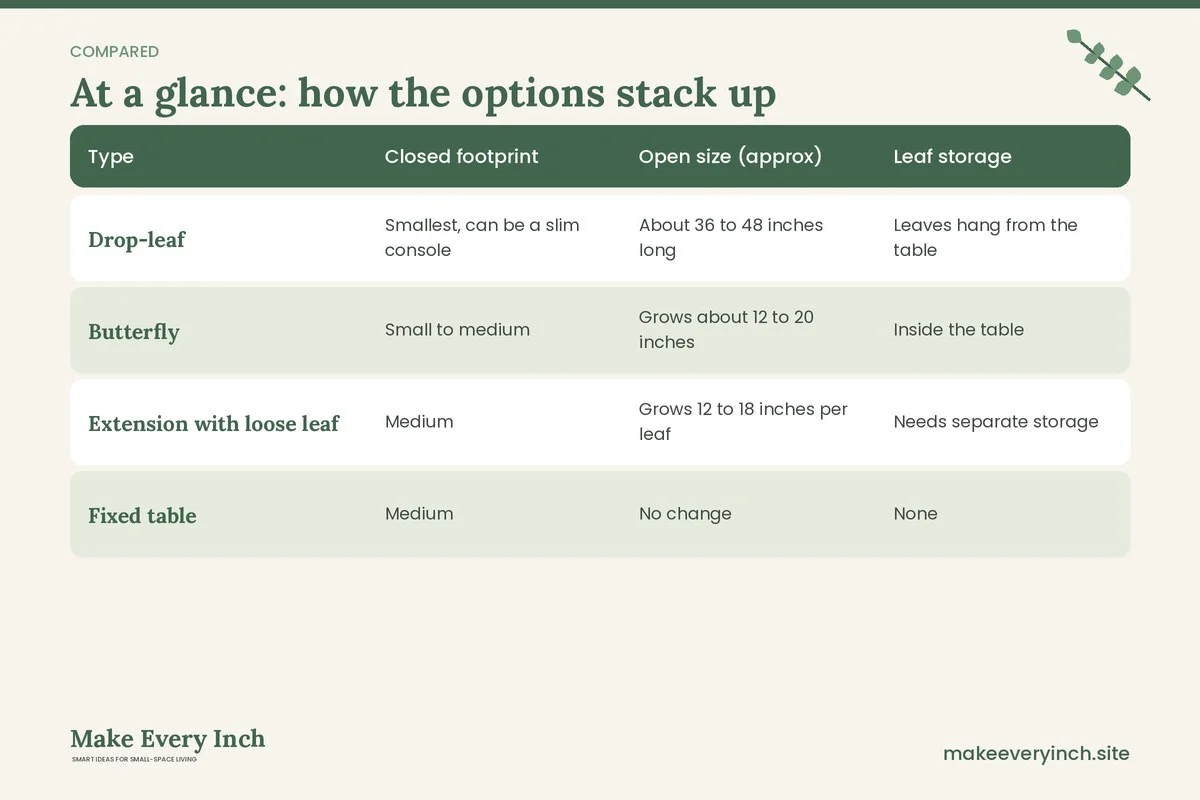
| Type | Closed footprint | Open size (approx) | Leaf storage | Ease of use | Main risk |
|---|---|---|---|---|---|
| Drop-leaf | Smallest, can be a slim console | About 36 to 48 inches long | Leaves hang from the table | Very quick | Sagging hinges, weak supports |
| Butterfly | Small to medium | Grows about 12 to 20 inches | Inside the table | Quick, with some force | Binding or pinched fingers |
| Extension with loose leaf | Medium | Grows 12 to 18 inches per leaf | Needs separate storage | Slower, often two hands | Heavy, stored leaves get lost |
| Fixed table | Medium | No change | None | None needed | Too small for guests |
Sizes that work in a small room
Think of a table in two states, closed and open, and plan the room for both. Seat width is the key number. Allow roughly 20 to 24 inches of table edge per person for a comfortable seat, and about 16 to 18 inches if you do not mind being close. These are guidelines, so adjust for your chairs.
- A closed table of about 30 inches wide by 36 to 42 inches long seats two comfortably and four in a pinch.
- A closed table of about 36 inches wide by 48 inches long seats four, and it grows to about 60 to 70 inches to seat six.
- A drop-leaf of about 24 inches wide with both leaves up (about 40 inches square) seats four in a narrow room.
- Depth of about 30 to 36 inches gives two people facing each other enough room for plates. Less than 28 inches is shallow, and more than 40 inches is hard to reach across.
Do the room check in the open state, since that is the one that causes problems. A table that fits when closed but blocks the door when open is no good. Tape the open size on the floor and test all the walkways. The walkway guideline is about 36 inches behind seated chairs where people pass, and about 24 to 30 inches where nobody does. Chair pull-out takes about 24 to 30 inches. All of these are hedged numbers, so verify with your own chairs. If the room fits the open table only if the sofa moves, use a layout that lets you do that easily. Our guide to small living room layout ideas covers sharing a room between living and dining.
Where to store leaves
Loose leaves are the most common reason an extension table never gets used. Plan their home before you buy.
- Behind a wardrobe or under a bed. A flat leaf slides easily into the gap under a bed, ideally in a protective sleeve. Check the bed height first.
- In a closet on a hook. A leaf is flat and awkward, but a wide shelf or two hooks can hold it upright. Make sure it will not fall.
- Behind a sofa. A flat leaf slides between the back of the sofa and the wall, though this is only safe where no one sits or leans.
- In a slim cabinet. A vertical slot in a tall cabinet, anchored to the wall, can hold a leaf on its edge.
- Under a console or sideboard. A leaf lying flat under a low unit stays out of the way.
Wrap leaves in a blanket or a padded cover to prevent scratches. Avoid damp spots, such as a bathroom or an exterior wall, since moisture warps wood. Label the leaf with the table it belongs to, because leaves are often cut to match one table. A leaf stored near the table is the one you will use, so the best storage spot is within a few steps of the dining area. For more ideas on hiding bulky items, see our post on hidden storage ideas, and for general advice see our small space organization ideas.
Mechanism safety
Moving parts need regular care. The points below prevent most accidents and damage.
- Check the locks. Many extension tables have locking clips under the top. Engage them every time you extend the table, and check that the halves cannot slide apart.
- Watch your fingers. Butterfly mechanisms and leaf gaps can pinch. Keep hands on the outer edges when opening or closing, and teach children not to touch the center of the table.
- Support drop-leaves fully. Make sure the gate leg or bracket is fully out, and the leaf rests flat before you place anything on it. A partly supported leaf can collapse with a heavy dish.
- Do not sit or lean on a leaf. Leaves often hold less weight than the center of the table. Keep heavy items near the legs.
- Check hardware regularly. Tighten screws, look for cracks in the slides and wipe the rails. A dry or sticky slide can be cleaned and, if the manufacturer allows, lightly lubricated with a product it recommends.
- Lift with two people. A table with leaves is heavy, so use help to move it and never drag it across a floor.
- Keep children away from the gap. The space between halves is a pinch point, and open slides are a trip risk when the table is half extended.
- Stable benches. If you use a bench with an extendable table, make sure it is sturdy and will not slide, and that the table height matches.
- Child chairs. A high chair or booster should be used according to its instructions, with a stable base and a harness, and away from the table’s moving parts.
Also respect your home. Do not drill into walls to mount a leaf holder without permission from the landlord, and anchor any tall cabinet that holds leaves with hardware suited to the wall. If you use a lamp or pendant above the table, keep the cord clear of the extended end, and leave any wiring changes to a qualified electrician.
Three example rooms
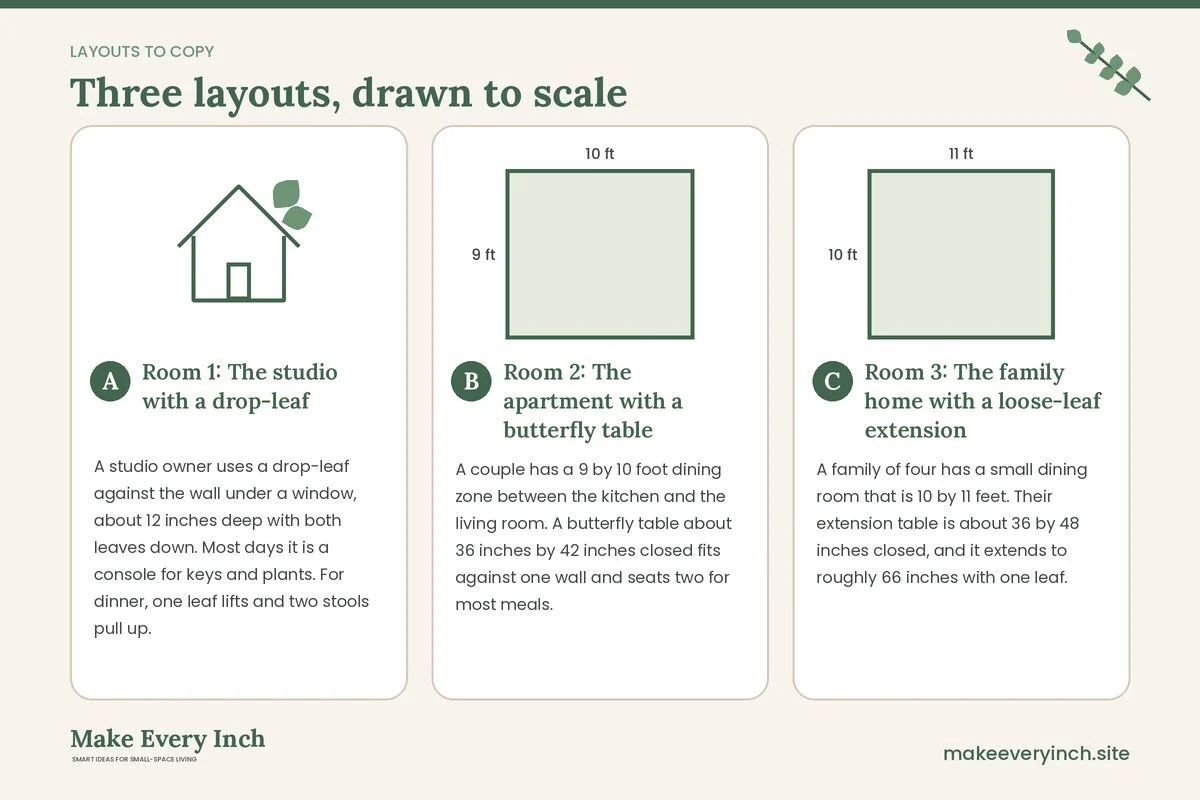
Room 1: The studio with a drop-leaf
A studio owner uses a drop-leaf against the wall under a window, about 12 inches deep with both leaves down. Most days it is a console for keys and plants. For dinner, one leaf lifts and two stools pull up. For a friend dinner, both leaves lift and the table becomes roughly 36 inches square. The room’s walking path stays about 30 to 36 inches wide with the table closed, and the stools sit under a bench at other times. For other ideas in this kind of home, read our guide to studio apartment dining area ideas.
Room 2: The apartment with a butterfly table
A couple has a 9 by 10 foot dining zone between the kitchen and the living room. A butterfly table about 36 inches by 42 inches closed fits against one wall and seats two for most meals. When guests come, they pull out the top, lift the folded leaf, and the table grows to seat six at a squeeze with a bench on one side. The leaf is always inside, so there is nothing to lose. The couple checks that the table can open fully without hitting the refrigerator door. For the kitchen end, our guide to small apartment kitchen ideas is a good companion.
Room 3: The family home with a loose-leaf extension
A family of four has a small dining room that is 10 by 11 feet. Their extension table is about 36 by 48 inches closed, and it extends to roughly 66 inches with one leaf. The leaf lives in a sleeve under a bed in the next room, and the family extends the table on weekends and holidays. They anchor a slim sideboard to the wall for plates, keep a rolling cart for serving, and use a bench on the wall side to save space. Locking clips are checked every time, and the children are taught to keep their hands off the center.
How to choose: a step-by-step plan
1. Write down your closed and open needs. For example, two to four for daily use and six for guests.
2. Measure the room and tape both sizes. Walk around the taped open outline with a chair.
3. Pick the mechanism by your habits. Quick and frequent suits a drop-leaf, easy and moderate suits a butterfly, and large and rare suits an extension.
4. Check the legroom. Sit at the table and see whether the apron, a leg or a drop-leaf support hits your knees.
5. Test the mechanism. If you can, open and close it a few times. It should move smoothly without force.
6. Plan the leaf storage. Choose a spot before you buy.
7. Choose chairs that stack, fold or tuck. Extra chairs should be easy to store. Folding chairs on a wall hook, with permission, are a classic trick.
8. Add lighting that suits both sizes. A pendant over the center works for both, and a floor lamp works if you cannot change the fixture.
Making the extended table feel good
An extended table is more than a number. Make it feel like a meal, not a workshop.
- Cover the join. A tablecloth or runner hides the gap between sections and smooths out the surface.
- Mix chairs. Add a bench, a stool or a folding chair, and treat the mismatch as a style choice.
- Keep decor low. Flowers and candles should sit low enough to see over, and candles should never sit near curtains.
- Plan the serving. Set dishes on a nearby cart or sideboard so the table keeps space for plates.
- Put the extra chairs away after. Stored chairs keep the room open in everyday life.
Ready-made options exist for the room as a whole. A dining zone in a living room benefits from a rug that defines the area. Size it so the chairs stay on the rug when the table is open. If you use a smaller rug, choose a flat weave that does not catch chair legs.
Mistakes to avoid
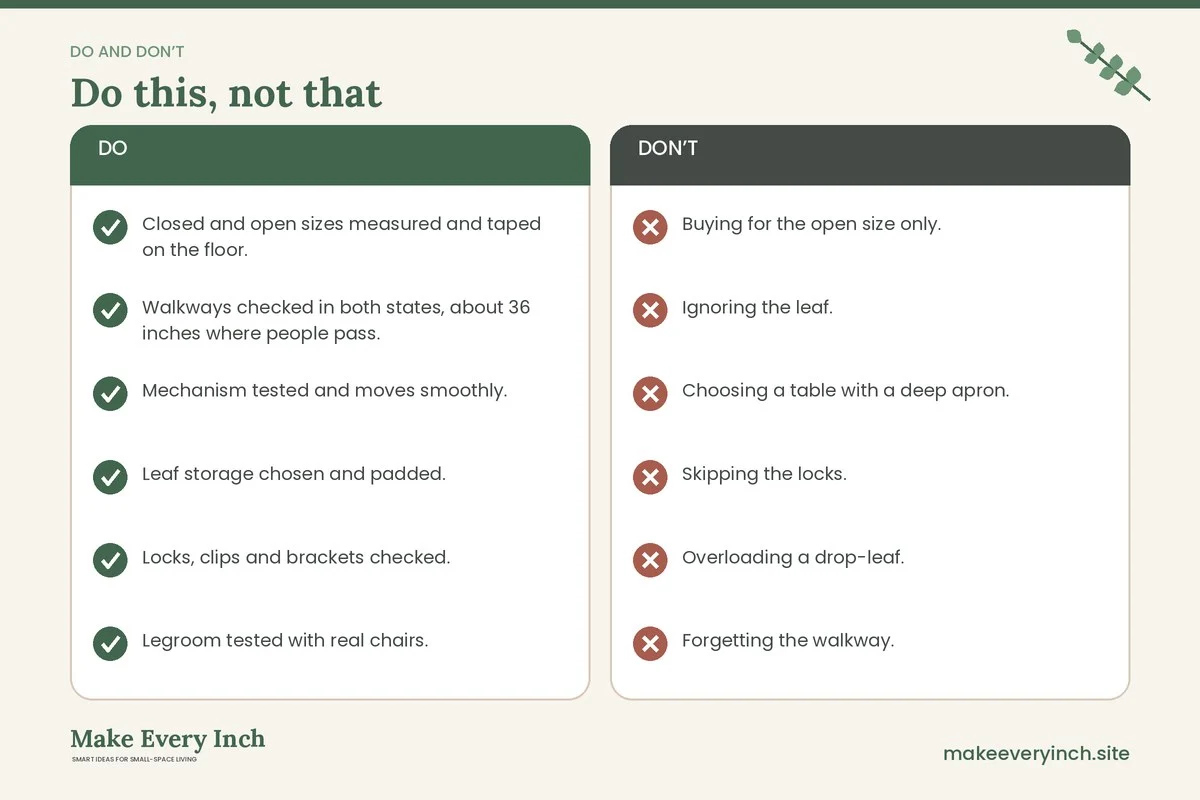
- Buying for the open size only. You live with the closed table 360 days a year.
- Ignoring the leaf. A leaf with no home becomes clutter.
- Choosing a table with a deep apron. It hits knees and limits seating.
- Skipping the locks. An unlocked extension can slide apart under load.
- Overloading a drop-leaf. The leaf holds less than the center.
- Forgetting the walkway. The open table must leave room to pass.
Quick checklist
- Closed and open sizes measured and taped on the floor.
- Walkways checked in both states, about 36 inches where people pass.
- Mechanism tested and moves smoothly.
- Leaf storage chosen and padded.
- Locks, clips and brackets checked.
- Legroom tested with real chairs.
- Spare chairs, stools or a bench planned.
- Lamp or pendant cords clear of the extended end.
- Lease checked before any drilling or hanging.
- Tall storage anchored to the wall with permission.
FAQ
What is the best extendable table for a small dining room?
It depends on your habits. A drop-leaf suits tight rooms and frequent small changes, a butterfly suits occasional guests with no loose parts, and a classic extension suits larger gatherings if you can store the leaf.
How small can a drop-leaf table be?
Many are about 10 to 14 inches deep with the leaves down, and about 36 to 48 inches long when open. Check each model, since sizes differ.
Do extendable tables wobble?
They can if the slides are worn or the locks are not engaged. Check the hardware, level the feet and avoid leaning on the edge of a leaf.
Where do I store a table leaf in a small apartment?
Under a bed in a padded sleeve, behind a wardrobe, in a closet, or in a slim anchored cabinet. Keep it dry and flat, and within easy reach of the table.
Are extendable tables safe for kids?
They can be, with a few rules. Lock the extension, keep small hands away from the gap and the butterfly joints, and use child seats according to their instructions. Supervise when the table is opened or closed.
Can I use a round table that extends?
Yes, some round tables have a leaf that turns them into an oval. If you prefer a circle, see our guide to small dining room ideas with round tables.
How do I choose a table to match a small kitchen?
Think of the kitchen and dining area as one zone and keep the paths clear. Our guide to small kitchen ideas has tips for both.
Keep going: Keep planning with our guide to small dining room ideas, the roundup of the best small dining tables and the post on small dining room ideas with round tables.
Save this guide for later
Pin the ideas you like to Pinterest so you can come back to them when you plan your space.