Renter Friendly Entryway Organization Ideas
Quick answer: The best renter friendly entryway organization ideas use three families of tools: adhesive or removable hooks for light items, over-door racks for coats and bags, and freestanding pieces such as a narrow shoe cabinet, a bench or a rolling rack for everything heavy. Check your lease first, ask permission before using anything that touches the wall or door, photograph the entry before you begin, and keep every load within the rating on the package.
Renter friendly entryway organization ideas matter more than most renters expect. The entry is the one spot where keys, shoes, coats, bags, mail and wet umbrellas all arrive at once, and in a rental you often cannot drill, paint or build anything to hold them. The result is a heap by the door and a daily scramble before work. The good news is that a small entry can be organized well with hooks, over-door racks and freestanding furniture, none of which need permanent changes. This guide explains how to read your lease, how to measure the space, how to choose among the three families of tools, how the options compare, and how to protect your deposit. It also gives three example entries, a daily routine, a list of mistakes and a checklist. For the wider topic, see our hub guide on renter-friendly apartment decorating ideas, the companion post on no-drill storage ideas for renters and our overview of small entryway ideas.
Start with the lease and a set of photos
Before you buy a single hook, read the parts of your lease that cover alterations, wall treatments and doors. Many leases ban nails, screws and anything that changes the surface of a wall, and some also mention adhesive products or stickers. Others allow small removable items but require approval for anything else. If the wording is unclear, ask your landlord or property manager, and ask in writing so that you have a record. A short message works well: describe what you plan to use, such as removable hooks on the wall by the door and an over-door rack, and ask whether that is acceptable.
Document the condition of the entry before you start. Take clear photos of the walls, the door, the trim, the floor and any existing marks. Include a wide shot and a few close shots, and keep the files with the date. If your landlord has a move-in checklist, compare your photos with it. These images protect your security deposit, because they show what was already there and what you left behind. Take another set when you finish setting up, and a final set at move-out.
Also check three building rules that affect entries:
- Fire exits and shared hallways. Do not store shoes, racks or boxes in a shared hallway, on a landing or in front of a door, because most buildings treat that as an obstruction.
- Door rules. Some doors, especially fire-rated unit doors, have restrictions on what can be attached. Ask before you hang anything that clamps onto, or sticks to, the door.
- Noise and flooring. If you share a floor with a neighbor, felt pads under furniture and a mat that stays put prevent scraping sounds.
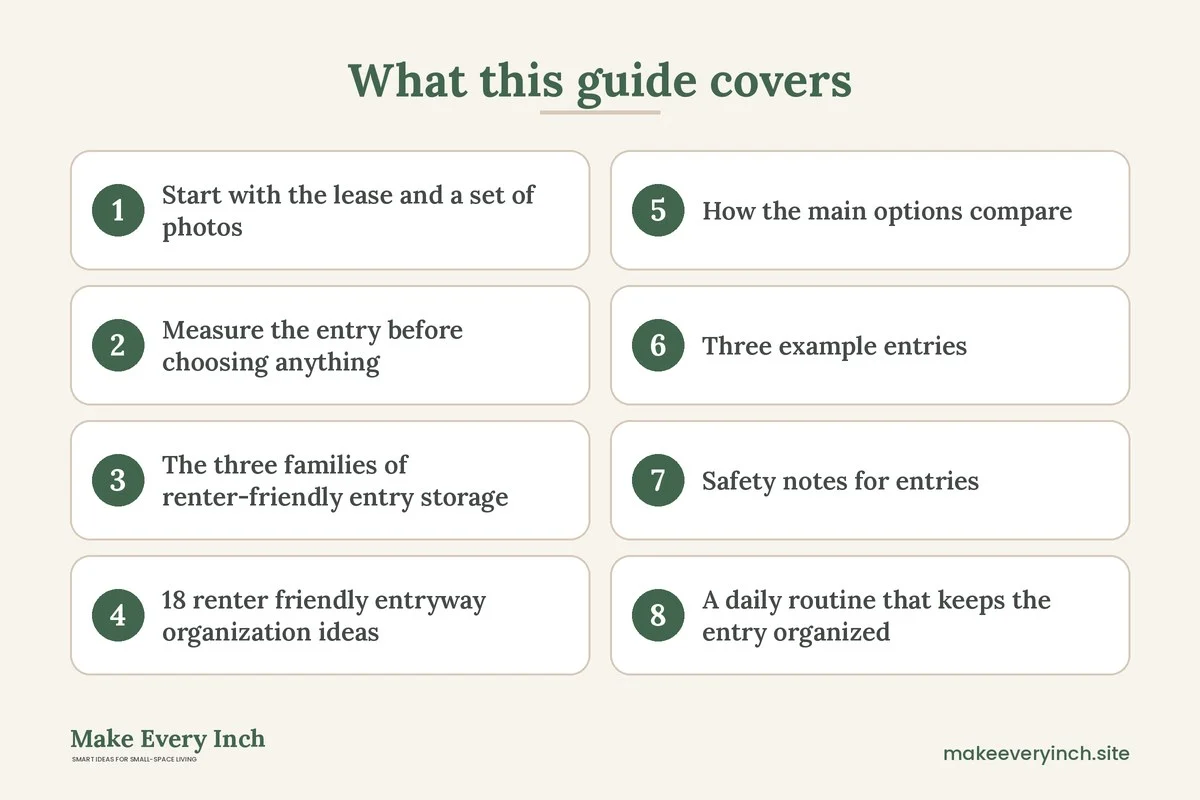
Measure the entry before choosing anything
A small entry fails when the furniture is too deep, not when it is too short on storage. Measure these points with a tape and write them down.
- Door swing: note which way the door opens and how much floor it sweeps. Keep that arc clear.
- Clear floor depth: the distance from the wall to the edge of the door swing. Many renter entries have only 12 to 24 inches.
- Wall width beside the door: the usable space on the latch side and the hinge side.
- Walking path: keep at least 30 to 36 inches clear where you walk through, and no narrower than about 24 inches if the path is short.
- Height of the hooks: adults usually reach 60 to 66 inches comfortably. Children reach about 40 to 48 inches, so a lower row is useful in a shared home.
- Door thickness: over-door products fit specific thicknesses, so measure the door edge and the gap between the door and the frame, since a hook that is too thick can stop the door from closing.
Painter’s tape makes this easy. Mark the footprint of a shoe cabinet or a bench on the floor, and the position of each hook on the wall. Live with the tape for a few days. If you bump into it, the real object will be worse.
The three families of renter-friendly entry storage
Every idea below belongs to one of three families. Knowing the family helps you judge risk to the wall and to your deposit.
Family 1: Hooks and small hangers on the wall
Adhesive hooks and removable strips hold light loads. They suit keys, a light jacket, a tote or a scarf. They need a clean, smooth, dry wall and enough time to bond before they carry a load. They are not for heavy coats, wet umbrellas or a bag loaded with a laptop, because adhesive weight ratings are for static loads and an entry sees daily tugging. Always read the rating on the package, stay well below it, and test the hook with an empty hand before loading it.
Textured, dusty, damp or freshly painted walls hold adhesive poorly. Paint that has not fully cured can peel when the strip comes off, so avoid applying adhesive to a wall that was painted in the last month or so. Test a strip on a hidden spot, such as behind the door, and remove it slowly after a few days to see how the paint reacts. Pull the tab parallel to the wall, not outward, and use a hair dryer on low to soften the adhesive if it resists.
Family 2: Over-door racks and hangers
Over-door hooks, racks and organizers hang from the top edge of the door and need no adhesive. They suit coats, bags, hats, scarves and slim pockets for gloves. Check three things before you buy: the thickness of the door, the clearance between the door and the frame, and whether the door still closes and latches properly. Add self-adhesive felt or foam to the contact points so the hook does not scratch the paint, and keep the load balanced so that the door does not swing open by itself. Avoid hanging heavy loads on a lightweight hollow door, and never use over-door gear on a fire door without asking your landlord.
Family 3: Freestanding pieces
Freestanding furniture is the safest family for walls and deposits because it touches only the floor. Examples include a shoe cabinet, a bench with storage, a console, a narrow shelf, a coat rack on a stand, a rolling garment rack and a tall slim bookcase. Heavy loads belong here. The main concerns are floor protection, footprint and stability. Put felt or rubber pads under every leg, keep the unit away from the door swing, and anchor tall pieces to a wall only with the landlord’s permission. If you cannot anchor, choose lower pieces that are less likely to tip, and keep heavy items on the lowest shelves.
18 renter friendly entryway organization ideas
Hook ideas
1. A row of removable hooks at adult height
Place three to five removable hooks in a line about 60 to 66 inches off the floor, spaced 6 to 8 inches apart. Use them for light jackets and tote bags, and keep each hook below its rated load. A line of hooks looks tidier than scattered ones.
2. A lower row for children or short users
Add a second row at about 40 to 48 inches. Children can then hang their own bags and coats, which reduces the pile on the floor. Use lighter hooks and keep the items they hang small.
3. A key hook beside the door
One small hook or magnetic holder at about shoulder height, next to the door, gives keys a home. Put it where your hand lands when you step inside. A habit of hanging keys there stops the daily search.
4. A leaning rail with S-hooks
A removable rail, if your landlord allows adhesive, can hold S-hooks for bags and caps. If adhesive is not allowed, lean a tall pole rack or a tension pole against the wall.
5. A tension rod across a niche
If the entry has an alcove or a recessed wall, a tension rod holds hangers and S-hooks without any adhesive. Make sure the rod is rated for the load, and place it where the walls are firm. Check the paint under the rubber ends after a few weeks.
Over-door ideas
6. An over-door hook rack for coats
A rack with five or six hooks holds the daily coat load of one to three people. Choose one with padded hooks, and hang the heaviest coat nearest the hinge side so the door stays balanced.
7. An over-door shoe pocket organizer
Pockets hold slim shoes, slippers, gloves and hats. They suit a closet door or a door in a nearby room, and they turn a flat panel into 12 or more storage slots. Keep the heaviest items in the lower pockets.
8. An over-door mirror
A mirror gives you a last check on the way out and bounces light into a dark entry. Hang it on the inside of the door only if the weight is within the rating of the hooks, and ask permission if the door is a fire door.
9. An over-door bag and umbrella hanger
Wide hooks can hold a backpack, a tote and an umbrella without adhesive. Place a small tray on the floor beneath to catch drips.
Freestanding ideas
10. A slim shoe cabinet
A cabinet 8 to 12 inches deep with tilt-out drawers holds a household’s daily shoes while staying out of the walking path. The top becomes a drop surface for keys and mail. For models, see our guide to the best narrow shoe cabinets.
11. A bench with shoe storage
A bench 14 to 18 inches deep and 16 to 18 inches tall gives you a place to sit while putting on shoes. Choose one with open cubbies or baskets below. See our post on small entryway bench ideas for sizes that fit narrow halls.
12. A freestanding coat tree or pole rack
A tall stand holds coats and bags without touching the wall. Pick one with a heavy, wide base for stability, and keep heavier items on the lower hooks so that the stand does not tip. Do not overload the top.
13. A rolling garment rack
A rolling rack suits a no-closet entry. It holds a week of coats and can be pushed into a corner or a bedroom when guests arrive. Choose a model with a lower shelf for shoes, and lock the wheels once it is in place.
14. A narrow console with baskets
A console 8 to 12 inches deep gives you a drop zone for mail, a bowl for keys and baskets underneath for hats and gloves. Keep it out of the door swing. For more drop-zone concepts, read our post on small home drop zone ideas.
15. A tall, slim shelf for bags and baskets
A bookcase 9 to 12 inches deep, with bins on the shelves, handles the overflow. It needs wall anchoring in most cases, so ask permission before you do that. If you cannot anchor it, keep it short, below about 36 inches, and put the heaviest bins on the lowest shelf.
Floor and surface ideas
16. A boot tray and a washable mat
A tray with a raised lip catches snow, mud and wet shoes. A washable mat inside the door reduces what gets tracked into the rest of the home. Choose a mat with a non-slip backing, and check that the door can open over it.
17. A bowl, a tray and a basket system
Assign each family member a small basket for their daily items, and give keys a bowl and mail a tray. Containers define the storage limit. When a basket is full, something must leave.
18. A wall-leaning mirror and a plug-in light
A leaning floor mirror needs no hardware, and a plug-in or battery light adds warmth where the ceiling fixture is dim. Our post on renter friendly lighting ideas lists options that do not require wiring.
How the main options compare
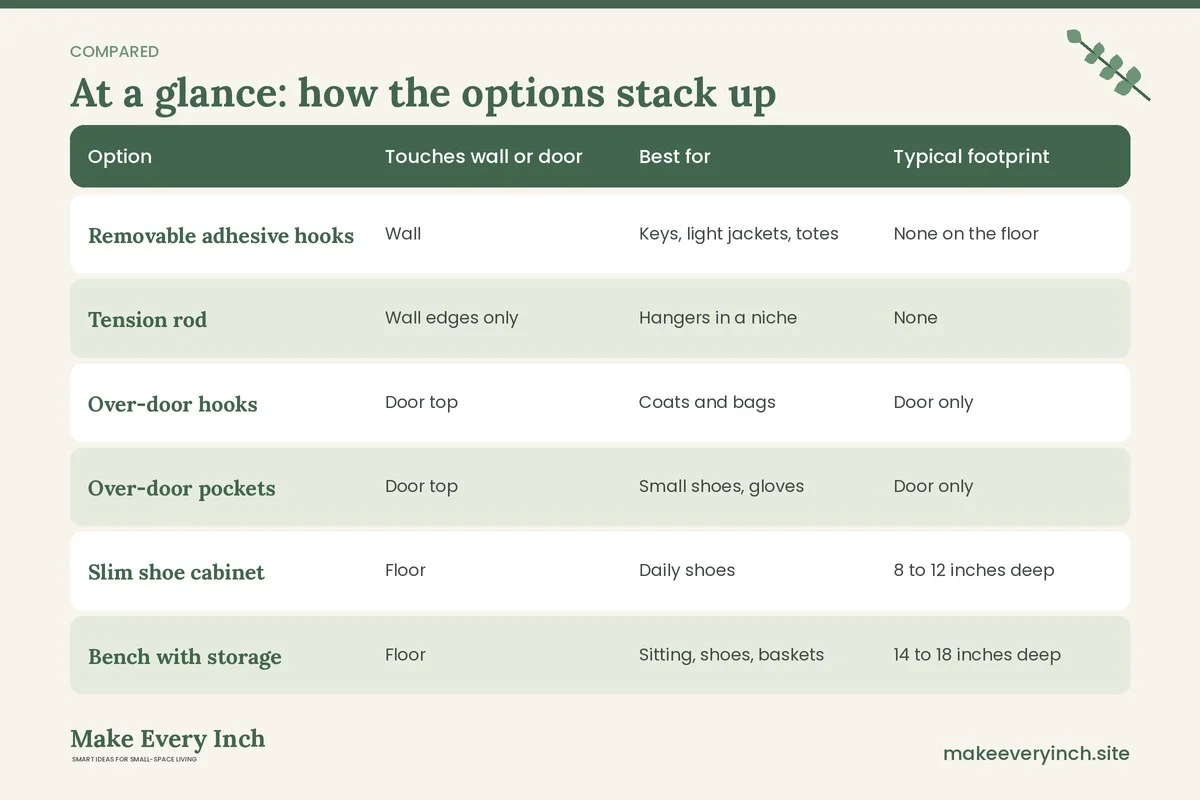
Use this table to choose by wall risk, load and the space you have. The ratings are general guides, so always follow the maker’s instructions and your lease.
| Option | Touches wall or door | Best for | Typical footprint | Watch out for |
|---|---|---|---|---|
| Removable adhesive hooks | Wall | Keys, light jackets, totes | None on the floor | Weight rating, paint damage, cure time |
| Tension rod | Wall edges only | Hangers in a niche | None | Slipping under load, rubber marks |
| Over-door hooks | Door top | Coats and bags | Door only | Door closing, fire doors, scratches |
| Over-door pockets | Door top | Small shoes, gloves | Door only | Weight in the lower pockets |
| Slim shoe cabinet | Floor | Daily shoes | 8 to 12 inches deep | Door swing, tipping |
| Bench with storage | Floor | Sitting, shoes, baskets | 14 to 18 inches deep | Blocking the path |
| Coat tree | Floor | Coats and bags | A 16 to 20 inch base | Tipping if overloaded |
| Rolling rack | Floor | No-closet entries | 16 to 20 inches deep | Wheels, visual clutter |
| Narrow console | Floor | Keys, mail, baskets | 8 to 12 inches deep | Door clearance |
Three example entries
A 3 by 6 foot entry hall beside the door
The entry is a short corridor, about 36 inches wide, with a door that opens inward toward the wall. There is little floor to spare. Hang an over-door hook rack on the inside of the door for coats, and add a row of three removable hooks on the latch-side wall for bags, with the key hook at shoulder height. Use a shoe cabinet 8 inches deep along the long wall, so the walking path stays about 28 inches wide. Put a small tray on top for mail and a bowl for keys. The wall by the door gets a thin plug-in light, and the cabinet top becomes the only flat surface. No hardware is drilled anywhere.
A studio with the door opening into the living area
The door opens straight into the room, so there is no hall at all. Define the entry with a rug 2 by 3 feet, placed just inside the door and out of the door swing. Add a rolling rack against the nearest wall, with a lower shelf for shoes. Place a narrow console 10 inches deep behind the sofa, and use it as the key and mail drop. A leaning floor mirror beside the door lets you check yourself before you leave. The sofa back and the console create a visual boundary, so the entry reads as a place without any construction. See our post on small entryway ideas with no closet for more plans of this type.
A shared apartment with two or three adults
Several people need separate spots, or else shoes and coats end up in a pile. Give each person a labeled hook on an over-door rack or on a row of removable hooks, and a basket on a shelf or console. A bench 16 inches deep with open baskets holds the shared shoes, and a boot tray handles the wet ones. Agree on a weekly reset: the person who has the most items in a basket empties it first. This approach works with a modest footprint and no wall changes.

Safety notes for entries
- Anchoring tall furniture. Tall shelves and cabinets can tip, particularly with children in the home. If the lease allows, anchor them to a wall stud with the hardware that comes with the unit, and ask permission before you drill. If anchoring is not allowed, keep furniture low and the heaviest items at the bottom.
- Never drill without permission. A small hole can still count as damage under a lease. Choose a non-drilling option when in doubt.
- Keep exits clear. The path to the door, and any fire exit, must stay open. Do not store anything in a shared hallway.
- Electrical items. Use plug-in lights and power strips as intended, and do not run cords under rugs or across the path. Avoid overloading a single outlet.
- Slip risks. A rug at the door should have a non-slip pad, and a wet-shoe tray should have a lip that holds water.
- Weight. A coat rack or an over-door hook has a maximum load. A winter coat plus a wet bag can pass it quickly, so spread the weight across several hooks.
A daily routine that keeps the entry organized
Storage works only with habits. Try this routine for a few weeks and adjust it.
- Arrive: keys in the bowl or on the hook, shoes in the cabinet or on the tray, coat on the hook.
- Sort mail at once: put recycling in the bin, bills in a tray and anything else in a basket to deal with later.
- Night reset: two minutes before bed, tuck stray shoes away and empty the tray.
- Weekly edit: check each basket and remove out-of-season items. In a small entry, a limit of two or three pairs of shoes per person is realistic.
- Seasonal swap: store heavy winter coats in a bedroom closet or under-bed bag during warm months. Our guide on small coat storage ideas has suggestions.
Mistakes renters make in the entry
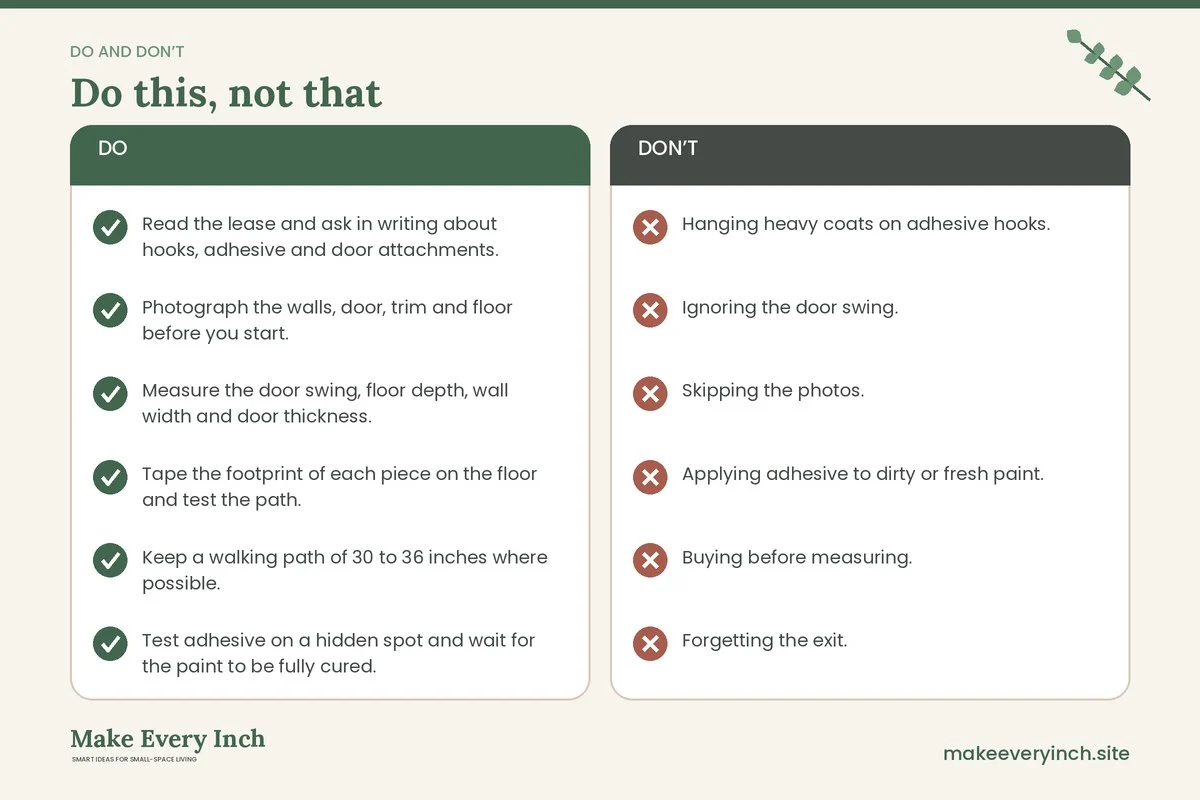
- Hanging heavy coats on adhesive hooks. A wet coat plus a bag can exceed the rating. Use an over-door rack or a freestanding stand.
- Ignoring the door swing. A bench or a cabinet that blocks the door causes damage to both the furniture and the wall.
- Skipping the photos. Without a record of the original condition, you may be charged for marks that were there before you arrived.
- Applying adhesive to dirty or fresh paint. Clean the area with a mild cleaner, let it dry fully and avoid recently painted walls.
- Buying before measuring. Many entry pieces are 4 to 6 inches deeper than they look in photos.
- Forgetting the exit. Anything stored in a shared hallway can cause a lease violation and a safety problem.
- Using every wall. Leave a calm area. An entry with too many hooks and baskets feels busier than it needs to be.
Protecting your deposit when you move out
Plan the removal on day one. Keep the adhesive packaging, which usually shows the removal steps, and note the date you installed each item. When you move out, pull adhesive tabs slowly and parallel to the wall, and use a hair dryer on a low setting if one resists. Clean any residue with a mild soap solution, and check the paint. Wipe felt pads off the floor, and look for scuffs near the door. Take final photos in good light and send them to your landlord with a short note if you have an agreed inspection process. Our guide to security deposit safe apartment upgrades covers the broader approach.
Budget and shopping approach
You do not need to buy everything at once. Start with the item that solves your biggest daily frustration, such as a key hook or an over-door rack. Live with it for two weeks and then add the next piece. Second-hand shops and online marketplaces often have benches, small cabinets and baskets, and many entry pieces work in other rooms if you move. Choose neutral, sturdy items that fit a range of layouts, because your next entry may be a different shape. For more low-cost ideas, read our posts on budget renter upgrades and cheap storage ideas for apartments.
Renter entryway checklist
- Read the lease and ask in writing about hooks, adhesive and door attachments.
- Photograph the walls, door, trim and floor before you start.
- Measure the door swing, floor depth, wall width and door thickness.
- Tape the footprint of each piece on the floor and test the path.
- Keep a walking path of 30 to 36 inches where possible.
- Test adhesive on a hidden spot and wait for the paint to be fully cured.
- Choose hooks rated well above the actual load.
- Use an over-door rack for coats and check that the door closes.
- Put heavy items on freestanding furniture with felt pads.
- Ask permission before anchoring tall furniture.
- Assign a spot for keys, mail, shoes and bags.
- Add a boot tray and a non-slip mat.
- Keep shared hallways and exits clear.
- Take photos when you finish, and again at move-out.
FAQ
Can I use adhesive hooks in a rental entry?
Often yes, but it depends on your lease. Some landlords allow removable products and others ban anything that touches the wall. Ask in writing, test on a hidden spot and follow the package instructions for installation and removal.
What is the best way to store coats without a closet?
An over-door rack, a freestanding coat tree or a rolling garment rack. All three avoid wall damage. Choose according to the space you have, and spread the weight across several hooks.
How many hooks does a small entry need?
Plan one hook per person for the daily coat, one for a bag and one for keys, then add a few for guests. Three to five hooks cover most one- or two-person homes.
Will an over-door rack damage my door?
It can scratch the paint or stop the door from closing if it is too thick. Add felt or foam at the contact points, check the clearance and ask before using one on a fire door.
How do I organize shoes in a narrow entry?
A slim cabinet 8 to 12 inches deep, a tray for wet pairs and a limit on the number of pairs per person. Move out-of-season shoes to a bedroom closet. Our guide to small shoe storage ideas covers more options.
Do I need to anchor a tall shelf in a rental?
Tall shelves can tip, so anchoring is safest. Ask your landlord for permission first. If you cannot anchor, choose lower furniture and keep heavy items near the floor.
How do I make a tiny entry look bigger?
Use a mirror, a light color on the floor mat, a slim console and a plug-in light. Keep the surfaces clear and limit the number of objects on display.
Keep going: Keep planning with our guides to small entryway storage, small entryway organization and narrow entryway ideas for better flow.
Save this guide for later
Pin the ideas you like to Pinterest so you can come back to them when you plan your space.