
14 Small Laundry Room Ideas for Older Homes
Quick answer: A small laundry room in an older home usually means working around quirks: uneven floors, narrow doorways, limited or older wiring, aging pipes, damp basements and awkward venting. Start with an inspection of electrical, plumbing, venting and moisture, level the machines, keep clearance for ventilation, and add storage that is freestanding or properly anchored. Ask a licensed professional about anything involving wiring, gas, pipes or old paint.
A small laundry room older homes owners inherit rarely looks like the neat rooms in catalogues. It might be a corner of a damp basement, a converted pantry, a porch that was enclosed decades ago, a closet off the kitchen or a bathroom nook with a pipe sticking out of the wall. The charm of an older house is also the source of its quirks: floors that slope, doorways that are narrower than modern appliances, wiring that was not designed for a washer and a dryer, and walls that move with the seasons. This guide is about working with those quirks rather than fighting them. It covers the pre-checks that matter most, how to measure oddly shaped rooms, 14 ideas, a table of common old-house problems, three example rooms, safety notes and a checklist. For the wider topic, read our pillar guide on small laundry room ideas, and see the companion post on small laundry room ideas with a sink if you plan to add water access.
Start with an inspection, not a shopping list
In a new building, you can mostly assume the basics are standard. In an older home, you cannot. Before you buy shelves, paint or a new appliance, walk through the laundry area with a notebook and check the following. These are observations, not repairs, and anything that looks doubtful should go to a licensed professional or your landlord.
- Electrical: Look at the outlets near the machines. Are they grounded three-prong outlets, or older two-prong ones? Is the outlet on a circuit that also runs lights in other rooms? Do lights flicker when the washer starts? Are there extension cords or power strips doing a job that a proper outlet should do? Older wiring may not be sized for modern appliances, and only a qualified electrician can confirm it.
- Plumbing: Check the supply pipes and the drain. Are there visible leaks, rust staining, green corrosion or bulging joints? Is water pressure weak or uneven? Older homes may contain pipe materials that are no longer used, and a plumber can assess them.
- Venting: Where does the dryer exhaust go? A dryer venting into a basement, crawl space or attic is a moisture and lint hazard. Check that the duct is metal, short, and leads outdoors, and that the outdoor flap opens freely.
- Moisture: Look for dark patches, efflorescence (white powder on masonry), peeling paint, musty smells or rusted feet on the machines. A damp laundry area needs a solution before anything else.
- Floor: Roll a ball or place a level on the floor. Many old floors slope toward a drain, an outer wall or the center of the room. Washers spin hard, and an unlevel machine will walk across the floor and wear the hoses.
- Walls and finishes: Old paint, flooring and insulation can contain materials that need careful handling. If your home was built before the late 1970s, do not sand, scrape or demolish anything without having it tested or consulting a professional.
- Gas: If you have a gas dryer, shutoff valves, flexible connectors and the combustion air supply need professional attention. Do not disturb a gas connection yourself.
If you rent, report anything worrying in writing and do not attempt repairs yourself. Your lease will almost certainly say that the landlord is responsible for plumbing, wiring and structural issues.
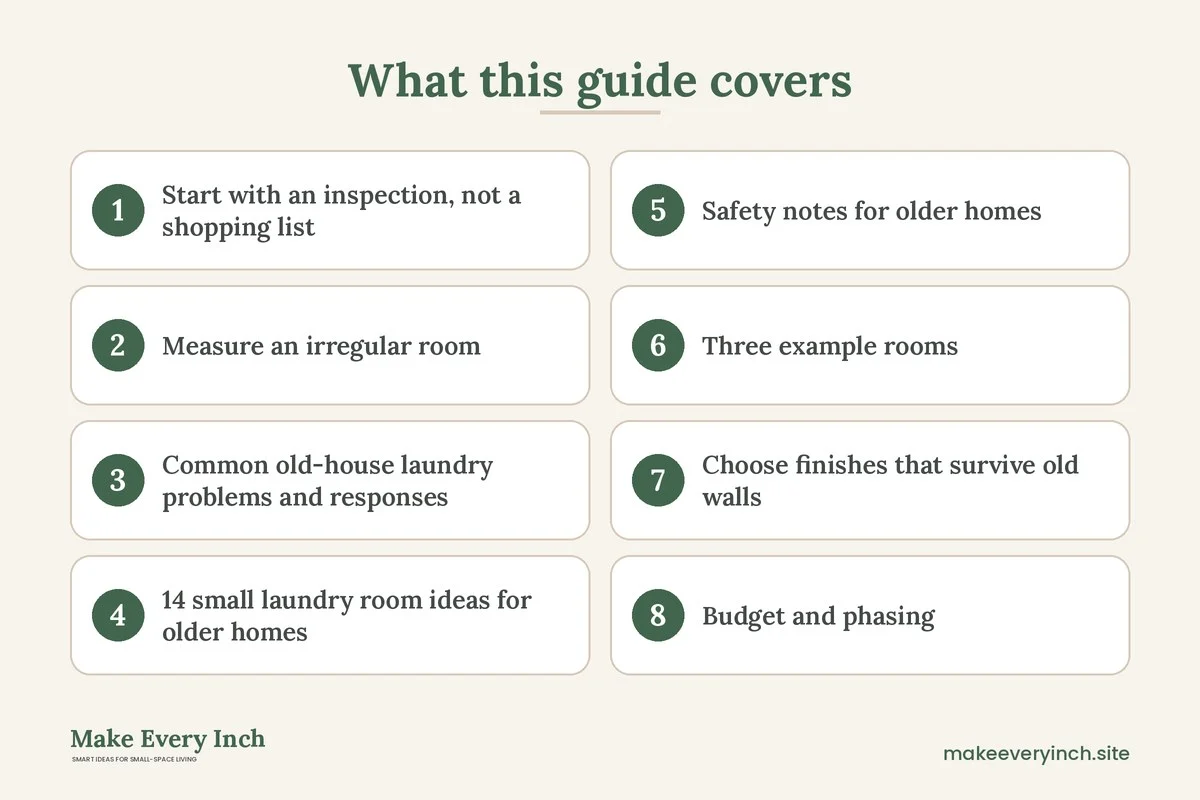
Measure an irregular room
Older rooms are seldom square, so measure more than once. Use a tape and write down each number with a sketch.
- Width at three heights: measure the wall-to-wall distance at floor level, waist height and near the ceiling. Walls can lean, and baseboards or plaster can add inches at the bottom.
- Doorway clear width: measure the narrowest point of every doorway, stair and corner the machines must pass. Old doors can be narrower than modern ones, and the trim can reduce the opening further.
- Ceiling height: low basement beams and sloped ceilings change what shelves and rods will fit. Measure at the lowest point you will use.
- Window and radiator locations: a window sill or a radiator can block a wall that looks free.
- Appliance dimensions: write down the width, depth and height of the machines you have or plan to buy, and add the clearance listed in the manual for hoses, vents and airflow. Appliance manuals are the authority here.
- Floor drain location: note whether a floor drain exists, because it changes how you handle spills.
Use painter’s tape on the floor to mark where the machines would sit, then walk the route from the door to the spot. If a corner is tight, test with a cardboard box the size of the washer.
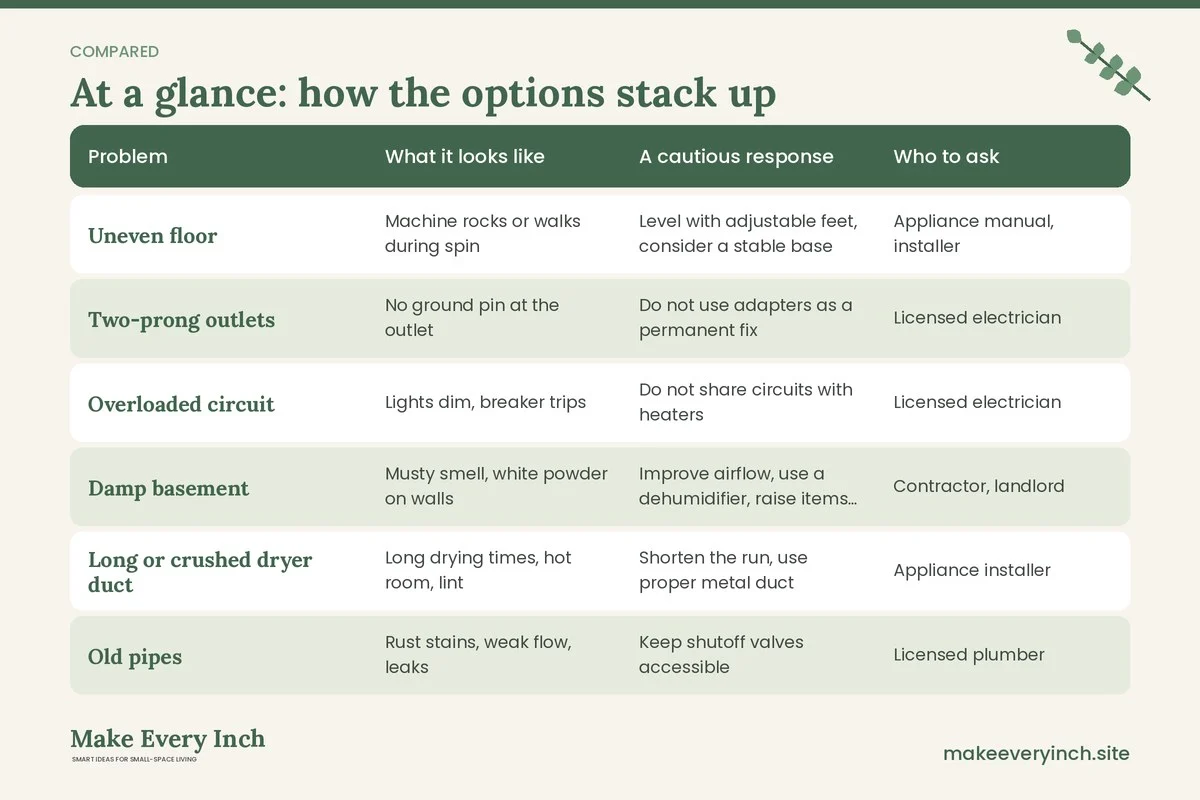
Common old-house laundry problems and responses
| Problem | What it looks like | A cautious response | Who to ask |
|---|---|---|---|
| Uneven floor | Machine rocks or walks during spin | Level with adjustable feet, consider a stable base | Appliance manual, installer |
| Two-prong outlets | No ground pin at the outlet | Do not use adapters as a permanent fix | Licensed electrician |
| Overloaded circuit | Lights dim, breaker trips | Do not share circuits with heaters | Licensed electrician |
| Damp basement | Musty smell, white powder on walls | Improve airflow, use a dehumidifier, raise items off the floor | Contractor, landlord |
| Long or crushed dryer duct | Long drying times, hot room, lint | Shorten the run, use proper metal duct | Appliance installer |
| Old pipes | Rust stains, weak flow, leaks | Keep shutoff valves accessible | Licensed plumber |
| Narrow doorway | Machine will not pass | Measure, consider a compact model, remove doors only if permitted | Installer, landlord |
| Low ceiling | Shelves hit beams | Use shallow shelves and a rod under the lowest point | Self, with measurements |
| Old finishes | Peeling or chipping paint | Do not sand or scrape without testing | Testing professional |
| Gas appliance | Dryer on gas line | Never move it yourself | Licensed technician |
14 small laundry room ideas for older homes
Fit the machines to the room you have
1. Choose the machines for the doorway
Many older homes have narrower doorways, steep stairs or tight corners. When shopping for appliances, measure the entire route, not just the final spot. Compact or narrower machines are available, and a stacked pair frees floor area, but a stack must be installed correctly and the floor must support the weight and vibration. Follow the manual and consider professional installation.
2. Level the floor, not just the machine
A sloping floor causes vibration and noise. Most washers have adjustable feet. Level the machine front to back and side to side, then check it again with a full load. If the floor is badly out of level, ask an installer about a stable platform or base. Do not wedge shims or boards under the machine unless the manual allows it.
3. Use a pedestal for height, not just storage
A pedestal under a front-loading washer raises the door and gives you a drawer for supplies. It also lifts the machine off a damp floor. Make sure the pedestal is designed for your machine and that the combined height does not hit a low ceiling or shelf.
Plan around older wiring and plumbing
4. Give the machines their own outlets
Many older homes have too few outlets for a laundry area. Rather than daisy-chaining extension cords, ask an electrician to evaluate what is safe. A dedicated circuit may be recommended, depending on the appliances and local codes. Renters should ask the landlord, not attempt this themselves.
5. Add GFCI protection near water
Any outlet near a sink, a standing tub or a damp floor is a candidate for ground-fault protection. This is a standard upgrade that an electrician can often provide. Test the device regularly, and never use an extension cord near wet floors.
6. Label every shutoff
Older houses often have valves that are stiff, hidden or unlabeled. Find the valve for each fixture and for the whole house, and tag them. Operate them gently once or twice a year to be sure they work, but if a valve will not move, do not force it. Call a plumber.
7. Replace hoses and keep a drain pan in mind
Old rubber hoses can crack and burst. Many manufacturers suggest replacement on a schedule, and braided hoses are commonly used. Check the manual and your local rules. A shallow drain pan under the washer, connected or sized appropriately, can reduce water damage if there is a leak, but it must not block ventilation or the machine’s feet.
Tame damp basements and enclosed porches
8. Raise everything off the floor
In a basement, keep shelves, bins and boxes a few inches above the floor. Plastic or metal shelving is more forgiving than particle board. A raised platform for the machines can protect their bases from standing water, but it must be stable and rated for the load.
9. Improve airflow and manage humidity
Laundry produces moisture. A dehumidifier, a vent fan or an open window helps, as long as it does not interfere with the dryer’s venting. Do not exhaust a dryer into a basement to warm the room. It adds moisture and lint to the air and is a recognized fire hazard.
10. Treat a converted porch or pantry as a small room
A former pantry or porch has windows, a door and thin walls, which mean temperature swings. Insulate where allowed, seal gaps and protect the machines from freezing. In an unheated space, water left in hoses can freeze, so follow the manual for cold-weather care.
Make the storage fit the quirks
11. Use shallow shelves on walls that lean
When walls are not plumb, deep shelves leave gaps and wobble. Shallow shelves, about 8 to 12 inches deep, are easier to fit and keep things visible. Anchor any tall shelves to studs or masonry using the right fasteners, and avoid loading them with heavy items near the top. Renters need permission before drilling. See our no-drill storage ideas for renters for options that do not touch the walls.
12. Hang a drying rod under the ceiling beam
A rod hung under a beam or between two studs makes a drying zone. Check the weight that the support can bear, because wet clothing is heavy. In a rental, a tension rod or a freestanding rack is safer. Keep drying racks away from the dryer vent and heaters.
13. Turn a deep closet into a laundry cupboard
Many older closets are deeper than modern ones. A stackable pair, a shelf above and a bar for hanging fit in a closet if the door can fold or be removed with permission. Louvered or vented doors help airflow. Check the dryer’s clearance rules before closing the door while the dryer is running. Our post on small closet ideas shows how to use depth well.
14. Keep a mudroom flow if the laundry is near the back door
When the laundry sits near the kitchen entrance, add a bench, a few hooks and a bin for dirty clothes. That prevents mud and wet gear from crossing the house. For more on this, see our small entryway ideas guide.
Safety notes for older homes
Older homes need extra care because many of the protections we now assume were not built in. The points below are general guidance. They do not replace local codes, manufacturer instructions or a qualified professional.
Electrical
- Do not use adapters to defeat a missing ground. A three-to-two plug adapter is not a substitute for a grounded circuit.
- Do not overload outlets. A washer, a dryer, a space heater and a dehumidifier should not all draw from the same circuit.
- Look for warm outlets, burning smells or flickering. If you notice any, stop using the outlet and call an electrician.
- Keep outlets dry. Use GFCI protection near water where required, and ask an electrician before adding outlets.
Dryers, lint and ventilation
- Maintain the clearance around the dryer. Follow the manual for minimum distances to walls, shelves and other objects.
- Clean lint regularly. Clean the filter after every load, and have the exhaust duct cleaned on a regular schedule. Lint buildup is a known fire risk.
- Vent outdoors. Use proper metal duct, keep the run as short and straight as practical, and check the outside flap. Do not vent into a basement, crawl space or attic.
- Gas dryers need professional attention. Never adjust gas connections yourself, and make sure the room has fresh air supply as required. If you smell gas, leave and call the gas company or emergency services.
- Keep the area clear. Do not store paper, cardboard, aerosols or oily rags near the dryer.
Water and leaks
- Inspect hoses and valves. Replace damaged hoses promptly and keep shutoff valves accessible.
- Use a leak sensor. A battery-operated sensor near the floor can warn you early, particularly in a basement.
- Avoid wood and particle board near water. Use moisture-tolerant materials and seal edges.
Weight, vibration and shelving
- Check the floor. Old floors can flex. A stacked washer and dryer, or a water-filled tub, adds weight and vibration, so ask a professional if the floor looks soft.
- Anchor tall shelves. Use the right fasteners for plaster, lath or masonry, and follow the manufacturer’s directions.
- Keep heavy items low. Detergent jugs and buckets belong at waist height or below.
Chemicals and old finishes
- Store cleaners away from children and pets. Use high shelves or a lockable cabinet, in original containers with labels intact.
- Never mix cleaners. Bleach with ammonia or acids can create harmful fumes. Use one product at a time and ventilate the room.
- Treat old paint with care. If the home is old, do not sand, scrape or burn off paint without proper testing and containment. Ask a professional.
- Choose low-VOC paint and ventilate. If you repaint, pick a low-VOC product suited to damp rooms, and keep the area ventilated while it dries.
Rental and permission
- Read your lease. Many leases limit changes to walls, floors, plumbing and electrical systems.
- Ask in writing. Describe what you plan to do and wait for approval.
- Never drill without permission. Use freestanding or tension-based storage if the answer is no.
- Report problems. Mold, leaks, tripping breakers and failing pipes are usually the landlord’s concern.
Three example rooms
A basement corner with a slope
A basement laundry sits in a corner with a floor that slopes toward a drain. The washer and dryer are side by side, and the dryer exhausts through a short metal duct to a basement window. The plan is to level the machines, place a leak sensor near the washer, set the shelves on a metal frame that stays a few inches off the floor and add a dehumidifier. A drying rack stands in the open area, well away from the dryer vent. A GFCI outlet is added by an electrician near the utility tub. The room stays dry, and the machines stay stable.
A former pantry off the kitchen
A narrow pantry, about 4 feet wide, becomes a laundry cupboard. A stacked pair fills one end, and a shallow shelf sits above. Louvered doors provide airflow, and the owner keeps the doors open while the dryer runs. Because the pantry shares a wall with the kitchen, the owner checks the dryer manual for clearance and adds a vented outside duct. A basket on the floor catches lint trap cleanings and a pull-out caddy holds detergent. Cleaners are stored on a high shelf with the lid closed.
An enclosed back porch
A porch with large windows and thin walls serves as the laundry. The washer sits on a stable pedestal, and the dryer vents through a short wall duct to the outside. The owner insulates where permitted, adds weatherstripping and learns the manual’s advice on cold weather. A hook rail by the back door holds aprons and bags, and a bench with a bin handles muddy shoes. The room also gets a small rug that dries quickly. For storage ideas that can move with you, see our small space organization ideas.
Choose finishes that survive old walls
Older rooms often have plaster, brick, wood paneling or painted masonry. Your finish choices should respect them.
- Paint: choose a washable, moisture-tolerant, low-VOC paint in a light color. Prime any stained areas, and ventilate during the work. Do not paint over active moisture problems.
- Flooring: vinyl sheet or tile resists water better than carpet. If you suspect old flooring materials contain hazards, do not sand or lift them. Float a removable waterproof mat on top instead.
- Walls: if the plaster is cracked, patch small cracks and leave big ones for a professional. Avoid heavy loads on weak plaster without anchors.
- Lighting: older rooms are often dim. A bright, moisture-rated fixture helps, and a plug-in light can work in a rental. See our small kitchen ideas for older homes for more ways to brighten old rooms.
- Rugs and mats: use a mat that dries quickly and does not slide. Avoid thick rugs that trap moisture.
Budget and phasing
You do not need to fix everything at once. A sensible order is: safety first, moisture second, stability third and style last. Start with an inspection and the repairs that protect people and property, such as ventilation, wiring and leaks. Then address floor leveling and drainage. After that, add storage and finishes. Prices for professional work vary widely by region, so ask for written quotes. Free or low-cost steps include cleaning lint, labeling valves, clearing the floor and moving flammable items. For more ideas that stretch a small budget, see our budget small space ideas guide, and for organization tips see our practical guide to small laundry room organization.
Mistakes to avoid
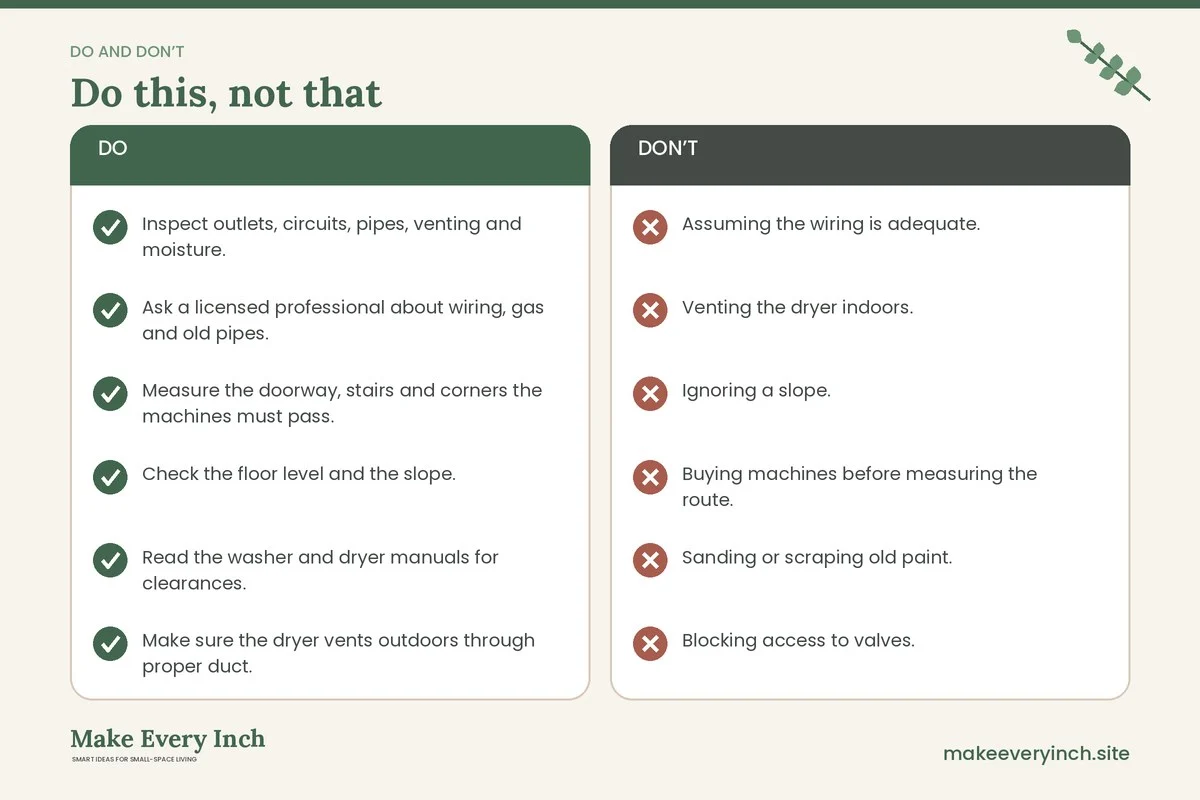
- Assuming the wiring is adequate. Older circuits may not handle modern appliances.
- Venting the dryer indoors. It adds moisture, lint and risk.
- Ignoring a slope. An unlevel machine wears itself out.
- Buying machines before measuring the route. Many a washer has stuck in a stairwell.
- Sanding or scraping old paint. That can release hazardous dust.
- Blocking access to valves. Emergencies need quick access.
- Skipping permission. A rental owner may take offense, or charge for damage.
- Storing cleaners within reach of children. Use a high shelf or lock.
- Using deep shelves on leaning walls. They wobble and waste space.
Checklist
- Inspect outlets, circuits, pipes, venting and moisture.
- Ask a licensed professional about wiring, gas and old pipes.
- Measure the doorway, stairs and corners the machines must pass.
- Check the floor level and the slope.
- Read the washer and dryer manuals for clearances.
- Make sure the dryer vents outdoors through proper duct.
- Clean the lint filter and schedule duct cleaning.
- Label shutoff valves and keep them accessible.
- Replace old hoses as advised and add a leak sensor.
- Raise storage off damp floors.
- Anchor tall shelves with the right fasteners, or use freestanding units.
- Keep cleaners away from children and pets, and never mix them.
- Get written permission before any change if you rent.
FAQ
What is the biggest risk in a small laundry room in an older home?
It varies, but common concerns are older wiring, poor dryer venting, moisture and old plumbing. A licensed professional can assess each. Start with safety before style.
Can I put a washer and dryer in a closet of an older home?
Often yes, if the closet has enough space, ventilation, electrical capacity and water connections, and if the manuals allow it. A stacked pair needs a stable floor. Ask an installer.
Do I need a dedicated circuit for a washer or dryer?
Many appliances do better on their own circuits, and codes in many places require them for certain machines. Ask a licensed electrician what applies to your home.
How do I deal with a damp basement laundry area?
Improve airflow, use a dehumidifier, raise items off the floor and fix leaks. If dampness persists, ask a professional about drainage or waterproofing. Never vent a dryer into the basement.
Can I paint over old paint in a laundry room?
Painting over intact paint is often fine, but do not sand or scrape old paint without testing, since older finishes can contain hazardous materials. Use low-VOC paint and ventilate.
What if my doorway is too narrow for a new washer?
Measure carefully, look at compact models and ask an installer about options. Removing a door or trim may be possible, but renters need permission.
How can I add storage without drilling into old plaster?
Use freestanding shelves, over-the-door racks, tension rods and rolling carts. If you own the home, use the right anchors for plaster or masonry, and consider a stud finder. Our guide to renter-friendly apartment decorating ideas lists more no-damage approaches.
Keep going: Keep planning with our small laundry room ideas pillar guide, our small laundry room ideas with a sink and our small bathroom ideas for rooms that share a wall with the laundry.
Save this guide for later
Pin the ideas you like to Pinterest so you can come back to them when you plan your space.