14 Small Laundry Room Organization Systems for Families
Quick answer: Small laundry room organization families can keep up with starts with sorting by person instead of by color, giving every child a labeled basket, and moving the work to a weekly rhythm. Keep detergents and cleaners high, closed and away from children and pets, keep the dryer vent and shutoff valves clear, and make every system simple enough for a child to follow.
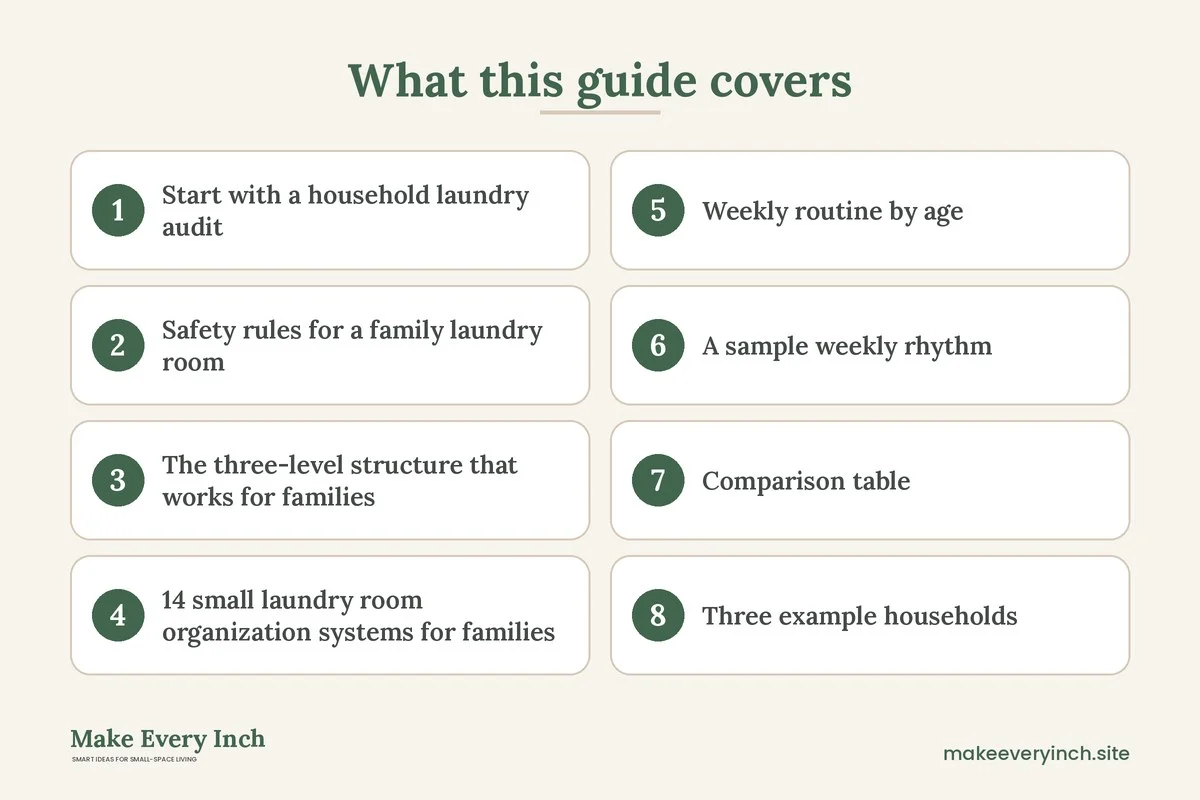
Small laundry room organization families can actually maintain looks different from the neat, minimal photos online. A family room of laundry deals with school uniforms, sports kits, towels, sheets, muddy knees, a toddler who wants to help and a baby who is not allowed anywhere near the detergent. The room is often a closet, a corner of a kitchen or a strip of hallway, and it has to handle several loads a week. This guide focuses on the people, not just the shelves. It covers a household audit, safety rules for a space with children and pets, 14 systems, a weekly routine by age, a comparison table, three example households, mistakes and a checklist. For the broader overview, see our pillar on small laundry room ideas, and for a surface to fold on, read our guide to small laundry room countertop alternatives. If you want a plain storage walkthrough first, our post on small laundry room organization covers the basics.
Start with a household laundry audit
Before buying a single bin, spend one week watching what actually happens. Families often find that the problem is not a lack of storage. It is that nobody knows who owns which pile.
Count and note the following for seven days.
- Loads per week. Write down each load and who it belonged to. Many families discover that they are washing the same mixed pile three times a week instead of two full loads.
- Where clothes land. Note whether dirty clothes pile in bedrooms, bathrooms, the hall or the laundry itself.
- Where the process stalls. Is it getting clothes to the machines, moving them to the dryer, folding or putting away? The stalled step is where your system should be strongest.
- Who does what. Be honest. If one adult does all of it, the plan has to be lighter or must share the load.
- Special items. Cloth diapers, uniforms, school PE kits, work scrubs, bedding for a child who has accidents, pet blankets. Each one may need its own bin or its own day.
At the end of the week, write a single sentence that names your biggest problem, such as “Folded clothes sit in baskets for days” or “Dirty laundry never reaches the machines.” That sentence picks your first system. Resist the urge to reorganize everything at once.
Safety rules for a family laundry room
A laundry room is a utility space with chemicals, heat, water and electricity. With children and pets, the rules matter more than the look. These notes are general, and your appliance manuals and local rules take priority.
- Chemicals out of reach. Detergent, pods, bleach, stain removers and fabric softener should live on a high shelf or in a closed cabinet with a child lock, in original containers with the labels intact. Pods in particular look like candy to small children, so store them in a closed container well out of reach. Keep the poison control number on the wall or in your phone.
- Never mix cleaners. Bleach combined with ammonia-based or acidic products can release dangerous fumes. Use one product at a time, rinse between uses and keep the room ventilated.
- Keep pets and children away from open machines. Always check inside the dryer and washer before starting a load, because cats and small children can climb in. Close the doors when machines are not in use.
- Clearance and ventilation around the dryer. Keep baskets, bins and towels away from the back and sides of the dryer, and follow the clearances in the manual. Do not block the vent.
- Lint buildup and fire risk. Clean the lint trap after every load and have the vent cleaned as the manual or a professional recommends. Do not store rags that have touched oil, solvents or cleaning products near heat.
- Venting rules. Dryer vents follow local code and the manufacturer’s instructions. Do not change the vent run without a professional, and never vent into a living space.
- Water leaks and shutoff valves. Teach older children and every adult where the shutoff valves are. Keep them reachable, and check hoses occasionally for cracks or bulges.
- GFCI near water. Outlets near washers and sinks are commonly required to be GFCI-protected. Do not let children plug anything in there and keep cords off wet surfaces.
- Weight and vibration of stacked units. Stacked machines vibrate. Do not let children climb on them or lean on them, and never place heavy items on top. Follow the manufacturer’s stacking kit rules.
- Anchor shelves and racks. Any tall shelf, rack or cabinet in a family space should be anchored to studs or with rated anchors so that a climbing child cannot tip it. Check weight ratings.
- Lease permission. If you rent, get written permission before drilling or mounting. Many of the systems below work without any tools.
- Check the manuals. Appliance manuals state what may sit on top, how much space is needed and how to level the machines.
The three-level structure that works for families
Most family systems that last use three levels. Think of the room as three heights.
- High (above about 60 inches): Anything unsafe for children or rarely used. Detergent stock, bleach, stain sprays, spare bulbs, out-of-season bedding.
- Middle (about 30 to 60 inches): Adult-reachable items you use every load. The current bottle of detergent in a closed container, dryer sheets or wool balls, a lint brush, a stain stick.
- Low (below about 30 inches): Child-reachable items. A labeled basket per child, a step stool, a hook for a hamper bag, a bin for lost socks.
Write the heights on a note and hold it against the wall before you shop. The numbers are rough guides, because families differ in height and ages. A household with a toddler needs a taller “safe” line than one with only teenagers.
14 small laundry room organization systems for families
Sorting systems
1. One hamper per person
Instead of one big hamper in the hall, give each person a bag or bin in their own room. The clothes arrive at the machines already separated by owner, which makes folding and putting away much faster. For very small rooms, use slim hamper bags hung on a door hook.
2. A three-bin sorter for the whole family
If bedrooms cannot host hampers, use a three-compartment rolling sorter in the hall or laundry. Label the bins by laundry type, such as darks, lights and towels, or by household rhythm, such as school, home and bedding. Keep the whole rolling unit out of the dryer area.
3. A “needs attention” bin
A small, lidded bin for items with stains, missing buttons or repairs prevents a loose pile from growing on top of the machine. Empty it on a set day. This one habit prevents a lot of re-washing.
4. A separate basket for special loads
Sports kits, scrubs, reusable diapers and pet blankets often need a separate wash. A dedicated basket with a lid keeps odors under control and ensures nothing gets mixed into the family load by accident.
Chemical and supply storage
5. A high closed cabinet for products
Install or choose a closed cabinet at a height children cannot reach, with a child lock or latch. Keep detergents in their original containers or labeled sealed containers. Anchor the cabinet to studs when permitted. In a rental, ask first, or use a freestanding unit with anti-tip straps.
6. A single “today” caddy
Decant nothing, but move only the product you need into a small caddy on the middle level. When the laundry is done, the caddy returns to the high shelf. This limits how long chemicals are within reach.
7. A spill tray under products
A shallow tray under bottles on a shelf catches drips and prevents sticky rings. Wipe it weekly. It is a small habit that keeps the shelf clean and the labels readable.
Folding and putting away
8. A fold-and-sort table or cart
Whatever your surface, make it a family zone. A rolling cart or a fold-down shelf provides a flat area where adults fold and children can sort their own socks. For options that work without a counter, see our post on small laundry room countertop alternatives.
9. A basket per child
Each child gets a labeled basket, with a name or a picture for the youngest ones. Folded clothes go in the basket, and the child carries it to their room and puts the items away. The basket then comes back empty to the laundry. This keeps stacks off the bed and places responsibility with the owner.
10. A “no-fold” drawer system
For children’s t-shirts, socks, underwear and pajamas, consider a shallow open bin in the child’s own room where clothes can be tossed in rather than folded. A rule of “folded is for adults, tossed is for kids” can cut the task in half. It suits families who care more about finishing than perfection.
11. A sock pairing station
Odd socks pile up. Keep a mesh bag in the wash for each person or use a clip. A single bin by the machines for orphan socks gives them one place to wait, and you empty it monthly into the rag bin.
Making the room itself work harder
12. A door-back organizer
A hanging organizer on the back of the laundry door can hold a lint brush, stain stick, spare buttons and pins. No drilling is needed with an over-the-door design. Keep anything sharp high and sealed.
13. A wall chart with a rhythm
Put a simple chart on the wall or the door using removable adhesive suitable for your wall. It lists a day for each person’s laundry, or a simple weekly rhythm. Keep it basic. A chart that takes more than ten seconds to read will be ignored.
14. A seasonal bin above the machines
Out-of-season bedding, scarves and sports gear can sit in a labeled bin on a high shelf. Remove it from the daily reach so the room only holds what the household uses this month.
Weekly routine by age
A system lasts only if everyone can do their part. Adjust to your children, and be realistic about what a child can safely do. Never allow children to handle chemicals or to operate machines without supervision, and keep young children out of the dryer area.
- Toddlers (about 2 to 4): Put dirty clothes in the hamper, help drop clothes in a basket under supervision, match simple pairs. Keep them away from machines and chemicals.
- Early school age (about 5 to 8): Carry their own basket, put away folded stacks, match socks, put the hamper bag by the door on laundry day.
- Older children (about 9 to 12): Fold their own clothes, make their bed with clean sheets with help, learn the sort process. Supervised use of machines may start when the household is ready.
- Teenagers: Run their own loads once they have been taught the basics, including the lint trap, the right detergent amount and the shutoff location. Agree on a schedule.
- Adults: Handle the chemicals, the vent, the stain treatment and the checks on hoses and valves.
Each family has its own pace. The point is to match tasks with ability and safety, not to follow a fixed chart.
A sample weekly rhythm
Here is a simple example for a family that does about five loads a week. Adjust it to your own household.
- Monday: Towels and bath mats.
- Tuesday: Kids’ clothing, folded and returned the same evening.
- Wednesday: Rest day, or sports kits and school uniforms.
- Thursday: Adult clothing.
- Friday: Sheets and bedding, with a second load if needed.
- Weekend: One catch-up load only, and a ten-minute reset of the room.
A fixed rhythm reduces the “everything at once” weekend marathon and makes it easier for a small room to cope. If the machines are in use most evenings, consider running loads on a timer or when you are home. Do not run a dryer when no one is home or when you are asleep, because an unattended appliance raises the risk if something fails.
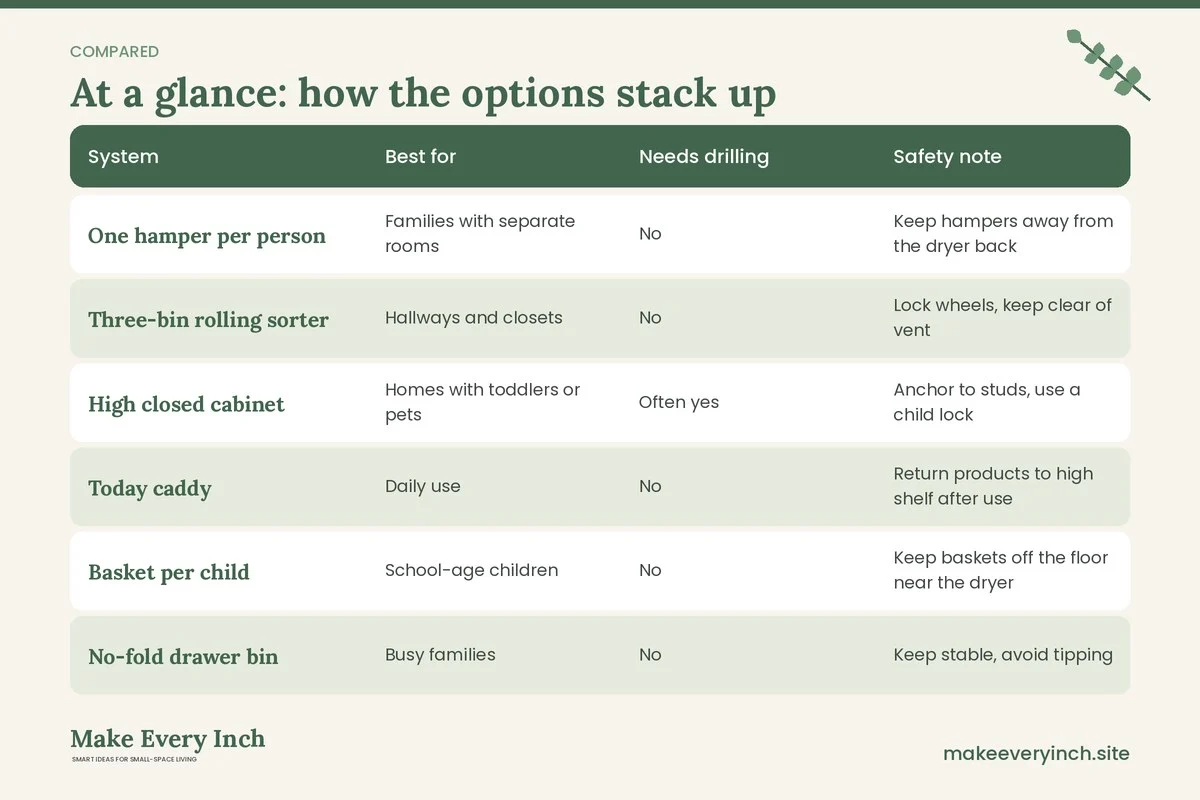
Comparison table
| System | Best for | Needs drilling | Safety note |
|---|---|---|---|
| One hamper per person | Families with separate rooms | No | Keep hampers away from the dryer back |
| Three-bin rolling sorter | Hallways and closets | No | Lock wheels, keep clear of vent |
| High closed cabinet | Homes with toddlers or pets | Often yes | Anchor to studs, use a child lock |
| Today caddy | Daily use | No | Return products to high shelf after use |
| Basket per child | School-age children | No | Keep baskets off the floor near the dryer |
| No-fold drawer bin | Busy families | No | Keep stable, avoid tipping |
| Door-back organizer | Small items | No | Check the door’s weight limit |
| Wall chart | Teaching routines | No, removable adhesive | Use only on suitable surfaces |
| Seasonal high bin | Rarely used items | No | Do not overload high shelves |
Three example households
Household 1: Two adults, two school-age children, a closet laundry
The stacked machines sit in a hallway closet with a 30-inch opening. There is no counter and no space for a table. The family keeps one mesh hamper bag per person on the back of each bedroom door. On laundry day, the bags are carried to the closet. Detergent lives on a high shelf with a child lock. A rolling cart provides a folding surface in the hall, and each child has a labeled basket for folded clothes. The chart on the closet door lists a day for each person.
What works: nothing is installed, and the closet stays tidy. What to watch: the vent and valves must remain reachable, and the cart must not block the closet door.
Household 2: One parent, a toddler, a dog and a kitchen corner
The machines sit at the end of a galley kitchen. The challenge is safety. A latched cabinet above the machines, anchored to the wall with the landlord’s written permission, holds all products. A baby gate keeps the toddler and the dog out of the corner during loads. Dirty clothes go in a lidded hamper in the bedroom. Folding happens on the dining table, which makes the kitchen corner a pure machine area. A short routine of two loads on set days keeps the pile from growing.
What works: chemicals are secure, and nothing is stored on or behind the dryer. What to watch: the baby gate must not trap the user, and the dryer door should be closed after every use.
Household 3: Two adults, three children, a basement utility area
There is more space but less light. A set of shelves holds a basket per child and a sorter for the household. The shelving is anchored to studs. Chemicals sit in a locked cabinet near the ceiling. A GFCI-protected outlet powers a lamp over the folding table. The shutoff valves are labeled with tape so every adult can find them quickly. A weekly schedule on the wall lists each child’s day, and the older ones run their own loads after being taught.
What works: clear roles and good light. What to watch: damp basements may need extra ventilation or a dehumidifier to avoid mildew, and the vent must follow the manual.
Mistakes families make
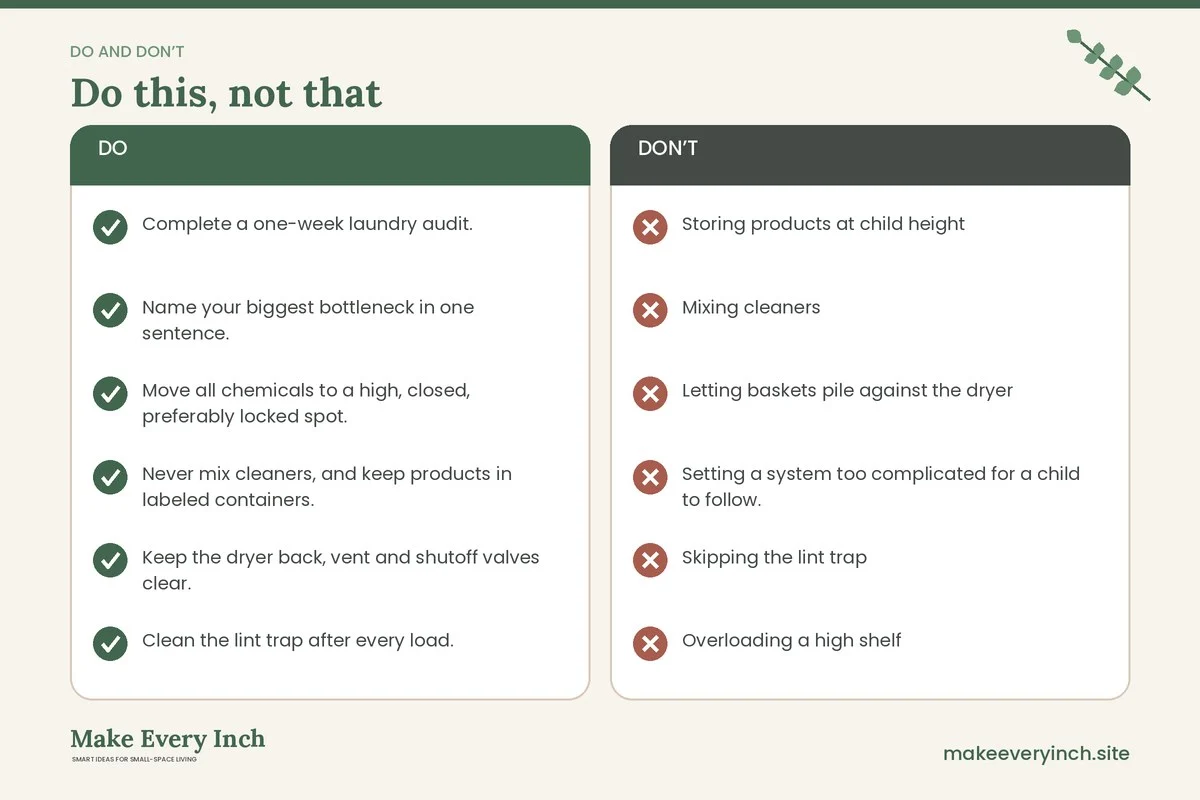
- Storing products at child height because it is convenient.
- Mixing cleaners in a rush, or storing them in unlabeled bottles.
- Letting baskets pile against the dryer and blocking airflow.
- Setting a system too complicated for a child to follow.
- Skipping the lint trap when the household is rushing.
- Overloading a high shelf or leaving a tall unit unanchored.
- Folding everything perfectly when a simple toss system would be used.
- Drilling without permission in a rental.
- Running the dryer when no one is home.
Making the room feel calmer
A family laundry room will never be silent, but a few touches make it easier to live with.
- Light. A bright, even light helps with stain spotting. Use a low-heat bulb and keep cords away from water.
- Labels. Simple labels with words or pictures help every age. Use removable ones where permitted.
- A hook or two at child height for jackets and bags that need to dry.
- A small trash bin for lint and dryer sheets, emptied after each load.
- A mat in front of the machines with a non-slip backing.
- A visible clock or timer so no one forgets a load.
For ideas from other parts of the home, see our posts on small home organization for families, small space organization ideas and small entryway ideas, where dirty gear often starts. If the laundry area shares a bathroom, look at small bathroom ideas. For kitchen corners, see small kitchen ideas. A renter will find more no-tool thinking in no-drill storage ideas for renters and renter-friendly apartment decorating ideas, and a tight budget is covered in budget small space ideas. For wardrobe storage after the laundry, our small closet ideas can help.
Keeping the system going
Systems fail when life gets busy. Plan for the bad weeks.
- Set a ten-minute weekly reset. Clear the surface, empty the lint trap, check the hoses, wipe the shelf and put any stray items back.
- Review monthly. Ask whether the system still fits the household. Children grow, schedules change and an arrangement that worked in September may not suit January.
- Keep a minimum viable version. On a hard week, the minimum is to get clothes into the machines and out again. Folding can wait.
- Do a quarterly deeper check. Look at the hoses, the vent exterior, the shelf anchors and the contents of the high cabinet. Discard expired or unlabeled products according to local guidance.
Checklist
- Complete a one-week laundry audit.
- Name your biggest bottleneck in one sentence.
- Move all chemicals to a high, closed, preferably locked spot.
- Never mix cleaners, and keep products in labeled containers.
- Keep the dryer back, vent and shutoff valves clear.
- Clean the lint trap after every load.
- Anchor any tall shelf or cabinet, with permission if renting.
- Give each person a hamper and each child a labeled basket.
- Choose a folding surface that can be cleared quickly.
- Set a weekly rhythm and a ten-minute reset.
- Read the appliance manuals for clearance and top-of-machine rules.
- Check that outlets near water are GFCI-protected.
FAQ
How do I organize a tiny laundry room with young children?
Put everything unsafe on a high, closed shelf, keep a labeled basket for each child at a low level, and shut the machines when not in use. Use a baby gate if the room is open to play areas.
Should kids be allowed to do their own laundry?
It depends on age and readiness. Younger children can sort and carry. Older children and teens can run machines once they are taught the basics, with adult oversight on chemicals and the dryer.
How often should a family do laundry?
Many families settle on a fixed rhythm of a few loads a week. The right number depends on household size, so use your audit to decide.
Where should I store detergent with a toddler in the house?
High, closed and ideally locked, in the original container. Return it to the shelf as soon as you finish.
Is it safe to run the dryer overnight?
It is safer to run it while you are home and awake, and to follow the manual. Clean the lint trap every load and keep the vent clear.
What can I do if I cannot drill in a rental?
Use over-the-door organizers, rolling carts, freestanding shelves with anti-tip straps, and removable adhesive where the surface allows it. Ask your landlord for written permission for anything that needs mounting.
Keep going: Keep going with our small laundry room ideas, small home organization for families and small laundry room countertop alternatives.
Save this guide for later
Pin the ideas you like to Pinterest so you can come back to them when you plan your space.