Renter-Friendly Decor Ideas on a Budget: A Spend-Last Plan
Quick answer: Renter Friendly decor on budget works best as a ladder. Start with free changes (rearranging, decluttering, borrowing, moving things between rooms), then low-cost fixes (textiles, plants, lamps, hooks that need no tools), and only then save for the one item that changes the room most. Photograph the walls, read the lease, and keep every change removable so the deposit stays safe.
Renter Friendly decor on budget is not about finding the cheapest version of everything. It is about spending in the right order, so that the few things you pay for do the most work and nothing you buy has to be thrown out when you move. Most people do the reverse. They buy a rug first, a set of frames next, a few baskets after that, and end up with a room that is full of small purchases but still feels unfinished. This guide takes a different route. It is a spend-last plan: you work through free changes first, small purchases second, and larger upgrades only when the earlier steps have shown you what the room really needs. You will find a tier table, a room-by-room breakdown, three sample apartments, a 30-day schedule, safety notes and a checklist. For the wider topic, read our main guide to renter-friendly apartment decorating ideas, then pair it with budget renter upgrades and the small apartment makeover on a budget walkthrough.
Why a spend-last order saves money
Budget decorating goes wrong in a predictable way. A tight budget makes every purchase feel risky, so people buy the safe, cheap thing now and plan to fix it later. A month on, the room has six safe, cheap things and no direction. The fix is to separate decisions about the room from decisions about shopping. Make the room decisions first, using only what you already own. Then shop to fill the specific gaps the free changes could not solve.
There are three practical reasons this works in a rental.
- Free changes teach you what you need. After you rearrange, you find out whether the problem was the layout or a missing object. Many rooms that seem to need a new shelf actually need the sofa moved 10 inches.
- Removable items hold their value. A lamp, a rug or a freestanding shelf can move with you or be resold. A decal stuck to a wall or a paint job you did without asking cannot.
- Small spends add up unseen. Ten purchases of a modest amount each often equal one good item. Writing the purchases down before you buy them shows you the real total.
The rule underneath all of this is simple. Do not spend on a problem until you have tried to solve it for free for a week.
The four tiers, from free to saved-up
Sort every idea into one of four tiers. Do the tiers in order. Do not move to the next tier until the current one feels finished.
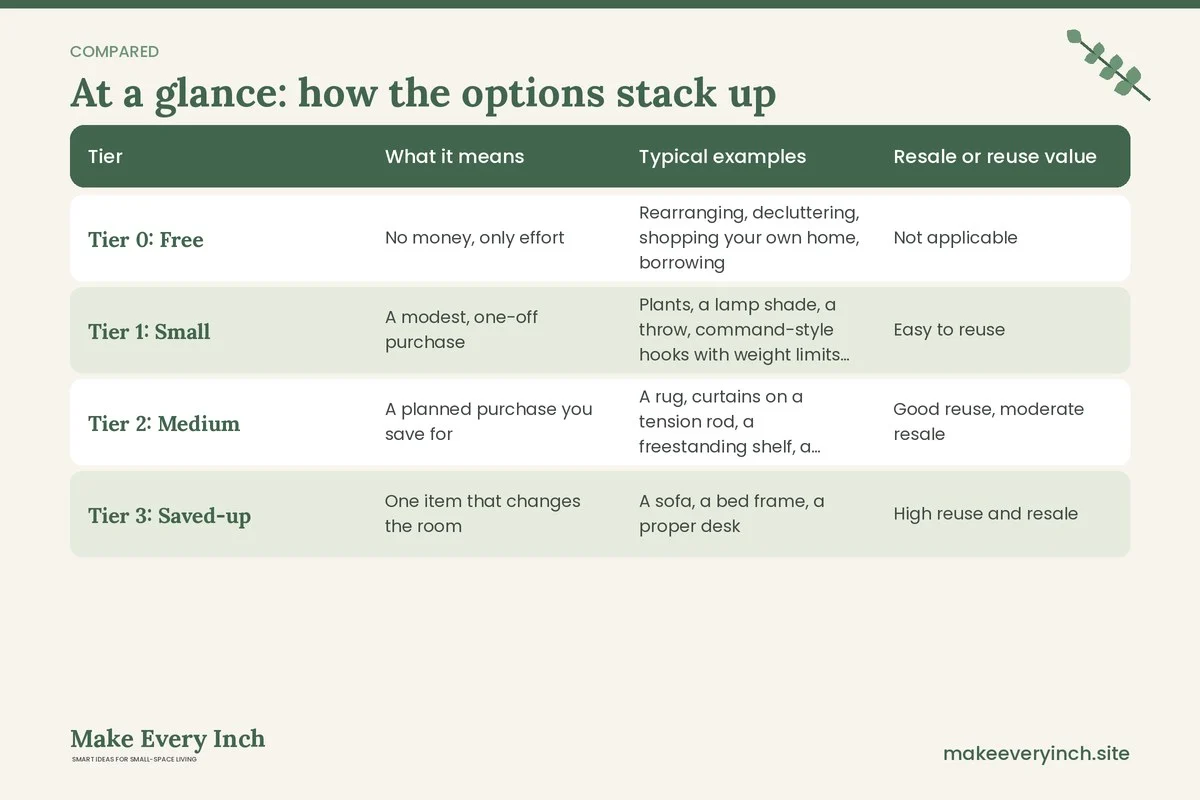
| Tier | What it means | Typical examples | Resale or reuse value | |
|---|---|---|---|---|
| Tier 0: Free | No money, only effort | Rearranging, decluttering, shopping your own home, borrowing | Not applicable | |
| Tier 1: Small | A modest, one-off purchase | Plants, a lamp shade, a throw, command-style hooks with weight limits, plug-in lights | Easy to reuse | |
| Tier 2: Medium | A planned purchase you save for | A rug, curtains on a tension rod, a freestanding shelf, a mirror | Good reuse, moderate resale | |
| Tier 3: Saved-up | One item that changes the room | A sofa, a bed frame, a proper desk | High reuse and resale |
Pricing varies widely by region and season, so this plan avoids fixed numbers. Instead, set a cap for each tier as a share of your own decor budget. A common approach is to hold back about half of the budget for the single Tier 3 item and split the rest across the other tiers. Adjust the split to your situation.
Tier 0: Free changes that often do the most
Free changes are the most underrated part of renter friendly decor on budget. They cost nothing, they are fully reversible, and they show you what is really wrong. Work through these in order.
Clear one flat surface per room
Pick the largest visible flat surface in each room and remove everything from it. Put back only what you use daily. Many rooms look half decorated simply because every surface is full. A bare table or dresser top makes the room look larger and gives you a clean base for the one or two objects that matter.
Move the furniture, then live with it for a week
Try three layouts for each room. Pull the sofa 4 to 6 inches off the wall, rotate the bed so the headboard sits on a different wall, or angle a chair into a corner. Leave each layout for two or three days. Notice where you trip, where you reach, and where light falls. Keep the walkways at 30 to 36 inches for main paths and about 24 inches for side paths. Mark the new positions with painter’s tape if you are unsure.
Shop your own home
Move objects between rooms. A vase from the hallway becomes a bedroom accent. A tray from the kitchen becomes a coffee table organizer. Frames in a drawer can be restyled with new prints, which can be free if you print your own photos or use pages from old calendars and books. Spend half an hour opening every cupboard and listing what you forgot you owned.
Borrow and swap
Friends and neighbors often have a spare lamp, mirror or stool they would gladly lend. Local swap groups and building noticeboards turn up free items regularly. Treat borrowed pieces as a trial. If you still like a borrowed lamp after a month, you know it is worth buying one.
Fix the light you already have
Open curtains fully in the daytime and clean the glass. Dust lamp shades and replace dim bulbs with the correct type and wattage for the fixture. Check the packaging for the maximum wattage on the lamp, and never exceed it. Moving an existing lamp from a bookshelf to the corner behind the sofa often changes how the whole room feels.
Edit the walls without touching them
Take photos of every wall before you decorate. Then decide which walls stay empty. A rental rarely needs every wall filled. One calm wall and one decorated wall usually looks better than four half-filled walls. For when you do want to hang things, see our guide on renter-friendly wall decor ideas.
Tier 1: Small purchases that stay removable
Tier 1 is where you fill gaps that Tier 0 could not. Keep each purchase small, removable and useful.
- Textiles: A throw blanket, two cushion covers and a pair of pillowcases in the same color family pull a room together. Cushion covers are cheaper than new cushions, and you can reuse the inserts you already own.
- Plants: Cuttings from friends, small potted herbs and low-light foliage plants add life. Check that any plant you bring home is safe for children and pets. Many common houseplants are toxic if chewed, so confirm with a reliable plant safety list before buying.
- Plug-in light: A small plug-in or battery light warms a dark corner. Use a bulb that stays cool and never hide a cord under a rug where it can overheat. For more options, read about renter-friendly lighting ideas.
- Adhesive hooks and strips: Light, removable hooks hold towels, keys and small frames. Follow the weight limit printed on the package, clean the wall surface first, and let the adhesive set as directed. Test a hidden spot first, because some paint finishes peel.
- Contact paper or removable liner: Inside a cabinet or on a drawer bottom, it hides stains and stays out of sight. Only use it where the lease or landlord allows it, and avoid it on surfaces you cannot test.
- A tray or two: A tray corrals a candle, a plant and a book on a coffee table or at the end of a bed. It makes clutter look intentional.
A good test for any Tier 1 purchase is whether you can name the specific spot it will go before you buy it. If you cannot, wait.
Tier 2: Planned purchases worth saving for
Tier 2 items change the feel of a room, so they deserve a little planning. Measure first, then buy.
A rug that fits the room
A rug anchors a seating area and hides worn floors. In a small living room, the front legs of the sofa and chairs should sit on the rug so the furniture looks grouped. Leave at least 6 to 8 inches of bare floor between the rug edge and the wall. Choose a low pile or flat weave that lies flat and does not catch the door. Add a non-slip underlay sized to match, because rugs that slide are a trip hazard.
Curtains on a tension rod
A pair of floor-length curtains hung high on a tension rod makes a ceiling seem taller and hides a dull window. Check that the rod fits the opening snugly and that the weight stays within the rod’s rating. If the window frame is not suitable for a tension rod, use a ceiling-track option the lease allows, or ask the landlord. Our guide to renter-friendly window treatment ideas compares your options.
A freestanding shelf
Freestanding shelves hold books, plants and baskets without a single hole. A tall bookcase must be anchored to the wall, which normally means a screw. If you cannot drill, choose a lower unit under about 36 inches, or ask the landlord for permission to anchor. Never leave a tall, heavy bookcase unanchored in a home with children or pets, because tipping is a serious hazard. For more ideas, see renter-friendly shelving.
A mirror leaned against the wall
A large leaning mirror bounces light and adds depth. Place it where it can reflect a window, not a cluttered corner. Check that the base is stable on a nonslip pad, and keep it clear of walkways where it can be knocked. Use a lean-stand or secure it with a permitted anti-tip strap if children or pets are around.
Storage that looks like furniture
An ottoman with a lid, a bench with baskets, or a bed with underbed drawers holds clutter and doubles as seating. See organization ideas for renters for approaches that fit most layouts.
Tier 3: The one saved-up item
If you can afford only one larger piece, choose the one you use most. For most people that is a sofa, a bed or a desk chair. A decent anchor piece makes the cheaper accents around it look better. Buy it last, after the earlier tiers have taught you the right size, color and shape. Measure the room, the door, the stairs and the elevator before you order. Many people forget to check that a large piece can actually be carried into the apartment.
Where you cannot afford new, look at secondhand. Test any used upholstered piece for odors and pests before bringing it home, and check that wooden furniture is steady and free of cracks. Wipe used items with a safe cleaner before use.
Room-by-room: what to do in each tier
| Room | Tier 0: Free | Tier 1: Small | Tier 2: Medium | |
|---|---|---|---|---|
| Living room | Pull sofa off wall, clear coffee table | Cushion covers, plug-in lamp | Rug, curtains | |
| Bedroom | Move bed, edit nightstand | Pillowcases, bedside light | Headboard alternative, curtains | |
| Kitchen | Clear counters, reorganize cupboards | Removable hooks, liner | Rolling cart, open shelf | |
| Bathroom | Remove clutter from the sink | Shower curtain, tray | Freestanding shelf over toilet | |
| Entry | Clear shoes, add a hook row | Mat, small tray | Bench, mirror |
For the bathroom, keep electrical items well away from water and use only fixtures rated for wet areas. Never place a plug-in light or extension cord near a tub or sink, and use a GFCI-protected outlet where available. For more, read renter-friendly bathroom ideas.
Three example apartments
A 420 square foot studio with one wall of windows
The owner had a bed, a sofa and a table in one room. In Tier 0 she moved the bed to the far corner and the sofa to face the window. In Tier 1 she added a floor lamp and cushion covers in two shades of green. In Tier 2 she saved for a rug and a bookcase that doubled as a room divider. The Tier 3 item, a better sofa, waited six months. Her main spend went to the item she sat on every night. For the divider idea see renter-friendly ways to divide a studio apartment.
A one bedroom with beige walls and a landlord who bans nails
The tenant could not hang anything. Tier 0 meant rearranging and removing clutter. Tier 1 meant leaning art on a shelf, a plug-in sconce, and a few plants. Tier 2 meant a tension-rod curtain and a leaning mirror. The room looked layered without a single hole. This also fits the wall-free approach in no-drill storage ideas for renters.
A shared two bedroom with three tenants
Three tenants split the cost. They pooled a modest budget for a shared rug and lamp in the living room and agreed that each person decorated their own bedroom from Tier 0 and Tier 1 only. They kept receipts, photographed the walls on move-in day and listed shared items so that nothing was lost when one tenant moved out.
A 30-day schedule
You do not have to do everything at once. A month is plenty.
- Days 1 to 3: Photograph every wall, ceiling and floor. Read the lease on alterations. Write down what you may and may not change.
- Days 4 to 10: Declutter and rearrange. Complete all of Tier 0.
- Days 11 to 17: Make a list of the gaps that remain. Rank them by how often you notice them.
- Days 18 to 24: Buy or borrow Tier 1 items for the top three gaps. Do not buy for gaps lower down.
- Days 25 to 30: Start a savings note for a Tier 2 item. Set a monthly amount and a deadline.
After the month, live with the room for a few weeks before buying anything else. The urge to buy usually fades once the room feels cared for.
Safety and lease notes
Budget decorating can become risky when corners are cut. Keep these in mind.
- Lease first: Read the clause on alterations before you stick, paint or hang anything. When in doubt, ask for permission in writing. Never drill without permission.
- Anchor tall furniture: Bookcases, dressers and wardrobes can tip. Anchor them, or choose lower pieces if you cannot.
- Electrical: Do not overload outlets or extension cords. Do not run cords under rugs or through doorways. Check the wattage rating on every lamp.
- Paint and ventilation: If your lease allows painting, choose a low-VOC paint and ventilate the room well. Keep windows open while you work and until the smell fades. If you are not allowed to paint, use removable options only.
- Weight limits: Adhesive hooks, strips and tension rods all have weight ratings. Stay well below them and test before trusting.
- Wet areas: Keep electrics away from sinks and tubs and use GFCI-protected outlets where fitted.
- Children and pets: Avoid toxic plants, choke hazards, dangling cords and unstable shelving.
- Secondhand items: Inspect for pests, cracks and loose joints before you bring them in.
Common mistakes in budget rental decor
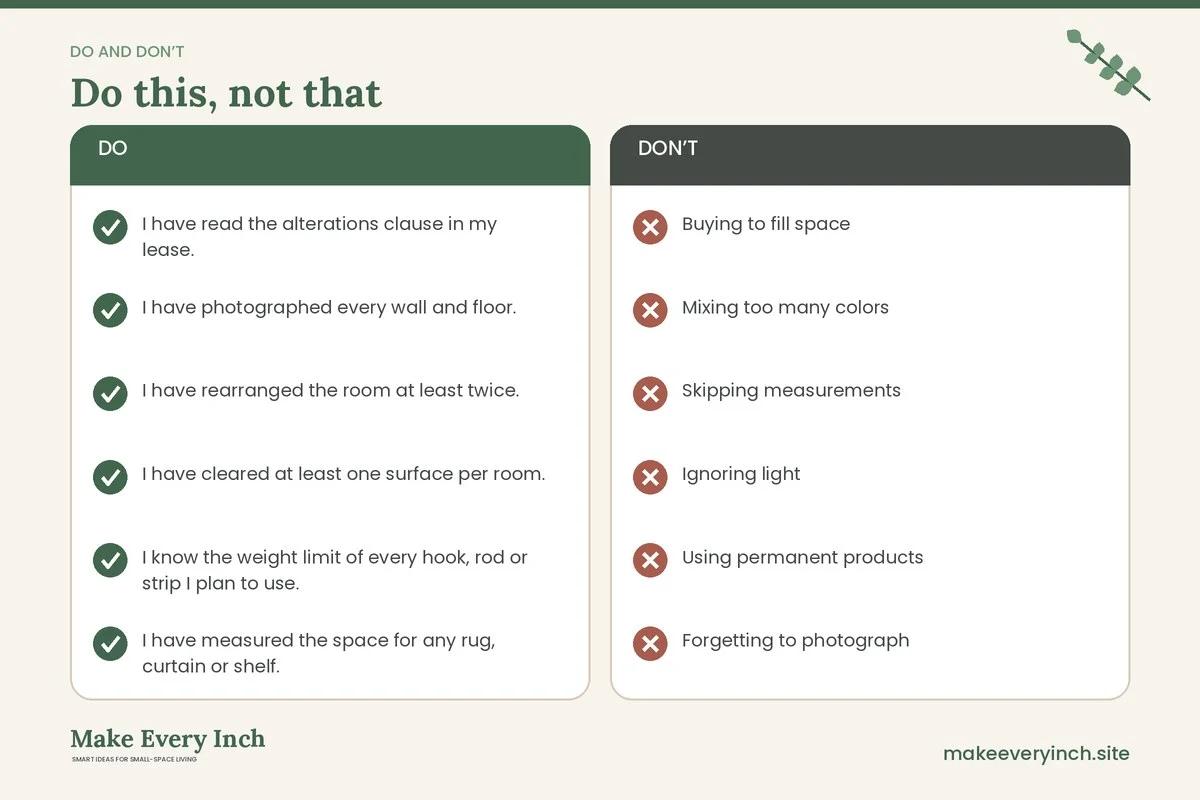
- Buying to fill space: Empty space is not a problem. Fill it only when a specific need appears.
- Mixing too many colors: Pick two main colors and one accent. Cheap items in a consistent palette look intentional.
- Skipping measurements: Wrong-sized rugs, curtains and shelves are the most common waste of money.
- Ignoring light: A dim room looks cheap whatever you put in it. Fix light early.
- Using permanent products: Wallpaper, strong glue and screws can cost your deposit. Choose removable options and test them.
- Forgetting to photograph: Without move-in photos, you cannot prove what was already damaged.
A short checklist before you spend anything
- I have read the alterations clause in my lease.
- I have photographed every wall and floor.
- I have rearranged the room at least twice.
- I have cleared at least one surface per room.
- I know the weight limit of every hook, rod or strip I plan to use.
- I have measured the space for any rug, curtain or shelf.
- I can name the exact spot for each Tier 1 purchase.
- I have a plan to anchor any tall furniture.
- I have checked plants for child and pet safety.
- I have a written savings note for the Tier 3 item.
Frequently asked questions
How much should I set aside for decor in a rental?
There is no single right number, because rent, space and lifestyle differ. A useful approach is to choose a total you are comfortable losing if you move in a year, then split it across the four tiers. Spend little on Tier 1, plan Tier 2, and hold the rest for one anchor item.
What is the cheapest way to make a rental feel like home?
Light, textiles and clean surfaces. Warm light in the evening, a throw and cushion covers, and a clear coffee table often change a room more than new furniture.
Can I paint a rental on a budget?
Only with written permission. If permitted, choose low-VOC paint, ventilate well and ask whether you need to repaint when you leave. If not allowed, use removable fabric, art and lighting instead.
How do I decorate walls when I cannot make holes?
Lean art on shelves and furniture, use light adhesive strips within their weight limit, hang fabric from a tension rod and use plug-in lights. Our guide to renter-friendly wall decor ideas covers each in detail.
Is secondhand furniture a good option?
Often yes, provided you inspect it. Check for pests, odors, wobble and cracks, and clean it before use. Secondhand pieces often keep their value better than new flat-pack items.
What should I buy first?
Nothing. Start with Tier 0. After a week of rearranging and clearing surfaces, the right first purchase is usually obvious, and it is often lighting.
How do I protect my deposit while decorating?
Photograph everything on move-in day, keep all changes removable, store original fixtures if you swap them, and return the home to its original state before you leave.
Keep going: Keep going with renter-friendly apartment decorating ideas, compare budget small space ideas, and read about renter-friendly ways to hide cords to finish the room tidily.
Save this guide for later
Pin the ideas you like to Pinterest so you can come back to them when you plan your space.