Small Home Office Ideas in a Closet
Quick answer: The best small home office ideas in a closet start with the numbers: a closet at least 24 inches deep and about 36 inches wide can hold a shallow desk and a chair, while a 30 inch deep walk-in is far more comfortable. Plan ventilation and heat first, add lighting that avoids glare, run power safely, choose a door that opens out of the way, and keep every change removable if you rent.
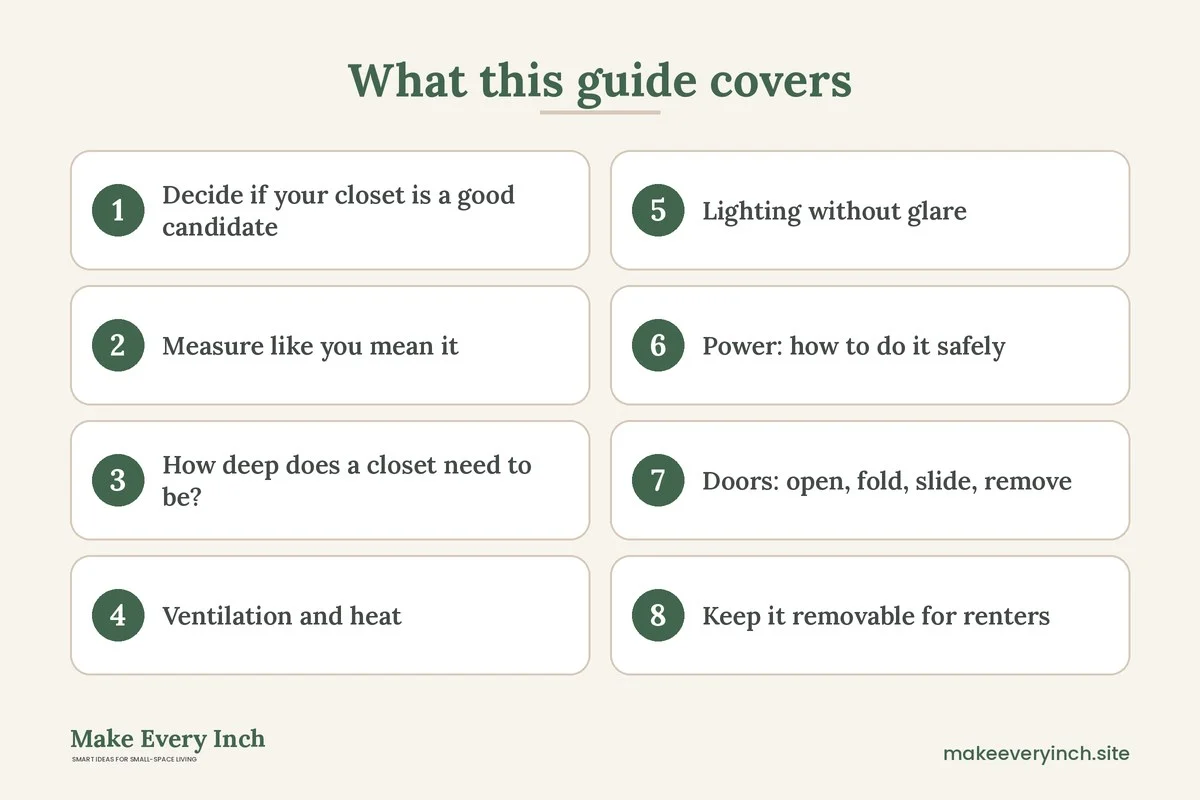
Small home office ideas in a closet appeal to anyone who has a spare alcove and no spare room. A closet already has walls, a door and a ceiling, which makes it one of the few places in a small home that can be closed off at the end of the workday. That separation is the real prize. You shut the door, and the laptop, the notes and the papers disappear. But a closet is also a small, enclosed box with little air movement, one light at most and one outlet if you are lucky, so a good conversion needs more thought than a desk and a chair. This guide covers how to measure, how deep a closet needs to be, what to do about ventilation and heat, how to light and power the space safely, which door styles work, how to keep everything removable for a rental, three example closets, a comparison table, a mistake list and a checklist. For the wider topic, start with our pillar guide to small home office ideas, and for a companion piece on the furniture itself, see small home office desk ideas.
Decide if your closet is a good candidate
Not every closet should become an office. Before you empty the shelves, ask five questions.
- Is it deep enough? A closet under about 20 inches deep is hard to work in, because a laptop and a keyboard need room in front of you. Most closets for hanging clothes are 24 inches deep, which is workable for a shallow desk, and a walk-in or a double-width closet is better.
- Is it wide enough? Around 30 inches is the practical floor for one person with a laptop, and 36 to 48 inches gives room for a monitor, a lamp and a notebook.
- Is it tall enough? Most closets are 7 to 8 feet high, which is plenty for shelves above the desk.
- Is there air? A closet with a vent, a gap under the door or a nearby window is easier to keep comfortable than a sealed box.
- What will you lose? Moving clothes out is part of the cost. If you have nowhere to put them, the project will create clutter somewhere else. Our guide to small closet ideas helps with the clothes that need a new home.
If the answers look good, move on. If your closet is shallow or narrow, consider a fold-down or a wall-mounted solution that sits outside it, or look at how to fit a desk into a studio apartment for other layouts.
Measure like you mean it
A closet office succeeds or fails on a few inches. Write down these measurements and keep them handy.
- Width of the opening and of the interior. Door frames often reduce the opening by an inch or two on each side. Note both numbers.
- Depth from the door line to the back wall. Measure at desk height, because baseboards and trim steal depth near the floor.
- Height to the ceiling and to the top of the door frame.
- The location of the outlet, the light switch and any vent. Mark them on a sketch.
- The swing of the door and what it hits when it opens.
Typical comfortable figures, which vary by person and should be treated as ranges, are a desk surface 24 to 30 inches deep, a desk height of roughly 28 to 30 inches, and a chair seat that leaves around 8 to 12 inches between your thighs and the underside of the desk. In a very shallow closet, a desk with 20 to 22 inches of depth can work for a laptop, but a full-size keyboard and monitor generally need more. Use painter’s tape to mark the desk footprint on the closet floor and sit there for ten minutes with your laptop on a box, then judge whether you could work there for an hour.
How deep does a closet need to be?
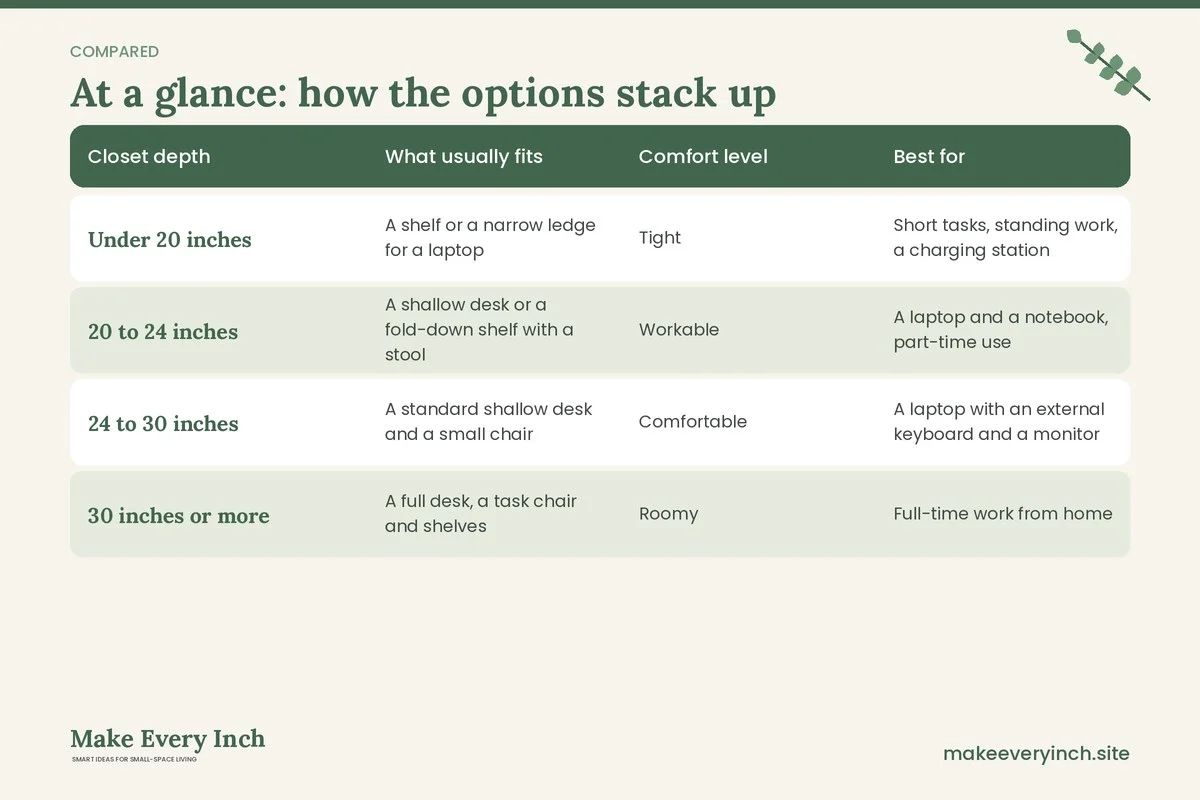
Depth is the most common dealbreaker, so it deserves its own section. Here is a rough guide for what fits at different depths. These are hedged ranges, and your own body, equipment and habits will move the numbers.
| Closet depth | What usually fits | Comfort level | Best for |
|---|---|---|---|
| Under 20 inches | A shelf or a narrow ledge for a laptop | Tight | Short tasks, standing work, a charging station |
| 20 to 24 inches | A shallow desk or a fold-down shelf with a stool | Workable | A laptop and a notebook, part-time use |
| 24 to 30 inches | A standard shallow desk and a small chair | Comfortable | A laptop with an external keyboard and a monitor |
| 30 inches or more | A full desk, a task chair and shelves | Roomy | Full-time work from home |
If your closet is shallow, a tall, narrow chair or a stool that tucks under the desk saves the most room. A chair with arms may not fit, so measure the chair width against the opening. If you want a laptop at a standing height instead, a counter-height shelf and a stool that slides away may be the better choice.
Ventilation and heat: do not skip this step
A closet is a small, closed space, and a person, a laptop and a lamp all give off heat. With the door closed, the air can become warm and stale within an hour. This is a comfort problem, and it can also be a safety issue if electronics are packed tightly with no airflow. Plan ventilation before you plan the decor.
- Keep the door open while you work. Treat the door as a privacy and tidiness tool for when you are away from the desk. A louvered or open door leaves air moving.
- Check for a vent. If the closet has a heating or cooling vent, do not block it. Leave the vent free, and never cover a supply or return vent with furniture or fabric.
- Leave gaps. Keep a few inches between electronics and the walls. Do not stuff cables, papers or fabric behind a router or a power strip.
- Use a small fan. A quiet, low-power fan placed so it moves air across the space can help. Position it so the cord does not cross the floor and check that it is stable.
- Be careful with space heaters. Do not place a space heater in a closet office. The small volume and the nearby paper, fabric and cables raise the fire risk. If the space gets cold, consider heating the room instead, and check your lease and the heater’s instructions.
- Think about humidity and mold. A closet on an exterior wall can feel damp. If you notice a musty smell, a cold wall or condensation, deal with that before adding furniture and papers. Tell your landlord if it looks like a building problem.
If you plan to paint the inside of the closet, choose a low-VOC paint, leave the door open and ventilate while it dries. In a rental, check the lease first and ask for permission in writing. Paint smells can linger longer in a small enclosed space than in a bigger room.
A rule of thumb many people use is to take a break every hour. In a closet that break doubles as an air break: step out, open a window in the main room and let the air move.
Lighting without glare
Closets often come with one bare bulb or no light at all. A poor lighting plan makes the space tiring, so give lighting some attention. Our guide to renter-friendly lighting ideas goes deeper on options that need no wiring.
- Layer the light. Use one general source, such as a ceiling fixture, and one task light that you can aim at your work.
- Avoid glare on the screen. Put the light beside or above the screen and not behind it. A bright bulb in your line of sight, or a glossy surface reflecting the lamp, causes eye strain.
- Choose a neutral to warm white. Very cool, blue-white light can feel harsh in a small space. A lamp with an adjustable color or brightness lets you set it to your taste.
- Use battery or plug-in options in a rental. Adhesive-mounted battery lights, plug-in wall lights and clip-on lamps need no electrician. Rechargeable strip lights can run under a shelf to light the desk.
- Use pale walls. White or a light color bounces light around the closet. If you cannot paint, a removable light-colored panel or a sheet of peel-and-stick covering may help, subject to the lease.
- Mind the cord. A lamp cord that dangles over the desk gets tugged. Route it along the wall, and see our guide to renter-friendly ways to hide cords.
If the closet has a built-in bulb you plan to keep, check the maximum wattage on the fixture and do not exceed it. Use LED bulbs, which produce less heat than older kinds.
Power: how to do it safely
A closet usually has few outlets, which tempts people to chain extension cords. Do not. Electrical safety matters most in a small space with paper and fabric nearby.
- Count your devices. A laptop, a monitor, a lamp and a phone charger draw modest power, but a printer, a space heater or a second monitor adds up fast. Check the label on each device for its power rating.
- Use one good power strip. Choose a power strip with a built-in circuit breaker, plug it directly into a wall outlet and do not plug one power strip into another. Do not use an extension cord as a permanent solution.
- Respect the circuit. Closets are often on the same circuit as the bedroom or the hall. If a breaker trips when you run several devices, stop, unplug something and consider asking a qualified electrician or your landlord for help.
- No outlet inside? Run a flat, low-profile cord from the nearest outlet along the baseboard and tuck it under the door gap, using cord covers that stick on and peel off. Do not run cords under rugs or through places where they may be pinched by the door.
- Do not drill or wire anything. In a rental, any new outlet or wiring must be done by the landlord or an approved electrician. Do not attempt to hardwire a light.
- Keep the strip off the floor. Mount the power strip on the underside of the desk or on a wall with removable hooks if the lease allows, so the plugs stay away from dust and spills.
Heat-generating devices, such as a printer, should live outside the closet or on a shelf with space around them. Switch devices off at the strip when you finish for the day.
Doors: open, fold, slide, remove
The door is the most flexible part of a closet office. It affects airflow, privacy and how much room you have inside. Our post on small closet door storage ideas shows how to use the door itself for storage.
- A hinged door that swings in. Swinging in takes away usable floor space, so it is rarely ideal for a closet office.
- A hinged door that swings out. This is better, though you need clear floor space in the main room. Consider hanging the door on a hook or tying it back with a loop when you work.
- Bifold doors. Bifold doors fold to the side and leave the opening mostly clear. They usually leave a gap on one edge, so they can be left open while you work and closed at the end of the day.
- Sliding doors. A sliding door always covers half the opening. If you remove it, the whole width is available, but the track remains.
- No door at all. In a rental, ask whether you may remove the door and store it, and put it back before moving out. A curtain on a tension rod is a removable replacement that hides the desk and does not block the opening when you are working.
- A door you use as part of the office. The inside of a door can hold a corkboard, a pocket organizer or a hook, but check weight limits and make sure the door still closes.
If you remove a door, label the hinges and screws, put them in a bag and tape the bag to the door. Take photos before you start. Do not remove a door without permission from your landlord.
Keep it removable for renters
A closet office is a great rental project because most of it can be freestanding. The golden rule is that the closet must go back to its original state when you move out. Our guides to organization ideas for renters and no-drill storage ideas for renters cover more of this.
- Use freestanding furniture. A narrow desk, a small shelving unit or a cart needs no tools. Anchor tall shelves to the wall only if the lease allows, and otherwise choose a lower unit that cannot tip.
- Use tension rods. A tension rod across the closet holds a curtain and a shelf-like row of baskets. A second rod can hold hanging organizers.
- Use adhesive strips carefully. Strips and hooks rated for the weight can hold a corkboard or a lightweight shelf. Test them on a hidden spot and follow the weight limit.
- Reuse the existing rod. The clothes rod can hold a hanging shoe organizer for supplies or a hanging file bag. Or lift it out and keep it for later.
- Protect the floor. A mat or a thin rug under the chair prevents scratches.
- Photograph before and after. Date-stamped photos of the closet before you start prove the original state and speed up a deposit return.
- Ask in writing. If you want to remove a shelf or a door, get written permission.
Three example closets
The 24 inch reach-in with a fold-down shelf
A standard reach-in closet, around 24 inches deep and 60 inches wide, is common in bedrooms. Remove the clothes rod and the shelf, if allowed, or work around them. Place a narrow desk, about 20 to 24 inches deep and 36 to 48 inches long, against the back wall, and use a stool or a small chair. Add a plug-in wall light, a rolling cart for papers and a curtain on a tension rod if you want the door off. This layout fits a laptop and a notebook, and it is best for part-time work. See our guide to small reach-in closet organization ideas for how to store the clothes you move.
The 30 inch deep walk-in
A small walk-in closet, about 5 by 6 feet, is the best candidate. Put a 48-inch desk along the back wall and leave about 30 inches of floor for the chair. Mount a shelf above the desk if the lease allows it, or place a freestanding shelving unit at the side. Keep the clothes on one side of the closet and the desk on the other, so the closet works as a wardrobe and an office. For layouts, read about small walk-in closet layout ideas.
The shallow hallway closet
A hallway closet may be only 18 to 20 inches deep, which is too shallow for a desk. Instead, set up a standing station: a shelf at about elbow height holds a laptop, with a tall stool that tucks beside it. Use it for short sessions, answering email or video calls, and not for an eight-hour day. Add a small lamp and a power strip mounted at the side. Keep the closet door on, since a hallway closet often shares airflow with the rest of the home.
Comparison: closet office options
| Option | Depth needed | Setup effort | Removable | Best for |
|---|---|---|---|---|
| Freestanding narrow desk | 24 inches or more | Low | Yes | Full-time work |
| Fold-down shelf | 18 to 24 inches | Medium | Often needs fixings | Short sessions |
| Wall-mounted ledge | 14 to 20 inches | Medium | Depends on the lease | Laptops and notes |
| Desk on casters | 20 to 30 inches | Low | Yes | Rolling it out to use |
| Stool and shelf standing station | 14 to 18 inches | Low | Yes | Quick tasks |
| Rolling cart as a desk | 16 to 22 inches | Low | Yes | Occasional use |
Choose based on how many hours a day you work, whether you rent and how deep the closet is. Many people begin with the cheapest freestanding option and upgrade after a few weeks.
Storage inside the closet
The closet is already built for storing things, so keep that advantage. Use vertical space with shelves above the desk, and keep the work surface clear. Our guide to small space organization ideas has more.
- Shelves above the desk. Keep heavy items low. Anchor tall shelving units to a stud only if the lease allows, and otherwise choose a short unit.
- Wall pockets and pegboards. A pocket organizer on the door or a pegboard on an adhesive-backed panel holds pens, cables and small tools.
- Drawers on wheels. A rolling drawer unit tucks under the desk and comes out for the move.
- Vertical file holders. Papers stand up on a shelf and take less room than a stack.
- Baskets for odds and ends. Label them so you can grab the right one fast.
- A clean surface. Keep only the laptop, a notebook and a lamp on the desk. Everything else has a home on a shelf.
Make it comfortable
Comfort affects whether you actually use a closet office. This section gives general guidance and is not medical advice. If you have pain or a health condition, talk to a professional.
- Set the screen near eye level. A laptop stand or a stack of books raises the screen, and a separate keyboard lets you keep your arms relaxed.
- Use a chair that fits. A chair that tucks under the desk saves space. Some people like a small cushion for the back.
- Add a footrest. If your feet do not rest flat, a low box or a footrest helps.
- Move often. Stand, stretch and leave the closet every so often. Use the door as a reminder to step out.
- Manage sound. Soft materials, such as a rug, a curtain or a fabric-covered board, absorb echo. A closet full of clothes is already a quiet place, which makes it good for calls.
- Reduce visual clutter. A plain wall in front of you helps you focus.
Common mistakes
- Ignoring ventilation. A closed closet gets warm, and that makes you sleepy and uncomfortable.
- Overloading one outlet. Chained power strips and extension cords are a fire risk.
- Using a heater. A space heater in a closet is a bad idea.
- Choosing a bulky chair. If the chair does not fit, the desk is useless.
- Skipping the lease. Removing doors, shelves or rods without permission can cost you your deposit.
- Forgetting where the clothes go. If the clothes land in a heap, the project fails.
- Putting the light behind the screen. This produces glare and tired eyes.
- Blocking a vent. Furniture in front of a heating or cooling vent is both a comfort issue and a safety issue.
- Fixing everything at once. Try the layout with tape and boxes before buying.
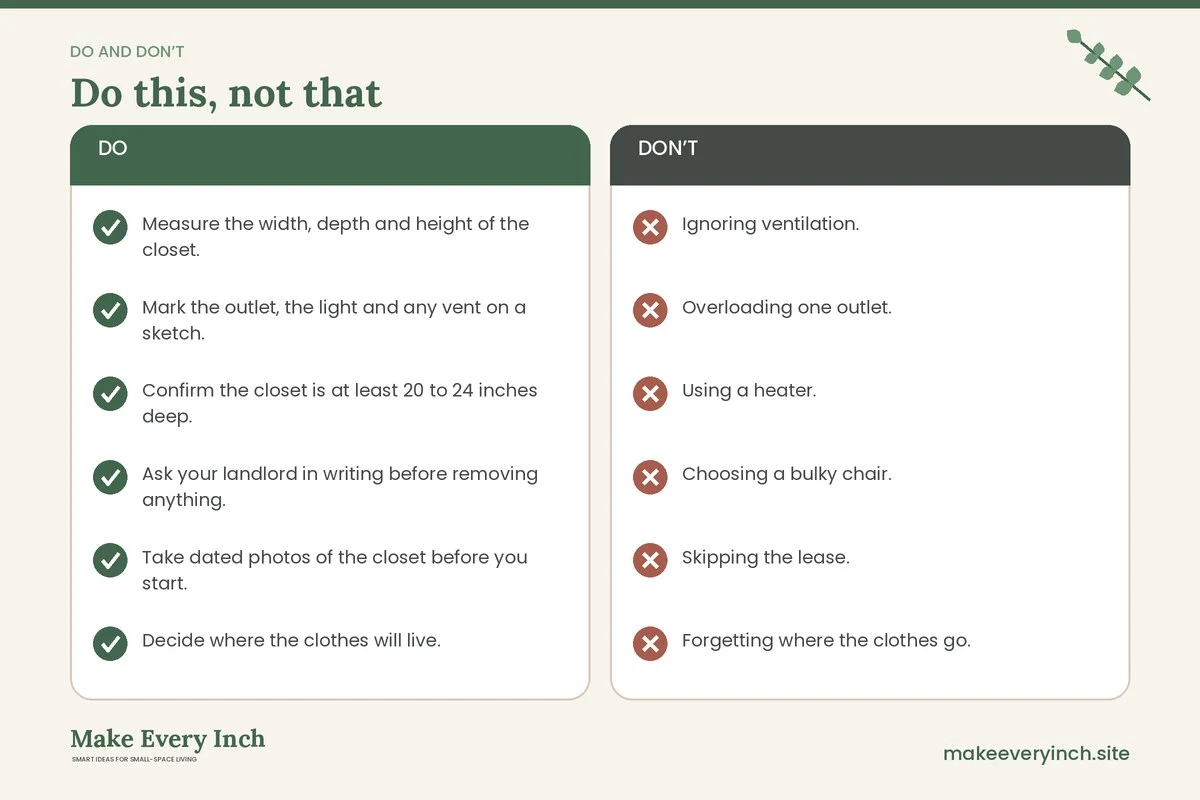
Closet office checklist
- Measure the width, depth and height of the closet.
- Mark the outlet, the light and any vent on a sketch.
- Confirm the closet is at least 20 to 24 inches deep.
- Ask your landlord in writing before removing anything.
- Take dated photos of the closet before you start.
- Decide where the clothes will live.
- Leave vents and gaps clear for airflow.
- Choose a desk, a stool or a shelf that fits the depth.
- Add a task light that avoids glare.
- Use one power strip with a circuit breaker, plugged straight into the wall.
- Keep any space heater out of the closet.
- Choose a door plan: open, bifold, curtain or removed with permission.
- Add storage above and beside the desk.
- Keep tall shelving low or anchored where the lease allows.
- Plan a break every hour and a daily reset.
FAQ
How big does a closet need to be for a home office?
A closet roughly 24 inches deep and 30 to 36 inches wide can hold a shallow desk and a small chair. A bigger closet is more comfortable, and a shallower one is better as a standing station or a short-session spot. Treat these numbers as ranges, since your equipment and body matter.
Is it safe to work in a closet?
It can be, if you plan ventilation, avoid blocking vents, keep electronics from overheating, use power strips correctly and never use a space heater inside. Leave the door open while you work and take regular breaks to move around.
Can I turn a rental closet into an office?
Often yes, when the setup is freestanding and removable. Check your lease, ask for permission before removing doors or shelves, and avoid drilling. Use a curtain, tension rods and adhesive hooks instead.
What should I do about a closet with no outlet?
Do not chain extension cords. Run a flat cord from the nearest wall outlet, protect it with a removable cover and avoid pinching it in the door. If you need a new outlet, ask your landlord about a qualified electrician.
What is the best light for a closet office?
A task light that sits beside or above your screen and does not reflect off it, plus a gentle general light, works well. Plug-in or battery options need no wiring, and an LED bulb makes less heat.
Will a closet office hurt my posture?
It depends on your setup, and this is not medical advice. A screen near eye level, a chair that supports you and regular breaks help most people. If you feel pain, speak with a health professional.
Keep going: Keep planning with our pillar guide on small home office ideas, the companion post on small home office desk ideas and our guide to studio apartment ideas for working from home.
Save this guide for later
Pin the ideas you like to Pinterest so you can come back to them when you plan your space.