Renter-Friendly Storage Ideas for Small Apartments
Quick answer: The best renter-friendly storage ideas for small apartments use freestanding furniture first, adhesive and tension-based options second, and anything that touches the wall only with permission. Go room by room: vertical shelves and bins in the entry, under-bed and lidded pieces in the bedroom, tiered racks and over-door organizers in the kitchen, and rods and stackable bins in the bathroom. Check the load limit of everything, anchor tall units, and photograph your walls before you start.
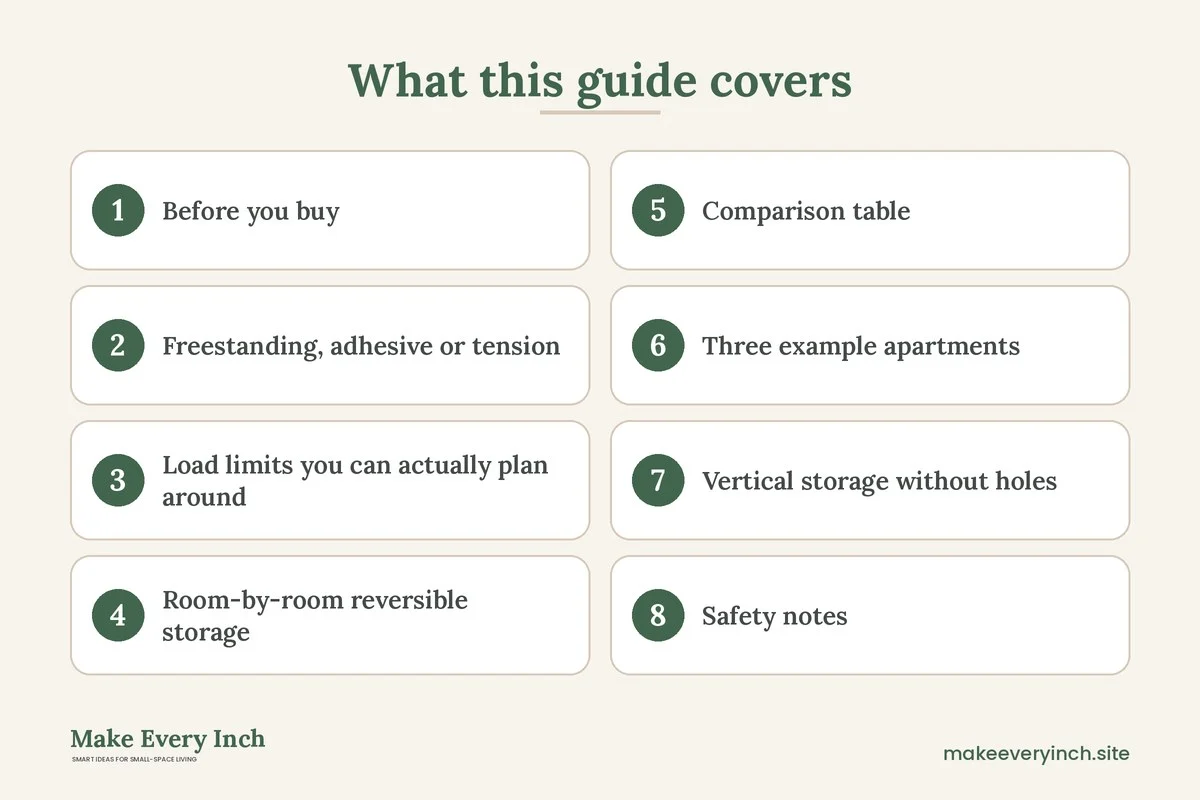
Renter-friendly storage ideas for small apartments have to do two jobs at once. They must hold a surprising amount of stuff in very little floor space, and they must leave the walls, doors and cabinets exactly as you found them. That balance is hard, because the most efficient storage in a small home is usually vertical and attached to the building, which is exactly what most leases forbid. This guide solves the problem room by room. It explains the freestanding versus adhesive versus tension decision, gives load limits and measurements, covers the entry, living room, kitchen, bedroom, bathroom and closet, compares the main methods in a table, walks through three example apartments, and ends with safety notes, mistakes and a checklist. For the wider context, read our hub on renter-friendly apartment decorating ideas, and for a deeper look at hole-free methods, see no-drill storage ideas for renters.
Before you buy: lease, photos and a quick audit
Start with the lease. Look for clauses about screws, nails, adhesives, over-door hardware, shelf brackets and changes to cabinets. If you want to fix anything to a wall, ask for permission in writing. Do not assume that a small hole or a removable strip is acceptable. Then photograph each wall, door, cabinet and floor area where you plan to put storage, in daylight, with a few wide and close shots. These photos are your proof of the original condition when it comes time to recover your deposit.
Next, audit what you own. Empty one category at a time, such as shoes, pantry items or towels, and measure how much space it needs. A rough method is to measure the width, depth and height of the pile, then add 20 percent for growth. Decide what you will keep, donate or store elsewhere. Buying storage before editing leads to bins full of things you do not need. Our post on small apartment decluttering ideas gives a simple routine.
Finally, measure the space. Note the height to the ceiling, the width of alcoves and the clearance under beds and sofas. Measure doorways, hallways and stairs so the pieces you buy can actually get in. Write the numbers on a single page and carry it when you shop.
Freestanding, adhesive or tension: how to choose
Renters have three main families of storage. Each has strengths, limits and risks, and the right choice depends on the load, the surface and your lease.
Freestanding storage
Freestanding pieces stand on the floor and need no fixings. They include bookcases, shoe racks, carts, baskets, bins, ladders and wardrobes. They are the safest bet for heavy loads, because the floor carries the weight. Their weakness is footprint: they take up floor space. Tall units can also tip, so they need anchoring when you have permission, or low, stable proportions when you do not.
Adhesive storage
Adhesive hooks, strips and caddies stick to walls, doors and tiles. They suit light items and save floor space. Every product has a weight rating, and real-world results depend on the surface, its cleanliness, the temperature and humidity, and how long the product stays in place. Textured, dusty, oily, painted-over or damp surfaces often fail. Treat adhesive as a light-duty tool, stay well under the stated limit, and always test in a hidden spot. Get permission first, because removal can lift paint on some surfaces.
Tension and pressure storage
Tension rods, tension poles and pressure-fit shelves wedge between two surfaces. They work for curtains, shower rods, cabinet dividers and light shelving in alcoves. Their holding power depends on the strength of both surfaces and the rod’s weight rating. They are not suitable for heavy loads or for use on surfaces that flex, such as thin drywall edges or loose window frames.
Over-door and hanging storage
Over-door hooks and organizers hang from the top of a door and rest against it. They usually leave no mark, but check the door’s clearance and the lease, because some doors are too tight or have finishes that can scuff. Do not hang heavy loads that could pull the door off its hinges or stop it from closing.
Load limits you can actually plan around
A load limit is a promise from a manufacturer under certain conditions, not a guarantee in yours. Use these planning habits to stay safe.
- Stay under half the stated rating for adhesive products, and under the rating for anything holding items that could fall on a person or a breakable object.
- Spread weight. Two hooks hold more safely than one, and a wide shelf spreads load better than a narrow one.
- Weigh your items. A row of books is much heavier than it looks. A bathroom scale gives you a quick figure for heavy bins and bags.
- Put heavy items low. On any freestanding shelf, put heavy things on the lowest shelves. This lowers the center of gravity and reduces the risk of tipping.
- Check the shelf rating, not just the unit. A shelf may hold a few dozen pounds while the whole unit holds more. Read the label or the instruction sheet.
- Allow for movement. Doors swing, drawers pull and children climb. Add a safety margin whenever motion is involved.
Room-by-room reversible storage
The entryway
The entry is where daily clutter arrives, so it needs fast, simple storage. A narrow shoe rack that stands against the wall holds several pairs in a depth of about 8 to 12 inches. A freestanding coat rack or a hall tree holds jackets and bags without holes. If you have a door, an over-door hook rail gives you more pegs. A small bench with a lid or a basket underneath holds hats, scarves and umbrellas, and gives you a place to sit. Add a tray on a narrow console for keys and mail, and a mirror leaned against the wall. For more, see our post on apartment entryway decorating and our guide to small coat storage ideas.
If you have no entry at all, mark one with a rug, a rack and a basket. Our post on no entryway apartment ideas covers this situation in depth.
The living room
A small living room needs furniture that stores. A lift-top or storage ottoman holds blankets and games. A console behind the sofa holds baskets for remotes and chargers. A freestanding bookcase, kept to a depth of 10 to 12 inches, holds books and baskets without crowding the room. Use matching baskets so that mixed items look tidy. Choose a coffee table with a shelf or drawer where it fits the space. Our guides to small living room storage ideas for renters and small apartment living room ideas with storage add more options.
For walls, use leaning ladder shelves rather than mounted ones. They stand on the floor, lean on the wall at a slight angle, and hold plants, books and baskets. Check that the unit is stable, put heavy things lower, and keep it away from high traffic areas.
The kitchen
Kitchens in rentals usually have too little counter space and few cabinets. Use vertical space inside cabinets with stackable shelves, wire racks and lid organizers. Put a tiered rack or a lazy susan in a deep cupboard to bring back items from the dark. A rolling cart, about 12 to 16 inches wide, holds pots, a kettle or pantry goods and rolls out of the way. A freestanding shelf or a baker’s rack adds a pantry in a dead corner. Magnetic strips and rails work on a fridge side or a metal backsplash, but ask permission before using any adhesive on a painted wall. Our guides to small kitchen storage ideas without remodeling and small kitchen wall storage ideas show how to push further. Check weights on racks that hang from shelves or cabinet doors, since those hinges are not built for heavy loads.
The bedroom
Bedrooms have more hidden space than any other room. The area under the bed is the biggest. Use flat, lidded bins or rolling drawers that fit the clearance, which is often 6 to 12 inches. Bed risers can add several inches when the lease and bed design allow, as long as they are stable and rated for the load. Keep bins off the floor if the flooring is delicate, and slide them rather than drag them. A bed with drawers is a bigger investment, so read our guide to the best beds with storage. Add a bench at the foot of the bed for spare blankets. A tall, narrow dresser holds more than a wide one in the same footprint, but it must be anchored when allowed, and its drawers should be loaded from the bottom up. See our posts on under-bed storage ideas and small bedroom storage ideas that save floor space.
The bathroom
Bathrooms are small, damp and often tiled, which makes adhesive less reliable. Choose freestanding pieces: a slim shelving unit over the toilet that stands on its own legs, a corner shelf unit, a small cart between the sink and the tub, or a stool for towels. Tension poles in the corner of a shower hold baskets for bottles. Hooks that hang over a towel bar or a door use existing hardware. Suction items often fail with soap and steam, so check them regularly. Keep storage clear of the floor drain, away from splash zones for electrics, and never block ventilation. Our guides to tiny bathroom storage ideas and the best over-the-toilet storage give more options.
The closet
A rental closet is often one rod and one shelf. Double the capacity with a second hanging rod that hangs from the first, stackable shelves, a hanging shoe organizer and slim hangers. Use the floor for bins and the top shelf for lidded boxes of off-season items. A freestanding clothing rack can add a second wardrobe in a bedroom corner. Our guide to DIY closet organization for small spaces shows how to use every inch.
Comparison table: which method for which job
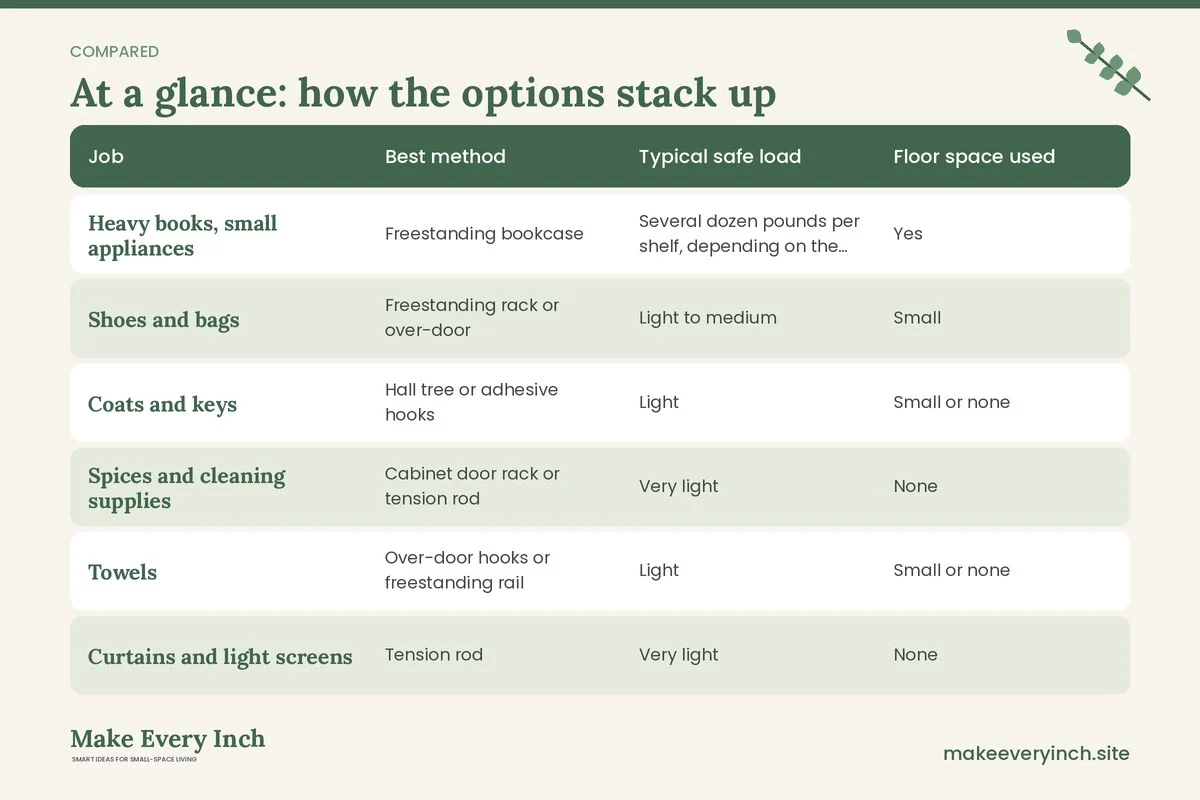
Use this table to pick a method quickly. Always read the rating on the product and treat these ranges as hedged rules of thumb, not guarantees.
| Job | Best method | Typical safe load | Floor space used | Risk to walls |
|---|---|---|---|---|
| Heavy books, small appliances | Freestanding bookcase | Several dozen pounds per shelf, depending on the unit | Yes | None, if anchored with permission |
| Shoes and bags | Freestanding rack or over-door | Light to medium | Small | None to low |
| Coats and keys | Hall tree or adhesive hooks | Light | Small or none | Low if tested |
| Spices and cleaning supplies | Cabinet door rack or tension rod | Very light | None | Low |
| Towels | Over-door hooks or freestanding rail | Light | Small or none | Low |
| Curtains and light screens | Tension rod | Very light | None | Low |
| Linens and off-season clothing | Under-bed bins | Moderate | None | None |
| Pots, pans, pantry | Rolling cart or baker’s rack | Moderate | Small | None |
| Decor and photos | Leaning shelf or ledge | Light | Small | None |
| Tall items such as ladders and mops | Door-back organizer | Light | None | Low |
Three example apartments
A 380 square foot studio
A studio has one room for everything, so every piece of storage must work hard. At the entry, set a narrow shoe rack and a freestanding coat rack beside the door. Use a bed with drawers or flat bins under the bed for clothing. Place a bookcase back to back with the sofa as a room divider, loaded with baskets on the sleeping side. Add a rolling cart in the kitchen for pantry goods and a stackable shelf in the cupboard for plates. The bathroom gets a freestanding corner shelf. Nothing touches the walls. The whole system fits in a van when you move.
A 650 square foot one-bedroom
The living room gets a storage ottoman, a console behind the sofa and a leaning ladder shelf. The kitchen uses a tiered rack in the deepest cupboard and a baker’s rack in the corner of the dining nook. The bedroom has under-bed bins and a bench at the foot. The closet gets a second rod and a hanging organizer. The entry has a bench with baskets and over-door hooks. Because the unit has more wall, the owner asks the landlord in writing about a few shelf brackets, and photographs the wall before and after. If the answer is no, the freestanding plan still works.
A shared two-bedroom with roommates
Shared spaces need clear zones. Give each person a labeled bin or a shelf in the kitchen cupboard and in the bathroom. Add a shared shoe rack at the entry with one row per person. Use a rolling cart as a shared pantry, so that it can be moved when the room is needed. In the living room, use a bookcase and baskets for communal items. Keep a list on the fridge of what is shared. If someone moves out, the pieces that belong to them can leave without disturbing the rest. Our post on organization ideas for renters goes deeper into systems for shared homes.
Vertical storage without holes
Going up is the secret of small spaces. A floor-to-ceiling tension pole system, where allowed and rated for the load, holds light shelves without nails. A tall, narrow bookcase takes the same floor area as a small chair but holds many times more. A ladder shelf or a stackable cube unit goes up without taking up depth. Use the top of wardrobes and cabinets for lidded boxes, but keep items light and well away from ceiling fixtures and sprinklers. A gap of at least 18 inches below a sprinkler head is a common safety rule, so check the rules in your building. See our posts on vertical storage ideas and renter-friendly shelving for more inspiration.
Safety notes
Storage can create hazards if it is chosen carelessly.
- Anchor tall furniture. Bookcases, dressers, wardrobes and tall shelves can tip and cause serious injury, especially to children and pets. Use the manufacturer’s anti-tip hardware and ask your landlord for permission to drill. If drilling is not allowed, choose low and wide pieces, put heavy items at the bottom, and keep climbing children away.
- Never overload adhesive products. A fall can break items and injure people. Keep adhesive hooks away from beds, cribs and seating.
- Respect electrical safety. Do not place storage against hot appliances, radiators or heaters. Keep plug strips off the floor in damp areas, and never cover them with fabric or bins.
- Keep exits and vents clear. Do not block doors, windows, fire exits, smoke alarms or heating vents. Keep storage clear of the water heater and the electrical panel so they remain accessible.
- Ventilate closed spaces. Stored damp towels or clothing can grow mildew. Leave a gap for air. If you apply any sealant or paint, with permission, use low-VOC products and open the windows.
- Lift properly. Put heavy items at waist height or below, and avoid stacking boxes high enough to topple.
Protecting your deposit
Your deposit is protected by proof and care. Photograph the walls, floors and cabinets before you start and after you finish. Keep a folder with the lease, emails granting permission and the dated photos. Test adhesives in a hidden place and remove them slowly, using gentle warmth if the manufacturer recommends it. Use felt pads under freestanding furniture to prevent floor scratches. Do not slide heavy bins across a finished floor. Our guide to security-deposit-safe apartment upgrades lists more habits.
Common mistakes
- Buying before editing. More storage means more clutter if you keep everything.
- Forgetting depth. A deep shelf in a narrow hall steals walking space. Measure the clearance, and keep a path at least 30 inches wide where you can.
- Overloading adhesive. If the label says a certain weight, plan for much less.
- Skipping the anchor. An unanchored tall unit is a tipping risk. Ask for permission or choose a lower piece.
- Ignoring humidity. Adhesive and cardboard fail in steamy rooms.
- Using mismatched containers. A jumble of sizes wastes space. Choose a few modular sizes that stack.
- Forgetting the lease. A small hook that damages paint can cost more than the shelf was worth.
Reversible storage checklist
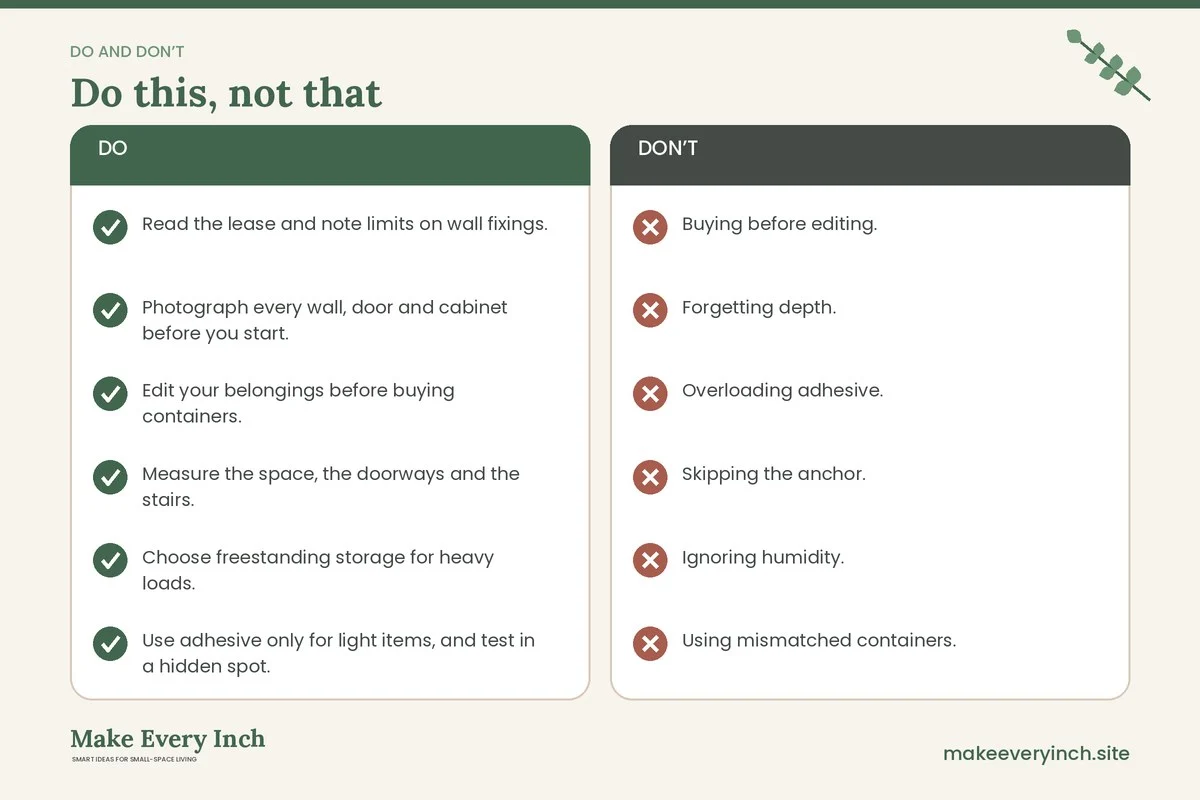
- Read the lease and note limits on wall fixings.
- Photograph every wall, door and cabinet before you start.
- Edit your belongings before buying containers.
- Measure the space, the doorways and the stairs.
- Choose freestanding storage for heavy loads.
- Use adhesive only for light items, and test in a hidden spot.
- Stay under half the stated load rating.
- Put heavy items on the lowest shelves.
- Anchor tall furniture with permission.
- Keep walkways at least 30 inches wide where possible.
- Keep exits, vents and panels clear.
- Label bins so you can find things.
- Use felt pads under furniture feet.
- Keep original hardware and boxes.
- Repeat the photos before you move out.
FAQ
What is the best storage for a rental that bans drilling?
Freestanding pieces are the best choice. Bookcases, racks, carts, ottomans, under-bed bins and ladder shelves need no fixings. Use adhesive and tension products only for light loads and with permission.
How much weight can an adhesive hook hold?
It depends on the product, the surface and the conditions. Read the rating, plan to use half or less, and test in a hidden spot. Avoid adhesives for heavy, fragile or hazardous items.
How do I stop a tall bookcase from tipping without drilling?
Choose a low, wide design, put heavy items at the bottom, and keep it away from children. If you can get permission to use an anti-tip strap, that is the best option. Ask your landlord in writing.
Can I use tension rods for shelves?
Light loads only. Tension rods hold curtains, small baskets and dividers. They are not suited to heavy items, and they depend on strong, rigid surfaces at both ends.
Will under-bed storage scratch my floor?
It can, if bins are dragged. Choose bins with smooth bases or felt pads, and lift rather than slide. On delicate floors, use rolling bins with soft wheels.
How can I add storage to a bathroom with tile walls?
Choose freestanding shelves, a corner unit, an over-the-toilet shelf with legs, or a cart. Adhesive products often fail on wet tile. Check them often if you use them.
How do I store things when I have no closet?
Use a freestanding wardrobe or a clothing rack, add bed storage, and keep seasonal items in lidded bins under the bed or on top of furniture. Edit your clothing so the system stays manageable.
Keep going: Keep going with our guide to renter-friendly small space upgrades that make a difference, our ideas for small home storage in every room and our tips on cheap storage ideas for apartments.
Save this guide for later
Pin the ideas you like to Pinterest so you can come back to them when you plan your space.