14 Small Living Room TV Wall Ideas for Couples Who Share One Screen
Quick answer: The best small living room TV wall ideas for couples balance two tastes on one wall: a screen sized for a 6 to 8 foot viewing distance, centered near seated eye height (about 40 to 44 inches from the floor), with storage split into his, hers and shared zones. Keep both seats within about 30 degrees of the screen’s center line, anchor everything to the wall, and follow the TV and mount instructions.
Small living room TV wall ideas for couples are really about negotiation. One person wants a big screen and a console full of cables, and the other wants a calm wall with books, plants and art. In a small room there is only one wall that can do the job, so the design has to satisfy both. This guide takes a couple’s-eye view of the TV wall. It covers how to settle the screen debate, where each of you should sit, the angles and heights that keep both seats comfortable, 14 layouts, a compromise table, night-in routines, noise and lighting tips, safety rules for mounting, and a checklist. For the broad overview, read our main guide to small living room TV wall ideas and the wider small living room ideas pillar. The sibling posts on modern TV walls and cozy TV walls cover style in more depth.
Settle the screen debate first
Before you buy a bracket or move a shelf, talk through four questions together. It sounds fussy, but the answers decide almost everything else on the wall.
- How often is the screen on? A couple who watches one show every evening needs a different wall than a couple who only watches on weekends.
- What else is the screen for? Games, video calls, workouts, background music and shared photos all change where the screen should go and how it should be mounted.
- How visible should it be when off? Some people do not mind a black rectangle. Others want it hidden. This is the biggest style disagreement in most homes.
- Who controls the clutter? Remotes, game controllers, chargers and streaming sticks pile up quickly. Agree on one shared home for them before they spread.
A helpful trick is to rank your needs separately, then compare. Each of you writes down your top three wishes for the wall. Where the lists overlap, those are fixed. Where they differ, look for a layout that gives each person at least one win. A hidden-screen cabinet might suit the person who dislikes black rectangles, while a good sound setup suits the person who loves film nights.

Where each of you sits
Most couples sit side by side on a sofa, and the screen should be centered on the pair, not on one seat. If the sofa is 72 to 84 inches wide, the center of the pair is usually close to the center of the sofa. A screen centered on the wall but viewed from the far end of the sofa will feel off-axis.
The angle rule
Aim for each seat to be within roughly 30 degrees of a line that comes straight out of the center of the screen. On a 72 inch sofa viewed from 7 feet, a seat at the far end sits about 36 inches off center. That gives an angle of roughly 23 degrees, which is comfortable for most screens. On a sofa 96 inches wide at 6 feet, the end seat might hit 35 degrees or more, and the picture can look washed out or distorted, especially on some panel types. If the angle is too wide, move the sofa back, turn the screen slightly or use a swivel mount.
Matching viewing habits
Couples rarely agree on posture. One person likes to curl up with feet on the sofa. The other likes to slouch with a laptop. Check the screen from each person’s typical position, including lying down. The sofa-sitting eye height is about 38 to 44 inches from the floor, and a lying position is closer to 25 to 30 inches. If one of you often lies on the sofa, aim the center of the screen lower, around 38 to 40 inches, or use a tilting mount to angle it down slightly.
Measurements that keep both seats comfortable
These numbers apply to a typical small living room. Treat them as starting points and check your own setup with painter’s tape and a piece of cardboard cut to the screen size.
- Viewing distance: about 1.2 to 1.6 times the screen’s diagonal. For a 43 inch screen, 4.5 to 6 feet. For a 50 inch screen, 5 to 7 feet. For a 55 inch screen, 5.5 to 7.5 feet. Follow the manufacturer’s guidance for your model.
- Screen center height: 40 to 44 inches from the floor for a standard sofa. Lower for a low lounge sofa or for lying down.
- Sofa to wall gap: 7 feet or less in most small rooms. Under 6 feet and a large screen feels overpowering.
- Console depth: 14 to 18 inches for a base cabinet, which leaves a walkway of 30 inches or more in front of the sofa.
- Side clearance: 4 to 6 inches between the screen and neighbors to avoid a crowded wall.
- Shelf height above the screen: at least 4 to 6 inches, and keep the load light.
- Seating spacing: if you use two chairs instead of a sofa, place them 18 to 24 inches apart so that the pair feels like one audience.
Stand where you sit, hold up the cardboard cutout against the wall and ask each other: Can you see all four corners? Is it too high? Does your neck feel strained? A five-minute test saves a lot of unscrewing later.
14 small living room TV wall ideas for couples
Layouts that give both of you a say
1. A balanced wall with two shelves
Mount the screen in the center and put a shelf on each side. One shelf is his and one is hers. Fill one with books and the other with plants, or let each person decide. The symmetry makes the wall feel balanced, and each of you gets a personal display area.
2. A hidden-screen cabinet
For the person who dislikes a black rectangle, a cabinet with doors closes over the screen. The other person gets a media setup that is ready for a film. Use a cabinet with ventilation, and never close the doors while the TV is on, since gear and screen need airflow. Follow the manufacturer’s instructions for clearances.
3. A gallery wall that wraps the screen
Hang framed prints, photos and small mirrors around the screen so it becomes part of the arrangement. Black frames echo the screen, which makes it blend in. Keep the screen at the center and arrange pieces in a rough rectangle. For lightweight options that avoid damage, see our post on renter friendly wall decor ideas.
4. A paint block behind the screen
Paint a rectangle or an arch behind the TV in a deep, rich color. The dark backdrop reduces the contrast between a bright screen and the wall, which is gentler on the eyes. It also frames the screen as a feature. Choose a color both of you like, and test a sample before you commit.
Layouts that save space
5. A narrow console with a pair of baskets
A console of 12 to 14 inches deep fits tight rooms. Slide two baskets underneath, one for each person’s blankets, books or game gear. Put the router and a tidy power strip in a closed section.
6. A floating shelf run
A long floating shelf under the screen holds the streaming box, a soundbar and a few decor pieces, and leaves the floor open. Make sure the shelf can carry the load, and fix it to studs or with anchors rated for the weight. Always follow the instructions for the shelf and the TV.
7. A corner setup with an angled screen
In a small room with a sofa against one wall, a corner TV on an articulating mount lets both of you watch from the sofa and swing the screen toward the dining table for meals. Check that the arm, when extended, clears the shelves and the door.
8. A TV over a low bookcase
A low bookcase of 30 to 36 inches tall holds books, games and baskets, and the TV hangs above. The bookcase top works as a surface for a lamp, a plant and a couple of framed photos. A bookcase is easier to move than a built-in, which suits couples who rent.
Layouts for different tastes
9. A warm wood wall with soft lighting
For couples who want a cozy feel, wood slats or a wood-effect panel behind the screen soften the look. Add a warm LED strip behind the panel for a gentle glow. Panels should be installed according to their instructions and fixed to the wall structure, not just to drywall surface. See our cozy sibling post for more atmosphere ideas.
10. A sleek, minimal wall
For couples who like clean lines, mount the screen on a slim mount and tuck every cable out of sight. Use a single floating shelf with a soundbar and nothing else. The calm, bare wall stays restful, and the screen is the only feature.
11. A shelf wall with a place for hobbies
If each of you has a hobby, give it a shelf. A shelf for records or a camera, a shelf for craft supplies or plants, and the screen in the middle. The wall tells your story as a couple, and the screen becomes one piece among many.
12. A two-tier wall: media below, art above
Keep the screen low, near the top of the console, and place a large art piece or a mirror above. The screen sits at the center of the composition, and the eye travels up to the art. Use a mirror carefully so it does not reflect the screen glare onto the sofa.
Layouts for multi-purpose rooms
13. A TV wall that doubles as a work corner
If one of you works from home, put a narrow desk shelf at one end of the media wall. The screen can double as a second monitor on an arm. Keep the work zone to one side so that the other person can watch in the evening. The guide to best desks for small apartments can help.
14. A fold-away media setup
For a studio or an open plan, use a rolling stand or a swing-arm mount that stows the screen against the wall when you are not watching. A fold-away design keeps the sleeping or dining area calm and gives the room a second life in the daytime.
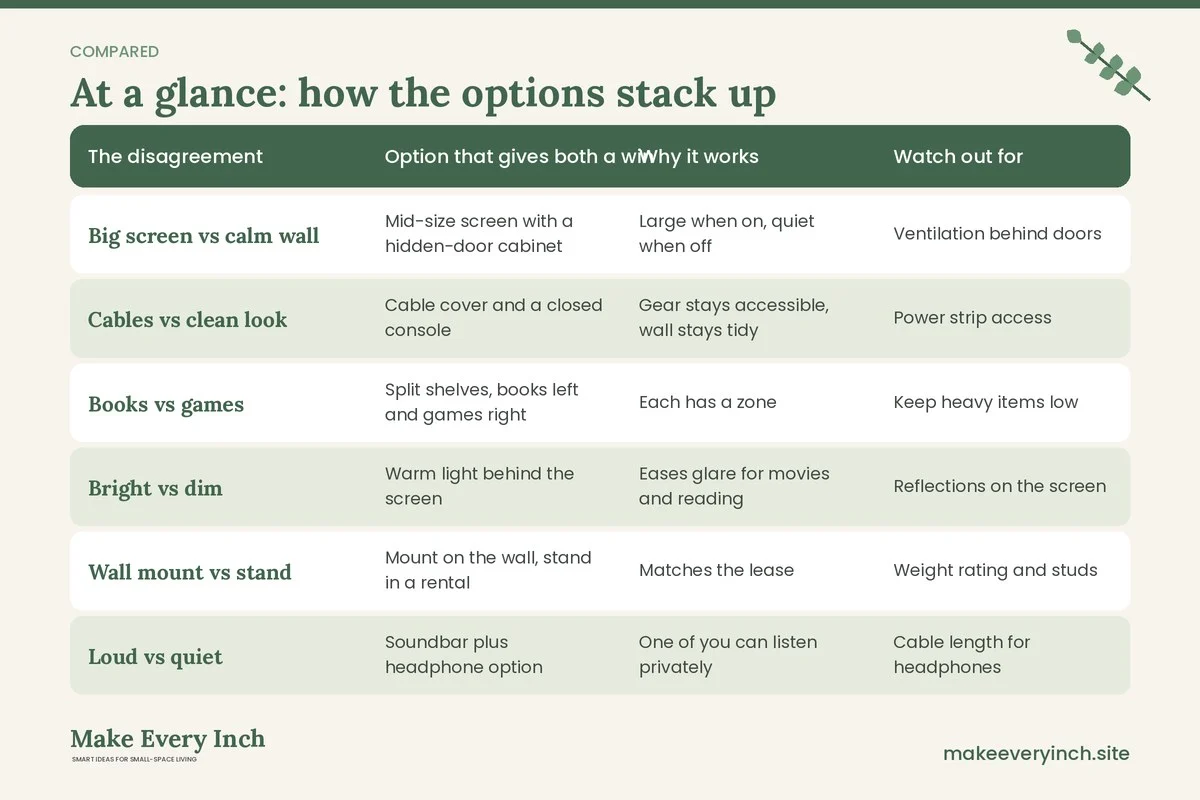
Compromise table: who gets what
Use this table as a negotiation tool. Find the row that matches the disagreement, and look at the option that gives both of you something.
| The disagreement | Option that gives both a win | Why it works | Watch out for |
|---|---|---|---|
| Big screen vs calm wall | Mid-size screen with a hidden-door cabinet | Large when on, quiet when off | Ventilation behind doors |
| Cables vs clean look | Cable cover and a closed console | Gear stays accessible, wall stays tidy | Power strip access |
| Books vs games | Split shelves, books left and games right | Each has a zone | Keep heavy items low |
| Bright vs dim | Warm light behind the screen | Eases glare for movies and reading | Reflections on the screen |
| Wall mount vs stand | Mount on the wall, stand in a rental | Matches the lease | Weight rating and studs |
| Loud vs quiet | Soundbar plus headphone option | One of you can listen privately | Cable length for headphones |
| Art vs screen | Gallery wall that wraps the screen | Screen becomes part of a display | Glare from glass frames |
Night-in routines that keep the wall tidy
A good wall can be undone by a bad habit. A few routines keep the system from collapsing.
- The remote dock: give every remote and controller one home, such as a tray on the console. The last person to finish returns them.
- The two-minute reset: before bed, return blankets to the basket, pick up cups and put controllers back. It takes two minutes and keeps the room restful for the morning.
- Charging station: a small basket inside the console with a multi-port charger stops phones sprawling across the room.
- A shared playlist for the wall: if the screen shows photos or art when it is off, agree on which pictures run. It makes the wall feel personal.
- A weekly dust: screens attract dust, and open shelves show it. Spend five minutes on the wall on the same day each week.
Sound, volume and shift schedules
Couples often have different sleep or work schedules. A small living room can be close to a bedroom, so sound matters.
- Soundbar or small speakers: a compact soundbar delivers clear speech at low volume, which lets one of you watch while the other sleeps nearby.
- Wireless headphones: if your screen supports them, they let one of you watch at full volume while the other reads. Keep a charging spot near the sofa.
- Soft surfaces: a rug, curtains and upholstered pieces soak up echo. A bare small room can sound loud even at low volume.
- Vibration: do not set a subwoofer on a floating shelf. Keep it on the floor, with a felt pad to protect the floor.
- Quiet hours: agree on a time after which the volume comes down. It is a small habit that prevents arguments.
Lighting for two moods
A TV wall that looks great during the day can feel harsh at night. A bright screen in a dark room can tire the eyes, and a bright overhead light can create glare.
- Bias lighting: a soft LED strip or lamp behind the screen reduces eye strain by lowering the contrast between the screen and the wall. Choose a neutral or warm tone.
- Lamp on each side: a small lamp at each end of the sofa lets one person read while the other watches. Dimmable bulbs are best.
- Avoid reflections: place lamps so their light does not bounce off the screen. Check from both seats.
- Control the daylight: curtains or blinds near the TV wall reduce glare in the afternoon.
Our guide to small living room lighting ideas gives a more detailed plan.
Safety: mounting, anchoring and living with it
A screen on the wall is heavy and expensive, and a falling one can hurt someone. Treat the safety steps as non-negotiable.
- Read the instructions for the TV and the mount. They state the weight limit, the hole pattern, the screws and the recommended fixing method. Follow them exactly.
- Find the studs. Use a stud finder and mark the studs. Fix the mount to studs where possible. If the studs are in the wrong place, ask a professional about the right fixing for your wall type, such as masonry anchors for brick or concrete and suitable heavy-duty anchors for drywall, rated for the load.
- Check for hidden services. Scan for pipes and wires before drilling.
- Use two people. Lifting a screen onto a mount alone is how screens get dropped.
- Anchor furniture. Any tall bookcase, cabinet or shelf unit beside the screen should be fixed to the wall with anti-tip hardware.
- Mind the cables. Keep cords out of walkways and away from small children and pets. Do not run mains cable inside a wall unless it is in-wall rated and installed by a licensed electrician.
- Keep vents clear. Do not block the vents of the screen or the gear. Leave space around them.
- Weight on shelves. Check the load rating of every shelf. Place heavy items low.
In a rental, check the lease before you drill. If drilling is not allowed, a floor stand, a TV on a console or a leaning shelf unit can keep the screen off the wall. Our guides to no-drill storage ideas for renters and small living room ideas for renters have more options.
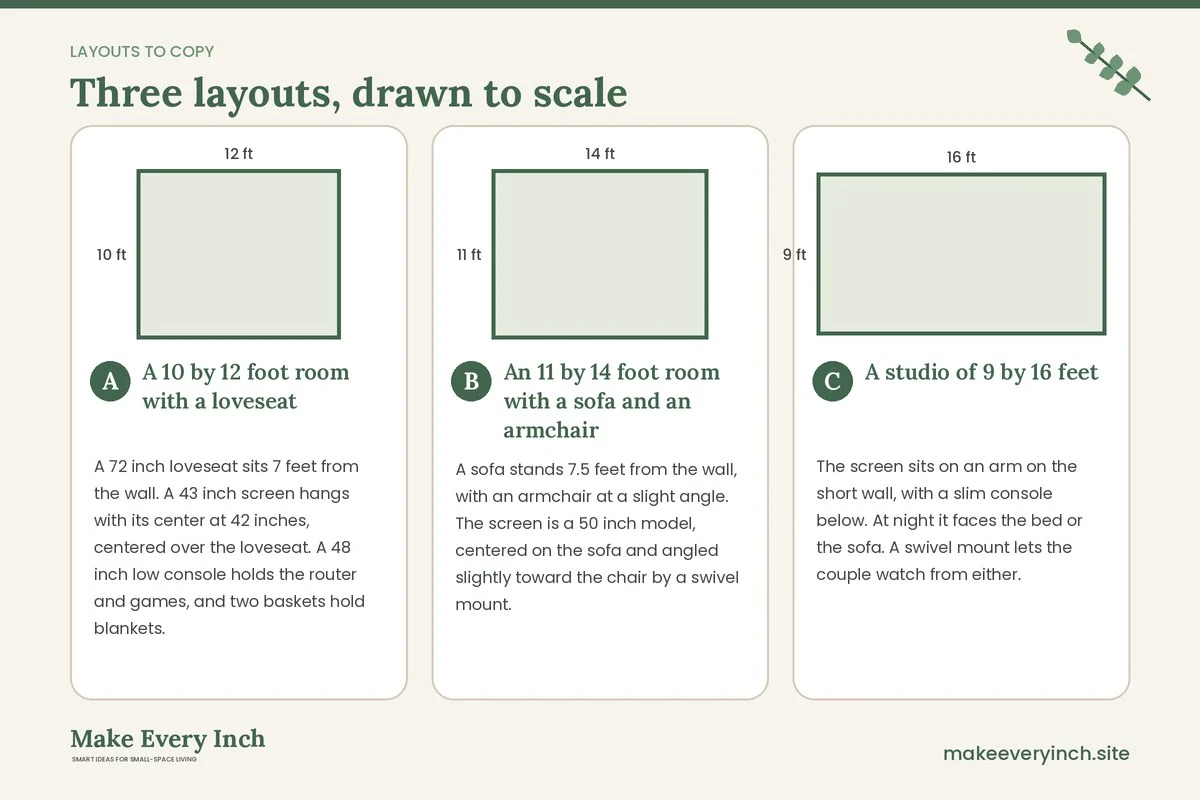
Three example rooms for couples
A 10 by 12 foot room with a loveseat
A 72 inch loveseat sits 7 feet from the wall. A 43 inch screen hangs with its center at 42 inches, centered over the loveseat. A 48 inch low console holds the router and games, and two baskets hold blankets. A floating shelf on each side holds a plant and a lamp. The far seat is about 23 degrees off axis. The room reads as a quiet, balanced pair.
An 11 by 14 foot room with a sofa and an armchair
A sofa stands 7.5 feet from the wall, with an armchair at a slight angle. The screen is a 50 inch model, centered on the sofa and angled slightly toward the chair by a swivel mount. A bookcase of 34 inches tall on the left holds books and games. The chair is within about 30 degrees of the center line. The couple can stretch out or sit upright.
A studio of 9 by 16 feet
The screen sits on an arm on the short wall, with a slim console below. At night it faces the bed or the sofa. A swivel mount lets the couple watch from either. Doors on the console hide the gear. The wall doubles as a divider, with a slim shelf that holds a lamp and a plant.
Mistakes couples make
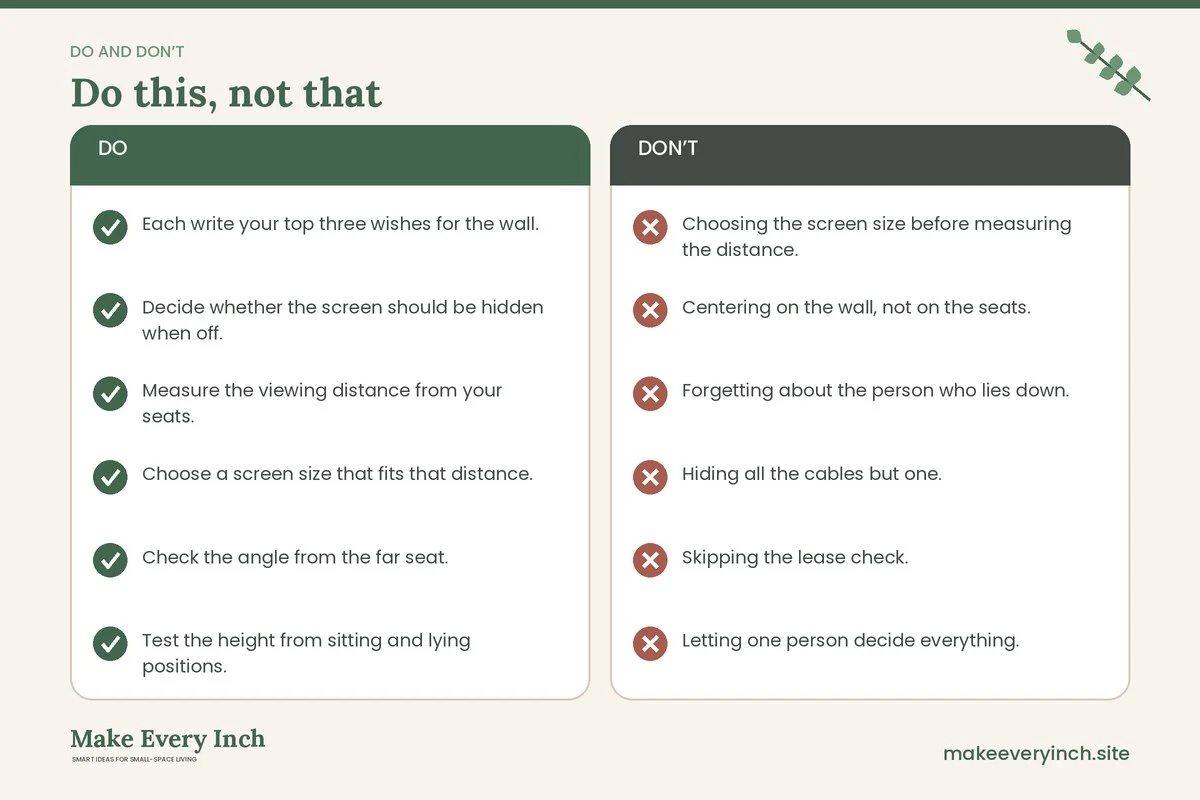
- Choosing the screen size before measuring the distance. A big screen in a small room strains both of you.
- Centering on the wall, not on the seats. The viewers matter more than the wall.
- Forgetting about the person who lies down. Check the height from a reclined position.
- Hiding all the cables but one. Leave an accessible power strip.
- Skipping the lease check. A drilled wall can cost a deposit.
- Letting one person decide everything. A shared wall needs a shared plan, and a quick compromise table avoids long arguments.
- Ignoring sound. A thin wall and a late shift need a soundbar or headphones.
- Overloading floating shelves. Check the weight rating and use proper fixings.
Budget and phasing
You do not need to finish the wall in one weekend. Start with the essentials: a safe mount, a cable plan and a place for the remotes. Live with it for two weeks and note what bothers each of you. Then add the shelf, the lamp, the art or the paint. Second-hand shops and local marketplaces often have low consoles and bookcases. Prices and availability vary, so measure first and compare options. Keep a running list of annoyances, and use it to decide what to add next.
Couple’s checklist
- Each write your top three wishes for the wall.
- Decide whether the screen should be hidden when off.
- Measure the viewing distance from your seats.
- Choose a screen size that fits that distance.
- Check the angle from the far seat.
- Test the height from sitting and lying positions.
- Mark the stud positions.
- Confirm the weight rating of the mount.
- Plan cables, the power strip and the charging spot.
- Add a lamp or bias light for night viewing.
- Plan a sound solution for quiet hours.
- Anchor any tall furniture.
- Agree on where remotes and controllers live.
- Schedule a weekly five-minute tidy.
FAQ
How high should we hang the TV if one of us lies on the sofa?
Aim for the screen center between 38 and 42 inches from the floor, or use a tilting mount. Test from both positions with a piece of cardboard before drilling.
What size TV is best for a couple in a small living room?
For a seat 6 to 8 feet away, many couples find 43 to 55 inches comfortable. Measure your distance, and check the manufacturer’s guidance for your model.
Can we hide the TV without a cabinet?
Yes. A gallery wall that wraps the screen, a dark paint block behind it or a mirror-style frame can make it less prominent. Pick the option you both like.
How do we avoid arguments over clutter?
Give each of you a basket or shelf, plus a shared tray for remotes. The rule is simple: if it is not in its home, it goes back before bed.
Is it safe to mount a TV over a shelf or console?
It can be, if the screen is fixed to the wall structure, not to the shelf, and the shelf is clear of the screen’s heat and vents. Follow the TV and mount instructions.
What can renters do instead of drilling?
Use a floor stand, a media console or a tall unit with anti-tip fixings that need only small holes, and ask your landlord first.
How do we watch at different volumes?
A compact soundbar and wireless headphones let one person listen privately. Soft furnishings help reduce echo.
Keep going: Keep planning with our small living room storage ideas, small living room furniture ideas and the sibling guide to budget TV wall ideas.
Save this guide for later
Pin the ideas you like to Pinterest so you can come back to them when you plan your space.