16 Small Balcony Ideas for Hot, Sunny Spaces to Cool and Shade
Quick answer: For small balcony hot sunny spaces, map where the sun falls, then layer shade you can set up without drilling, choose light-colored and cool-to-touch surfaces, pick heat-tolerant and pet-safe plants in heavy low pots, and keep furniture back from the railing. Check your lease, weight limits and fire rules first, and secure anything that wind or heat could move.
Small balcony hot sunny spaces are a gift in winter and a challenge by midsummer. The same sun that makes a balcony bright in the morning can turn it into a hot, glaring box by afternoon, with scorching floors, faded cushions and plants that wilt before dinner. The goal is not to block all the light. It is to shape the sun, so that the balcony has a cool corner, a comfortable hour and a safe set of surfaces. This guide covers a sun-path method, the lease and safety checks, 16 ideas for shade, surfaces, plants and furniture, a materials table, three example balconies, watering and drainage, cooling at night and a checklist. For the wider topic, read our pillar guide to small balcony ideas, and for the dining side of the story, see how to create a tiny outdoor dining area.
Start with permission and safety
Heat makes everything on a balcony behave differently: surfaces get hot, containers dry out, fabrics fade and wind can feel stronger when the air is warm and dry. Before you add anything, check the rules and the risks.
Lease, landlord and building rules
Read the lease, building rules and any HOA or landlord notes. Many forbid hanging items from railings, attaching shades to walls or ceilings, storing items outside or using certain materials. Some require a neutral look from the street. When in doubt, ask in writing. Never drill into a railing, wall, ceiling or floor without permission, because those parts are often structural and owned by the building. Everything in this guide can be done with freestanding, weighted or tied-on solutions, but even ties need approval if they touch the railing.
Weight limits
A balcony has a load limit you cannot see. Heavy planters full of wet soil, a bench, a table and several people can add up fast. Ask the building manager about the limit, spread weight across the floor rather than stacking it in one spot, and choose lightweight materials where you can. If you notice cracks, rust, spongy floors or a loose railing, stop using the balcony and report it.
Railing height and climbing risk
The railing is the main safety barrier. It is designed for adults, and a determined child or pet may climb furniture to get over it. Keep chairs, benches, planters and tables well back from the railing, at least a couple of feet where you can. A decorative screen or shade cloth on a railing does not make it safer, and may give a false sense of security. If you have young children or active pets, treat the balcony as a supervised space, and keep the door closed when no adult is outside.
Falling objects and tip-over
A hot, sunny balcony tends to be breezy, and wind plus tall objects equals tip-overs. Keep planters, shelves and decor within the line of the railing, never on top of it, and avoid rail-mounted planter boxes, which many buildings ban because they can fall on people below. Use heavy, low containers, place tall pots against a wall or in a corner, and bring light items inside when storms are forecast. Secure anything that could blow away or tip, including umbrellas, shade cloths and lanterns.
Fire rules, grills and open flame
Sun-dried plants, cushions and wooden decks burn easily. Many leases and codes ban grills, fire pits, patio heaters and open flames on balconies, including candles. Check your rules before you bring any of these out. Choose flameless LED lanterns instead of candles, and never leave anything hot or burning unattended. Dry leaves and debris in corners should be cleared regularly in the hot season.
Electrical safety for lights and fans
Heat and sun are hard on cables. If you use outdoor string lights or a small fan, use items marked for outdoor use, plug them into a GFCI-protected outlet where one is available, and never overload a socket or a power strip. Do not run cords through a door gap where they can be pinched, and keep plugs off wet floors. Battery or solar lights avoid most problems on a rental balcony. Unplug everything in storms.
Drainage and water damage to neighbours
Hot weather means more watering, and more watering means more runoff. Water that spills over the edge lands on the balcony below, and standing water can damage the floor and the structure. Keep drains clear, use saucers with a lip under each pot, empty them after watering, and never hose down the floor. If a plant waters itself through its drainage hole onto the tiles, move it to a deep tray. Tell the building manager if you notice leaks, staining or peeling paint.

Map the sun before you buy anything
Stand on your balcony at three times of day, such as 9 a.m., 1 p.m. and 5 p.m., and note where the sun lands. A phone photo at each time works well. Mark the zones on a sketch: full sun, part shade and shade.
Read the direction
A balcony that faces south in the northern hemisphere gets strong light for much of the day, and the high midday sun is easiest to block with an overhead cover. A west-facing balcony gets low, intense afternoon sun, which is harder to block from above and often needs a vertical screen. East-facing balconies get a gentler morning sun that often finishes before the day gets hot. In the southern hemisphere, the directions reverse. Knowing which sun you have tells you whether you need a roof, a wall or both.
Find the heat sources
Heat comes from the sun directly, but also from reflected light. Glass doors, light walls and metal railings bounce heat back onto the balcony. Dark floors absorb heat and release it into the evening. Note which surfaces feel hot at 3 p.m. by touching them lightly with the back of your hand. Those are your target zones.
Choose a cool zone
Pick one corner and make it the cool zone, even if the rest stays sunny. A cool corner for sitting, a sunny shelf for herbs and a clear path between them is far more usable than a uniformly shaded balcony. Place seating in the part-shade zone and plants in the full-sun zone.
16 ideas for small balcony hot sunny spaces
Shade you can set up without drilling
1. A weighted freestanding umbrella
A free-standing umbrella with a heavy base gives overhead shade for a bistro table or a pair of chairs. Check that your building allows it and that the base is heavy enough for the size. In wind, close and lower it, and never leave it open when you are away. Choose a canopy that is smaller than the balcony so it does not stick out over the railing.
2. A shade sail tied between sturdy points
A sail cloth stretches between fixed points to cast shade. This is only suitable if you have permitted, structural attachment points, and the ties are strong. Never tie to a railing that is not designed for it. A loose sail can fly off in a gust and fall on people below, so it is often better to choose a different option on a small rental balcony.
3. A tension-pole curtain or screen
A vertical pole pressed between floor and ceiling holds a curtain or a screen. Where ceilings allow it and the lease permits, it can block low afternoon sun on the west side. Use breathable, outdoor fabric so wind passes through, and keep the weight modest.
4. A tall planter screen
A row of tall, heat-tolerant plants in heavy, low containers makes a living screen on the sunny side. Keep it set back from the railing and secure against wind. See our guide to small space plants and planters for plant and container ideas.
5. Light, breathable fabric panels
Light-colored panels tied to a freestanding frame diffuse glare and allow airflow. Avoid dark colors, which absorb heat, and avoid solid sheets, which turn into sails.
Cooler surfaces
6. A light-colored outdoor mat
A pale mat over dark tiles reflects some heat and protects bare feet. Pick one that drains quickly, does not trap water and has a flat edge so nobody trips. Lift it regularly to let the floor dry.
7. Interlocking tiles over hot concrete
Removable tiles can sit over the floor without gluing, if the lease permits. Choose ones with open slots for drainage, and avoid dark colors. Leave gaps at the edges so water can reach the drain.
8. Pale cushions and covers
Light fabrics stay cooler to sit on and fade less visibly. Choose outdoor-rated fabric that dries fast, and store cushions indoors when not in use.
9. A sun-reflective table top
A pale table top is more comfortable than a dark metal one. Test every surface with the back of your hand before use, and do not leave children or pets on a hot surface. Metal and dark plastic can reach temperatures that burn skin in direct sun.
Plants that cope with heat
10. Heat-tolerant herbs in deep pots
Rosemary, thyme, oregano and lavender cope well with sun and dry spells. Use pots that are deep enough to hold moisture, and put them on the sunniest shelf or floor spot. Check each herb against a pet-safe list, since some herbs and ornamentals can upset animals when chewed.
11. Light-colored pots
Dark pots heat the roots. Pale or glazed containers reflect more heat. Group pots together so they shade each other’s roots, and put them on a stand or feet so air can circulate.
12. A self-watering or reservoir planter
A planter with a built-in reservoir reduces the number of watering trips. Make sure the overflow does not drain onto the floor below, and fill it carefully to avoid spills.
13. A mulch layer on top of the soil
A layer of mulch, stones or bark over the soil slows evaporation and keeps roots cooler. Choose pieces heavy enough not to blow away.
Furniture and layout
14. A low bench with storage
A bench with a ventilated lid keeps cushions and a watering can out of the sun. Place it against the wall, well back from the railing, and choose a light finish.
15. A fold-away bistro set
Fold-away furniture lets you reclaim floor space for shade or plants, and means you can put the furniture away to protect it from sun damage. See how to create a tiny outdoor dining area for table formulas and measurements.
16. A misting or cooling corner
A small tray of water with a plant, or a cool, shaded drink station, makes a corner feel cooler. Avoid misting devices that spray water over the edge or onto the neighbours. If you use a fan, choose an outdoor-rated one, place it where the cord is safe, and keep it away from water.
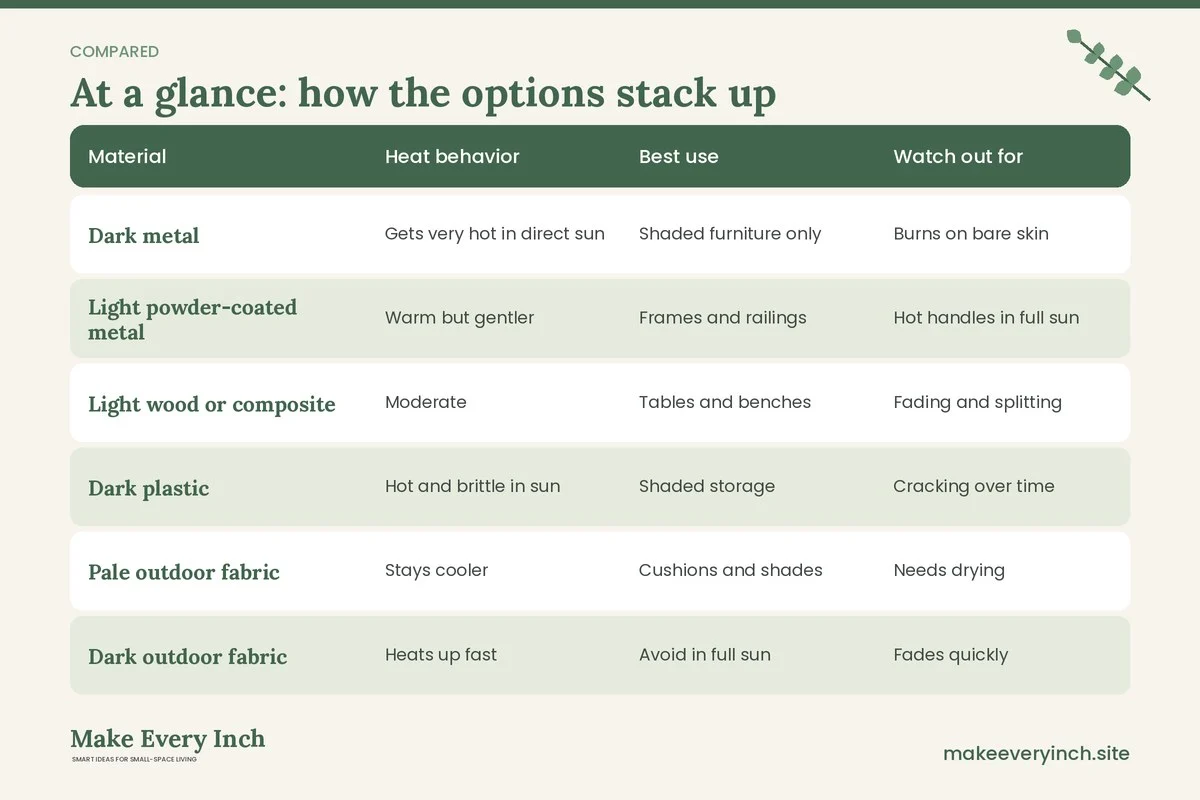
Materials and surfaces table
| Material | Heat behavior | Best use | Watch out for |
|---|---|---|---|
| Dark metal | Gets very hot in direct sun | Shaded furniture only | Burns on bare skin |
| Light powder-coated metal | Warm but gentler | Frames and railings | Hot handles in full sun |
| Light wood or composite | Moderate | Tables and benches | Fading and splitting |
| Dark plastic | Hot and brittle in sun | Shaded storage | Cracking over time |
| Pale outdoor fabric | Stays cooler | Cushions and shades | Needs drying |
| Dark outdoor fabric | Heats up fast | Avoid in full sun | Fades quickly |
| Terracotta pots | Cools by evaporation | Herbs | Dries out fast |
| Glazed or pale pots | Reflect heat | Sunny shelves | Can be heavy |
| Stone or tile floor | Holds heat into evening | Light mats on top | Slippery when wet |
Three example small balconies
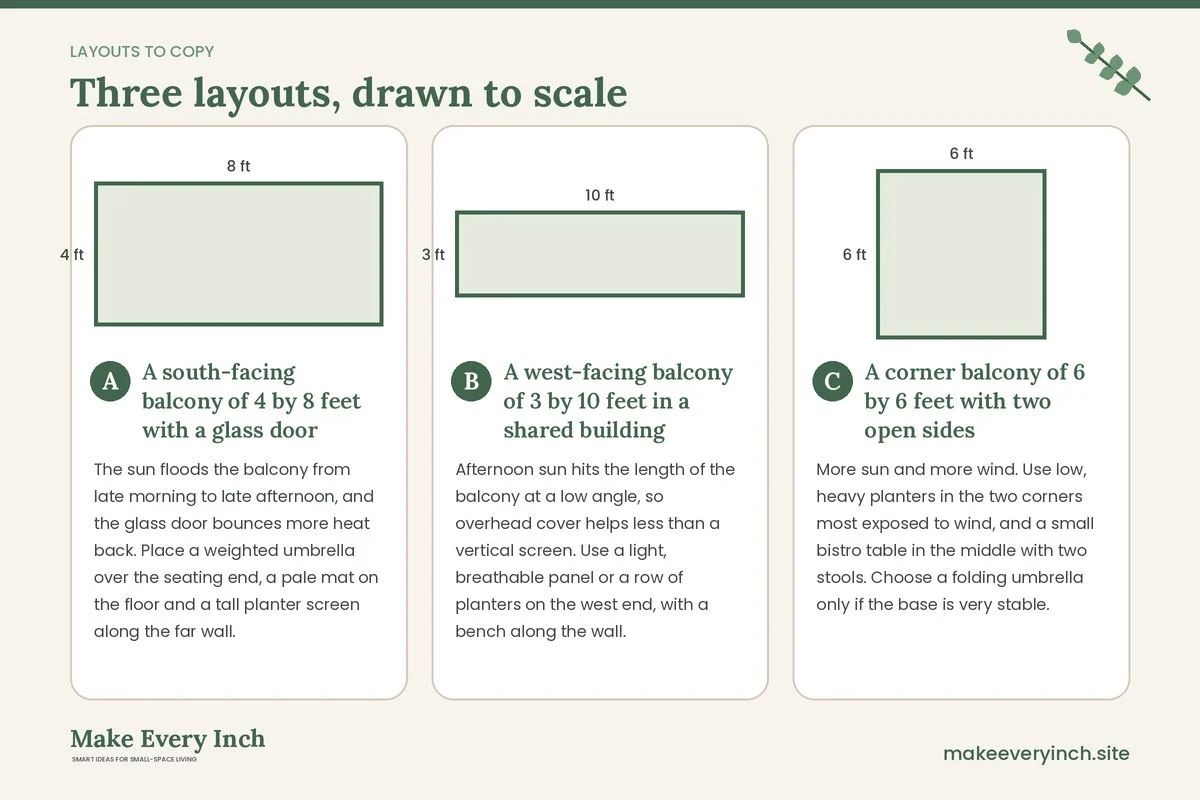
A south-facing balcony of 4 by 8 feet with a glass door
The sun floods the balcony from late morning to late afternoon, and the glass door bounces more heat back. Place a weighted umbrella over the seating end, a pale mat on the floor and a tall planter screen along the far wall. Seating stays near the door, back from the railing, with two folding chairs and a small table. Herbs go on the sunniest wall, in light-colored pots, in saucers. This layout keeps the balcony usable all afternoon with minimal weight.
A west-facing balcony of 3 by 10 feet in a shared building
Afternoon sun hits the length of the balcony at a low angle, so overhead cover helps less than a vertical screen. Use a light, breathable panel or a row of planters on the west end, with a bench along the wall. Because the lease bans attachments to the railing, all screens must be freestanding and weighted. Cushions are stored indoors in the afternoon. A solar lantern gives light in the evening, when the balcony cools down and becomes comfortable.
A corner balcony of 6 by 6 feet with two open sides
More sun and more wind. Use low, heavy planters in the two corners most exposed to wind, and a small bistro table in the middle with two stools. Choose a folding umbrella only if the base is very stable. Keep everything at least 18 inches back from the railing. Group pots to shade each other’s roots, and put a mulch layer on the soil. Because the balcony is exposed, bring light items inside on windy days.
Watering without waste
Plants on hot balconies need regular water, but water is also a risk for neighbours and the floor.
- Water early or late, when the sun is lower, to reduce evaporation.
- Water at the soil, not the leaves, since wet leaves in sun can scorch.
- Use saucers with a lip, and empty them so the water does not sit and breed insects.
- Use a watering can with a long spout so you do not splash the floor or railing.
- Group plants by water need, so you do not over-water herbs that like dry soil.
- Check the soil with a finger instead of watering on autopilot.
- Watch for runoff onto the floor below, and move pots into trays if needed.
If you travel, ask a neighbour to water for you, and consider a self-watering pot. Do not leave a hose running or a tray overflowing while you are away.
Pet and child safety in the sun
Hot floors and railings can hurt paws and hands. Test surfaces with the back of your hand, and keep a shaded, cool zone for pets. Provide fresh water in a heavy bowl that cannot tip. Keep pets and children away from the railing and from toxic plants. Some common balcony plants are poisonous if chewed or swallowed, including certain lilies, oleander and some succulents, so check each plant against a trusted pet-safe list. Do not leave a child or pet alone on a hot balcony, and never let them climb on furniture near the rail.
Cooling the balcony at night
A balcony that holds heat is no fun in the evening. Stone and tile floors release heat after dark, so a pale mat helps. Open the balcony door in the evening to let cooler air through, and consider an outdoor-rated fan placed where the cord is safe. Use LED lanterns, which give little heat, instead of candles. Water the floor only if the building allows it and the water will not reach neighbours. Keep the balcony free of clutter so air can move.
Light and glare
Bright sun can make it hard to read or use a screen. A matte, light-colored table top reduces glare compared with glossy dark ones. A tall plant or a light curtain on the sunny side diffuses light. If you use glass or mirrors, make sure they cannot reflect light onto plants or surfaces in a way that could scorch them or into neighbours’ windows. Sunglasses and a hat remain the easiest solution for the sitter. For lighting at night, see our post on layered lighting ideas for small apartments.
Protect furniture and fabrics from sun
Sun fades and weakens fabrics, plastics and wood over time. Choose outdoor-rated materials, keep cushions indoors when not in use, and cover or fold furniture when you are away. Wipe down surfaces at the end of the season. Check for loose screws, rust and cracks each spring. A tidy balcony with fewer pieces ages better than a crowded one, and it also keeps the weight down. For wider ideas on keeping small homes organized, read our guide to small space organization ideas.
Make it a place you want to be
Once the heat is under control, add comfort and personality.
- A small rug that drains quickly softens bare feet.
- A tray table gives you a cool spot for drinks.
- Outdoor-rated cushions in pale colors add comfort.
- A single piece of art made for outdoors, resting on the floor and leaned against a wall, adds style without drilling.
- A solar lantern or battery string light gives evening glow without cords.
Since the balcony is a transition between inside and out, a small colour link between your living room and your balcony helps it feel like part of the home. For inside ideas, see our guide to small living room ideas, the broader small room decor ideas and the post on renter-friendly apartment decorating ideas.
Budget and shopping approach
Start with the cheapest thing that makes the biggest difference. Often that is a light-colored mat, a pale cushion cover and a few heat-tolerant herbs in light pots. Add shade next, then furniture. Second-hand furniture often suits balconies, but check for rust, splits and wobbly legs. Choose pieces that fold and stack so you can fit them in a closet during storms. For further ideas on spending carefully, see budget small space ideas and our guide to the best furniture for small apartments.
Common mistakes to avoid
- Blocking all the light. You lose the benefit of a sunny balcony.
- Using dark surfaces. They store heat and burn skin.
- Putting furniture against the railing. It creates a climbing risk.
- Hanging planters on the railing. They can fall on people below.
- Overloading the balcony. Wet soil, big pots and people add up.
- Choosing a large sail or umbrella without anchoring. Wind can lift it.
- Over-watering or hosing. Water reaches the neighbours below.
- Using candles, grills or heaters where banned. Check your rules.
- Ignoring toxic plants. Check the list for pets and children.
- Leaving cushions out. Sun fades them and rain rots them.

Frequently asked questions
How do I cool a hot sunny balcony without drilling?
Use weighted, freestanding or tied-on solutions with permission: a heavy-based umbrella, a tension-pole curtain, a planter screen or pale mats. Always check the lease, because even ties to a railing may need approval.
What is the best shade for a west-facing balcony?
Low afternoon sun is easier to block with a vertical screen than an overhead cover. Use a light, breathable panel or a row of tall, heavy planters, set back from the railing and secured against wind.
Which plants cope with hot sun?
Herbs such as rosemary, thyme, oregano and lavender are often heat tolerant. Check each plant against a pet-safe list before you buy, and keep risky plants out of reach.
Can I use a grill or fire pit on a sunny balcony?
Often not. Many leases and codes ban grills, fire pits and open flames on balconies. Check the rules and use flameless alternatives.
How hot can balcony furniture get?
Dark metal and plastic can get hot enough in direct sun to be uncomfortable or to burn skin. Test every surface with the back of your hand and choose lighter colors.
How do I stop water running down to my neighbours?
Use saucers with a lip, empty them, water at the soil with a can, keep drains clear and never hose down the floor.
Is my balcony strong enough for planters?
Ask the building manager about the load limit. Wet soil is heavy, so spread containers around, use lightweight pots and avoid stacking.
Are string lights safe in the heat?
They can be if they are outdoor-rated, plugged into a GFCI-protected outlet, kept away from flammable fabrics and not overloading a socket. Solar or battery lights are simpler.
Final checklist
- Read the lease and building rules before changing anything.
- Ask about the weight limit and spread weight evenly.
- Photograph the sun at three times of day and sketch the zones.
- Identify hot surfaces with the back of your hand.
- Choose one cool corner for seating.
- Pick freestanding or tied-on shade that is permitted.
- Use light-colored mats, cushions and pots.
- Choose heat-tolerant, pet-safe plants in heavy, low containers.
- Keep furniture and planters back from the railing.
- Secure anything that could blow or tip.
- Use outdoor-rated lights on a GFCI outlet and avoid overloaded sockets.
- Skip candles, grills and heaters unless clearly allowed.
- Use saucers, clear the drain and keep water off the neighbours.
- Store cushions indoors and review the balcony each season.
Keep going: Keep going with our pillar guide to small balcony ideas, the dining companion on how to create a tiny outdoor dining area and our practical post on renter-friendly small balcony ideas.
Save this guide for later
Pin the ideas you like to Pinterest so you can come back to them when you plan your space.