15 Small Living Room Storage Ideas for Couples Who Share Every Inch
Quick answer: The best small living room storage ideas for couples give each person a clearly marked zone, then add a shared middle for the things you both use. Use matching boxes or a column each, keep one shared landing spot for keys and mail, and run a short audit every season. Two sets of stuff fit when the rules are simple and the labels are visible.
Small living room storage ideas for couples have to solve a problem that single-person guides skip: two sets of belongings, two routines and two opinions about what counts as clutter. One person has a camera, the other a guitar. One reads on paper, the other has cables for three devices. When these end up on one coffee table, a small room feels full within a week. This guide gives you a different way to plan: divide the room into his, hers and ours zones, set a simple rule for each, and match the storage to the habit rather than the other way around. You get 15 named ideas with measurements, a table for splitting space fairly, a three-step audit, house rules that prevent arguments, three example rooms and a checklist. For the wider picture, start with our pillar guides on small living room storage ideas and small living room ideas.
Why couples need a storage plan, not just more storage
Most storage advice assumes one owner. A couple shares the room and the clutter, so the problems are different. First, items migrate. A jacket on a chair becomes a pile on the arm of the sofa, and each person thinks the other made it. Second, preferences differ. One of you wants everything hidden behind doors, and the other wants books and objects in view. Third, routines clash. The person who comes home at six needs a landing spot, and the person who works from the sofa needs a surface and a place to put the laptop away at night.
A plan fixes these by giving everything a home that both people agree on. The home does not need to be big. A single basket, a hook or a drawer is enough, as long as it is clearly assigned. Research on household habits is mixed, so treat this as a practical tip rather than a rule: things that have a visible home tend to get put back, and things without one drift.
The other big idea is fairness. If one person gets the closet and the other gets a corner of the sofa, resentment follows. A fair split does not have to be equal in size. It should be equal in access and in how well it fits what each person owns. The audit later in this guide shows how to decide.
Start with a two-column audit
Before you buy anything, sit together with two sheets of paper. Each person lists, in the living room only, what they use weekly, what they use monthly and what they only keep. Keep it quick, about ten minutes each.
Step 1: Sort by frequency
Weekly items need to be within arm’s reach: remotes, chargers, current books, a laptop, a controller. Monthly items can go in closed boxes or a lower shelf: board games, craft kit, spare cables. Keep-only items should leave the living room unless they are decor. Move them to a closet, under a bed or into a box in storage.
Step 2: Sort by owner
Mark each item as his, hers or ours. Ours tends to be the biggest category, such as the games, the throws, the shared books and the TV gear. Count each list. If one person has twice as many weekly items, they need more weekly storage, even if the room splits evenly on paper.
Step 3: Measure the stuff
Stack the items by category and measure each stack in inches: how wide, how deep and how tall. A shelf of 12 inch deep boxes can only hold a stack up to that depth. Add 20 percent to every stack for growth. This number tells you how many inches of shelf you need, which is more useful than a guess about cubes.
Divide the room into three zones
A small living room has three kinds of space: wall, seat and surface. Split each into his, hers and ours, and the room becomes manageable.
The wall zone
If you have a long wall, divide it into thirds. Give each person a column of cube shelves or a tall narrow unit, with the middle third for shared items. A 60 inch wall can hold two 15 inch columns and a 30 inch shared unit. If the wall is shorter, pick a vertical split: the top half for one, the bottom half for the other, with shared items at the middle height where both can reach.
The seat zone
Sofas and chairs hold their own clutter: laptops, blankets and books. Give each side of the sofa a small side table or a clip-on tray, and assign each a basket on the floor or a ledge behind the sofa. A shared ottoman with a lid holds the throws.
The surface zone
The coffee table and console are shared. Reserve a tray for each person and one for the shared remotes. Once the trays are full, the surface is full. This rule alone stops the slow spread of mail, mugs and cables.
15 small living room storage ideas for couples
Matching-pair ideas
1. Twin baskets at the sofa
Set one lidded basket at each end of the sofa, each about 14 to 16 inches wide. They hold the blanket, the book and the headphones that each person uses most. Pick the same basket so the pair looks planned. Because each basket is personal, there is no argument about whose it is.
2. Two side tables, two heights
Put a table at 20 to 24 inches high on each side of the sofa, and let each person choose their own style within a size limit of 14 to 16 inches in width. A drawer in each table holds charging cords and glasses. Small tables with a shelf below give you a second level.
3. Mirrored cube columns
Place two cube columns, each 2 wide by 4 high, on either side of a window or the TV. Each person fills theirs with boxes in their own colour. The symmetry looks designed, and each column is a private zone with a clear edge.
4. His and hers hooks by the door
If the living room opens straight into the entrance, mount two sets of three hooks, one for each person, with a shared tray on a ledge. This is the quickest fix for coats and bags on the sofa. See small entryway storage for more landing-spot ideas.
Shared-middle ideas
5. The shared console drawer
A console 12 to 15 inches deep with two drawers lets one drawer be shared (remotes, batteries, coasters) and the other be flexible (bills, tickets, lists). Label each with a small tag. The console top holds lamps and a tray, and keeps the TV wall tidy.
6. The lidded ottoman for shared throws
A storage ottoman 24 to 30 inches wide replaces a coffee table and takes the blankets and games. Keep the rule that the lid stays clear, so it works as a table when needed. For options, see best storage ottomans.
7. A game and media unit
Give media a single home: a low cabinet 15 to 18 inches deep with a door for consoles, discs and controllers. Add a small cable box to avoid tangles. Two people share one cabinet more easily than two shelves of stuff scattered around the room.
8. The family calendar and drop zone
Mount a small wall rail with a calendar, a key hook, a mail slot and a tray at 48 to 54 inches high. Both people see the schedule at a glance. Our hub on organization ideas for renters has no-drill versions.
Flexible and behind-the-scenes ideas
9. A bench with two labelled boxes
Put a bench 40 to 48 inches wide under a window or against a wall, with two boxes underneath. One box is his, the other hers, and the top is shared seating. Boxes slide out so each person can take theirs to the sofa.
10. Under-sofa trays
If the sofa has legs at least 6 inches high, slide shallow rolling trays beneath it. Each person gets a tray for slippers, magazines or a laptop. It uses floor you cannot walk on anyway. Our guide to under-bed storage ideas shows how to measure for clearance.
11. A floating shelf pair
Hang two shelves 24 to 36 inches wide at different heights, one for each person, above the sofa or desk. Each shelf holds a few books, a plant and a favourite object. Differing heights give a lively look without extra work.
12. A narrow tower for hobbies
A tall unit 12 to 15 inches wide in a corner holds hobby gear: a guitar stand at the base, a camera box on a shelf, or a craft basket. Fix it to the wall. If both people have a hobby, use two towers in opposite corners to balance the room.
13. A fold-down or small desk with drawers
For those who work from home, a compact desk 36 to 42 inches wide with drawers keeps the laptop and papers off the sofa. Choose one with a closing top or a drawer so it disappears at the end of the day. See best desks for small apartments.
14. A rolling cart for the shared evening
A slim cart 12 to 16 inches wide holds drinks, snacks or the evening reading. Roll it to the sofa when you need it and park it by the wall when you do not. It is also useful when guests visit.
15. The seasonal swap box
Keep one lidded box per season somewhere out of sight and rotate throws, candles and books. It prevents the room from collecting too much, and the swap is a good reason for the two of you to check in about what to keep.
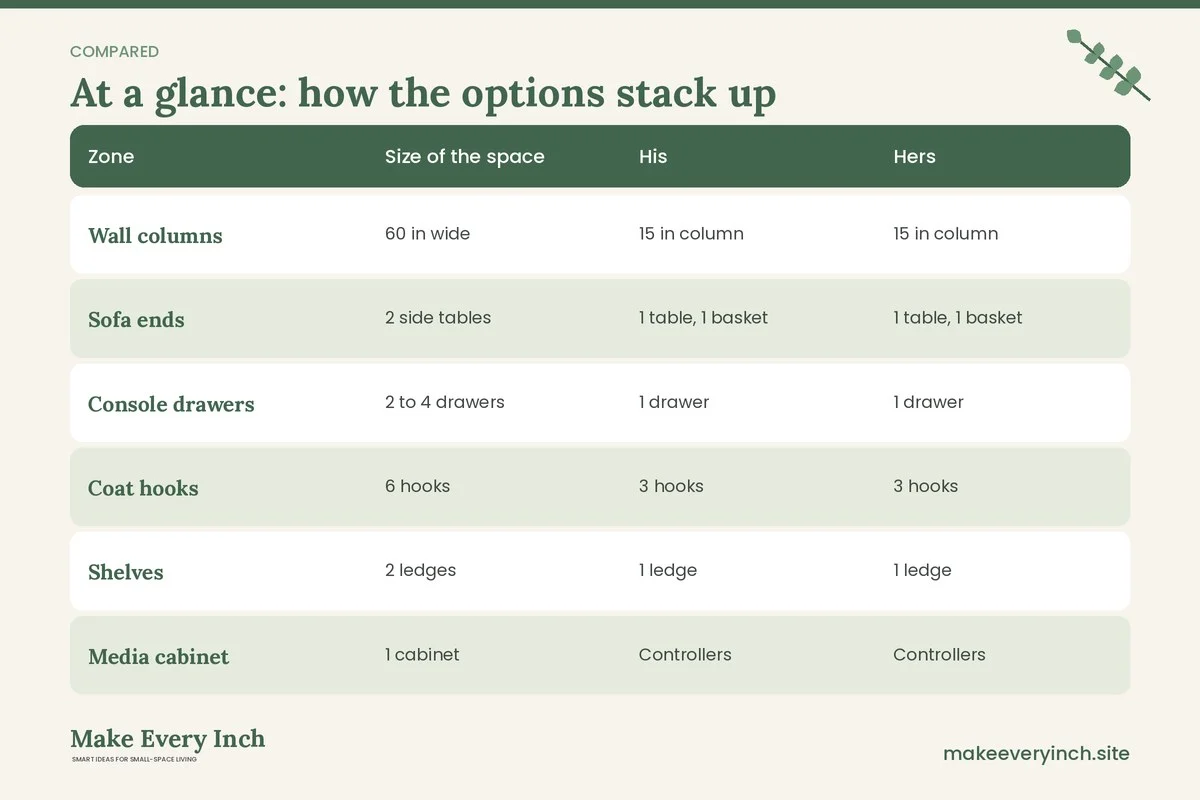
Table: splitting a small living room fairly
| Zone | Size of the space | His | Hers | Ours | Notes |
|---|---|---|---|---|---|
| Wall columns | 60 in wide | 15 in column | 15 in column | 30 in unit | Keep depth 12 to 15 in |
| Sofa ends | 2 side tables | 1 table, 1 basket | 1 table, 1 basket | Ottoman | Tables 14 to 16 in wide |
| Console drawers | 2 to 4 drawers | 1 drawer | 1 drawer | 1 to 2 drawers | Label each |
| Coat hooks | 6 hooks | 3 hooks | 3 hooks | 1 tray | Keep at 60 in high |
| Shelves | 2 ledges | 1 ledge | 1 ledge | none | At different heights |
| Media cabinet | 1 cabinet | Controllers | Controllers | Consoles | One cable box |
| Under-sofa | 2 trays | 1 tray | 1 tray | none | Needs 6 in clearance |
House rules that keep the plan working
Rules sound unromantic, but a few simple ones can prevent arguments. Agree on them once, in a calm moment, and write them on a sticky note for a week.
- One thing in, one thing out. If a new book arrives, an old one leaves.
- The surface rule. Anything on the coffee table at bedtime goes into its tray or box.
- The five-minute reset. Each night, both people spend five minutes returning items to their homes.
- No unlabelled boxes. If you cannot tell what is in a box, neither can your partner.
- The veto of the shared zone. Anything in the shared zone needs both people to agree. A personal zone is up to the owner.
- The seasonal check. Every three months, open each box and decide what stays.
These are not strict laws. They are a starting point to adjust for your habits. The aim is to make tidying a joint routine rather than one person’s job.
Dealing with different styles
Many couples differ in taste: one person likes open shelves, the other prefers closed cabinets. Solve it with a mixed unit. A cube grid with a few doors lets one person show a collection and the other hide their gear. Or give each person full control of their own column and agree on a shared palette for boxes, such as three neutral tones, so the wall looks calm.
If one of you is a collector and the other a minimalist, set a space limit rather than a number limit. A collector gets a shelf of 36 inches, and when it is full, something goes. A minimalist keeps their surfaces clear and does not have to look at it all the time, since the collection stays in its zone. Our guide to minimalist apartment ideas can help the minimalist half of the couple feel at ease.
When one person works from home, treat the workspace as a third personal zone. A small desk, a cart or a lap tray needs its own box so the paper does not spread. Use a closing lid or a folding screen, so the sofa returns to relaxation after work.
Three example rooms
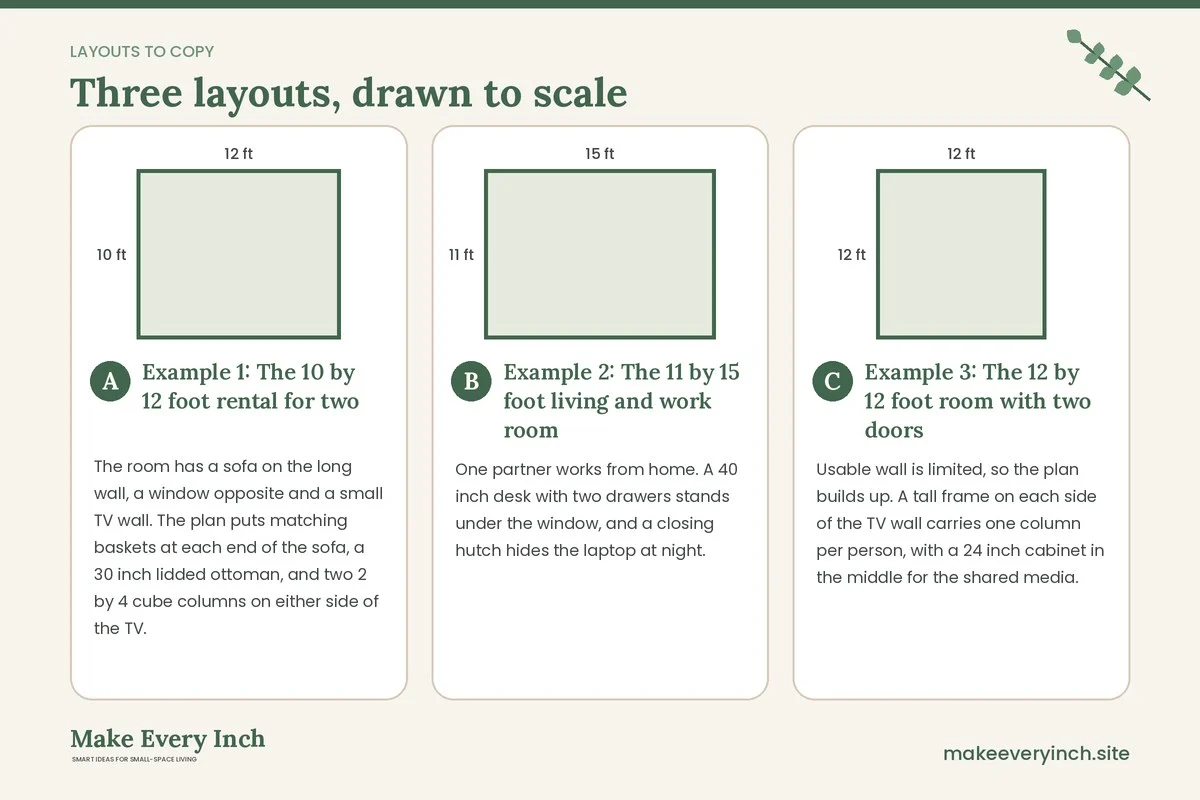
Example 1: The 10 by 12 foot rental for two
The room has a sofa on the long wall, a window opposite and a small TV wall. The plan puts matching baskets at each end of the sofa, a 30 inch lidded ottoman, and two 2 by 4 cube columns on either side of the TV. A rail of two hooks each by the door holds coats and bags. The shared console drawer under the TV holds remotes and charging cables. Main path stays at 34 inches, and nothing is attached to the wall except a strap on each tall unit.
Example 2: The 11 by 15 foot living and work room
One partner works from home. A 40 inch desk with two drawers stands under the window, and a closing hutch hides the laptop at night. The sofa floats 14 inches off the wall with a console behind it, split into his drawer, her drawer and a shared tray. A wall rail by the door holds keys and a calendar. A tall tower in the corner holds the hobby gear of the other partner. The result is a room that works at nine and relaxes at seven.
Example 3: The 12 by 12 foot room with two doors
Usable wall is limited, so the plan builds up. A tall frame on each side of the TV wall carries one column per person, with a 24 inch cabinet in the middle for the shared media. A bench with two boxes sits at the foot of the sofa as a landing spot. A pair of wall shelves at different heights above the sofa carry one favourite object each. The owner of each shelf chooses what goes on it, and the room feels personal for both.
Budget and shopping tips
These are rough guides rather than quotes. Prices vary by region and shop, so use the ideas, not the numbers.
Start with what you own
Reuse baskets, crates and boxes. Pair them with a label and a rule before you buy a thing. A week of sorting often reveals that you need less storage than you thought.
Buy for the shared zone first
The shared zone is where most clutter lands, so invest in the console, the ottoman and the media cabinet before the personal pieces. Personal zones can use boxes you already have.
Buy matching, not identical
Matching boxes in the same colour and size keep the wall calm, even if the contents differ. Look for second-hand and sale items. See cheap storage ideas for apartments and small living room storage ideas on a budget for ways to stretch a small budget.
Think about moving together
If you may move soon, pick modular and freestanding pieces. They go with you, and you can add to them. For modular planning, see small living room storage ideas IKEA style.
Common mistakes to avoid
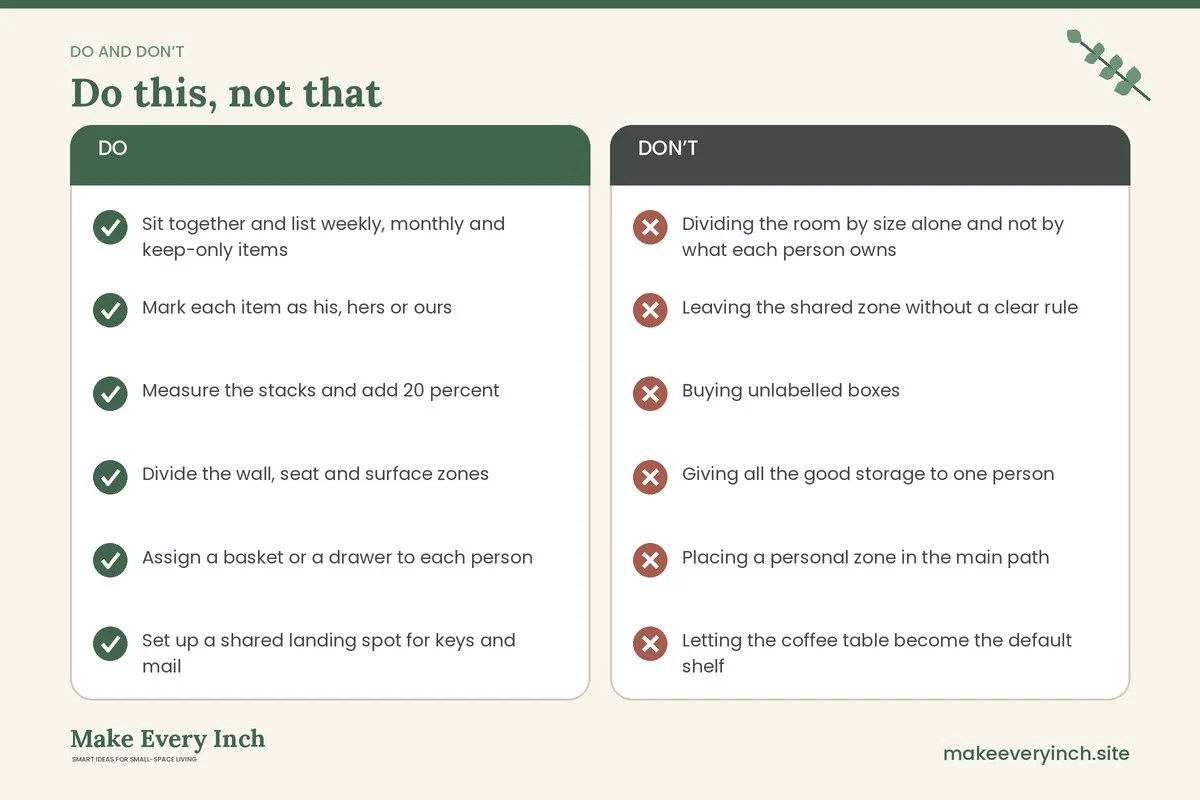
- Dividing the room by size alone and not by what each person owns
- Leaving the shared zone without a clear rule
- Buying unlabelled boxes
- Giving all the good storage to one person
- Placing a personal zone in the main path
- Letting the coffee table become the default shelf
- Forgetting a landing spot for keys, mail and bags
- Filling every shelf, so there is no room for new things
- Skipping the seasonal check
Couples’ storage checklist
- Sit together and list weekly, monthly and keep-only items
- Mark each item as his, hers or ours
- Measure the stacks and add 20 percent
- Divide the wall, seat and surface zones
- Assign a basket or a drawer to each person
- Set up a shared landing spot for keys and mail
- Choose matching boxes for a calm look
- Agree on house rules and write them down
- Keep main paths at 30 to 36 inches
- Anchor all tall pieces
- Label every box
- Repeat the audit every season
FAQ
How do we share storage fairly in a small living room?
Split by need, not by size. Count each person’s weekly items, then give the person with more items more easy-reach space. Keep the shared zone for things you both use.
What are the best small living room storage ideas for couples with lots of stuff?
Use vertical space with tall narrow units, add a lidded ottoman and a bench with boxes, and move keep-only items out of the room. Two cube columns and a shared console cover most needs.
How can we keep the coffee table from becoming a dump?
Give each person a tray and keep one for shared items. When a tray is full, something must move. A five-minute reset each night helps.
What if one of us likes open shelves and the other likes doors?
Use a mixed unit with some doors and some open cubes, and give each person control of a column. Match the boxes to keep the wall calm.
Where should keys, mail and bags go?
Set a landing spot near the door with hooks, a tray and a small ledge. Give each person their own hooks and share one tray for mail.
How do we handle one person working from home?
Treat the workspace as its own zone. Use a compact desk with drawers or a cart with a lid, and pack it away at the end of the day.
How often should we review our storage?
Every three months works well. Open each box, decide what stays and adjust the zones to match how you live.
Where can we find more storage ideas for a small living room?
See our guides to small living room storage ideas for families and small apartment living room ideas for couples, which look at similar problems from other angles.
Keep going: Keep planning with our small living room storage ideas, small space organization ideas and small apartment living room ideas with storage.
Save this guide for later
Pin the ideas you like to Pinterest so you can come back to them when you plan your space.